















Flannery O'Connor explains that the grotesque in Southern fiction serves as a literary device to reveal deeper moral and spiritual truths about human nature, arguing that Southern writers are uniquely positioned to recognize 'freaks' because they maintain a conception of the whole man that is still feeling logical, and that the grotesque tradition in American literature has become intermingled with the romance novel tradition, allowing writers to connect concrete points with invisible but firmly believed points through prophetic vision.
Flannery O'Connor: The Grotesque in Southern Fiction (1960)
Added:An understanding of the core characteristics of Southern Gothic literature, including its focus on damaged, delusional, or eccentric characters and decaying settings.
Familiarity with Roman Catholic theology, particularly the concepts of original sin, grace, sacramentality, and redemption.
Prior reading of Flannery O'Connor's major short stories (such as 'A Good Man Is Hard to Find' or 'Good Country People') to provide concrete context for her theories.
A basic definition of 'the grotesque' in art and literature as a style that combines the comic and the terrifying, or the normal and the distorted.
In-depth study of O'Connor's concept of 'prophetic realism' and how it functions as a vehicle for spiritual revelation in postwar American fiction.
Comparative analysis of the use of the grotesque in other Southern writers such as William Faulkner, Carson McCullers, and Tennessee Williams.
Exploration of theological literary criticism, examining how other 20th-century religious writers (e.g., Graham Greene, Evelyn Waugh) integrated orthodox faith with modern realism.
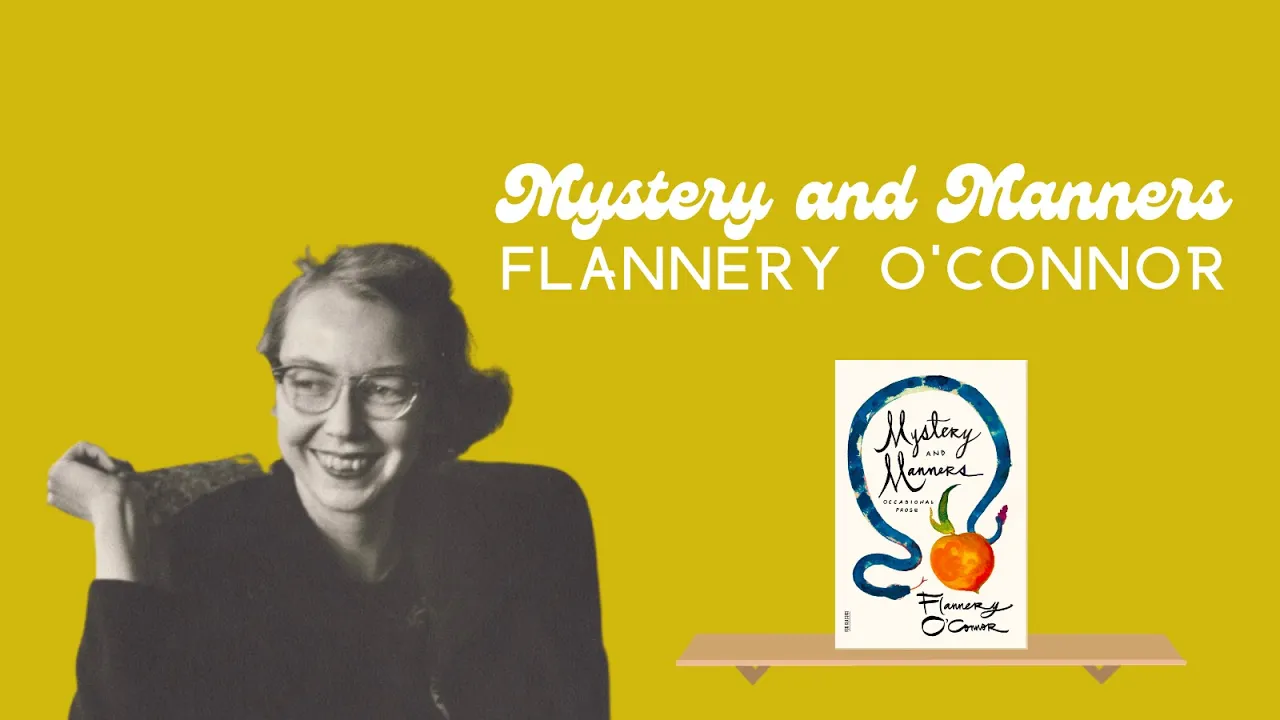
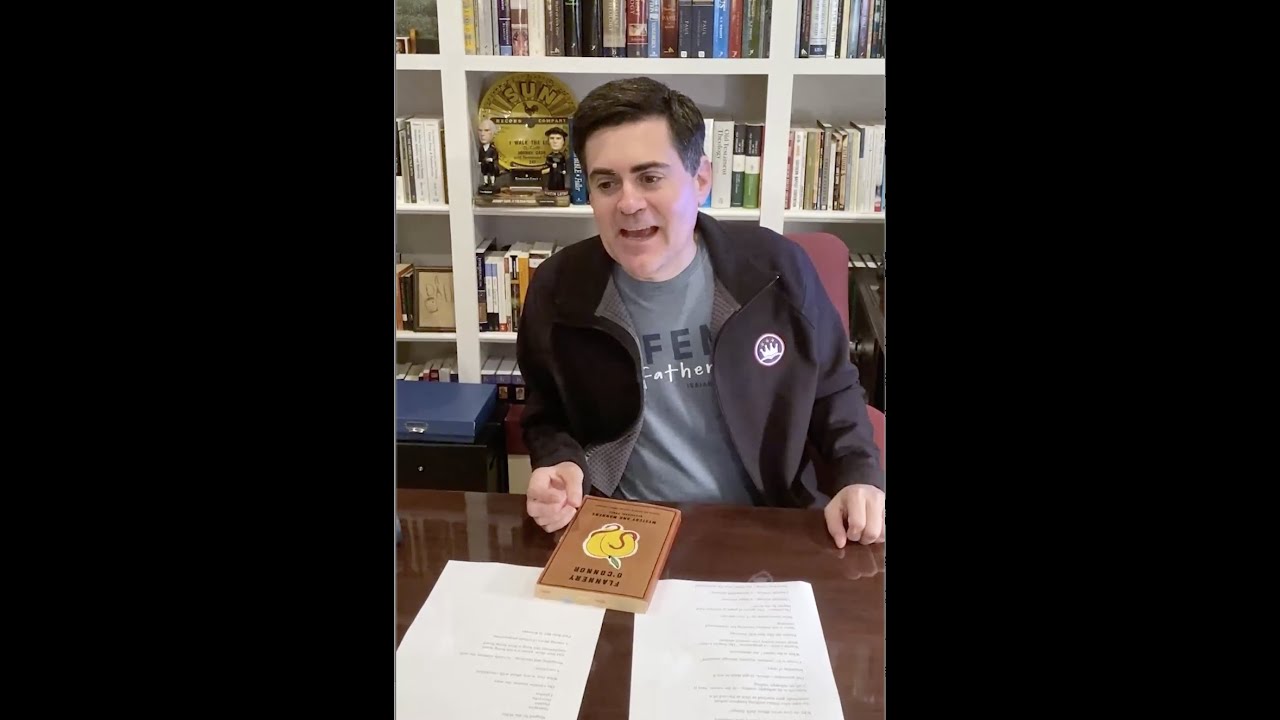
Analysis of O'Connor's collected essays and lectures in 'Mystery and Manners: Occasional Prose' to deeper understand her views on the craft of writing and the role of the Christian novelist.
832 views19likes9:20Original Release: 2024-06-25
very nice to ask me to come here tonight and read a story I've found that at most universities the Storyteller is tolerated as long as some abstract statement can be wrong out of him he's out to find himself reduced to making comments about his own stories of other people's and the process leaves him very much like the handsome hero po story uh the one who before he went to bed at night removed his wooden arm and his wooden leg and his teeth and his b box and his wi and his glass eye what was left of him was not impressive with this much said I I should let well enough alone and go ahead and read my story but since the story I want to read is considered grotesque and since the many people the word grotesque is a description tending to be majority and I feel I might as well Hazard a few comments about the kind of story this is and about what makes it that way I discovered that any fiction that comes out of the South is going to be called grotesque by the northern reader unless it is grotesque in which case it's going to be called realistic when my fiction first began to receive some attention it was generally considered to have come out of that mythical entity the school of Southern degeneracy every time I heard about the school of Southern degeneracy I felt like BR rabbit stuck on the T baby I think the social sciences have cast a Dre bite on the public approach to fiction if you write about people who don't always wear shoes someone is bound to think that you consider shoes important anyway if you have once got rid of a label like the Southern degeneracy you accept the label grotesque with better Grace essentially any writer who produces stories that can be called grotesque does so because he has that kind of a talent but I believe that in addition there are reasons that intensify the grotesque quality of some writing in these times I feel that the grotesque quality of my own work is intensified by the fact that I'm both a Southern and a Catholic writer it's standard for the Catholic writer to say that he is not a Catholic writer but a writer who happens to be a Catholic this is a Formula that has its uses uh but I often wish that Cardinal Spellman had said it instead of Mr Graham green then we would have heard no more about it I've always been more tempted to say that I'm not a southern writer but a writer who happens to be a southerner however I feel that both of these are evasions and that they stop discussions that they ought to begin the southern riter can't escape the image of the South that has built up a life of its own in his senses any more than the Catholic can escape the indelible marks of the sacraments put on his soul the s's sense of place is usually as unadjustable as the believing Catholic sense of right and wrong I think a writer from Minnesota might be able to go to Japan and stay a few months and write a story about credible Japanese but if I went and tried to write a story about credible Japanese all my Japanese would sound like Herman talage basil notes whenever I'm asked why Southern writers particularly have a pensent for writing about freaks I say it's because we are still able to recognize one to be able to recognize a freak you have to have some conception of the whole man and in the South the general conception of man is still feeling logical now that that is a big statement and it's dangerous to make it almost anything you affirm on the subject of subn belief can be denied in the next breath with equal propriety I'm sure some poll taker could come along and get up a table to prove that the South doesn't believe anything at all but approaching the subject from the standpoint of the writer I think it's quite safe to say that while the south is hardly Christ centered it is most certainly Christ haunted the S who isn't convinced of it is very much afraid that he may have been formed in the image and likeness of God and ghosts can be very Fierce and instructive they cast strange Shadows particularly in our literature in any case it's when the freak can be sensed as a figure for our essential displacement that he attain some depth in literature all this is is changing of course the ghost is being exercised in 20 years the southern writer may be writing about men in Gray flannel suits and may have lost his ability to see that these gentlemen are even greater freaks than what we're writing about now but for the present Southern literature abounds an example of the grotesque and it is a kind of grotesque that is much more complicated in serious than 19th century grotesque writing are than the kind of grotesque fiction that urin calwell turned out in the 30s a good many people believe of course that southern writing tends to the grotesque not because we are still able to recognize freaks but because in the South there's so many more freaks to recognize I just don't take that up still others seem to have decided that if you write about freaks you do so on account of your great compassion uh it's considered an absolute necessity these days for writers to have compassion compassion is a word that sounds good in anybody's mouth and which no book jacket can do without it's a quality that no one can put his finger on in any exact critical sense and so the word is always safe for anybody to use Thomas man has said that the grotesque is a true anti busha style but I think that the kind of hazy compassion demanded of the writer now makes it difficult for him to be anti anything certainly when the grotesque has a legitimate reason for being it will be used in a way that gives to the intellectual and moral judgments implicit in it the ascendancy over a feeling in 19th century American writing there was a good deal of grotesque literature which came from the frontier and was supposed to be funny but our present grotesque Heroes if they are comic or at least not primarily so they seem to carry an invisible ver that fanaticism is a reproach not merely an eccentricity I think they are figures that come about from the kind of vision peculiar to the writer who is concerned with a larger stretch of reality than can be accounted for by a naturalistic view of the world you can call it prophetic Vision because this kind of writer is the kind of realist the prophet is he's a realist of distances Henry James said that in his fiction he did things way that took the most doing I think the writer of uh grotesque fiction does them in the way that takes the least because he in his work distances are so great he's looking for one image that will connect two points one is a point in the concrete and the other is a point not visible to the naked eye but believed in by him firmly more real to him really than what everybody sees it's not necessary to point out that the look of this fiction is going to be wild that it's going to tend toward poetry and not toward sociology it's almost of necessity going to be violent and comic because of the discrepancies that it seeks to combine at some point along the line of American literature the grotesque has become intermingled with the tradition of the romance novel that has come down to us from ham and M but writers whose fiction is grotesque have learned so much from the na naturalist that their work is often thought to be realism when it isn't at all we're able to make things real that for the reader have no business being are things seem typical that are only possible I'm always having it pointed out to me that life in Georgia is not at all the way I depicted who Escape criminals do not roam the roads of Exterminating families nor Bible salesman PR about looking for girls with wooden legs it's very hard to get it across that where you belong is with the writers of romance Little Romance I'm going to read you tonight is called a Good Man is Hard to [Music] Find Rance I'm going to read grandmother didn't want to go to Florida
Up Next

62:25
Furnace Creek Novel Discussion | National Humanities Center
@NationalHumanitiesCenter
320 views•2022-05-18

13:43
Formalism in Literary Criticism: An Academic Lecture Overview
@mattalberhasky9952
39.1K views•2015-08-05

6:08
Point of View in Fiction: First Person vs. Third Person
@magicalthriftyteacher
153.8K views•2014-03-31

15:25
1984: Orwell's Dystopian World and the Mechanisms of Totalitarianism
@AlternateHistoryHub
7M views•2017-03-04
Related Study Plans & Knowledge Roadmaps
Structured learning paths in Literature
literature
Graphic Memoirs: Visual Art, Trauma & History
01Foundations of Sequential Art and Visual Language
02Autographics and Processing Historical Trauma
03Visualizing Personal Trauma, Grief, and Graphic Medicine
+ 2 more learning modules
14h5 modules
Explore Roadmap
literature
Campus Novels: Evolution, Themes & Critique
01Introduction to the Campus Novel Genre
02Mid-Century Satire and the Post-War Academy
03Dark Academia and the Critique of Privilege
+ 2 more learning modules
14h5 modules
Explore Roadmap
literature
Theater of the Absurd: Philosophy & Plays
01Postwar Existentialism & Historical Roots
02Dismantling Narrative: Esslin & Absurdist Conventions
03Samuel Beckett and Tragicomic Existentialism
+ 2 more learning modules
12h5 modules
Explore Roadmap
literature
Revenge Tragedy: Justice, Madness & State
01Foundations of Early Modern English Theatre
02Anatomy of Revenge: Structural Conventions
03Psychological Complexity: Madness and Melancholy
+ 2 more learning modules
15h5 modules
Explore Roadmap