











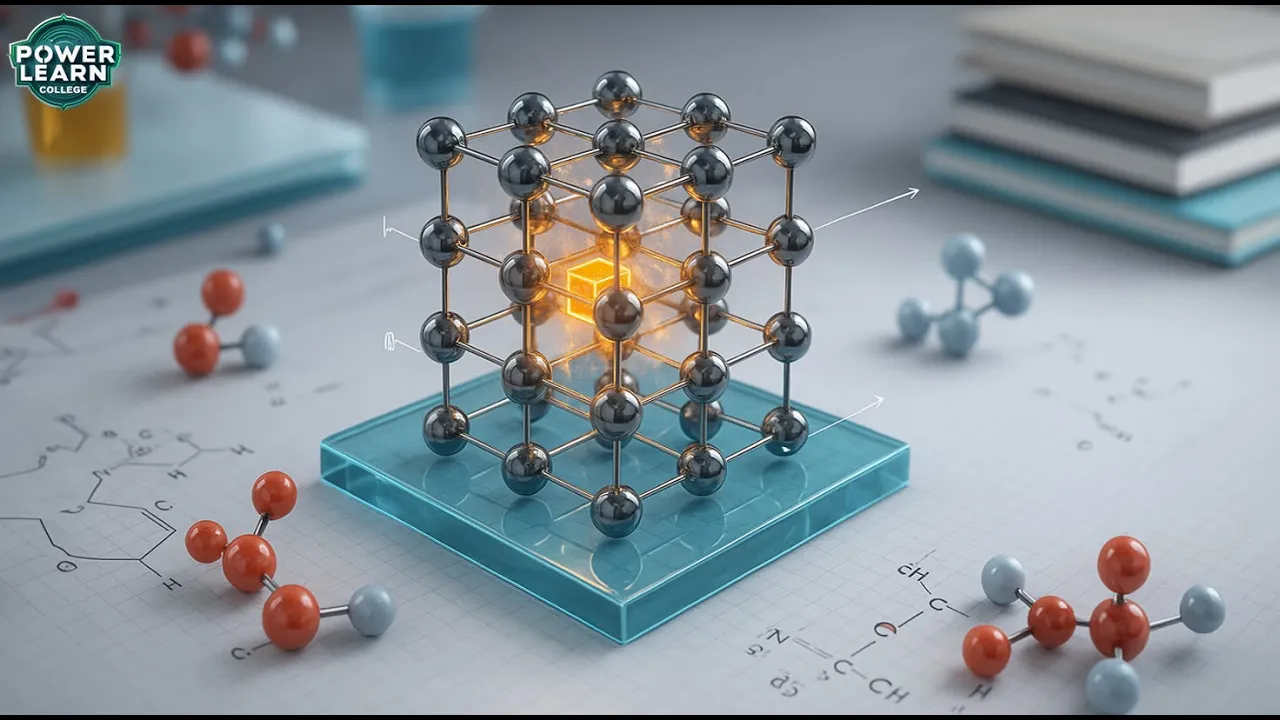





Crystalline solids have a regular, three-dimensional arrangement of particles with long-range order, sharp melting points (less than 5°C range), anisotropic properties, and are called true solids; examples include NaCl, iron, and gold. Amorphous solids have irregular particle arrangement with short-range order, broad melting points (greater than 5°C range), isotropic properties, and are called pseudo-solids or supercooled liquids; examples include glass, rubber, and wax. The four types of crystalline solids are ionic solids (NaCl, CaCO3), metallic solids (Fe, Au, Ag), covalent solids (diamond, graphite, SiO2), and molecular solids (ice, sugar, CO2), each with distinct bonding and physical properties.
Crystalline vs Amorphous Solids | Class 12 Chemistry
Added:Basic understanding of the three states of matter (solids, liquids, and gases) and their general physical characteristics.
Concept of intermolecular forces of attraction, such as ionic, covalent, metallic, and van der Waals forces, that bind constituent particles.
The kinetic molecular theory of solids, specifically how particles are closely packed and vibrate only about their fixed mean positions.
Classification of crystalline solids into molecular, ionic, covalent (network), and metallic solids based on the nature of intermolecular forces.
Study of crystal lattices and unit cells, including the 14 Bravais lattices and calculations involving unit cell dimensions and density.
Analysis of close packing in solids, coordination numbers, and the geometric differences between tetrahedral and octahedral voids.
Investigation of crystal defects and imperfections, such as stoichiometric (Schottky and Frenkel) and non-stoichiometric defects.
Exploration of the electrical, magnetic, and dielectric properties of solids, including the band theory of conductors, semiconductors, and insulators.
303.7K views6.4Klikes7:46Original Release: 2021-09-08
solid state crystalline and amorphous solids four types of crystalline solids firstly let me teach you some basic concepts of solid which we have already learned we know that solids have definite shape and definite volume secondly we learn that strong intermolecular forces exist between the particles of solids thirdly solids cannot be compressed and they do not fill the container ligases so note down these common properties of all solids now there are two types of solids crystalline solids and amorphous solids in crystalline solids there is regular arrangement of particles in space for example all the particles in the crystalline solids are regularly arranged in three-dimensional way while in amorphous solids there is irregular arrangement of particles in the space for example particles have this type of irregular arrangement and amorphous solids secondly in crystalline solids there is long order in arrangement of the particles for example we can see that all the particles have same arrangement throughout the lattice while in amorphous solids there is short order in arrangement of the particles for example these particles are orderly arranged but soon this pattern breaks and we get a regular arrangement thirdly crystalline solids are called true solids while amorphous solids are called pseudo-solids are super cooled liquids here let me ask you do you know that why crystalline solids are called true solids and amorphous solids are called pseudo solids or supercooled liquids well let me explain it crystalline solids are called true solids because they have true properties of solids like they have regular arrangement of particles they have long order an arrangement etc personally i call them perfect solids while amorphous solids are called pseudo-solids because they have fake properties of solids like they have no regular arrangement of particles no order and arrangement of particles etc personally i call them imperfect solids also we call amorphy solids as supercooled liquids it is because they have ability to flow like liquids over time if temperature change here let me teach you one of the most important questions of exam why is glass called a super cooled liquid well glass is an amorphous solid molecules are irregularly arranged and ate due to weight molecules can flow if there is change in temperature for example if temperature change then glass can flow like viscous fluid or honey if temperature is increased so we therefore call it super cooled liquid fourthly crystalline solids have sharp melting point the range of melting point is less than 5 degree centigrade for example the melting point of sodium chloride is 801 degree centigrade it may either increase or decrease by 5 degree centigrade depending upon various factors while amorphous solids have ranged melting point the range of melting point is greater than 5 degree centigrade for example the melting point of glass is from 1400 degree centigrade up to 1600 degree centigrade fifthly crystalline solids are anisotropic in nature while amorphous solids are isotropic in nature do you know the meaning of anisotropic and isotropic property well let me explain it anisotropic means that crystalline solids have different physical properties in different directions for example consider wood the speed of light would be different in the wood and different directions while isotropic means that amorphous solids have the same physical properties in all directions for example consider glass the speed of light would be the same in all directions sixthly the examples of crystalline solids are sodium chloride iron gold sugar etc while the examples of amorphous solids are glass rubber wax etc just noted down all these important points about crystalline solids and amorphous solids now let me teach you the four types of crystalline solids because we have to study all about crystalline solids in our college course the four types of crystalline solids are ionic solids metallic solids covalent solids and molecular solids to learn all about these four types of crystalline solids let me teach you my personal trait i always teach as ionic solids contain ionic bond metallic solids contain metallic bond covalent solids contain covalent bond and molecular solids also contain covalent bond now i will write the properties of each bond respectively ionic solids contain ionic bond so their examples are sodium chloride calcium carbonate magnesium oxide etc metallic solids contain metallic bond so their examples are iron gold and silver covalent solids contain covalent bonds so their examples are diamond graphite and silicon dioxide molecular solids also contain covalent bond so their examples are ice sugar and carbon dioxide now i will write all the physical properties of these compounds ionic solids like sodium chloride are made up of cations and anions like sodium iron and chlorine iron i mean they are made up of metals and non-metals they have high melting points they are brittle in nature they are insulated in solid states but in molten are aqueous solution they are conductor or conduct electricity secondly metallic solids like iron are made up of metal atoms like iron atom which have sea of delocalized electrons they have high melting points they are malleable and ductile they are good conductor of electricity because they have c of delocalized electrons thirdly covalent solids like diamond are made up of non-metal atoms like carbon they have high melting points they are hard in nature they are poor conductor or semiconductor of electricity fourthly the molecular solids like eyes are made up of molecules like h2o they have low melting points they are soft and natural they are insulator are non-conductors just noted down all these important points about the four types of crystalline solids i hope that you have learned all about crystalline solids and amorphous solids
Up Next

48:16
MIT 3.091 Introduction to Solid State Chemistry: Lecture 1 (Sadoway)
@mitocw
545.4K views•2010-12-18

83:56
Biocatalysis and Catalysis in Islatravir Synthesis | Merck Webinar
@SCIwheresciencemeetsbusiness
675 views•2020-10-08
18:25
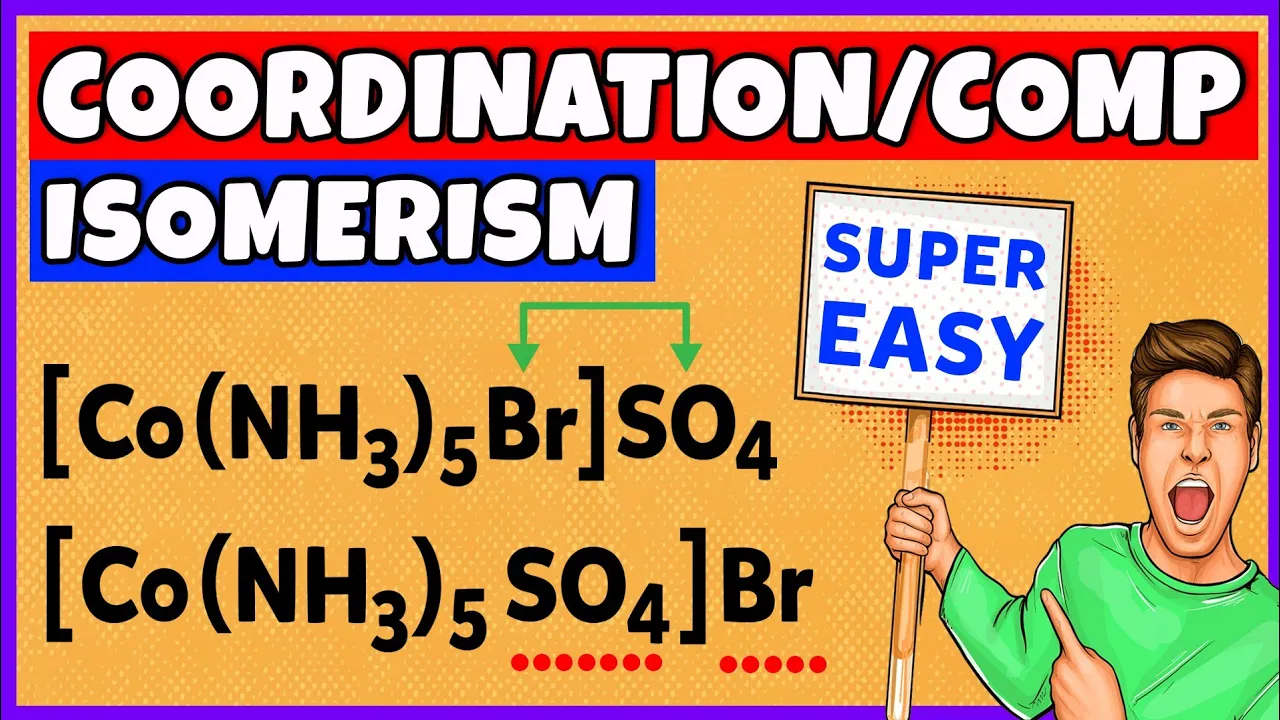
Isomerism in Coordination Compounds Explained | Types of Isomerism
@NAJAMACADEMY
289K views•2024-09-23

17:31
Edible Water Bottles: A DIY Guide to Sodium Alginate Spherification
@ryan
10.5M views•2019-06-21
Related Study Plans & Knowledge Roadmaps
Structured learning paths in Chemistry
chemistry
Nuclear Chemistry: Decay, Meds & Fuel Cycle
01Introduction to Nuclear Structure and Radioactivity
02Decay Dynamics and Kinetics
03Radiation Interaction and Detection
+ 2 more learning modules
24h5 modules
Explore Roadmap
chemistry
Supramolecular Chemistry: Forces & Machines
01Foundations of Chemical Bonding and Intermolecular Forces
02Introduction to Host-Guest Chemistry
03Thermodynamics and Dynamics of Self-Assembly
+ 2 more learning modules
16h5 modules
Explore Roadmap
chemistry
Photochemistry: Excited States & Reactions
01Foundations of Light-Matter Interactions
02Molecular Orbitals and Electronic States
03Photophysical Processes and Jablonski Diagrams
+ 2 more learning modules
18h5 modules
Explore Roadmap
chemistry
Coordination Chemistry: Bonding & Properties
01Introduction to Transition Metals and Ligands
02Crystal Field Theory (CFT) and Geometry
03Magnetic Behavior and Spin States
+ 2 more learning modules
14h5 modules
Explore Roadmap