A soft robotic gripper designed with multiple thin tentacle-like filaments can securely grasp heavy and oddly shaped objects through collective action, where individual filaments are weak but together they entangle and ensnare objects using simple inflation without requiring complex sensing, planning, or feedback control.
Jellyfish-Inspired Soft Robot Gripper Grasps Fragile Objects
Added:Deep Dive
Introduction to Soft Robotics: Understanding the differences in materials, compliance, and degrees of freedom between rigid and soft robotic systems.

What is Soft Robotics?! | Wow in the World | Podcast for Kids
988.6K
Soft robotics involves robots made from flexible materials like rubber rather than rigid metal, enabling them to perform tasks impossible for traditional robots. These robots can crawl over rubble like snakes or swim into small spaces like fish. Biomimicry is the practice of scientists studying natural organisms to create their own versions, such as gecko feet inspiring space cleaning robots. This approach allows robots to adapt to complex environments and interact with delicate objects safely.
Click to watch →

Why Soft Robots Are Better Than Rigid Ones for Space Exploration
4.2M
Soft robots are constructed from flexible materials like plastic tubing rather than metal or wood. They employ punctuated rolling locomotion, where the robot tips from one face to another as its center of gravity shifts. Some designs use entirely pneumatic circuitry without electronics, making them safe for hazardous environments like mines or MRI facilities. The fundamental compliance of soft robots provides inherent safety around humans, as they cannot exert dangerous forces. These robots can be physically manipulated without causing damage, demonstrating their unique combination of functionality and safety.
Click to watch →

The Age of Soft Robots Is Coming, Here’s How They Work
118.2K
Soft robotics is an emerging field where robots are designed with flexible, squishy materials like rubber, polymers, and fabric instead of rigid metal, using actuators such as hydraulics, pneumatics, or shape memory alloys to create motion, enabling them to adapt to environments and tasks more naturally than traditional rigid robots, with applications ranging from ocean exploration to medical procedures.
Click to watch →

I Printed a Microchip That Runs on Air — A Nervous System for Squishy Robots!
168.4K
This section introduces the concept of building microchips powered by air rather than electricity, specifically for controlling soft robots. The presenter explains that traditional microchips use silicon wafers and electronic circuits, but air-powered logic circuits offer an alternative approach using squishy silicone wafers and vacuum pressure. The motivation comes from soft robots like snakes and salamanders that use vacuum-powered muscles, but still require bulky external pumps and valves for control. The goal is to integrate the nervous system directly into the robot body using printable air logic circuits.
Click to watch →

Soft Robotics: Nature-Inspired Robot Evolution in Emerging Technology
2.4K
Soft robotics is an emerging field that creates flexible, compliant robots using rubber polymers and fabric instead of traditional rigid materials, drawing inspiration from soft organisms like octopi and squid to achieve advantages in manipulation, maneuverability, and adaptability for applications including space exploration, rescue missions, and medical procedures.
Click to watch →
Deep Dive
Principles of Biomimicry: How biological structures and organisms, such as jellyfish or octopuses, inspire engineering designs and mechanical systems.

Biomimicry: Design Inspired by Nature
29.4K
Biomimicry means 'to imitate life' or 'design inspired by nature,' applicable across disciplines from manufacturing to art. A foundational principle is that life creates conditions for life through circular systems—when a tree dies, it enables mushroom growth, whose mycelial network supports more trees. This circularity means resources continuously feed back, similar to compound interest. The circular economy applies this principle through three ideas: minimizing waste/pollution, keeping materials in use indefinitely, and regenerating natural systems. This contrasts with linear models focused on short-term consumption and landfills.
Click to watch →

"The Promise of Biomimicry" : Innovation and Design Inspired by Nature
77.7K
Biomimicry is innovation inspired by nature, examining three levels: elegant energy-efficient designs, life-friendly processes, and ecosystem strategies. The methodology includes design challenges for hands-on learning, nature observation, biological literature research, and innovation matchmaking. Case studies demonstrate practical applications: a mosquito control device mimics pitcher plant trapping mechanisms, a passive building cooling system combines cactus-inspired shading, termite ventilation, and evaporation techniques, and anaerobic wastewater treatment replicates cow stomach digestion. These solutions address global challenges including climate change and resource depletion while providing inherently regenerative and resilient approaches aligned with sustainability goals.
Click to watch →

The SHOCKING Way Humans COPIED Nature's Secrets | What is Biomimicry? | Soban Attari
247.8K
Biomimicry is the search for efficient design in the natural world. Nature serves as a vast classroom offering countless lessons for human innovation. The video introduces key examples: owl-inspired stealth technology, kingfisher-inspired bullet train design, and V-formation flight for fuel efficiency. The purpose of engineering is to make life easier, safer, and more comfortable, but many engineering products require years of research. Nature has already solved many challenges that humans face, making it an invaluable resource for technological innovation.
Click to watch →
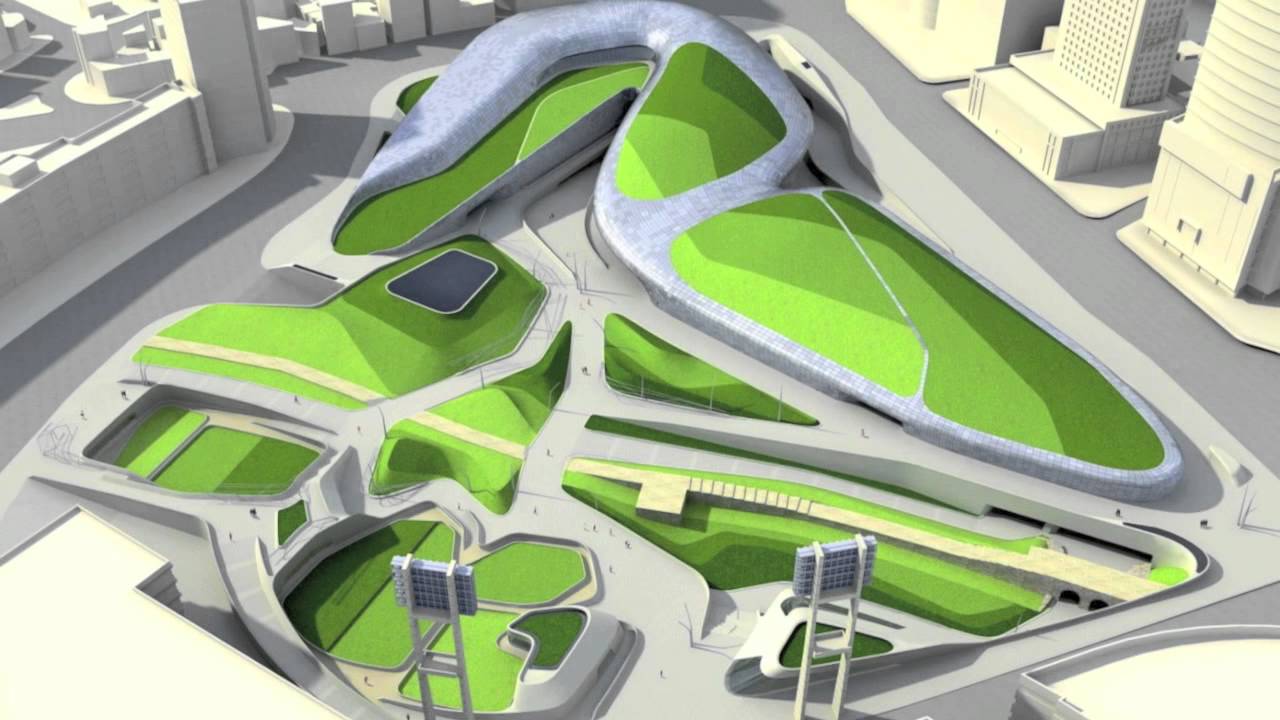
Biomimicry and Landscape Architecture
183.8K
Biomimicry is defined as the process of looking at something like a leaf and trying to figure out how to make a better solar cell. It has become popular in design disciplines because people are seeking more sustainable ways to do things. Organisms have learned through 3.8 billion years of evolution what works and what is appropriate on the planet, making this knowledge valuable for redesigning our world. The most important principle is recognizing that a sustainable world already exists, and answers to sustainability questions are all around us in nature.
Click to watch →
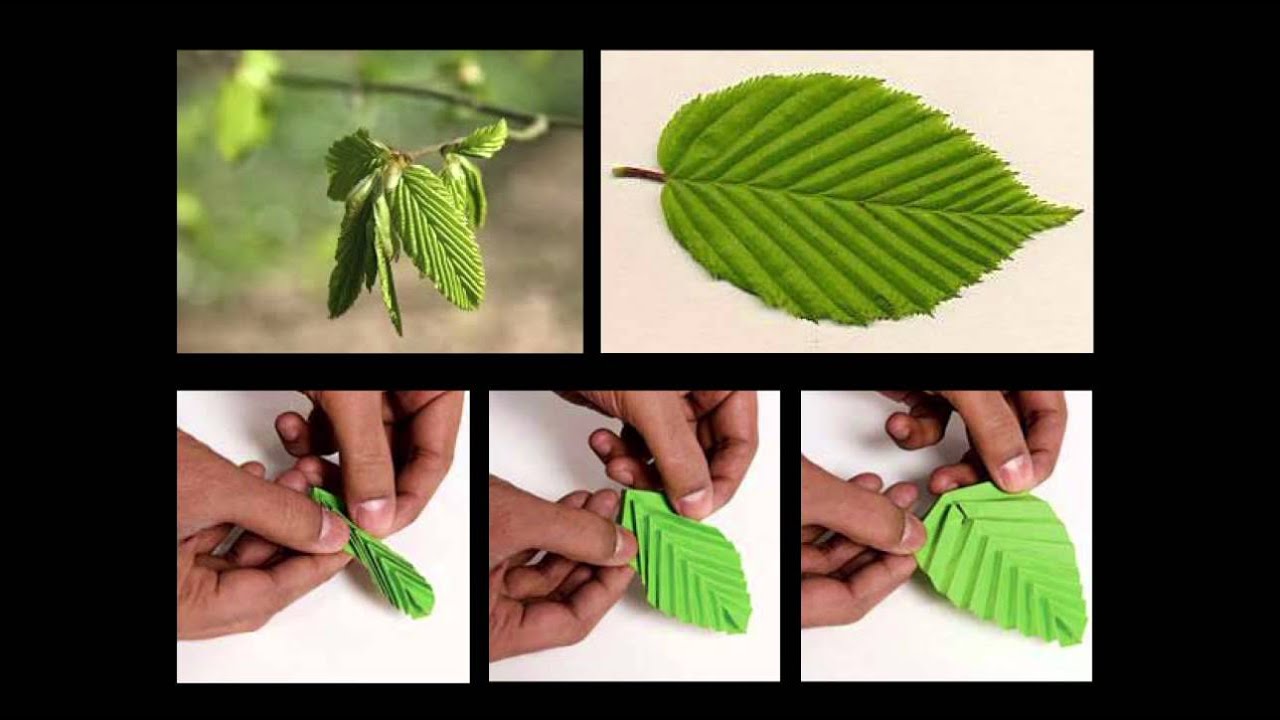
Michael Pawlyn - Biomimicry in architectural design
145.9K
Biomimicry offers a paradigm shift from sustainable to restorative design by learning from nature's 3.8 billion years of R&D. Nature achieves radical resource efficiency through evolved adaptations: blue morpho butterflies use structural coloration instead of toxic pigments, bark beetles detect fires at 80km (vs 10m for human detectors), and rainforest plants focus diffuse light through microscopic lenses. The three fundamental challenges for humanity are achieving radical resource efficiency, shifting to closed-loop models, and transitioning to a solar economy. Creating breakthrough sustainable buildings requires starting with minimal briefs and assembling multidisciplinary teams including biologists. The design process begins by identifying goals: minimum 10% productivity increase, passive heating/cooling, complete daylighting, net energy production, and cleaner exhaust air. Daylight emerges as the primary driver of architectural form. Biological research reveals sophisticated light-gathering strategies: spookfish mirror eyes focus bioluminescence, stone plants channel light through underground stems, and brittle stars use skin lenses for predator detection. The solution involves undulating building forms ensuring no point exceeds 6 meters from windows, tapering structures to bring light downward, and installing central light reflectors. Structural optimization follows biological principles where materials are expensive while design is cheap—bird skulls combine dome and space frame technology in thin bone layers, while cuttlebone uses undulating walls for stiffness and lightness. Ground coupling provides passive temperature regulation, utilized by ground-dwelling animals and mastered by termites maintaining egg-laying chambers at ±0.5°C despite external 40°C variations. Murray's law governs branching biological systems with consistent diameter and angle proportions representing evolved minimum energy solutions. For facades, daylight should be valued above electricity—admitting exact light amounts while converting surplus to electricity. Moving photovoltaics between two positions is cheaper than full-range movement; biological examples include sensitive plants, iris folding, and beetle wing patterns. Cold-formed bending glass technology produces curved, frameless glazing elements using half the glass of conventional solutions. Studies show 20% productivity increases in daylight-rich environments, with 10% productivity gains paying for buildings in 3 years. NASA research identifies three plants for indoor air purification: money plant oxygenates daytime, mother-in-law's tongue produces nighttime oxygen, and ara palm removes VOCs. Biophilia theory suggests humans evolved in natural environments, making contact with nature improve physical health. Mature ecosystems operate on closed-loop principles cycling water, carbon, and nitrogen without waste, contrasting with human-made systems that are simple, disconnected, linear, and wasteful. The cardboard-to-caviar project demonstrates closed-loop principles: cardboard becomes horse bedding, then worm compost producing worms fed to sturgeon yielding caviar returned to restaurants. This evolved to include people with disabilities shredding cardboard, reforming addicts working in fish farming (65% success vs 95% rehab failure), and using treated sewage sludge for willow biomass heating. Such systems reintegrate underutilized human resources while boosting biodiversity.
Click to watch →
Deep Dive
Basic Pneumatic and Hydraulic Actuation: How fluid or air pressure is utilized to generate motion, bending, and force in flexible structures.

VTU MTX17ME754 M5 L1 Introduction to Hydraulics
154
This module introduces pneumatic and hydraulic actuation systems as essential components in mechatronics for automation purposes. These systems are widely used in industrial automation to perform work tasks. The module covers the meaning of hydraulic and pneumatic systems, their applications, basic components, circuit design for specific applications, and the selection criteria between pneumatic and hydraulic systems for particular applications. The contents include classification of valves (pressure relief valves, pressure regulating valves, pressure reducing valves), actuators (cylinders and rotary actuators), and the principles of DCV (Direction Control Valve) and FCV (Flow Control Valve).
Click to watch →
Hydraulic Systems Part-1 Basic elements
604
Hydraulic and pneumatic actuation systems are control system components that convert electrical signals into mechanical movements (linear or angular). Hydraulic power supply units consist of a reservoir, pump, non-return valve, pressure relief valve, and accumulator to provide regulated liquid power, while pneumatic systems use compressors, filters, silencers, coolers, and air receivers for compressed air delivery. Linear actuators include single-acting cylinders (powered on one side with spring return) and double-acting cylinders (powered on both sides), while rotary actuators produce rotational motion. Valves control fluid direction and pressure, with poppet valves allowing one-way flow, spool valves controlling multi-port switching, and pressure control valves (relief, regulating, and sequencing types) maintaining safe operating pressures.
Click to watch →

HORA EXTRA 01 SHP
172
Actuators are the movement components in pneumatic and hydraulic systems. Pneumatic actuators use compressed air (gas) while hydraulic actuators use hydraulic oil (liquid). Both achieve similar results but serve different applications. Pneumatic actuators, commonly called 'pistons,' have advance and return chambers. When the advance chamber fills, the actuator moves forward; when the return chamber fills, it moves backward, often assisted by a spring. The choice between pneumatic and hydraulic systems depends on force requirements, precision needs, and application-specific considerations.
Click to watch →

Actuators - Explained
357.5K
Hydraulic actuators use oil pressure while pneumatic actuators use air pressure to create mechanical movement. Both systems consist of a reservoir, pump, valve, and piston-cylinder assembly. The pump forces fluid into one side of the cylinder, pushing the piston in that direction while fluid exits through the opposite side and returns to the reservoir via the valve. These systems can move pistons in both directions by reversing the pump or changing valve orientation. Gravity can sometimes be used to return components instead of reversing the pump. Common applications include construction equipment like backhoes and forklifts, as well as power steering systems in vehicles.
Click to watch →

valves introduction to acutators
1.1K
There are three basic types of actuation: pneumatic actuators, hydraulic actuators, and electric actuators. Pneumatic actuators use air pressure to produce motion and are probably the most common type used in process systems. Hydraulic actuators are powered by pressurized liquid such as hydraulic fluid and are usually more powerful than pneumatic actuators of the same size. Electric actuators use electricity to produce motion and usually fall into two general classifications: solenoid actuators or motor-driven actuators (often referred to as motor operators).
Click to watch →
Deep Dive
Fundamentals of Contact Mechanics: Concepts of force distribution, friction, and surface contact limits required to handle fragile or irregular geometries.

حصة مباشرة شرح الدرس 01 في الميكانيك : قوانين نيوتن - الجزء الأول
83.4K
Mechanics is essential for national exam success, requiring consistent practice and deep understanding. Before beginning, students must master foundational concepts. The first major concept is weight force (Poids), the gravitational force acting on a body, always directed downward toward Earth's center with its point of application at the center of inertia. The magnitude is P = m × g, where m is mass in kilograms and g is approximately 9.8 N/kg. Contact forces are equally important: the normal force (Réaction du support) is the reaction force exerted by a surface on a body in contact with it, always perpendicular to the surface and directed upward when there is no friction. When friction exists, the friction force acts parallel to the surface and opposite to the direction of motion. These forces can be decomposed into tangential and normal components. Understanding these forces is crucial for analyzing motion on surfaces with or without friction.
Click to watch →

Full slice lesson with Holger Rune and Patrick Mouratoglou
222.9K
This segment covers the foundational mechanics of generating power in tennis. The key principles include: (1) Contact point position determines body action—hitting closer to your feet generates more power than hitting too far in front; (2) At the end of your motion, your racket should point directly toward your target; (3) Rather than trying to generate pace through arm speed, engage your entire body to create power; (4) Avoid blocking your arm—instead, let it move forward naturally while your body follows. These principles establish the foundation for effective tennis technique.
Click to watch →

Tyre Camber explained
608.7K
Tire camber is the angle of wheel mounting relative to the vertical axis, with neutral camber meaning perfect alignment, positive camber pointing outward, and negative camber pointing inward. The contact patch is the flattened rubber area meeting the track surface, compressed by the car's weight. Larger contact patches provide better grip, traction, and reduce wear/heat by spreading load over more rubber. F1 tires are wide to maximize this effect. During cornering, high lateral forces cause load transfer to outside tires and body roll, tilting tires away from the track and reducing effective contact patches. Negative camber compensates for this by allowing tires to maintain larger contact patches during cornering, maximizing traction consistency despite some tread deformation.
Click to watch →

Bryson Dechambeau's Golf Coach Dials my Golf Swing By Using This...
46.4K
Quality of contact depends on the low point of the swing circle (angle of attack). For irons, golfers should hit 4+ degrees down to control launch and spin. Swing direction is the actual club path, which combines with angle of attack to determine ball flight. The head should drop 3.5-4 inches at position 5 (lead arm parallel) to ensure proper contact. Spine extension (natural thoracic spine extension) differs from vertical lift (moving away from the ball). Rotation combines horizontal and vertical movement; staying vertical without dropping causes pushing. Landing closed (club behind the ball) and pushing back creates better swing path. The Greg Norman drill (standing on left foot, wider stance, swinging to the right with right foot going back) teaches proper side bend and swing path. Club path is the mixture of angle of attack and swing direction. Ben Hogan used closed stances for drivers (to build rightward swing direction for slight fade) and open stances for irons (to pull path out and neutralize).
Click to watch →

Playing Contact! (Ep. 2)
357.8K
Contact is a word-solving game where one person (the blocker) is against everyone else. Players try to figure out a word letter-by-letter, starting from the front to the end. The only way to figure out the letters is to telepathically connect with teammates and guess the same word at the same time. If the blocker says 'contact' when someone guesses correctly, they are blocked. If the blocker doesn't say contact, the guess is accepted and the next letter is revealed. This game requires strategic thinking, team coordination, and vocabulary knowledge.
Click to watch →
Prerequisite Knowledge
- Concept 01Introduction to Soft Robotics: Understanding the differences in materials, compliance, and degrees of freedom between rigid and soft robotic systems.
- Concept 02Principles of Biomimicry: How biological structures and organisms, such as jellyfish or octopuses, inspire engineering designs and mechanical systems.
- Concept 03Basic Pneumatic and Hydraulic Actuation: How fluid or air pressure is utilized to generate motion, bending, and force in flexible structures.
- Concept 04Fundamentals of Contact Mechanics: Concepts of force distribution, friction, and surface contact limits required to handle fragile or irregular geometries.
Subsequent Learning
- Step 01Control Systems for Continuum Robots: Studying the mathematical modeling and feedback control strategies required to manage highly-deformable, non-linear soft actuators.
- Step 02Advanced Smart Materials: Investigating shape memory alloys, dielectric elastomers, and hydrogels for next-generation soft robotic actuation.
- Step 03Applications in Marine Biology and Deep-Sea Exploration: How delicate soft grippers are deployed on underwater ROVs to safely sample fragile marine organisms.
- Step 04Surgical and Medical Robotics: Exploring how soft, tentacle-like grippers can be adapted for minimally invasive medical procedures and delicate organ manipulation.
Opening
Core Start
Transition
Key Points
Conclusion
Ending
Opening
0:19Playing Section
- 1
Begins with brief acknowledgments.
- 2
Minimal content, primarily transitional.
Limitations in Control Precision and Durability of Soft Biomimetic Grippers
While soft, jellyfish-inspired grippers excel at gently grasping fragile objects, they face significant limitations compared to traditional rigid grippers equipped with advanced force-feedback systems. A major drawback of the entanglement-based soft gripping approach is its lack of precise control and predictability; it cannot guarantee the exact orientation of an object upon release, making it unsuitable for automated assembly lines or structured industrial tasks. Additionally, soft elastomers are highly vulnerable to wear, tear, and punctures, leading to a shorter operational lifespan than metal or rigid plastic counterparts. Critics and roboticists argue that integrating high-resolution tactile sensors and machine learning into rigid or hybrid grippers offers a more durable, precise, and versatile solution for handling delicate items without sacrificing speed, strength, or positioning accuracy.
Deep Dive
Control Systems for Continuum Robots: Studying the mathematical modeling and feedback control strategies required to manage highly-deformable, non-linear soft actuators.

ESEC 2019 - Robotics - Jessica Burgner-Kahrs
995
Conventional robotics uses simple geometric relationships, but continuum robots require elasticity theory. Cosserat rod theory (developed by the Cosserat brothers in Paris around 1900) models long, thin structures as rods where two dimensions are negligible. The theory tracks coordinate frames along the structure to represent material orientation and tangent vectors, requiring only six parameters (bending, torsion, shear strains, and dilatation) to describe the full state at any instant. This framework enables formulation of differential equations describing robot kinematics, equilibrium, and constitutive relations, solved numerically in real-time at kilohertz rates. Kinematic accuracy achieves 1.5-2% of robot length, with tip position errors typically below 2 millimeters. Motion planning critically depends on actuation sequence—moving all joints simultaneously versus sequentially produces dramatically different paths. Constraints include obstacle avoidance, null-space motion, shape constraints, and follow-the-leader motion. Control strategies include teleoperation using haptic interfaces with motion scaling for surgical applications, and automatic control using visual feedback with stereo cameras achieving sub-millimeter precision. Sensing challenges arise from robot size, requiring trade-offs between precision, integration complexity, and maintaining working channels for tools.
Click to watch →
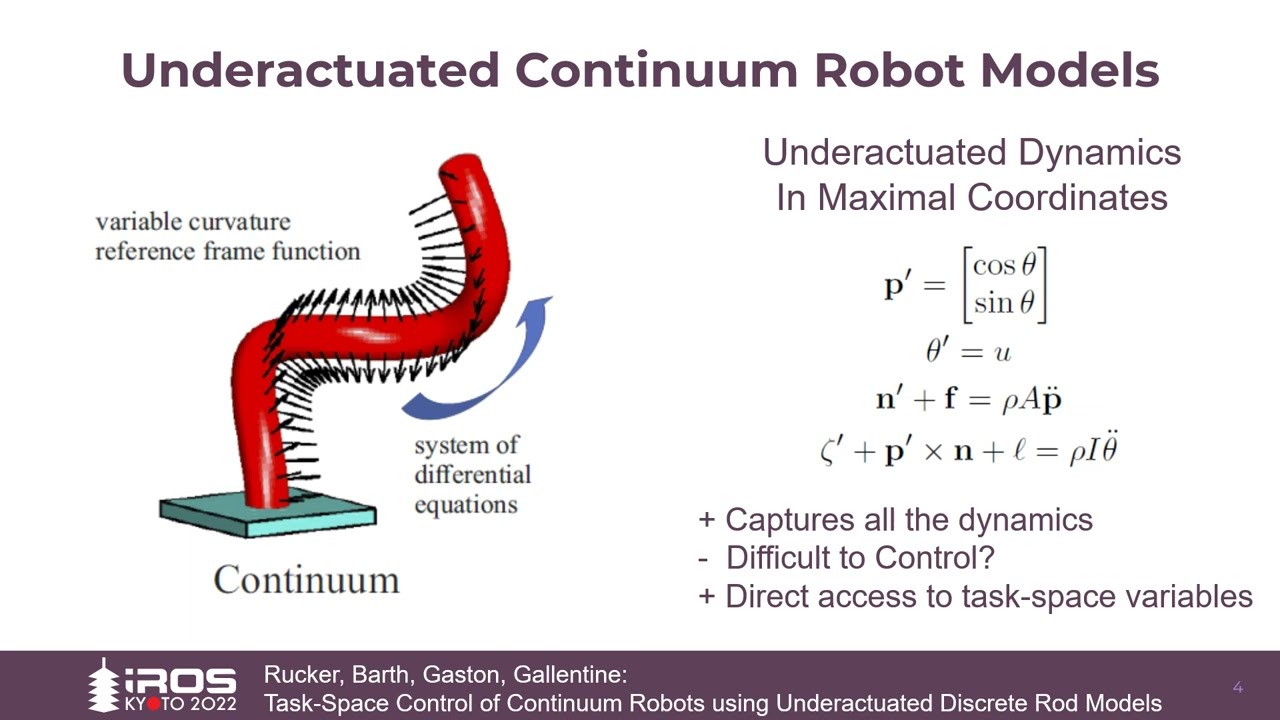
Controlling Soft Robots in Task Space
2.3K
This video presents a model-based control approach for soft and continuum robots that robustly accounts for their highly underactuated dynamics by using underactuated discrete rod models in maximal coordinates, which enables direct formulation of task-space control schemes through feedback linearization and sliding mode control, with a passive observer estimating the full dynamic state from limited sensor measurements.
Click to watch →

Learning Dominant Dynamics for Continuum Robot Control (John Alora, PhD Defense)
1.5K
This research introduces a model-based control methodology for continuum robots that leverages spectral submanifolds (SSMs) as structural priors for data-driven system identification. By learning the dominant dynamics on these low-dimensional invariant surfaces, the approach achieves several factors of computational compression while outperforming both purely data-driven and equation-based methods in trajectory tracking accuracy. The methodology includes a robust tube MPC framework that quantifies compression error to guarantee safety under model uncertainty, and an extension to adiabatic SSMs for handling more dynamic tasks with significant geometric nonlinearities. This approach enables safe, real-time control of continuum robots in high-stakes environments.
Click to watch →

IROS 2014 Bioinspired Robots I & Multi-Robot Coordination
245
Extensible continuum robots have continuous backbones inspired by animal elements like giraffe tongues and octopus arms, allowing bending at any point. The OctArm has 9 degrees of freedom with three serially connected sections based on McKibben actuators, capable of 3D motion. Three controllers were compared: proportional derivative, sliding mode, and feedback linearizing. Experiments showed good tracking results, though accuracy requirements differ from rigid link robots. This demonstrates how biological inspiration enables versatile robot designs for unstructured environments.
Click to watch →
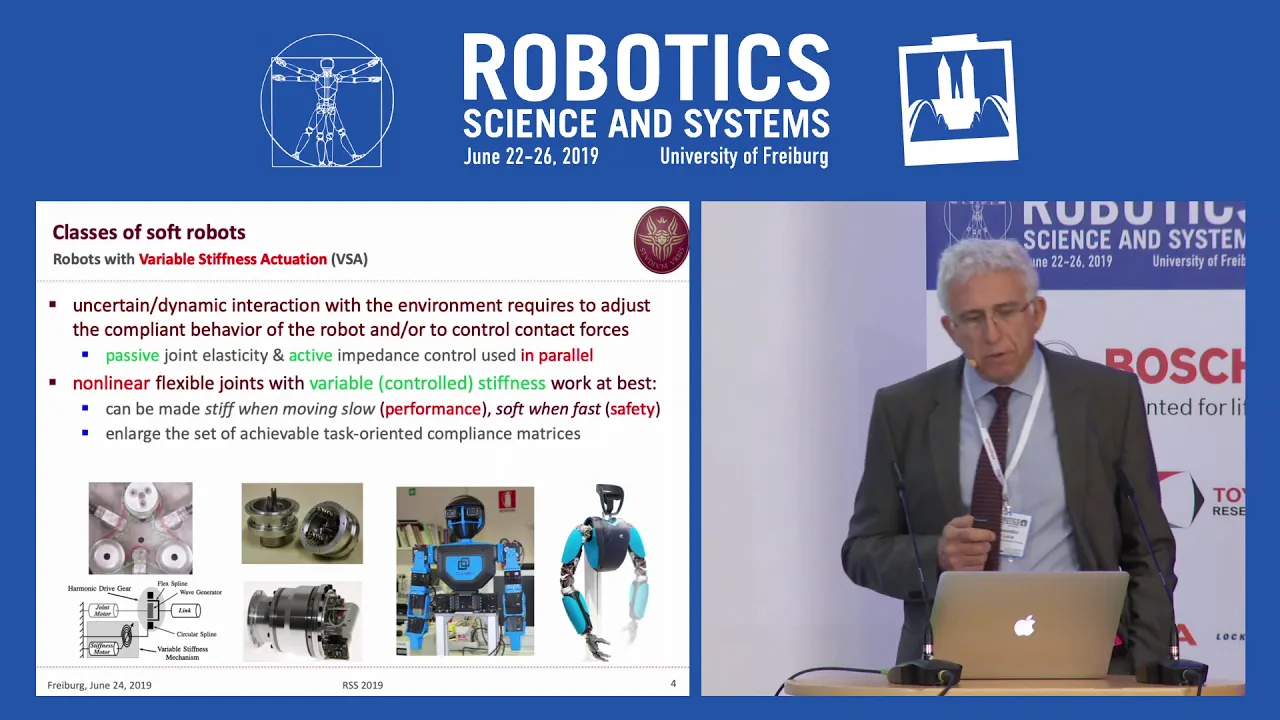
RSS 2019, Keynote 1 by Alessandro De Luca: Control of soft joint robots for safe physical HRI
468
Continuum soft robots can be approximated by finite segments with constant curvature that can be controlled. Under assumptions of point mass representation and linear elasticity/damping distribution, these infinite-dimensional systems can be modeled similarly to rigid robots plus stiffness and damping terms. A physically motivated PD controller using the system's actual stiffness and damping values achieves global asymptotic stability for regulation tasks, avoiding arbitrary controller parameter selection.
Click to watch →
Deep Dive
Advanced Smart Materials: Investigating shape memory alloys, dielectric elastomers, and hydrogels for next-generation soft robotic actuation.
Smart Materials of the Future - with Anna Ploszajski
61.8K
Ferrofluids represent advanced liquid smart materials containing magnetic nanoparticles suspended in carrier fluids, invented by NASA in the 1960s for controlling liquids in zero-gravity environments. These materials change shape dramatically in response to magnetic fields while maintaining liquid-like flow properties. Since metals conduct heat efficiently, ferrofluids can be pumped through aircraft wings to precisely control temperature of moving smart material components, preventing unwanted shape changes due to atmospheric temperature variations. Current smart materials face challenges including slow response times, instability over time, difficulty in precise control, potential toxicity, and high manufacturing costs. Material scientists predict these challenges will be overcome within 20-30 years, enabling transformative applications like morphing aircraft that achieve the adaptive wing designs envisioned by Leonardo da Vinci. These developments represent the convergence of historical biomimetic design principles with cutting-edge smart material technologies.
Click to watch →

NEW 007 JAMES BOND GAME DROPPED! - 007 First Light - PART 4
2.5K
The video describes a 'smart composite nanopiber material' used for robot outer shells that is 'ultralight and shock absorbing' and 'damn near indestructible.' This material is described as revolutionary for space travel applications. The narrative also explores how such materials combine multiple properties (lightweight, durability, shock absorption) to create materials with unprecedented performance characteristics. The concept illustrates how advanced materials science is pushing the boundaries of what is possible in engineering and technology development.
Click to watch →

«Умные» материалы – Федор Сенатов / ПостНаука
7K
Smart materials are a new class of materials that change their properties in response to external factors like pressure, temperature, humidity, pH, or magnetic fields. Key types include piezoresistive materials (change resistance when deformed, used as sensors), piezoelectric materials (generate charge when deformed, used in precision devices), thermochromic materials (change color with temperature), and photochromic materials (respond to light). Advanced applications include micro-wires with giant magneto-impedance for structural monitoring, shape memory alloys like Nitinol that return to original shape after deformation (used in medical devices), and self-healing materials that repair damage through microcapsules or shape memory mechanisms. These materials originated in aerospace and medical sectors before spreading to other industries.
Click to watch →

Smart materials (3 of 5): shape shifting material, drug delivering nano particles
202K
Smart materials are engineered substances that can change shape, respond to stimuli, or perform specific functions in response to external inputs like electrical charge or temperature changes; these materials are revolutionizing fields from aviation (shape-shifting wings using piezoelectric ceramics and shape memory alloys) to medicine (drug-delivering nanoparticles and stents), enabling technologies that mimic or exceed natural biological capabilities.
Click to watch →

Alimentos falsos com os quais você já foi enganado (e nem sabia)
5.6K
This segment explores advanced robotics and smart materials. The Magnetic Slime Robot is made of water-soluble polymer, borax, and iron particles, acting as both liquid and solid depending on pressure. Iron particles enable magnetic control for movement, shape formation, and electrical conductivity. It can navigate passages as small as 1.5 cm and stretch seven times its length. The robot is self-healing, able to reassemble after being cut. Transparent solar panels capture non-visible wavelengths while allowing visible light to pass through, potentially transforming windows into power-generating surfaces.
Click to watch →
Deep Dive
Applications in Marine Biology and Deep-Sea Exploration: How delicate soft grippers are deployed on underwater ROVs to safely sample fragile marine organisms.

Что на самом деле нашли в Марианской впадине — тайны самого глубокого места на Земле
469
Some deep-sea organisms have been studied alive, and what scientists discovered in their biochemistry already has practical applications. Enzymes from bacteria in hydrothermal vents that can work at extreme temperatures have found applications in molecular biology. In particular, such an enzyme is a key component of the polymerase chain reaction (PCR) method used for testing for COVID-19 and many other diseases. Life from the depths literally saves lives on the surface. Other deep-sea organisms contain substances with potential antibiotic and anti-tumor properties.
Click to watch →

Beyond Blue - Part 3 - Deep Ocean Floor Exploration
41.9K
Deep sea exploration offers significant potential for medical breakthroughs. Organisms living in extreme environments like brine pools undergo constant biological warfare, producing biochemicals with potential applications in curing diseases such as cancer and Alzheimer's. These organisms also produce antibiotics and antivirals that could improve human health. Scientists are developing non-invasive research methods, including suction cup tags for whales and robotic 'squishy fingers' for collecting deep sea samples without harming organisms. This approach represents a shift from destructive sampling to gentle, comprehensive study that preserves specimens for future research while providing valuable information about marine biodiversity.
Click to watch →

7 Najbardziej Niewiarygodnych Zwierząt Żyjących W Rowie Mariańskim
7.3K
Deep-sea organisms provide solutions to engineering problems that humans have struggled with for millennia. The tube worm's eyes inspired optical projects with rotating lenses and adjustable fields of view. The anglerfish's red bioluminescence led to research on hidden lighting. The snailfish's gel-like body inspired pressure-resistant, elastic, and adaptable materials. The isopod's aluminum coating represents 138 million years of evolution—only now being discovered. Xenophyophores concentrate uranium, lead, and mercury in quantities that would kill most cells, making them potential bioaccumulators, pollution monitors, or sources of new pharmaceutical compounds. Chemosynthetic tube worms at 9,533 meters contain bacteria never before cultured—new metabolic pathways converting methane and hydrogen sulfide to energy without sunlight. Understanding these mechanisms could enable artificial chemosynthesis, energy production from waste gases, industrial applications, and climate solutions.
Click to watch →

What They Found In The Deepest Place On Earth
55.9K
The discovery of quantum effects in deep sea life has opened entirely new fields of research that bridge biology, chemistry, and physics. Scientists are now studying these organisms not just to understand how they survive, but to learn principles that might be applied to everything from more efficient solar panels to quantum computers that operate at room temperature. Evolution working under the extreme constraints of the deep ocean has produced solutions that our most advanced technology is only beginning to understand.
Click to watch →

Scientists Finally Revealed What's Hiding at the Bottom of the Mariana Trench
445
The MEER project aims to understand how organisms keep their proteins stable and cells intact under crushing pressure. This biological knowledge could eventually lead to new pressure-resistant materials, new drugs, or research relevant to how the human body might cope with extreme environments during long-duration space travel. The deepest trench on Earth may teach us something useful about leaving the planet entirely.
Click to watch →
Deep Dive
Surgical and Medical Robotics: Exploring how soft, tentacle-like grippers can be adapted for minimally invasive medical procedures and delicate organ manipulation.
Inventos Asombrosos Que Deberías Ver ¡La Mejor Recopilación Del 2025!
9K
This segment covers medical robotics and advanced surgical technology. Robotic surgery has advanced to the point where robots are used in hospitals to improve patient outcomes. The Da Vinci surgical robot is a multi-armed system that eliminates surgical errors and makes surgery less invasive, with precise control and 3D high-definition vision. The CyberKnife administers radiation therapy with submillimeter precision, focusing and adjusting rapidly to treat cancer while minimizing exposure to healthy tissues. The Laser Snake is a remarkable robotic marvel for nuclear decommissioning, armed with a 5kW laser capable of cutting nuclear cells. It has over four degrees of articulation and HD cameras, with electronic components protected from radiation contamination.
Click to watch →
Las mejores innovaciones de 2024 según Time: De los corazones artificiales a los robots | PRO Robots
18.9K
This segment explores the intersection of robotics and medical technology. Unify Medical's digital lenses provide microscope-level precision while recording video for surgical training, with government funding for night vision and fluorescence imaging applications. The da Vinci Surgical System became the first FDA-approved robotic surgery system, compensating for natural body movements with incredible precision. The system is scheduled to receive AI capabilities for autonomous tasks like suturing arteries. The iRobot massage robot demonstrates AI in personal wellness, using machine learning and body scanning to create individualized massage plans. Digit represents the first humanoid robot to be paid for warehouse work, with a 2-year amortization period. These innovations show robotics advancing from industrial applications to precision medicine and personal healthcare.
Click to watch →

Los ROBOTS están YA en nuestros HOSPITALES | El futuro de la medicina es INCREÍBLE
21.8K
Modern medical robotics encompasses surgical systems like Davinchi 5 (performing over 2.6 million surgeries in 2024) and specialized micro-surgery robots like Simani for repairing microscopic vessels. Autonomous surgical robots like SRTH can perform complete operations independently while adapting to patient anatomy. Hospital logistics robots such as Moxi and TUG deliver medications and transport samples autonomously, reducing staff workload and increasing precision. Patient handling robots like Robear use pressure sensors to move patients with delicate precision. Emergency triage robots like Daisy can take vital signs and generate medical reports automatically. Blood extraction robots like Aleta use ultrasound and AI to perform painless, error-free venipuncture. These technologies collectively represent a transformation in medical precision, efficiency, and patient care.
Click to watch →

Die größten Monopole & tiefsten Burggräben in einem Video | Investflow Aktienvorstellung
81.2K
Intuitive Surgical controls approximately 80% of the surgical robotics market with the da Vinci system. The moat is built on superior technology and precision, long-standing relationships with surgeons, and consumable revenue from disposable surgical instruments. The surgical robotics market is projected to reach $22 billion by 2028, growing at over 20% annually. The video emphasizes that technology leadership creates moats in medical devices through superior precision and reliability, long-standing relationships with healthcare professionals, and recurring revenue opportunities from consumables.
Click to watch →

A renaissance -- the coming end of human work | Kevin Surace | TEDxOrangeCoast
107.1K
Surgical robots like the Da Vinci system allow doctors to perform delicate procedures using computer-controlled instruments. However, fully autonomous surgical systems could potentially outperform human surgeons by making split-second decisions based on hundreds of thousands or millions of possible outcomes. Given that approximately 400,000 people die annually in the United States due to medical mistakes—ten times the number killed in automobile accidents—autonomous surgical systems could significantly reduce preventable deaths through consistent, error-free performance.
Click to watch →
Opening
Core Start
Transition
Key Points
Conclusion
Ending
Opening
0:19- 1
Begins with brief acknowledgments.
- 2
Minimal content, primarily transitional.
Limitations in Control Precision and Durability of Soft Biomimetic Grippers
While soft, jellyfish-inspired grippers excel at gently grasping fragile objects, they face significant limitations compared to traditional rigid grippers equipped with advanced force-feedback systems. A major drawback of the entanglement-based soft gripping approach is its lack of precise control and predictability; it cannot guarantee the exact orientation of an object upon release, making it unsuitable for automated assembly lines or structured industrial tasks. Additionally, soft elastomers are highly vulnerable to wear, tear, and punctures, leading to a shorter operational lifespan than metal or rigid plastic counterparts. Critics and roboticists argue that integrating high-resolution tactile sensors and machine learning into rigid or hybrid grippers offers a more durable, precise, and versatile solution for handling delicate items without sacrificing speed, strength, or positioning accuracy.
Introduction to Soft Robotics: Understanding the differences in materials, compliance, and degrees of freedom between rigid and soft robotic systems.
Principles of Biomimicry: How biological structures and organisms, such as jellyfish or octopuses, inspire engineering designs and mechanical systems.
Basic Pneumatic and Hydraulic Actuation: How fluid or air pressure is utilized to generate motion, bending, and force in flexible structures.
Fundamentals of Contact Mechanics: Concepts of force distribution, friction, and surface contact limits required to handle fragile or irregular geometries.
Control Systems for Continuum Robots: Studying the mathematical modeling and feedback control strategies required to manage highly-deformable, non-linear soft actuators.
Advanced Smart Materials: Investigating shape memory alloys, dielectric elastomers, and hydrogels for next-generation soft robotic actuation.
Applications in Marine Biology and Deep-Sea Exploration: How delicate soft grippers are deployed on underwater ROVs to safely sample fragile marine organisms.
Surgical and Medical Robotics: Exploring how soft, tentacle-like grippers can be adapted for minimally invasive medical procedures and delicate organ manipulation.
136.1K views1Klikes1:22@harvardengineeringOriginal Release: 2022-10-21
[Music] thank you thank you foreign [Music] foreign [Music]
Up Next
11:57
Precise In-Hand Manipulation of Soft Objects with Soft Fingertips | RoboSoft 2020
@ImperialREDSLab
474 views•2020-05-18

58:25
MathWorks Virtual RoboSub Simulation Environment | Webinar 2026
@RoboNationInc
209 views•2026-03-10

11:04
How to Build a Self-Balancing Robot: Arduino Nano & MPU6050
@easytechzones
16.8K views•2022-03-09
25:22
Micromouse: The Fastest Maze-Solving Robots on Earth
@veritasium
23.5M views•2023-05-24
Related Study Plans & Knowledge Roadmaps
Structured learning paths in Robotics
robotics
Building Delta Robots: Kinematics & Pico
01Foundations of Delta Robots & Mechanical Design
02Electronics and Microcontroller Setup with Pi Pico
03Delta Robot Kinematics and Coordinate Math
+ 3 more learning modules
65h6 modules
Explore Roadmap
robotics
Building Ballbots: Dynamics, Kalman & LQR
01Embedded Electronics & Omniwheel Actuation
02Ballbot Kinematics & Rigid Body Dynamics
03IMU Sensors & Kalman Filter State Estimation
+ 2 more learning modules
42h5 modules
Explore Roadmap
robotics
Micromouse: Hardware, PID Control & Flood-Fill
01Electronics & Teensy Microcontroller Basics
02Sensors and Actuators: Motors, Encoders & IR
03Precision Movement: Implementing PID Control
+ 2 more learning modules
35h5 modules
Explore Roadmap
robotics
CDPR: Kinematics, Arduino & Winch Control
01Foundations of Arduino & Basic Electronics
02Stepper Motors and Winch Mechanics
03Kinematics of 2D Cable-Driven Robots
+ 2 more learning modules
28h5 modules
Explore Roadmap