
















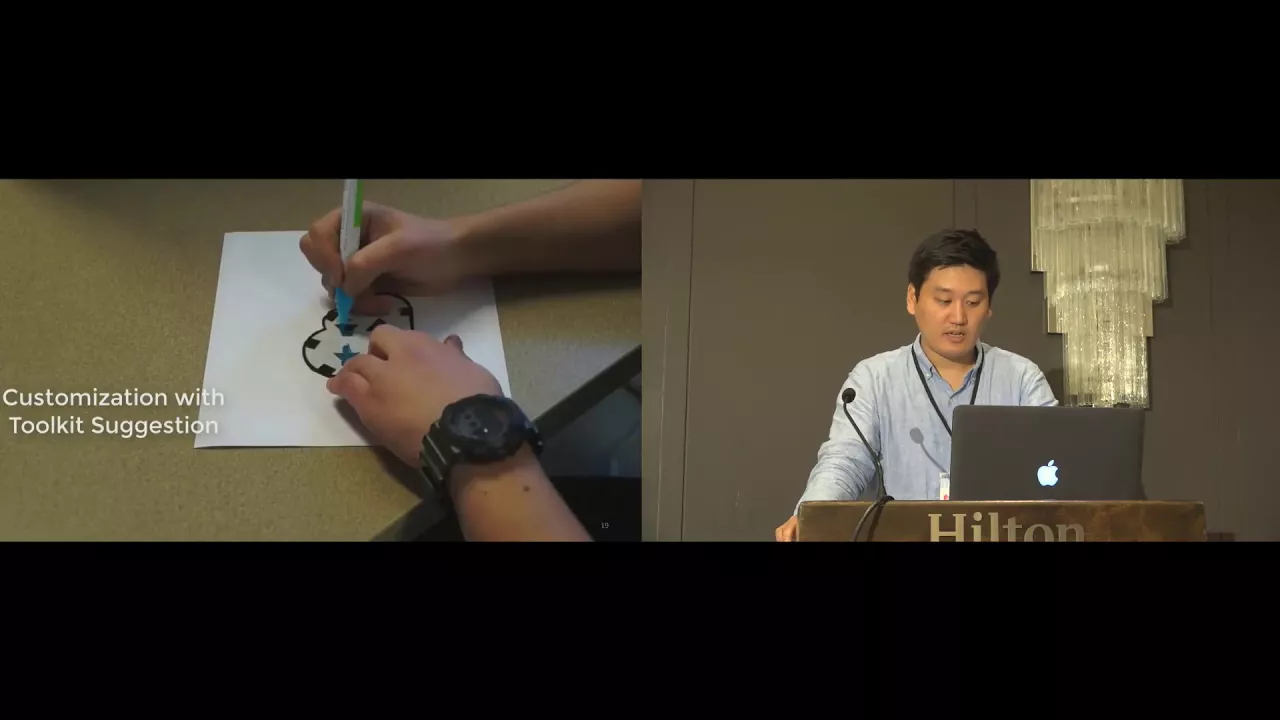





This video presents a novel dual-purpose soft fingertip design that combines tactile sensing and active shape-changing capabilities for precise in-hand manipulation of soft objects. The design uses embedded inflatable air cavities within silicone fingertips, where internal air pressure changes correlate with external forces (via the ideal-gas law), enabling both tactile sensing and controlled deformation. The system achieves translation and rotation of grasped objects by selectively inflating different air cavities—both left cavities for rightward translation, both right cavities for offset translation, and coordinated inflation for rotation. Characterization tests establish mathematical relationships between pressure, deformation, and manipulation performance. Experiments demonstrate that initial object rotation angles affect manipulation range, with optimal performance achieved when air cavities maintain contact with objects during inflation. The closed-loop pressure feedback control ensures constant counter-forces between fingertips and objects, preventing compression while enabling precise manipulation. This approach significantly enhances the dexterity of soft robotic grippers for handling delicate soft objects.
Precise In-Hand Manipulation of Soft Objects with Soft Fingertips | RoboSoft 2020
Added:hello everyone my name's I see from intro College London I'm glad to present my work for this video in this special situation in this video I'm going to present the proposed so fingertip and the supplications for precise in hand relations and others I will go through several key elements in this paper in this order so before we move to this new type of stuffing the tip I'm going to give you a general background of so fingertips in rubber hand design area so fingertips have shown significant development for grasping tasks due to their high compliance characteristics for example this well-known brand new jelly universal grandpa made by Armand can easily adapt to the shape of objects for grasping soft objects so fingertips with tactile senses perform better than Richard fingertips with Ritchie fingertips robotic repairs can achieve a repeatable staple husband force and high precision control but they are lack of at the ability and complies and they are prone to damage and deform very fragile and soft objects apart from the grasping tasks here are some other applications of soft fingertips figure 3 shows that the granule jammies or fingertips have been attached to a simple prepare to perform the patient asks figure 4 shows the soft on mask ability being used in tact or sensor applications what are some finger tips have shown significant development for grasping tasks its ability to facilitate the manipulation of objects within the hand is still limited in this paper we propose this novel so finger design for he had when Clayton saw objects by impacted air cavities for each saw fingertip because his steel air cavities inside which can perform as tactile sensor and achieve actives shape changing when the air cavities inflated was air by posting pressure those are the prototype of the saw fingertips where the two impacted breath aircraft is made from silicone are evenly distributed in each fingertip under the semi transparent silicone rubber the special finger based structure is designed to secure the silicone fingertip and the air and ensure the inflate Direction is currently as desire [Music] now I'm going to show you some demos of the dura functionals of fingertips here we use the impacted air cavity as soft tactile sensors according to the ideal-gas law the internal air pressure shows a correlation to the volume change of the ear cavity considering the incompressibility of silicone the volume change of the ear cavity caused by external force can be measured with a pressure sensor this video illustrates the active defamation of the fingertip by positive pressure here the internal pressure of the air cavities start from 0 kilopascal to 60 kilo pascal this active defamation can secure the grasp in vertical direction without escaping and damaging the soft object in order to understand the fingertip properly we perform the fingertip characterization test to analyze the relationship between the pressure affirmation this video shows the numerical information of the fingertip based on the English processing of a real inflated and deflated fingertip Barry's pressure level showing in different color and based on the outline curves we define the best fit equation in MATLAB here Y is the defamation X is the point along the edge of the fingertip in 2d and P is the internal pressure later on we use the previous defined equation to generate the simulation model for niha translation and rotation the country or person for this manipulation is described in the next two slides for translation tasks both air cavities of left fingertip are inflated for moving right both air cavities of right fingertip are inflated for offset translation direction for this simulation model the object translation distance T is determined from the object center point distance between the initial state and the final state where the variable is the pressure P when the laptop and robot and air cavities by inflated together the graph object rotate clockwise instead if the left button and right hot air cavities are inflated together the grass object rotates anti-clockwise for the simulation holder we assume the contact points between the non inflated aircraft it and the objects stay the same and then the rotation angle R can be worn out by trachoma tree is the inside of the internal pressure of the soft energy during the in hand inflation different color indicates different air cavities apart from the active deformed ear countess the rest of the finger is acting as an active turtle sensor to ensure the counter forces between fingertip and some objects are constant during the inflation by actuate in the servo motor as you can see in the bottom right figure this light blue curve indicates the finger interval where is increasing during the manipulation additionally the object internal pressure in green is stable during the manipulation which means the option will not be compressed during the manipulation the aim of this experiment is to show the dura professor fingertip can perform precisely handle inflation of soft object was a limited dexterity gripper the proposed figurative is attached to the fingers of the redesigned tree our children here is an example of tree Archer prefer manipulates richer objects with normal fingertips in the experiment we have tested the gripper as seven different positions the several grasping positions are distributed evenly in the GRT movement range shown as blue dots where position four is the middle grasping position one at the seventh are the maximal left and right resting position respectively previously we have seen the performance of the gripper at the middle cross pin position at those seven testing positions the initial grasping end o are different as shown in the video here black arrows show the option initial rotation due to gripper design and rolling the table shows the exact values of patience negative signs means rotating in anti-clockwise direction this video demonstrates the gripper performance at different gasping face the green shaded areas illustrate the experimental rotation range at different grasping positions similarly the pink shaded area indicates the translation range the translation and rotation capabilities of the gripper with the dual purpose fingertips has been shown clearly we observed that the of relative position between the fingertip and the object affect the inhalation performance and both translation and rotation range decrease when the initial rotation angle of the object increase in a rotation task if the object has ignition rotation stage in the same direction of the target rotation for example if the object is healthy at position 6 and intended to rotate to right the inflated air cavities will have a gap between the grasping objects during the inflating stage the air cavity will touch the object and then rotate the object therefore in this case the optimal tension is smaller than normal here is the summary of this paper this work proposed and evaluated in novel chiral purpose of fingertip design presenting a new way to precisely Hahnemann plays soft objects without damaging this approach is based on enhancing the dexterity of proper hands wire saw fingertips with structure sensing and active shape changing was active shape changing of the embedded air cavities the fingertip has proved its ability to inhabit played soft objects perhaps away with pressure feedback control the purple simulation model gives an evaluation on the manipulation ability of the enhanced grip breath which can be improved by taking the initial rotation angle and the deformation of the fingertips into account with the proposed closed-loop control approach and the novel dura perspective the object position can be adjusted at each cosmic evaporation thirst increasing largely the grip res dexterity the control of reserve can be developed further in future works for more complex perhaps we have McLeish's that combine translation and rotation with irregular objects and that's it thanks for listening bye [Music]
Up Next
Remote-Controlled Robot Avatars: A VR Technology Overview
@Motor_Explorer1
20.9K views•2021-08-08

MathWorks Virtual RoboSub Simulation Environment | Webinar 2026
@RoboNationInc
209 views•2026-03-10

How to Build a Self-Balancing Robot: Arduino Nano & MPU6050
@easytechzones
16.8K views•2022-03-09
Micromouse: The Fastest Maze-Solving Robots on Earth
@veritasium
23.5M views•2023-05-24
Related Study Plans & Knowledge Roadmaps
Structured learning paths in Robotics