














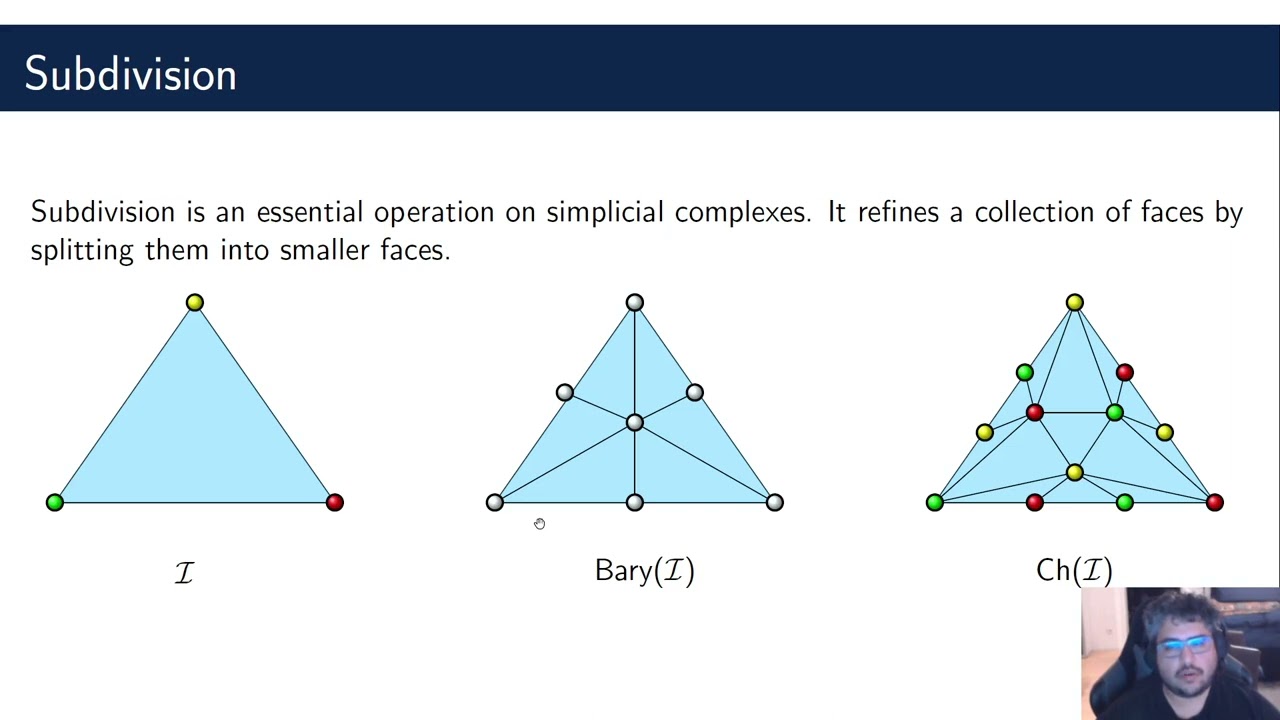
A simplicial complex is a finite collection of simplices that satisfies two closure properties: (1) if a simplex is in the complex, all its faces must also be in the complex, and (2) the intersection of any two simplices is either empty or a common face of both. The underlying space of a simplicial complex is the union of all its simplices, equipped with the subspace topology. A topological space has a triangulation if it is homeomorphic to the underlying space of some simplicial complex. Key related concepts include subcomplexes (subsets that are themselves simplicial complexes), full subcomplexes (containing all simplices spanned by their vertex sets), skeletons (subcomplexes containing only simplices of dimension ≤ j), stars (sets of cofaces of a given simplex), closed stars (smallest subcomplexes containing stars), and links (subsets of closed stars disjoint from the original simplex).
Simplicial Complexes: Definition, Subcomplexes, and Triangulation
Added:all right so now we'll talk about uh some platial complexes which are a way to assemble simplices together it's like to start representing uh topological spaces okay okay so let me give you a definition for what is a pleasure complex is all right so it's impressive complex is basically a collection of simplicities with certain nice properties right so is a finite collection uh simplices and we denote this by k okay with the property that if you have a simplex which is an element of the simplicial complex and you have faces of that simplex so tau is a face of sigma okay this implies that tau itself is an element of the simplicial complex so put another way it's like this collection of simplices is closed under taking faces of entries in the set okay so that's one thing and then another thing is that so given two elements of this implicit complex let's say sigma and sigma zero okay in the complex then you can look at the intersection sigma intersect sigma zero okay is either empty okay or it is a face of both of these simplices so there's a face of both sigma and sigma zero so put another way this is a just a guarantee that the you know it's like the simplicities are glued together nicely so that when they intersect they only intersect it's like on their um and their faces okay all right so in the case so so of course if you have a simplex you can talk about uh its dimension um so when you have a collection of simplices in particular simplicial complex we also want to talk about the dimension of that some pleasure complex so the dimension of k right is the maximum dimension of the simplices it contains okay so that's one concept and then the other concept is the idea of what is called the underlying space okay so the underlying space which i denote by uh sort of sort of like the absolute value of k right is the union of the simplices and of course it's like when you take this union then it's going to be a subset of rd where um you have some sort of uh ambient space right and then so once you have that you have to then also define a topology and this and the topology we're going to endow it's like this underlying space with is the subspace topology which comes from looking at the topology of rd and then um saying that you know it's like any open set in um the underlying space is um the intersection of an open set it's like an rd um with uh sort of the unlike space okay so uh so it's the union of simplices so that's geometrically what it is all right and then you have to sort of define a topology in it so with the subspace topology induced by the ambient space rd right okay so so the reason of course uh why i want to you know endow it's like the underlying space with a topology is because i'm going to start talking about you know using these implicit complexes to represent um some topological space okay um and then so as you will see in a little bit you know having that topology is important it's like to make things make sense in that setting okay so if you have a topological space right x okay has a triangulation if there is a simplicial complex okay together with a homeomorphism between x and the underlying space of k okay all right so so basically it's like you have again some topological space x right so that's a space with a topology on it all right and we want to talk about triangulating inside this topological space and the way we do that is that we um you know we introduce this some pleasurable complex and this initial complex you know is such that there's a homomorphism between x and the underlying space of the simplicial complex then we say that the topological space x has a triangulation okay so as is always the case it's like when we work with topology right if you have things which are homeomorphic to each other then the topological invariants it's like are invariant that's almost a tautology that's a tautology in a sense because uh basically by definition it's like a topological invariant uh is insensitive it's like two you know things it's like which are homeomorphic to each other okay anyhow so so hopefully it's clear it's like why you want to introduce this notion of triangulation is because we want to replace the topological space it's like with the simplicial complex and then do the calculations if you will on the simplicial complex itself okay then we say that a topological space is bow right if a triangulation exists okay all right so the other thing we want to do is to look at subsets if you will of the simplest complex which are again themselves and pleasure complexes so we refer to such things as subcomplexes so a subcomplex of k is a subset let's say l which is contained in k that is also a simple complex okay and we say that the sum subcomplex is full okay okay if it contains all the simplicities in k that are spanned by vertices in l okay okay so maybe let's uh have an example of that just so that it's clear what's going on all right so let's say we have the tetrahedron okay all right so u0 u1 u2 and u3 and sort of filled in right and in particular you could have you could have something like this right which is u1 u2 and u3 all right but i only have the the edges right and the and the the vertices it's like associated so i'm not going to fill in it's like this too simplex here okay so so this of course is still a subcomplex of this original tetrahedron okay it's easy to convince yourself that it is closed under you know taking faces it's like of the simplicities which are there and that you know when you take two simplicities in this the intersection is again a simplex or the empty set okay so so this is a subcomplex but it's not a full subcomplex because again it doesn't contain the the sort of the triangle which is spanned by u1 u2 and u3 okay so even though u1 u2 and u3 right has spans a triangle it's like in the original complex right that triangle is not here so it's not full okay all right so this of course is a special example of a skeleton it's like well not technically it's like um but um if you will it's like you can think of this as being the skeleton of a um of a triangle okay of a two simplex and let me sort of explain what i mean by that so an important subcomplex is this idea of is the j skeleton and and it's denoted by k with a superscript j it's like but in parentheses okay so this is just a set of simplices uh which are in the original simplicial complex but with the property that you only look for simplices which are dimension less than equal to j okay so the dimension of sigma is less than equal to g okay so um so in this example if you had uh you know this triangle you span by u1 u2 and u3 right and then you looked at the the one skeleton it's like of that then that basically it's like omits the uh the two simplex because it's dimension greater than two okay so it just has again it's like the edges it's like n vertices but it doesn't have this two-dimensional piece here okay and you could also have the zero skeleton of this zero skeleton just gives you the vertices okay so um so the zero skeleton okay it's the vertex set okay so the vertices of k are just given by the xero skeleton okay and then as we have sort of observed before right these skeletons in general are not full subcomplexes so skeletons are generally not full okay all right now we're going to introduce a few more concepts which have to do with in some sense the neighborhood if you will it's like a simplex okay so the star of a simplex tau okay denoted by star as t of tau right is the set of simplices which which are co-faces it's like of tau okay so sigma is an element of k such that tau is a face of sigma alternatively sigma is a co-face of tau right so this consists of the co-faces of tau and and one observation is that in general this is something which is not closed under taking phases so it's not a subcomplex so it is generally not closed undertaking faces okay so uh so what you can do of course is that you can add it's like the missing faces so that you get a complex okay so adding the missing faces gives us some pressure complex which we refer to as the closed star okay denoted by s t bar tau which is the smallest simplification complex which contains the star right okay so maybe let's look at an example of this so let's again look at this situation where you have the two simplex and then you want to look at the okay so that's what i call sigma okay actually let's just called that entire collection it's like k and then we have uh you know it's like tau which is just this piece here okay so if you want to look at the star you want to look at all the all the things which have tau as a face okay so you want to look at all the co-faces so you have this and you have so you have the two simplex right and you have the edges here right and that is the face sorry that's the star but it's not a complex because it's missing this last vertex right so that vertex obviously is totally disjoint it's like from that edge right so so there's no relationship between the two that's not going to mean the star but of course it's like in order to make this a simplistic complex you have to have the um you have to have it's like the boundaries that's like off the um you have to have well the proper faces it's like off this edge which includes that particular vertex okay so um so this thing here so okay so if you have this as tau then this is the star of tau and then the close star of tau is is actually the whole thing okay all right so hopefully that gives you an example of what we're referring to here okay and then finally the other concept is this idea of the link so the link lk of tau is the set of sort of vertices in the star of tau such that the intersection between uh that vertex and tau okay is i'm sorry the closed star right is the empty set okay so um so in this case for example at the if you have that edge then the closed star is has that point but that that vertex right and that intersection at the vertex with that edge is empty so you know that that vertex is in this link okay so this consists of simplices in the closed star at a disjoint from tau okay so so let's look at a few special cases of this link right so if tau is a vertex then the link of tao is just the closed star of tao excluding the star of town okay but then more generally right the link of tao is the closed star of tau excluding the union of the stars of v where v is a face of tau okay so another way to sort of think about this is that if you think of the closure operation as in some sense completing any collection of um simplicities so that it is actually a complex then this is a little bit like saying that the link is the closure of the star of tao excluding the star of the closure of town okay so anyway so so we'll see um more of that okay all right so this is uh so these are some of the main operations which show up it's like when you're working with uh sort of actual geometric realizations of simplicial complexes and then there's sort of a more abstract formulation it's like often pressure complexes where we don't worry about embedding it into an ambient space and which we'll talk about later alright so let me stop here for now
Up Next

Linear Algebra: Vector Spaces and Operators | MIT 8.05 Quantum Physics II
@mitocw
132.6K views•2014-06-17
Elliptic Curve Cryptography Explained: ECC, ECDSA, ECDH
@PracticalNetworking
28.5K views•2024-10-21
Vietoris-Rips Complex: Definition & Relation to Čech
@melvinleok
741 views•2020-12-25

The Mathematical Impossibility of Accurate World Maps
@Vox
23.3M views•2016-12-02
Related Study Plans & Knowledge Roadmaps
Structured learning paths in Mathematics