















The Vietoris-Rips complex is a topological construction that simplifies the computation of intersection properties compared to the Čech complex; while the Čech complex requires checking whether the common intersection of multiple balls is non-trivial, the Vietoris-Rips complex only requires that all pairwise intersections between elements of a set are non-trivial, making it much easier to compute. Specifically, the Vietoris-Rips complex of radius r consists of all subsets of points with diameter at most 2r, and it contains the Čech complex of the same radius. Furthermore, the Nerve Lemma states that the Vietoris-Rips complex is contained in the Čech complex of radius √2 times r, providing a useful approximation relationship between these two constructions.
Vietoris-Rips Complex: Definition & Relation to Čech
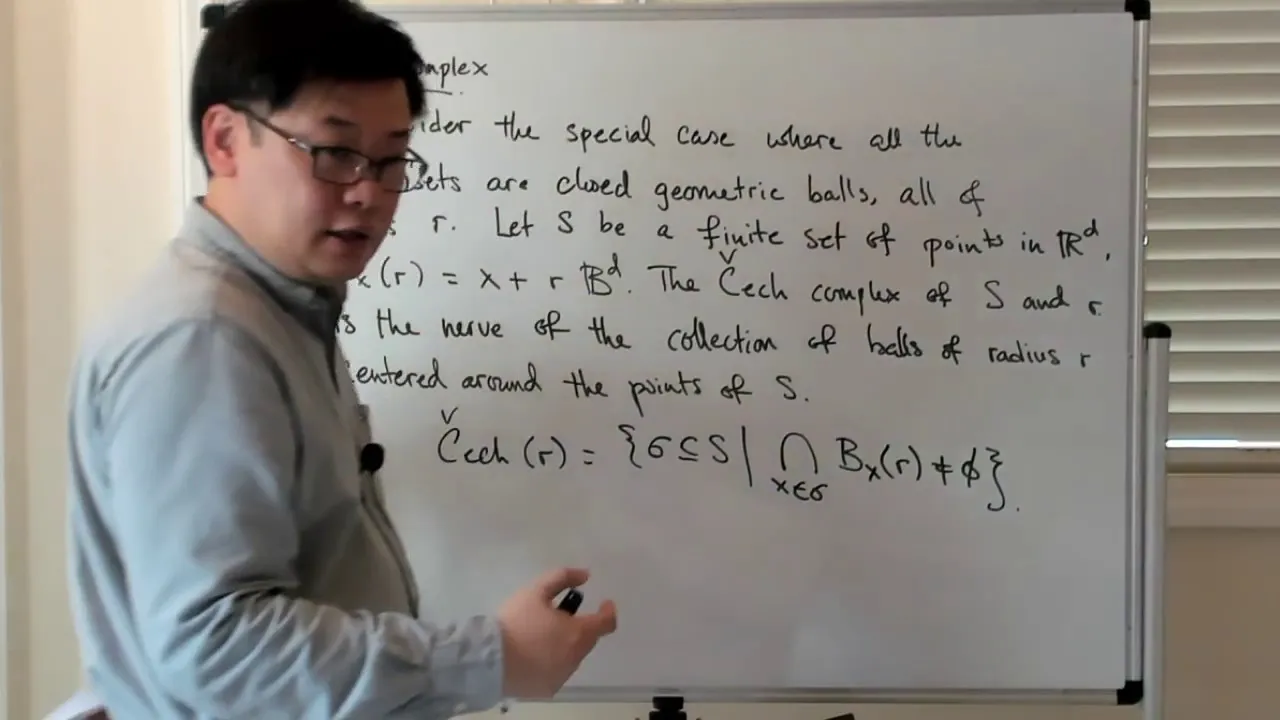
Added:all right um so instead of just considering the check complex which of course if you recall requires you to check whether or not the common intersection of a whole bunch of balls right is non-trivial i'm going to introduce a slightly easier to compute complex called the venturous ribs complex and then i'll say something about how those two things are related to each other so instead of checking for sort of common intersections right we can consider complexes of sub-collections where you only require that all pairwise intersections between elements of that set are non-trivial okay and of course this is a much easier condition to check right so this is a much easier condition to check and leads to what is called the vitatorious rips complex of s and r okay and this consists of all subsets of points of diameter at most two are okay okay so so let me just be more explicit here so this is the victorious rips complex for radius r right this is the set of uh collections of points okay with the property that the diameter of that collection of points is less than equal to 2r okay and obviously if the diameter if this thing is less than equal to 2r it's like then it will tell you that um you know it's like every single pairwise interaction uh sorry every single pairwise intersection of balls or radius r it's like centered at those points will um will always be non-trivial okay so some obvious immediate observations right which is that this condition is obviously the condition for there being an edge in the check complex so so clearly the edges and the vitarus rips complex are the same as the check complex okay and then more generally speaking it's actually the check complex is actually contained in the vatarius rips complex so the check complex radius r right is contained in the vitara's ribs complex okay and of course the reason why you have this inclusion is that a non-trivial common intersection right implies non-trivial pairwise intersections right because if you recall the condition that something is in the check complex right is that imagine if you had three sets for this set for abc to be in the check complex of radius r implies that uh you know it's like the well i mean the balls of radius are centered at points a b and c right have a non-trivial intersection here okay but if that is true then clearly the pairwise intersections of balls of radius are centered at a and b or a and c or b and c will also be non-trivial okay and and of course that uh sort of easier to satisfy condition is the condition for it for that abstract simplex if you will to be in the vitara's ribs complex so any case what that tells you then is that anything in the check complex of radius r is going to be nevatar's ribs complex of radius r as well okay so now the question is is it possible then to have the variator's ribs complex be contained in some other check complex perhaps of a larger radius okay so so that's basically what is called dividers rib slimmer and i'll state it inside but i won't prove it okay so let me just state this okay so inverters rip slimmer says uh something like the veritas ribs complex is contained in some of the check complex okay so let s be a finite set of points in some euclidean space the dimension doesn't matter okay and then we need r to be greater than equal to zero okay then the claim is that the vectors rips of r is contained in the check complex of radius square root 2 times r so this is a constant multiple obviously of the r but it's independent of the radius okay and then proof i'm not going to sort of discuss but you can look at the textbook if you're interested in this so more or less it's really sort of a geometric argument which says that uh if you again let the radius be large enough uh then anything it's like which is um doing pairwise intersections right it's going to give you um sort of you know it's like common non-trivial intersections footballs which are a slightly larger radius okay so let me just stop here for a minute
Up Next

What is Homology? An Intuitive Introduction to Algebraic Topology
@VisualMath
20.6K views•2021-08-24

JEE Maths | Circles: Pole & Polar Explained with Equations
@TargetPublications
14.4K views•2019-02-23

Simplicial Complexes: Definition, Subcomplexes, and Triangulation
@melvinleok
953 views•2020-12-25
The Mathematical Impossibility of Accurate World Maps
@Vox
23.3M views•2016-12-02
Related Study Plans & Knowledge Roadmaps
Structured learning paths in Mathematics