Robert Lowell (1917-1977) was a pioneering American poet who revolutionized modern poetry through his confessional style, transitioning from formal, mythic works like Lord Weary's Castle (1946) - which won the Pulitzer Prize and explored themes of violence, guilt, and Puritan legacy through dense, allusive poetry - to Life Studies (1959), widely regarded as the first major confessional poetry collection that broke away from traditional forms to expose his mental illness, family conflicts, and personal struggles in raw autobiographical verse, thereby reshaping American poetry and influencing subsequent generations of poets including Sylvia Plath and Anne Sexton.
Robert Lowell Confessional Poetry | Life Studies & Key Works
Added:Deep Dive
Understanding of the Modernist poetic tradition, particularly T.S. Eliot's theory of impersonality, which Confessional poetry directly reacted against.

Tradition and the Individual Talent by T.S.Eliot Summary and Explanation
195.7K
TS Eliot's theory of impersonal poetry states that the progress of the artist is a continuous self-sacrifice, a continual extinction of personality called depersonalization. The poet must sacrifice their personality to the art and tradition of poetry. Eliot demonstrates this through a chemical reaction analogy: the mind of the poet is like platinum catalyst introduced into a gas chamber containing oxygen and sulfur dioxide, which combine to form sulfuric acid while the platinum remains unchanged. Similarly, the poet's mind is a receptacle that can cease and stone countless images, pictures, thoughts, feelings, and emotions. What matters is not the greatness of emotion but the intensity of the artistic process and the pressure under which artistic fusion takes place.
Click to watch →
Theory of Impersonality II T.S. Eliot II Saroj Kumar Pasayat
190
T.S. Eliot was a great critic of the 20th century and a strong supporter of classicism, reacting against romantic theory that viewed poetry as the expression of the poet's personality. Eliot argues that the poet must develop consciousness of the past and continue developing this throughout their career. Without knowledge of tradition, a poet cannot become a great artist. The progress of an artist is a continual self-sacrifice and extinction of personality, moving from personal expression toward impersonal artistic creation. Honest criticism is directed upon the poetry, not the poet. The mind of a mature poet differs from an immature one in the degree of dissociation of personality from the poetry. Eliot uses the catalyst analogy: the poet's mind transforms emotions into art without being changed by the process. The poet's mind is a receptacle for storing feelings, phrases, and images that blend into new compounds. The business of the poet is not to find new emotions but to use the ordinary ones and work them off into poetry. Eliot criticizes Wordsworth's theory that emotions recollected in tranquility is inexact. The concentration of the poet is unconscious, not conscious recollection. A good poet is unconscious when going through the intensification of feeling but conscious when collecting different feelings and making choices. A bad poet is unconscious about selection but conscious when intensifying. Both errors make poetry personal. Poetry is not the turning loose of emotion but an escape from emotion, and not the expression of personality but an escape from personality. The emotion of art is impersonal and the poet cannot reach this impersonality without surrendering himself wholly to the work to be done.
Click to watch →

Impersonality|Tradition and Individual Talent|T.S Eliot|Bengali Summary
163
T.S. Eliot's theory of impersonality in poetry argues that great poetry is not the direct expression of the poet's personal emotions, but rather a transformation of emotions into universal artistic form through a complex process of artistic discipline; the poet acts as a medium or catalyst who channels personal experiences and historical consciousness into works that transcend individual subjectivity, with true originality emerging from deep engagement with tradition rather than personal confession.
Click to watch →

टी. एस. एलियट का साहित्य चिंतन | निर्वैयकि्तकता सिद्धांत #MHD-05 #MHD
4.3K
T.S. Eliot's Impersonal Theory was formulated as a counter to Romantic poets' individualism. Eliot believed poets should be objective and impersonal, similar to scientists. He argued that poetry is not the expression of personal emotions but an objective arrangement of words. The poet serves as a medium for creation, not the source of personal expression. Eliot used the platinum wire analogy: in a chemical reaction between oxygen and sulfur dioxide, platinum acts as a catalyst facilitating the reaction without undergoing change. Similarly, the poet should facilitate artistic creation while remaining emotionally detached. Eliot distinguished between natural impersonality (art for its own sake) and personal impersonality (using matured personal experiences to express universal truths).
Click to watch →

MH Abrams | A Glossary of Literary Terms Part 5 | UGC NET English Literature by Aman Kakkar
509
Confessional poetry is a genre of poetry where the poet writes about their own personal experiences, emotions, and life events in the first person. It is highly subjective and personal, often dealing with difficult topics such as mental illness, family problems, sexuality, addiction, and other challenging life experiences. Key examples include: (1) Robert Lowell's 'Life Studies' (1959), which dealt with his bipolar disorder, (2) Sylvia Plath's 'Ariel' (1965), which explored themes of death, anger, and relationships with her father, (3) Allen Ginsberg's 'Howl' (1956), which addressed madness and American life, and (4) John Berryman's 'Dream Songs' (1964). The opposite of confessional poetry is impersonal poetry, which is associated with T.S. Eliot's objective correlative theory.
Click to watch →
Deep Dive
A basic definition of 'Confessional Poetry' as a literary movement that focuses on highly personal, autobiographical, and taboo subject matter.

Confessional Poetry movement
5.6K
Confessional poetry is a literary movement that emerged in the late 1950s and early 1960s, characterized by first-person narration, intimate autobiographical subject matter, and the deliberate revelation of taboo topics such as mental illness, sexuality, and personal trauma. The movement rebelled against the impersonal academic poetry of modernism and the New Criticism movement, with key pioneers including W.D. Snodgrass, Robert Lowell, Sylvia Plath, and Anne Sexton. This genre transformed poetry by encouraging writers to explore their deepest emotions and private experiences, influencing contemporary literature and memoir writing.
Click to watch →
Literary Movements /Groups | One-Shot Revision | PYQs Practice | UGC NET English | Part-2 🎯
233
Confessional Poetry was a post-war American poetry movement where poets wrote deeply personal, autobiographical poetry revealing mental illness, trauma, sexuality, and family conflict. The term was coined by M.L. Rosenthal in 1959 while reviewing Robert Lowell's Life Studies (1959). The purpose was to bring private emotions into public poetry, breaking boundaries of private life and highlighting ordinary people's trauma. Notable members included Robert Lowell (founder who shifted American poetry from formalism to personal revolution), Sylvia Plath (most famous Confessional poet who explored mental illness, gender, death, and identity), Anne Sexton, and W.D. Snodgrass. Major works include Lowell's Lord Weary's Castle (1946), Life Studies (1959), and For the Union Dead (1969); Plath's The Colossus and Other Poems (1960), Ariel (1965), and The Bell Jar (1963); Sexton's All My Pretty Ones and Life Without Men; and Snodgrass's Heart's Needle (1959). John Berryman was an associated poet who used confessional elements with masks and personas.
Click to watch →

Confessional Poetry | Most Asked Term | UGC NET English Literature | By Rashi Poddar
143
Confessional poetry is a genre where poets write honestly about their personal lives, including taboo topics like mental health, sexual relationships, and suicidal impulses. The term 'confession' means accepting something in front of people about topics not acceptable in society. This genre emerged around 1950-60 in America when society was conservative and reluctant to discuss personal struggles. The term was first applied to Robert Lowell's 'Life Studies' (1959), with critic M.L. Rosenthal coining the term. Key features include: deeply personal content about taboo topics, raw honest emotions without filters, colloquial language without fancy literary devices, autobiographical focus on the 'I factor,' and first-person narrative style. It emerged as a counter to modernist poetry's impersonal approach.
Click to watch →

confessional poetry (Sylvia Plath)
296
Confessional poetry is a literary movement that emerged in the United States after World War II (late 1950s-1960s) as a reaction against the depersonalized and academic poetry of modernists like T.S. Eliot and W.H. Auden. This form of poetry focuses on the poet's personal history, experiences, and intimate subject matters—including mental illness, sexuality, suicide, and domestic life—using first-person narration to create complete openness between poet and reader. The term was coined by critic M.L. Rosenthal in 1959 when reviewing Robert Lowell's 'Life Studies,' who is considered the founding father of this movement. Major confessional poets include Sylvia Plath, Robert Lowell, John Berryman, Anne Sexton, Allen Ginsberg, and W.G. Snodgrass. The poetry serves as both artistic expression and therapeutic catharsis, helping writers and readers understand themselves by openly discussing taboo topics that were previously considered inappropriate for public discourse.
Click to watch →

Confessional Poetry: Definition, History & Key Poets
18.4K
Confessional poetry, emerging in the late 1950s and early 1960s through poets like Robert Lowell, Sylvia Plath, Anne Sexton, and W.D. Snodgrass, is characterized by its extremely personal subject matter focusing on private experiences such as death, trauma, depression, troubled relationships, and psychological struggles; it employs an autobiographical style where the poet removes the traditional mask, uses first-person narrative to reveal authentic emotions, and maintains lyrical craftsmanship despite addressing deeply intimate themes that transcend customary social reticence.
Click to watch →
Deep Dive
Familiarity with the post-WWII American social and cultural context, including the rise of psychoanalysis and changing views on mental health.
Mental Health — Andrew Scull: The Historical Journey of Mental Health
545.4K
Scottish surgeon James Braid discovered that Mesmer's patients exhibited genuine hypnotic states characterized by anesthesia-like effects, developing hypnotism as a distinct technique independent of magnetic fluid theory. At the Salpêtrière hospital, Jean-Martin Charcot applied hypnosis to study hysteria, attracting international attention including young Sigmund Freud. Freud initially pursued physiological explanations but abandoned them for psychological theories emphasizing repressed memories and emotions. His collaboration with Josef Breuer resulted in 'Studies on Hysteria,' establishing foundational case studies. World War I's shell shock phenomenon validated Freud's emphasis on psychological factors, demonstrating that environmental trauma could cause mental breakdown. During WWII, psychiatric casualties doubled compared to WWI, prompting rapid training of psychiatrists in psychotherapeutic techniques. Before the war, America had 2,500 psychiatrists; by war's end, the army employed 2,500 trained in these methods. After the war, these psychiatrists returned to civilian practice, believing mental illness could be treated outpatient through talk therapy. Psychoanalysis dominated American psychiatry until the 1970s-1980s. The 1980s anti-Freud critique sparked intense controversy that paradoxically sustained psychoanalysis's influence. Mainstream psychiatry abandoned psychoanalysis, swinging heavily toward biological explanations rooted in brain function and genetics. Despite billions invested in neuroscience and genetics research, treatment outcomes have not improved substantially, with life expectancy for people with serious mental illness remaining 15-25 years shorter than the general population.
Click to watch →
Czym jest klasyczna psychoanaliza? / #Pofilozofujmy i #Poteoretyzujmy !
17.6K
After World War II, psychoanalysis migrated to America where Jewish refugees established orthodoxy emphasizing Freud's original theories. American psychoanalysts applied sexual theories universally, even diagnosing pseudo-masculinity in prostate surgery patients. Training institutes proliferated at every university, and the first DSM editions were psychoanalytically oriented. However, by the 1970s, biological psychiatry gained prominence, and the third DSM edition abandoned psychoanalytic causal explanations for descriptive classifications. This transition marked the decline of Freudian orthodoxy in American psychiatry.
Click to watch →

The Century of the Self - Part 2: "The Engineering of Consent"
794.5K
During WWII, 49% of soldiers evacuated from combat were sent back due to mental problems. In desperation, the Army turned to psychoanalysis. Refugee psychoanalysts from Central Europe worked with American psychiatrists to guide rehabilitation projects. This was the first time attention was paid to ordinary people's feelings and anxieties. The Army made film records using hidden cameras to document the experiment.
Click to watch →

Джей Стивенс - "Штурмуя Небеса: ЛСД и Американская Мечта". Часть 2. Аудиокнига
351
American psychology transformed dramatically after World War II. The war and Russian Revolution shattered Victorian rationalism, revealing that spiritual equilibrium faces constant internal challenges. Between 1919-1929, psychoanalysis flourished as Americans became fascinated with libido, IQ, conditioned reflexes, and Freudian theories. Army testing of 2 million soldiers revealed alarming results: 864,646 unfit for service, with average mental capacity equivalent to 13-year-olds. This triggered intellectual self-improvement until the Depression shifted focus. By the 1930s, psychology split into warring factions: psychoanalysis with multiple schools, and behavioralism declaring mental processes unmeasurable and therefore nonexistent. The National Mental Health Act of 1946 allocated $2.4 million, growing to $176 million by 1964. Psychiatrists grew from 3,000 to 7,500 by 1950, and APA membership surged from 3,000 to 15,000+ by 1956, reflecting the nation's commitment to understanding and treating mental illness.
Click to watch →

The Century Of The Self
567
The Second World War would utterly transform the way governments saw democracy and the people they governed. The terrible evidence from the death camps seemed to show what happened when these forces were unleashed. Politicians and planners in post-war America would come to believe that hidden under the surface of their own population were the same dangerous forces. They would turn to the Freud family to help control this enemy within. During World War II, the American army was faced by an extraordinary number of mental breakdowns among its troops - 49% of all soldiers evacuated from combat were sent back because they suffered from mental problems. In desperation, the army turned to the new ideas of psychoanalysis. They made a film record of the experiment using hidden cameras. The psychoanalysts used techniques developed by Freud to take the men back into their past, becoming convinced that the breakdowns were not the direct result of fighting but triggered old childhood memories.
Click to watch →
Deep Dive
General awareness of the UGC NET English syllabus structure, specifically the weightage of American Literature.

UGC NET English June 2025: ULTIMATE 3-Month Strategy to qualify JRF | Full Study Plan + Timetable
18.5K
The UGC NET English syllabus requires understanding what topics to cover and how to approach them. Two critical mistakes students make: (1) Relying solely on UG/PG syllabi, which is ineffective because UGC NET is MCQ-based while university exams are subjective. (2) Limiting study to UG/PG syllabi, which is a major roadblock since UGC NET tests a wide range of works including lesser-known texts not taught in universities. The true scope encompasses anything written and translated in English, including British, French, German, and Indian writers like Kalidasa and Premchand. The syllabus is extremely vast, and students must go beyond what is mentioned in the NTA syllabus. To create an exhaustive list of exam-relevant topics: Step 1: Download previous 10 years of UGC NET English question papers. Step 2: Analyze each question and record the writer and specific work in a notebook. Step 3: Group writers into categories (Romantic, African American, Modern) to create a structured list. British Literature constitutes 40-50% of UGC NET English question paper weightage with over 300+ writers. Divide into ages: Anglo-Saxon, Medieval, Elizabethan, Restoration, Enlightenment, Romantic, Victorian, Modern, and Post-Modern. Within each age, categorize by genre (poets, novelists, essayists). Before 1670, only poetry and drama existed; novels began around 1670. American Literature is the second major component, covering all major American writers divided into Romantic, Victorian, and Modern ages. Post-Colonial Literature combines African, Mexican, Australian, Caribbean, and other British colonies, but Indian Literature is studied separately as an independent unit due to high question frequency from Indian authors. European Literature covers all European countries except Britain, including works in French, Latin, Russian, and other languages with English translations. Indian Literature covers writers from Raja Ram Mohan Roy to contemporary authors like Amitav Ghosh and Anita Desai, including all canonical writers in Hindi and English over the past 100 years. Literary Criticism covers major critics from Plato to T.S. Eliot, including lesser-known critics like Dante and Bachelard. Literary Theory covers Structuralism, Formalism, New Criticism, Post-Modernism, Feminism, Post-Colonialism, and Reader Response Theory. Linguistics and English Language Teaching covers important linguistics terms and teaching methods, plus miscellaneous topics like dictionaries, magazines, journals, and award winners. English in India covers language development during British rule including Woods Dispatch and Macaulay Minutes. Research Methodology overlaps with Paper 1 content and includes mnemonics and diagrams for learning shortcuts.
Click to watch →

What is the "Real Syllabus" of NTA NET JRF English Literature ?
82.7K
The real syllabus of UGC NET English Literature extends far beyond the basic list of writers and books provided by official sources; it requires a comprehensive, scholarly approach that integrates British literature (reduced from 70% to 20-30%), American literature (including post-colonial perspectives), Indian literature (pre-1947, partition novels, post-colonial, and women writers), world literature (Russian, French, German, Italian, African-American), linguistics, literary criticism, translation theories, culture studies, and contemporary topics like LGBT studies and fourth-wave feminism, all studied with deep analytical understanding rather than superficial memorization.
Click to watch →

UGC NET General Paper Syllabus 2025/UGC NET Updated Syllabus 2025/UGC NET Syllabus 2025 Paper 1
122
The UGC NET English Literature syllabus consists of four main units: (1) Drama, Poetry, Fiction, Short Story, and Non-fictional Prose; (2) Language Basic Concepts, Theory, and Pedagogy; (3) English in India - History, Evolution, and Futures; (4) Cultural Studies, Literary Criticism, Literary Theory, Post-War World Research Methods, and Materials in English. The first four units must be tested through comprehension passages to assess critical reading, critical thinking, and writing skills. The syllabus covers world literature including British, Canadian, Caribbean, Australian, Indian, and Pakistani literature. For preparation, British Literature should receive 50% weightage, while Criticism, Theory, and Cultural Studies should receive 70-80% weightage, with Language Pedagogy, Research Methodology, and English in India receiving 20-30% weightage.
Click to watch →

Timetable to Study British Literature in just 30 Days | Boost Your Score Upto 300%
110.7K
British literature constitutes approximately 70% of the UGC NET English Literature syllabus, making it the most heavily weighted section. This high percentage is both advantageous and challenging: advantageous because students are already familiar with major British authors like Charles Dickens, T.S. Eliot, Virginia Woolf, and Shakespeare from their undergraduate and postgraduate studies; challenging because British literature encompasses around 500 important writers and over 2,000 important texts, making comprehensive preparation difficult within limited time.
Click to watch →

UGC NET English Dec 2026 | UGC NET English Syllabus, Eligibility, Exam Pattern & Cut Off
199
The NTA syllabus for English Literature is not well-defined and lacks specific details, requiring candidates to create their own comprehensive syllabus. A comprehensive English Literature syllabus should cover: British Literature (including Anglo-Saxon, Middle English, Pre-Elizabethan, Jacobean, Caroline, Puritan, Restoration, Augustan, Romantic, Victorian, Modern, and Post-Modern periods), American Literature (including Latin American and Afro-American), Post-Colonial Literature (African, Australian, Canadian, Caribbean), European Literature (German, Classical Greek, Roman, Russian), Indian Literature (including poets, prose writers, novelists, theater, Dalit Literature, Translation Writers, Regional Writers, Diaspora Literature, and Indian Aesthetics), English in India, Literary Criticism, Cultural Studies, Literary Movements, Research Methodology, and Linguistics.
Click to watch →
Prerequisite Knowledge
- Concept 01Understanding of the Modernist poetic tradition, particularly T.S. Eliot's theory of impersonality, which Confessional poetry directly reacted against.
- Concept 02A basic definition of 'Confessional Poetry' as a literary movement that focuses on highly personal, autobiographical, and taboo subject matter.
- Concept 03Familiarity with the post-WWII American social and cultural context, including the rise of psychoanalysis and changing views on mental health.
- Concept 04General awareness of the UGC NET English syllabus structure, specifically the weightage of American Literature.
Subsequent Learning
- Step 01Comparative study of other key Confessional poets such as Sylvia Plath, Anne Sexton, John Berryman, and W.D. Snodgrass.
- Step 02Close reading and textual analysis of specific major poems by Lowell, such as 'Skunk Hour', 'For the Union Dead', and 'The Quaker Graveyard in Nantucket'.
- Step 03Critical evaluation of the term 'Confessional' itself, including the debates surrounding its validity and the tension between artifice and raw truth in poetry.
- Step 04Analysis of Lowell's transition from the dense, formalist style of 'Lord Weary's Castle' to the loose, conversational free verse of 'Life Studies'.
- Step 05Solving UGC NET practice questions and analyzing previous years' papers on mid-20th-century American poetry.
Lowell's Early Masterpiece
Shift to Confessional Poetry
Lowell's Early Masterpiece
0:01Playing Section
- 1
Explores Robert Lowell's confessional style and thematic evolution.
- 2
Analyzes 'Lord Weary's Castle' for its historical guilt and formal verse.
- 3
Highlights poems on violence, religion, and moral decay.
The Aesthetic and Ethical Critique of the 'Confessional' Label
While Robert Lowell’s 'Life Studies' is celebrated for pioneering confessional poetry, significant critical counterpoints challenge this classification. First, many critics and poets (including Lowell himself) objected to the term 'confessional' because it implies raw, unmediated therapy. They argue this label overlooks the intense craftsmanship, artifice, and fictionalization Lowell employed to construct his poetic personas. Second, an ethical critique—famously articulated by Lowell's close friend Elizabeth Bishop—questions the morality of exploiting the private lives, letters, and traumas of family and friends for artistic output, famously warning that 'art isn't worth that much.' Finally, formalist critics argue that confessionalism risks solipsism, reducing poetry to exhibitionism and committing the 'biographical fallacy' by prioritizing personal therapy over universal aesthetic value. Understanding these critiques helps students see Lowell's work not as mere autobiography, but as a highly contested aesthetic and ethical battleground.
Deep Dive
Comparative study of other key Confessional poets such as Sylvia Plath, Anne Sexton, John Berryman, and W.D. Snodgrass.
Confessional Poetry | Most Asked Term | UGC NET English Literature | By Rashi Poddar
143
Major American confessional poets include Sylvia Plath, John Berryman, and W.D. Snodgrass. Sylvia Plath's 'Daddy' addresses psychological struggles and suicide, while 'The Bell Jar' (1963) is her autobiographical novel. John Berryman's 'The Dream Songs' (1960) consists of 385 songs exploring mental instability and addiction, distinguished by its use of humor. W.D. Snodgrass's 'Heart's Needle' (1959) won the Pulitzer Prize in 1960. There is controversy about who is the 'father of confessional poetry'—some credit Robert Lowell while others credit Snodgrass, though Lowell is typically the correct choice in examinations.
Click to watch →
Confessional Poetry: What It Is, And Why It Is Important? Sylvia Plath, Anne Sexton | Chapter 27
14.1K
Confessional poetry is a literary movement that emerged in the 1950s as a reaction against modernist impersonal poetry, where poets began openly confessing about their personal traumas, vulnerabilities, and intimate experiences in their work; Robert Lowell coined the term 'confessional poets' in his collection 'Life Studies,' and major practitioners include Sylvia Plath, Anne Sexton, D. Snodgrass, and John Berryman, whose works such as Plath's 'Ariel' and Sexton's 'Live or Die' explore deeply personal themes of mental illness, marital betrayal, and psychological pain.
Click to watch →

Confessional Poetry: Snodgrass, Sexton, Berryman, Plath, and Stanford
3K
Confessional poetry, an informal grouping of American poets from the mid-20th century including WD Snodgrass, Anne Sexton, John Berryman, Sylvia Plath, and Frank Stanford, represents an extension of the Romantic poets' emphasis on personal authenticity and the 'I' voice, taking it further by owning and writing about deeply traumatic, horrifying, and authentic life experiences that were previously considered too private or disturbing for poetry, thereby creating a window into the depths of human experience.
Click to watch →
confessional poetry (Sylvia Plath)
296
Modern poetry considered art isolated from the creator, with no room for personal experiences, focusing on grander and general topics. Confessional poetry believed poetry and poet are one and the same, requiring personal experience to justify writings. Major confessional poets include Sylvia Plath, Robert Lowell, John Berryman, Anne Sexton, Allen Ginsberg, and W.G. Snodgrass. Confessional poetry provides therapy and catharsis, helping writers and readers understand themselves by discussing emotions and feelings openly, making it a journey toward self-discovery.
Click to watch →
Confessional Poetry EXPLAINED | UGC NET English Paper 2 | Sylvia Plath, Lowell, Sexton
900
Confessional poetry is a revolutionary American literary movement that emerged in the 1950s-1960s, characterized by deeply personal, autobiographical writing that openly discusses taboo topics such as mental illness, addiction, trauma, and intimate life experiences. Unlike previous poetic traditions that relied on nature imagery or fictional personas, confessional poets like Robert Lowell, Sylvia Plath, Anne Sexton, John Berryman, and W.D. Snodgrass removed the mask and spoke directly from their own lives, creating raw, emotionally charged works that challenged societal taboos and transformed American literature by proving that poetry could be brutally honest and psychologically intense rather than distant or decorative.
Click to watch →
Deep Dive
Close reading and textual analysis of specific major poems by Lowell, such as 'Skunk Hour', 'For the Union Dead', and 'The Quaker Graveyard in Nantucket'.
![On Robert Lowell's "For the Union Dead" [Brookline, MA meetup]](https://i.ytimg.com/vi_webp/w65cpaZjCLY/maxresdefault.webp)
On Robert Lowell's "For the Union Dead" [Brookline, MA meetup]
605
Robert Lowell's 'For the Union Dead' (1960) uses the demolition of Boston's South Boston Aquarium and the construction of parking garages on Boston Common as metaphors to critique how modern urban development threatens historical memory and civil rights progress; the poem connects Colonel Shaw's Civil War monument (leading the 54th Massachusetts Infantry) to contemporary civil rights struggles, revealing how Boston's liberal self-image masks ongoing racial segregation and how commercial consumerism replaces meaningful civic engagement with 'savage civility slides by on grease.'
Click to watch →
![Allen Grossman - Lecture #8 [Part 2] - Robert Lowell & Elizabeth Bishop](https://i.ytimg.com/vi/upLUd45xWsU/sddefault.jpg?sqp=-oaymwEmCIAFEOAD8quKqQMa8AEB-AH-BIAC6AKKAgwIABABGGAgYChgMA8=&rs=AOn4CLCOFEMZjuGTNF89JsyKIXOGfvA0bg)
Allen Grossman - Lecture #8 [Part 2] - Robert Lowell & Elizabeth Bishop
567
Lowel's 'Skunk Hour' exemplifies the pattern class of poems that declare the end of cultural viability. The poem traces from general decline of civilization to particular genealogical implications for the person. The speaker encounters skunks in the garbage, whose presence must qualify his last action. The poem presents an intrepid animal not afraid, but the poet's repetition of failed substantial figuration confirms the absence from linear narrative history of a name that constructs the person. There is no genealogy connecting Lowel and skunks—they cannot breed. The animal serves as a placeholder for an inaccessible image that would supply conviction of the certainty of other persons.
Click to watch →

Robert Lowell Reads "For the Union Dead"
31.9K
In Robert Lowell's Pulitzer Prize-winning poem 'For the Union Dead,' the speaker reflects on the tension between historical memory and contemporary urban development, using the bronze monument of Colonel Shaw and his Black infantry regiment to explore themes of racial injustice, the failure of historical commemoration, and the ongoing struggle for civil rights; the poem contrasts the static, often inadequate nature of monuments with the living, evolving nature of social progress, suggesting that true remembrance requires active engagement rather than passive observation.
Click to watch →

Robert Lowell: Voices & Visions Documentary Analysis (1988)
25.8K
Lowell's later work engaged deeply with historical memory and national trauma. In 'For the Union Dead,' he writes about Colonel Shaw's monument in Boston, noting that half the regiment died attacking Fort Wagner two months after marching through the city. The monument 'sticks like a fish bone in the city's throat.' Shaw's father wanted only the ditch where his son's body was thrown. Lowell connects this to Hiroshima, suggesting atomic bomb imagery. The poem uses the aquarium standing in a Sahara of snow, with 'snow' containing 'now'—predicting nuclear doom. Lowell experienced an explosion of possibilities in his later work, with sonnets coming quickly as lines 'banging through his head' that he had to capture and order. Things he had thought about, read about, and amused himself with throughout his lifetime suddenly found their way into poems.
Click to watch →

Annual James Merrill House Lecture by Sir Jonathan Bate
497
Robert Lowell's poem 'Quaker Graveyard in Nantucket' begins with an epigraph from Genesis: 'Let man have dominion over the fishes of the Sea and the fowls of the air.' This connects to James Merrill's poem 'Channel 13' which states that merely naming the creatures spells their doom. Lowell references Captain Ahab and the pursuit of the white whale, showing how he is locked into the literary sea tradition. In 'Water,' Lowell describes a Maine fishing village where water represents both liberation and danger. In 'Near the Ocean,' Lowell compares human desire for freedom to the chinuk salmon which comes from the sea to the land in order to spawn, using the salmon's journey as a metaphor for human freedom and mortality.
Click to watch →
Deep Dive
Critical evaluation of the term 'Confessional' itself, including the debates surrounding its validity and the tension between artifice and raw truth in poetry.
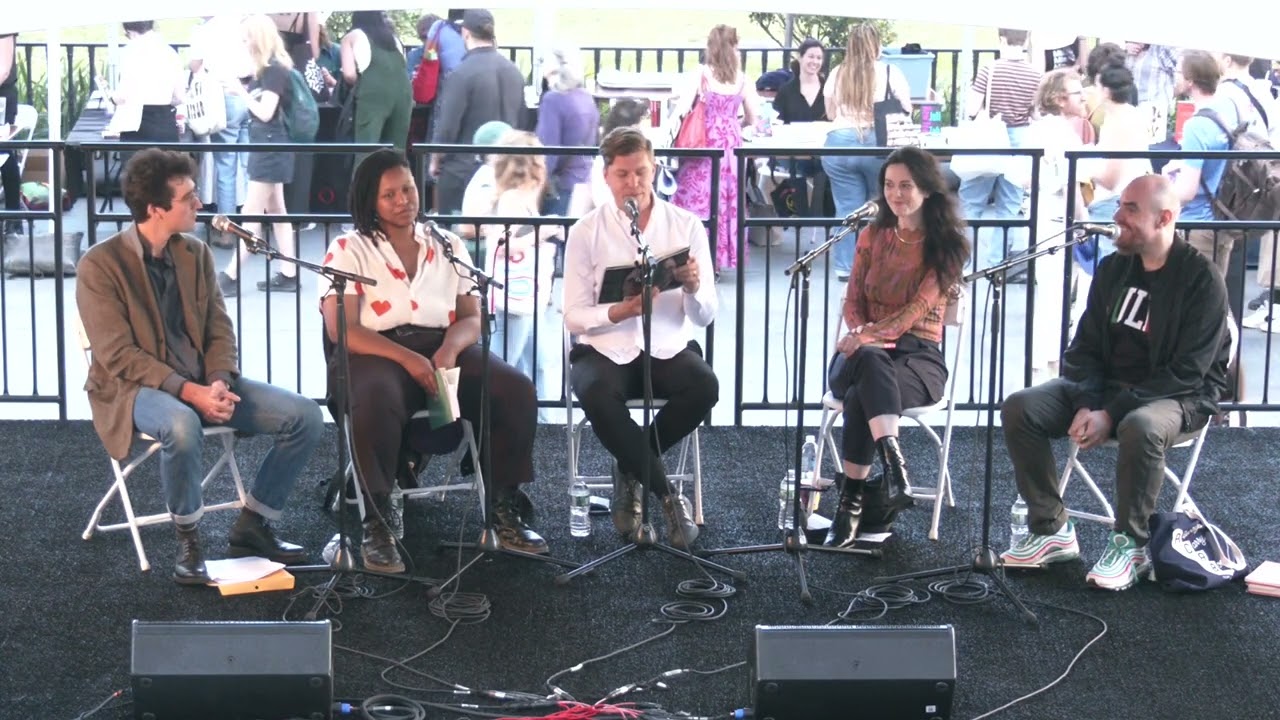
Brooklyn Book Festival- 4 pm- Main Stage-- Poets on Love, Sex & Desire
112
Confessional poetry creates tension between revealing authentic truth and maintaining artistic control. Poets aim to give readers intimate experiences while acknowledging poems are artificial constructions. This contrasts with pre-confessional love poetry designed for seduction with power dynamics between speaker and recipient. The challenge lies in balancing honest disclosure with recognition that all poetic expression involves mediation and construction.
Click to watch →

Craft Talks with David Baker and Vievee Francis
524
The confessional school in American poetry emerged in the late 1950s through the late 1960s, with poets putting themselves at life-altering risk by refusing to hide or hide as much. While the term 'confession' typically means disclosure of something shameful or wrong, many poets feel a distaste for personal disclosure in their work. The key distinction is between poets who avoid personal disclosure and those who reveal themselves in ways that push back against accepted and expected cultural assumptions from the inside or outside.
Click to watch →

Po pierwsze: ostrożnie z wyznawaniem J.Jarniewicz | Artur Hellich | Mistrzowska Szkoła Poezji | 3/40
336
Confessional poetry (poezja konfesyjna) is defined by linguists as a pleonasm because lyrical poetry inherently involves sharing something personal and private with others. The term derives from Latin 'confessio' meaning to confess or declare. Confessional poetry involves sharing intimate, hidden, or difficult-to-express truths, typically including love, painful truths, or faith. The social context requires a listener who evaluates and judges the speaker, creating inherent power dynamics. American confessional poetry emerged in the 1960s with poets like Sylvia Plath and Robert Lowell, who wrote about personal psychological problems, operating on the assumption that only individual, private truths exist rather than universal truths.
Click to watch →
Auto biography by Sally Cline - I M.A., Life Writings( The Arvon Book of Life Writing)
3.9K
Autobiographical poetry emerged in the 20th century, particularly in the 1950s and 1960s. Confessional poets revealed intensely personal emotions including sexuality, illness, depression, and death. Sylvia Plath's 'Ariel' contains autobiographical elements, while Ted Hughes' 'Birthday Letters' represents autobiographical poetry. The term 'confessional poetry' was coined in 1959 by critic ML Rosenthal, who noted that earlier poets showed tendencies toward autobiography but always behind the mask, while Lowell removed that mask to reveal raw personal truths.
Click to watch →
Confessional Poetry: What It Is, And Why It Is Important? Sylvia Plath, Anne Sexton | Chapter 27
14.1K
Confessional poetry is a literary movement that emerged in the 1950s as a reaction against modernist impersonal poetry, where poets began openly confessing about their personal traumas, vulnerabilities, and intimate experiences in their work; Robert Lowell coined the term 'confessional poets' in his collection 'Life Studies,' and major practitioners include Sylvia Plath, Anne Sexton, D. Snodgrass, and John Berryman, whose works such as Plath's 'Ariel' and Sexton's 'Live or Die' explore deeply personal themes of mental illness, marital betrayal, and psychological pain.
Click to watch →
Deep Dive
Analysis of Lowell's transition from the dense, formalist style of 'Lord Weary's Castle' to the loose, conversational free verse of 'Life Studies'.
Robert Lowell: Voices & Visions Documentary Analysis (1988)
25.8K
Robert Lowell (1917-1977), an American poet from a Boston Brahmin family, evolved from writing formally structured, intense poems like Lord Weary's Castle to more conversational, confessional works in Life Studies, demonstrating how personal trauma, mental health struggles, and artistic experimentation shaped his distinctive voice in American poetry.
Click to watch →

Confessional Poetry - Dr. Minu Susan Koshy
124
Robert Lowell (1917-1977) launched the confessional poetry movement with his 1959 collection 'Life Studies,' winning the National Book Award. Suffering from bipolar disorder and troubled family life, he used mixed meter and free verse with colloquial language. His poem 'Walking in the Blue' courageously depicted hospital experiences, stating 'I myself am hell.' Sylvia Plath praised his courage in depicting mental hospital experiences, noting he brought new seriousness to poetry by depicting personal emotional experiences honestly. His work established the template for subsequent confessional poets.
Click to watch →
Major Literary Movements & Literary Groups | One-Shot Revision with PYQs | UGC NET English 🎯
302
The notable members of the Confessional Poets included Robert Lowell, Sylvia Plath, Anne Sexton, and W.D. Snodgrass. Robert Lowell was the founder of Confessional poetry, shifting American poetry from formalism to personal revolution. His major works include 'Life Studies' (1959), 'Lord Weary's Castle' (1946), and 'The Dolphin' (1973).
Click to watch →

Robert Lowell
299
In March 2005, the Academy of American Poets named 'Life Studies' one of the groundbreaking books of the 20th Century, noting its profound impact on the confessional poetry movement. Editors of Contemporary Literary Criticism stated that the book exerted a profound influence on subsequent American poets including other first-generation confessional poets like Sylvia Plath and Anne Sexton. Stanley Kunitz wrote in 1985 that 'Life Studies' was perhaps the most influential book of modern verse since Eliot's 'The Waste Land.' In June 1967, Lowell appeared on the cover of Time magazine as part of a cover story praising him as 'the best American poet of his generation.'
Click to watch →

Marked by Memories: Remembering Robert Lowell
5.1K
Robert Lowell's poetic journey spans from his early work animated by religious convictions to his mature political poetry. His first book, Lord Weary's Castle (1946), drew on Jonathan Edwards' sermons, employing rhetorical authority and grand rhymed couplets. Following manic depressive breakdowns that undermined his religious and aesthetic convictions, Lowell entered a period of silence before publishing Life Studies (1959), his most perfectly realized work. This collection marked a radical departure, exploring personal and political themes with unprecedented candor. His poem 'Fall 1961' captures Cold War anxiety through vivid imagery of nuclear threat and collective paralysis. Lowell's fable translations demonstrate his ability to transform classical forms for contemporary political commentary. A central theme throughout his work is the relationship between greatness and meanness—never writing about one without addressing the other. The exchange of poems with Elizabeth Bishop exemplifies this theme, using small animals to create portraits of each other.
Click to watch →
Deep Dive
Solving UGC NET practice questions and analyzing previous years' papers on mid-20th-century American poetry.
All American Writers in 1 Video | American Literature | NTA UGC NET | Sunaina Jethani
59.5K
T.S. Eliot's 'The Waste Land' is a landmark modernist poem requiring detailed study. Ezra Pound's 'The Cantos' is his magnum opus. Sylvia Plath's 'Ariel' collection contains three essential poems: 'Daddy,' 'Lady Lazarus,' and 'Ariel,' exploring themes of mental illness and female identity. Adrienne Rich and Alice Walker are important contemporary writers whose works have appeared in recent examinations. Students should prioritize studying these authors as they represent significant voices in American literature gaining increasing importance in recent years.
Click to watch →

the best book each year from the past 100 years (according to goodreads)
344.9K
Mid-20th century American literature produced enduring works addressing racial injustice, identity, and social critique. The Great Gatsby defined the Jazz Age. 1984 created terminology entering common language. Invisible Man explored racial identity. Giovanni's Room examined isolation under homophobia. These novels demonstrated literature's capacity to document social conditions while achieving artistic excellence and shaping cultural discourse.
Click to watch →

NTA NET English: MCQs on 20th Century Poetry
2.2K
This video provides a comprehensive quiz-based review of 20th century poetry, covering major movements like Imagism (with Richard Alington's 'Death of a Hero' and 'Images in War'), The Movement (with Philip Larkin's 'Annus Mirabilis' and the 'New Poetry' anthology edited by Alfred Alvarez), and Black Poetry (with Lorna Bennett's 'Colonization in Reverse' and Edward Kamau Brathwaite's 'Nation Language' concept). It also examines key poets including W.H. Auden's 'Funeral Blues' and 'In Memory of W.B. Yeats', Ted Hughes' 'Birthday Letters' about Sylvia Plath, Basil Bunting's 'Brick Flats', and Simon Armitage's postmodern works, while addressing themes of colonialism, diaspora, and language experimentation in the Language School.
Click to watch →

UGC NET DEC 2025 | UGC NET English American Literature Marathon | UGC NET English By Abhay Sir
4.1K
This comprehensive UGC NET English American Literature session covers major authors including Robert Putnam (coined 'Bowling Alone' to describe community erosion), Edgar Allan Poe (Tales of Grotesque and Arabesque, William Wilson), Eugene O'Neill (Pulitzer Prize 1920 for 'Beyond the Horizon'), Tony Kushner (Angels in America), John Steinbeck (The Grapes of Wrath), Emily Dickinson (confessional poetry with dashes), and Walt Whitman (poet of democracy), along with key literary movements like Transcendentalism and Imagism, and frequently asked questions from previous UGC NET papers.
Click to watch →

The Mid-Century (A Short History of American Poetry)
1.3K
The mid-20th century marked a transformative period in American poetry, characterized by the Harlem Renaissance's infusion of jazz rhythms into poetry (exemplified by Langston Hughes's 'Harlem'), the Beat Movement's explicit exploration of American society and mental health (Allen Ginsberg's 'Howl' and 'A Supermarket in California'), and the Confessional poets' raw introspection into personal trauma (Sylvia Plath's 'Daddy'). This era, spanning from the 1940s to 1960s, represented a shift from modernist experimentation toward more direct, emotionally honest poetry that addressed the psychological and cultural challenges of post-war America.
Click to watch →
Lowell's Early Masterpiece
Shift to Confessional Poetry
Lowell's Early Masterpiece
0:01- 1
Explores Robert Lowell's confessional style and thematic evolution.
- 2
Analyzes 'Lord Weary's Castle' for its historical guilt and formal verse.
- 3
Highlights poems on violence, religion, and moral decay.
The Aesthetic and Ethical Critique of the 'Confessional' Label
While Robert Lowell’s 'Life Studies' is celebrated for pioneering confessional poetry, significant critical counterpoints challenge this classification. First, many critics and poets (including Lowell himself) objected to the term 'confessional' because it implies raw, unmediated therapy. They argue this label overlooks the intense craftsmanship, artifice, and fictionalization Lowell employed to construct his poetic personas. Second, an ethical critique—famously articulated by Lowell's close friend Elizabeth Bishop—questions the morality of exploiting the private lives, letters, and traumas of family and friends for artistic output, famously warning that 'art isn't worth that much.' Finally, formalist critics argue that confessionalism risks solipsism, reducing poetry to exhibitionism and committing the 'biographical fallacy' by prioritizing personal therapy over universal aesthetic value. Understanding these critiques helps students see Lowell's work not as mere autobiography, but as a highly contested aesthetic and ethical battleground.
Understanding of the Modernist poetic tradition, particularly T.S. Eliot's theory of impersonality, which Confessional poetry directly reacted against.
A basic definition of 'Confessional Poetry' as a literary movement that focuses on highly personal, autobiographical, and taboo subject matter.
Familiarity with the post-WWII American social and cultural context, including the rise of psychoanalysis and changing views on mental health.
General awareness of the UGC NET English syllabus structure, specifically the weightage of American Literature.
Comparative study of other key Confessional poets such as Sylvia Plath, Anne Sexton, John Berryman, and W.D. Snodgrass.
Close reading and textual analysis of specific major poems by Lowell, such as 'Skunk Hour', 'For the Union Dead', and 'The Quaker Graveyard in Nantucket'.
Critical evaluation of the term 'Confessional' itself, including the debates surrounding its validity and the tension between artifice and raw truth in poetry.
Analysis of Lowell's transition from the dense, formalist style of 'Lord Weary's Castle' to the loose, conversational free verse of 'Life Studies'.
Solving UGC NET practice questions and analyzing previous years' papers on mid-20th-century American poetry.
130 views2likes3:32@TheDiscourseOriginal Release: 2025-07-26
Robert Level and his important works.
Hello and welcome to the discourse.
Robert Level is a towering figure in 20th century American poetry best known for his pioneering confessional poetry, a movement that deeply influenced later poets like Sylvia Pla and Annie Saxton.
His works are marked by intense self-revelation, historical consciousness and a shift from strict formalism to free versificance lies in his stylistic evolution, thematic depth and his role in reshaping modern poetry. Lord Ver's castle published in 1946. A dark vision of history and guilt. Lel's early masterpiece Lord Vir's castle won the Pulitza prize and established his reputation as a major poet. The collection's title alludes to a Scottish ballad Lanin suggesting themes of violence and retribution. The poems are dense, elusive and heavily influenced by metaphysical poetry and new criticism.
Two key poems from this collection, the Quacker Graveyard in Nantket and Koi in Black Rock, exemplify Lel's preoccupation with religious guilt, Puritan legacy, and moral decay. The Quacker graveyard in Nantket, an allergy for his drowned cousin, intertwins Mal's Mobidik with Christian symbolism, contrasting nature's brutality with human violence. Colloqui in Black Rock meanwhile meditates on suffering and redemption through stark religious imagery. These works reflect Lel's early style formal mythic and morally charged about Lanin. Lanin or Lanin also known as long Lanin or Bolakans is a well-known English and Scottish ballad categorized as child ballad number 93.
It tells a gruesome tale of the murder of a woman and her child often within the setting of a castle. The ballad is known for its dramatic and macabra elements.
Life studies published in 1959 the birth of confessional poetry. With life studies ll revolutionized American poetry by turning inward exposing his mental illness, family conflicts and personal breakdowns in raw autobiographical births. This collection is considered the first major work of confessional poetry, breaking away from traditional forms to embrace free verse and intimate subject matter. Waking in blue painfully documents ll's hospitalization or bipolar disorder, while skunk hour, a symbolic portrait of decay and resilience, uses skunks scavenging at night as a metaphor for survival amid despair. The shift from Lord Viri's castle's formalism to life studies conversational style marks a defining moment in literary history influencing generations of poets who sought to blend personal trauma with artistic expression. Legacy and relevance for UGCNET Lel's work is crucial for understanding postwar American poetry the confessional movement and the transition from modernist formalism to postmodern subjectivity. His exploration of mental illness, familial strife and historical consciousness makes his poetry rich for critical analysis.
So this is it for today. We will continue to discuss the history of American English literature. Please stay connected with the discourse. Thanks and regards.
Up Next
57:05
Robert Lowell: Voices & Visions Documentary Analysis (1988)
@AuthorDocumentaries
25.8K views•2021-05-28

13:43
Formalism in Literary Criticism: An Academic Lecture Overview
@mattalberhasky9952
39.1K views•2015-08-05
15:03
Moll Flanders by Daniel Defoe | Characters, Summary, Analysis
@TheDiscourse
16.2K views•2023-07-08

15:25
1984: Orwell's Dystopian World and the Mechanisms of Totalitarianism
@AlternateHistoryHub
7M views•2017-03-04
Related Study Plans & Knowledge Roadmaps
Structured learning paths in Literature
literature
Graphic Memoirs: Visual Art, Trauma & History
01Foundations of Sequential Art and Visual Language
02Autographics and Processing Historical Trauma
03Visualizing Personal Trauma, Grief, and Graphic Medicine
+ 2 more learning modules
14h5 modules
Explore Roadmap
literature
Campus Novels: Evolution, Themes & Critique
01Introduction to the Campus Novel Genre
02Mid-Century Satire and the Post-War Academy
03Dark Academia and the Critique of Privilege
+ 2 more learning modules
14h5 modules
Explore Roadmap
literature
Theater of the Absurd: Philosophy & Plays
01Postwar Existentialism & Historical Roots
02Dismantling Narrative: Esslin & Absurdist Conventions
03Samuel Beckett and Tragicomic Existentialism
+ 2 more learning modules
12h5 modules
Explore Roadmap
literature
Revenge Tragedy: Justice, Madness & State
01Foundations of Early Modern English Theatre
02Anatomy of Revenge: Structural Conventions
03Psychological Complexity: Madness and Melancholy
+ 2 more learning modules
15h5 modules
Explore Roadmap