












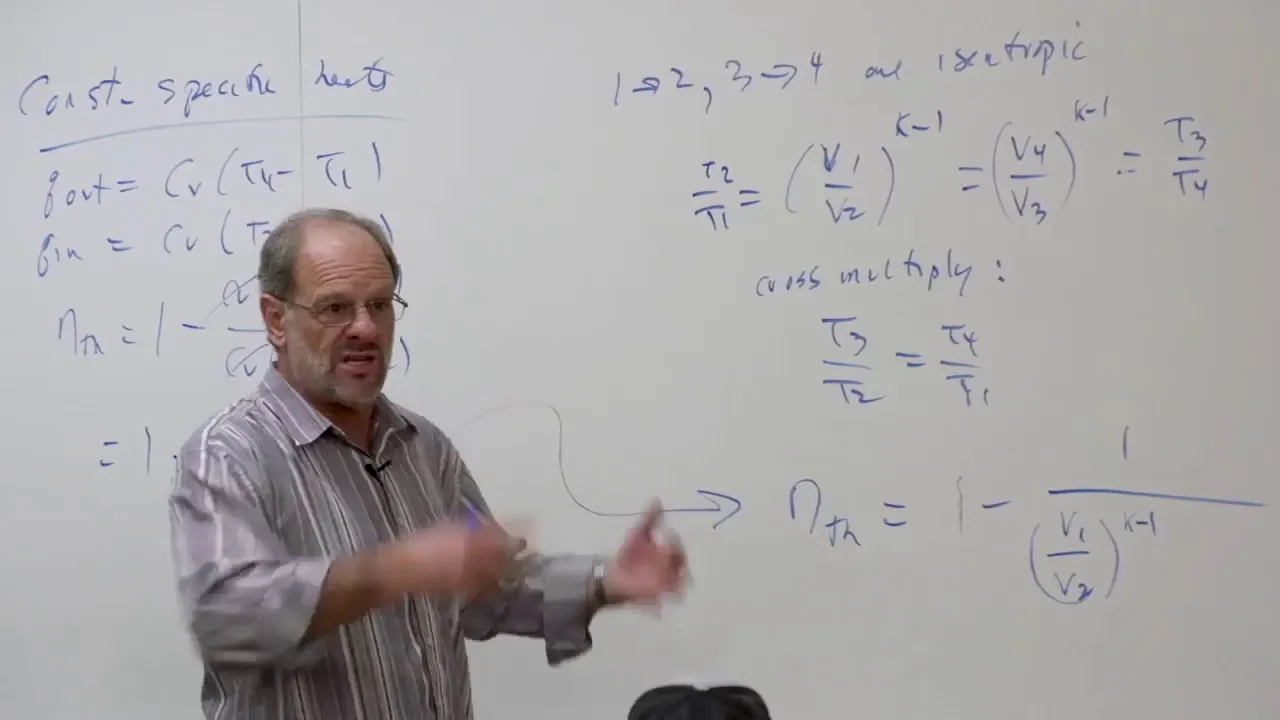








In an adiabatic process, since Q = 0, the first law gives ΔU = -W. For any process, ΔU = nCVΔT, so work can be calculated as W = -nCVΔT. This means that during adiabatic compression (work done on gas, W negative), temperature increases (positive ΔT). During adiabatic expansion (work done by gas, W positive), temperature decreases (negative ΔT).
Thermodynamics PV Diagrams Internal Energy Heat Work Problems Explained
Added:Fundamental definitions of temperature, pressure, volume, and the Ideal Gas Law (PV = nRT).
The basic concepts of work, kinetic energy, potential energy, and the conservation of energy from classical mechanics.
Understanding graphical analysis, specifically how the area under a curve on a coordinate plane represents a physical quantity (basic integration concepts).
The qualitative distinction between heat (thermal energy transfer) and temperature.
The Second Law of Thermodynamics, entropy, and the limits of thermal-to-mechanical energy conversion.
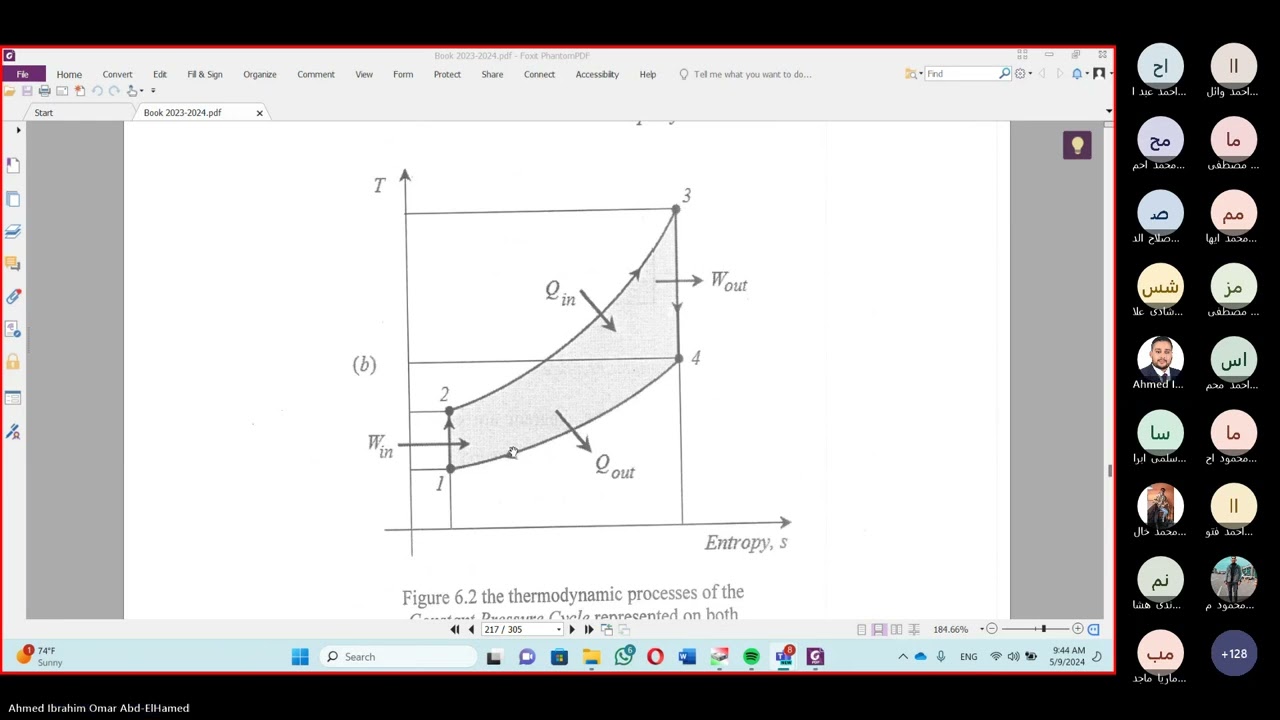
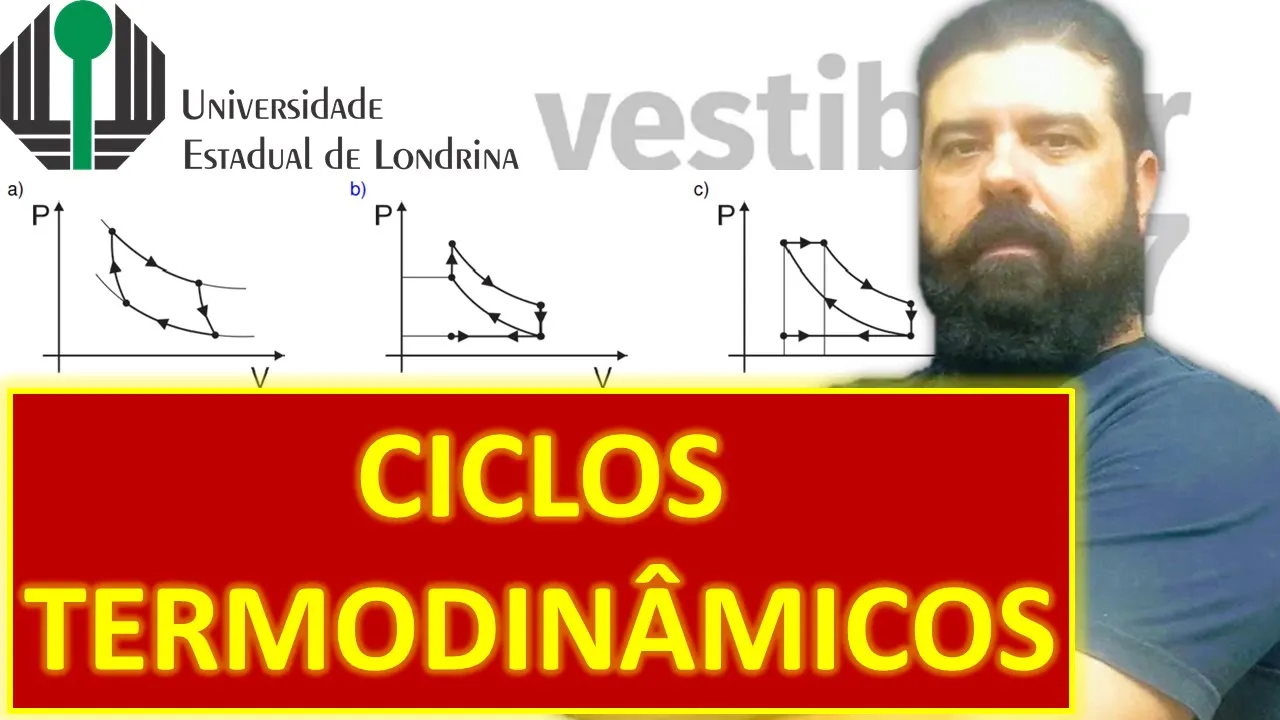
Analysis of complete thermodynamic cycles, such as the Carnot cycle, Otto cycle, and Diesel cycle.
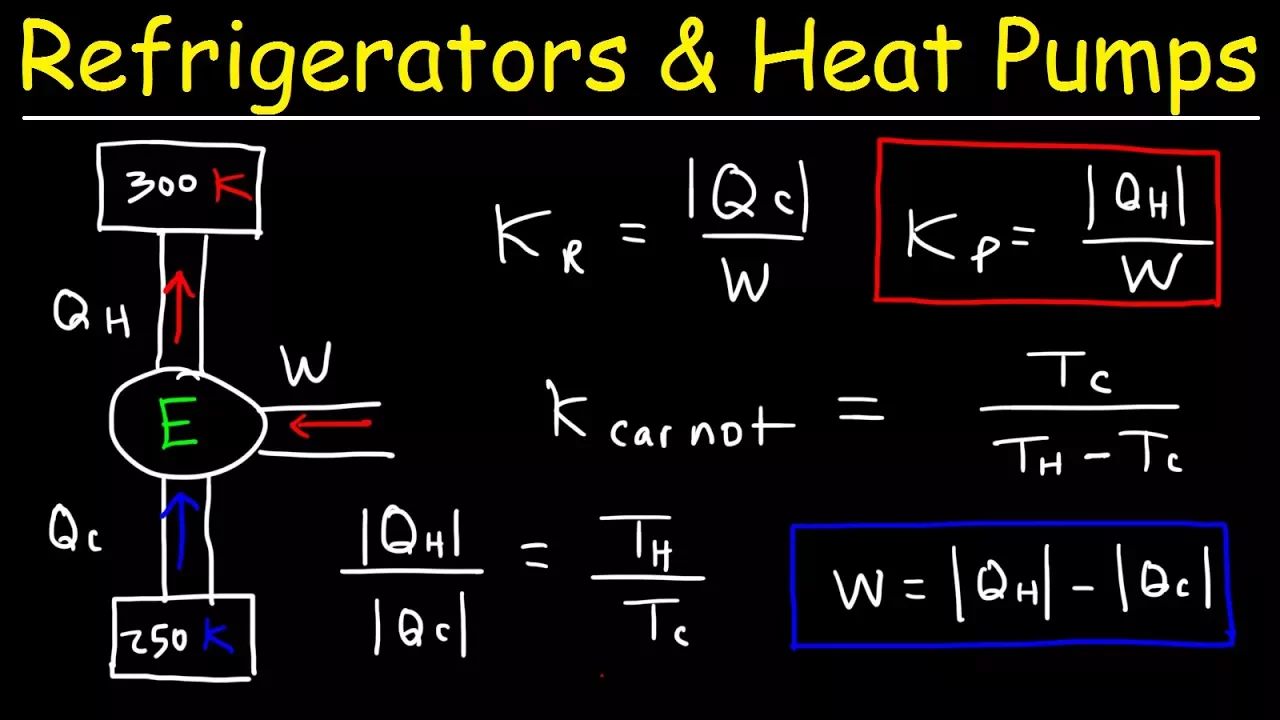
The operation and coefficient of performance (COP) calculations of heat engines, refrigerators, and heat pumps.
Statistical mechanics, which connects macroscopic thermodynamic variables to microscopic molecular behaviors.
2.8M views32.9Klikes2:11Original Release: 2016-12-17
in this video we're going to focus on solving thermodynamic problems particularly problems associated with internal energy heat work isothermal isocoric adiabatic processes and even isobar processes but first let's go over the equations that we need to know let's organize it into a table so on the left side the First Column we're talk about the different types of processes that you need to know and then here we're going to have the equations for work Q which represents the heat flow into or out of the system and also Delta U the change in internal energy so the first process that we're going to talk about is the ISO oric process now for an isocoric process what you need to know is that the change in volume is equal to zero the volume is constant and because the volume is constant the work done for an isocoric process will always be equal to zero now the change in internal energy is equal to Q minus W so therefore since W is zero the change in internal energy will simply be equal to Q to calculate Q you can use this equation it's equal to n * CV * Delta C now if you don't know what these variables mean don't worry just sit back relax take notes throughout the video I'm going to explain how to use these equations and also when to use them I'm going to give you plenty of practice problems for you to work on but you need to know that n represents the number of moles CV is basically the molar heat capacity when the volume is constant of an idal gas and delta T is the change in temperature delta T can be in Kelvin or Celsius anytime you see just T in the equation without the triangle the temperature has to be in kelvin if you see the triangle associated with it it can be in Celsius or kelvin the change in temperature in celsius and Kelvin is the same but when you multiply or divide by T it has to be in kelvin now the next thing that we need to talk about is the isobaric process in an isobaric process the change in pressure is equal to zero the pressure is constant under constant pressure conditions you can calculate the work using this equation it's equal to the pressure times the change in volume by the way you can also calculate the work using this equation NR * delta T we'll talk more about that throughout this video now what about Q for an isobaric process what equation will be useful to us so like the equation above Q is going to be equal to NC delta T but instead of CV it's going to be CP because we're dealing with constant pressure CP is the m heat capacity of a gas measured at constant pressure and then times the change in temperature now Delta U you can always use this equation it's the heat minus the amount of work now another equation that you can use to calculate Delta U for any process is this equation it's ncv delta T keep in mind Delta U is equal to Q for an isocoric process but Delta is always equal to n CV * delta T now the next thing that we need to talk about is an ISO thermal process under this process the temperature is constant so delta T is equal to zero now because the change in temperature is equal to zero notice that Delta U will be equal to zero so under isothermal conditions the change in internal energy is always equal to Zer if that's the case then Q minus W is equal to Z which means that Q is equal to w so how do we calculate the work or the heat exchange in an isothermal process let's see if I can fit this equation in here so one way to do it is to use this equation work is equal to n RT natural log the final volume divided by the initial volume another equation that you can use in terms of pressure keep in mind if you want to find Q it equals this as well but you can also use this equation it's equal to nrt times the natural log the initial pressure divided by the final pressure pressure and volume are inversely related by the way make sure you know the gas laws because with this with these types of problems you can be dealing with gases for example in an isocoric process because the volume is constant if the temperature increases the pressure will increase therefore you can use this equation P1 / T1 is equal to P2 / T2 for an isocoric process now what about an isobaric process where the pressure is constant whenever you increase the temperature at constant pressure the volume has to increase if you've taken chemistry and you've studied the gas laws this is known as Charles's Law whenever you heat a gas the gas will expand now the equation that you need for this type of situation is V1 / T1 is equal to V2 / T2 now there's a lot more equations that we need under isothermal conditions if you increase the pressure the volume will decrease and likewise if you increase the volume the pressure will decrease volume and pressure are inversely related this is known as a boils law so the equation that is associated with Bo's law is P1 V1 is equal to P2 V2 now the last process that we need to go over is the adiabatic process under this process Q is equal to zero so what this means is that no heat flows into or out of the system now this can occur if let's say the process occurs quickly or if it's well insulated because heat takes time to flow from one place to another a process that happens quickly will allow a very small amount of heat to travel through so basically you could say Q is almost zero H I should have put that in this column now because Q is equal to zero that means that the change in internal energy is equal to negative W so let's write that over here so Delta U is equal to W and Delta U is always equal to ncv delta T which means that the work is equal to negative n the number of moles times CV the molar heat capacity at constant volume times the change in temperature now there are some other equations associated with this process and I'm going to add that throughout this video but something that you need to know is that CV for a monoatomic gas is equal to 3 over2 * R and that's true for any of these processes a monoatomic gas is simply a gas that contains one atom for a diatomic gas we'll talk about what to do in those circumstances later make sure you know that CP is equal to 5/2 * R for a monoatomic ideal gas so those are the main equations that you need to know for now there are more equations but we'll go over that throughout the video so what exactly is thermodynamics thermodynamics is basically it's associated with the study of heat mechanical work and internal energy and how these three correlates to each other the first law of thermodynamics is basically uh this equation Delta U is equal to Q minus w u represents the internal energy of a system and it's proportional to temperature Q represents the amount of heat that flows into or out of the system there's basically two ways of transferring energy and that is through heat and mechanical work if you apply a force on a box you can increase its kinetic energy or you add heat to a system the temperature will go up and the kinetic energy of the molecules will increase whenever heat flows into the system Q is positive and Q is negative when heat flows out of the system a positive Q value increases the internal energy of a system because heat is entering into the system a negative Q value will decrease the internal energy of the system the next thing you need to know is the signs for work when work is done by the system W is positive now let's think about that imagine if you're doing work if you're running if you're exercising you're burning energy as you do work your internal energy will go down so whenever the system does work its internal energy decreases so work is done by the system W is negative if work is done on a system that is if the surroundings perform work on a system a good example is if you compress a gas and let's say the system is the gas work is being done on the system the internal energy will increase now if the gas expands then it's doing positive work and so its internal energy decreases now let's work on this particular practice problem for each of these questions make sure you pause the video and work on these problems yourself that's the best way you're going to learn thermodynamics calculate the change in internal energy the system absorbs 300 Jew of heat and performs 500 Jews of work so let's say this box represents the system now 300 jewles of energy enters the system that means the internal energy should go up by 300 and also the system performs 500 jewles of work now because heat is flowing into the system we know Q is positive 300 if work is done by the system that means that the work is positive so using the equation Delta U is equal to Q - W this is going to be 300 - 500 so the change in internal energy is200 Jew now let's make sense of this heat flows from the surroundings into the system and 300 Jews of heat flows into it and the system performs work to do work it has to expend energy so it's to losing 500 Jews of energy so therefore we can see that the net change is 200 it took in 300 jewles as heat and it lost 500 Jews by means of doing work on the surroundings now what about Part B the system absorbs 720 Jew of heat energy and the surroundings perform 300 Jew on a system so is cute positive or negative in this particular example since heat is absorbed Q is positive now what about W is it positive or negative well the surroundings perform 300 Jews of work on a system so work is done on a system and therefore W is negative whenever that's the case so using the equation Delta Al to Q minus W it's going to be 720 minus -300 which is the same as 720 plus 300 and that's equal to 1,20 Jew now what about part C what is w in this problem and what's Q 400 Jew of work is done all on a system so is W positive or negative just like before anytime work is done on a system W is negative now the system loses 225 jewles of heat energy so Q is negative because heat went from the system to the surroundings anytime the system loses heat or releases heat into the surroundings Q is negative so now using this equation it's going to be -225 minus -400 which is the same as -225 + 400 which is positive 175 so the internal energy of the system went up because more work was done on a system compared to the amount of heat energy lost by the system so the system gained a net of 175 jewles of energy now what is the difference between an open system a closed system and an isolated system in an open system matter can enter into and out of the system so let's say like oxygen gas it can flow into the system and out in addition energy can flow into or out of the system so heat can flow into or out of an open system system in a closed system matter cannot enter or leave in a closed system so oxygen gas O2 will not be able to enter however heat can flow into or out of a closed system so in an open system matter and energy can flow into and out of it but in a closed system energy can flow into or out of it but not matter now in an isolated system no energy or matter can flow into or out of an isolated system so because heat can't flow into it Q is equal to zero and no type of energy can enter into the system so that means that there can be no work uh done on a system or by the system so w is zero which means that the internal energy is constant so the change in internal energy of an isolated system is always zero so keep that in mind the equation Delta U is equal to Q minus W typically applies to a closed system where energy can enter into or out of it for an open system you have to take into account the amount of matter that that enters or leave the system but this equation usually applies to a closed system let's try this problem how much work is required to compress a monoatomic ideal gas at a pressure of 2.5 * 10 5 pascals from an initial volume of 015 Cub M to a final volume of 01b M so is this an isocoric process isobaric adiabatic or isothermal process notice that the pressure is constant as a result this is an isobaric process and what exactly is an ideal gas some gases behave almost ideally others do not basically if a gas behaves in a way that fits this equation nicely it behaves it's almost ideally this is the isog gas law equation pressure time volume is equal to the moles of the gas * R * the change in temperature now what about a monoatomic gas what is that exactly the word or the prefix mono means one a monoatomic gas is a gas that contains molecules that have a single atom so noble gases such as helium helium argon neon these are monoatomic gases diatomic gases contain molecules with two atoms the word d is associated with two so oxygen gas nitrogen gas hydrogen gas these are datomic poly means many polyatomic gases have molecules with many atoms sulfur dioxide has a total of three atoms 1 plus 2 is three sulfur trioxide is a polyatomic gas carbon dioxide too these are gases with many atoms now here's another question for you the gas is being compressed do you predict the sign of w to be positive or negative in this case anytime a gas expands the work done by the gas is positive during gas compression the work is done on the gas by the surroundings so therefore the work is negative so our final answer for the first part of this problem should be negative so what equation can we use to calculate the work required to compress this gas now ear in a video I mentioned that for isobaric processes the work is equal to the pressure times the change in volume but let's derive that equation so let's say if we have a gas trapped and it's rectangular solid and let's say this solid has a movable piston and here's the gas now if we apply let's say a force to compress the gas the Piston is going to move a certain distance let's call it Delta D now the work done to apply a force to move any object is simply the force times the displacement and anytime you apply a force over a certain area you're applying a pressure pressure is equal to force / area so if we multiply both sides by a we can see that the pressure times the area is equal to the force so therefore we can replace f with p * a so the work is therefore equal to the pressure times the area times the displacement or the distance that the Piston moves to compress the gas now for a rectangular solid volume is equal to the length time the width time the height and we know that the area of a rectangle is length time width so we can view the volume as being the area times the height and you can think of the height as being the change in the displacement of the Piston so we can say V is equal to a times Delta D so therefore we can replace this term with Delta V so that's how we can come up with the equation work is equal to P * Delta V now let's draw a PV diagram for this isobaric process this is a graph that contains pressure and volume we're going to put pressure on the Y AIS volume on the x- axis so the pressure is at 2.5 * 10 5 pascals and we have two volumes the lower value is 01 and the higher value is 015 cubic meters now because the gas is being compressed we're going to start at the higher value and travel towards the lower value let's call this position a and position B so we're going to travel from A to B it turns out that the area of the PB diagram is equal to the work done on a gas or by the gas so the work is equal to the area now we know that the area is equal to the length times the width the length of this rectangle is basically the pressure and the width of the rectangle is the change in volume It's the final volume minus the initial volume so we can say the width is equal to Delta V the change volume so therefore another way to get the equation for work for this particular PV diagram is equal to the pressure which is L times the width or the change in volume so that's another way in which you can derive this equation from the PV diagram so sometimes you need to use the fact that the work is equal to the change in area it's going to help you to calculate the work um for problems that you'll see later in this video but now let's finish this problem so w is equal to P Delta V for an isobaric process and the pressure is 2.5 * 10 5 pascals the change in volume is the final volume which is 01 minus the initial volume of 015 and units for that is cubic meters now you need to pay attention to the units 1 Pascal * 1 cubic m is equal to one Jewel sometimes you might see the units liters and ATMs 1 lit * 1 atm is equal to 101.3 Jew so you don't need to convert ATM into pascals and liters into cubic meters you can simply multiply these two and convert it once into Jews if you ever get a question like that now for those of you who want to convert ATM into pascals and liters into cubic meters here are the conversion factors that you need to know 1 atm one atmospheric pressure is equal to 1.013 * 10 5 pascals and 1 cubic meter is equal to 1,000 lit so you may or may not need those conversions but you have them now just in case if they ever become important in the future but now let's go back to this problem so if you type this in exactly the way you see it in your calculator you should get 1250w and we could see why it's negative because the gas is compressed by an outside force so now that we have the work done on the gas what is the change in the internal energy of the system now we have the heat and heat is being released by the system so Q is- 350 so we can use the equation Delta U is equal to Q minus W so that's -350 minus -250 or -350 + 1250 so therefore the change in internal energy is positive 900 Jews let's try this problem how much work does a gas perform at a constant pressure of 8.4 ATM as it expands from a volume of 2 L to 4.5 l so under constant pressure conditions we can use this equation once more work is equal to pressure times the change in volume so the pressure is 8.4 atmospheres and the volume changes from final minus initial 4.5 minus 2.0 l so this is equal to 21 L * ATM now typically you want your answer to be in Jews so let's convert it as we mentioned before there's 101.3 Jew per 1 liter * 1 atm notice that because the gas expanded the work done by the gas is positive the final answer is 2,127 jewles 4.5 moles of an ideal gas is heated at constant pressure from 30 C to 150 C calculate the work performed by this gas draw a PB diagram for the process as well so the equation that we can use is this equation work is equal to n * R * delta T now keep in mind PV is equal to nrt this is the idog gas law equation so therefore the pressure times the change in volume must be equal to n r * the change in t so so if work is equal to P Delta V then it's also equal to NR delta T N is the number of moles we have 4.5 moles of an Ido gas R is the energy constant for a gas it's 8.3145 jewles per mole per Kelvin now the temperature difference in Celsius is equal to the temperature difference in kelvin anytime you have a delta T value it can be in kelvin or Celsius the change in temperature 150 minus 30 is 120 so the Kelvin difference is 120 notice that the units will be in Jews so let's multiply these three numbers numers so the final answer for this problem is 4,400 and if you round it 90 jewles now the work is positive because as you heat the gas it will expand according to Charles's Law whenever you increase the temperature of a gas at constant pressure the volume of that gas must increase so now let's draw a PV diagram now that we know the volume is increasing we know which direction in the PV diagram we're moving towards so here's the pressure here's the volume and the current pressure is about we don't know what the current pressure is so let's just call it P0 now we don't know what V1 or V2 is equal to but we can just call it V1 V2 we do know the volume is increasing so if we call this point a and point B at Point a the temperature is 30° C and at point B it's 150 to increase the volume you have to increase the temperature or at least that's one way in which you can increase the volume so imagine if you have a a cylinder with a movable piston and then you have a gas inside which is at 30° C if you add heat to this gas particularly at a slow rate so that the pressure is constant the temperature of the gas will increase and as that happens the vol volume will increase the gas will exert a force that will push up the Piston against the atmospheric pressure and as the volume increases the gas is performing work against the surroundings so anytime you heat up a gas at constant pressure the volume will increase the pressure of a gas inside a rigid 2.4 L cylinder is decreased from 4.8 to 3.4 ATM so how can we accomplish this well let's say if we have a metal rigid cylinder and there's a gas inside let's say the temperature of this gas is 300 Kelvin and at this temperature let's say that the pressure is 4.8 ATM now the volume is constant because we have a rigid cylinder the cylinder has a fixed volume of 2.4 l so therefore this is an isocoric process under constant volume the only way to really decrease the pressure is to decrease the temperature if the air of the surroundings let's say if it's less than 300 Kelvin let's put it at 200 Kelvin heat is going to naturally flow from hot to cold so heat energy is going to leave the gas into the colder surroundings and as that happens the pressure will decrease the relationship between pressure and temperature under constant volume conditions is this this is uh believe it's called gayus sax law temperature and pressure are directly related so we can use this equation to calculate the new pressure or the new temperature uh whichever we need but we don't need to do all of that for this problem whenever you have an isocoric process you need to know that the work is always equal to zero whenever the volume is constant for one thing if you use the equation work equals P Delta V the change in volume is zero so the work has to be zero that's one way you can look at it also if you draw the PV diagram we have a pressure of 4.8 and it's decreasing into 3.4 at a constant volume of 2.4 l so we're going from position a to position B notice that this graph has no area because the area is zero that is the area between this curve and the x axis since there's no area the work is therefore equal to zero so for any isocoric process W is always equal to zero how much heat energy is required to increase the temperature of 7 moles of each of the following gases by 50 kin so first we have helium at a constant volume of 5.4 L perhaps in an earlier chapter you've learned that Q is equal to M cap where m is the mass C is the specific heat capacity and delta T is the temperature Q can also be used in terms of moles it's equal to n c * Delta V where C is the molar heat capacity at constant volume you want to use CV the molar heat capacity measured at a constant volume process and under constant pressure conditions you want to use CP the molar heat capacity at constant pressure now what exactly is CV for helium we see we have an isocoric process the volume is constant but what is is CV for H how can we find it Well the first thing you should do is look it up in your textbook helium has a value of 12.47 Jews per mole per Kelvin now if you don't have this value you can estimate it using this equation CV is approximately equal to 32 * R for a mon Atomic idog gas now let's see how close the answer is going to be or the CV value rather so R is 8.3145 and let's multiply that by 3 and divid by two this is equal to 12.47 2 which is very close to this value so for most monoatomic gases cval 32 R is a good approximation of the actual value so chances are for a question like this you probably won't be given the CV value you just have to know that CV is equal to 3 over2 * R for monatomic gas so now let's use the equation Q is equal to ncv delta T so we have seven moles of gas CV let's use 12.47 and delta T the change in temperature is 50 Kelvin so Q is equal to positive 43645 juw a positive Q value is typically associated with an increase in temperature so the change in temperature is going to be positive when Q is positive now what about Part B at a constant pressure of 9.2 ATM by the way if you have the ch in temperature you really don't need to use the value of the volume or the value of the 9.2 it's only important if you don't know the change in temperature so for Part B Q is going to be equal to n * CP * delt T so what is CP for a monoatomic gas argon is a monoatomic gas it's a gas that is composed of particles that have only one atom N2 is diatomic as two atoms per single molecule now we said that CV is 3 over2 R for a monoatomic gas but CP is going to be 5 over 2 * R the actual value for Argon is about 20.78 and if we take 5 over2 and multiply by 8.3145 this will give us 20.78 which is still pretty close to this number so for monoatomic gases make sure that you know that CP is equal to 5 over2 * R because if you don't have access to a table or if this value is not provided you have to use uh this fact to calculate CP so Q is going to be stimes 20.78 time delta T which is 50 Kelvin so this is positive 7,273 jewles now what about part C where we have a diatomic molecule or part D where we have a molecule with three atoms what can we do so let's review so CV is equal to 3 over2 * R for a monoatomic gas that is a gas basically with one atom in a molecule or in a particle for diatomic gases it's approxim equal to 5 2 * R and nitrogen fits that description now for polyatomic gases with three molecules it turns out that it's approximately 7/2 * R however at this point it begins to deviate so let's use an approximately equal 2 symbol so CO2 would fit this example it has three atoms per molecule now for CP is different CP is 5/2 * R for a monoatomic gas it's 7 over2 * R for a diatomic gas like N2 and it's approximately 9 /2 * R for a gas that has three atoms or triatomic so now let's go back to N2 if you look up in your textbook the values for CP and CV for N2 you'll see that CV is 20.7 6 and CP is 29.7 for N2 at least that's according to the textbook that I have so for diatomic gas who said it's 5 over 2 * R so if you take 8.3145 multiply by 5 and divide by two this is going to give you 20. 786 which we calculated that earlier and as you can see it's not exactly the same but it's still pretty close so for monoatomic gases and diatomic gases you can use these equations to get a good approximation for CP it's 7/2 * R so 8.3145 * 7 / 2 is about 29.1 which is still a good approximation for CP once you start having molecules with three atoms then it begins to deviate but let's finish part C so Q is going to be n times not CP but we're going to use CV since we want to find out how much heat is required to increase the temperature at constant volume so it's going to be 7 * 20.7 time 50 and this is 7,266 jewles now for Part D CO2 let's talk about the values of CV and CP CV for CO2 is about 2846 and CP is equal to 36.9 4 so now if we approximate CV using the equation 7/2 R this is going to be 8.31 4 5 * 7 / 2 and that's 29.1 as you can see there's a slight difference uh between these two values you might be maybe 2% off but it's still pretty close so if you don't have the actual value of CV for CO2 go ahead and use this approximation but if you have it preferably use this one now for CP it's approximately 9 2 * R this will give you delta T so it's 7 * 3694 * the change in temperature of 50 Kelvin and this is equal to 12,000 929 Jew the temperature of a sample of ideal gas increase from 300 Kelvin to 500 kin calculate the change of the internal energy if there were five moles of a monoatomic gas anytime you want to find a change in the Eternal energy of the system you can use this equation Delta U is equal to n CV delta T now keep in mind for a monoatomic ideal gas the CV value is 32 * R so Delta U is equal to n or simply 3 over2 NR delta T for monoatomic idog gas so it's going to be 3 over2 * 5 moles R is 8.3145 and the change in temperature final minus the initial value that's 500 - 300 which is a change of 200 Kelvin and this is going to be equal to 12,472 Jews round it to the nearest whole number now what about Part B for Part B we can use the same equation but for a datomic gas CV is equal to 5/ 2 * R so therefore for datomic gas we have the equation 52 NR delta T and this part n is going to be 8 R is 8.3145 and delta T is still 200 Kelvin so this is equal to 33,258 jewles how much work is required to compress 7.5 moles of an idal gas at 400 Kelvin from 5.2 L to 2.1 l so what type of process do we have and let's begin by sketching a PV diagram notice that the temperature is constant under constant temperature conditions we have an isothermal process and during an isothermal process the change in internal energy is zero so that's the answer for the second part of the problem keep in mind Delta U is always equal to n CV delta T for any process so for an isothermal process delta T is zero which means that that Delta U has to equal zero now just because the temperature is constant doesn't mean q is zero heat can still flow into the system or out of the system it just happens in such a way that the temperature remains constant now during an ISO thermal process as the volume of the gas increases the pressure will decrease now it's not going to decrease like this according to B's law it's going to decrease more like that it's not a straight line it's actually curve but how can we calculate the work required to compress this particular gas so if the gas is being compressed let's say if we're going from position a to position B we're going this way as you travel towards the left of a PV diagram the work done is going to be negative anytime you're compressing a gas W is negative anytime the gas expands W is positive now the work done is going to be equal to the area under the curve so how can we calculate this particular area it doesn't look like a rectangle so we can't use the area equation which is length time width to get the formula that you need you need to use calculus the work required which is the area under the curve is simply the anti-derivative of the pressure function using volume as a differential so it's the anti-derivative of P DV now according to the ideal gas law equation PV is equal to nrt let's get p as a function of v so if we divide both sides by v p is equal to nrt / V so there therefore we have this equation we can now replace p with nrt over V now since the differential is based on the variable V we're going to treat nrt as constants so we can move it in front of the integral so the work is going to be nrt times the anti-derivative of 1 / V DV now for those of you who have taken calculus you know that the anti-derivative of 1 /x is equal to Ln X for those who haven't taken calculus yet just sit back relax and then you'll see the equation that you need in order to solve this problem I'm just going to go over the steps to get that equation so if the anti-derivative of 1 /x is L and X the anti-derivative of 1 over V is going to be the natural log of V evaluated from position a to position B which position a was the initial volume and position B was the final volume so it's going to be nrt we need to plug in these two values the final value minus the initial value so it's nrt Ln V final minus nrt Ln the initial now if you recall from your algebra class or pre-calculus class the natural log of a minus the natural log of B can be Rewritten as Ln a / B so therefore we can combine these two expressions as a single log so the equation that we need for this problem is nrt natural log V final / V initial now let's finish this problem n is the number of moles which is 7.5 R is the energy constant for gases 8.3145 T is the temperature 400 Kelvin and then this is going to be Ln V final which is 2.1 ID V initial and that's 5.2 so in this problem W is 22617 Jew and we can see why it's negative because the gas is being compressed from a high volume to a low volume so that's how you can calculate the work for an isothermal process now what about the heat we know that the internal energy the change and the internal energy is zero but how can we calculate the heat transferred during this process well one equation that you can use is Delta U is equal to Q minus W if we add W to both sides we can see that Q is Delta u+ W and since Delta U is zero Q is equal to W so Q is also 22,6 17 that's how much heat is transferred so basically let's understand what's happening in this situation consider a cylinder with a movable piston and let's say that we have a gas inside now as work is being done on the gas to compress it so work is negative we can see that the volume is decreasing the gas is releasing heat into the environment now this is occurring at such a rate that the temperature remains constant so the energy that's going into the system to compress the gas is leaving the system as heat so 22,00, 66 Jew of work goes into the system to compress the gas so that action increases the internal energy by that amount however heat leaves from the gas and about 22,616 Jew leave the gas at the same time so that decrease es the internal energy so therefore the change in internal energy is zero the amount of energy that is being transferred into the gas by means of the mechanical work is equal to the amount of energy that leaves a gas um by means of heat so the gas gains no internal energy the internal energy remains constant in this particular problem 3.2 moles of an idal gas expands from a pressure of 5 ATM to 1.4 ATM at a constant temperature of 127° is work done by the gas or on the gas anytime a gas expands the work is positive and whenever the work is positive work is done by the gas on the surroundings so now how can we calculate the work for this problem once again the temperature is constant so we have an isothermal process with a PV diagram that looks like this so this time we're traveling towards the right anytime you travel towards the right of a PV diagram the work done is positive now this problem is slightly different from the last one because in the last problem we had two values for volume but here we have two values of pressure so what can we do in this problem well let's start with this equation W is equal to nrt natural log V final / V initial for an isothermal process since temperature is constant whenever you increase the volume the pressure will decrease according to Bo's law P1 V1 is Al to P2 V2 so we could say p initial * V initial is equal to P final * V final now let's divide both sides by V initial and also by pfal if we do that notice what happens V initial cancels on the left side pfal cancels on the right side so therefore P initial / P final is equal to V final / V initial so we can replace V final over V initial with P initial P final so therefore this is the equation that you want to use for this problem so during an isothermal expansion or compression you can use this equation W is equal to nrt Ln P initial / P final so now let's finish the problem n in this problem is 3.2 moles R is still 8.3145 now the temperature has to be in kelvin if you have any equation where you just see T like in pval nrt or this equation it has to be in kelvin but for equations where you would see the term delta T it can be in kelvin or Celsius just keep that in mind so to get the Kelvin temperature we need to add 273 to 127 which is about 400 Kelvin let's multiply that by the natural log of the initial pressure which is 5 ATMs divided by the final pressure of 1.4 for so the work done should be positive and it's done by the gas so the answer to this problem is positive 13, 548 jewles now as you mentioned before for an iso thermal process Delta U is equal to zero and Q is equal to W so therefore the system absorbed 13548 jewles of heat energy and at the same time it used that energy to perform 13548 jewles of work so the energy that entered the system as heat left it by means of mechanical work an ideal monoatomic gas expands from 2.5 L at 300 kin to 8 L at a constant pressure of 3 ATM what is the temperature when the volume is 8 l so let's draw a PB diagram now the first thing you want to do is identify what type of process we have and it turns out that this is an isobaric process since the pressure is constant the volume changes from 2.5 L to 8 lit and the pressure is always at 3 ATM so the work has to be positive since we're traveling towards the right of the PV diagram so we're going from position a to position B at position a the temperature is 300 Kelvin we need to calculate the temperature at position B so how can we do that well we can use this equation V1 / T1 is equal to V2 / T2 under constant pressure conditions this is known as Charles's Law V1 is 2.5 liters T1 the temperature that corresponds to it is 300 Kelvin so we want to find the new temperature at a volume of 8 l so let's cross multiply 300 * 8 is400 and this is going to be equal to 2.5 * T2 so 2400 divided by 2.5 will give us a temperature of 960 K now what about Part B how many moles of gas are present let's use the equation PV is equal to nrt the pressure in this problem is 3 ATM now we can use point a or point B let's focus on point a at Point a the volume is 2.5 L we're looking for n r is going to be 8206 now the R value that you want to use in this equation is dependent on the units of p and v there's two R values that you need to be aware of you've seen this one 8.3145 jewles per mole per Kelvin if you're going to use this r value the pressure has to be in pascals and the volume has to be in cubic meters because 1 Pascal * 1 Cub met is equal to a Jew now the other r value which is the one that we're using 8206 it has the units liters time ATM / moles time Kelvin and since the pressure is in ATM and the volume is in liters this is the r value that we want to use in this equation T at Point a is 300 Kelvin if you use the values at Point V I mean not V but point B you should get the same answer so let's calculate n it's going to be 3 * 2.5 ID 300 and then take that result ID 08 206 so you should get 304 66 moles now let's calculate the work performed by this gas so we can use the equation W is equal to NR delta T so we have n which is 30466 now for R I'm going to use 8.3145 because I want my answer to be in Jews and delta T the change in temperature the final minus the initial temperature that's 660 Kelvin so multiplying these three numbers will give us a value of 1672 jewles so that's how much work is performed by this gas now keep in mind you can also use this equation W is also equal to P Delta V under constant pressure conditions so the pressure is three the change in volume the final minus the initial volume that's 8 minus 2.5 which is uh 5.5 * 3 that's equal to 16.5 L time ATM now you need to convert this to jewels so we need to multiply by 101.3 jewles per liter per ATM and if you do that you should get approximately around 1671 jewles which is pretty close to this answer by the way keep in mind this answer is rounded now how can we calculate the change in the internal energy of the system to do that the equation that we need is Delta U is equal to n CV delta T this is true for any process so make sure you keep this equation in mind so n is still 30466 now we have a monoatomic gas so CV is 3 over2 * R that's 3 over2 * I mean time 8.3145 we want Delta U to be in Jews and the change in temperature is 6 60 kin so this gives us a value of 2500 and8 Jew so that's the change in the internal energy of the system so now how can we answer Part D how much heat energy was transferred well there's different ways in which we can do that so first let's make some space one equation that we can use is the equation that is associated with the first law of thermodynamics Delta U is equal to Q minus W therefore Q is Delta u+ W since we have those two values Delta to U is 258 and W is 1672 so therefore the amount of heat transferred is about 4,180 Jews now this is not the only way in which we can get this answer we can also get it using other equations as well you can use this equation Q is equal to n CP delta T So n is still 30466 CP for a monoatomic gas is 5/ 2 * R and delta T is 660 C so this will also give you 4,180 Jew rounded to the nearest whole number so that's how you can find Q if you have uh the change in internal energy and if you have the work or you can also find it in terms of temperature or you can find it in terms of pressure and volume so let me give you a third equation that might be useful if you don't have the temperature and it's uh Q is equal to P * CP Delta V / R by the way this equation only applies to processes dealing with constant pressure that is isobaric processes and this equation also so applies to isobaric processes so if you have that chart that I gave you earlier it might be good to expand that chart and add these equations to the isobaric uh row I couldn't fit all of the equations that I had on the screen so I'm going over it now so let's plug in the values that we have so P which is constant is 3 ATM and CP that's going to be 5 over 2 * R since we have a monoatomic gas at constant pressure and Delta V is 8 L minus 2.5 so that's a change of positive 5.5 let me uh get rid of something first since this is in the way now I really don't have to plug in the r value because as you can see R will cancel so therefore it's going to be 3 * 2.5 which is 5 over 2 * 5.5 now this answer is in liters times ATM because pressure was in ATM and the volume was in liters so we need to convert it so as of now you should get 41.25 lers time ATM so we need to multiply by 101.3 jewles and if you do that you should get about 4,179 as you can see these answers are very very close so that's how you can calculate the heat transferred in terms of pressure and volume instead of using temperature so you have many different ways in which you can calculate q but now let's talk about how we can derive that equation so it comes from this equation Q is equal to n CP delta T now we know that PV is equal to nrt the ideal gas law equation and in this problem the pressure is constant but the volume is not constant the volume changes so therefore we could say that P Delta V is equal to NR delta T since pressure is constant only volume and temperature is changing so I added a triangle to only that portion of the equation now we need to solve for delta T So P Delta V / NR is equal to delta T so now let's replace Delta t with this value so Q is equal to n * CP * P Delta V / NR so we can cancel n so therefore Q is equal to P the pressure time CP the molar heat capacity at constant pressure times the change in volume / R so keep in mind CP is equal to 5/2 R for a monoatomic gas for a diatomic gas it's 7 over2 R and if you have a gas with three atoms it's going to be 9/ 2 R approximately so you can use that estimation if you don't have the exact value but if you can look up the value in your textbook for that particular gas molecule make sure you use that value because it's more accurate 700 jewles of work was done on an igil gas in imp perfectly insulated container how much heat energy was transferred so first is the work positive or is it negative since work is done on the gas the work is negative 700 Jew Anytime work is done on a gas the gas under go compress ression now what type of process do we have is this an isobaric process isochoric adiabatic or isothermal the key expression here is the gas is contained in a perfectly insulated container so if it has good insulation it's going to be difficult for heat to flow into or out of the system so therefore for Q is equal to zero if heat energy cannot flow into or out of the system Q is zero which means that we have uh an adiabatic process so the answer to part A is zero now what about Part B well Delta U is equal to Q minus W since Q is zero for an adiabatic process Delta U is negative w and W is700 which means Delta U is equal to positive 700 so in an adiabatic process the work performed on a gas goes directly to change its Eternal energy so 700 jewles of work was done on a gas as a result the internal energy went up by 700 Jew now will the temperature increase or decrease well Delta U is proportional to delta T so if Delta U is positive delta T will be positive which means that the temperature will increase so anytime you have an adiabatic compression the temperature will go up and during an adiabatic expansion the temperature will go down so as we compressed the gas adiabatically the net effect was to increase its internal energy and therefore the temperature went up let's work on this one 3 moles of Neon gas expands adiabatically against a piston and the temperature drops from 800 Kelvin to 500 Kelvin what is the change in the internal energy of the system or of the gas to find the change in the internal energy we can use this equation ncv delta T which applies to any process so n is 3 moles now neon is a monoatomic gas so CV is equal to 3 over2 * R so that's 3 over2 * 8.3145 and delta T the change in temperature 500 minus 800 so it drops by 300 kin so delta T is -300 so Delta U is negative 11,225 Jews Part B the amount of heat transferred during any adiabatic process is always zero so in this case Delta U is equal to W which means that W is equal to negative Delta U and if Delta U is 11,225 that means the work done by the gas is positive 11,225 Jew anytime a gas expands the work done by that gas is equal to a positive value let's try this problem we have.5 moles of a datomic gas particularly nitrogen gas and it's placed inside a 5.0 rigid container at a pressure of 2 ATM this gas is heated until it reaches a pressure of 8 ATM so let's begin by drawing a PV diagram so the volume is 5.0 lit the initial pressure is two atmospheres and it increases to eight atmospheres notice that this is an isocoric process the volume is constant since the gas is contained in a fixed rigid 5.0 lit container for an isocoric process to work done by the gas is zero so no work is done in this process so how can we calculate how much heat energy will be absorbed by the gas particularly in terms of pressure and volume an equation that you can use is this one Q is equal to V * CV * Delta P / R the volume is 5 L CV is 20.7 the change in pressure 8 minus 2 so that's an increase of 6 ATM and R is 8.3145 so this gives us a value of 74.9 but V has the units liters P has unit ATM so we need to multiply this number by 101.3 to convert it to jewels so the answer is about 7,500 88w so that's how much heat energy is absorbed in the process and we know that Delta U is Q minus W and since W is zero Delta U is equal to Q in this problem so as a result Delta U is also 7,500 and 88 now we know that Delta U is always equal to this equation ncv delta T so you can also find Q using that equation so n is 0.5 CV is 20.6 the only thing we're missing is delta T which we can find that as we work on Part B I should have kept this so what is the temperature when the pressure is 2 ATM and when the volume is five so how can we find it well let's go back to the ideal gas law equation PV is equal to nrt so at point a the pressure is 2 atmospheres the volume is 5 l n is5 r is 8206 and we could solve for T so it's going to be 2 * 5 which is 10 ID 0.5 which is 20 ID 8 206 so at Point a the temperature is 243.166 do the same for uh part or point B this time the pressure is going to be eight instead of five I mean instead of two so basically if the pressure is increased by a factor of four the temperature should be increased by a factor of four so if we multiply 2 43.7 * 4 it should be about 9748 but that answer is round an answer because I the this answer so let's use the equation 8 * 5 /.5 that's 80 ID 8206 so that's 9749 Kelvin so now we can find the heat transferred using the other equation so delta T is going to be the final temperature which is 9749 Kelvin minus the initial temperature of 243.166 in this particular process is positive 7,000 590 Jew which is very very close to the other answer of 7,588 Jew so as you can see you can find Q if you have the change of temperature using this equation for a constant volume process or if you have the volume and pressure you can use this equation Q is equal to V CV Delta P / R but now let's talk about how we can derive that equation because it really comes from this equation n CV Delta C Now using the ideal gas law equation pval nrt we need to replace Delta t with something now in this problem the volume is constant so the pressure is changing so Delta P * V is equal to NR delta T So solving for delta T it's Delta P * V over NR so let's replace Delta t with this value so it's going to be n CV Delta P * V over NR so Q is equal to the volume times the molar heat capacity measured at constant volume times the change in pressure / R so that's how you can find Q if you have an isocoric process and if you're given the volume and the two different pressure values if you have the change in temperature then it's easier to use this equation and also keep in mind that Q is equal to Delta U for any isocor process since W is equal to0 so make sure you write these down um in your chart so you can organize all of the equations you need for the different types of processes that you'll see on your exam an ideal monoatomic gas is compressed from 12 L to 3 l at a constant pressure of 2.58 heat is added to increase the pressure at constant volume until the temperature reaches its original value calculate the total work done by the gas and the total heat flow into the gas and also draw a PV diagram so let's do that first so we're starting at high volume a volume of 12 L and the volume is decreased into 3 l at a pressure of 2.5 ATM so we're going this way let's call this position a position B so that's an isobaric process now heat is added if heat is added the temperature will increase and the pressure will increase as as well and this occurs at constant volume so that's an isocoric process so we need to go up in the PV diagram and then the temperature will reach its original value calculate the total work done by the gas and the total heat flow into the gas let's call this position C so what can we do in this problem how can we figure out the answer well we need to calculate the work done as we travel from position a to position C so let's find it from A to B so that's an isobaric process so we can use the equation P Delta V the pressure is 2.5 ATM and the change in volume the final minus initial that's 3 - 12 and then we need to multiply it by 101.3 to convert it to Jews so this is 2.5 * 9 * 101.3 so the work done from A to B is 2279 JW now what about the work done from B to C from B to C that's an isocoric process volume is constant and the work is always zero therefore the work done from a to c is the sum total of these two values which is just - 2279 Jew now what about going from a to c notice that this is an isothermal path the key expression is the temperature the temperature remains at the same value it reaches its original value so whatever the temperature was at Point a is the same as Point C and for an isothermal uh graph or process Delta U is equal to zero so from a to c the fact that Delta U is equal to zero which means that Q is equal to w q is w+ Delta u based on this equation if you rearrange it so if Delta U is z q is equal to W which is - 2279 now let's see if there's another way we can get the same answer by calculating Q through the individual paths so we need to get - 2279 uh during this other technique or other method so first let's assign the temperature value to point a let's say the temperature is 1,000 Kelvin now notice the volume decreased from 12 to 3 l whenever the volume decreases the temperature decreases as well if the pressure is held constant the volume decreases by a factor of four if you divide 12 by 4 you should get three likewise if we divide 1,000 Kelvin by 4 it should give us a temperature of 250 Kelvin so that's going to be the relative temperature at point B if point a is 1,000 Kelvin now at Point C the temperature is 1,000 Kelvin because it's back to its original value but going from B to C the temperature increases by factor four which means the pressure must increase by factor four at constant volume if you raise the temperature the pressure will increase so 2.5 * 4 is 10 ATM now how can we calculate Q in the isobaric process from A to B there's two equations that you can use you can use this one Q is equal to n CP * delta T during a constant uh pressure or an isobaric process or we can use the other equation Q is equal to P CP Delta V / R ideally we want to use this equation because we have the pressure and the change in volume we don't have the moles we do have the temperature but if we are going to use the first one we need to find n which we could do using equation PV equals nrt we could find it at any points uh point a b or c but we don't have to do that so let's use this equation so Q is going to equal p which is 2.58m time CP and this is a monoatomic gas so therefore CP is going to be 5 over 2 * R CV is 3 over2 * r Delta V the change in volume final minus initial is 3 - 12 and then divid R and don't forget you need to multiply this value by 101.3 to convert it to Jews so it's 2.5 * 5 / 2 * 9 you should get 56.25 and then multiply that by 101.3 so Q from A to B is equal to 5,698 Jew now what about from B to C how can we calculate Q so from B to C you can use this equation Q is equal to n CV Delta C since the volume is solid constant or we can use this equation V CV Delta P / R let's go ahead and use that one so V is 3 l from position B to C it's a constant 3 l and CV that's 3/ 2 * R and Delta P the change in pressure final minus the initial value 10 - 2.5 that's a change of 7.5 / R and then multiplied by 101.3 to convert it back to jewels so it's 3 * 3 / 2 * 7.5 that's 33.75 * 101.3 so this is equal to 3,400 18.9 now to calculate the total heat which we said was - 2279 Jew we could simply add the heat absorbed or released by processes A to B and B to C so if we take 5,698 and add it to 341 18.9 this will give you -22 79 Jew which is the same answer that we had before but now you know how to calculate the heat energy absorbed or released during an isobaric process and an isocoric process how much work is performed by the gas as the system moves in a cyclic path A to B to C to D to a well a simple way to find the work is to calculate the area that is the area of the Shaded region so we have the shape of a rectangle and the area is simply the length times the width the length of the rectangle as you can see is the change in pressure and the width of the rectangle is the change in volume the change in pressure is the difference between 1 and 8 atmospheres so that's seven and the change in volume 6 - 2 so that's 4 and we need to convert it to Jews so we're going to multiplied by 101.3 Jew per liter per atmosphere so the work perform is 2,8 36.4 Jew now this answer is it positive or is it negative what would you say it turns out that if you're traveling in the clockwise Direction the work done is positive now if you travel in let's say the counterclockwise Direction the work done is going to be negative now let's prove that first we need to prove this answer to do that let's calculate the work perform in each step so let's start with the first step that is from A to B so that's an isobaric process so we can use the equation work is equal to P Delta V and anytime you go to the right the work done is positive so the pressure is 8 the final volume is 6us 2 so that's uh 8 * 4 which is 32 * 101.3 so the work done from A to B is positive 3,2 41.6 now the work done going from B to C that's an isocoric process and as a result the work is zero so from B to C and D to a the work is zero so now we need to calculate the work going from C to D so the pressure is now One D is the final position C is the initial position so it's going to be 2 - 6 so that's -4 * 101.3 and that's equal to - 45.2 Jew so if we add these two values 32 41.6 + - 45.2 this is going to be equal to 28 36.4 and if you go in the reverse Direction the numbers will be reversed instead of this value being 2 - 6 it's going to be 6 - 2 so this is going to be positive 405 and this will be - 32 41.6 you can try but going in the counterclockwise Direction the work will be negative 28 36.4 that's the answer to the second part of the problem but for the first part of the problem traveling in the clockwise Direction the work done is positive now if you want to understand why that's the case keep in mind anytime you travel towards the right the work is positive and if you travel towards the left in the PV diagram the work is negative as you travel towards the right notice that the pressure is higher and therefore the work done by the gas is going to be higher as you travel towards the left the pressure is lower it's one and so the negative work performed by the gas is going to be lower so the net work done is positive because the higher side is moving towards the right if you mooving towards the left at the higher pressure then the overall work is going to be negative the work is determined by the direction of the system at high pressure because at high pressure that's where most of the work will be accomplished go ahead take a minute pause the video try this problem and then unpause it when you want to see the solution so let's begin by drawing a PV diagram now the volume of a gas increases from 3 l to 9 L and it occurs at a constant pressure of 4 ATM which is lower than 10 so we're traveling in this direction let's call this position a and position b or state a and state B next heat is added to increase the pressure to 10 ATM so that's an isocore process finally heat is removed to decrease the pressure and volume back to its original values that is at three and four and it's going to travel back to the original um state in a straight line path so calculate the total work done in this process to find the answer we got to calculate the area under the curve and this is the area of a triangle so it's going to be 1 12 base time height the base of the triangle is the change in volume and the height of the triangle is the change in pressure so the change in volume is going to be equal to 6 L and the change in pressure is 10- 4 so that's a difference of six * 101.3 to convert it to Jews so 6 * 6 is 36 half of that is 18 so the work done is going to be 1,823 point4 jewles now here's a question for you is the work done positive or negative so notice the direction that we're traveling in that is the system is rotating in the counterclockwise Direction which means that work in this process is negative if it's moving in a cyclic clockwise Direction the work should be positive but now let's see if we can get this answer by calculating the work done in each individual step so let's start from A to B that's an isobaric process so we can use the equation P Delta V the pressure is four at this point the change in volume final minus initial 9 - 3 that's 6 * 101.3 so 24 * 101.3 gives us a value of 2431.2 and the work done is positive now between B and C that's an isocor process so the work done for that region is zero let's see if I can fit it here now what about in this section going from C to a how much work is performed by the gas and taking that route it turns out that you can use this equation to get the answer but you have to use it in a certain way notice that the pressure is not constant it changes from 10 to 4 so what value of P should you plug in to this equation to make it work it turns out that if the pressure increases at a constant linear rate you can use the average pressure so the equation for the path to to calculate the work from C to a it's going to be 12 P initial plus P final * Delta V to find the average of these two numbers you need to add them up and divide by two so the average pressure is the initial and the final pressure is the sum of the two values ID two or half of the sum so using that equation 10 + 4 is 14 half of that is seven so the work is going to be the average pressure of seven time the change in volume final minus initial so 3 - 9 which is -6 * 101.3 so -42 * 101.3 gives us a value of negative 42546 now the reason why it's negative is because we're traveling towards the left of the PV diagram here it's positive because we're going towards the right of the PV diagram now in terms of the magnitude of these two values the one at the top is greater because the average pressure is higher than the pressure at the bottom which is four so keep in mind the direction of the system at high pressure determines the overall sign of the work done for this entire cyclic process that's why the overall work done is negative because at the top is moving towards left now let's add these two values so -42 54.6 + 24 31.2 gives you this answer 8 23.4 which of the following is not a state function pressure internal energy work temperature volume which one it turns out that work is not a state function pressure internal energy everything else is a state function let's say if we have a PB diagram and let's say we have three points point A B and C the work that's required to go from a to c by means of B it's going to be different than the work required to go from a to c it's not going to be the same let's say a to c is an isothermal path however the change in internal energy going from ABC or AC directly is going to be the same it may not be zero but it's going to be the same the change in internal energy does not depend on the path it depends on the state as long as you go from a to c regardless if you pass through this path or this path the change in internal energy is the same which means it's a state function the work will not be the same the work depends on the path that you take if you go from a to c by taking this route the work is different than if you take this route because the area on the curve is different also heat is not a state function now pressure temperature and volume they will be the same regardless of the path taken if I take the path A to B to C the pressure at C will still be the same let's say it's two atmospheres if I go from a to c at C the pressure would still be two atmospheres so as you can see the pressure is a state function it depends on the initial and final States just like internal energy it doesn't depend on the path taken whereas work and heat which are forms of energy transfer they depend on the path taken and so work and heat are not State functions let's try this problem so let's focus on path a to d to C which is this path and we're given the amount of heat that flows into the system so because heat is absorbed by the system Q is positive and we're told that 45 Jew of work is done by the system whenever the system does work or performs work the work done is positive now in path a BC the work performed by the gas is 30 Jew how much heat energy is absorbed in path ABC to answer this question it's important to realize that internal energy is a state function the change in the internal energy and going from ABC or ADC is the same so if we could find Delta U for this path we can use it to find Q in path ABC Delta U is equal to Q - W so that's 125 - 45 which is 80 so we can use this value for path ABC solving for Q Q is Delta U plus W so that's 30 + 80 so 110 Jew of heat energy was absorbed in path ABC now what about the next part when a system returns from C to a along the Curve Earth path that's the path in the middle 38 Jew of energy is transferred by work now this energy transfer is it positive or is it negative anytime a gas is compressed or if you travel towards the left of a PV diagram the work done is negative as you travel towards the right the work done will be positive so this is4 5 now in order to find q that is the amount of heat energy transferred during this process we need to find Delta U so how can we do it well we know that going from A to B to C Delta U is positive 80 going back from C to B to a it's going to be negative 80 because the internal energy is a state function it really doesn't matter the path that you take take as long as you get from a to c it's POS 80 so going back to C to a it's 80 it's also 80 if we take the curve path the change in the internal energy of a system is independent of the path taken so Delta U going from C to a is going to be 80 instead of positive 80 so now we could find Q which is Delta U + W so that's uh80 Plus 45 actually that's not supposed to be 45 it's supposed to be 38 I guess I was looking at this number but going from C to a 38 Jews of energy is transferred by work so this is 38 so if we add these two numbers this is going to be -118 so that's how much heat energy is transferred now because Q is negative that means that heat was released during this process as a system went from C to a now what about the next part if UA is equal to Z and U is equal to 20 how much heat energy is absorbed in paths ab and BC well first let's find the internal energy at path c as you mentioned before going going from A to B to C the change in the internal energy is 80 so if a is zero C is 80 Jew higher than a so at C the internal energy is 80 so with that information we can calculate Q now the work done for any isocoric process which is B to C or a to d is zero so let's uh make some space so w is equal to zero and it's equal to zero on this side as well now the work going from ad DC is 45 so that's here to here so if a to D is already Zero D to C must be 45 5 the work done from a to d plus the work done from D to C is equal to work done from a to d to C so this is zero this is 45 this other value must be 45 now what about the work done from A to B we know the work done from A to B plus that for B to C is equal to work done for A to B to C now this is zero so these two must be equal to each other so therefore the work done from A to B is 30 so now that we have these values we can calculate Q so focusing on path a q is equal to Delta u+ w Delta U is the difference between these two values UA is zero U is 20 so the change going from a 2B is positive 20 going from B to a must be negative - 20 and W is 30 so that means Q AB is equal to postive 50 Jew now what about from or path B to C and path B to C W is zero but going from B to C the change in the internal energy is positive 60 it changes from 20 to 80 so final minus initial 80us 20 is 60 so Q is 60 therefore QBC is equal to positive 60 and this is in line with qabc which is 50 + 60 which is 110 and as we can see these two are equal to each other now what about the last part of the problem if UD is equal to 30 how much heat is transferred in paths a and DC so let's put 30 here now let's focus on ad so Q is Delta U + w so if we add Z Plus the change which is 30 we can see that q a d is equal to POS 30 now what about Q DC what's the answer for that well notice that the change in the internal energy going from D to C it increases by 50 80 minus 30 is 50 and the work done going from D to C is positive 45 so Q is Delta u+ W so 50 + 45 that's equal to positive 95 now if we add 30 and 95 it should give us the total of 125 which it does so everything is balanced so to speak the PV diagram shown below applies to 2.1 moles of an ideal diatomic gas calculate the temperature at all points now we need to use the equation PV is equal to nrt at least for the first point and then we can easily find the other points now notice that the volume is in cubic met 1 Cub met is equal to 1,000 l so to convert these values into lers multiply by th000 so this is basically 10 L and this is equivalent to 50 L now let's calculate the temperature at Point a since that temperature is going to be the lowest temperature the temperature increases whenever you move in this general direction the temperature increases as you go towards the right in the P diagram and it increases as you go up in a PV diagram so using this equation at Point a the pressure is five atmospheres the volume is 10 L we have uh 2.1 moles R is 8206 and we're looking for T So 5 * 10 is 50 / 2.1 and then take that result divided by 8206 so the temperature at Point a is 290 Kelvin now what about the temperature at Point D notice that the volume increases from 10 L to 50 L if you increase the temperature at constant pressure the volume will increase proportionally so the volume increased by a factor of five which means the temperature should also increase by a factor of 5 290 * 5 is equal to 1450 Kelvin now if you want to you can use the PV equals nrt equation to get that answer if you plug in a pressure of 5 a volume of 50 and 2.1 for n and the same r value 5 * 50 is 250 ID 2.1 that's 19 19 divide that by 8206 and you get about 1450 Kelvin now it's really close to 1451 it's 14.7 because this answer was rounded so I'm going to leave it as 1450 I'm going to round it to a nice whole number so this answer is an estimate so to speak now what about the temperature at point B notice that the pressure increases from 5 to 40 going from A to B so 40 / 5 is 8 so the pressure increases by a factor of eight at constant volume if you increase the temperature the pressure will increase proportionately that means that we have to increase this value by factor of a two 90 * 8 is equal to 2320 Kelvin now going from D to C the pressure increases by a factor of eight so we can multiply 1450 by 8 and that will give us 11,600 Kelvin or we can go from uh B to C where the volume increases by a factor of five so 2320 * 5 will also give you 11600 so now what about Part B how can we calculate the heat transferred and paths AB b c c d and da well let's start with AB there's many different equations that we can use but the first thing that we need to realize is this is an isocoric process the volume is constant so we can use this equation n CV delta T So n is 2.1 CV for an ideal datomic gas is 5/2 * R and the change in temperature going from A to B it's a final minus initial so that's 2320 - 290 so this is going to be about 88,500 round into three6 fix now what about Q BC here we have an isobaric process so we can use the equation n CP delta T now the CP value for a diatomic gas is going to be 7 /2 * R and going from B to C the final temperature is 11,600 minus the initial temperature of 2320 so this is going to be about 567,000 so let me take a minute and just clear away a few things in the meantime go ahead and calculate the other two Q values now let's calculate Q CD this time let's use a different equation we have another isocoric process but instead of using the ncv delta T equation let's use V CV Delta P / R the volume is 50 L CV for datomic gas is 52 * R the change in pressure is -35 and we can cancel R and let's not forget to multiply by 101.3 so this is going to be negative 443,000 Jew I'm in each answer to three Sig fix now what about the last part Q da so going from D to a how can we calculate it so let's use this equation since we have a isobaric process the pressure is constant so let's use the equation P CP Delta V / R so the pressure is 5 ATM CP is 7/2 * R and the change in volume final minus initial 10 - 50 is -40 so we can cancel R so as you can see whenever you go up and to the right Q is positive when you go down and towards the left Q is negative and you can tell by the change in temperature to increase the temperature typically you have to put heat into the system and to decrease the temperature from 11,000 to 1450 you have to remove heat from the system so now let's calculate this value so five * 3.5 * -4 * 101.3 this is about - 70,000 and 900 Jew so now that we have the Q values for each step let's calculate the net Q value for the cyclic process so as we travel from position A to B B to C C to d d to a let's find the net amount of heat energy absorbed or released into the system so we just got to add these four values 88600 + 567,000 - 443,000 - 7,900 this is equal to positive 141,000 now what is the work done in a cyclic process we know the work done is equal to the area of the Shaded region and since we have a rectangle it's basically the length times the width the length is basically the change in pressure the width is the change in volume the change in pressure is 35 if you subtract 40 minus 5 and the change in volume 50 l - 10 L that's 40 L multiplied 101.3 to converted to jewels and this will give you about 141,000 820 but let's round these values to approximately 142,000 it's about the same if we keep it to three sigfigs as we've been doing for each of these problems now BAS on rounding errors there's going to be some slight differences but theoretically these two should be equal which they are now let's think about what this means we see that q and W are the same the question is why now we started at position a we went all around the rectangle and we ended back at position a so going from a to a the internal energy is is the same there's no change therefore Delta U is equal to zero for any cyclic process and if Delta U is equal to zero and we know that Q is Delta u+ W therefore Q is equal to a W for any cyclic process and that's why we can see they're the same the area is not only equal to the work done but also it's equal to Q because it's a cyclic process now let's talk about something else but first let's get rid of a few things what is the total amount of heat energy that went into the system let's say if this block represents the system if we add these two values we're going to get how much heat energy flowed into the system and that's about 65,66 Jew of energy went into the system this is also known as qh now how much heat energy went out of the system that's basically these values because they're negative if we add them this is going to be negative or just simply 53,9 this is also known as a ql that's the amount of heat energy lost to the environment qh is the amount of heat energy that enters into the system the work is the difference between these two values 655,000 minus 53,9 is equal to approximately 142,000 if you round it so that's how much energy that came from heat and that was transferred into mechanical work now let's calculate the efficiency of the system the efficiency is basically the output work divided by the total heat energy that went into the system that is qh time 100% so that's going to be 142,000 ided by the 65,66 times 100% so the efficiency is 21.7% so what this means is that this particular system can take 21.7% of the heat energy that is transferred to it and convert that heat energy into useful mechanical work the other 78.3% is lost to the environment which is a lot of energy that's lost so these um devices are not very efficient but nevertheless you can still use it to perform useful mechanical work ethane gas has a gam ratio of 1.22 what is the molar heat capacity of ethane at constant volume and not constant pressure so how can we uh find CP and CV given this gamma ratio gamma is CP / CV it's the ratio of these two different M he capacities and we know that CP is equal to 5 over 2 R that's basically uh the same as 2.5r and CV is 3 over2 R for U monatomic gas that's 1.5 R now 2.5r is equal to 1.5 r + 1 R 1.5 + 1 is 2.5 so therefore we can say that CP is equal to CV plus r so using uh this relationship which is very accurate for ideal gases we could say that gamma is equal to CV + r / CV so basically we replace CP with CV plus r and we could separate this into two uh fractions we could divide CV by itself and R by CV which means that uh gamma is 1 + r divided by uh CV so let's subtract one from both sides if we do that we're going to get this and if we this is the same as gamma minus one over one if we flip both sides this is 1 over gamma minus 1 is equal to CV / R and now if we multiply both sides by R we can see that CV is equal to R over gamma minus one so this is how you could find CV from gamma using that equation now there's one more equation that we can write so keep we said that gamma is CP / CV so if we let's move this this way if we multiply both sides by CV CP is gamma time CV and CV is equal to that equation so CP is R * gamma over gamma minus one so this is another useful equation so with these two equations we can find CP and CV if we're given the gamma ratio for a gas so let's calculate CV that's going to be uh 8.3145 divid by 1.22 - one 1.22 -1 is simply 22 on the bottom so 8.3145 /22 gives us a CV value of 37.8 so that's the first answer that's the molar heat capacity at constant volume now at constant pressure we can uh take R which is 8.3145 multiply by gamma / gamma minus one so 8.3145 * 1.22 id22 is 46.1 so that's the M capacity at constant pressure so that's how you can find it given the gamma ratio here's another problem that we could try how much heat is required to raise the temperature of 6.3 moles of propane from 30 C to 50 c at a constant pressure of 2 ATM and we're given the gamma ratio well to find Q at constant pressure we can use the equation Q is equal to n CP delta T so we got to find CP first and we can use the equation that we got um in the last problem which is uh R * gamma over gamma minus one so that's 8.3145 Times 1.27 divid by 1.27 minus1 which on the bottom is 0.127 so 8.3145 * 1.27 /.27 is about 73 78 so using this we can now calculate Q so Q is going to be equal to n the number of moles which is 6.5 time CP which is 73.7 times the change in temperature final minus initial 50 minus 30 that's uh 20 so 73.7 * 6.5 * 20 is equal to 9,5 91.4 jewles so that's the aners to the first part of the problem now for the second part what is the change in the internal energy of the gas to find the change in internal energy we can use Q minus W but we don't know the work so we can also use uh n CV delta T which is true for any process so we got to find CV um before we can use that equation so let's uh go ahead and do that and we know that CV is equal to R / gamma minus one so that's 8.3145 / 1.27 minus 1 so 8.3145 divid 0.127 is around 6547 so Delta U is going to equal to the number of moles 6.5 time CV time delta T which is still 20 so 6.5 * 6547 * 20 is equal to 8,500 11.1 Jew and that's it for this problem now here's a question for you let's say if you have a PV diagram with three isothermal graphs which looks like this let's say the first one is graph a this is B and this is C and there's three temperature values 300 Kelvin 400 Kelvin and 500 Kelvin so with this information which graph is which one which one occurs at which temperature let's say we have pressure on the y- AIS volume on the x- axis if you ever see a question like this you need to know that the temperature increases as you go up in this general direction whenever you go to the right the temperature increases because the volume increases at constant pressure according to Charles law when you increase the temperature the volume goes up and when you go up the increase in temperature causes an increase in pressure at constant volume at constant volume when you increase the temperature the pressure goes up so therefore C is at the highest temperature that is at 500 Kelvin a is at the lowest temperature of 300 K which means B is in the middle at 400 kin so anytime you go in this general direction C the temperature increases make sure you understand that for PV diagrams now let's spend some time talking about the graph of an adiabatic expansion and let's see how it differs from an isothermal expansion so let's say this is an ISO thermal expansion from A to B keep in mind for isothermal graphs or any isothermal process delta T is equal to zero the change in temperature is zero so the temperature remains constant now for an adiabatic expansion it looks very similar but notice that the curve is lower so a to c is anotic expansion and for that Q is equal to zero no heat enters or leaves the system but notice that the temperature drops so this is let's call this a d arotic expansion this is the isothermal graph so for adiabatic expansion when the volume increases the pressure decreases but it happens in such a way that the temperature drops for isothermal graph when the volume goes up the pressure goes down but because the temperature is constant for an ismal graph you can use the equation P1 V1 is equal to P2 V2 now because the temperature changes in the adiabatic expansion because it cools down you need to use the variant of this equation the equation that you need to use is uh P1 V1 raised to to the gamma power is equal to P2 V2 raised to the gamma power so as you can see it looks like that equation but slightly different and there's also another equation that you need to know it's T1 V1 raised to the gamma minus one which is equal to T2 V2 rais to gamma minus one we can talk about how to derive this equation later well let's work on a problem using those equations a car engine takes in air at 25° C and 1 atm and compresses it adiabatically to 0.1 times the original volume the air has a gamma ratio of 1.4 what is the final temperature and pressure so we know that the temperature decreases during adiabatic uh expansion but during adiabatic compression increases and if you decrease the volume the pressure will go up and it turns out the temperature will go up as well so let's work out this problem let's begin by using equation P1 V1 raised to the gamma value is equal to P2 V2 raised to gamma now let's make a list of the information that we have T1 is 25 cels and if you add 273 to it that's going to equal 298 Kelvin now we don't know what T2 is equal to we know that P1 is 1 atm and we don't have the value for P2 we need to find that as well we don't know what V1 or V2 is equal to however we do know the ratio it's 0.1 so let's say if V1 is one liter that means V2 is going to be 0.1 time that.1 L it really doesn't matter the the actual values of V1 and V2 the relative values is what matters if V1 was 10 L V2 would be 10 *.1 which is 1 so regardless if you use 1 in 0.1 or 10 and one the answer will still be the same now if you've taken General chemistry perhaps you've seen the combined gas law equation now if we had T2 or P2 we could find a missing value but here we have two missing values so therefore the combined gas law won't help us we need to use this equation to find uh P2 and then the other equation to find T2 so let's begin P1 is 1 V1 is 1 raised to the gamma which is 1.4 we're looking for P2 V2 2 is.1 raised to the uh 1.4 so to solve for P2 it's going to be 1 raised to the 1.4 which is simply 1 / 0.1 raised to the 1.4 so P2 is about 25.1 ATM now let's use the other equation T1 V1 gamma -1 is equal to T2 V2 gamma minus one so T1 is 298 Kelvin V1 is 1 gamma minus 1 that's 1.4 minus 1 which is uh4 we're looking for T2 and V2 is uh 0.1 raised to the point4 so T2 is going to be 298 times 1 raised to anything is 1 so 1 to the point4 is 1 so it's 298 /.1 ra to the4 and you should get 7485 Kelvin if you subtract that by 273 that's now let's talk about this but first let's make some space now the volume changed from 1 liter to.1 lit so the volume decreased by a factor of 10 when the volume goes down the pressure goes up but notice that all we did was we decreased the volume by a factor of 10 and the pressure increased more than a factor of 10 how did that happen well it has to do with the change in temperature by decrease in the volume by a factor of 10 the pressure actually goes up by a factor of 10 they're proportional according to B's law but let's look at the temperature the temperature changed from 298 kelv to 7485 Kelvin when you increase the temperature you also increase the pressure if we divide 7485 by 298 it tells us that the the temperature went up by 2.51 so therefore the pressure should go up by 2.51 if you multiply these two values you can see the pressure went up by a combined value of 25.1 so it increased by a factor of 10 due to the decrease in volume and it increased by a factor of 2.51 due to the increase in temperature so as you can see the pressure and the temperature greatly increased in this situation which means adiabatic compression is very useful for engines if you think about it as the gas compresses adiabatically the increase in pressure and the increase in temperature greatly accelerates the reaction between the air and the fuel at high pressures gas molecules Collide more frequently which increases the rate of the reaction also if you increase the temperature they Collide not only more frequently but also with more energy making the reaction more spontaneous and as a result when you compress the when you compress the air fuel mixture adiabatically you really don't need a spark plug the high temperature and pressure could ignite the mixture spontaneously which is very useful for engines now let's talk about how to derive those equations for an adiabatic process we know that there's no exchange of heat the heat flow into or out of the system is zero so so Q is z and according to the first law of thermodynamics the change in internal energy is Q minus W so if Q is zero that means Delta U is equal to W and we know that Delta U for any process is ncv time delta T and the work is typically pressure times a change in volume and according to the ID gas law PV is equal to nrt so if we solve for p it's nrt divid V so let's replace p with this expression so now we have the expression ncv delta T is equal to nrt over V * Delta V so we can cancel the number of moles which is n and so we're left with uh CV delta T is equal to RT Delta V divided by V so now what we're going to do is divide both sides by T and CV so I'm going to divide the left side by CV and T and the right side by CV and T so on the left side T is going to cancel and on the right side CV will cancel so I now have the expression delta T / T is equal to RV over CV Delta V / V now if you recall CV is equal to R / gamma minus one if we multiply both sides by gamma minus one or even if we cross multiply CV * gamma - 1 is equal to 1 * R which is R so if we divide both sides by CV gamma minus 1 is equal to R over CV so now we can replace R over CV with gamma minus one so we have delta T / T is equal to gamma - 1 Delta v v now let's take this expression let's move it to this side so it's delta T / T is equal to positive well not equal to but plus gamma minus1 time Delta V over V and this is equal to zero now delta T if the change is very small we can say it's approxim equal to DT and Delta V given a small change in V we could say that's equal to DV so I'm going to rewrite the expression as 1 / T * DT plus Gamma minus1 1 / V * DV and this is equal to zero so now we're going to find the anti-derivative of both sides of the equation so let's integrate 1 / T 1 V and Z gam minus one is a constant so we can move it in front of the integral now if you recall we said the anti-derivative of 1 /x is L and X so the anti-derivative of 1/ T is Ln T and the anti-derivative of 1/ V is simply lnv times the constant in front of it which is gamma minus one the anti-derivative of zero is equal to a constant now a property of natural logs allows us to take the constant in the front and move it to the exponent position so 2 Ln a is equivalent to Ln a^ 2 so using that property of natural logs we can take the value gamma minus one and move it onto the exponent of V so Ln t plus Ln V raised to the gamma minus 1 is equal to a constant another property of logs that we can employ is this property LNA a plus Ln B is equivalent to Ln a * B so we can take two natural logs and compress it into a single natural log so Ln T * V raised to the gamma minus one is equal to a constant so Ln T1 V1 gam minus1 is equal to a constant which is equal to Ln T2 at a different temperature and V2 at a different volume but raised to the gamma minus one so if these two are equal to the same constant they must be equal to each other so we can say that T1 V1 gamma minus 1 is equal to T2 V2 G minus one now at this point let's go back to the ideal gas law equation PV is equal to nrt this time we're going to solve for a t PV / NR is equal to T if you divide both sides by the NR value if you do that D will cancel and you get this expression so let's replace t with PV over NR so T1 is P1 V1 / NR R is constant and we're not going to change the moles of gas so n will be constant so T2 is going to equal P2 V2 over NR * V2 gamma - so n r is the same we can cancel these two now according to the rules of algebra if you multiply let's say two common variables you can add the exponents so X2 * X Cub is x 5 2 + 3 is 5 therefore if we multiply V1 raised to the first Power with V1 raised to the gamma minus one we can add 1 + gamma - 1 which is equal to gamma so V1 * V1 gamma minus one is just V1 raised to the gamma so these two combine will simply become V1 raised to the gamma power and the same is true for the other side it's going to be V2 raised to the gamma so that's how we we can get this equation so now what we're going to do is go over all of the equations that we went in this video we're just going to do a final summary and that's going to be uh it for this video now the first and most important equation that you need to know is the first law of thermodynamics which is basically the change in internal energy is equal to Q minus W anytime heat is absorbed by the system Q is positive and when heat is released Q is negative when work is done by the system work is positive and when work is done on the system work is negative so let me just write that this is by the system and this is on the system now the system performs work whenever the gas expands now to do work on a system ideally on a gas you need to compress it so compress in a gas work is always negative for that process Now Delta U is always dependent on temperature Delta U is equal to n CV delta T for any process so if the change in temperature is zero Delta U is zero if the temperature increases then the internal energy will increase as well so this is the next equation that you need now keep in mind for monoatomic gases like helium uh neon argon CV is approximately equal to 3 over2 * R and CP is 5 over2 * R now R has two values for the most part R is usually 8.3145 jewles per mole per Kelvin but if you're dealing with gases where p is in ATM and V is in liters sometimes you may use this equation typically you may need to use this RV value for the ideal gas law equation PV is equal to nrt but going back to gases if we have a datomic gas like N2 or O2 or even H2 you can approximate CV using this equation 5 over 2 * R and CP is 7 over2 * R and if you have a gas with three atoms like CO2 SO2 it's better to look up the CP and CV values but if you don't have it if you can't look it up the best thing you could do is estimate the answer so CV is going to be equal to 7/2 R and CP is approximately equal to 92 R so this is approximately equal to there will be some uh variations now the first process that we need to talk about is an isocoric process in a PV diagram it looks like this it's basically a straight line going up or down for an isocoric process the change in volume is zero so therefore the work performed is zero since there's no area there's no shade of region because work is equal to zero Q is equal to W I mean not W but Delta U so this equation still applies Delta U is Q minus W and since W is zero Delta U equal Q so you can use this equation to find Delta u n CV delta T this will always work and Q is also equal to ncv do T because the volume is constant so those equations are the same since they equal each other now this more for an isocoric process where the change in volume is constant I mean is equal to zero you can also use this equation Q is equal to V CV Delta P / R so this equation applies and also since the volume is constant when the temperature goes up the pressure will go up proportionally so you can also use this equation P1 / T1 is equal to P2 / T2 during an isocoric process so that's it for this process now let's move on to the next one now let's talk about the isomeric process this is when the pressure is constant so Delta p is equal to zero and the PV diagram looks like this you can travel to the right or to the left now keep in mind whenever you travel towards the right the work performed by the gas is positive and if you travel towards the left the work performed by the gas is negative and remember the work performed is equal to the area of the Shader region so for an isobaric process the work is equal to P Delta V V this is the equation that you want to use now you can also find the work in terms of temperature it's equal to NR * delta T since PV is equal to nrt P Delta V is equal to NR delta T so that's another way you could find the work during an isobaric process now to calculate Q during an isobaric process you can use the equation n CP delta T you can also use the equation P CP Delta V since the volume changes ID R and Delta U is still Q minus W this equation applies and it's also equal to n cv.
t now for an isobaric process since the pressure is constant when you increase the temperature the volume will increase and according to Charles's Law you can use this equation V1 / T1 is equal to V2 / T2 now let's say if you have a cyclic process which looks like this as you mentioned before the work performed by the gas is equal to the area of the Shad of region and since we have a shape of a rectangle the area is basically the length times the width the length is the change in pressure the width is the change in volume so in this instance the work is equal to the change in pressure times the change in volume so that's a combination of an isobaric and isocoric process now if you have a PB diagram that looks like this let's say if you start at an initial pressure and it increases to a final pressure and also the volume changes from an initial value to a final value the work perform is still the area of the Shaded region but a simple way to calculate this area is to use this equation it's to use an average pressure to find the average pressure you still use the equation P Delta V but to find the average pressure you simply add up the initial and the final pressure and divide it by two so the work performed is2 the sum of the two pressures times the change in volume that's if the pressure changes at a constant rate it can increase or decrease as long as that line is a straight line you can use this equation if you want to you can calculate the area by turning this into a rectangle and triangle so if you find the area of the rectangle and and the triangle um you can also calculate the area which is equal to the work the area of a rectangle is length time width the area of a triangle 1 12 base time height now there's one more thing we need to talk about so let's say if we have a cyclic process so you know how to find the work which is the area of the Shaded region but you need to know if it's positive or negative so if the process is moving in the clockwise Direction the work performed is positive but if you have a cyclic process moving in the counterclockwise Direction then the work performed is negative so keep that in mind and also the net heat flow during a cyclic process is equal to W because as you start from position a going to B to C to D and back to a going from a to a the change in internal energy is zero and since Delta U is Q minus W if Delta U is equal to zero that means Q has to equal W so for any cyclic process the total heat flow or the net heat flow is basically W the net heat flow is the amount of heat that enters the system minus the heat that leaves the system qh represents the energy that enters the system that's how much that's the total heat absorbed by the system ql represents the energy that is released by the system and the difference between those two is equal to W the efficiency is basically the work performed divided by the total heat that entered the system these two values are different this is usually larger so the efficiency is W minus qh but also times 100% the third process that we need to review is the ismal process ISO means the same so isothermal the temperature is going to be the same so the change of temperature is zero now the isothermal graph looks like this in a PV diagram to calculate the work performed in an isothermal situation you can use this equation it's equal to nrt * Ln V final / V initial you can also use this equation nrt Ln p P final / P initial now because the change in temperature is zero that means Delta U is equal to zero keep in mind Delta U is ncv delta T So if this part is equal to zero the whole thing is equal to Zer now if Delta U is equal to Z and Delta U is Q minus W that means Q - W is equal to Z which means Q is equal to W for an isothermal process so you can also find Q using any one of these equations since it is equal to W now since the temperature is constant for an isothermal process that means that as you increase the volume at constant temperature the pressure decreases proportionally so you can also use this equation P1 V1 is equal to P2 V2 that is spoils law so that's it for an isothermal process now let's move on to an adiabatic process in this process the insulation is either very very good or the process happens so quickly that heat doesn't have enough time to enter into or out of the system so for an antibiotic process Q is approximately equal to zero and if that's the case that means that Delta U is equal to W since Q is zero so we know we could find Delta U using this equation ncv delta T for any process that means that you can also find the work using equation negative n CV delta T now keep in mind you can find CV by using this equation it's equal to R over gam minus1 where R is 8.3145 and CP is equal to R * gamma over gamma minus one and Gamma is the ratio between CP and CV and then you also have these equations P1 V1 raised to the gamma is equal to P2 V2 raised to the gamma and also uh T1 V1 gamma minus 1 is equal to T2 V2 gamma minus one now you can also find work using some other equations so starting with this equation n CV delta T it might be useful to write this equation in terms of pressure and volume so using equation PV is equal to nrt the change in PV is equal to NR time the change in delta T so the change in PV / NR is equal to delta T so we have ncv times Delta PV over NR so n cancels so here's another equation that you might find useful the work is equal to negative CV / R times pfal V final minus P initial * V initial so that's another equation that be useful if you need to calculate the work performed in a adiabatic process and if you don't have the temperature but if you have the pressure and the volume you can use that as well you can also use this equation W is equal to -1/ gamma -1 p P final V final minus P initial V initial you can get that equation using the fact that CV is R over gamma minus one if you cross multiply CV * gamma minus1 is equal to R and if you divide both sides by let's say CV gamma minus one is r/ CV therefore 1 over gamma minus one is CV over R so you replace this with uh one over G minus one and that's how you get the other equation so basically that's all the equations that you need for this particular topic so that is it for this video thanks for watching and have a great day
Up Next
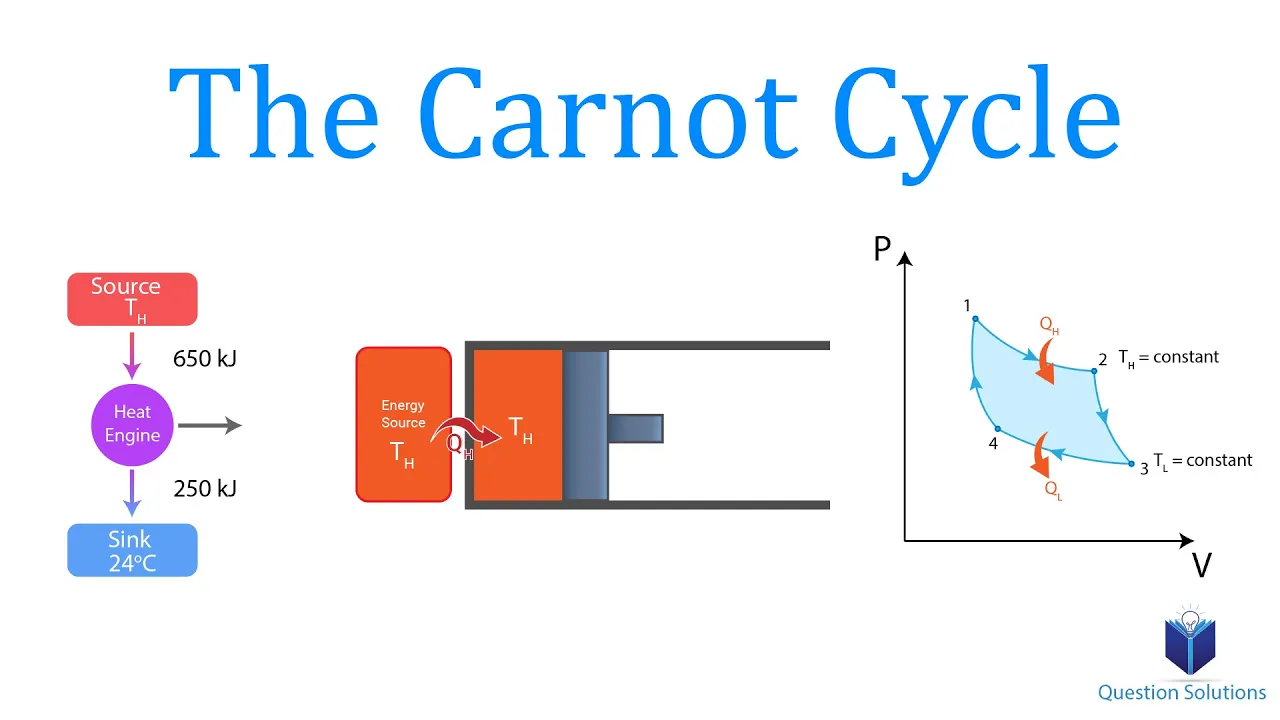
11:51
Understanding the Carnot Cycle: Maximum Heat Engine Efficiency Explained
@QuestionSolutions
131.1K views•2023-12-14

12:53
21cm Hyperfine Transition in Neutral Hydrogen: Radio Astronomy Basics
@AaronRobertParsons
12.4K views•2011-10-13
14:56
Total Internal Reflection & Critical Angle | Physics Tutorial
@TheOrganicChemistryTutor
551.2K views•2016-08-06

27:14
Entropy and the Second Law of Thermodynamics Explained
@veritasium
27.5M views•2023-07-01
Related Study Plans & Knowledge Roadmaps
Structured learning paths in Physics
physics
Nuclear Physics (Decay, Fission & Reactors)
01Atomic Structure and the Binding Force
02Radioactive Decay and Half-Life
03Nuclear Fission Mechanics and Chain Reactions
+ 2 more learning modules
12h5 modules
Explore Roadmap
physics
Soft Matter (Polymers, Colloids & Rheology)
01Foundations of Soft Matter & Thermal Forces
02Polymer Physics and Macromolecules
03Colloids, Surfactants, and Self-Assembly
+ 2 more learning modules
38h5 modules
Explore Roadmap
physics
Analytical Mechanics: Lagrangian & Hamiltonian
01Mathematical Foundations: Calculus of Variations
02From Newtonian Mechanics to Constraint Dynamics
03The Principle of Least Action & Lagrangian Mechanics
+ 3 more learning modules
28h6 modules
Explore Roadmap
physics
General Relativity (Spacetime & Cosmology)
01Foundations of Relativity: Special Relativity
02The Geometry of Spacetime: Equivalence Principle & Curvature
03Einstein's Field Equations: The Mathematics of Gravity
+ 2 more learning modules
55h5 modules
Explore Roadmap