















The NIHSS is an 11-item standardized stroke severity scale used to quantify neurological deficits, where higher scores indicate more severe stroke; it assesses level of consciousness, gaze, visual fields, facial palsy, motor function, cerebellar function, sensory function, language, dysarthria, and extinction/inattention, with a score of zero indicating no stroke symptoms and scores of 21+ indicating severe stroke, though it cannot localize stroke location and may overestimate right hemisphere and posterior circulation deficits.
NIH Stroke Scale (NIHSS) Training: Scoring & Elements
Added:Basic neuroanatomy and cerebrovascular supply, including the vascular territories of the cerebral arteries (e.g., MCA, ACA, PCA).
Fundamental neurological examination techniques, particularly assessing cranial nerves, motor function, and sensory systems.
The clinical distinction between ischemic and hemorrhagic strokes, and the importance of time-critical interventions.
Core neurological terminology such as aphasia, dysarthria, ataxia, hemiparesis, and hemianopia.
Clinical decision-making algorithms for acute stroke interventions, specifically using NIHSS scores to determine eligibility for tPA (thrombolysis) and endovascular thrombectomy.
Obtaining official NIHSS provider certification through standardized practice cases to ensure inter-rater reliability.
Correlating NIHSS deficits with neuroimaging findings (such as CT, CTA, and MRI) to localize the site of vascular occlusion.
Utilizing serial NIHSS scoring to monitor patients for neurological deterioration, hemorrhagic transformation, or recovery during the acute post-stroke phase.
37.3K views447likes24:00Original Release: 2020-07-14
>> Instructor: Now we will be going over the National Institutes of Health stroke scale.
The stroke scale has an acronym NIHSS for short, and I'll be introducing you to it and reviewing the testing elements.
The NIHSS is a standardized stroke severity scale.
It is not a diagnostic exam because it cannot localize where a patient stroke is.
As well, it is an 11-item scoring system.
But the severity scale, when it comes to looking at the neurological deficits, it grossly overestimates the right hemisphere and the posterior circulation, so that we, on top of doing the NIHSS, doing a more comprehensive neurological exam in your patients is gonna get a more balanced exam from your patients.
But this exam allows us to quantify our clinical exam, determine if the patient's neurological status is improving or deteriorating, and provide for standardization and a way for us to communicate among healthcare providers the patient status.
As far as the scoring for the NIHSS, a patient who scores a zero, this doesn't mean that they didn't have a stroke.
It just means they have no stroke symptoms.
A minor stroke will be a score from one to four.
It increases to a moderate, and then finally on to a severe stroke when you hit 21 or more points.
A few guiding principles when doing the NIHSS is that the most reproducible response is generally the first response.
As well, you do not code your patients unless it's specified in the instructions that you're allowed to.
Also, some items are scored only if definitely present, and record what the patient does, not what you think the patient can do.
Unlike other tests when you get points, the higher the points, the better it is, when it comes to the NIHSS, the more points you get, the more severe your stroke is.
So the more intact your patient is without having any signs of a stroke, they're gonna be closer to zero.
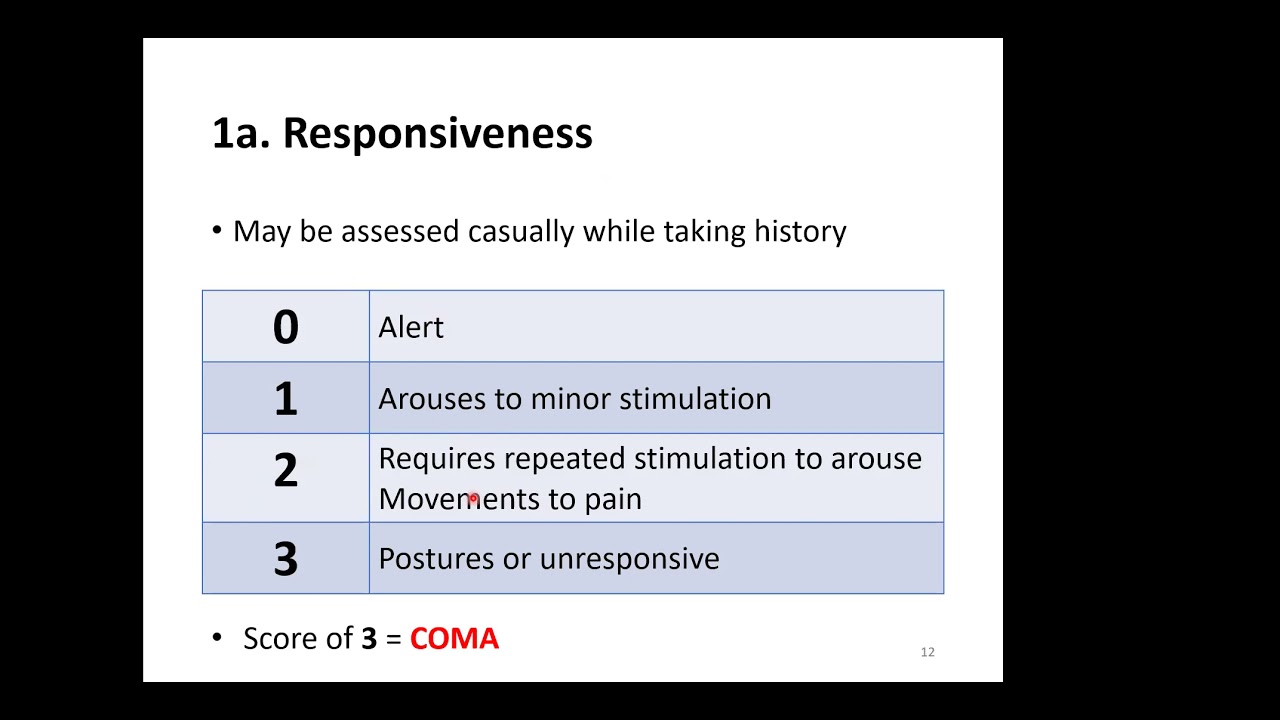
The first question, number one, is divided up into A, B, and C, all relating to level of consciousness.
The first one is looking at your patient's response just as you approach them in the room.
You're looking to see is your patient alert?
Are they keenly responsive?
Are they not alert, but by giving them minor stimulation just by touching them, they're able to talk to you and obey commands or respond to you?
That would be one point.
If they're not alert and they require repeated stimulation to attend to, or they're obtunded, requiring strong, painful stimulation to make movements, but that once you actually give them pain, maybe sternal robbing them, they do do that, then you're gonna give them two points.
You'll give your patient three points if your patient makes no movement other than reflexive posturing in response to a noxious stimulation.
So if you do sternal rubbing and all they do is do decorticate or decerebrate posturing, they would get three points.
The second part of level of consciousness is asking the patient some questions.
You're gonna ask the patient their age and wait for their response.
And you're going to ask them what's the month and wait for their response.
When it comes to this question, we do not coach them and we do not give partial credit.
For these questions, if they answer both correctly, they do not earn any points.
If they only get one right and one wrong, they get one point.
And if they answer both incorrectly, they'll get two points.
If a patient is aphasic and they can't comprehend the questions, you're going to give them two points.
They cannot answer either of them correctly.
Patients unable to speak due to an endotracheal tube intubation or oral tracheal trauma or severe dysarthria from any cause, including having a language barrier or any other problem not secondary to aphasia, they will earn one point.
The third part of level of consciousness is following commands.
You're gonna ask the patient to open and close their eyes and then grip and release your hand, and you're gonna use the patient's non-paretic hand, so the hand that actually has strength in it, 'cause we're seeing can they follow directions.
With this one, you're going to give them credit if there's an unequivocal attempt made, and so you can see that they actually tried to squeeze your hand but they can't do it, you can give them credit.
If the patient does not respond to a command, the test should be demonstrated.
So you can actually demonstrate and coach them in doing it.
Point into your eyes so that you can show them when your eyes are open and then show them your eyes closing to have them mimic you.
The second item is best gaze.
With this one, you're going to ask the patient to follow your finger as you move it horizontally across their face.
They should be tracking you with their eyes, and you wanna get the point, to the point that their pupils are what we call burying the entire way.
So when their eyes are looking all the way to the right, their right eye and the left eye should have no white of their eyes visible on the right side past their pupil.
And the same thing when you move them to the left.
For a patient who's unconscious, you can use the oculocephalic maneuver for that.
And for this one, it is okay to coach the patient.
And as well, you may have to establish eye contact and physically move yourself from one side of the patient to the other to try to get them to track you across the room to see what their eye movements are doing.
So as far as scoring for this one, if they have normal horizontal movements and they can bury the full way, they earn no points.
You can see here for the patient on the bottom left, this patient is looking to his right, but his left eye, you can see there's still some whites of his eyes that you can see next to his pupil.
So he is gonna earn one point.
He has a partial gaze palsy.
And then the patient to the right here, we can see that even when we're trying to have them look at us or look at our finger, they're having a forced gaze only to one side.
These patients are not able to move their eyes.
And so this patient would receive two points 'cause they have complete days palsy.
They can't move it past midline to get to look to their right.
For the patients who are not responsive, you can do an involuntary eye test called the oculocephalic reflex, also known as a doll's eyes test.
And with this one, the normal response to this would be that both eyes move in the opposite direction of head movement, and then an abnormal response will be that one eye moves appropriately and one eye doesn't.
And then it's absent is when both eyes remain fixed.
So let's take a look at some pictures to help you with this.
So you probably will need to open your patient's eyes 'cause we don't do this for a patient who's with it and can follow directions to try to look side to side.
And so with doll's eyes, you're gonna, you might need to open up the eyelids.
And as you turn the patient's head from the right to their left, as you can see on the top here, it's normal.
If I turn them to their right, that their, both their eyes look to the left.
And if I turn their head to their left, their eyes look the opposite way to their right.
And this is a normal response we expect when they're intact with this reflex.
If it's abnormal, you can see here in the middle, when you turn the patient's head to the right, one eye stays looking to the right, but one eye looks correctly to the left means it's partially intact.
And then if it's absent here at the bottom, as you move their head side to side, their eyes stay exactly with whatever direction their head is moving.
Next up is visual fields.
With this, you're gonna ask the patient to look directly in your eyes or at your nose.
And in the picture here, I did the green dotted lines to show you how you're gonna make quadrants, and you're going to be testing if the patient can see your fingers and see your fingers move in each quadrant.
You're gonna test the upper quadrants and the lower quadrants.
You wanna be probably about three feet away and on the same level as the patient.
You don't wanna be looking down at them.
You want your eyes to be at the same level.
And just so you'll test both sides to see if they can see your finger moving, is we're seeing is there any deficit in any four quadrant.
So how we score this, if your patient has no visual loss, they can see your fingers in all quadrants, you're gonna give them no points.
If they have a partial hemianopia, so they have either a sector or a quadrant where there is missing vision.
You can see that in black here.
You're gonna give them one point.
If a patient has a complete hemianopia, so they have a full hemisphere in one or both eyes that are gone, you're going to give them two points.
And then at the bottom, if they cannot see you at all, it's bilateral hemianopia or blindness.
You're going to give them three points.
If there is unilateral blindness as their baseline, or they have enucleation, so their eyeball is no longer there, you're only gonna test the vision of their good eye.
The next item is facial palsy.
And with this one, you're simply gonna ask the patient to smile.
You're gonna look at the symmetry of the smile both when they're smiling and when they're not smiling.
You're going to look at their nasolabial fold, and you're seeing if they're able to elevate both sides of their mouth bilaterally equally.
As well, you're going to be taking a look at their forehead.
And it's normal if you ask the patient to lift their eyelids to see wrinkles across your forehead, but a patient may have weakness there.
So with these patients, we're gonna score them zero points if they have a normal symmetrical movement of their face.
If they have a minor paralysis, meaning they have a flattened nasolabial fold, or when they smile, there's a little asymmetry on one side, you're gonna give them one point.
If they have a partial paralysis, and this is where we consider a total or near paralysis of just the lower face.
So when they try to smile, their one side goes up, but the other side doesn't at all, but their eyelids both can go up and they have creases in their forehead, you're gonna give them two points.
They only have a partial paralysis near their mouth.
You're gonna give them three points if they have a complete paralysis on entire side of the face or both.
So it means that both they're unable to smile on that one side, and as well, they're unable to lift their eyebrows and see that they have forehead folds.
For a patient that is aphasic or confused, you may have to give them pain to actually see the symmetry of their mouth when it's in motion.
So looking at these pictures, we can see to the left here, this man has a little decreased nasolabial fold on the right.
You can see as he's talking that there's actually movement on that right-hand side, so he would earn one point.
In the middle, this woman here, we can see she's trying to smile, she can only move the left side of her face, and you can see the forehead wrinkles.
But you can see on her right side she has complete paralysis of that lower quadrant of her face.
So she's gonna earn two points.
And then the man to the right, we can see that he lacks the folds on his forehead from lifting his eyebrows.
Can't lift that left, his right eyebrow.
And he also is unable to lift up the right side of his face in a smile.
So he has a complete paralysis of that right side of his face and he will earn three points.
Items five and six are testing the motor and legs of the patients.
It with this one we're going to test each limb one at a time.
And you're going to start with the limb that is not impaired.
You're gonna place the limb at an appropriate position.
So if it's the arm, you're gonna extend the arm straight palm down at 90 degrees, or if the patient's sitting, if they're lying in bed, you're going to do it at 45 degrees if they're supine.
And with your testing of their leg, you'll raise their leg about 30 degrees up.
With this, you're going to see if the patient has a drift.
So does the patient's arm or leg fall.
So does the arm fall before 10 seconds, or will the leg fall before five seconds.
So with this one, it's really recommended as you have their arm going up, remember, one arm at a time, you actually with your fingers, you start counting out all the way from one to 10, showing your fingers increase to 10 seconds.
And you can really encourage the patient to try to keep the arm up in this one.
With the leg, you'll just count out for five seconds.
With this test, you might see your patient have a little dip, perhaps, or a drift.
And a dip is a very small change that the patient tries to instantaneously correct, whereas a drift is that the limb is lowering to any significant degree, and when they have that, it is never considered normal.
They will earn points for this.
So let's go over the points.
So if the patient has no drift and they're able to keep their arms up for 10 seconds and both legs up for five seconds, they would earn no points.
If the patient has a drift, but their arm or their leg never actually hits the bed, they earn one point.
If the patient has a drift towards the bed, but you can tell they've put in some effort towards gravity, so it's not like the arm just drops right to the bed right away.
They put in some effort, but the arm hits the bed, they're gonna get two points.
If you lift against gravity and the arm falls right away, and there's no effort, they may score a three or a four, 'cause, right, this patient's not showing any movement.
With this patient, you can ask the patient to shrug their shoulder or move their arm or leg side to side and see if there's any movement.
If there's any trace muscular movement in the arm when trying to shrug the shoulder or moving the limb side to side, they get a three.
If when you ask them try to shrug their shoulder or move the arm side to side and they can't, they will get four points.
If the patient has an amputation or a joint fusion, you will not be testing that extremity.
The next test is a cerebellar test looking at limb ataxia, and with this one, we're gonna be able to detect unilateral, a unilateral cerebellar lesion.
So with this one, we do the finger to nose test and the heel to shin test.
So you're gonna ask the patient to touch their nose and then just touch your finger and go back and forth.
And then you're gonna ask them to put their heel on the top of their knee and then go along their shin.
And of course, we're going to test the side that does not have weakness first, and we're looking to see dissipation of smooth accurate movements.
Because when a patient has ataxia, it means they cannot control their movements well.
With this one, we can, we are allowed to do verbal cues to walk them through the steps.
And of course, we're testing each limb separately.
We also wanna remember this is not a test of weakness.
So this, we need to make sure that the patient's ataxia is out of proportion to weakness.
So if they're weak and can't perform it correctly, we're not gonna give them points for ataxia.
They actually have to show that they have issues with gross motor control.
So for these patients, they get zero points if they're intact and there's no sign of ataxia.
If it's present in one limb, they'll get one point, and if it's present in two limbs, they'll get two.
Remember, ataxia is what is scored for the patient.
If a patient can't understand the exam or they're paralyzed with weakness, their score is zero.
We're not gonna give them points for something we can't prove.
The next test is a sensory test for item eight, and with this, we're gonna use a safety pin, and we're going to use a single patient for single time only.
So we're gonna put this in our sharps container after we use it.
And we're going to do little pricks on their face, arms, and legs, and we're going to ask them does each side feel the same compared to the other side.
If a patient has normal sensory, they're not going to earn any points.
If they have mild to moderate sensory, meaning the patient is aware of being touched, but they notice that the pinprick is less sharp or it's more dull on an affected side, they earn one point.
If the patient has severe or total sensory loss, meaning the patient is not aware at all that they're being touched on the face, arm, or leg, they will get two points.
Also to note, stuporous and aphasic patients will probably score zero or one point based on if they give you any facial grimaces showing that they got poked.
And remember, we only record sensory loss due to stroke.
This is not testing for peripheral neuropathy.
And we only record sensory loss if it's clearly demonstrated, If you can't truly tell that they have a sensory loss, we're not going to give them points for it.
Next up we have is best language.
And with this one, we use our stroke cards, and we're gonna be testing our patient's ability to name, repeat, and their comprehension.
As well, we can tell if a patient has attention deficits.
So this is one of the cards here, and we're gonna ask them to name these objects.
Another card here.
We're going to ask them to read these sentences, and we're looking to see how fluent and clear that they are speaking.
Also, if a patient when we came here to the items, if they're not able to speak, you can actually allow them to write out their answers 'cause usually written is parallel to spoken deficits.
So they are allowed to do that.
So also, if they're intubated, they can write out the answers to those.
Ask them to read the sentences.
And then here you're gonna ask them to look at this picture and show what is wrong with this picture, and you'll be able to tell, do they have attentional deficits.
Maybe they actually have a field cut, so they're only gonna see one side of the picture, or other attentional deficits.
They're not noticing that there's something wrong in the picture, that the water's overflowing the sink or that the boy trying to grab the cookie is on a stool that's about to fall.
With regards to scoring a best language, if a patient has no aphasia, they have normal fluency and comprehension, they earn zero points.
If they have mild to moderate aphasia, so they have some obvious loss of fluency or comprehension, but they're able to get their ideas across, you can figure out what they're saying, you're gonna give them one point.
If they have severe aphasia so that all communication is limited and the examiner, you pretty much have to guess what they're trying to communicate, you're gonna give them two points.
And the difference between that and three points is the patient's unresponsive, they're mute, they are globally aphasic.
They don't have any usable speech or any auditory comprehension, and the patient is unable to follow any of our one-step commands, they earn three points.
Patients also, when it comes to the naming of the objects, we sort of think that once they've missed more than two-thirds of the objects and the sentences, or if they're only able to follow a few of the simple one-step commands for this test, they would score two points.
The 10th item is dysarthria, and this is looking at the clearness with which the patient is talking.
So with this one, you're going to ask the patient to read another stroke card, as you can see here on the right, and if the patient has aphasia, we're gonna look at the clarity of the articulation of their speech to also rate it.
So scoring for dysarthria is if they have normal speech, we're gonna give them no points.
If they have mild to moderate dysarthria, so they slur some words, but we can understand what they're saying, they'll get one point.
If they have severe dysarthria, so their speech is so slurred they're unintelligible in the absence or out of proportion to any dysphasia, or they're mute, they'll get two points.
If your patient is intubated or has any other physical barrier from communicating, you're not going to give them any points.
The last item we score is extinction and inattention or neglect.
With this test, we have to do it in more than one field.
So we can't just test tactile.
We're gonna also do tactile and visual.
So with tactile, we're gonna do this by touching our patients' arms and legs.
So I'm gonna touch their right arm and ask which arm I'm touching.
Of course, ask them to have their eyes closed.
Ask them which arm you're touching.
Touch the opposite arm.
Ask them which arm you're touching.
And then touch both at the same time.
And you're going to see if they have extinction to only one side, and this'll be when you touched both arms, they say they only feel it on one side.
And you're gonna do this on the arms and on the legs.
And then you can do a test here for visually where you can give your patient a piece of paper, and you'll just write lines all over it.
And you're gonna give them a pen, and you're gonna ask them to cross all the lines that they see.
And if you can see here in this example, the patient's only filling out what lines they see on the right side.
So we can see they have an inattention.
They're neglecting to see what's on the left side of the page.
As well, you can also, another test you can do is you show the patient their arm and you ask them whose arm it is, and if they can recognize it as themselves, they're intact.
But if they say it's your arm or don't respond, or, sorry, if they say it's your arm, then it means they're not recognizing their own arm.
For extinction, this is where the patient feels the touch on both sides separately, but when touched on both sides, they report it to only be on one side.
When it comes to the scoring, if there's no abnormality, they're gonna get zero points.
If the patient has visual, tactile, auditory, spatial, or some type of personal inattention or extension to bilateral simultaneous testing in one or both modalities, so it has to be more than one, you'll get one point.
If the patient has a profound hemi-inattention or hemi-attention to more than one modality, like they don't recognize their own hand, or they orient to only one side of space, they will earn two points.
For extinction, remember that this is one way that you can get the tactile exam out of them.
So when to communicate the NIHSS results.
So when your patient has any type of neurological decline, so if they have an increase in two to four points.
I mean, something to remember about the NIHSS is that it's not a linear exam.
So if I change from one to three points, so the patient goes from being able to move his arms to not being able to move one arm at all, that is a huge increase compared to someone who's maybe a score of a 22 to 24.
That is a much smaller change in results.
As well, if you notice any new focal deficit or an advancing neurological deficit, so maybe as your shift or the prior shift that the numbers have been increasing, or any other concerns, you wanna make sure you notify the prescriber.
That's what I said.
And remember that if there is a change, it might be slight, which might be due to individual variability, but you wanna strongly consider immediate communication for change even of a single point when it comes to any motor strength, sensory change, or new visual field deficits, please notify your provider.
Next up, we'll be talking about the nursing care of a stroke patient.
Up Next

92:58
Acute Ischemic Stroke: Diagnosis & Management | KGMOA Webinar
@academickgmoa
241 views•2025-08-27

48:47
Graphic Medicine: Comics for Collaborative Healthcare Communication
@nationalpatientadvocate
189 views•2023-12-04

10:28
Neuroanatomy: Central and Peripheral Nervous System Divisions Explained
@AKLECTURES
136.2K views•2014-09-20
3:05
Stages of Labor and Vaginal Birth | Childbirth Animation
@nucleusmedicalmedia
52.1M views•2017-08-18
Related Study Plans & Knowledge Roadmaps
Structured learning paths in Medicine
medicine
Abnormal LFTs: Diagnostic Workup & Pathology
01Liver Anatomy and Basic Physiology
02Introduction to Liver Function Tests (LFTs)
03Hepatocellular vs. Cholestatic Patterns
+ 3 more learning modules
12h6 modules
Explore Roadmap
medicine
Analyzing Blood Smears: RBC, WBC & Platelets
01Introduction to Blood Components & Smear Preparation
02Normal Morphology of Blood Cells
03Erythrocyte Pathologies & Morphological Variants
+ 2 more learning modules
12h5 modules
Explore Roadmap
medicine
Mechanical Ventilation: Waveforms & Alarms
01Anatomy and Physiology of Breathing
02Introduction to Mechanical Ventilation & Core Modes
03Ventilator Settings and Waveform Interpretation
+ 2 more learning modules
12h5 modules
Explore Roadmap
medicine
Neuro Exam: Localization & Stroke Syndromes
01Foundations of Neuroanatomy and Vascular Supply
02The Neurological Examination: Step-by-Step
03Principles of Neurological Localization
+ 3 more learning modules
18h6 modules
Explore Roadmap