









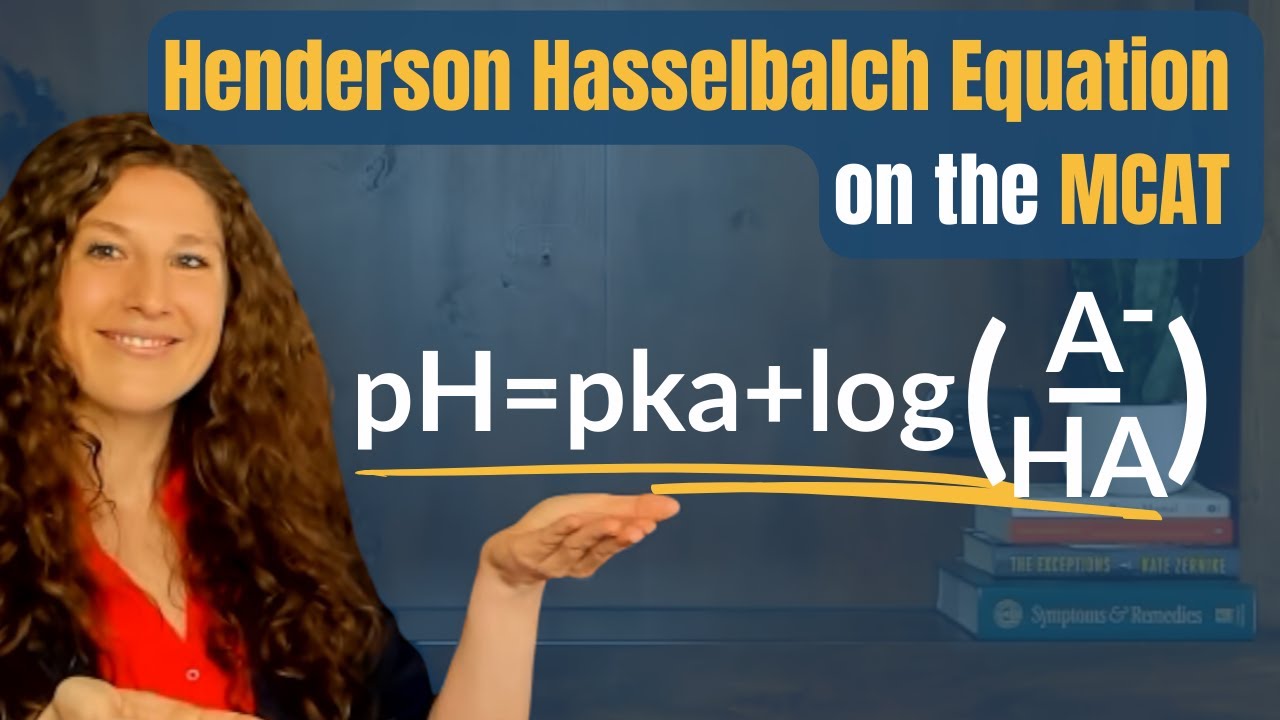









Water is a universal solvent in biochemistry due to its polarity (oxygen more electronegative than hydrogen, creating a bent sp3 hybridized molecule with hydrogen bonds), and its amphiprotic nature allows it to act as both acid and base, forming the basis for the pH scale where pH = -log[H+] and pKa determines acid strength; the Henderson-Hasselbalch equation (pH = pKa + log([A-]/[HA])) enables calculation of weak acid solutions, while buffers resist pH changes by maintaining equilibrium between weak acids and their conjugate bases, with maximum effectiveness within ±1 pH unit of their pKa value.
Water, Acids, Bases, and Buffers Explained | Biochemistry Lecture
Added:Understanding of chemical bonding, specifically polar covalent bonds and the physical nature of hydrogen bonding.
Familiarity with the concepts of chemical equilibrium, reversible reactions, and the equilibrium constant (Keq).
Basic mathematical proficiency in logarithms, which are essential for performing pH, pOH, and pKa calculations.
Fundamental stoichiometry concepts, including molarity, solute-solvent relationships, and solution preparation.
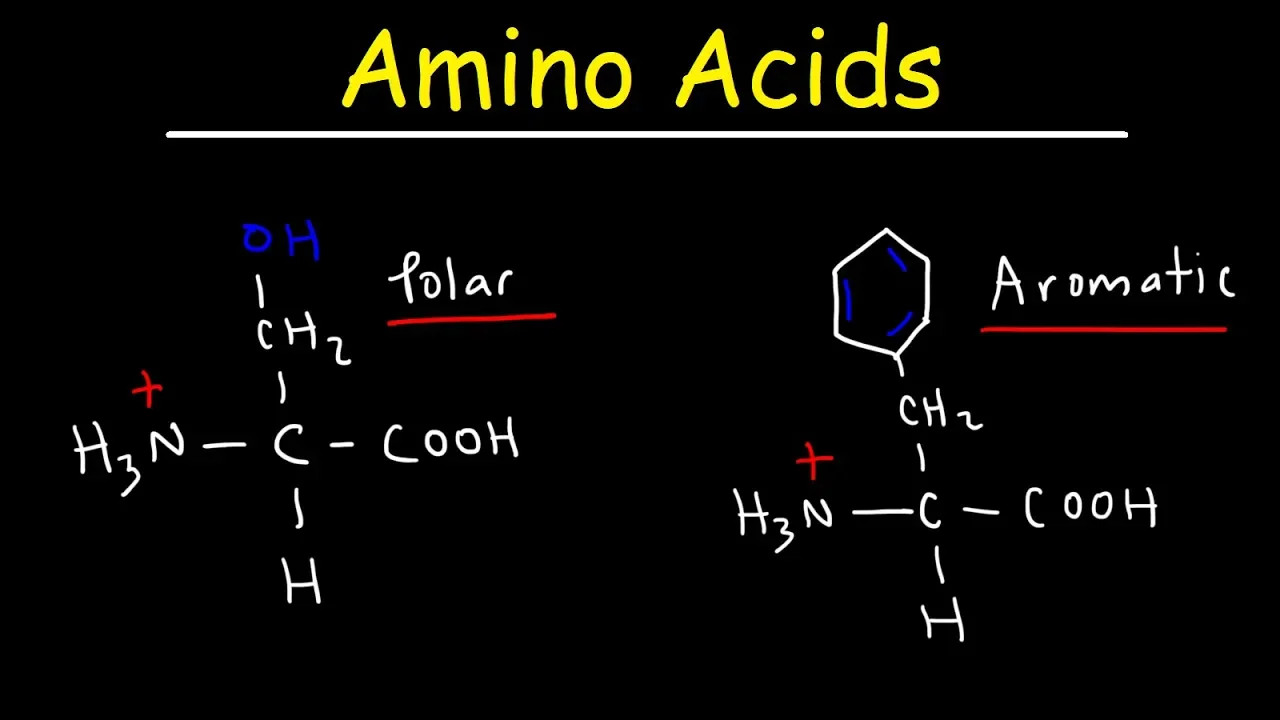
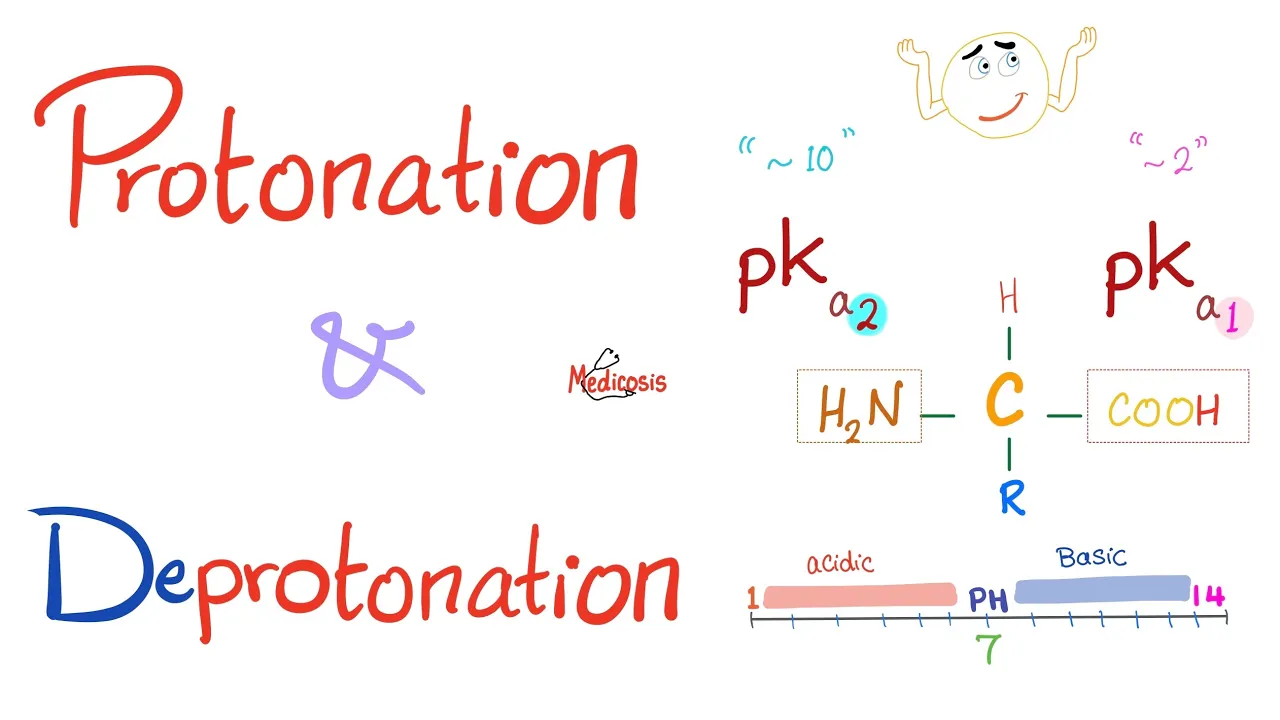
Application of the Henderson-Hasselbalch equation to predict the ionization state of amino acids and proteins at different pH levels.
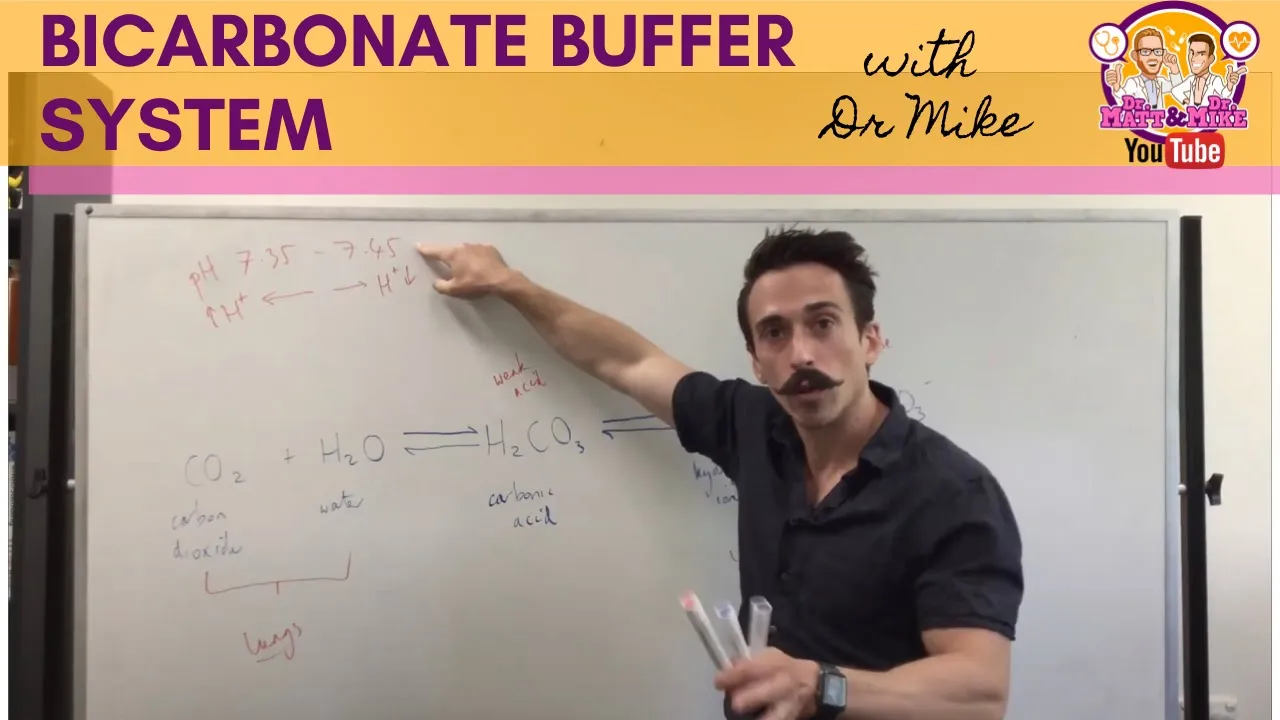
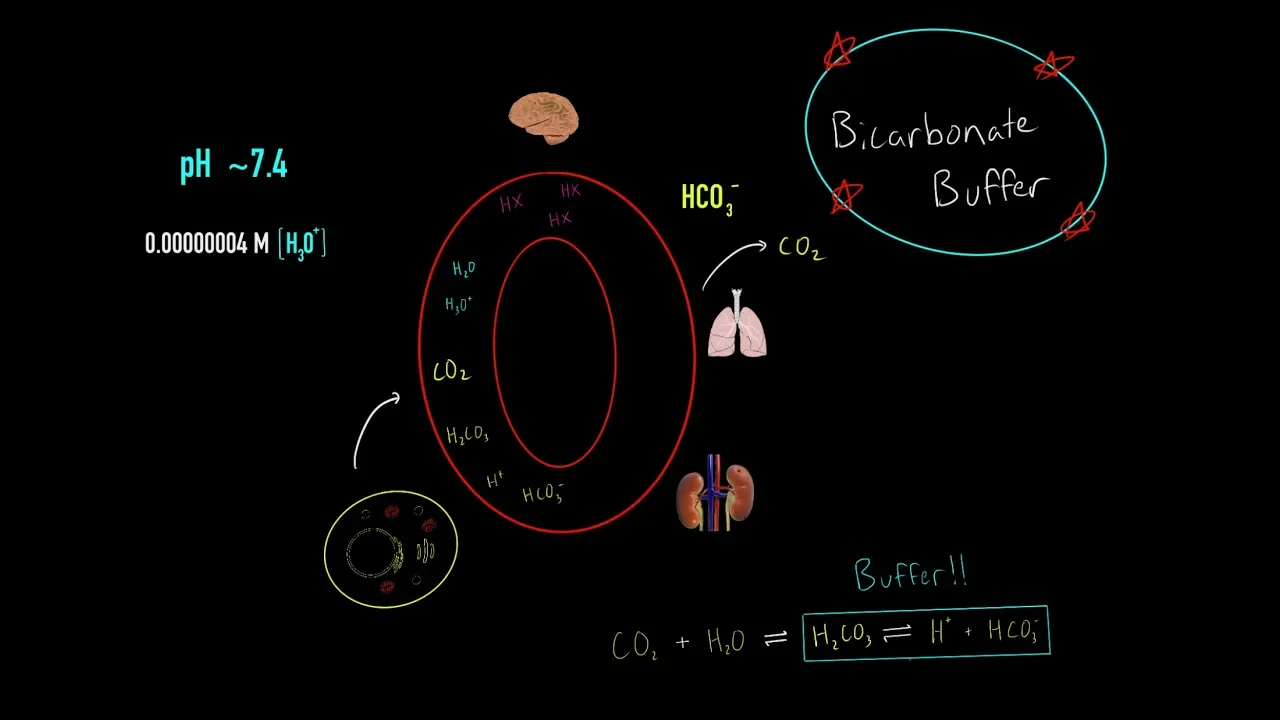
Exploration of physiological buffering systems, such as the bicarbonate buffer system in human blood and its regulation by the lungs and kidneys.
Investigation of how pH changes affect enzyme structure, active site ionization, and overall catalytic activity.
Analysis of titration curves for polyprotic acids and amino acids to determine pKa values and isoelectric points (pI).
46.3K views847likes50:27Original Release: 2020-08-24
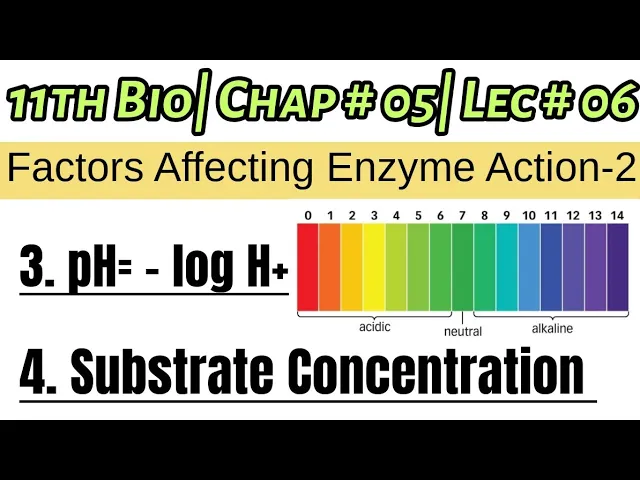
hello today we will be talking about water acids and bases so in this lecture it's going to be quite lengthy because we're going to go through a couple of concepts and those concepts are fairly difficult to understand the first time so don't feel sad if you don't understand this the first time okay for some of you it might be a review but it's very in-depth okay so in biochemistry you're going to be working a lot with water the reason why you work with water a lot is because it is a unique solvent it is a uni universal solvent in biochemistry it acts as a solvent and a reaction or a reactant in some reactions okay so it's a solvent and a reactant okay now water makes up about 70 percent of a cell's weight and you know it's very important so for instance uh your tissues your skeletal muscles 79 water your heart is 83 water and your liver is 71 percent water so it's pretty important for you to understand how water reacts in biochemistry notice that water is going to play a big role in the formation of the ph scale which i will derive for you later on in the lecture okay so we're going to look at the water molecule so this is going to be a hydrogen right here so here we have our hydrogens okay so our h and this is going to be the oxygen okay so notice that the hydrogen is going to be slightly more positive right here than the oxygen okay the oxygen is slightly more negative so what we have here is going to be a dipole reaction now a dipole reaction is essentially the direction of where the electronegativity goes that's the net reaction okay so hydrogen is going to be pulled towards the oxygen in this direction okay the same thing could be said here in that direction so overall the net dipole moment or movement is going to go downwards okay that's what makes it bent so let's see the oxygen is actually going to be sp3 hybridized and you're probably wondering what sp3 hybridized is well this diagram is missing some important things in that case it is missing the two lone pairs so here's a lone pair right there and here's a lone pair right there okay so how many things surround the oxygen well let's see that's one thing the hydrogen is one thing the other hydrogen is the second thing and each individual lone pair is going to be another thing that surrounds the oxygen so that's three and four so where do we get the sp3 from well the s is always going to be present and that counts as one thing and the p has a maximum of three things okay so that goes three right so the p is for what the other uh object surrounding oxygen so s is always going to be present there's always an s so yeah let's go so one two three four okay so one plus three is equal to four so in total oxygen has four things surrounding it one hydrogen one hydrogen a lone pair and a lone pair okay so that makes it sp3 hybridized now this is a bent shape so it's a bent shape and if you want to get into the molecular geometry it is a tetrahedral so it's a tetra meaning four hedgerow uh configuration okay so is a bent shape it's a tetrahedral configuration and it's sp3 hybridized so that's kind of the basic information for water some other information that you need to know is that water is imperative it's very important in reactions because it can regulate temperature now it takes a lot of energy to heat up some water right have you ever tried to make oatmeal or something and it takes like 13 000 hours to just get it to a boil well that's because water is very efficient in you know taking a lot of temperatures right it takes a lot of heat to even move it one degree so in that case water is very important in reactions because it's going to control the maximum temperature in the reaction it is also important because it allows materials to be transported it's kind of like the fuel for the vesicles right it allows the transportation of materials throughout the cell and finally the water is important because it regulates intracellular ph so if the ph gets too high inside a cell the water is there to calm it down to bring it down or to bring it up why is that well remember that water is amphiprotic so meaning that it can act as a base or an acid so depending on what it needs to do it'll be acidic or it'll be basic okay so you could get hydronium or you could get hydroxide from water water also has a unique ability to bond with itself okay so for instance with this uh diagram right here if i really wanted to i can actually make a bond between another h and an oxygen right so i could do that i could bond it again with that so here we go and you know water is very efficient at doing that these are called hydrogen bonds okay so these little baby little baby bonds right are called h bonds and h bonds typically occur with nitrogen so let's say h bonds uh occur uh that was pretty bad occur with you know nitrogen oxygen and fluorine okay so those are you know very important elements that it could bond with okay now i remember in a chemistry one and two they used to say you know h bonds are like super super strong well in biochemistry they're not that strong well why are they so important well you know think of think of uh ants okay think of ants one ant is not gonna lift a potato chip by itself right you're gonna need at least 12 ants to lift that potato chip that's what makes it strong h bonds by itself not that strong but when you have millions and millions and millions in one compound it becomes amazingly durable amazingly strong so the more h-bonds you have the stronger the connections are that's what makes h-bonding so important within biochemistry biochemistry you work with trillions of h-bonds that's what makes it so strong in biochemistry you will often see h bonds forming with you know biomolecules so for instance it could bond with dna it could bond with protein it could bond with other things right and is that well because it can bond with you know biomolecules they can offer shape they can offer structure they can offer you know like so many things to the bone molecule and that's why it's so important in biochemistry so now we're going to be talking about ventricle forces so it's a vp of chem 1 right so van der vaal so van der vaal is like one of the weakest forces out there in chemistry so it's a weak force and essentially it's kind of like when carbon bonds with carbon or hydrogen bonds with hydrogen so let's just use um carbon with carbon okay so this bond yeah it's covalent but it's kind of weak right also with ch these are very weak bonds well either they're bonded by itself or it's bonded with another weak element for instance hydrogen now these um for specifically for this one well specifically for these two they're essentially neutral okay they cross out okay with uh the electronegativity so there's no net uh movement no net dipole however sometimes there's kind of like a sloshing effect so that's what i call it so um there's a slosh okay and what that is is that imagine that there's a bucket okay imagine that there's a bucket let's draw a bucket and inside here is going to be trillions of carbon-carbon bonds okay let's just do that trillions of carbon-carbon bonds now at one point maybe in one second the net dipole movement even though it's very small and very insignificant will go here okay and then it's going to slosh back here the next second so for that split second there is a net dipole movement going this way and then one second later there is a net dipole movement going that way and only that way okay so that's the sloshing effect right or solution slosh i think it's one o my bad so that's a sloshing effect where if you have a carbon carbon bond or carbon hydrogen bond or it can even be fluorine bond right so it could be um excuse me so essentially if you have something that is bonded to itself it's going to be a van der waal force and also a sloshing effect where for one second the total net dipole moment of the entire system is going to go towards the right or towards one side and then like half a second later the net dipole moment is going to go towards the left okay and during those reactions it's going to be bonding with the other molecules next to it and then it's going to break that bond and go to the other molecule next to it towards the left side so that's the sloshing effect if you don't know what i'm talking about get a cup of water and kind of gently move it around left to right those waves when they go to the right you can imagine as a net dipole moment and move it towards the left that's another net dipole moment but when you hold it still it's neutral there's no waves okay now imagine that moment that movement about a hundred thousand times faster it's happening so quickly that to the naked eye there's no movement but if you freeze frame by frame there's a net dipole moment every thousand times you know and now we go into the ionic bonding so ionic bonding is when there's an unequal sharing of electrons so for instance if we bond carbon with fluorine well fluorine is like super negative right it's super negative and carbon in this case would be really positive so the net dipole moment is going to go towards the molar electronegative side which is fluorine so fluorine essentially well imagine carbon and fluorine are sharing some chips well fluorine hasn't eaten in like three weeks so he's eating the chips all of it he's eating all of it and carbon has no chips you know all of its chips its electrons were taken away so now carbon is starving they're still bonding they're they're friends but it's not an equal sharing of electrons it's not an equal sharing of potato chips you know whenever you have carbon and carbon well they're bros they're friends they're going to be chairing those uh chips equally right their electrons are equal but in ionic bonds there is an unequal sharing of electrons typically the metal or the most negative component gets the electrons we will now talk about the hydrophobic effect now the hydrophobic effect is one of the most important effects in biochemistry so you have to know this okay so essentially whenever you add a non-polar substance to water for instance let's say uh olive oil to water you're going to see that the non-polar substance the oil in this case will kind of ball up and separate itself from the water why does it do that well in this case the oil doesn't want to mix with the water if it does you're going to have a lot of polar some substances mixing with non-polar substances and they don't like each other non-polar substances are hydrophobic meaning that they're scared of water they don't want to bond with water if they do bond with water it's going to take a lot of energy to do that and to maintain it and it takes so much energy that it's going to exhaust the energy in the system okay so this is actually entropy driven okay so this is entropy entropy uh driven okay so entropy is just the amount of disorder or kind of like unorganized things in a system a system typically wants to be ordered and clean so imagine your room right whenever you first enter your room it's usually clean but over time the entropy increases you know you might find a sock here a cat here you might find i don't know like a baseball team in your room somehow there's a lot of disorder there's a lot of chaos and that's entropy the universe actually is driven towards entropy there's a lot of disorder that keeps on multiplying and multiplying over time usually the system wants to be as ordered and organized as possible it wants to decrease the amount of entropy in the system if we mix two things that don't like each other they're gonna be a lot of disorders there's gonna be a whole lot of chaos and that's gonna drive up the entropy so the hydrophobic effect drives up the entropy okay so entropy driven you can say that in thermodynamics it's unfavorable to mix these two substances so thermodynamically unfavorable okay to mix it why is that well the non-polar substances tend to kind of like group each other and exclude water so if you ever see mean girls whenever whenever they're at the cafeteria you have your cliques right you got the jocks the nerds teachers the tas whatever cheerleaders well they congregate they meet up into one group for instance here are the cheerleaders here are the jocks here are the nerds here are the geeks or whatever well they're all forming into one cluster and they're excluding the water so here's you you're the water they're not letting you sit at their table they're creating chaos okay well actually they're not creating chaos they're creating order now if everything were to mix together you have the jock sitting with the nerds the nerves sitting with the cheerleaders and you know there's like food fights everywhere it's completely crazy there's so much entropy okay and the system does not like entropy so it kind of separates itself to maintain order so in theory or not in theory but in actuality the nonpolar substances will bind to each other okay and exclude the water well you can say that water has a greater affinity a greater tendency to bind to itself okay and that decreases the entropy and increases the order of the system so whenever the water let's say in this part right here the water surrounds the unpolar substance it's kind of like blocking the unpolar substance from binding to anything else but when the water is blocking the non-polar substance it's also limiting itself because now it can no longer bind with the other water molecules around it okay so imagine that one of the cheek leaders is like hey you can't sit here you can't sit here go somewhere else and like that cheerleader just keeps on saying it and saying it well as they're blocking other people they cannot talk to their friends they cannot form other bonds to the other cheat leaders okay so it's it's very impractical okay so entropy is lost with water whenever you add a non-polar substance so as a recap water when it's blocking the nonpolar substance it's losing its ability to bind with other water molecules it's so preoccupied and it's trying to maintain order so entropy is lost but when you somehow mix it together entropy is being increased so the amount of disorder is increasing okay so they're forming bonds with things that they shouldn't bond with right everything has an order everything has a binding purpose so again in biochemistry the hydrophobic effect is one of the main factors in the binding process and we're going to talk about binding later on in the lectures okay so whenever someone says hey why does you know the alpha helix form you're saying well it's the hydrophobic effect okay and we're going to talk about alpha helixes soon but one of the main factors for the alpha helix is a hydrophobic effect we will now go back to talk about h bonds so do you know that in 25 percent 25 percent of pharmaceutical drugs use uh fluorine instead of hydrogen so essentially the reason why they use fluorine instead of hydrogen for instance you have f3c and not h3c is because fluorine is very electronegative okay and because it's so electronegative it's going to be taking away electrons from the benzene ring or some structure now this actually decreases acidity okay it decreases acidity now when it decreases basically of amino acids it actually allows the drug to penetrate the cell more efficiently okay so it's going to bind with the cells at a greater uh rate than if it were more basic okay so when you add fluorine to a drug let's say prozac okay you're decreasing the vicidity of the amino acid and it allows the overall drug to bind with the cell easily okay so you can see that h-bonding plays a key role whenever you're making drugs so now we will be talking about everybody's favorite concept in chemistry acids bases and buffers i don't like this and i'm pretty sure a lot of people don't like acids bases and buffers it's a pain to uh learn so this is kind of like a chemistry two concept but we're going to be talking about ionization so ionization is essentially the reverse process of water breaking into its component right so you can see that water can go back into an acid and to a base but together those can make a water okay so this is called the ionization okay so this is going to be the water and this is going to be the acid and also the base okay now to be more explicit typically you don't just have a single proton you don't really have an h just like floating around whenever this reaction occurs you're actually making hydronium okay but to make it more simplified i just made it into an h okay so when water breaks into its components it can make an acid and it can make a base that's what it's called amphiprotic now if you're more into math which a lot of people aren't we can actually describe this via an equation okay so the k which is the equilibrium constant is actually a ratio so keq is a ratio of products over reactants of products over reactants so as you can see our products which is the acid and the base is over the reactant now over like centuries and centuries of research the nerds of our planet have found out that keq is actually equal so keq is actually equal to 1.8 times 10 to the negative 16 if i remember correctly m that's not an m that's an m okay where m is equal to uh moles over liters so that's molarity okay so moles per liter okay so there we go now they also found out that the concentration of h2o is typically 55 um 55.5 m okay so if we do some basic multiplication we can actually multiply the h2o to the keq okay so if we do that we have keq multiplied by h2o is equal to h plus the acid times the base okay but we know what those two um components are okay so we know that that is 1.8 times 10 to the negative 16 m multiplied by 55.5 m okay and we can do that because they have the same units m molarity so if we were to multiply it we would get a product of 1 times 10 to the 14th negative 14 m okay so that must mean that 1 times 10 to the negative 14 m is equal to the acid and the base and you know we can actually divide it you know this is some elementary stuff right so if we were to divide this number by two we would get that h plus and o h negative are equal to about uh 1 times 10 to negative 7. so essentially negative 14 divided by 2 is negative 7 okay and that essentially is um the ph scale so congratulations you just kind of derived the ph scale you did what took hundreds of years to do in like two minutes it's kind of weird right but uh that's the ph scale okay so that's the ph scale and you should remember that the ph is equal to the negative log it has to be negative okay negative log of the amount of acid present okay and if you don't like that equation you can also do that the ph is equal to the log of 1 divided by the amount of acid present okay so those are two equations that you can derive right so um yeah there we go if you really want to go into detail you're going to have this you can have the negative log right of 1 times 10 to the negative 14.
okay so whenever you take the negative law you can just ignore everything and focus on this number notice that that number is negative well this negative is going to cancel out with that negative just giving you 14 okay so it only works on like even numbers right not like 14.1 14.2 it has to be like a solid number so typically you can just kind of ignore everything else and just focus on the 14.
okay so that is equal to the negative log of your acid plus the negative log of your base so whenever you do that you will have 14 remember what i told you um that everything cancels out it just gives you 14.
and that is equal to the ph so how did it get this p well the p is just shorthand for the negative log so whenever you think of pka just think of the negative log of the ka okay where small p is equal to the negative log so that is a ph plus the poh okay that's what it stands for so there you go now you're probably wondering okay well what's the significance of the ph scale well if you have a difference of one so let's say you're measuring acids and one acid is a ph of six and the other acid is a ph of seven well the six is about like i say like 10 times stronger maybe 100 times stronger than um the ph of 7. so it's logarithmic meaning that a difference of 1 is a huge difference there's like a lot of strength in one number okay and that is the ph scale so as you can see from this uh scale right here we have our ph right so a ph of zero is you know one okay but a ph of seven is about like one two three four five six and seven so it's about one million times weaker than the ph of zero okay so it's very very um exponential okay so that's the ph scale right let's talk about the dissociation of the acid which is decay okay so k is dissociation whenever you talk about a that's the acid now now if i was talking about kb that is the disassociation of the base okay so k is disassociation k is equal to dis association i spelled it wrong because spelling is not my strong suit obviously so let's see this uh association right so there you go now that's the acid right so we're going to put acid well the ka that's equal to the acid and the base well we'll call the base a okay and that's divided by what h a right so a negative is the base right and h is the acid so again if you want the pka or pka you just get it from the negative log of the ka okay and typically you're going to have a table or you're going to memorize a little bit of the ka values and you can derive the pka okay because again small p means negative log of something right and here we're gonna have our relation so a small pka so small pka is equal to a very strong acid very strong acid and a large pka is equal to a very weak acid okay okay so let's do an example right so calculate the ph of a 4 millimolar solution of hydrochloric acid in water so we're going to be making an assumption okay we're going to make a guess that hcl is a very strong acid and since it's a strong acid it's going to completely break up when it's in water that's called disassociation now whenever you have a weak acid you're going to use a different equation a different formula because sometimes not all of the weak acid is going to break up completely you're going to have little chunks that are still formed but whenever you have a strong acid all of it is going to break so it's very easy to to calculate the ph okay so let's do it so the ph we know is equal to the negative log of the acid so let's do hcl right but notice that this has to be in molars not millimolars okay so what is a millimolar well we know that millimolar is like 1 times 10 to the negative 3 so that's going to be 1 2 and 3. so that's three zeros right there so 1 times 10 to the negative three is a millimolar so you need three zeros to do that okay so there we go so now we have that the ph is equal to the negative log of 0.004 molar okay and that is equal to what a ph of 2.4 and is that basic or acidic well it's acidic okay right so there you go so that's how you essentially uh calculate the ph of a very strong acid all right so biochemistry focuses on weak acids however you know such as acetic phosphorus or carbonic acid maybe even lactic acid you know whenever you work out you have lactic acid in your muscles well biochemistry focuses on those weak acids so for the most part we're not going to be calculating the ph of strong acids right again they don't completely disassociate so the acid will be much lower than the overall um disassociation the equilibrium will need to be dealt with and you know also amino acids the 20 amino acids which we're going to be focusing on in this class they're all weak acids okay so amino acids are weak so we will need a different equation to figure out the ph of the environment the equation that will be needed to focus on weak acids is the henderson-hasselbalch equation so the henderson is as follows okay and it's for weak acids so like almost everything in biochemistry yeah all right and it shows that the ph is equal to the p k a plus the log of the base over what the acid now overall these are conjugate bases so conjugate base over the acid right now sometimes if if a negative is equal to the acid then the log is going to be one right so the log of one is equal to zero okay so the ph is equal to the pka plus zero which means that the ph is equal to the pka but that only occurs whenever that conjugate base is in equilibrium with the acid not all the time but sometimes it happens okay so there you go so yeah now we're going to be talking about buffers so what is a buffer a buffer is something that resists changes in the ph whenever you add an acid or base all right now this is useful whenever you're monitoring monitoring the blood of the ph or sorry the ph of the blood or the ph of cells so of course your blood has a ph typically seven and your cells have ph well sometimes whenever you eat something or exhale or whatever your ph fluctuates now your blood needs a buffer so the fluctuation the changes of your ph aren't dramatic because if it's dramatic you could die right so a buffer is always is equal to a weak acid and its conjugate base or it's a conjugate base and or sorry or it's a weak base and it's conjugate acid so vice versa okay the maximum buffer capacity so how strong a buffer can be is equal to the ph or minus one so if a ph is six it could be five or seven right so the minimum that the buffer can be is five and the maximum that it could be is seven right so um page of the pka okay so if you see a pka table and it has again six it could be five for the minimum or it could be seven for the maximum okay so now you know about the henderson-hasselbuck equation but what if you don't know about conjugate acids and conjugate bases okay we'll we'll review it obviously so whenever you have an equation you want to figure out what was the acid okay so we go to our reactant side and then we look at our product side so notice that on our product side this substance lost a hydrogen okay so here's our hydrogen and it was lost in the formation of the product so from here to here this acted as an acid because acids actually lose lose protons or hydrogens right so there we go so now this is going to be acting as an acid so we know that over here this is going to act as a conjugate base why do we call it a conjugate base well now this substance right here can act as a base meaning it can accept a hydrogen to become the acid okay so that's the conjugate base over here notice that the hydroxide the o-h gained a hydrogen to become water now that is a definition of a conjugate acid because the water can act as an acid meaning it can release a hydrogen to reform the base so it could come so it could become the hydroxide okay now the henderson-hasselbalch equation okay is that the ph for a weak acid which is most of biochemistry is the pka plus the log okay of what the conjugate base over the acid so in this case it would be ch3 cool negative over what the acid so ch3 cooh okay now depending on if you know the molarity you would have your answer and the pka of course so that is the conjugate base base or the acid initial acid so that's what a buffer is okay hopefully that clears it up for you so i i kind of want to talk about the maximum buffering uh capacity okay so in case you were confused let's say that the initial pka okay or pk would have to be five right so the minimum that it can go to be effective would have to be four and the maximum that it can go would have to be six this designate a buffer capacity of plus or minus one of the pk okay so it's like um actually pka so what i mean is that if you were you know deprotonating the molecule okay the maximum that you can be is six and when you hit six right there the buffer is no longer effective you're just gonna shoot up to a basic level okay so you're gonna shoot up to like maybe nine or fourteen 14 6 is essentially the last location that you would have an effective buffer so if you keep on adding bases and you're deprotonating you're going to have a very very basic substance okay but in the same idea if you were to add acid and acid in acid and you're protonating this substance the most acidic that you can get before your buffer fails is four okay so once you hit four and you add a little bit more acid you're gonna shoot down to maybe one or zero so your range your buffer capacity is always going to be plus or minus one of the pka okay so in this case the pka would have to be five or something like that and if we add bases eventually we're going to hit six and that's the maximum that we can go if you add more bases you're going to shoot up exponentially towards the basic side of the ph scale in the same idea if you were to add more acid the maximum that you can go with an effective buffer would have to be four if you add more acid you're gonna shoot all the way down to maybe one or zero hopefully that clears out for you oh and um for every you know buffer there's a different uh buffer capacity okay so again plus or minus one pka okay so now i will teach you how to make a buffer uh when you're given the ratio okay of a acid or base okay so here's how we do it so it says calculate the base the conjugate base to acid ratio in blood ph of 7.4 okay so the pkas of phosphoric acid are 2.1 7.2 and 12.7 the formula for phosphoric acid is h3po4 now in real life some pkas are multi-protic meaning that they have multiple protons to give they could be an acid like three times so in this case phosphoric acid can be an acid three times it can completely disassociate the three hydrogens so here's how we do it you want to write out the full equation so first we have h3 po4 and then is going to kind of deionize or dissociate to h2 po4 negative and that could go that ways to hpo4 uh two minus and it can also do this it could become po4 uh three minus okay so notice that as we go towards the right you're actually losing hydrogens okay so when you lose hydrogens you have the ability to gain hydrogens okay so that causes an increase in basicness so as we move towards the right we can become more basic okay that means that the pka should uh increase as well so for our values this would have a value of 2.1 because there's a lot of acid power over here this is a value of 7.2 and this is a value of 12.7 okay so whenever you have this okay you want to pick the acid or excuse me you want to pick the pka that is very close to the ph of the blood or whatever you're measuring in this case the pka of 7.2 will just work nicely okay so these are pka values so again you want to pick the pka that is very close to the um ph of whatever you're measuring okay so here's what we do since we want to have a pka of 7.2 we have this right there okay we have that so we will have that the ph is equal to the pka plus the log of the conjugate base [Music] over the acid okay so what is our conjugate base if we're just looking between the blue brackets this is going to be acting as our acid right because we have h2 but if we look on the right hand side there's only one h so the h2 must have deprotonated meaning it acted as an acid and that this right here my friend is a conjugate base okay so it's not it's not difficult okay so that's a conjugate um conjugate base so we have everything we need to do we know the ph of blood is 7.4 okay the ph of blood which is what we're measuring is 7.4 what is the pka 7.2 and then we're going to do the log of hpo4 two minus divided by h2 po4 now you're probably saying hey you know brian we don't have a value for hp042 minus or whatever but that's okay because we're solving for that we're finding the ratio okay because we're trying to create a buffer that will be efficient for this uh reaction so what i do is i'm going to subtract 7.2 by this so 7.2 right there that's going to give me 0.2 that's equal to the log of h po4 to minus over h2 po4 okay now we're going to solve for this and if you know how to solve for it it's pretty easy so the way we solve for it is that we take the antilog so it's basically log minus one there's a function on your calculator that does that of 0.2 and that's equal to the ratio of hpo4 to minus over h to po4 okay so when you get that you should have 1.6 is equal to the ratio okay so what does 1.6 mean is just some random number well actually it's 1.6 over 1.
so what does that mean it means that if you were to make a buffer let's say in a couple of milliliters you would need to have 1.6 milliliters 1.6 milliliters of uh your base and one milliliter of your acid so in total your buffer in total your buffer your buffer is about uh 2.6 milliliters in total okay 1.6 of that is the conjugate base and one milliliter of that is the initial acid okay so that's how you find the buffer for a system so in in this case blood so let's do a quick recap so you know what you're doing over here we're asked to find the ratio between the conjugate base and the acid the blood has a ph of 7.4 well since this weak acid has multiple levels of depronation there are three pkas 2.1 7.2 and 12.7 whenever you're doing this you want to have the pka that is very very very close to the ph that you are looking for in this case 7.4 so i notice that in this step right here the pka is 7.2 so i'm going to be focusing on that step only so again that's the acid and that's the conjugate base so we have that the ph 7.4 is equal to the pka 7.2 plus the log of the conjugate base or the acid so we just subtract the pka from the ph and then you take the antilog of whatever you got and then divide it by one and that should be your buffer so again 1.6 milliliters would be the conjugate base one milliliter would be the acid for a total of 2.6 milliliters for the buffer hopefully that makes sense and that concludes the lesser in the lesson over water acids bases and some buffers in the next video we will be discussing physiological buffers meaning buffers found within the body and we'll talk about some facts like um hyperventilation or something like that hopefully this video helps you and i hope that you have a great day thank you
Up Next
3:47
Molecular Self-Assembly: Nature's Nanoscale Engineering
@SciToons
54.8K views•2018-03-02
83:56
Biocatalysis and Catalysis in Islatravir Synthesis | Merck Webinar
@SCIwheresciencemeetsbusiness
675 views•2020-10-08
10:06
1H NMR: Determining Number of Peaks from Structure
@MSJChem
59.2K views•2017-04-06
17:31
Edible Water Bottles: A DIY Guide to Sodium Alginate Spherification
@ryan
10.5M views•2019-06-21
Related Study Plans & Knowledge Roadmaps
Structured learning paths in Chemistry
chemistry
Nuclear Chemistry: Decay, Meds & Fuel Cycle
01Introduction to Nuclear Structure and Radioactivity
02Decay Dynamics and Kinetics
03Radiation Interaction and Detection
+ 2 more learning modules
24h5 modules
Explore Roadmap
chemistry
Supramolecular Chemistry: Forces & Machines
01Foundations of Chemical Bonding and Intermolecular Forces
02Introduction to Host-Guest Chemistry
03Thermodynamics and Dynamics of Self-Assembly
+ 2 more learning modules
16h5 modules
Explore Roadmap
chemistry
Photochemistry: Excited States & Reactions
01Foundations of Light-Matter Interactions
02Molecular Orbitals and Electronic States
03Photophysical Processes and Jablonski Diagrams
+ 2 more learning modules
18h5 modules
Explore Roadmap
chemistry
Coordination Chemistry: Bonding & Properties
01Introduction to Transition Metals and Ligands
02Crystal Field Theory (CFT) and Geometry
03Magnetic Behavior and Spin States
+ 2 more learning modules
14h5 modules
Explore Roadmap