















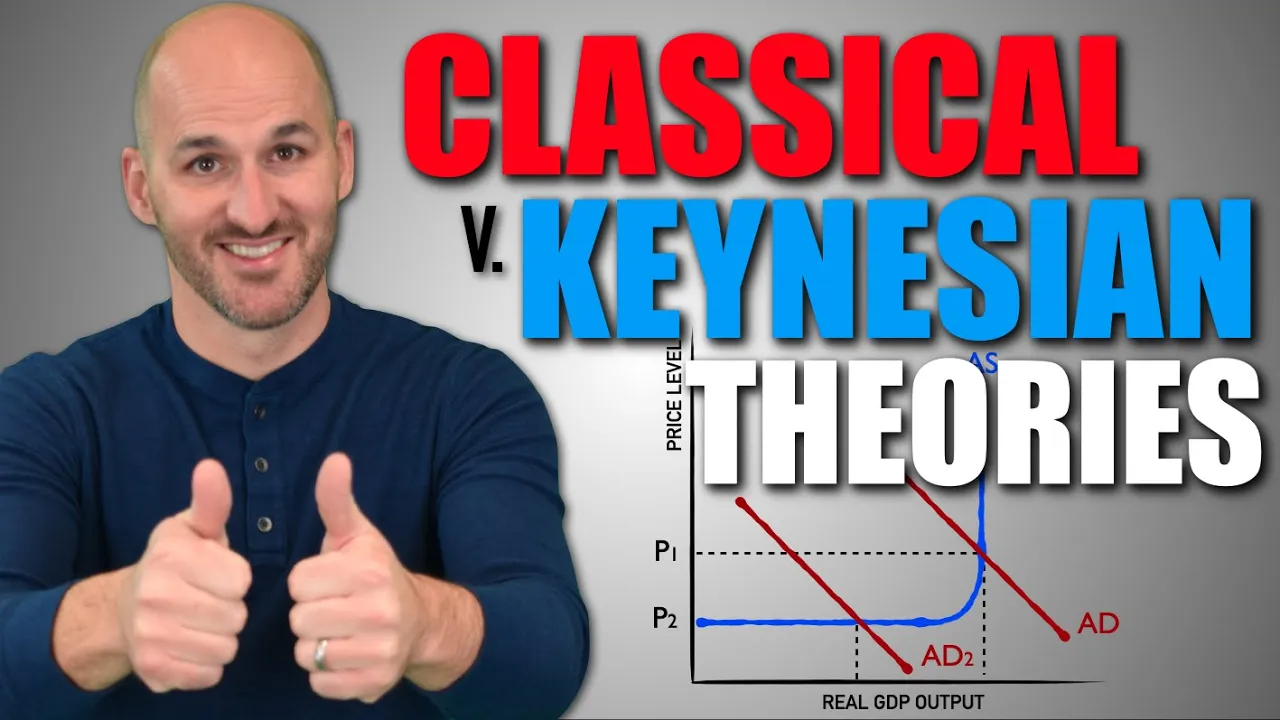







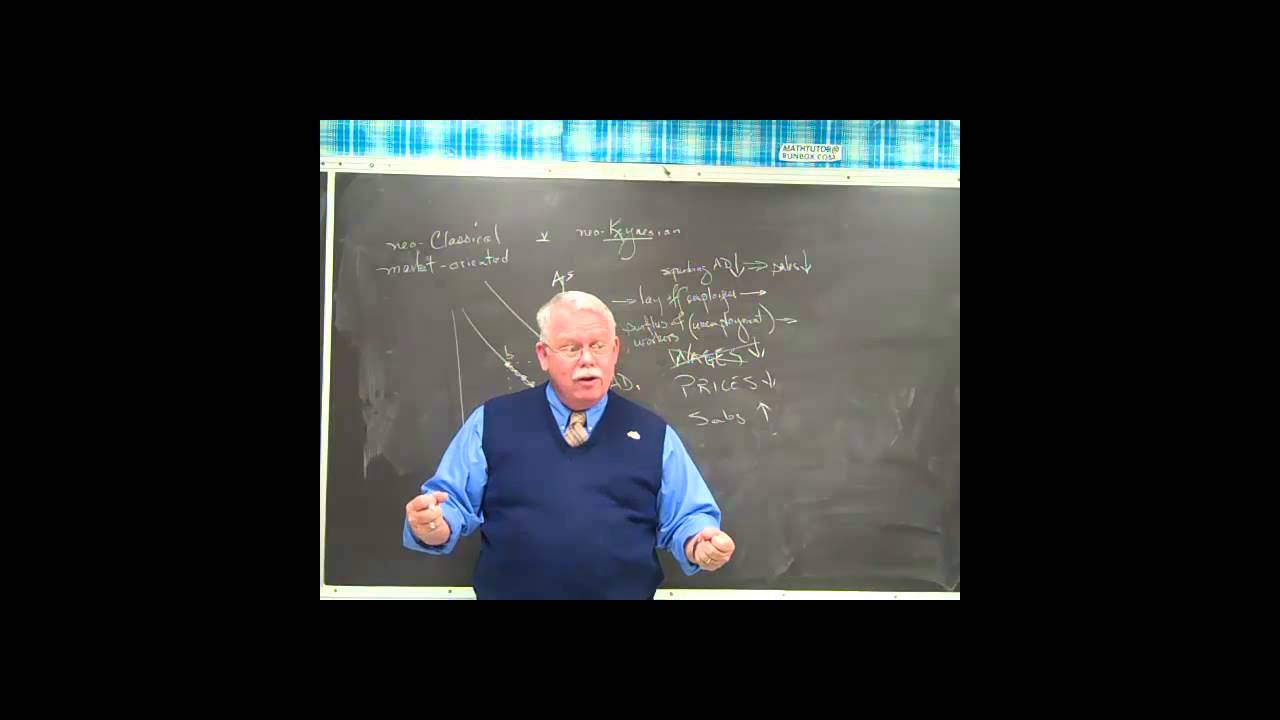

Classical economics, founded by Adam Smith, assumes free markets are stable with flexible prices and wages that automatically adjust to achieve full employment equilibrium without government intervention; in contrast, Keynesian economics, developed by John Maynard Keynes, views free markets as inherently unstable with sticky prices and wages that prevent automatic adjustment, necessitating government fiscal and monetary policy to achieve full employment and stabilize the economy.
Classical vs Keynesian Economics: Key Differences Explained
Added:Basic laws of supply and demand, and how market equilibrium is traditionally established.
Fundamental macroeconomic indicators such as Gross Domestic Product (GDP), inflation, and the definition of full employment.
The concept of the business cycle, including the phases of expansion, peak, contraction, and trough.
An introductory understanding of the roles of fiscal policy (government spending and taxation) and monetary policy (central bank actions).
The formal Aggregate Demand and Aggregate Supply (AD-AS) model, focusing on the differences between the vertical long-run AS curve and the upward-sloping short-run AS curve.
The Great Depression of the 1930s as a pivotal historical case study that challenged Classical theory and led to the rise of Keynesian economics.
Subsequent macroeconomic schools of thought that emerged to bridge or challenge these views, such as Monetarism (Milton Friedman) and the New Classical Synthesis.
Analyzing modern economic crises, such as the 2008 Great Recession and the COVID-19 economic downturn, to evaluate the effectiveness of Keynesian stimulus versus Classical austerity policies.
73.2K views1.6Klikes10:33Original Release: 2022-08-26
[Music] hello everyone welcome back to the channel of ecoholics so today i'm here in front of you sharing the most wanted topic from the students of ecoholics as well as every one of you so it's a video on the comparison of classicals and kinesions i have seen a number of students struggling with the concept of classicals and kinesions and the one thing which they are always coming is what are the differences how do we remember there are so many assumptions in classical so many assumptions and connections so how do we all remember that what are the major differences between them the classicals and connections are same on few pages but not exactly same on each and every page so in this video i will be taking you throughout the whole process that how you can remember the differences between them and what are the major differences on which we differentiate classicals as well as kinesions so let us see all right so when we start with kinesion or classical they are the first school of thought with which you are going to start your macro economics preparation for any exam you wish to give right so when we are talking about classical organism they are defining some sort of economy structure they are talking about that how are we going to reach our desired level of output if we are planning to do how the things are going to work in the economy so each and every assumption of theirs or each and every theory of theirs is based on the point that how are we going to reach the equilibrium output in the economy so for reaching the equilibrium level of output in the economy both of them have the different views so first i will be sharing all those views with you all right so the first point is about the structure of economy so the canadian says that free market economies are unstable whereas the classical say free market economies are stable so what happens is canadians have a belief that private sector is very unstable and it is that sector which is capable of bringing fluctuations in the economy over here whereas the classicals they believe that private sector is the sector which is going to stabilize the fluctuations so according to canadians if we leave the market free if we don't interfere in the market if we are leaving each and every force with the market itself with the private sector itself it's the economy is never going to be stable so they are unstable whereas the classicals believe that if we don't interfere in the working of the free market economies the market economies are always going to be at a stable point they are not going to fluctuate if we let them free so that is their first belief about the economy because to understand their procedure we should know what are their views on the economies after that what they talk about employment so why i have taken the employment to be my first point because when you talk about classicals the determination of output under classicals starts from the determination of employment because according to classicals the capital stock cannot change very rapidly it's just that when your employment will change that will bring an increase in the output so employment is a first point of starting under the classical that is why we are talking about it right here so connections according to canadians equilibrium is achieved here you can achieve equilibrium in the labor market in the employment market but full employment a very important point to bring a distinction between the classicals and canadians so full employment is something which is a very important point to bring distinction between the classicals as well as canadians according to clinicians full employment can never be reached whereas classical says that if you leave the market economies free it will always be maintained at the full equilibrium level of employment so full employment and full production is not the belief here it is not possible here so under employment is a possibility whereas in classical it's not a possibility so economies tend towards the full employment and full equilibrium a very important point to distinguish between the classicals and canadians after that we come to prices and wages because when we are talking about employment the next factor which comes is wages so classical is believed that prices and wages are fully flexible they took this thing as assumption that because you cannot hide information from the workers or from the employers so workers would know the perfect information about the prices so it means they are getting their wages they know about prices they know what are their real wages whereas the canadians believe that prices and wages are not fully flexible the wages are also sticky they cannot increase or decrease will not be accepted by the workers increase is not going to happen suddenly and because of these reasons the prices also tend to be little sticky in the short run as well so prices as well as wages are rigid here whereas in the classicals they are fully flexible and because of this reason we are going to understand one very important implication of classicals as well as kinesions now the next factor which differentiates classicals and canadians is that demand creates its own supply so kinesion is a model which is demand determined it says that whatever demand is created by the people of the economy that can be supplied whereas the classical say that supply creates its own demand so classical is a supply determined model whereas kinesion is a demand determined model classical had a belief that if you will produce a level of output even if your demand is lower because you are producing output you will employ people they will earn income and they will ultimately be consuming your product so whatever supply you are doing it will create its own demand whereas the canadians had the opposite belief now because we have already talked about structure of economy so government role is quite obvious because according to canadian the free market economies are unstable so we need government intervention but classical say that market economies are quite stable so we do not allow the interference of government under the classicals now after this thing fiscal and monetary policy which is again an instrument done by the government so if canadians are allowing the government interference they will be happy to accept the fiscal and monetary policy according to canadians fiscal and monetary policy they stabilize the economy so whenever there is some kind of distortion presented by the private sector the government can correct that with the help of fiscal and monetary policy so these policies are required whenever the economy goes into this equilibrium but in classical we don't need anybody we don't need interference by government so there is no role of fiscal and monetary policy over here let's come to aggregate supply so i told you that i will be telling you one very important implication of prices and wages assumption under classical and canadian now what happens classical say that prices and wages are quite flexible they are going to change whenever anything is going to be a change in the model so if we require wages to come down because the labor demand is down so that i can bring equilibrium again that will happen in classical but canadians don't support this idea they say even if labor demand is down people the employed people they are not going to accept the wage cut so in other sense the labor because the wages are not going to come down the employer is going to lay off the extra worker to save on the wage bill because of this reason since in classical prices and wages will fully flexible they are going to adjust to every disequilibrium and will bring equilibrium again so output will not be affected and as a reason of this aggregate supply is vertical because we are working at full employment prices and wages are always adjusting to maintain that full employment level so aggregate supply curve is going to be vertical over here for every price level i am going to have here okay so this is going to be this is my aggregate supply curve over here i have full employment level this is a s correct so it's going to be vertical because price change is not affecting the output because economy is already at the full employment level whereas the canadians believe that aggregate supply is upward sloping that is if you are going to increase the output the prices are going to increase because the prices are not known to the workers so they their wages will adjust slowly the prices will increase and because of these reasons the as is going to be upward sloping so this was all about the classical and kinesian comparison if you want more such comparisons please let us know in the comment section down below please like share and subscribe to the channel thank you everyone you
Up Next

9:24
Keynesian Economics and the Great Depression: FDR's New Deal
@Dawgmandede
40.5K views•2010-02-27

5:07
Impact of Yuan in Indo-Russian Trade Amid Sanctions
@WION
261.9K views•2022-07-01
10:33
Behavioral Economics Explained: Rationality, Nudges, and Risk
@crashcourse
1.1M views•2016-03-12

113:18
The Age of Easy Money: Fed & Inflation | Full Documentary
@frontline
21.2M views•2023-03-15
Related Study Plans & Knowledge Roadmaps
Structured learning paths in Economics
economics
Sovereign Debt: Defaults, IMF & Restructuring
01Introduction to Sovereign Debt & Government Bonds
02Debt Sustainability & Credit Ratings
03Anatomy and History of Debt Crises
+ 2 more learning modules
12h5 modules
Explore Roadmap
economics
Market Design: Matching Theory & Gale-Shapley
01Introduction to Market Design and Price-Free Markets
02Two-Sided Matching & The Gale-Shapley Algorithm
03School Choice Systems and Mechanism Design
+ 2 more learning modules
10h5 modules
Explore Roadmap
economics
Impossible Trinity: Forex, Capital & Policy
01Introduction to Monetary Policy and Central Banking
02Exchange Rates and International Capital Flows
03The Mundell-Fleming Model
+ 2 more learning modules
8h5 modules
Explore Roadmap
economics
Healthcare Economics: Market Failures & Systems
01Introduction to Healthcare Markets and Market Failure
02Asymmetric Information and Adverse Selection
03Moral Hazard and Insurance Design
+ 2 more learning modules
12h5 modules
Explore Roadmap