Probate is expensive due to multiple mandatory costs including filing fees (several hundred dollars), attorney fees ($3,200-$7,500 depending on jurisdiction), publication fees ($90-$190 per notice for 3-4 publications), certified mail costs ($7-$9 per notice), and additional fees for real estate transactions, appraisals, and auctions; these cumulative expenses make probate a costly estate administration process.
Understanding Probate Costs and Fees: A Comprehensive Guide
Added:Deep Dive
The fundamental definition and purpose of the probate court process in estate administration.

How to Start Estate Administration
130
Probate is an administrative court process that ensures orderly accounting and distribution of assets after death. The process involves filing documents with the court, including applications for executor/administrator appointment, inventory filings, and distribution reports. Key roles include: Power of Attorney (ceases at death), Executor (named in will), Administrator (appointed when no will), and Trustee (manages trusts). When there's no will, anyone with legal interest can apply as administrator, but must establish highest priority to the court. Administrators must post fiduciary bonds and may need court authorization to sell property. Without a will, there's greater uncertainty, costs, and delays.
Click to watch →

Wild Court Moments #47
41.9K
Probate court is a specialized court that handles cases involving estates after someone has died. When a person dies, their estate must go through probate court to determine who has the legal authority to manage and distribute the property. The court issues orders determining who is the executor or administrator of the estate. Only with such an order can a person legally negotiate or take actions regarding the deceased's property. The judge explained that the wife needs to go through probate court to be found or determined as the administrator of the estate, and that order would give her the right to negotiate on property rights.
Click to watch →
Understanding the executor office
8.7K
This section explains the probate process and estate administration. Probate is the act or process of proving a will before an authorized person. There are two kinds: probate in common form (granted in registry without formal court procedure) and probate in solemn form (final decree pronounced in open court with all parties cited). The difference is that common form is revocable while solemn form is irrevocable. A surrogate is an officer who grants letters testamentary and letters of administration. The estate address is the file number on the birth certificate, and the estate resides at that file number and cannot move elsewhere.
Click to watch →
What is Probate? | The American College of Trust and Estate Counsel
6.3K
Probate is the court-supervised process of validating a decedent's will and administering their estate, where a personal representative is appointed to gather assets, pay debts and taxes, and distribute remaining assets to beneficiaries; this process typically takes months, involves minimal court involvement unless disputes arise, and is not inherently expensive, though assets with beneficiary designations or joint ownership can avoid probate entirely.
Click to watch →

Probate and the administration of estates Q&A
20.3K
Probate is the legal process of administering a deceased person's estate, involving obtaining a grant of probate (when there's a will) or letters of administration (when there isn't), which proves the executor's authority to manage the estate; this includes duties such as registering the death, valuing assets and liabilities, calculating and paying inheritance tax, collecting and distributing assets, and keeping proper records. Executors have personal liability for their actions and can renounce their role or reserve power to step back if they choose not to actively participate. Probate is not always required—for jointly-owned property passing to surviving partners, or sole bank accounts under £50,000—but is mandatory for sole property ownership. The application process involves submitting inheritance tax returns (short-form for simple estates, long-form for complex ones) and can take 3-4 weeks for simple cases or longer for taxable estates. Legal costs are paid from estate funds, and appointing a solicitor can provide peace of mind and efficient coordination, particularly for complex estates or when multiple executors are involved.
Click to watch →
Deep Dive
Basic estate planning vocabulary, specifically distinguishing between a decedent, executor, administrator, and beneficiary.
Bond: Corporate Surety - Video Tutorial
1.3K
This section defines essential terminology for estate administration. A decedent is a person who has died. An executor is the person named in a will to administer the estate. An administrator CTA is appointed by the court when a decedent left a will but did not name an executor, or when the named executor cannot serve. An administrator handles estates without a probated will. A personal representative encompasses any appointed administrator (executor, administrator, or administrator CTA). Heirs are individuals who inherit when no will exists, while beneficiaries are those named in a will to inherit.
Click to watch →

sharing ng mga heirs, pag-uusapan!
218.1K
A decedent is the person who has died. The estate refers to the property owned by the deceased at the time of their death. When a person dies, their property becomes subject to inheritance laws and must be distributed according to legal guidelines.
Click to watch →

Lawyers for Learners Webinar: Estate Planning 101
133
Essential estate planning terms include: (1) Decedent - the person who is deceased; (2) Heir - who would inherit if there is no will (parents, then siblings, then children); (3) Beneficiary - a person designated in a will or other document to receive assets, commonly used in insurance policies; (4) Probate - the court process for administering and overseeing distribution of assets and payment of debts; (5) Testate - having a will; (6) Intestate - not having a will; (7) Last Will and Testament and Trust - written means of transferring assets to beneficiaries.
Click to watch →

I’m an executor! Now what? 2016
275
An executor is the individual nominated in a decedent's will and appointed by the court as the personal representative. An administrator is a person appointed by the court to handle the decedent's estate when there is no will. Both have the same fiduciary duties and obligations to beneficiaries. The key difference is that an executor acts under a will, while an administrator handles intestate estates where no will exists.
Click to watch →

WHAT'S THE DIFFERENCE BETWEEN, EXECUTOR AN ADMINISTRATOR OF AN ESTATE.
599
An executor is named in a will by the decedent to handle estate settlement, while an administrator is appointed by the probate court when there is no will; both serve as personal representatives with the same core duty to settle the decedent's estate.
Click to watch →
Deep Dive
The core differences between testate succession (dying with a valid will) and intestate succession (dying without a will).

(Family) Life Beyond Death || Family Life Togetherness Week of Prayer || 15th October 2025
345
Testate succession occurs when a person dies with a valid will. Executors apply for grant of probate, and the will is published in the Kenya Gazette for 30 days to allow objections. Intestate succession occurs when a person dies without a valid will. Close relatives apply for letters of administration, requiring a letter from the area chief, publication in the Kenya Gazette, and court confirmation. The administrator has six months to trace assets. The law does not recognize 'illegitimate children' and all children have equal inheritance rights.
Click to watch →

Herencias: diferencia entre las sucesiones intestadas y las testadas | Tip Legal | El Espectador
2.8K
In Colombian succession law, intestate succession (without a will) follows a legal hierarchy where the law determines heirs: first descendants (children, grandchildren), then ascendants and spouse, then siblings and spouse, then nephews/nieces, and finally the state; testate succession (with a will) allows the deceased to distribute assets according to their wishes, but they must reserve 50% of their estate for 'legitimaries' (descendants and ascendants) who cannot be disinherited regardless of the will.
Click to watch →
ethiopian law of succession part 1 በአማርኛ
1.6K
Testate succession occurs when a valid will exists, while intestate succession applies when no will exists. A person must be alive at the time of death to inherit (survivorship requirement). When multiple people die simultaneously in the same incident, the law presumes they died simultaneously, and neither can inherit from the other. Each estate is distributed separately according to its own inheritance rules.
Click to watch →

Carmen Gloria a tu servicio | Capítulo 8 de septiembre 2023: La hermandad que nos queda.
254K
Testate succession occurs when a person dies with a valid testament, while intestate succession occurs when a person dies without a testament. In testate succession, the court follows the instructions in the testament. In intestate succession, the property is distributed according to legal rules, typically favoring close family members. The process differs significantly between the two scenarios.
Click to watch →

Civil Law | The Frequently Asked Topics on the 8 Bar Subjects
9.7K
Succession transmits property rights through death by will or law. Testate succession divides estate into legitim (50% for compulsory heirs) and free portion (50% testator can dispose). Intestate succession goes entirely to compulsory heirs. Ownership opens at moment of death, so heirs can sell shares immediately but cannot sell future inheritance (nemo dat quod non habet). Joint wills are prohibited except for foreigners executing them abroad. Valid will requirements: in writing, in language known to testator, subscribed by testator, witnessed in presence of testator and each other, marginal notes and numbered pages, and attestation clause stating page count, testator's signature, and witnesses' signatures.
Click to watch →
Deep Dive
The distinction between probate assets (subject to court distribution) and non-probate assets (which pass directly to co-owners or beneficiaries).

Probate vs. Non-probate Assets | Estate Planning TV 007
1.3K
Non-probate assets are those that pass to beneficiaries outside the probate process, including life insurance, retirement accounts, investment accounts, and bank accounts with transfer-on-death designations, while probate assets require court supervision for distribution; in Washington State, real property can now be designated to transfer upon death outside of probate through transfer-on-death deeds.
Click to watch →

Probate vs Non-Probate Assets Explained ⚖️💰 #shorts #lawyer #law
1.5K
Probate assets are those that go through the probate process and are subject to the jurisdiction of probate court, meaning they are subject to creditor claims. Non-probate assets are assets that do not go through the probate process, are not subject to court jurisdiction, and are not subject to paying creditor claims.
Click to watch →
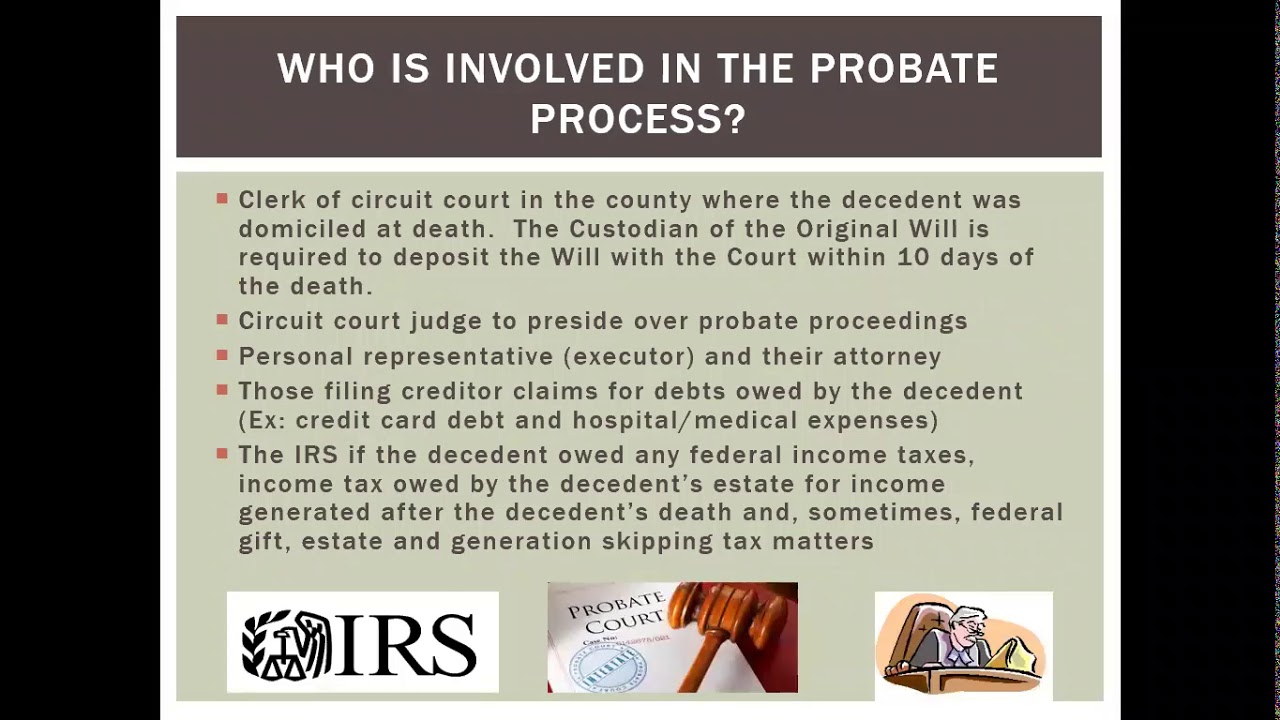
Understanding the Probate Process
102
Probate assets are those titled in the decedent's sole name, including bank accounts, life insurance, annuities, IRAs without beneficiary designation, and real estate in sole name or as tenants in common. Non-probate assets transfer directly to beneficiaries or surviving owners, including assets with right of survivorship, joint accounts with survivorship, and property owned as tenants by the entirety (for spouses). Probate is necessary to transfer legal title of assets to beneficiaries, and without a will, Florida intestacy statutes determine inheritance priority.
Click to watch →

An Introduction to Probate Court: Inventory and Appraisement
5K
Probate assets pass under the will or through state intestacy laws, while nonprobate assets pass directly to beneficiaries without court involvement. Nonprobate assets are controlled by contracts or law rather than the will. Examples include life insurance policies, joint bank accounts, IRA accounts, and 401K accounts. Jointly owned property with right of survivorship, such as cars or checking accounts, passes directly to the surviving owner. Both types of assets must be listed on the inventory and appraisement form, though county requirements for nonprobate assets may vary.
Click to watch →
I Asked Lawyers About Probate vs Non-Probate Assets Here's What They Said
196
Assets are classified as probate or non-probate based on ownership structure and beneficiary designations: probate assets go through court oversight and creditor claims, while non-probate assets transfer directly to designated recipients. Life insurance with beneficiaries and joint bank accounts are typically non-probate, whereas real estate owned by a single person or held as tenants in common goes through probate. Joint tenants with rights of survivorship avoid probate by automatically transferring to the surviving owner upon death.
Click to watch →
Prerequisite Knowledge
- Concept 01The fundamental definition and purpose of the probate court process in estate administration.
- Concept 02Basic estate planning vocabulary, specifically distinguishing between a decedent, executor, administrator, and beneficiary.
- Concept 03The core differences between testate succession (dying with a valid will) and intestate succession (dying without a will).
- Concept 04The distinction between probate assets (subject to court distribution) and non-probate assets (which pass directly to co-owners or beneficiaries).
Subsequent Learning
- Step 01The mechanics of establishing and funding a Revocable Living Trust to successfully bypass the probate court.
- Step 02Utilizing alternative asset-transfer designations, including Payable-on-Death (POD) bank accounts and Transfer-on-Death (TOD) deeds.
- Step 03An analysis of 'Small Estate' affidavits and summary administration procedures for qualifying lower-value estates.
- Step 04The legal duties, fiduciary standards, and potential liabilities associated with acting as an estate executor.
- Step 05Distinguishing probate expenses from federal and state estate/inheritance taxes, and tax minimization planning.
Cost Breakdown
Extra Fees & Fix
Cost Breakdown
0:00Playing Section
- 1
Filing fees and attorney costs form the bulk of probate expenses.
- 2
Publication and certified mail notices add significant hidden charges.
The Strategic Advantages and Protections of the Probate Process
While mainstream financial advice heavily emphasizes avoiding probate due to perceived costs and delays, estate planning experts highlight several critical benefits of the process. Probate provides structured, court-supervised dispute resolution, which is invaluable for estates with complex family dynamics or potential litigation. Crucially, probate initiates a strict statutory 'creditor claim period' (often just 3 to 6 months). Once this window closes, outstanding creditors are legally barred from making claims against the estate's assets, offering beneficiaries permanent closure that non-probate transfers (like trusts) may not automatically guarantee. Furthermore, in states with streamlined 'informal' probate laws, the actual costs and timelines of probate are often minimal, making the expensive upfront fees of creating and maintaining living trusts financially impractical for simpler, uncontested estates.
Deep Dive
The mechanics of establishing and funding a Revocable Living Trust to successfully bypass the probate court.
#1 Reason Revocable Living Trusts Fail to Avoid Probate!
299
A revocable living trust only avoids probate if it is properly funded by retitling assets (such as real estate, bank accounts, vehicles, and personal property) into the trust's name; the most common reason these trusts fail to avoid probate is that assets remain titled in the individual's name rather than being transferred to the trust.
Click to watch →
How Can You Avoid Probate?
893
Probate is a court-supervised process that manages a person's financial affairs when they are incapacitated or deceased, and it can be avoided by establishing a fully funded revocable living trust, which acts as a private rule book for asset management that bypasses court oversight; however, simply creating a trust is insufficient—the trust must be properly funded by transferring assets into it through updated titling and beneficiary designations to ensure those assets pass according to the trust's instructions without probate.
Click to watch →

HOW TO FUND YOUR REVOCABLE LIVING TRUST// Transferring Assets Into Your Trust
66.2K
A revocable living trust must own the assets it is intended to control; this is achieved by transferring real estate through a quick claim deed, naming the trust as beneficiary on financial accounts, and executing a personal property assignment for personal possessions, with the key requirement that all assets must be transferred into the trust to avoid probate.
Click to watch →

Funding a Revocable Trust | Brandon, FL Elder Law Attorney
177
A revocable living trust must be properly funded by transferring and retitling assets (such as real estate and bank accounts) into the trust during the grantor's lifetime to avoid probate; if assets remain in the individual's name, the trust fails to serve its purpose and beneficiaries may still need to go through probate.
Click to watch →
Probate Attorney Explains How To Avoid Probate
2.2K
A revocable living trust is the most common tool for avoiding probate. Assets titled in the trust's name bypass probate entirely. The trust designates a successor trustee who can sell assets, access funds, and distribute to beneficiaries without court involvement. Benefits include: (1) Single trustee handles all transactions efficiently, especially important with multiple heirs. (2) Successor trustee can manage assets during owner's incapacity more reliably than powers of attorney. (3) Assets remain in trust for beneficiaries, providing divorce protection and financial management safeguards.
Click to watch →
Deep Dive
Utilizing alternative asset-transfer designations, including Payable-on-Death (POD) bank accounts and Transfer-on-Death (TOD) deeds.

Đừng Làm Living Trust Nếu Chưa Biết 3 Rủi Ro Này: Bí Mật Luật Sư Ít Khi Nói Với Người Việt Tại Mỹ!
3.4K
For those seeking to pass assets to heirs without the complexity of living trusts, POD (Payable on Death) for bank accounts and TOD (Transfer on Death) for securities, vehicles, and in some states, real estate offer simpler alternatives. These are typically free to establish and require only a death certificate to transfer assets. Critically, because these assets are not transferred immediately upon death, they do not affect SSI or Medicaid eligibility. The grantor retains full control and ownership until death, making these options safer for those receiving government benefits.
Click to watch →

Legacy Luxe What We Learned TODAY? 🧐 W6: Transfer With EASE
529
Payable on Death (POD) and Transfer on Death (TOD) designations are beneficiary designations for financial accounts and assets that allow assets to pass directly to beneficiaries without going through probate. For example, if you designate someone as payable on death on your bank account, they can walk into the bank with a death certificate and ID and receive the funds directly. Similarly, TOD applies to investment accounts, brokerage accounts, vehicles, and sometimes real estate. These tools turn assets into non-probate assets that skip the court process entirely, providing an express lane for asset transfer.
Click to watch →

Conscious Caregiving with L & L "Legalities & Seniors"
142K
Transfer on death (TOD) and pay on death (POD) designations are inexpensive ways to handle bank accounts. They allow the account to pass directly to the beneficiary without going through probate. Banks don't typically ask about these options, so caregivers should specifically ask about them. These designations keep assets out of someone's estate until that person passes away.
Click to watch →

Helpful Form Seniors Can File to Protect Bank Accounts – 2026 Overview
1.9K
For standard bank accounts (checking, savings, money market), the form is called a payable on death (POD) designation. For investment or brokerage accounts, it is called a transfer on death (TOD) designation. Both work on the same principle: you name a beneficiary directly on the account. When you die, that beneficiary brings a certified death certificate to the bank and funds are released. No probate, no court, no creditor waiting period, no attorney fees. Processing time varies by institution, from same day to 3-5 business days, but never 11 months. The designation is a contractual instruction attached directly to the account, living in the contract layer rather than the probate layer, so it supersedes any instruction in a will or unfunded trust.
Click to watch →
Lawyers for Learners Webinar: Estate Planning 101
133
Transfer on Death (TOD) designations, also called Payable on Death (POD), allow assets to pass to beneficiaries without going through probate. These can be used for investment accounts, financial accounts, and bank accounts. For real estate, a Transfer on Death Deed allows the asset to avoid probate. TOD designations are like beneficiary designations in insurance policies - you designate who receives the asset when you die. These are useful for passing assets to loved ones quickly and privately.
Click to watch →
Deep Dive
An analysis of 'Small Estate' affidavits and summary administration procedures for qualifying lower-value estates.
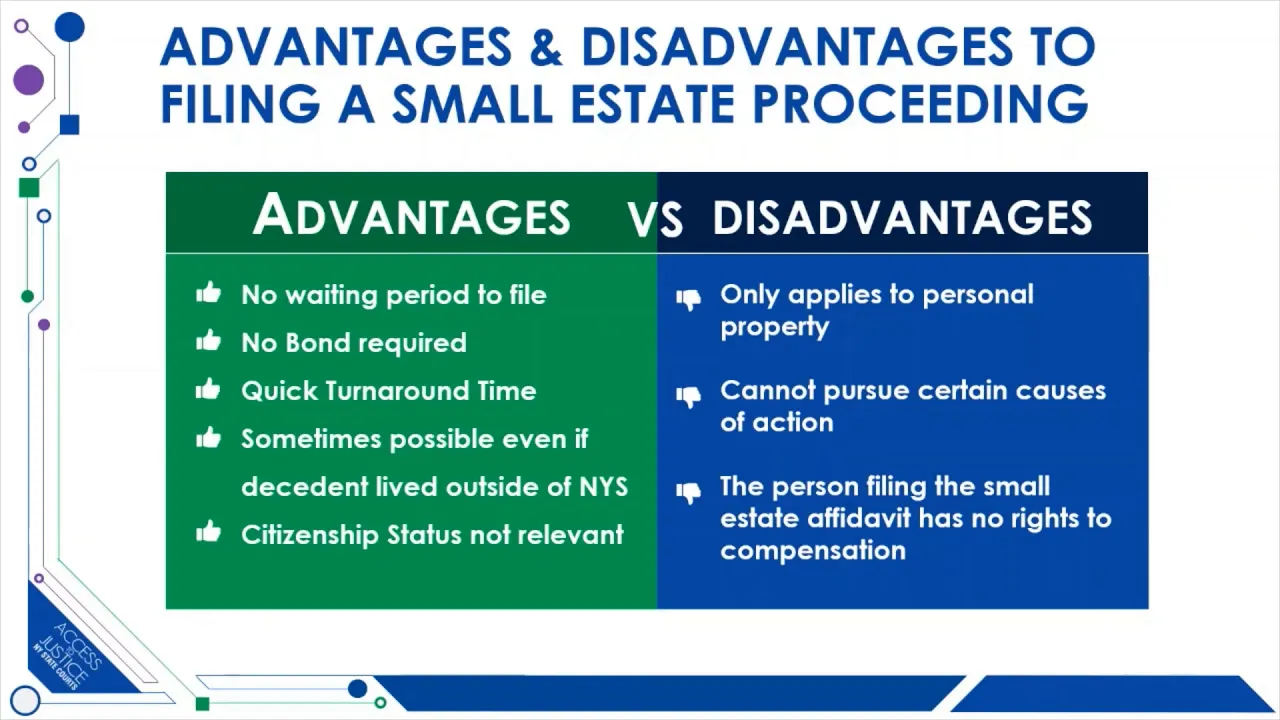
Accessing Justice During COVID-19: Information for People without an Attorney
369
This comprehensive section covers estate administration in New York State. A small estate affidavit is a court proceeding used when a person passes away and their property needs to be accessed or tasks involving their property need completion with authorization. To qualify, the estate value must be $50,000 or less, regardless of whether the deceased had a will. Priority to file depends on will existence: with a will, priority goes to executor, then successor executor, then beneficiaries, then distributees; without a will, priority goes to spouse, then children/grandchildren, then deceased parents, then siblings/nieces/nephews, then aunts/uncles. Required documents include death certificate, $1 filing fee, original will (with copy made without removing staples), and NYPD property voucher if applicable. The DIY form program on nyCourts.gov simplifies paper preparation. During the pandemic, virtual notarization and e-filing through NICEST are accepted. The voluntary administrator's responsibilities include collecting assets, paying debts, distributing remaining balance, and filing asset statements. An administration proceeding is used when the deceased did not have a will AND either the estate exceeds $50,000 OR contains real property. Section 1001 of the Surrogate's Court Procedure Act lists eligible people in priority order. Non-marital children need order of affiliation or acknowledgment of paternity for father's estate. Ineligible persons include infants under 18, incompetent persons, felons, and non-domiciliary aliens (who can serve as co-administrators). Filing fees are based on estate value. Papers must be filed with the Surrogate's Court in the county where the decedent was domiciled. Waivers are filed by competent adults with prior or equal right to letters of administration. If waivers aren't signed, citations are needed to get jurisdiction over distributees. The bond requirement protects creditors' and distributees' rights; if all distributees consent, the court may waive it. If objections are filed, the judge sets schedule for proceedings. If no objections, the judge issues decree granting petition.
Click to watch →
How to File Summary Administration in Florida | Step-by-Step Probate Guide.
161
Summary Administration is a simplified probate process in Florida for estates valued below a certain threshold or for decedents who have been deceased for more than 2 years, allowing asset transfer without lengthy court proceedings; the process requires gathering a death certificate, asset list, and will (if any), preparing a sworn petition for summary administration signed by all beneficiaries or with their written consent, filing it with the probate court in the county where the decedent owned property along with the filing fee, and waiting for court approval before distributing assets to beneficiaries.
Click to watch →

What Is A Small Estate Affidavit?
761
A small estate affidavit is a two-page legal document used in Washington State to liquidate assets without probate, but it can only be used when three specific conditions are met: the estate value must be under $100,000, there must be no real estate, and there must be sufficient assets to pay all debts; additionally, national banks may not process this document, potentially requiring formal probate instead.
Click to watch →

California Small Estate Affidavit - Everything You Need to Know
10K
A small estate affidavit is a legal document in California that allows beneficiaries to collect and distribute assets from an estate worth less than $166,250 (excluding vehicles and vessels) without going through probate court; the process requires waiting 40 days after death, obtaining a certified death certificate, creating an itemized asset list, gathering proof of ownership, completing Form DE-221 (for spouses) or DE-160/GC-040 (for non-spouses), signing and notarizing the affidavit, filing it with the probate court in the deceased's county of residence for a $435 fee, and presenting it to third parties to recover assets, though separate forms are needed for real estate transactions.
Click to watch →

Probate Consultation Part 3 – Getting Qualified as Executor (Who’s in Charge of the Probate Train?)
265
A small estate is defined as having probate assets under $50,000. When assets are below this threshold, formal probate is not required. Beneficiaries can use a small estate affidavit (statutory form) to transfer assets. Requirements include: the decedent must have been dead for a specified number of days, if a will exists it must be filed with the probate office, and all beneficiaries must sign the affidavit. This tool is commonly used for bank accounts, stocks, bonds, and vehicles with de minimis values.
Click to watch →
Deep Dive
The legal duties, fiduciary standards, and potential liabilities associated with acting as an estate executor.

Paris Jackson Slams Michael Jackson's Estate Over Legal Disputes & Wasting Resources | Legally Us
1.2K
Executors can be held personally liable through surcharge when they breach fiduciary duties causing financial loss to estates. Key breaches include self-dealing (using estate assets for personal benefit), conflicts of interest, and over-litigation (unnecessary legal battles causing waste). Courts assume executors act in good faith, placing the burden of proof on claimants to demonstrate clear misconduct. Proving over-litigation is difficult due to the subjectivity of legal strategy, while proving personal benefit is easier through forensic accounting. The standard requires actions exceeding reasonable conduct expected in those circumstances.
Click to watch →

Law of succession - interpretation of wills - PVL2602 - P16
8.5K
Executors hold positions of trust requiring disclosure of personal interests and prohibition against secret profits. Letters of executorship authorize asset administration. Legal duties mandate preserving and liquidating estates. Executors need court permission to purchase estate property. These obligations ensure proper estate management and protect beneficiaries' interests throughout the administration process.
Click to watch →

Monongalia County Commission Oct. 2, 2019
253
West Virginia Code Section 44-1-3 requires executors to faithfully perform their duties to the best of their skill and judgment. This fiduciary duty is described as the highest standard of duty implied by law, as established by courts across the country. Executors have a legal obligation to protect estate assets, ensure creditors are paid, and distribute assets to heirs according to the will or intestacy laws. This duty creates a legal and ethical responsibility that cannot be violated, even under court orders that would require the executor to participate in fraudulent activities.
Click to watch →

Fiduciary Duties and Wrapping up the Estate: Module 5 of 5
620
Executors serve as fiduciaries who must manage estates in good faith, defending the testator's intentions while ensuring creditors are treated fairly, taxes are filed, and assets are distributed properly; failure to meet these fiduciary responsibilities constitutes a breach that can result in removal, loss of bond, and personal liability, while the estate administration process varies significantly between small/summary administrations (requiring minimal court oversight) and formal/supervised administrations (requiring detailed accounting, court approval, and resolution of all claims before closure).
Click to watch →

กฎหมายลักษณะมรดก กรณีคดีคุณ "แตงโม"
403
An estate executor has five main duties: (1) Collect and inventory all estate assets; (2) Pay the deceased's debts from estate assets; (3) Manage and preserve estate property; (4) Distribute assets to heirs according to legal provisions or the will; (5) Perform other necessary acts to settle the estate. The executor must act according to court orders or the will and cannot make decisions benefiting themselves at others' expense. An executor can be removed for: failure to perform duties, neglect, misconduct, or conflict of interest (particularly if also an heir disqualified from inheritance). An estate consists of three components: assets, debts, and claims. Heirs receive assets but must settle debts from estate assets, up to the value of what they receive.
Click to watch →
Deep Dive
Distinguishing probate expenses from federal and state estate/inheritance taxes, and tax minimization planning.

Estate Planning (3 of 3)
116
Estate planning should include planning for federal and state estate and inheritance taxes. Not many people qualify for these taxes, but those that do face high rates (up to 40%). These things change frequently, with exemptions being much lower than before and rates potentially changing in the future.
Click to watch →

06 02 wisdom webinar welathy or not your estate matter
187
Most states have probate fees, though Pennsylvania has relatively low fees (approximately $1,300 for $1 million in assets). Many states also have inheritance or estate taxes, though the federal estate tax threshold is $11.7 million. While these costs may not be significant for most people, they can be substantial for those with larger estates. Estate planning can help minimize these costs.
Click to watch →

When One Spouse Dies, The Other Pays More Tax — Here’s How To Stop It
570
A will does not avoid probate; it is your ticket into it. A living trust only works if assets are actually inside it. Many people face state estate taxes (death taxes) that are smaller than federal estate tax but still significant. Probate can cost $60,000-$100,000 and take up to 24 months. Additionally, states may impose estate taxes on top of probate costs. The fix is to have a fully funded living trust with proper provisions to capture each spouse's estate tax exemption.
Click to watch →

Do You Have to Pay Tax on a Large Inheritance
8.4K
Probate is not a tax but a legal process for transferring assets through a will after someone's death. It involves court oversight and attorney fees for service. Many states offer small estate affidavits that simplify the process for estates below certain thresholds. This is distinct from estate or inheritance taxes, which are actual taxes imposed on the value of assets.
Click to watch →

Estate Planning: Should You Avoid Probate? Legal Guide
30.3K
Probate creates significant emotional and financial stress for families. When heirs discover estate value shortly after death, they may act as if they already own assets, leading to stress when delays occur. Market fluctuations during settlement cause additional stress. Probate expenses include lawyer fees, court filing fees, and accounting requirements. The largest expense is typically hiring a lawyer. Income generated by estate assets during administration is subject to estate income tax, with estates paying the highest rate (37%) on income exceeding $12,950.
Click to watch →
Cost Breakdown
Extra Fees & Fix
Cost Breakdown
0:00- 1
Filing fees and attorney costs form the bulk of probate expenses.
- 2
Publication and certified mail notices add significant hidden charges.
The Strategic Advantages and Protections of the Probate Process
While mainstream financial advice heavily emphasizes avoiding probate due to perceived costs and delays, estate planning experts highlight several critical benefits of the process. Probate provides structured, court-supervised dispute resolution, which is invaluable for estates with complex family dynamics or potential litigation. Crucially, probate initiates a strict statutory 'creditor claim period' (often just 3 to 6 months). Once this window closes, outstanding creditors are legally barred from making claims against the estate's assets, offering beneficiaries permanent closure that non-probate transfers (like trusts) may not automatically guarantee. Furthermore, in states with streamlined 'informal' probate laws, the actual costs and timelines of probate are often minimal, making the expensive upfront fees of creating and maintaining living trusts financially impractical for simpler, uncontested estates.
The fundamental definition and purpose of the probate court process in estate administration.
Basic estate planning vocabulary, specifically distinguishing between a decedent, executor, administrator, and beneficiary.
The core differences between testate succession (dying with a valid will) and intestate succession (dying without a will).
The distinction between probate assets (subject to court distribution) and non-probate assets (which pass directly to co-owners or beneficiaries).
The mechanics of establishing and funding a Revocable Living Trust to successfully bypass the probate court.
Utilizing alternative asset-transfer designations, including Payable-on-Death (POD) bank accounts and Transfer-on-Death (TOD) deeds.
An analysis of 'Small Estate' affidavits and summary administration procedures for qualifying lower-value estates.
The legal duties, fiduciary standards, and potential liabilities associated with acting as an estate executor.
Distinguishing probate expenses from federal and state estate/inheritance taxes, and tax minimization planning.
152 views6likes3:30@CortesLawFirmOriginal Release: 2022-02-05
Why is probate so expensive?
The simple answer is, well, there's a lot of costs and expenses that go into probate.
first of all, there are filing fees and depending on your jurisdiction, it can be several hundred dollars just to file a probate down at the courthouse.
The next thing is, of course, attorney fees.
We don't work for free.
And depending on your jurisdiction, the attorney fees are probably going to make up the bulk of the probate costs.
Just like I answered in the question regarding what it costs to probate, the attorney fees, costs and everything can be from $3,200 to about $7500, depending on your jurisdiction.
It could be a lot more where you live.
It just depends on your jurisdiction.
The next cost is publication fees.
one thing that people don't realize when you do a probate is there has to be a lot of publication of notices in a probate.
Every time there is a hearing, the judge will issue an order for notice of that hearing.
That notice of hearing has to be published in the newspaper.
Usually ten days prior to the hearing.
Now, in a probate, there might be three or four different publications.
And depending on the newspaper and how many words are in that publication, it can cost you anywhere from 90 to about 180 $190 for each individual notice.
The next thing that people don't realize is during a probate.
The next thing is postage usually, especially if there is real estate during a probate, just like we had to publish those notices.
We usually always send notices to beneficiaries and other interested parties by certified U.S.
mail, and that is not cheap.
Every single one of those notices can cost between $7 and $9, depending on where we're sending it to and how much paper we are sending to them.
So there is a lot of expenses that can go into a probate that doesn't even take into account.
Realtor fees, title company fees, auctioneer fees if we have to auction things off, appraisal fees is another big one that a lot of people don't realize if there's real estate involved.
Then we usually have to get an appraiser involved in the case if there's personal items or artwork or cars that have some sort of value.
We will usually always have to get those appraised as well, and I can tell you that that is not an inexpensive cost.
So there is a lot of expenses that go into probating an estate, and that's why it usually costs so expensive.
Like I said in the last one, about $3,200 to about $7500 from start to finish.
The simpler way and maybe the less expensive way is to get a revocable living trust centered estate plan set up so that your family avoids the probate process completely.
Up Next
15:40
Understanding Intestate Probate Procedure: A Legal Guide
@estateplanningseries
227K views•2020-03-01

4:27
US Secondary Sanctions Impact on EU Businesses and Blocking Legislation
@Bureauvandijk
1.6K views•2019-03-20

5:27
Forensic Phonetics: Speaker Identification in Legal Cases
@nptel-nociitm9240
539 views•2025-03-19

24:42
Police Interrogation Tactics: False Confessions & Legal Reform
@LastWeekTonight
7M views•2022-04-18
Related Study Plans & Knowledge Roadmaps
Structured learning paths in Law
law
Self-Defense Law: Imminence & Castle Doctrine
01Foundations of Self-Defense Law
02Imminent Threat & Reasonable Belief
03The Principle of Proportionality
+ 3 more learning modules
12h6 modules
Explore Roadmap
law
Defamation Law: First Amendment & Actual Malice
01Introduction to civil torts and the First Amendment
02Elements of Defamation: Libel and Slander
03Public Figures vs. Private Individuals
+ 2 more learning modules
8h5 modules
Explore Roadmap
law
Hearsay Rule: Trial Evidence & Exceptions
01Introduction to Trial Evidence & Courtroom Basics
02Demystifying Hearsay: The Core Definition
03Non-Hearsay: Exclusions Under FRE 801(d)
+ 3 more learning modules
14h6 modules
Explore Roadmap
law
Medical Malpractice: Law, Liability & Care
01Foundations of Tort Law and Civil Liability
02The Four Elements of Medical Malpractice
03Defining and Proving the Standard of Care
+ 2 more learning modules
12h5 modules
Explore Roadmap