




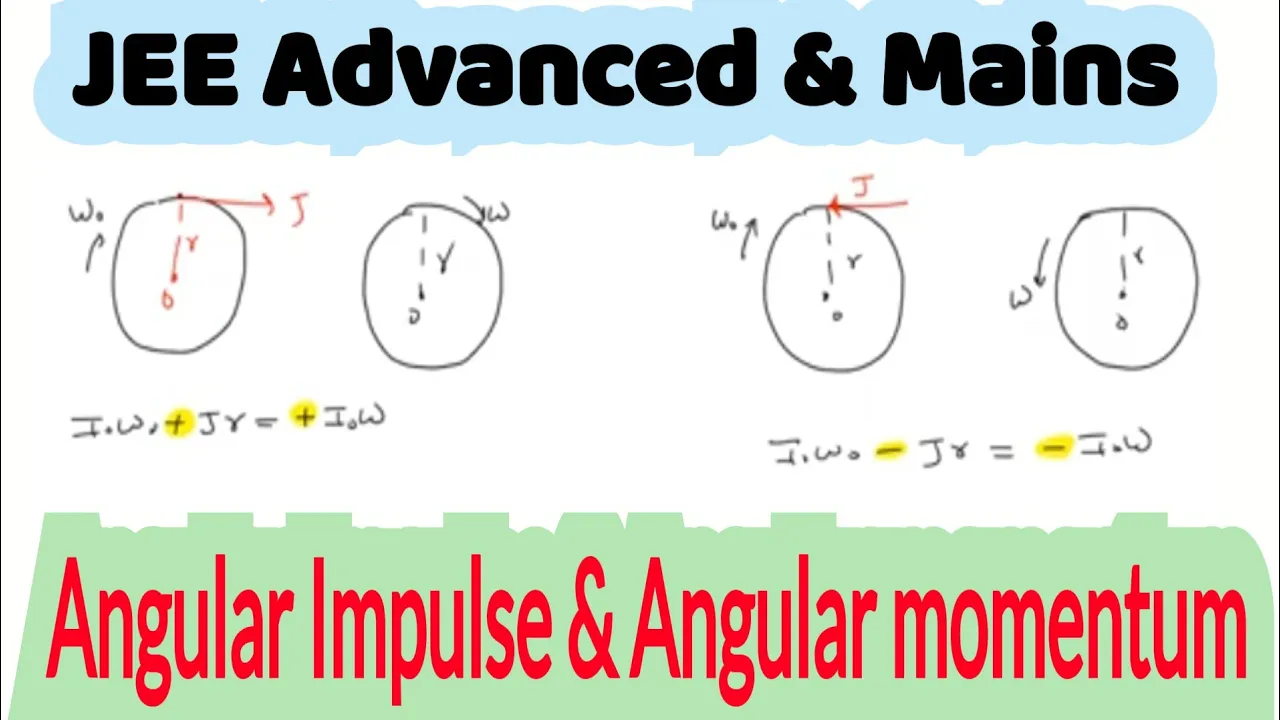











When two pivoted rods collide, angular impulse is conserved about the pivot points; for rod AB with initial angular velocity ω₀ and final ω₁, and rod CD initially at rest, the angular impulse J×(L/2) equals the change in angular momentum (I×ω), allowing calculation of CD's final angular velocity ω₂ using the relationship between the impulses and moments of inertia of both rods.
Angular Impulse in Collision of Two Pivoted Rods | JEE Physics
Added:Moment of Inertia of rigid bodies, particularly uniform rods pivoted at one end (I = 1/3 * M * L^2).
The definition and formulation of Angular Momentum (L = I * omega) for rotating rigid bodies.
The Rotational Impulse-Momentum Theorem, understanding how torque integrated over time relates to change in angular momentum.
Basic principles of collisions, including the Coefficient of Restitution (e) and line of impact.
Collisions of free (unpivoted) rigid bodies in 2D space, involving simultaneous conservation of linear and angular momentum.
The concept of the Center of Percussion (or 'sweet spot') in pivoted rotating bodies to minimize hinge reactions during impact.
Calculating kinetic energy dissipation and thermal energy losses during partially elastic or inelastic rotational collisions.
Analyzing complex constraints and joint reactions in multi-link robotic arms or pendulums during sudden loading/impact.
160 views2likes6:33Original Release: 2023-03-19
and we have this around like this so you can try these two pencils you take it there are two pencils are there and with that two pencils you are making one pencil you keep it this one hold with your finger here with other pencil what happened you you rotate this word Omega naught so there's a rod a b they're old CD we have this angle Theta also okay this one and note this addressed at the midpoint exactly it will strike it the information it has given it P will write it for the shade of this round it tests so what is the question before Collision angle speed of a b is 4 radian per second anti-clockwise and CD is attached if angular speed of a b after Collision is one radians per second anti-clockwise so after Collision weapon it will become anti-clockwise no is asking the angular speed of Rod CD after Collision diagram there's no other way draw the diagram uh so I nowadays I'm scolding because uh because I had to if you go drastically some either way from science no as a teacher what happened I have to separate thing so don't take another way all right because my scoldings is for your better future only because why I'm scolding is means when you go for drastic thinking no so I should make it alert if I tell very sweetly no you may think okay I'm doing okay some minor mistake please don't take it another way hmm okay come for this one so he's telling uh this much is this Omega what can x what will happen here let's see I'll take it to this because we have to show me other things yeah uh sir Omega is anti-clockwise yeah I think I'm correct now if angle speed of a b after collusion is one radian per second anti-clockwise thanks yeah get into the problem whose LP are going to take that's what your trans question how to auto solve this whose help you are going to take it take two pencil sign one pencil you keep it on table other pencil with that you try to rotate and see what conditions will come that's all nothing big any impulse will act yes some impulse will act that impulse I'll show it here so that that impulse will act J on this Rod like this J on this road in this direction the simplest acting will make the rod this particular Rod to rotate in Omega 1 will write it Omega 2.
okay we'll write the equation for this uh like is it can you Omega naught uh what is the impulse so J cos Theta I'll resolve a component of impulse this will be how much it will be this is 90 minus Theta this is Theta no so J cos Theta will act here J cos Theta uh how that angle impulse opposite to that so minus J cos Theta into l is equal to I a Omega 1 so do we know Omega 1 as doing Omega naught as we know I a and what is I a ml Square okay Finish leave it so we get the value of J from the value of J so can I can I bring so what make the round C to the same impulse G so here this is on rod Maybe on Rod CD J into L by 2 initial angle momentum 0 J into L by 2 should be equal to ml Square by 3 into Omega 2.
so calculate the value of J from here substitute and so on we'll get the expression for Omega 2.
this see that nothing big no need to do anything here don't say I'll apply don't say that uh I'll apply a conversion of anglementary about B can you apply there'll be some impulsive reactions will act as the engine snow so the full angle atom is not conserved say here some impulses will come here some impulse will come very difficult to find out them so just leave it so better to go for angle impulse angular momentum equation I'll scroll down I'll scroll down see J sine Theta what this J sine Theta will do they'll be it backing like this there will be also centrifugal force Ang diversity will change so impulsive reactions do come here impulse reaction will also come here because the impulse acting open will try to Mono so the impulsive reaction here will act in this
Up Next

12:27
Pulley Mechanical Advantage: Fixed, Movable, and Compound Systems
@ScienceOnline
405.6K views•2007-04-16

12:53
21cm Hyperfine Transition in Neutral Hydrogen: Radio Astronomy Basics
@AaronRobertParsons
12.4K views•2011-10-13

32:32
NMR Spin Physics I: Zeeman Effect, Resonance Condition & Larmor Frequency
@nptel-indianinstituteofsci8064
2.3K views•2024-01-17

27:14
Entropy and the Second Law of Thermodynamics Explained
@veritasium
27.5M views•2023-07-01
Related Study Plans & Knowledge Roadmaps
Structured learning paths in Physics
physics
Nuclear Physics (Decay, Fission & Reactors)
01Atomic Structure and the Binding Force
02Radioactive Decay and Half-Life
03Nuclear Fission Mechanics and Chain Reactions
+ 2 more learning modules
12h5 modules
Explore Roadmap
physics
Soft Matter (Polymers, Colloids & Rheology)
01Foundations of Soft Matter & Thermal Forces
02Polymer Physics and Macromolecules
03Colloids, Surfactants, and Self-Assembly
+ 2 more learning modules
38h5 modules
Explore Roadmap
physics
Analytical Mechanics: Lagrangian & Hamiltonian
01Mathematical Foundations: Calculus of Variations
02From Newtonian Mechanics to Constraint Dynamics
03The Principle of Least Action & Lagrangian Mechanics
+ 3 more learning modules
28h6 modules
Explore Roadmap
physics
General Relativity (Spacetime & Cosmology)
01Foundations of Relativity: Special Relativity
02The Geometry of Spacetime: Equivalence Principle & Curvature
03Einstein's Field Equations: The Mathematics of Gravity
+ 2 more learning modules
55h5 modules
Explore Roadmap