















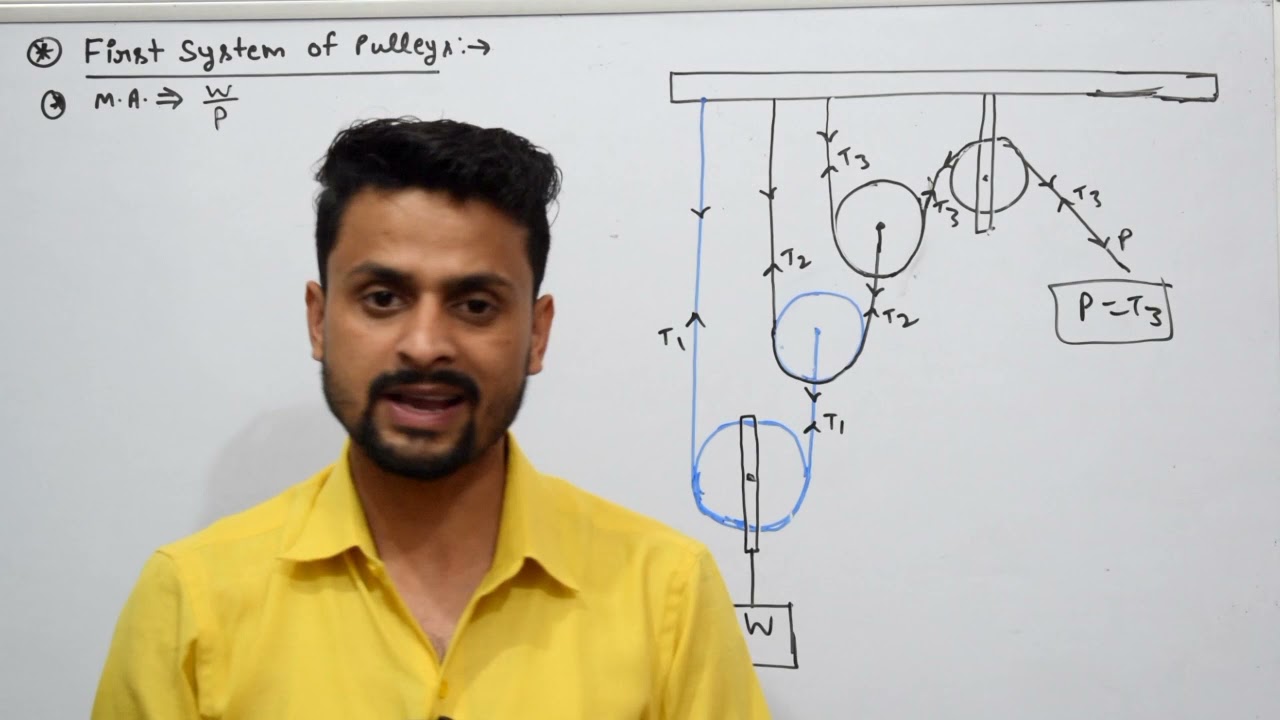











Mechanical advantage (MA) is calculated as force out divided by force in, where force out is the force acting on the load and force in is the force applied to the machine; a fixed pulley has MA = 1 (no force reduction), while a movable pulley has MA = 2 (doubles the input force), and compound pulley systems can achieve much higher mechanical advantages by combining multiple pulleys.
Pulley Mechanical Advantage: Fixed, Movable, and Compound Systems
Added:Basic definition of Force, Work, and the conservation of energy (Work = Force x Distance).
The general concept of Mechanical Advantage (the ratio of output force to input force).
Understanding of tension force and how it acts along a continuous rope or cable.
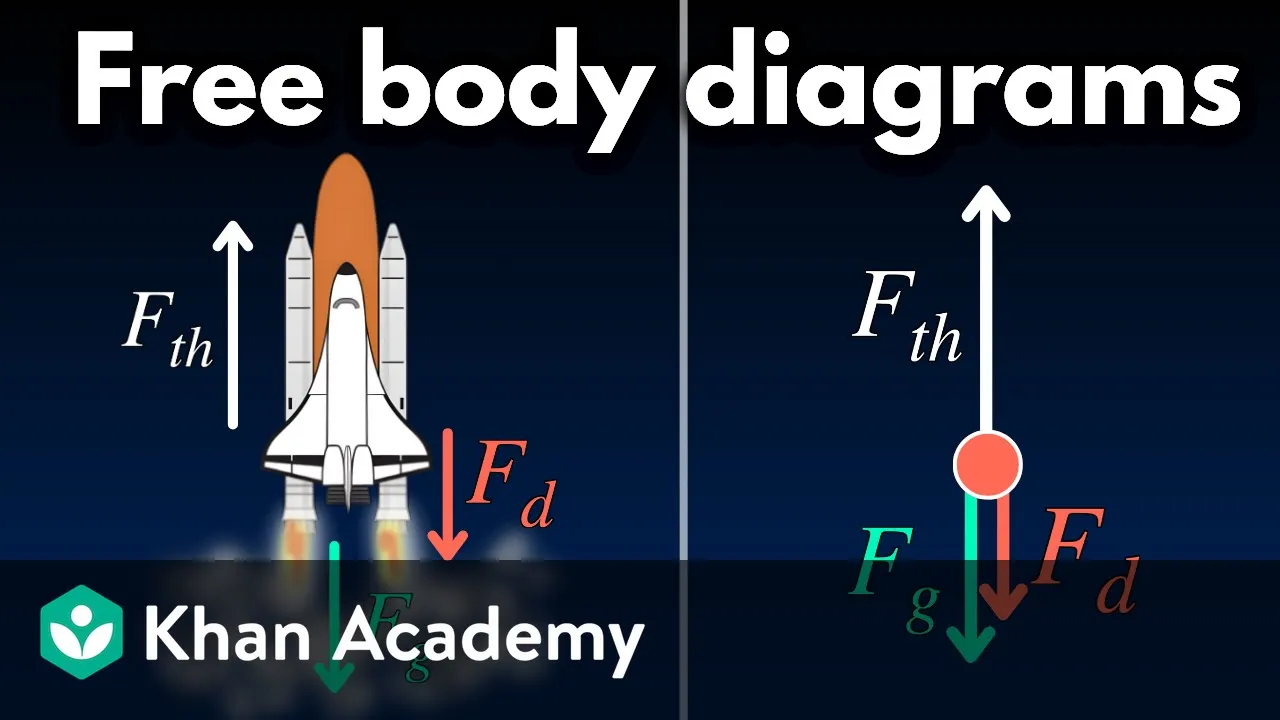
Basic vector addition and the use of free-body diagrams to represent forces acting on a static object.
Calculating real-world mechanical advantage by accounting for friction, rope rigidity, and the weight of the pulleys.
Exploration of complex rigging systems, such as the Block and Tackle, and Weston differential pulleys.
Analysis of compound machines that combine pulleys with other simple machines like levers, gears, or wheel-and-axles.
Practical engineering applications of pulley systems in cranes, elevators, and marine rigging, including safety factors and load limits.
405.6K views983likes12:27Original Release: 2007-04-16
[Music] [Music] A force is a push or a pull.
We can measure force with a spring scale.
The units of force are Newton's, a term commemorating Isaac Newton, the scientist who discovered the force that holds the universe together. Gravity.
The force of gravity acting on this apple is 1 decimal 4 Newtons.
Engineers say that work is done when a force moves something. When you use a push or a pull to move an object, you are doing work.
[Music] Simple machines are devices that are designed to make work easier.
Simple machines include levers, [Music] pulleys, [Music] and inclined planes or ramps.
Simple machines usually make work easier by reducing the force needed to lift or move a load.
Let's investigate the pulley. A pulley is a wheel and axle with a groove around its circumference.
A rope or string secured in the groove moves smoothly as the wheel rotates.
Let's use our pulley to lift this load, a concrete block.
With our Newton spring scale, we determine that this load requires 4 Newtons of force to lift it.
Engineers call a pulley configured like this a fixed pulley because it is firmly attached and does not move up or down.
Attaching our spring scale, we can measure the force needed to lift the load using the fixed pulley.
Reading our scale, it is upside down. We see that it still takes 4 newtons of force to lift the load. This simple machine, the fixed pulley, did not reduce the force needed to lift this load.
We call the force applied to the machine, in this case by my hand, the force in.
We call the force produced by the machine, the force that is directly lifting the block, the force out.
Even though they do not reduce the force, fixed pulleys can be very useful.
raising a flag for instance.
You can probably think of some other examples.
[Music] Let's try lifting our load with a pulley system configured like this.
This time we have attached our pulley to the load. Engineers call this a movable pulley because it moves up and down with the load. Attaching [Music] our Newton spring scale, we can measure the force needed to lift the load with the movable pulley.
This time, our scale indicates a force of 2 Newtons. The movable pulley allows us to lift a 4 Newton load with a force of only 2 Newtons. This movable pulley is doubling the input force. Engineers say this simple machine has a mechanical advantage of two.
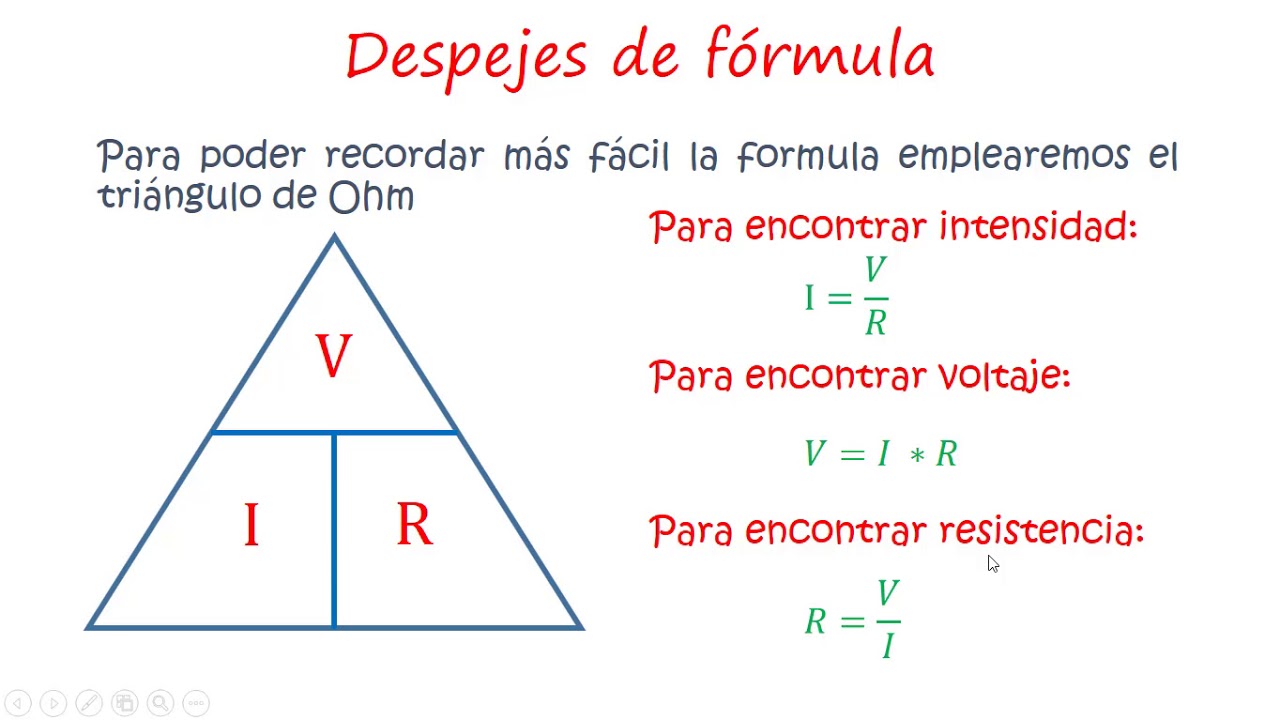
[Music] To determine the mechanical advantage of any machine, divide the force out by the force in. Remember, the force out is the force acting directly on the load and the force in is the force applied to the machine. In this case, by my hand.
In our example, the force out is 4 newtons. The input force, the force in, is the force we measured as we pulled with our hand, 2 Newtons.
Putting these numbers into the formula, we determine that the movable pulley has a mechanical advantage of two, doubling any force applied to it.
By measuring the forces involved, we have calculated the actual or real mechanical advantage of this machine.
[Music] Here is something else you should know about simple machines. If you watch the movable pulley closely, you will notice that my hand, the input force moves further than the load.
My hand and the load start at the white and yellow dots respectively.
After lifting, they finish here.
My hand actually moves twice the distance of the load. If you are using a simple machine to create a mechanical advantage larger than one, the input force will move further than the load.
Knowing that our movable pulley has a mechanical advantage of two, how much force is required to lift an 8 Newton load with a movable pulley? Can you figure it out?
Here is an 8 Newton load. I'll just confirm that with our Newton spring scale.
8 Newtons. I'm going to connect this to a movable pulley. Remember, we have a mechanical advantage of two.
[Music] And the question I've posed to you, what value am I seeing on our force in Newton spring scale connected to the input side of this machine a mechanical advantage of two.
We're lifting an 8 Newton load. So our our force out is 8 newtons. Mechanical advantage is two.
Our force in is you should be able to do that math in your head. Let's take a look the answer.
[Music] [Music] Did you get four newtons? That's the answer.
[Music] Remember the fixed pulley? The output force was four four newtons and the input force was also 4 newtons.
What is the mechanical advantage of the fixed pulley?
Because input and output force is the same, the mechanical advantage is one.
Use the formula to prove that [Music] combining fixed and movable pulleys creates a compound pulley. It is possible to produce large mechanical advantages with systems like these.
[Music] This is a chain block or chain hoist, a type of pulley system that uses chains.
At the bottom is a movable pulley. It moves up and down with the load. And at the top is an interesting pair of notched pulleys. These two pulleys are of different diameters and are connected. This simple machine is capable of producing huge forces. Let's calculate the mechanical advantage of this chain hoist.
I use this chain hoist to lift our lawn tractor when I need to service the mowing deck.
As with all simple machines, this chain hoist is designed to make work easy.
Connecting the hook to the tractor, it becomes an easy chore to lift this heavy load.
You will notice that I pull the chain a long distance, but the tractor only moves up a very small distance.
As we know, this happens with all simple machines that reduce the force needed to lift a load.
The input force force in moves further than the load or force out.
To calculate the mechanical advantage of this machine, we need to measure the force in and the force out.
Attaching a large Newton spring scale to the chain, I can pull and determine the force in.
In this case, it is close to 40 newtons.
To determine the force out, I have to connect the scale to the tractor and use the chain hoist to do the lifting.
[Music] [Music] Lifting the tractor clear of the ground, I see we have generated a force of 825 Ntons.
[Music] We know that mechanical advantage equals force out divided by force in ma equ= 825 ntons divided by 40 newtons which equals 20 decimal 625 and rounds to 21.
Our chain block has a mechanical advantage of 21.
More information about pulley systems can be found at our website hilerroad.com.
Follow the projects link.
Up Next

47:29
Astronomy Podcast: Solar System, Light, and Telescopes Explained
@ScottC-Astrophotography
196 views•2026-01-11

12:53
21cm Hyperfine Transition in Neutral Hydrogen: Radio Astronomy Basics
@AaronRobertParsons
12.4K views•2011-10-13

32:32
NMR Spin Physics I: Zeeman Effect, Resonance Condition & Larmor Frequency
@nptel-indianinstituteofsci8064
2.3K views•2024-01-17

27:14
Entropy and the Second Law of Thermodynamics Explained
@veritasium
27.5M views•2023-07-01
Related Study Plans & Knowledge Roadmaps
Structured learning paths in Physics
physics
Nuclear Physics (Decay, Fission & Reactors)
01Atomic Structure and the Binding Force
02Radioactive Decay and Half-Life
03Nuclear Fission Mechanics and Chain Reactions
+ 2 more learning modules
12h5 modules
Explore Roadmap
physics
Soft Matter (Polymers, Colloids & Rheology)
01Foundations of Soft Matter & Thermal Forces
02Polymer Physics and Macromolecules
03Colloids, Surfactants, and Self-Assembly
+ 2 more learning modules
38h5 modules
Explore Roadmap
physics
Analytical Mechanics: Lagrangian & Hamiltonian
01Mathematical Foundations: Calculus of Variations
02From Newtonian Mechanics to Constraint Dynamics
03The Principle of Least Action & Lagrangian Mechanics
+ 3 more learning modules
28h6 modules
Explore Roadmap
physics
General Relativity (Spacetime & Cosmology)
01Foundations of Relativity: Special Relativity
02The Geometry of Spacetime: Equivalence Principle & Curvature
03Einstein's Field Equations: The Mathematics of Gravity
+ 2 more learning modules
55h5 modules
Explore Roadmap