







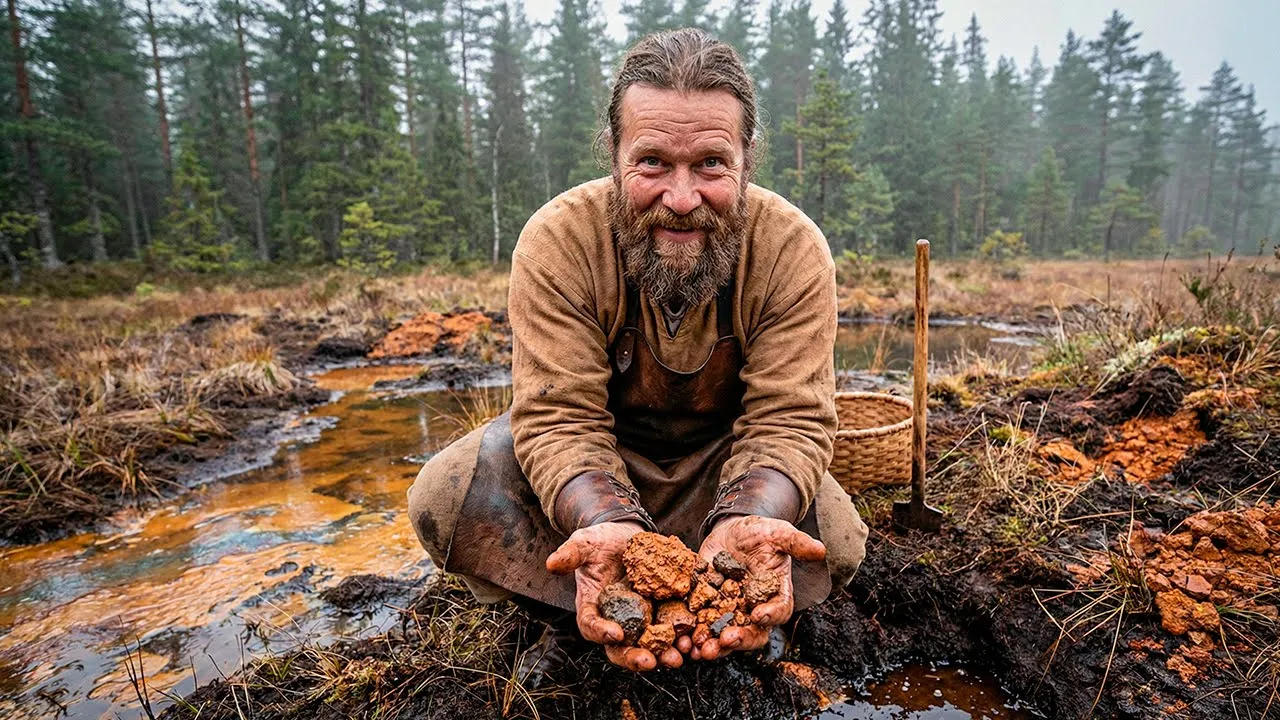



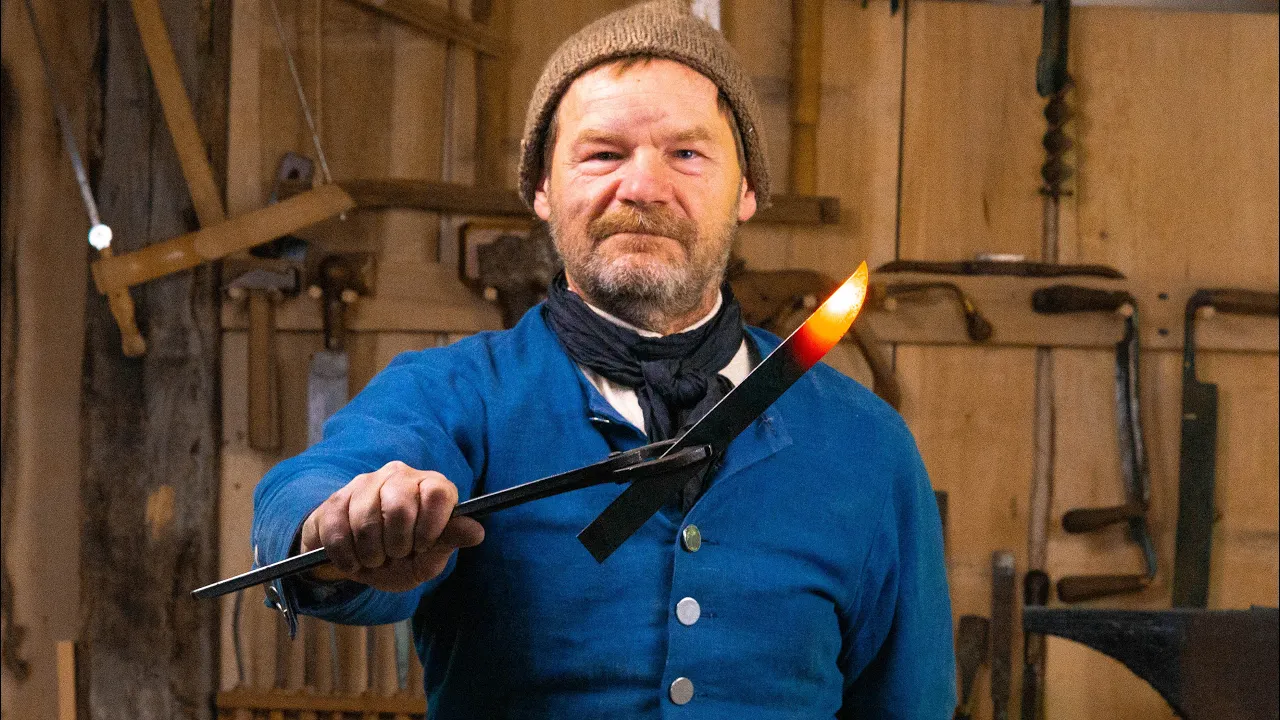


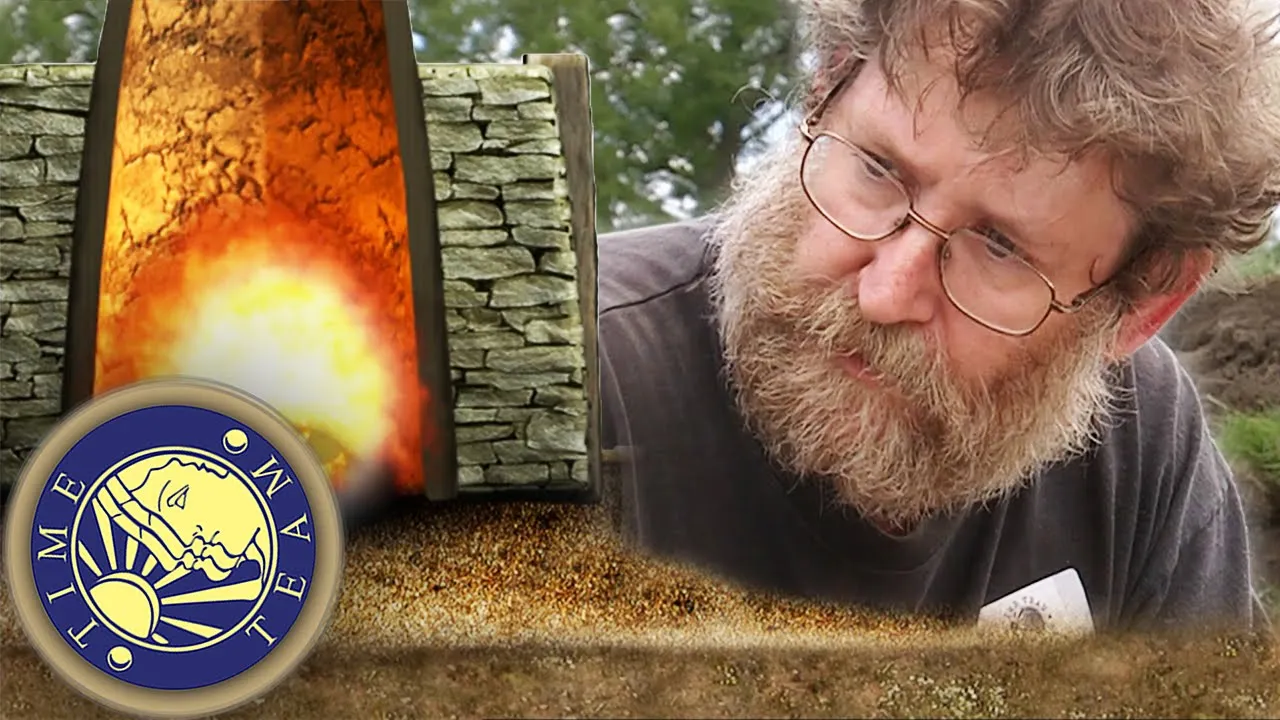








Iron Age iron smelting using bloomery technology involves constructing a clay/sand/horse dung furnace heated to approximately 1300°C, where iron ore and charcoal are layered and reduced to produce a solid iron bloom; this labor-intensive community effort requires continuous bellows operation, careful monitoring of temperature indicators like sparks and flame color, and typically yields around 800 grams of usable iron suitable for sword-making.
Iron Smelting Demonstration: Iron Age Bloomery Furnace at UK Festival
Added:The basic chemical process of reduction, specifically how iron oxides in ore are reduced to metallic iron by removing oxygen.
The historical context of the Iron Age, including the transition from bronze to iron and its impact on agriculture and warfare.
The fundamental difference between 'sponge iron' (bloom) produced in a bloomery and 'cast iron' produced at higher temperatures in a blast furnace.
The role of charcoal in metallurgy as both a high-temperature fuel source and a chemical reducing agent (producing carbon monoxide).
The post-smelting refining process, specifically how a blacksmith hammers the spongy bloom to expel slag and forge usable wrought iron.
The technological evolution from ancient bloomeries to medieval water-powered blast furnaces, enabling the production of liquid cast iron.
The material science of steelmaking, including how carbon content is controlled to transform soft iron into hardened steel.
The field of experimental archaeology, exploring how modern scientists and historians reconstruct ancient technologies to understand past societies.
7.9K views236likes12:34Original Release: 2024-08-05
[Music] [Music] want to think about people from [Music] hi everyone I'm Tom from Heritage blades I'm a professional bladesmith Cutler and living historian and I'm here today at chalk history Festival in Wilshire and we are just over here setting up our own little Iron Age iron smelt we have the intention that we're going to smelt some iron and we want to use this iron to forge a sword in the coming week we're going to do this all using traditional techniques and methods that they had in the Iron Age in Britain uh we're hoping to get at least 800 G of iron but I'm not promising anything and any extra we make well it just gives us license to have a bit more fun it's going to be a huge task but the forging of the sword the smelting of the iron is still only one part of what we're wanting to show here the reality is we we want to show people that it takes a whole Community to produce something like this smelting iron is a group effort one person can't do it on their own and forging a sword in a blacksmith's Workshop you would have whole teams of people to do it it's not like we see on TV all too often with just one blacksmith you would have a group of skilled people all working together trying to reach a agreed upon end [Music] [Laughter] [Music] so hi I'm Emma Harrison um I'm an iron smelter and today we're just trying to make uh iron the iron Agway doing Bloom re smelting so so far at the festival we've made the furnace so furnace is just here beside me it's a big kind of Chimney structure that's built of clay sand and horse dung so it's a lovely mixture we've got it preheating as well we put a couple of air pipes into the furnace um that will be where we work the Bellows and that will increase the temperature of the Furnace should be about, 1300° in the kind of Center area when it's lit um so it's just under the melting temperature of iron so iron would melt just over 50 1300 yeah 1300 is kind of The Sweet Spot so it should look kind of white hot when you look down the air hole and stuff so yeah it's a surprising amount of work before you actually get going this is as authentic as we can make it so it's difficult with any of the crafts from this time period cuz it is prehistoric so we're talking at least 2,000 almost 3,000 years ago for our iron AG craft so the thing with the furnace is you'll only ever find the base of it so you might find a pit in the archaeology it might have some charcoal in it it might have some slag in it which is the waste product from the smelting but that's about all you'll find and there's a fair amount of the Furnace bases found but you don't know the height of the Furnace you don't know the shape of the Furnace you don't know what the Bellows were like so there's a lot of gaps to fill in as well so it's quite difficult but that's what experimental Archaeology is for in terms of just trying to replicate or reconstruct these crafts as best we can so you just have to do it over and over until you figure out the way that matches what you find in the archaeology [Music] ni okay so our smell is underway uh and what we're feeding into the furnace is we have our charcoal which we've spent a few days grading making sure every piece is about the size of a walnut and we have our iron ore our iron ore we' broken down into sort of P siiz amounts so that when it goes into the furnace it actually melts actually gets heated up hot enough and extracts the iron from it the furnace has already been running for maybe about an hour and we have just breached having the flame blasting out the top this tells us we've reached the right temperature and that the gases have ignited and we're starting to get a reducing fire in that furnace so now after about an hour it's probably another five or six to go before we're going to be cracking it open and hopefully we have our iron [Music] okay so at the moment we're kind of about halfway well maybe a third of the way through the smelt I would say actually so we've been going I think for about an hour and a half adding the ore and the charcoal to the smelt so we're starting to build up some slag in the furnace I would say and exciting we've just had some Sparks in the furnace so out the top you get little firework type Sparks that usually mean that iron is forming so that's a really good sign um so we think this smelt is going well only a few cracks in the furnace so they're always fixable and that's a natural part of the process so we're just constantly adding the ore and the charcoal in layers and that's working its way down to the hot part of the furnace and hopefully giving us that bloom and the whole time we're pumping the Bellows so it's quite hard work um yeah it's hot it's really physical work but at the same time we're all singing songs and things at the same time so I feel like that would have been something that would have happened in the past cuz it is so labor intensive and it's very rhythmical so it's nice to get that sort of community thing going on with songs and stories and just laughing even though we're all tired and hot so we're having fun and it is hard work but it's going well okay we can get tongs now [Music] it is there's a second bit that should be Iron as well as well y sexy it's all very simple H quickly get around him yeah okay exactly gently little lighter how I do it the hammer it sh it's looking nice a nice block even though it's a cold okay oh yeah it is that's are we happy okay right that's that we works out when he's hot yeah right there's two trunks in I'm out the way know just Okay so we've just finished the iron smelt and it's actually worked um so it's much better than we thought we've got a really big block of iron but the end was a bit dramatic so we were trying to get a bit more ore in than we hoped um and then we were meant to add some more charcoal and burn down the furnace so it's quite a low level of charcoal but the thing is the slag was kind of rising up and blocking the air pipe so the the kind of furnace was essentially strangled there was just no air going in so it was cooling down um I went in and tried to get the Slag out by piercing the door of the Furnace but that just made the door collapse cuz it was just in pieces at that point um so at that point we just decided to pull all the charcoal out super hot like ridiculously hot but um yeah we managed to get that all out put pull out a block of iron after lots of hammering and trying to get it off the wall but it was kind of a bit stuck cuz it was larger than we thought so that involved kind of Smashing the furnace down so that didn't survive um but we have got the iron out it's coming three kind of biggish blocks so yeah then it was just taken over to the log for hammering all absolutely yeah we got onto a log and uh we've worked it down a little bit just a little bit with uh some wood and mallet I was a bit worried for some a fair few pieces were actually breaking off uh and there was bit of overhang I thought might snap off but actually the way it was crushing down squashing down quite nicely and actually really holding a good shape uh I mean that's pretty certain that's a good chunk of iron um and three pieces yeah I think I think we've definitely got enough to make a sword if not maybe two not that we're going to try and do that this week um but yeah a great success considering that especially at the end we were really worried as it was getting clogged with the slab really worried that we might actually not get have gotten enough iron ore in there to create a workable Bloom and now potentially we might have three fls to work so on to tomorrow [Music] n [Music] [Music] hey hey hey hey hey hey hey hey hey hey hey hey hey hey hey hey hey hey he
Up Next
14:28
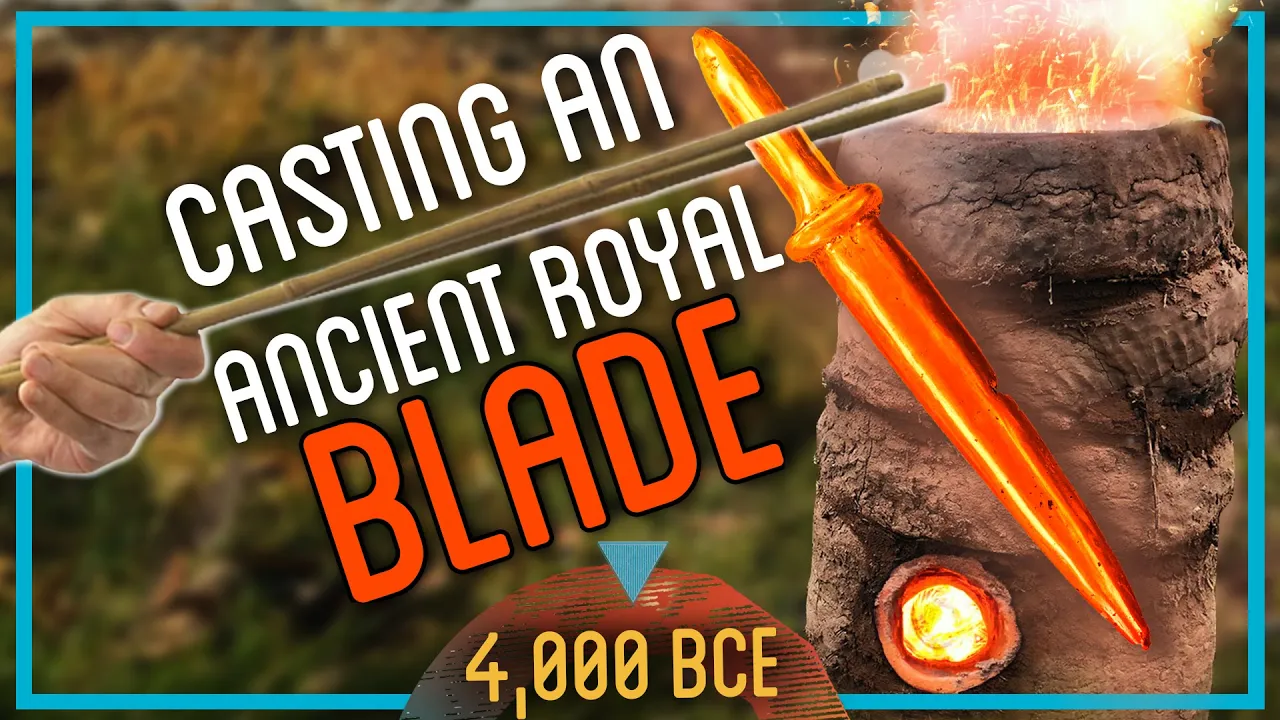
Casting a Bronze Dagger with Ancient Techniques | Lost-Wax & Natural Draft Kiln
@htme
390.4K views•2019-11-28

12:54
Triumph of Orthodoxy Icon: Byzantine Art & History Explained
@BenCallan
2.1K views•2024-08-06

9:49
FastAPI vs Flask vs Django: Choosing the Right Python Web Framework
@TechWithTim
302.5K views•2024-05-26

1:42
Game of Thrones Opening Credits: A Cinematic Analysis
@gameofthrones
46.3M views•2011-04-18
Related Study Plans & Knowledge Roadmaps
Structured learning paths in General & Interdisciplinary Studies
general-studies
Elevator Engineering: History, Physics & Cities
01From Hoists to Safety Brakes: The Dawn of Vertical Lift
02Hydraulic vs. Traction: The Engineering Physics of Elevators
03Modern Speed, Safety, and Algorithms
+ 2 more learning modules
12h5 modules
Explore Roadmap
general-studies
Rubber: Material Science, History & Geopolitics
01Origins of Natural Rubber & Mesoamerican History
02The Chemistry of Natural Rubber & Vulcanization
03The Geopolitics of the Rubber Boom & Colonization
+ 2 more learning modules
12h5 modules
Explore Roadmap
general-studies
Containerization: Evolution, Logistics & Trade
01Ancient Trade & Bulk Cargo: Amphorae to Barrels
02The Industrial Revolution & Cardboard Packaging
03The Containerization Revolution: Malcom McLean
+ 2 more learning modules
12h5 modules
Explore Roadmap
general-studies
Textile Tech: Evolution, Labor & Global Impact
01Pre-Industrial Textiles: Handloom & Cottage Industry
02Mechanization: The Spinning Jenny to the Power Loom
03The Factory System & Global Labor Transformation
+ 2 more learning modules
10h5 modules
Explore Roadmap