






















Refractive index is a physical quantity that measures how much light bends when traveling from one medium to another, calculated as the ratio of the sine of the angle of incidence to the sine of the angle of refraction (Snell's law) or as the ratio of the speed of light in the first medium to the speed of light in the second medium. The refractive index of glass with respect to air is 1.5, while that of diamond is 2.4, meaning light bends more in diamond than in glass. Higher refractive index indicates an optically denser medium where light travels slower and bends more towards the normal when entering from a rarer medium. This explains why eyeglasses are made of glass rather than diamond or amber, as glass provides an optimal amount of light bending for clear vision.
Refractive Index Explained | Class 10 Physics | CBSE & ICSE
Added:Have you ever been to the doctor for an eye check up?
If you're going to the doctor for an eye check up and he tells you that your eye power has increased or decreased, he will prescribe eyeglasses for you.
Now if you see an eyeglass you will notice that it is made up of glass.
Now why do you think are eyeglasses made up of glasses, and not any other material?
Let’s say for example- diamond.
Why do think eyeglasses are not made up of diamond? Because as we know glass is transparent and so is diamond. Light travels as easily through glass as it does through diamond or for that matter why do we not use amber? Because even amber is transparent. Why only glass?
Let us find out the mystery behind this.
We know that when light travels from one medium to another it bends, but do we know how much the light bends in different media?
Now the amount of bending when light travels from one medium to another medium can be measured by a physical quantity. This physical quantity of how much light bends when it travels from one medium to another medium is given by the refractive index of the medium.
Now before we find out what the refractive index is, let us recapitulate something.
We learned what Snell’s law was. Do you recall what Snell’s law was?
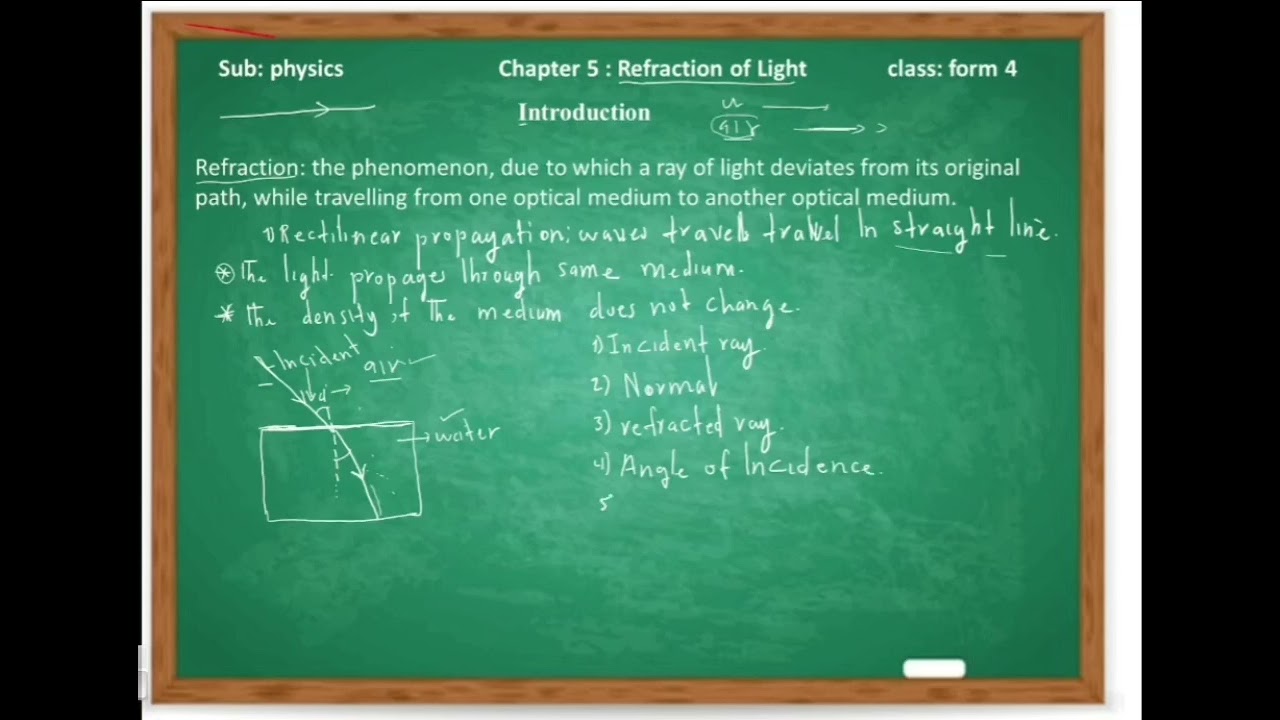
Snell’s law was that for a given pair of media the ratio of sine of the angle of incidence to the sine of the angle of refraction is a constant.
In other words what can we say? We can say that ‘sin I’ divided by ‘sin R’ was and is a constant.
Thus, ‘sin I’ by ‘sin R’ is a constant and this is known as Snell’s law.
Now we are given two facts. We are given that the speed of light in air is 2,99,700 km/s and we are also given that the speed of light in glass is 2,00,000 km/s.
Now from this information we can calculate the refractive index of glass. Let us find out how.
If we divide the speed of light in air by the that of the speed up light in glass we come up with 2,99,700 km/s divided by 2,00,000 km/s and then result we get is equal to 1.5 This is known as the refractive index of glass and if you recall from our previous lecture, this is the same value as we obtained if we got the ratio for ‘sin I’ and ‘sin R’.
Thus, this value 1.5 is equal to the value obtained if we took the ratio of ‘sin I’ and ‘sin R’ and we also learned that this value is constant for a given pair of media- in this case air and glass. So what can we say?
We can say that this constant is known as the refractive index of medium two with respect to medium one. In this case medium two is glass and medium one is air.
And how did we obtain the refractive index?
By the speed of light in air divided by speed of light in glass.
Now we have learned two methods to find out the refractive index of a medium.
The first method that we studied said that the refractive index of medium 2 with respect to 1 ‘sin I’ by ‘sin R’ and the second method that we studied was that the refractive index of medium 2 with respect to medium 1 is the velocity of light in medium 1 divided by the velocity of light in medium 2.
Now even when we consider refractive index there are certain points that need to be kept in mind.
That is refractive index can be of two types- one is relative refractive index and the other is absolute refractive index. Now let us find out what these two terms mean.
Relative refractive index is when we are considering any given pair of media.
In that case refractive index of medium 2 with respect to medium 1 as we learnt will be given by the velocity of light in medium 1 divided by the velocity of light in medium 2.
This is the refractive index of medium 2 with respect to medium 1.
And we also have the absolute refractive index. In case of absolute refractive index, we consider that there is one medium and the other medium is vacuum.
Or in other words we know that the velocity of light in vacuum is 3 x 10^8 m/s.
So if you are asked to find out the absolute refractive index of a medium, we will divide the velocity of light in vacuum by that of the velocity of light in the given our mentioned medium.
In other words since the velocity of light in a vacuum is known to us- that this 3 x 10^8 m/s, we will get the velocity of light in the medium that will be given to us and this ratio will give us the absolute refractive index of the medium.
Now we have been given with this information as you can see on the board.
We have been told that the refractive index of glass with respect to air is 1.5 and the refractive index of diamond with respect to air is 2.4.
Now with this information can you tell me in which medium light would bend more?
Let us find out mathematically how we can arrive at a conclusion.
Notice this diagram over here. Here an incident ray- marked in blue is incident at air-glass interface.
Now at the air-glass interface the incident ray encounters a change in medium. So it is refracted and it bends towards the normal. This refracted ray travels in glass. Now since glass is denser than air the refracted ray is bending towards the normal. The angle of incidence in this case is given by ‘I’ and the angle of refraction is given by ‘R(g)’. (g) because we’re considering glass in this case.
So what is the refractive index of glass with respect to air?
It will be given by ‘sin I’ by ‘sin R(g)’. So as we have been given that ‘sin I’ by ‘sin R(g)’ is 1.5 and this is the refractive index of glass with respect to air.
Now consider another diagram. In this diagram another ray of light is incident on the air and diamond interface.
This incident ray is given by the blue ray. Now since it is encountering a change in medium at the air-diamond interface, and since diamond is denser than air, the refracted ray again bends towards the normal. Or in other words, it shifts towards the normal.
Here the angle of incidence is given by ‘I’ and the angle of refraction is given by ‘R(d)’ And as we have been given that the refractive index of diamond with respect to air is 2.4 and we know that the refractive index of medium 2 with respect to medium 1 is ‘sin I’ by ‘sin R’.
So in case of diamond ‘sin I’ by ‘sin R(d)’. ‘d’ for diamond, that is equal to 2.4.
So now we have two equations in front of us. We have that ‘sin I’ by ‘sin R(d)’ is equal to 2.4.
We call this equation 1. And we have ‘sin I’ by ‘sin R(g)’ is equal to 1.5.
We call it equation 2. Now in order to find out the relation between the respective refractive angles we divide equation 1 by equation 2.
That is we perform 1 upon 2. Let us see what we get.
We get ‘sin I’ by ‘sin R(d)’ whole divided by ‘sin I’ by ‘sin R(g)’.
And that is equal to 2.4 divided by 1.5.
Now here we find that ’sin I’ is common, so we can cancel it.
What do we get after this?
After simplification, after cancelling ‘sin I’, we get ‘sin R(g)’ by ‘sin R(d)’ is equal to 24 by 15, that is if we remove the decimal point since both have one number after the decimal point we can write it as 24 by 15.
Now if we calculate this ratio we find that this ratio- that is the right hand side is greater than one.
So we can say that ‘sin R(g)’ by ‘sin R(d)’ is greater than one.
And from this what can we conclude?
We can conclude that ‘sin R(g)’ is greater than ‘sin R(d)’ and thus we can conclude that R(g) or the refractive angle in glass is greater than R(d)- that is refractive angle in diamond.
The angle of refraction in glass is greater than the angle of refraction in diamond.
So let us find out what this means.
Observe this diagram closely. Here, both the cases are taken together.
When a ray is incident from medium 1 to medium 2, if medium 2 is glass refractive angle or angle of refraction is R(g) and it is given by the ray with the blue arrow head.
And if the medium is diamond, then the angle of refraction is R(d) and it is given by the red arrow head- the refracted ray. And as we have learned just now and proved that R(g) is greater than R(d) so what can we say?
We can say that the angle of refraction of glass is greater than the angle of refraction for diamond.
And as we can see that when the angle of refraction is greater, the bending is lesser.
So we can say that if the angle of refraction is more, the bending of light will be less and if the angle of refraction is less the bending of light will be more.
So in glass and diamond the angle of refraction is less for diamond and the bending of light is more in diamond, so light bends more in diamond.
Now we found that the refractive index of diamond with respect to air which was 2.4 is greater than the refractive index of glass with respect to air that was 1.5 In other words we can say that the ratio between the velocity of light in air by the velocity of light in diamond is greater than the ratio of the velocity of light in air to the velocity of light in glass, and we know that this ratio gives us the refractive index of medium 2 with respect to medium 1.
Thus, since velocity of light in air is common in both terms it can be eliminated.
So what can we say? We can say that the velocity of light in glass is greater than the velocity of light in diamond. So what can we conclude from this?
We can conclude that the speed of light in diamond is lesser than the speed of light in glass, and we have also learnt that the refractive index of diamond is greater refractive index of glass. So greater the refractive index, lesser will be the speed and thus we can conclude that diamond is optically denser than glass.
So light from optically rarer to optically denser medium bends towards the normal, we can say in case of diamond light bends more towards the normal than it does in glass.
And when light travels from an optically denser to an Optically rarer medium light bends away from the normal because the speed increases.
So now can you answer? Why eyeglasses use glass, and not diamond and amber?
As we learnt when light travels from air to diamond at the air-diamond interface, bending of light occurs to a great extent. Due to this bending of light we are not able to see clearly.
We would not be able to see clearly if the eyeglasses were made of diamond.
Similarly if we use amber, the bending of light would occur to such an extent that we would not be able to see clearly what lay in front of us.
Thus, this is the reason why we're using glass- because it provides an optimal amount of bending of light. So to taking a quick recap- we learnt that when light travels from one medium to another, light bends. This bending is determined by a physical quantity that is known as the refractive index. Refractive index can be found out through ways- the first way of finding refractive index is by calculating the ratio between the sine of the angle of incidence to the sine of the angle of refraction. The second method to find out the refractive index is by finding the ratio of the velocity of light in medium 1 by the velocity of light in medium 2. Both these give us the refractive index of medium 2 with respect to medium 1. We also learnt that light bends more in diamond than in glass and we proved it mathematically- that the angle of refraction for glass was greater than the angle of refraction for diamond. That is more the angle of refraction lesser was the bending and that was the reason why we use glass in eyeglasses instead of diamond.
We also learnt that when light travels from a rarer- an optically rarer to an optically denser medium, the speed of light decreases and the path of light bends towards the normal.
And when light travels from an optically denser to an optically rarer medium, the speed of light increases and the path of light bends away or shifts away from the normal.
Up Next
Schlieren Imaging: How to See Air Currents and Temperature Gradients
@veritasium
1.6M views•2017-06-15

21cm Hyperfine Transition in Neutral Hydrogen: Radio Astronomy Basics
@AaronRobertParsons
12.4K views•2011-10-13

NMR Spin Physics I: Zeeman Effect, Resonance Condition & Larmor Frequency
@nptel-indianinstituteofsci8064
2.3K views•2024-01-17

Entropy and the Second Law of Thermodynamics Explained
@veritasium
27.5M views•2023-07-01
Related Study Plans & Knowledge Roadmaps
Structured learning paths in Physics