![Processo de Socialização: Instituições Sociais [2/3]](https://i.ytimg.com/vi/YPRk8yTSR8w/hqdefault.jpg)






























Robert D. Putnam's 'Bowling Alone' examines how modern Western societies have experienced a decline in community life and social connectedness over recent decades, introducing the concept of social capital as the networks, norms, and trust that enable communities to function effectively; the book argues that reconnecting through social networks is essential for building safe, healthy communities and achieving sustainable development goals, while noting that technology's impact depends on how it is utilized.
Bowling Alone by Robert Putnam: Community & Social Capital Explained
Added:Basic understanding of sociology, specifically how social institutions and civic organizations influence individual behavior.
The conceptual distinction between financial capital, human capital, and the general concept of social networks.
An overview of mid-to-late 20th-century American social history, particularly post-WWII suburbanization and technological shifts.
The definition of 'civil society' and its traditional role in supporting functioning democratic systems.
The theoretical distinction between 'bonding' (exclusive) and 'bridging' (inclusive) social capital.
Scholarly critiques of Putnam's thesis, including arguments that social capital did not decline but rather evolved into new formats.
The impact of the digital age, smartphones, and social media networks on modern community building and virtual social capital.
Practical applications of social capital theory in modern public policy, urban planning, and community organizing.
13.1K views240likes5:39Original Release: 2021-01-27
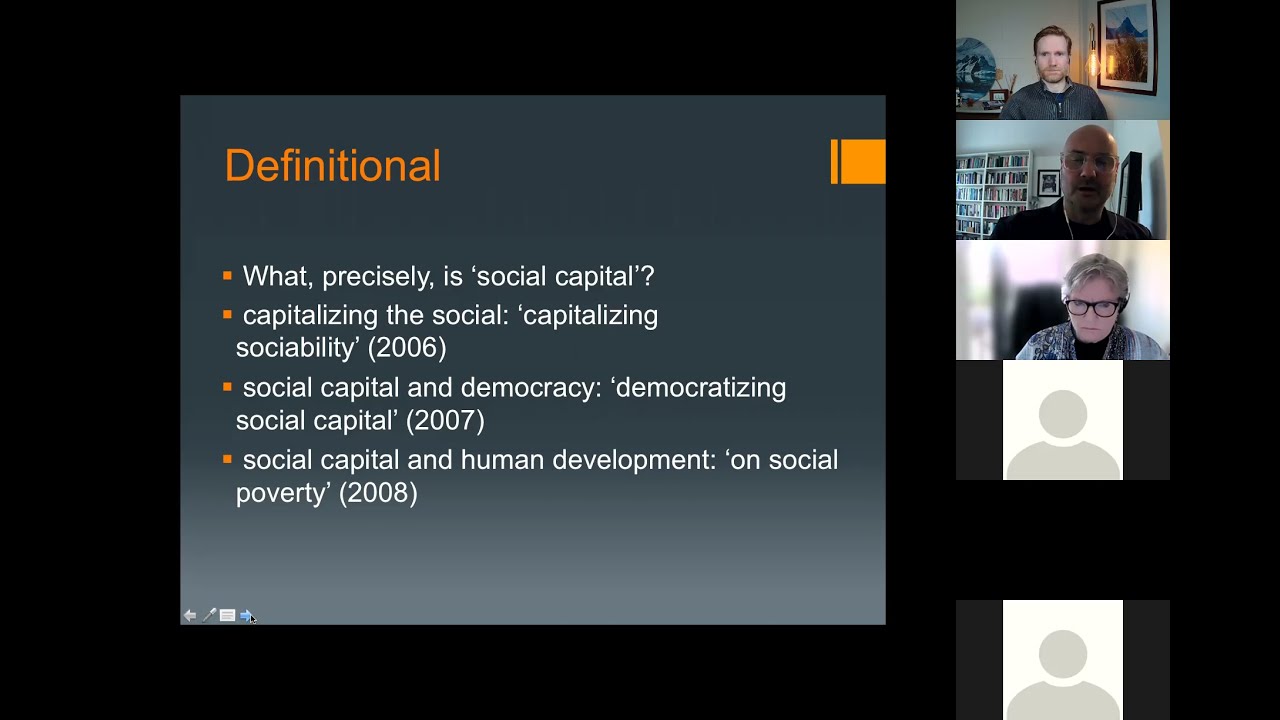
[Music] hello i'm alan blackshaw from herding together welcome back to our regular series of discussions essential reading this is a series of short videos discussing books that we consider to be essential readings in the fields of community development strength based approaches and corporate change don't forget to subscribe to the herding together youtube channel to stay up to date with our new video releases over 20 years ago robert d putnam published one of the most important books in the area of social theory bowling alone the collapse and revival of american community it's a lengthy work of almost 500 pages it's a readable study of the decline of community life it examines how social life in the usa changed over the course of a generation or so and discusses the changes in social connectedness using the example of bowling leagues and their decline putnam interrogates how people had become disconnected from each other what the impact of this change was and how this could be addressed sadly over two decades little seems to have changed of even greater concern is that the relevance of this book has to other western societies the changes putnam discusses are equally relevant to australia and i'd say to england to canada to new zealand as they are to australia and the usa we seem to suffer from the same problems we work longer hours have less time at home when we're at home we spend our time largely indoors or in the boundary of our premises we don't invite neighbours and friends to our house as frequently as we did in the past reading bowling alone in 2021 is just as illuminating as it was in the year of its publication 2000 bowling alone was one of the first books to examine in depth the issue of social disconnection and its consequences for us as individuals and as citizens it also examines the importance of reconnecting with each other to create safe and healthy community in reality if wherever to meet the united nations sustainable development goals the first thing we need to do is to reconnect as communities bowling alone doesn't only describe the problems but also investigates how we can reconnect with each other and once again build great community and society at the heart of the work is the concept of social capital in many ways this book introduced us to the importance of this type of capital putnam spends some time in detailing social capital what it is the different types of social capital and why it's essential in community life in short he says social networks have value just as a screwdriver physical capital or a college education human capital can increase productivity both in individual and collective so too social contacts affect the productivity of individuals and groups [Music] in this physical capital is about physical objects human capital the property of individuals and he then he goes on to say social capital refers to the connections among individuals social networks and the norms of reciprocity and trustworthiness that arise from them in essence it is the capital generated by social connection that produces supportive safe healthy and strong community without this connection such a community cannot exist bowling alone is one of those books frequently referred to by many involved in social change community building and place making is one of the core and foundational works in the canon of writing dedicated to social change and remains just as relevant today as it was when first published of interest are some of putnam's concluding remarks in the final chapter he outlines an agenda for change by social capitalist that is those of us intent on creating social capital [Music] of some interests there are a couple of paragraphs about media where he says no sector of american society will have more influence on the future state of social capital than the electronic mass media and especially the internet talk about prophetic and a few sentences later he says let us foster new forms of electronic entertainment and communication that reinforce community engagement rather than for stalling it i would suggest that during covert 19 lockdowns and social media and video conferencing technology has had the power to fulfill some of this recommendation and has helped many to retain contact with each other although it can be a two-edged sword and reinforce isolation it's all about how we use technology its power and its power to connect us bowling alone unfortunately is still as relevant as it was over 20 years ago but provides us with a firm foundation in building great communities if you haven't read it source it out it's an excellent piece of work
Up Next
39:06
Understanding Social Capital: Networks, Mobility, and Anti-Poverty Insights
@acf-gov
5.2K views•2020-03-11
54:57
Contemporary Sociological Theory: Micro, Macro, Integrative
@NaSESYNC
45.7K views•2016-02-17

19:23
How to Analyze Conversations Scientifically | Elizabeth Stokoe | TEDx
@TEDx
1M views•2014-12-04
9:41
What is Sociology? The Sociological Perspective Explained
@crashcourse
4.6M views•2017-03-13
Related Study Plans & Knowledge Roadmaps
Structured learning paths in Sociology
sociology
Celebrity Culture: From Hollywood to TikTok
01Foundations of Celebrity Sociology
02The Rise of Micro-Celebrity & Digital Platforms
03Parasocial Relationships & Algorithmic Intimacy
+ 2 more learning modules
12h5 modules
Explore Roadmap
sociology
Hostile Architecture: Space, Power & Control
01Introduction to the Sociology of Space
02Social Control and Surveillance in the City
03Hostile Architecture and Defensive Design
+ 2 more learning modules
12h5 modules
Explore Roadmap
sociology
Loneliness Epidemic: Third Places & Isolation
01Foundations of Social Capital and Community Cohesion
02The Death of Third Places and Urban Space Erosion
03The Privatization of Leisure and Atomization
+ 2 more learning modules
12h5 modules
Explore Roadmap
sociology
Sociology of Tourism: Gaze, Power & Heritage
01Foundations of the Sociology of Travel and Leisure
02John Urry and the 'Tourist Gaze'
03Staged Authenticity and Cultural Commodification
+ 2 more learning modules
14h5 modules
Explore Roadmap