




![💪TERMODINÁMICA. CICLO de CARNOT [👉ENTRA y APRENDE TODO HOY MISMO acerca de este IMPORTANTE CICLO👍]](https://i.ytimg.com/vi/6wEMLEtiKQY/maxresdefault.jpg)







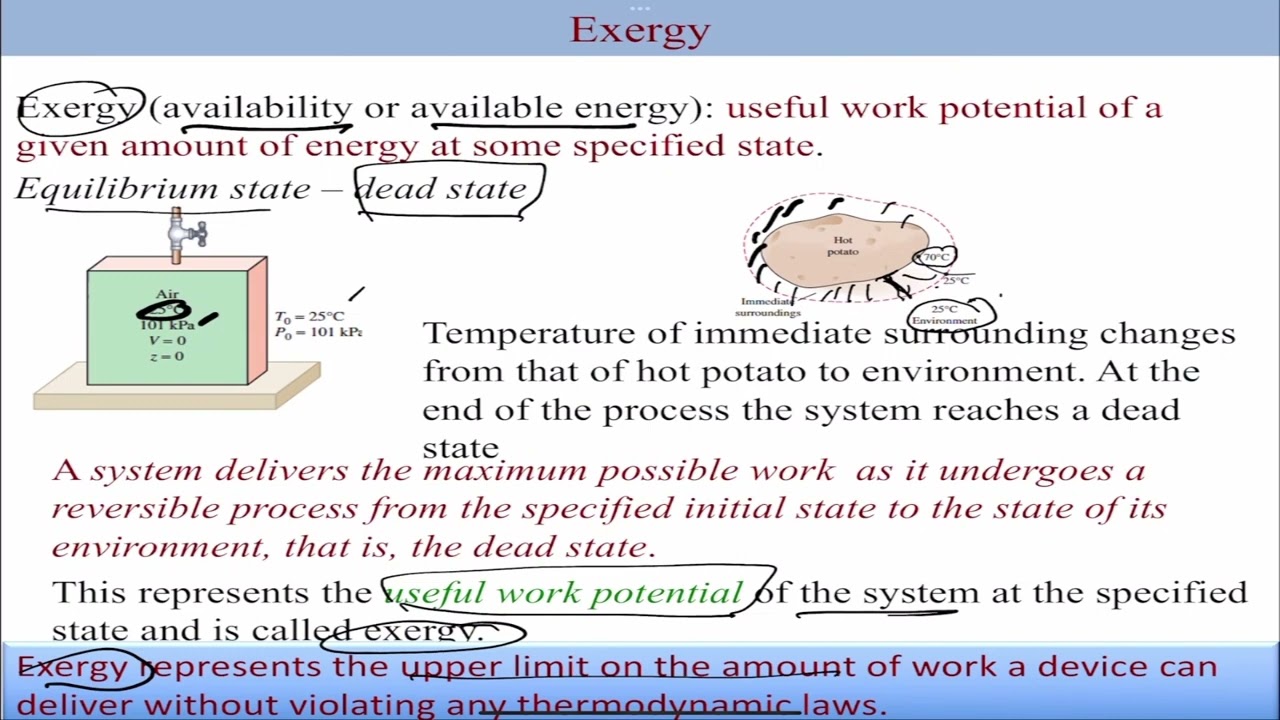









Available energy (also called exergy or availability) represents the maximum useful work that can be extracted from a given energy source under specified conditions, relative to a reference environment. Unlike total energy, which is conserved by the First Law, available energy is constrained by the Second Law, which states that heat cannot be completely converted to work in a continuous cyclic process. For heat available at temperature T1 with reference to ambient temperature T0, the available energy is calculated as Q1 × (1 - T0/T1). This concept distinguishes high-grade energy (work) from low-grade energy (heat and intermolecular energy), where only a portion of low-grade energy can be converted to useful work, with the remainder being unavailable energy that must be rejected to the environment.
Second Law and Available Energy - I | NPTEL Thermodynamics Lecture 10
Added:[Music] good morning uh welcome you to this session today I will first solve few example problems uh which is centered around the discussion that we had in the last two or three preceding sessions so let us start with that example problems then I will start a new section I as I told earlier that availability the concept of availability but before that we will go through this example example problem please see that first example is this one a heat engine operates between the maximum and minimum temperatures of 6 71° C and 60° C respectively with an efficiency of 50% of the appropriate carod efficiency that means the heat engine is prescribed which is operating between the two thermal reservers 6 71° C and 60° C but it is an irreversible heat engine where the efficiency is 50% of the appropriate caror efficiency well then this heat engine drives the heat pump which uses river water at 4.4 de C that means from this temperature of 4.4 de C that of the river water heat is being extracted by the heat pump to heat a block of flats where the heat is being delivered in which the temperature is to be maintained at 21. 1° C that means for heat pump the two thermal reservers are 4.4 de C where from heat is being taken and 21.1 de C where the heat is being delivered so from low to high temperature this is because the heat pump operates like that where it takes work from surroundings that is in this problem from this heat engine which is working between these two temperatures this is the definition of the problem apart from that there is another thing assuming that a temperature difference of 11.1 de C exists between the working fluid is very important and the river water on the one hand and the required room temperature on the other that means when the heat pump operates the system temperature the working system temperature the system executing the cycle when it rejects takes heat is not 4.4 de similarly when it delivers it it is not 21.1 de there is a difference between the temperature of the working system in the heat pump with the thermal reservers on both the sides is 11.1 de C assuming that a temperature difference of 11.1 de C exists between the working fluid and the river water on the one hand and the required room temperature on the other and assuming the heat pump to operate on the reverse canot cycle but with a cop of 50% of the ideal cop a reverse con cycle means an ideal or a reversible heat pump so this heat pump is an irreversible heat pump and that can you can very well uh recognize that there is the irreversible heat transfer because of the finite temperature difference of 11.1 de CI this is one of the reasons so the cop of this heat pump is 50% of the ideal cop so if this be the case we have to find out the heat input to the engine per unit heat output from the heat pump well the heat input to the engine per unit heat output from the heat pump and what would be the required heat input to the engine that means the same thing heat input to the engine per unit heat output if the required temperature difference in the heat pump is reduced from 11.1 de C to 5° that means this one is reduced to 5° that means this is the difference in temperature on both the sides of the reservers that means between the working fluid and both the reservers that four. 4° C and 21.1 de C so this is the problem so now let us see how we can solve this problem now the problem again if it is defined is like this there is a source temperature for a heat engine what is this this is six 71° C that means it will be in uh absolute 671 + 273 is equal to what 944 994 I'm am sorry 994 K9 6 71 944 I'm sorry 944k very good 944k very good and this heat engine operates this is a heat engine on a cycle thermodynamic cycle and it delivers heat to the temperature what is that temperature 60 60° C that means 60 plus 273 I'm adding 273 as you know this is the Kelvin conversion from Celsius to Kelvin that will be how much 33 333 K and this heat engine delivers work now this is the heat input q1 let us see let the heat rejected out of the engine is so w Is Der which is definitely is equal to q1 minus Q2 but this drives a heat pump that is the problem this is the heat pump which operates on a reverse cycle and here the temperature are like this from which it takes the heat that is 4.4 4.4 the figures are not conducive 273 what is this 277.49 and let this be Q4 okay so what is this temperature to which heat is being uh delivered is 21.1 + 273 what is this 2 29 29 4.1 K all right yes now what we have to find out we have to find out what is q1 by Q4 that is to be found out q1 by Q4 now you see the efficiency of this engine is 50% of the carod efficiency so therefore work now what is work here work is EA of this engine EA engine into q1 so I always try to induce the parameter q1 so I will use the formula which always involves q1 because we have to find out q1 by Q4 so my first job is to find out e engine what is ITA engine then it engine is 50% of the conos engine efficiency what is carot efficiency 1 minus 333 we know the canot cycle if this could have been a reversible heat engine so I could be equal to that is the canot efficiency 1 minus T2 that is the temperature of the thermal Reser where he is rejected divided by T1 the res thermal temperature in thermodynamic absolute scale of the reserver where heat is being taken from where heat is being taken that means 331 divided by 333 sorry divided by 944 and if you equate this value this will come to 32 so therefore we can write w is equal to 32 q1 all right now this W drives the heat pump so therefore what will be Q4 now Q4 by W is the cop so Q4 is W into cop of heat pump okay this is all right Q4 is W into cop of heat pump because this cop of heat pump is defined as heat delivered to the high temperature reserver where this this machine is acting as an heat pump so this is the output parameter of our concern divided by the input to the machine which is the work now what is the cop of the heat pump but here one catch is that there is a thermal irreversibility that means the temperature of the working fluid here and temperature of the working fluid let this temperature is T4 let this temperature of T3 neither T4 equal to 294.50 K so what is first T3 there is a temperature difference of 11.1 de C that it is defined in the problem so heat is coming from here that means this temperature will be less than this which means sorry 277 that means here I write T3 is equal to 277.49 what is this value 26 266 3 very good similarly what is T4 T4 heat will go from here so that will be 11.1 what is this value please tell me excuse me other way because ised huh yes he flow from lower temperature to high temperature yes yes heat is Flowing from lower temper heat has to First be transferred to the working system here so working system will have to be a lower temperature to take the heat in natural process of heat transfer heat is ultimately transferred from lower to high temperature but first heat has to be transferred to this fluid then it will transfer from heat there are other processes going on you see one of the processes is the heat taken up from this reservoir one of other processes is that heat given by the heat pump to this Reservoir so when heat addition is taking place to the working fluid of the heat pump the heat pump working fluid is of this temperature so that this temperature gradient can transfer heat from this temperature to the working fluid or working system this is one of the processes of the thermodynamic cycle executed by the system similarly one of of the processes in the thermodynamic cycle is the heat rejection by the system working system which has to reject heat to this reserver so this temperature has to be higher than this temperature so this way you will have to set so what is this temperature 305 2K so it is clear then okay then now we have to find out what is the ideal now cop of the heat pump cop of the heat pump is equals to5 into cop of the ideal heat pump what is the cop of the ideal heat pump that can be written as now cop of the ideal heat pum we have to consider a heat pum which is ideal then the Reser choosen by the heat pum has to be of this temperature so that it can reject heat to this temperature similarly it can take heat to this temperature so the heat pump will be a reversible one when the external irreversibilities will be reduced that means it the temperature of the reserver should be like this so that we can write this 305 3 sorry 35.2 divided by 35.2 minus 266.00 so this is the ideal cop why the cop is less because of internal irreversibility and the external irreversibility because of the finite temperature difference heat transfer so this comes out to be cop 3.93 then the problem becomes extremely simple then Q4 is w 3.93 w because this is the cop of The Heat now again W is 3 to q1 so Q4 is equal 32 into 3.93 q1 and which gives q1 by Q4 is 1 by 32 into 3.93 equals to 0 point this is the answer 79 K per kilj this is Kil per Kil means Kil of heat input per kilj of heat output you may may write it or may not write it because this quantity is unitless that means this is the amount of heat delivered to the heat engine per unit amount of heat delivered to the block of flats by the heat pump okay next problem next problem is also very simple but interesting problem this is relating to the entropy change a very simple problem but with entropy change an electric current of 10 ampere is maintained for 1 second in a resistor of 25 ohms while the temperature of the resistor is maintained at 27° C when an electrical electric current is passed through a resistor which is having some resistance the heat is gener the registered sorry I will not tell that heat is generated you know heat is an energy which comes in transit internal energy is increase so his temperature should increase but temperature of the resistor is maintained at 27° C in this problem that means this registor is cooled in such a way that the generation of internal energy because of the electric current must equal to the energy out of the electric this resistor so that temperature is maintained at 27° CSI this is very important in this problem that while the temperature of the resistor is maintained at 27° CI that means the temperature is constant for the resistor while the current is passed through this during a time of 1 second and that temperature is 27° C for this what is the entropy change of the resistor first part B what is the entropy change of the universe second part now you see the same current is maintained for the same resistor now the thing is that but now thermally insulated now the resistor is thermally insulated that means no heat is allowed to flow from the resistor which while allowing a current to flow for some time and it has a resistance may increase its temperature but heat is not being allowed to flow out out of the resistor now the resistor initial temperature is 27° C initial temperature is 27° if the resistor has a mass of 0.1 kg and a specific heat of 84 K per kgk this is the unit of specific heat as you know find what is the entropy change of the resistor and that of the universe so we have to find out what is the entropy change of the resistant and what is the entropy change of the universe in both the cases one case the resistor is not insulated rather it is cooled simultaneously while the current is flowing through it it gets hot and it is cooled so that temperature remains constant and in other case it is not cool thermally insulated so the temperature will increase it's initial temperature is 27° C it's mass and specific heat is given but one thing is missing in this problem whenever you are ask in any problem to find out the entropy change of the universe so a reference so to find out the entropy change of the universe you have to know what is the surrounding temperature which is very important you understand what is the surrounding temperature surrounding temperature you have to take the surrounding temperature surrounding temperature which is not how then you can equate the entropy change of the surrounding surrounding temperature surrounding temperature equals to 27° C which is very important for this problem if it is not mentioned you can consider you can take any value of the surrounding temperature but it should be mentioned another thing which has not been mentioned in this problem the way I have taken it the type is not typed that for this resistor consider the change in internal energy is given by specific heat of the resistors time the delta T this is another important thing that the change in internal energy of the resistor equals to specific heat time the delta T okay that is the temperature difference so these two will be required for solving this problem now let us find out the first one first one is what there is an electrical resistor through which an electrical current is Flowing because of some potential difference applied across the resistor so now the resistor is maintained at constant temperature which means there is an heat transfer from the resistor in this case I can use this resistor as a system I can represent the resistor as a system now you tell me when the electrical current is allowed to flow through this resistor which has a resistance R there is a potential difference across the resistor which means from thermodynamic Viewpoint that electrical work is being transferred into the system W electrical and since the temperature is maintained constant means some heat is also being coming out of this system Q so this is the problem from first point first law of thermodynamics that resistor as a system receives electrical work and rejects heat to the surrounding which is at a temperature of 27° C okay now if you consider the problem like this what we have to find out Delta s Universe Delta is Universe what do we know that Delta is Universe first part first part of the problem A A and B A and B oh we have to find out not only Delta s Universe we'll have to find out Delta s system also okay one thing is that if we have to find out Delta is Universe you have to find out both Delta s system and Delta s surrounding that's why it automatically comes Delta s universe is Delta s system well plus change in entropy of the surroundings surroundings well now you see in this case what is the delt s system Delta s system is zero why because resistor is at the same state the stady state so no properties is changed for the resistor now if I write the first law of thermodynamics I can write Q is equal to Delta U + W electric since resistor is maintained at constant temperature and if this relationship is given that Delta U is related like this so when the temperature remains constant that means delta T is zero so Delta U is also zero this has to be known otherwise the question will come that how do we know that if the temperature remains constant the internal energy also remains constant so we have to know this so that we can write that Q is equal to W electrical so what is the electrical work transfer it is the voltage difference times the current but voltage difference is not given we can relate this in terms of resistance also with the use of ohms law that you obviously know so one can write i s into r that is the electrical work which is being is transferred so what is happening physically you see the this electrical work is transferred to the system and because of electrical irreversibility this electrical work is being converted into internal energy first then immediately the heat is being coming out because of the increase in the internal energy which is because of the electrical dissipation of this electrical work and immediately the heat will come so that internal energy is restored to his initial value so this is the steps so therefore in this system the electrical work is ultimately coming out in the form of heat to the surrounding so this is the electrical work so this becomes is equal to what this becomes 10 amp that means 100 into 25 please T very good very good I'm very happy so I'm very happy 25 what is the unit of it what is the unit of it I sare RT je where I is I'm ampere R is in Noms T is the duration okay very good then it gives the amount of energy it is for one second so as far as the result is considered if you do not write it will be same but it is definitely conceptually wrong because I is the Ampere with that red is there so therefore this will imply the power so you have to multiply with time very good so this is the Q so therefore Delta s system is zero so Delta is universe is Delta is surrounding so what is this so therefore we can write Delta s Universe becomes equal to Delta s surroundings what is this surroundings receives Heat at a constant temperature so this will be a positive quantity any problem excuse me sir please how can we consider that Delta system is zero because yes I am asking I am answering this question but before that here one thing when you write this this thing so q and W though numerically all right but you have to follow the uh sign convention here this electrical work is negative Q is positive so therefore we can write that it is minus so that Q will come minus which means that heat is coming out from the system with reference to the system is minor so with reference to the surrounding it is a heat which is taken by the surrounding so Delta is surrounding is positive so that's why Delta is universe is positive and then value becomes equal to how much that value is 8.33 JW we have already solved the problem Jewel per K Jewel per Kelvin 8.33 JW per Kelvin okay all right now what is your question I how can we understand that Delta system is zero Delta system is zero I tell you that it is written that Delta U is C delta T this is given in the problem clear why you assume delta T is zero so Delta U is zero all right so Delta U is the property U is a Property Delta U is zero okay that means all the properties remain same that this this resistor is at steady steady temperature remains same it internal energy also remains same that means these all other properties remain same that means it is at a fixed state that is known as stady step so entropy is a point function so entropy remains same but sir you can consider that there is a exchange of heat huh so it gives heat and it takes work not that always a system gives heat or takes it it entropy will remain same if it gives it then takes it at the same time it receives work work interaction we have to consider whether it property State point is changed or not not necessarily you take it there is a system which takes there is a net heat transfer from the system that means it gives heat or it takes Heat at the same time there is a network transfer to the system if these two things balance so that system remains at the fixed State you understand then his entropy will be same entropy will not change don't consider that whenever there is a heat transfer that entropy will change entropy will change or not depend upon whether a system changes from one state to other state because entropy is a property as a point function State variables you have understood it has given some heat so his entropy should have decreased but at the same time it is taking work from the outside so that his entropy will increase that will balance that means system is be system is kept at a fixed state next problem will it will be clear that there is no heat transfer but still there is in change of entropy this is because it State point is change it is not always that heat has to be taken in I told you again categorically I earlier also told that whenever there is a change of this state there is an entropy change that means that change is possible by a divers process only by heat transfer you understand if you consider a process where the change of of states is possible by no heat transfer in a reversible process then only entropy will remain constant that is an entopic process I gave that example for example you take water in a bath and start it the next problem you hit the electrical wi wi or electrical conductor by insulating it it temperature increases but there is no heat transfer is only work transfer that work by virtue of some irreversibility in case of starring of pedal whe or star in a liquid it is the mean techical irreversibility friction which raises it temperature and change its state in case of electrical resistance insulated electrical resistance it is the electrical irreversibility which changes this work into intermolecular energy and changes the state so in that case there is a change in entropy why this is because the change State can be connected by a reversible process which demanded heat you understand that means that change in temperature can be made can be executed by addition of heat to the process so that there is an entropy change you understand so for a natural process whether heat added or it it is not added that is not the question of change in entropy whether the system state has changed or not and that change in system is associated with the heat transfer process definitely by a reversible process if entropy change is there but in an isentropic process there is a change of state by a system which is possible without he interactions in a reversible way that's why a reversible adiabetic process is an isentropic process there may be two states which can be connected by a reversible adiabetic process where heat transfer is zero and the process itself is reversible so there will be no entropy change okay their entropy changes are due to irreversibilities clear now next part of the problem is this what is the next part of the problem that next part is now you see the system is insulated that means electrical resistor is now insulated now you take this system which is insulated you can ask this type of fundamental question I will appreciate okay now this is there what transfer is there W electrical W electrical what is this amount this is minus 25 as already we have calculated Jewel but what is Q so according to First Law 0 is equal to Delta u - 25 now you see there is a Delta U that means the internal energy has increased and as we know that Delta U is equal to C into delta T that c is the capital c I'm sorry that could have been written by mass into specific heat so this is the capital c so actually this C is a into small C specific heat okay so therefore we can write this is equal to mass into specific heat into delta T according to this relationship so then we can write here I can write 2500 what is the mass mass is 0.01 kg and what is specific heat 84 K we have to transfer to Jewel that means 840 Jew per kg K times the temperature difference delta T that has to be found out so this gives a delta T So delta T I can write rather straightforward 840 into let TF is the final temperature that means it starts from TI initial temperature and reaches TF final temperature TF minus TI what is ti ti is 3 300K very good so if you do this calculation then you get TF equals to what TF equals to 5 97.62% equal to 5 97. 62 you check there may be some error here but roughly it will be 5 97.62% Delta is surroundings here zero because there is no heat interactions of the surrounding this is surrounding surroundings now again now your question will be better understood that Delta s system is there which is non zero obviously otherwise the principle of increase of entropy will be violated Delta is universe is greater than zero so system entropy changes because of the change in it state which is manifested through this change from temperature of 300K to this which could have been possible by a reversible heat transfer but as because it is an irreversible process the temperature change is possible even without heat transfer but in the reversible process temperature change can is never possible without a heat transfer if temperature change is possible it is only possible by a reversible heat transfer okay only in isentropic process temperature change is possible without a heat transfer process only by expansion and compression process that is reverseable adic process that will be again made clear afterwards so therefore this is enough so Delta system can you WR we can write as I have done earlier that if I consider a reversible heat transfer process so this will give mCP DT is the Delta Q because what I am doing Delta s system Delta s system precisely this is the thing is nothing but integration of Delta Q by T reversible now this reversible process heat addition is mcdt small temperature difference you give a reversible transfer so that magnitude becomes NCD so this will be integrated from TI to T this is a very important concept which G gives MC Ln DF by now you see that the change in entropy is connected between the states so one if one knows tfti even if the process is irreversible where the heat has not been given by this amount slowly but by some means the temperature is changed from TI to TF so therefore entropy change is same as whether it is a reversible or irreversible but to calculate it we'll have to use the equation for the reversible process and it comes MCL Ln TF by T now if you substitute the values m is equal to what 01 m is equal to 01 kg proper Unit C is equal to 840 J per kg okay okay and TF already we have found out this TI is this you get an delt s system is 5.85 J per K this is the unit of the entropy change so that becomes equal to Delta is Universe it's clear another thing I forgot to mention you I'm sorry that in the last example the I only solve the heat input to the engine per heat unit per United output from the heat pump another task is there that is left to you as an exercise when this 11.1 de change to 5.0 that means I am coming back to the earlier thing that means this temperature will change then system temperature by 5.1 here minus 5.1 you exercise this thing is a routine exercise and you will see that results will be reduced that means this value will be reduced and the result will be in this case 0.55 now you can ask me sir what does it convey a simple routine calculations just you change just like a kindergarten student just you change the value of 11.1 to5 but it will give you an idea that means if you go on reducing these temperature gaps this cop is ultimately going close to the what is that this value sorry not cop obviously cop is going close to the ideal cop and this value is reduced you understand that means this heat engine will require less heat per unit heat output from the heat pump to the block of flats so this value will be reduced okay so this is the exercise for which the second part that when it is reduced the temperature difference is reduced to 5° given that that you can solve so these two problems will give you an immense idea about how we can uh apply the entropy change formula for a problem there are number of problems if I get the opportunity I will solve now I will come to the next section that availability available energy and exergy before I start I must tell these things very few books write this sentence straightforward and boldly and sometimes that a very higher stage I tell from my first experience this is being asked at different levels even at a higher level at the recruitment level of a senior faculty positions also it is asked that what is the difference between availability and available energy what is the difference between availability and exer these are the terminologies it will be made clear afterwards but before that I must tell that these are synonymous terms just like three names of a person the same person identical person they are called by three names as and when required in his house his parents called by certain name his wingmate called by another nickname and his professional friends call by another name it's like that so as and when required according to the convention used we will use the terminology so therefore I must tell this three term what these are will be explained afterward But first you write this availability this is our available energy aable energy or exer or exer the way you pronunciate it ex or ex e ex they are synonymous terms and sometimes I will be use availability sometimes I will be use available energy and sometimes I will be used I'll be using X I will use this this and this depending upon the common convention that is followed okay now what is available energy and availability now this comes from the this is one of the very important aspect of Second Law the way entropy was defined as one of the very important aspect of straightforward consequences of the second law similarly the available energy is another important consequence of the second law before that again I brush up sometimes in teaching of thermodynamics particular thing has to be told repeatedly 10 20 times again I tell the first law of thermodynamics if this question is asked what new information about the quantity energy is being given by the two laws first law gives the two different status of energy one is this point function status another is the path function status so heat and work are identified as path function energy which are only defined in transit between the systems or system and surrounding but there are energies which are like properties which are properties of the system and they are energy with Point function property which can be stored within the system and are ascribed as the system properties and therefore they are Point function these are internal energy and first law tells the difference between the Heat and work interaction in a process is that energy which is stored in a system which GES the status of Point function so first law of thermodynamics gives the birth of two status of energy as Point function and path function but second law of Thermodynamics because I told at the beginning in this class we will only concerned we are only concerned with the heat and work so all first law Second Law aspects will be defined in terms of heat and work so Second Law gives a directional constraint as far as the mutual convertibility between heat and work in a continuous cyclic process what is that heat can never be converted completely into work continuously in a cyclic process whatsoever the cyclic process may be even in an ideal case you cannot do it but work can be continuously converted into an equal amount of itat that means this gives the directional constraint so if you write this second law concept on the constraint of mutual convertibility of heat and work I can show it like that that if heat is being converted into work in a continuous cyclic process heat is converted this is a cycle because a cyclic process is required for continuous conversion or we know that the result is that W is less than Q some of the heat energy has to be rejected cannot be converted everything cannot be converted while if you convert if you want to convert work into heat so you can definitely convert the entire work into heat Heat this does not violate the first law apparently it means it is in accordance with the energy conservation but it is not why because some portion of itat is still left here Q rejected so this is the basic foundation on which we Define the two grades of energy High gr what is the definition of highr energy high grade energy and low grade energy do you know what is then highr energy high grade energy is that energy don't tell that it is work again High gr energy is that energy which can be continuously converted into low gr energy but low gr energy is that energy which cannot be continuously into high energy if you make the two energy now in transit work and heat you see that heat can be completely heat cannot be completely converted into work whether work can be completely converted into heat this is the reason for which work is defined as high gr energy whereas heat is defined as low grade energy that means the low grade energy can never be converted into high grade energy with an equivalent amount whether the reverse is true but this is not always true for heat energy there are other forms of energy as I told that energy stored in a system internal energy we know there's a point function now this internal energy again we come back to the earlier discussion have two divisions one is the mechanical form of internal energy that is kinetic energy potential energy if you leave aside that form what are the other form of internal energy is inter molecular energy okay that is because of the temperature of the system because of the chemical bond energy of the system if a fuel you know that within a fuel there is an internal energy which sometimes we ascribe as chemical energy when you will come to the thermodynamics of reactive system these things will be clear these are all internal energy stored within the system so if you keep aside that mechanical form of internal energy that means kinetic energy and potential energy then we are left with this intermolecular energy which are manifested through temperature the chemical bondage energy that chemical energy this energy stored within the system as a point function this is also these energies are also lowr energy if you want to convert it into useful work the full amount you cannot convert so this will be conceived this way slowly it will come that if a system is at an elevated State compared to it surrounding I have told when when the system properties are exactly same with that of the surrounding the system is known as a dead state that means system cannot perform any process with the prescribed environment of surrounding but if the system is an elevated State because of it stored internal energy from that of the surrounding always an opportunity exist to develop some work while the system is allowed to come into equilibrium with the environment so in that process there is an opportunity to deliver some to get some work but that work can never be equal to the total stored energy within the system so therefore that's why the stored energy within the system apart from kinetic and potential energies are also termed as low gr energy so henceforth you must know that low gr energies either the energy in transit or the energy stored in the system are those forms of energy which cannot be completely converted in a cylic process by an equivalent amount in the form of H energy if there exists such type of energy which can be converted the reverse way with the other form of energy and in fact work is those ener that energy which is the highr energy which can be completely converted continuously either in heat which is the translate form of energy Transit form of energy or in the stored internal energy which is the point function or stored form of energy so that's why work is highr energy and heat and the inter ular energy stored within the system is a low grade energy all right so then I tell you a thing that this we can now show like this low grade energy low grade this is the information first I tell you the information then logic and deductions will come information is very important low grade energy especially nowadays day of Information Technology information generation information this communication all these things are very important low gr energy which comprises heat there is a trans Transit form of energy or intermolecular energy stored intermolecular energy stored intermolecular energy if you want to convert this continuous conversion continous conversion continuous conversion through a cyclic process continuous conversion through a cyclic process then we will see that we cannot have the entire energy converted there is an restriction there is a maximum amount work that can be obtainable maximum amount maximum amount of this energy obtainable as work obtainable as work that is the high grade energy so obviously these two are dependent a minimum amount so there is a minimum amount when this obtainable work there is a maximum that means a maximum conversion is possible as work which means automatically there is a minimum fraction or minimum amount left as what low grade energy very good left as low gr energy and this we defined as availability available energy available energy or xrg of what of this energy Sim similarly this is known as non-available energy nonavailability nonavailability non available energy I'm not writing this full and energy these are the terminal that means there is a minimum part which has to be rejected and there is a maximum part this is the second law this is an axium which can be converted that means this avalability available energy of this lowd energy symbolizes the work potential of the low energy what is the work potential of the low gr energy that means low gr energy has this work potential that means that is the maximum amount of work which can be extracted from it under any circumstances even in the ideal case this is an ideal Criterion whereas there is a minimum amount which has always to be left as low gr energy so this is known as what this serves as an work potential this is another terminology but not very frequently used this is the work potential of these are all ascribed to this but here one thing has to be understood very important these are all referred to a surrounding these are all referred to why because what will be the maximum work obtainable from a given low gr energy at a given prescribed state that means if I tell heat from this thermal reserver because it is heat in energy in transit this is the intermolecular energy stored in a system which is prescribed at certain State then if this question is what is his work potential or what is his available energy availability EX that is the maximum work that can be obtainable in an ideal system the next question will come then with respect to which surrounding because surrounding is very important surrounding has to be prescribed because you know the carod efficiency does not depend only on the thermal reserver or where heat is being taken it depends upon the temperature of the thermal Reser heat is being rejected so with respect to a given surrounding these values depend so that availability available energy or exergy that is work potential of a low grade energy is defined when the low grade energy and its state is prescribed with reference to a given surroundings which is sometimes known as availability available energy or exergy reference surroundings or environment this information is clear to youat the last part surrounding surrounding this is because last part of the surroundings I explained that the maximum work that is obtainable from this low grade energy will depend upon the surroundings for example I'm telling you have an elevated system that means that some pressure and temperature or some property with reference to a surrounding so the maximum work that you can get from this system there is an opportunity of developing work till the system comes to dead state that depends upon the surrounding if I tell a system at this pressure temperature volume and if I tell that what will be the maximum work can be obtainable before it comes to De state today is much different what it could have been done in the first week of January when the ambient temperature was 45° CI so you can very well understand so the ambient plays a major role that will be again clear okay afterwards now let us first find out heat heat in transit heat now I take now let us consider that heat is available from a temperature Reser T1 now you tell me if I post this problem that he heat is available q1 at and what is this maximum work obtainable we know that maximum work for maximum work we have to use a reversible engine that is carot engine reversible heat engine that means we'll have to search for a sink where the heat has to be rejected because otherwise we cannot get the work let this syn temperature T2 we know the work maximum work is of this given Heat at this temperature q1 into 1 by 1us T2 by what is this this is eao this is clear clear that means you see one thing that now you see this is the efficiency so for a given heat input to a engine the work develop depends upon the efficiency and efficiency is maximum for a reversible engine so this maximum efficiency depends upon T2 T1 more is the temperature for the given heat input more is the efficiency more is the extraction of work similarly lower is the sink temperature temperature of heat rejection more is the efficiency and more is the work extraction therefore our main motto will be to have a higher temperature and a as low as possible sink temperature heat rejection temperature now if this temperature is prescribed that means we know a temperature T1 where from we have q1 that means q1 of amount of heat is obtainable from the temperature at T1 then we'll have to search for the minimum T2 available so that we can get the maximum work what is the minimum T2 possible without any other effort that is the ambient temperature very good which is commonly symbolized as t0 so the ambient temperature so if that is true so the maximum work is q1 into 1us t 0 by T1 so therefore you see the surrounding comes into picture so depending upon the t0 so for the same amount of itat q1 at T1 the availability here will be much less than the availability very close to the poles because there the t z are very less okay so therefore the ambient comes into picture in this simple example now you see if therefore you see that this W Max this is the available energy so I write available energy of Q now these are now Quant available energy of q1 available energy of q1 at T1 equals to q1 into 1 - t 0 by T1 with reference to a surrounding temperature of T that means this we can take here also available energy of q1 at T1 with reference to a surrounding temperature of t0 is this all right so now the available energy depends both on the surrounding and on the temperature from which he is Q on is obtainable now you see that now if you consider that let t0 is fixed ambient temperature that is ambient now instead of getting the heat from T1 temperature or delivering the heat from T1 temperature to the engine I deliberately want as a designer as an engineer that this heat I will first transfer to a lower temperature this there may be some difficulties also the heat engine is unable to accept this temperature there is some practical problem where heat engine cannot take heat from that I just transfer it to by a natural process means T1 greater than T2 and the same heat is now given to the heat engine consider a reversible heat engine to the heat engine at T2 and it rejects the heat now you here you see sorry this is the heat rejection Q2 so what is Q2 Q2 is Q into t0 by T1 because this is q1 Q2 q1 t0 by T1 is the heat rejection this is the unavailable energy aable energy so therefore you see q1 comprises of two one is the available energy plus the unavailable energy so available energy is this plus so q1 is available plus unavailable energy now you see what is available energy of q1 now what is available energy of q1 now at T2 with reference to T1 this is all right with reference to t0 what is this you tell me this available energy is q1 into 1 - t 0 by T2 it is lower than the earlier one this available energy is lower than the earlier one what was that if it was taken from T1 it was q1 into 1 - t 0 by T1 now T1 is greater than T2 so therefore this available energy is lower than this clear that means when same heat is taken from a lower temperature its available energy or work potential is reduced so therefore it is always advisable to accept heat as at as highest possible thermal reserver that means if the temperature is rejected is reduced sorry is available energy or work potential is reduced that means it is not only the amount of heat which is important but it is the temperature of the pot or thermal reserver where from heat is coming it is important provided the surrounding is fixed okay so therefore always it is advisable that heat should be taken from the temperature which is as high as possible so this is the basic concept of available energy or availability of heat be the energy in transit okay today after this thank you next class again I will continue [Music]
Up Next

Quasicrystals in Medieval Islamic Architecture | Harvard Physics
@peterjameslu
58.3K views•2012-07-31

21cm Hyperfine Transition in Neutral Hydrogen: Radio Astronomy Basics
@AaronRobertParsons
12.4K views•2011-10-13

Lagrangian Equation for 2D Systems & Electrical Circuits | NPTEL
@iit
23.2K views•2010-01-15

Entropy and the Second Law of Thermodynamics Explained
@veritasium
27.5M views•2023-07-01
Related Study Plans & Knowledge Roadmaps
Structured learning paths in Physics