


























Medieval Islamic architects (1100-1600 CE) unknowingly developed quasicrystalline tiling patterns using five special equilateral polygons (girih tiles) that enabled the creation of non-repeating, aperiodic patterns with forbidden five-fold symmetry—achieving what Western science only understood theoretically in the 1970s. These patterns, found in buildings from Iran, Turkey, and India, demonstrate sophisticated mathematical understanding of pentagonal geometry and self-similar transformations, with tile ratios converging to the golden ratio through recursive subdivision rules.
Quasicrystals in Medieval Islamic Architecture | Harvard Physics
Added:The concept of translational symmetry and periodic crystal lattices in traditional crystallography.
The mathematical definition of Penrose tilings and how aperiodic tilings differ from periodic ones.
Basic geometric principles of regular polygons, specifically pentagons and decagons, and the mathematical limitations of tiling a plane with them without gaps.
An overview of Girih patterns and the traditional use of geometric strapwork in medieval Islamic architecture.
The physical discovery of natural and synthetic quasicrystals by Dan Shechtman and their representation in chemistry and materials science (2011 Nobel Prize in Chemistry).
The unique physical, thermal, and mechanical properties of quasicrystalline materials, such as low thermal conductivity and non-stick behavior, and their practical industrial applications.
The mathematics of higher-dimensional projection, demonstrating how 2D and 3D aperiodic structures can be mathematically projected from higher-dimensional periodic lattices.
The field of ethnomathematics, investigating other historical instances where advanced mathematical concepts were practically applied by artisans centuries before their formal scientific codification.
58.3K views980likes1:05:20Original Release: 2012-07-31
Okay. Uh perhaps we can start.
Uh we're glad to have one of our own students giving us a colloquium. Peter Louu uh is a grad student here at physics department. He did his undergraduate work in Princeton. His supervisor, thesis supervisor there was Paul Steinhard. He's a student here in our department. uh David Weights as his advisor and he's graduating this June is work he's working on colloids.
uh the talk he's giving today is not based on his thesis and it's related to something else something very interesting which actually exhibits the fact that we have very multi-talented graduate students multi-dimensional and they can combine various ideas they have into uh various interesting directions and that's what Peter has done in fact he has had a keen interest in uh restudying aspects of old civilizations and sometimes uh discovering ing things about old civilizations that suggest that we perhaps are not giving enough credit to older civilizations. For example, one work he did in 2004. Uh the title of his paper being early precision compound machine from ancient China is an is a direct is an indication of that kind of interest he has had. In fact, the discovery was highlighted uh in archaeology uh in the encyclopedia Britannica 2005 edition.
Um and the work he's going to talk about today uh coai crystals in medieval Islamic architecture has been widely covered in various media and uh uh newspapers and radio and so forth because the very very beautiful discovery that he and Paul Steinhard made last year. Fact Discovery magazine ranks as one of the top 100 discoveries of the last year in science.
uh it is uh the beauty of it is that it's uh unexpected and uh at the same time beautifully geometric for me when I first heard about the discovery that that they made last fall I was surprised I'm I'm myself from Iran I grew up in Iran and I have seen some of the sites that he's going to talk about uh as a child and I have also worked and at least at least I have one paper on quite crystals in context of string theory. So I know about quite crystals and I knew about those sites and I never made any connection between the two and uh it was quite remarkable that he made a connection and as you will see it's not completely obvious until he shows it to you that there's this beautiful connection. So uh here you are and here's Peter Lof.
[Applause] All right. Well, thank you to Professor Vafa for the very generous introduction and I'm here today to talk to you a little bit about my work that I've done in collaboration with uh my former undergraduate senior thesis adviser Princeton, Paul Steinhart, and also here at Harvard, Professor Guru Neiu, who's the Aakhan Professor of Islamic Architecture in the history of art and architecture department a little bit uh down the street. So, uh let's just get right into it. And I realize that some of these uh tilings might be a little bit unfamiliar to people here. So, I'm going to start off by just showing a few of the tilings, these geometric tiling decorations throughout medieval Islamic architecture. And I think we have a tendency these days to think of the Islamic world is confined to basically the oil patch in the Middle East. But in reality, uh, it stretched at times from Spain and Morocco all the way to India.
So, this is just a little bit of a a slideshow at the beginning. I could go on, of course, for hours about this, but just to give you a sense of the variety of the geometric decoration that we see.
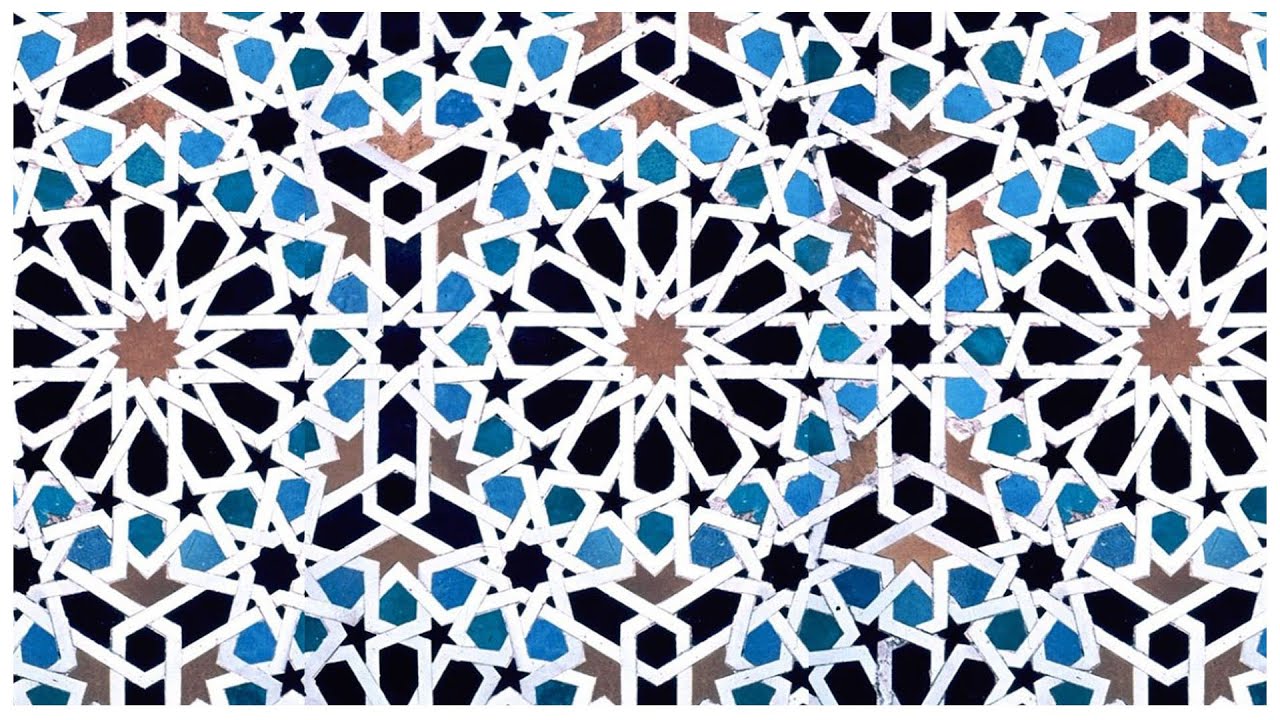
So let me begin by showing you the Gmbaradi Kabud in Maaga, Iran. Uh so just pay attention I think maybe to the cities and the dates to get a sense of the scope. This is 1197 CE. Uh moving forward this is the uh al- Mustansa Madrasa in Baghdad and again just a very ornate geometric tilings. This is Baghdad 1227. Uh this is in the the ceiling of the Jetu Musoleim in Sultania in Iran about 1300. And um uh this is the Friday mosque in Masid Jami in Yez in Iran about 1360. The uh D IM shrine. And you can see that uh this is 1453 in Isvahan.
There's a lot of different colors, a lot of different patterns, different kinds of materials. Uh this is the uh uh the Yzel Jami or the the green mosque in Bura in Turkey, an early Ottoman mosque.
And you know, again, different kinds of patterns. These are inlaid blue tiles.
and um uh the darbby kushk in isvahan again different colors and then finally um this particular pattern is kind of special to me personally because this is where I went with my cousin in Usbekiststan that got me started on this topic and uh again this is in a timid context in Bkharbakistan and then um this is the roof of the porch of the alikapu in Isvahan 1600 and then finally theamad aldala mausoleum in Agra India this building is right next door to the Taj Mahal was built just a few years earlier. So, uh I I just show these very quickly to give an introduction to the types of places and times that we're looking at. So, 1100, 1200 to 1600, 1700 and all throughout the Middle East, Central Asia and that sort of gives an idea of the scope of what we're dealing with here. So I mean you look at these things initially and okay it's kind of interesting but you know is there something that we can do to really understand the mathematics of how these things were designed how were they put together how were they constructed and does it tell us anything not only about the particulars about how these were constructed but can we say something also that these might be indicative of the general history of mathematical thought at the time and uh if we look back for instance at all the Greek classical manuscripts The only reason that we have them today really is because they were translated by the medieval Islamic world and preserved.
And so there's a great culture and history in terms of dealing with mathematics, dealing with architecture.
There are some documents, but in the end, the primary record and what I'm going to show in this talk is mainly what can we learn from direct observations from the buildings themselves. All right. So if you look at at most of the literature on these tilings uh in terms of the modern day, right, what do people say about them?
Most of the time the general suggestion is that these were put together with a ruler and a compass. So just you know simple draw circles, draw straight lines and through various constructions you can develop a lot of different geometry.
And I would say that that's sort of the paradigm before we came along at least that's what and and tried to think differently but this is if you look at most of the books on say geometric decoration in Islamic architectural tilings this is what you're going to see. So let me give you an example of the types of sophistication and it's actually it can get very complicated uh with this technique in mind. So here's the uh the quadro Abdullah Ansari in Gaza near Harat, Afghanistan and have a look now at the back wall and there's a tiling there that you'll see which is this pattern. So at first glance you look and it actually looks pretty periodic. And in fact there is within that yellow rectangle the unit cell of the pattern. So what I'm going to show you now is how with a ruler and compass you can construct this unit cell and therefore by extension the rest of the pattern. Okay. So we start out and draw a circle. Fine. Very straightforward.
Obviously divide that circle into 10 equal increments. And in this case, we know they knew how to do that because there are books and documents of the time showing compass constructions for how to divide a circle exactly into five and then how to bisect angles or bisect lines. So certainly this is something that they knew how to do. Now if you connect all of those lines up directly, you get a decagon. But what they did in this pattern was to connect every third vertex to make this star pattern. So again, you've divided the circle into 10. Just draw straight lines between every third vertex. you get this pattern and that's called the so-called 103 star for 10 points and the star connecting every third vertex. Now what I'm going to do in the next step is to take the compass point and put it there and make a circle whose radius is two star points away. And if we do that you can see that we get these two circles.
Now what I'm going to do is draw a rectangle whose height is the diameter of those circles and whose width is the diameter of the original uh original star the original circle that drew the star and here. Okay. Now if I then extend some horizontal lines across here I can then extend certain lines of the star pattern like this. Then delete the arrows the areas that are marked in red and we're left with this pattern. So the details of this aren't aren't quite so important, but the point is that when you then overlay it on the pattern, you could see how we've generated the whole thing. So this is a technique that gives you in a very simple fashion a way to generate a large number of patterns. And to show how widespread this is, let me give you some examples of the other places where this exact motif occurs. So we'll start with Ardistan at 1160 and there's the congregational mosque and you can see the pattern there. Then this is the Tuman Aka mausoleum in Samurand to the Timurid capital 1400. Again blue tiles completely different decoration but the same mathematical structure. Uh the DB Kushk which I showed earlier again same structure. The ceiling of the Alikapu and Isvahan again same structure. Now this is again completely different materials. And finally we see this on the Itamad Aala again right next to the Taj Mahal 1622. So this I think gives a little bit of the flavor of the types of things that I'm interested in.
We have all these patterns and I'm not particularly focusing on how did they make the tiles or how did they make the colors but what is really the geometric structure underlying how these patterns were designed. Okay. So I think ruler and compass gets you quite a ways but let me introduce you. Oh yeah. So then if we want to cover this of course once you've got the unit cell you just repeat and you basically like tile a decorated tile. In condensed matter physics, we'd say this is a lattice with a basis. And so now starting out with that, of course, you can now cover an infinite two-dimensional plane periodically with a decorated unit cell. And I'm using this condensed matter language because this is going to come up later in terms of when we talk about tilings of the plane. But I think this is a very simple simple thing to understand and there's no you could imagine a clever person with a ruler and compass could have come up with this. All right. Now that gives us the pattern. But let me introduce to you an alternative geometric construction. And this is something that uh is I think new about the work that that we did. And so let me start out with the same pattern from Afghanistan. And now every time there is a black X, I'm going to subdivide it with that red line. And I should say every black X outside of u outside of that original star. So this is that original star. Every time there's an intersection of black lines, I'm going to subdivide that and extend.
And so here we'll do it around the star and extend those red lines until they have sort of the closest contact with the next line. I can continue doing this for the rest of the pattern. At least the left half here. Okay. So why do I do this? Well, if you see this now, if you look carefully, there's a finite number of enclosed regions that these red dotted lines enclose. So the first is where the decagon used to be and that's a decagon that I'm going to highlight in blue. There's a hexagon that's elongated that's decorated here. I filled it in with green. And then finally the third one is a bow tie pattern that I filled in with pink. All right. So if we do that and you can overlay that now you can see that we actually might be able to construct this tiling in a slightly different way. And you can in fact overlay these tiles to generate the whole pattern. And now instead of having a complicated ruler and compass construction, we could actually make this pattern with just these three tiles. So let me mention a few things about these tiles. Well, they're all regular polygons and so the edge length is always the same. The internal angles are all multiples of 36 or 72 degrees.
So because it's based on this diagonal or pentagonal geometry. And finally, they have a special decoration. So the rules of these tiles is not just that these are any random set of shapes that we use to build this pattern. They must have this blue line decoration. And so the way that they're used is you simply assemble them like a jigsaw puzzle and you make sure that all the edges connect and there's nothing left over, no gaps.
And at the end you just keep the blue line decoration and you forget about the rest of the tiles. Now I've shown you three of those tiles. the decagon, the bow bow tie, the hexagon. Let's perform that same derivation on the masid jam and n Iran. And you can see that there are two more tiles here. In addition to the decagons that are in blue, there's now a purple rhombus and a yellow pentagon. All right, so leaving aside the derivation for a moment, these are the complete set of what I call the get tiles. So these patterns in the literature are often referred to as gerb patterns which comes from the Persian word for not because they've been sort of thought of as these interlocking geometric lace patterns. And so I just picked a word that had to do with that and was short and went well with tiles.
And so again, if we look at these tiles from a symmetry standpoint, the decagon for instance has a 10-fold symmetric rotational symmetry and uh the other ones have lower symmetry. So eventually with this, if you have to slide them around a surface without rotating, these are the only orientations that you get.
You've got one decagon, two pentagons, and then five each of the bow ties, the rhombuses, and the hexagons. So these are uh what I'm going to use to hopefully think of as as almost like atomic or molecular building blocks to assemble these particular tilings. So let's see how we might be able to understand how some of these patterns were built. So let me show you how I think the giddet tiles were used through a bunch of buildings in medieval Islamic architecture. All right. So let's go back to the al-nsuria madrasa in Baghdad and you'll see this pattern and you can in fact overlay it with the tessellation of the ga tiles and you can see that all of those white lines now correspond to the blue lines of the tile. And there's the idealized reconstruction.
This is Sultania, the old J2 mausoleum, one of the most important Mongol era buildings in Iran, 1304. And we have this complicated tiling that actually turns a corner. Well, in fact, here we can overlay this and reconstruct all of the thick white line decoration with one of these get tile reconstructions, and it folds around a corner. I've unfolded it for you at the far right, and you can see that actually all five of the tiles are used in this one particular tiling quite early on.
Uh this is the Yzeljami, the green mosque in Borders of Turkey. Again, the Ottoman mosque. And these tiles now are completely different. They're ceramic.
They've got different colors. And there's that white line decoration. Once again, we can overlay that with the tessellation of the Geta tiles. Then you can see that that's how we can show what the structure of the pattern is. And then finally, at the ATM Adela, there's now a large number of motifs. Um but here once again you can fill every single one of them with one of you can explain every single decorative motif with this picture of the ga tiles. And it's not just architecture. This is a frontist piece from the Quran of Abdugi Abdalah Albadi in Cairo Egypt around 1300 AD. And I apologize if I've massacred the pronunciation but there you'll see in the frontest piece again a geometric looking pattern. And once again, we can use these getter tiles to explain completely how that pattern is structured and designed. All right. So, you know, I've shown these more complex looking periodic patterns, but this does bring up the question, well, maybe this is just a mathematical shortorthhand that I myself in 2005 or whatever figured out.
Is there any evidence for this historically? Because if there's not well then it's kind of a nice curiosity but you know what did they actually do? Well have a look at the mashed dur kushk in isvahan almost 1500 AD and this is a very curious looking arch spandrel because there are no sort of decorative tiles. You'll notice that the brick pattern which is inlaid along the spandrel actually has a sort of geometric character. And the question is well you know how did they design this?
Well, if you overlay the tiles, you can see that not only the blue decorative lines, which have survived in all the other tilings I've shown, but let me just move back here, but also the actual edges of the tile boundaries are manifest in how the bricks were cut. And I find it very hard to believe that in this particular building that this was a gigantic accident. But what about uh historical documents? So, what can we learn from looking at those? Well, it turns out that there is some evidence for these tiles in contemporaneous architectural scrolls. So, this is a panel from an architectural scroll in the 15th century. It's now in the top cap museum in Istanbul. And this is kind of like a crib sheet for architects.
It's a the scroll that has I don't know 70 panels or something. And uh Professor Niboru in the art history department is the world's expert on this scroll and published pretty much the the seminal book describing it. And what they have are a lot of patterns that architects would have taken and then applied to buildings and there's kind of there's no writing but there's a lot of diagrams that I think would serve as sort of a fountain of ideas that then you could use for the basis of pattern generation.
So there's this very thick black line pattern that looks a lot like the geta patterns that we've seen in other locations. But now have a look at this very faint red dotted outline. And if you'll see that there and I can see if I can point that out. You see these red dots here now they they look like again enclosing a finite number of regions and it turns out that these correspond exactly to the gay tiles that that I've been proposing. So I I presented the derivation. I mean historically this is what I actually saw first and saw that as in other panels of the scroll you'll see a very different black line get a pattern but the outlines or the regions that these red dotted lines enclose again are all the same. And so these patterns get more complicated. And here you could see that black line pattern is starting to get pretty complicated. And and you can think a little bit about how uh you might want to draw that out with a ruler and compass, but it's starting to get, you know, pretty complex. But instead, you can see that the get tiles give you a very quick and easy way to make these patterns. And then finally, the 28th panel in the scroll is probably the most complicated. And you can see these overlapping patterns, but the faint red dots are there. And in fact, all five of the tiles that I presented are contained in this scroll panel. So I think that there's uh some good evidence that these are the actual tiles that they used to construct and design these patterns. And I think the reasoning is relatively straightforward. You need some very careful mathematics or at least some very careful drafting to devise the original set of tiles. But if you imagine a bit of a division of labor, if you're an architectural firm or whatever the equivalent was at that point, you have this big building to cover with a very complex looking tiling and you want to do it in some efficient fashion. You can sort of have your architects or designers make a very tightly constrained set of tiles and then give it to the workmen who then go ahead and build big surfaces as opposed to I don't know if you have some giant compass on one of these gigantic buildings. But there's, I think, a very practical reason that these tiles would have been used. And I think here because this is in these historical documents, these architectural crib sheets, if you will, there's very good historical evidence that this is uh what they probably used.
Now, that might be nice, but all the tilings that I've shown you so far, even if it was a bit more cumbersome, you still could construct a unit cell with a ruler and compass and build these things, even if it's a bit, like I said, more of a pain. But now let me see if we can take a look and if this giddy tile technology might actually enable the construction of new types of patterns.
So take a look here at the Mamakatun Mosalem in Tersan Turkey 1200 CE and this is a Seljic building. And uh have a look now at the left side along the portal where there's this decorative panel. Now, I want you to take a look at this because you see again that this is it's it's at first glance very similar to the types of diagonal or pentagonal decorations that I've shown. But note the absence of a diagonal star. You don't see any 10-pointed star there. And well, why does that matter? Well, it matters because if you recall how I did that compass derivation, you start by dividing a circle into 10 and then you extend the lines to various places and in various ways. But that's what preserves your geometry and that preserves all of those diagonal and pentagonal angles. So here you don't have that. And let me point out circled in yellow that there are two pentagons and they're not touching each other. So well why does this matter? Well, if you think about it, okay, well let's say we start with this pentagon here. You can divide a circle into five and then you know you can connect the vert the vertex of that pentagon to this one, this one, this one, this one, and this one. So there's sort of six pentagons there in a little bit of a ring. And if you were trying to draft it, you could do that in a semi-straightforward manner. The problem is that ring doesn't touch this part of the pattern. So, how are you supposed to line up these two pentagons exactly without sort of getting some of these distortions wrong? So, if you have any kind of angular distortion and how these connections work, you're going to get out of register and the pattern's going to be distorted. Yet, you can see that this is basically distortionfree.
Well, it turns out that there's a very simple way to construct this pattern with just two of the gear tiles, the bow tie and the hexagon. And the nice thing is once you've drafted these tiles very carefully at the beginning, if you stack them, I mean, it's basically child's play to just stack them, then you're guaranteed all of that these angles will be enforced and you don't have to keep doing all this complicated construction over and over again. So, we see a similar thing in contemporaneous uh buildings in Turkey. This is the great mosque in Maladia 1200 again about the same date. Again, another very nice geta pattern with pentagons but no diagonal star. And you can see that it's a different combination of the two hexagons and bow ties that give you the exact geometry of that pattern. And then a final example of this type is the Madrasa and Zuzan Iran also about the same time. Again, lots of perfect pentagons, no diagonal star, very easy to construct with just the two geta tiles.
All right. So, is it possible that then we might be able to push these tiles even further to do something not just a convenient way to make what still you might argue could have been made with a ruler and compass, but to do different things with different kinds of geometries and at multiple length scales. And let me show you where I think this was the case. So, back to the first building that I showed, this is the Gadi Kabud in Mar about 1197 AD. And this is actually a photo from the 1870s.
So, this is kind of a classic photo. And you can see that this octagonal tomb tower, so it's got eight faces, has eight panels of decoration, actually seven because there's a door on one of them. And if we have a closer look at one of these panels, you can see that there are le multiple levels of decoration on the bricks. There's this thick brick line pattern, which hopefully will look a little bit familiar compared to some of the other buildings that we've seen. And you could see the very tall brick again following this diagonal or pentagonal pattern. But then there's also I should say so yeah we can then explain the construction of that with the tessellation of these ghetto tiles. But then there's also a a shorter lower brick pattern that actually doesn't have anything to do with pentagonal geometry. You see all these curved motifs and I've highlighted that in white here. So you can see that you can also apply the same thing to the other tiles in the tiling. And I'm showing here the rhombus and the bow tie. And you can see that uh this white pattern which is marking the short bricks actually doesn't correspond at all to the diagonal symmetry. And this will end up uh being very important later when we talk about ideas of quasi crystals. But in this case, take a look at the white pattern. It follows the symmetry here. It's two planes intersecting right through the center of the tile at 90°. Same for this one and same for this one. So it's sort of a square symmetry for the white pattern.
And there's a decagonal or pentagonal symmetry for the blue pattern. And so these are not really compatible in the sense that you couldn't start out with a ruler and compass basing all these things on the pentagonal angle and then generate I think this white pattern with a completely different symmetry and curved motifs. I think this would, you know, really be a nightmare in terms of having to construct this if you had to just do it from the grid straight off.
But if you instead think about it in terms of these tiles, I think it gives you a very easy way to see how they built this pattern. Basically, they took the same tiles, decorated it with the standard blue decoration which we've seen, but then they also applied a second level of pattern in the white decoration and applied that in a different height of bricks on the building. And in that way, we can explain the two-level pattern at different length scales on the building with these ga tiles. So, uh, I think that this building presents pretty strong evidence that this particular paradigm must have been used to construct a lot of these buildings. All right. So, there is the original overlay onto one of the panels of the ga tiles. And now I'm just showing the blue line decoration. And then you can see for the whole panel, the whole pattern around the building, it repeats seven times out of the eight sides of the building. And there's one panel for the door. All right. So now the small white pattern really had no real geometric relation to the the the dark blue line pattern. But is it possible that maybe they used these geta tiles at different length scales in a way that did relate?
And let me show you why we might have some hope of thinking that might be the case. So we go back to this panel 28 from the top copy scroll. And as I showed before that the small the thin black line pattern and the accompanying red dots demarcate the regions that correspond to all five of the ga tiles that I've presented. But if you look again at this panel, there's something else that I didn't talk about that kind of jumps out, which is this thick red line up here. Right? So you see that and it's not sort of corresponding in a onetoone way with the little tiles. And so this is a bit curious and I don't think anybody really had any idea what that was doing there. But now if you look at it a little bit more closely you can see that in fact that red line corresponds to what I'm showing in blue here. But that's the decoration of the same geta tiles but at a much larger length scale. So let me show go back again. Watch your let your eye follow the red lines and you can see that that now fits the decoration of the same tiles at a much larger length scale. So this opens up I think a host of new possibilities that now we've got multiple overlapping patterns that are built out of the same building blocks but at different length scales. And I think that then begs the question might we see something that's self- similar?
Are there different kinds of properties now? And you know I think we're starting to get into what I find to be some very fascinating geometry. So did they actually use this on a building? Well, let me show you the uh the the tiling and the spandrel over an archway at the Durb Imam shrine in Isvahan 1453. And you can see here, and let me just uh show you the tiling itself without the the sort of border. And you can see the the little dark pattern is filled in completely with the tessellation of these gadet tiles. Not so surprising, but um you know, we've seen things like that before. But now take a look at this thick black line pattern. And that it turns out if we shrink it down a little bit is actually the decoration of a tessillation of much larger get tiles. And so now we've got again multiple overlapping tiles. And it turns out that the small pattern and the big pattern are in fact exactly related.
And they're related in what I'm going to call a subdivision rule. And why do I call it a subdivision rule? Well, this basically says every time you see one of the big geta tiles, substitute this combination of little geta tiles and you get the small pattern. So what do I mean by that? Okay, we'll start out with the big geta tile tessillation and then I'm going to plug in that subdivision rule.
So these are the combination of small tiles. But now if we look at the original area that bounded the pattern, you'll see that in fact that generates the small tiles. And here you could see that uh if it generates it gives you back the small decoration. So this is not just some random collection of tiles but in fact a very ordered very intricate sequence to generate a small pattern from a large one. Now the same subdivision sequence was used on other parts of the building.
This is a portal from the same building.
And you can see again a complex tiling with the big blue lines following this getaway pattern and then the small tiles following this getter pattern. And again, it follows the same subdivision rule. All right. So, I think I've shown some of the intricacies in designing the building, but is there a way that we can actually learn something a little bit more broadly about how these things were designed and constructed beyond or is there something that it tells us beyond just the details of what these architects were using at the time? And in particular, is there some manifestation of of modern geometric concepts 500 years ago? So, to explore this, let's talk a little bit in just uh traditional tiling. How do you cover a floor with tiles? So, if I want to make an infinite tiling, how can I generate that? And I'm going to go over two methods. The first is simply just taking tiles and attaching them to the outside of one tile. And there's the rules here.
We only get one tile. And we want to tile the floor infinitely. So, that's I think just the simplest. You're building a bathroom. You're just going to tile the floors around the tiles that you started with. You make sure that the edges are all aligned. And you can do this on to infinity. The other thing we can do is an analog where it's basically the subdivision. So I start out with a square and what I'm going to do is substitute every time I see a square four smaller squares half the length.
And so you fit four of them into the same original tiling. And then if I zoom in and multiply by a factor of two I get the original tiling. I can keep doing this over and over and over again until I cover the plane infinitely. So these are two equivalent ways of generating the same square tiling by starting out with a single square tile. Okay. So if we do this, what are the consequences of the symmetries that that tiling can have? Well, in this case, I'm going to refer to this square tiling as having a four-fold symmetry. And what that means is that I can turn it four times on itself in a complete circle and get the original result back. So here showing that the yellow dot there is just to help your eye remember where we are. So this is one rotation at 90°, two, three, and then four. It gets us back to the original. So when I talk about these tilings as having say a four-fold symmetry, that's exactly what I mean.
That that's a number of times you can rotate it before you get back to a complete circle. And every time you get the identical pattern. So if we look at what are the types of symmetries that are possible, we can tile the floor with rectangles, in which case we get a two-fold symmetry. We can tile it with triangles and get a three-fold symmetry, a hexagons and get a six-fold symmetry.
And the reason that I've put crystalraphically allowed symmetries at the top is that if you put an atom at the vertex of every one of these things, then you get models for atomic crystals, right? So I think this is pretty well known to this audience. But if you want to do it to get five-fold symmetry, well then it's not so clear exactly how this gets done. And this is a picture from Kepler in 1611 showing that if you tile the floor with pentagons, if you will, you have leftover gaps and you can't tile a periodic tiling with one pentagon without having, you know, like I said, leaving these gaps. And so it's just it can't be done. And so this is considered a crystalallographically forbidden symmetry. And if you note, there are no crystals in nature that have five-fold symmetry. You know, you go to the minological museum across the street, you'll see all these others two, three, four, sixfold, but you won't see anything that's either five-fold or sevenfold or higher. So, if you want to make a tiling that goes out to infinity without any gaps that has these forbidden symmetries, what are you going to do? Well, there's several things that you can do, and I'm going to again talk about uh one of them, which is to use multiple tiles. And this is these are the tiles of the so-called Penrose tiling, which is the most famous of a class of tiling called quasi crystallin tilings. And here the one on the left is called the kite and the one on the right is called a dart. And these are made up of lots of internal angles based on the pentagon. And uh these come together in a way that must respect the red and blue circles that I've drawn in there. And this is an example of what's called a matching rule because it constrains the combinations that these tiles can have when they touch each other in a tessillation. So what do I mean by this?
Well, here's an example of a fragment of a Penrose tiling. And you can see that the tiles are all touching each other, but only in a way that allows those red and blue lines to continue uninterrupted across the tile boundary. And if you follow this, you can actually go out to infinity and make a tiling that respects these rules. And it will have, you can see here, right, that there's this uh this pentagon down here, and that's got some local five-fold symmetry. And you can actually build these that are completely globally 10-fold symmetric.
And uh this is one of the ways to do it is with that matching rule. But there's another interesting property about the Penrose tiles that now I think ties into some of the concepts that I brought up with the subdivision. And that's in the quasi crystal literature called inflation. And again, what we're going to do is substitute combinations of smaller Penrose tiles every time we see one of these big Penrose tiles and build a new tiling that way. And so here's the explicit inflation or subdivision rule.
And you can see that you just put smaller versions of the same tiles everywhere you see the big tiles and you get a new Penrose tiling that will have all the same properties mathematically as the bigger Penrose tilings except for the fact that it's bigger. And you can do this over and over and over again out to infinity. So let me show you an example of how that's done. So we go back to this particular pattern and the first inflation then will substitute this set of Penrose tiles. And now you've got a fragment that's a bigger Penrose tiling but still obeys all the rules. And I'll do two more generations and I get this pattern and then finally two more generations. So this is now five times doing that inflation sequence and you get this uh very complex penrose tiling. But now you can see there's all over the place these red circles for for instance are are five-fold symmetric locations. And so we've managed to do this. The tiling never repeats and it has these forbidden symmetries. So this was really understood by Penrose in the 70s and there's I'm there's some a whole history of this in the 60s and 70s but this is certainly a relatively recent development. Now if you look at this you might ask the question well what happens you know is this a model for instance of an atomic tiling. I mean what happens if we put atoms there? Do these structures you know could we actually make a structure that has this five or 10fold symmetry? And it turns out the answer is definitely yes. And these are what are known as the quasi crystals metallic alloys where the atoms fall along the vertices of these penrose tilings. And this is an electron microraph of the structure of one of them. I've drawn in this red pentagon because I want your eye, you can pick out that there are parallel lines or parallel planes of atoms that run parallel to each side of the regular pentagon. So there's this line here. You can see a line there, a line there, you know, up here. There's one that goes there in this direction. You can see right there and here, number four, and then fine five, number five, finally there. So you've got these parallel planes of atoms. You've got these forbidden symmetries. And the one thing you have to give up to do this is any form of periodicity. Now, is it possible to actually see this? Well, take a look at the spacing. Your eyes is going to pick out these black lines. So, there's a black horizontal line here. There's another one there. There's another one here. And you could argue that maybe these are similar spacing. But then the next one is right here. And that's actually a shorter length scale. And if you look along all the planes, so here, there's one here. That's a sort of a short, a long a short. There's no periodic spacing of those black lines.
And you might have to stare at it a little bit to see that. But it turns out that there are now two sort of characteristic lengths spacing those lines. And they're related by the golden ratio, which is also the ratio of the diagonal to the side of the pentagon.
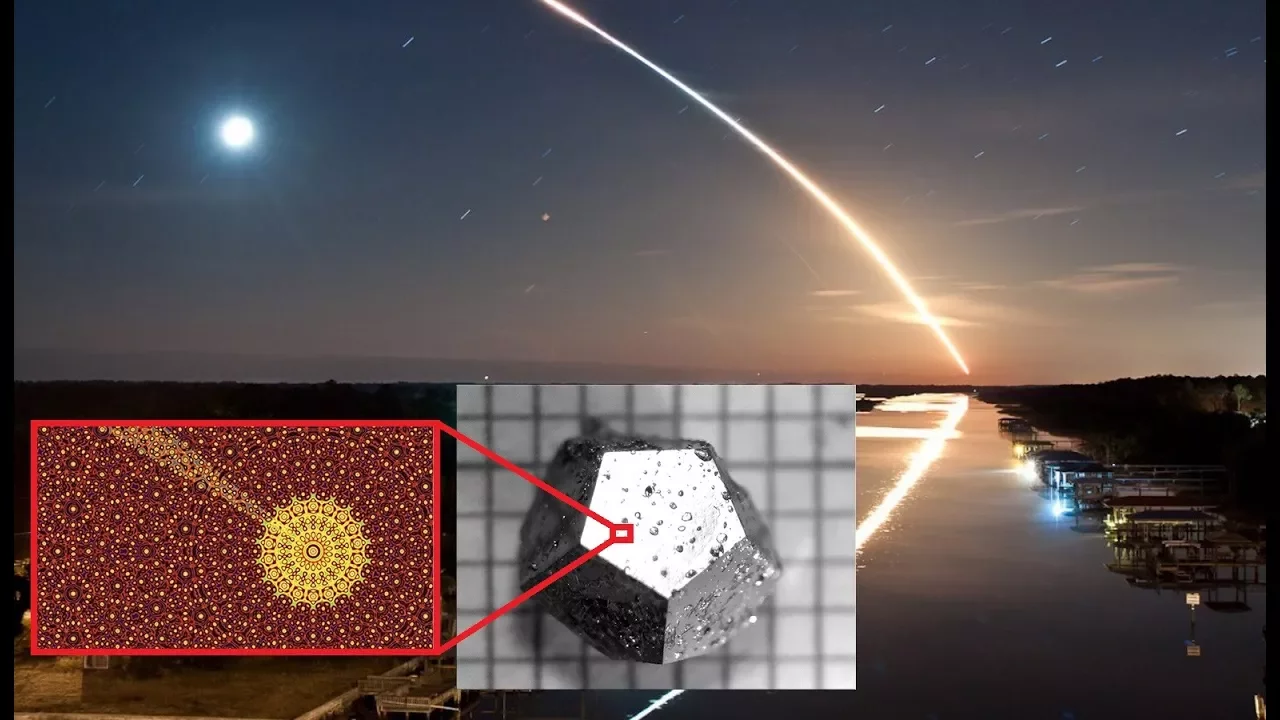
And and we'll get into a little bit more of some of these ratios in a minute. But I just want you to know that these are real materials. The atoms are placed there. They're forbidden symmetry and they don't repeat. And you can see that symmetry quite exactly in an electron defraction pattern along one of the 10 or the five-fold axes. And here you've got perfect pentagons with discrete brag peaks. And so you could see that this is an exact structure that has long range order. Otherwise, we wouldn't have this clean diffraction pattern. So these are real and a real manifestation of the Penrose tiling. They actually grow. This is a the scale bars are a millimeter actual pieces of these metals. And uh the example the only commercial example of quasi crystals actually occurs in these cooking pans. And um they coat the inside with an aluminum, nickel, cobalt alloy. And the reason they do that is that because we've given up periodicity, these quasi crystals, even though they're made out of metals, have some very strange material properties. They have very high electrical resistivity, very high thermal resistivity. And I think you can think about this if you just think about phonon propagation. If you propagate through a periodic lattice, then you can, you know, hit the right frequency and just go like a shot through a metal. But now if you have this quasi periodic spacing where there's not one length scale but these incommensurate length scales that repeat or just if you take away that periodicity I think the simplest way to think of it and now you're going to send something that's going to scatter back and your transport is going to be all messed up or at least certainly not quite as simple as it is in a simple metal. So the nice thing about these pans is that they're actually as hard as steel but more or less low stick or non-stick. And so I've actually probably cooked a hundred pieces of meat in this in the oven and it always comes clean right off of it because stuff doesn't stick to it. So it's it's a pretty amazing uh kind of material and you wouldn't expect that out of a pure metal alloy. All right. So why do I go on this long tangent about quasi crystals? Does this have anything to do with the buildings that we're looking at? Well, let me show you this mapping here that I actually found this middle bow tie. I have to credit Martin Gardner in Scientific American in one of the articles on quasi crystals. He had a little combination of penrose tiles that was in this book on his sort of recreational mathematics article and I said well that looks an awful lot like the bow tie that I've been looking at in these ga tiles. What happens if I try to map the rest of them? And this was like Christmas Eve on 2004 and I was here like over the holiday and then after that I just worked the whole thing like stayed up all night had to work out the whole tiling. So it was kind of a crazy time but uh this is really um almost like a little bit of a data dictionary if you will. So this I think is one way that we can start to see whether these patterns have anything to do with quasi crystals by doing this tile by tile mapping. Now let me point out a few things. So basically the rules go we have this a tessillation of ga tiles and now we want to see whether it fits to the penrose tiling regime. So if that works, what we should be able to do is substitute this combination of Penrose tiles every time we see one of these get tiles and check to see that all of these matching rules again those red and blue circles are continued across the boundaries. If we do that then we know we have a fragment of a perfect penrose tiling. Now there's a couple of things that we have to point I have to point out which is that we're breaking symmetry in doing so. So you'll notice here that there's blue at the bottom, red on top, red at the top, blue on the bottom. Whereas here, so if you flip that tile 180 degrees, you're going to reverse that. And so we've broken symmetry. So this tile has a lower symmetry than that one. And so when I do this substitution, I'm going to pick the best combination that I can. And this way, so you know, there's not there is no matching rule as far as I can tell about how to put these tiles together.
So already you know we have to put in a little bit of exposacto intelligence to decide whether this is actually going to work. So let's go to the back to the dur imam tiling that I showed. And in fact this maps to a fragment of a perfect penrose tiling. But I mean really there's only six tiles here. So maybe this isn't so surprising and there's all this basically empty space along the boundaries here. So I mean we're really looking at a relatively small area in terms of number of tiles. Six, you know, it maps to a couple dozen of the Penrose tiles. maybe nice, but yeah, maybe not that surprising. What is on the other hand quite remarkable is that the small tiles map as well. And here we're not talking one or two, but 3,700 Penrose tiles. And yeah, I kind of developed some carpal tunnel dragging all those tiles around. And just as a note, these aren't periodic. So you can't just copy and paste periodically. You have to drag all the tiles one at a time to align them. So this is, I think, really remarkable, right? We've got 3,700 Penrose tiles and it maps. But you could ask, is it perfect? And the answer is no. There are 11 defects that I've highlighted in the purple areas here.
Now, let's take a look. What do I mean by one of these defects? Well, here's an example of one of the defects. And you can see that where I've put these yellow dots, the red and the blue lines don't match up. Everywhere else, you can see across these get tile boundaries, the red and the blue circles match up. So, it's Penrose compatible. But the really remarkable thing about all of these defects, all 11 of them in the pattern that I showed is that they are removable point-like defects. And by removable, I mean that you can flip two tiles around.
This is a concerted get a tile operation that then restores the perfect Penrose pattern. So what does this mean? Well, let's think about how this was put together. I mean, to me, it seems like these could very well have been accidents in the actual construction of the building or maybe in the repair of the building, right? You've got some big work crew. You're building this building. The guy's beating on you. You have, you know, 500 of these tiles to put up before the end of the day. If you get a couple out of order, is anybody going to notice? And well, maybe nobody's going to notice for 500 years.
And so, you do this. And you know there's no way to know that you know maybe this was done during some repair but the point is that a concerted getile flip restores the perfect penrose pattern. And I think that's really quite remarkable. So we don't have any matching rules as I mentioned right there's no reason to believe at least from what I've seen and it's possible this could be worked out.
I just haven't you know I haven't come up with anything as far as a matching rules. But one could also question well what about the inflation procedure? I've shown you a subdivision procedure from the Dutterbam and I've described Penrose inflation. Are those in fact compatible?
Because as as as impressive as this fragment is, a fragment is only a fragment of a Penrose tiling and quasi periodicity requires a way to extend the tiling to infinity without any mistakes or defects. A fragment is not enough because every fragment of a Penrose pattern finite fragment can be embedded in a periodic matrix and then extended out to infinity periodically. So I I have to this is really the the key. If we don't have a way not just a fragment that looks kind of suspicious like it maps a penrose tilings but if we don't have a way to do this out to infinity then there is no basis for the claim of quasi crystallinity or of a penrose or any of these things. periodicity I close is not good enough because at the end of the day periodic always sneaks in and if it's not exactly quasyp periodic it's not going to happen. All right, so let's take a look at this uh subdivision sequence and can we actually map this subdivision rule to a penrose rule?
Well, for the decagon this actually works out quite beautifully, right?
You've got this gigantic 10-fold symmetric fragment of a penrose tiling that fits exactly mapped without any defects. So that's good. We've got one in our camp. However, take a look at the bow tie. We do the substitution and unfortunately this doesn't work. And if you look where I've highlighted with the yellow dots there, that defect occurs to there two defects that occur in this tiling and they cannot be removed by a concerted flip of two tiles. So this is a sort of non- removable defect. can push it around to a different part in that you can rotate some of the other tiles and you could sort of push it off into a different part of the tiling. So you can get it sort of in a different place if you needed it, but you can't get rid of it all together. So there are going to be two non- removable defects in this subdivision sequence if we have to compare it to a Penrose tiling. So uh unfortunately I think there's a quite a bit of misreporting on this. The daughter Imam shrine is not a Penrose tiling. We've got a nice mapping to Penrose tiles. And frankly, I think it is quite suspicious that it works out quite so well with the 3,700 tiles. But if we talk about it needs to have all the properties of a Penrose tile, then it doesn't. However, all hope is not lost because Penrose tiles are just one very specific type of quasi crystal pattern and it's one out of an infinite class of similar tilings that the the language that's in the literature is a local isomeorphism class. So there's actually a whole infinite family of tilings that have most of the properties of the penrose tilings, but they're not exactly the same. And so well, we might then try to look to see is in fact this subdivision procedure at the derby. I'm forgetting about penrose going to be anything that actually gives you a quasi crystal. Now I think you could sort of see that you could repeat this subdivision procedure over and over again and as long as the pattern that you started out with didn't repeat, you'll get a pattern that doesn't repeat. So I think intuitively we should expect that this ought to work out. But is there a way to say something a little bit more quantitative? So what I'm going to do now is just talk a little bit about counting tiles. So I'm going to represent in this column vector the number of bow ties, hexagons, and decagons in one of these tilings. And so I've just shown the three tiles on the right there. And why am I going to do this? Well, let's try and think about this subdivision rule in terms of the contents of one of these vectors. So we start out with this large bow tie and it's got 14 little bow ties, 14 little hexagons and for six little decagons. So it's it's a column vector of 14 14 and six. The decagon has got 80 80 and 36.
And then finally, I didn't present a rule for the large hexagon because it's not on the building, but there are some very strong constraints as to what this must be. And this is our best guess for the rule with 22 22 and 10. So if I write this down, this gives me a transformation matrix that if I to describe the subdivision procedure. So if I start out with the number of big bow ties, hexagons and decagons on the right hand side, I can calculate after one application of the subdivision, how many little tiles are going to be in the resulting pattern after I've gone through one division of or one one application of the subdivision by just applying this transformation matrix. So what do we do every time we see a matrix? Well, of course, we have to diagonalize it. So what happens? Well, before I get to that, let me just uh introduce just for notation.
I'm going to use toao here as the golden ratio. 1 plus the<unk> of 5 over2 again has to do with the many. It shows up in many places and it's all over this pentagonal geometry, but just for notational convenience, I'm going to show that subsequently. Okay. So we get three values. One of them is the largest one at 71.7 or 4 * t the 6 and the principal igen vector that corresponds to this igen value. This is remember the components of the number of bow ties hexagons and decagons in this basis one one one over the<unk> of 5. So this is the proof of quasi crystallinity because if you keep applying this matrix over and over again the ratio of the tiles is going to converge to the ratio of the components in this igen vector. And because the components are irrational or relatively irrational, you've got that square root of five. You're never going to get an integer or a rational relation of the number of tiles. And that's really the hallmark of quasi periodicity or quasi crystals in this particular context. And if you think about it, right, if you have a periodic tiling, if you made it out of different tiles, then tile ratios would automatically have to converge to whatever is basically in the unit cell, right? So if I made it out of two hexagons or, you know, two rectangles in a square, that ratio is going to stay fixed and it's going to be a fixed rational number as you extend out to infinity. With the quasi crystals, you never get there and there's this sort of irrational bit built into there. And that's sort of the proof of that. And there's this is the only igen value that's greater than one.
The second igen value is u 0.22. And so as you keep applying this transformation matrix over and over again. So again we want to generate this infinite tiling.
The igen values that are less than than one will all basically cut out their igen vectors and it gets sort of exponentially or gets suppressed. And then finally the third igen value is zero. Now this igen vector is actually pretty simple. 1 3 minus one. And that tells you uh this and I've shown graphically that every time you see a decagon you can substitute one bow tie and three hexagons and the matrix is actually degenerate. So in this actually allows us to do I think a slightly more simplified uh linear algebra treatment of all this. And let's just go ahead and convert everything to just two tiles the bow ties and the hexagons just because it's a little simpler I think to follow.
So if we now write this down and I've converted everything to the 2x2 matrix formalism that's the 20 32 32 52 that's the transformation matrix that describes again the same subdivision rule that we had for the full three tile treatment but what I want you to notice is that we can actually factor out a four and that's 5 88 and 13 and those you will probably recognize as successive integers in a Fibonacci sequence 1 2 3 58 13 etc. And the interesting thing about Fibonacci sequences is that as you go off to infinity, the ratio of successive Fibonacci integers actually converges to the golden ratio. So there's all these really neat connections. And I'm not I'm no number theorist. So there are obviously much better people that can explain some of the deeper meanings, but it's kind of neat that that kind of falls out. And that four you will see. So when we diagonalize it, looking at this matrix again, the first that four shows up in the principal igen value, but other than that, you've got a tow to the six. So that golden ratio shows up again there.
And uh so as we had hoped if the matrix is degenerate we recover the same igen values and the principal vector now is one and toao which means that if I keep applying this tiling matrix or this tiling subdivision over and over again the ratio of hexagons to bow ties converges to the golden ratio. Now if we want to tie this back into Penrose tilings the ratio of those kites to the dart tiles also converges to the golden ratio. And in fact, this is the principal igen vector that corresponds to the transformation matrix of the Penrose inflation itself. So we've got some very deep connections between stuff that's going on and uh you know so what exactly you know were they thinking?
It's hard to know and the second IEN value is less than one so we don't have to worry about that. So let me just leave you with a final picture of this particular tiling and it is a definitely an open question of what degree did they really understand all of this and I think uh you know there's been some un there's an unfortunate bias in the west that people tend to think well this is some gigantic accident they just got lucky they didn't really know everything either the Greeks figured it out or since the 1700s we in the west figured it out but what I would sort of humbly submit to you guys is that there is a building here this is you know there's no issues as to whether this is this building actually looks like this today.
I mean I was there in June and it still looks the same. And you know this is not just some mis I don't want to call it a mistransation but an interpretation reading into say a document or you know if it's not sort of written in a formal proof people tend to be very suspicious but the bottom line is there's a tiling you can pick that transformation rule off the wall and then the treatment that I did was simply counting tiles right you don't really need to know very much and then you just diagonalize a matrix and everything all falls out and so I think that you know there's great evidence from a lot of the other things with the manuscripts the other buildings that they had a tremendous amount of geometrical sophistication at the time.
And uh you know at the end I think that as professor Vafa said at the beginning we really ought to at least I hope to revisit some of the ideas that we have and some of the biases that people have that these guys were in the middle ages and unsophisticated. I mean they actually had graphical proofs of some of the properties of the golden ratio that to squal plus one for instance and that was incorporated as motifs on buildings.
There's a lot of mathematics and I think that you know if there's any hope from this work in particular it's that people like you and elsewhere will go and maybe apply some of these ideas from physics and see what you can learn about a lot of other people in a lot of different places because I think you know I hope to convince you guys that a more rigorous analysis applied to some random building in the library that I found in a slide actually leads to some interesting conclusions. So with that let me move on to the acknowledgements.
Jeff Spur, who's graciously joined us, is the one that kind of helped me out looking through thousands and thousands of slides just a couple blocks away. And I should say that, you know, all the pictures that you see here, all this research is actually done in the basement of the library. So, since the paper was published, I've been able to travel. There's been some expatriate Iranians that Professor Vafa works with, the Niki group that sponsored helped sponsor one of my trips over there and but basically all of the work and all the analysis was done looking at slides in the library. Tom Lens is the department the director of the Harvard Art Museums and he was a big supporter.
Thank Professor Vafa and then some of the other guys, my cousin in the Peace Corps and uh she was the one that I visited backstand with and finally my parents who paid for like my computer.
So if you want any more information uh the paper and all the links to the uh media coverage is on my website and I thank you very much for your attention and I'm happy to take [Applause] questions. Um Okay.
Yeah. Well, well, I I that's that's how I think about it. And let me just say um what they actually knew is as far as I can tell a mystery because we don't have sort of a it's not like somebody wrote a thesis on this in 1460 and said you know this is how I built the building. So um I would say that what do we really know from about this tiling? Well, I think that you know the placement, let me just back up here and yeah, sorry.
Um, yeah, and the placement of those tiles on the building itself is not an accident. Okay, this is a pretty good example, right? I mean, and and what I want to say is here, you've got this decagon tiles centered at the apex of the arch. You've got these center of the bow ties here at the corners. And in fact, you could actually argue that based on the geometry of the decagons and the pentagons here that the width of the height and the width to height ratio is actually a multiple or some multiple of the golden ratio. And you know, people always talk about like the pyramids or whatever. That's based on some measurement. But this is actually analytic because how they placed this arch relative to these get tiles was completely deliberate. And in particular, you could see that for instance, the arch boundary comes in right where the decoration gets subdivided there. This isn't an accident at all, right? This is not wallpaper in the sense that the pattern is just being randomly applied. So you're left now I let's say you've you've demarcated the large scale structure of the design and you've even shaped the part of the building based on that. Now you want to fill it in with something a bit more intricate. Now how do you do that? Well, you could do it by making smaller versions of the tiles and tiling periodically. But in this case they didn't want to do that. They use the subdivision rule. And we know that obviously if they did it once they could have done it again. But what they had was a procedure then to take a deliberate configuration of tiles expand it out to infinity without repeating and that and it will have all these forbidden symmetries. This 10fold and fivefold stuff is certainly not an accident. So empirically they developed a procedure that would give you an infinite quasi crystal and that I think deliberately so this is definitely not an accident. Now what they knew about the properties I kind of doubt they were writing down the matrix back in that point but you never know. But my point is that you know this is a deliberate very practical thing. They needed to solve a practical problem and it happened to be a very clean solution that incorporates this geometry. So you know what properties of these tilings did they know about? I don't know. But it's a forbidden symmetry tiling that never repeats that could have been extended out to infinity to cover an area of their choosing. And that is the essence of what a quasi crystal is.
Okay. Okay. So, yeah, let me I think this is a certainly um the the scrolls would tell you uh so I I showed the uh the Durb Kushk which had the cut bricks and I think that that's one piece of evidence. uh the scroll tiles are the scroll the patterns I think also show that this was a deliberate design convention but no we haven't found for instance underneath the bricks aside well I think that the dudri kushk that I showed evidences that but um okay so about the other tiles sure you could fill in uh the decoration with a different underlying grid and I would say that if you look at the literature you know you can do mappings or substitutions of different tiles to substitute for the ones that I have but these are the ones that show up in the documents. And so I'm not I I certainly there are there must be an infinite set of tiles that you could map equivalently to try and explain it, but you're not going to find I think anything else as far as I can tell with this pentagonal and diagonal geometry because this has actually been documented in the scrolls.
And I I should also say that you know we picked the I picked the simplest case of the decagonal or iicosahedral quasi crystal because frankly it's the simplest and it's I think you know it gives you the dramatic conclusion of a forbidden symmetry and it's also what I studied as an undergrad. So I did my thesis with Sinhardt and uh I we worked on the defraction properties of icosahihedral quasi crystals. So I was more or less predisposed to think about these particular ones. But there are many examples of other types of geometries. There are claims of other types of quasi crystals. None of which I find overwhelmingly persuasive. But there are certainly diagonal or octagonal quasi crystals, doicagonal quasi crystals. And you know, hopefully somebody who's not trying to graduate this year can go through and try and figure out the rest of this. I can't see there any other questions.
uh very possible although um I don't know exactly how you would evaluate that. Um, you know, I guess to me it's the question that was interesting to me is the kind of defect that were introduced. Is it consistent with the procedure that I think they were using to build this? And I think that the answer is yes in the sense that those defects also deviate from the the gate tile subdivision rule. And so you could imagine, you know, maybe they actually cut the tile physically wrong or they put in some motifs that don't agree with these get tiles, but they didn't do that. So, I I I've I've been asked this before and I it's beyond in my opinion what we're really going to be able to know unless somehow we were able to discover something of the intention of the original designer. But I think on the other I think it's also pretty easy to understand that if you were to put up 500 tiles and nobody's going to know or you're doing the best you can, you could make a mistake. And so it's a great question and I wish I knew.
Yeah. Okay. But but as for these buildings, I just don't know.
Well, that's uh it's Yeah. Well, I um unfortunately I can't answer that. It's sort of I tried to stay kind of as keep things I I like matrices and IEN values. It's it's much safer there, right? You don't really you don't offend people with the wrong sort of view on things. And so I've deliberately stayed as far away from those questions as possible because I as it's not I'm a Christian. I'm not a Muslim. And so I just don't know enough about this really like to have a really good answer for that. And I think that you know we've tried I've tried we tried to put this on a very quantitative framework. And if somebody can then take that in a particular direction then by all means I hope that they do. But I'm just not qualified to do it.
Yeah. But on the other hand, you know, most of the numbers are kind of significant up to the number 10, and there are only 10 of them. So, I mean, you know, I I don't know. I just I don't know how I think that'd be great if somebody wanted to look into that.
Yeah.
All right. Well, thanks, Jeff. Mhm.
Yeah, great great question. Um so basically this was a sort of focused march toward I decided to go to library and say well is there diagonal or is there an icosahedral quasi crystal or diagonal quasi crystal or not and it's a simple two-dimensional planer case I figured that I this is what I was sort of born to do in terms of my senior thesis and so that's what I was looking for but it's a fantastic question that there are mukarnas which are these sort of stelactite type patterns inside domes if you look at at mammlook cairo they actually have these get patterns wrapped around domes. And I think that there's a fascinating work, a fascinating amount of research waiting to happen there.
Yeah, I I I haven't really looked into it because that's, you know, that's sort of the next step. I wanted to sort of have a complete solution to the simplest ones and then, you know, postgraduation or post whatever maybe get back into this. Um but that's no I think it's a great area that I I hope that somebody and the other thing is you know there's I think a lot of the concepts of curve space that you could really apply in some differential geometry and you know that's something that I think is just waiting to happen and could be very exciting [Applause]
Up Next
10:15
Galilean Relativity Explained: Inertial Frames & Motion
@eigenchris
170.5K views•2020-03-14

12:53
21cm Hyperfine Transition in Neutral Hydrogen: Radio Astronomy Basics
@AaronRobertParsons
12.4K views•2011-10-13

32:32
NMR Spin Physics I: Zeeman Effect, Resonance Condition & Larmor Frequency
@nptel-indianinstituteofsci8064
2.3K views•2024-01-17

27:14
Entropy and the Second Law of Thermodynamics Explained
@veritasium
27.5M views•2023-07-01
Related Study Plans & Knowledge Roadmaps
Structured learning paths in Physics
physics
Nuclear Physics (Decay, Fission & Reactors)
01Atomic Structure and the Binding Force
02Radioactive Decay and Half-Life
03Nuclear Fission Mechanics and Chain Reactions
+ 2 more learning modules
12h5 modules
Explore Roadmap
physics
Soft Matter (Polymers, Colloids & Rheology)
01Foundations of Soft Matter & Thermal Forces
02Polymer Physics and Macromolecules
03Colloids, Surfactants, and Self-Assembly
+ 2 more learning modules
38h5 modules
Explore Roadmap
physics
Analytical Mechanics: Lagrangian & Hamiltonian
01Mathematical Foundations: Calculus of Variations
02From Newtonian Mechanics to Constraint Dynamics
03The Principle of Least Action & Lagrangian Mechanics
+ 3 more learning modules
28h6 modules
Explore Roadmap
physics
General Relativity (Spacetime & Cosmology)
01Foundations of Relativity: Special Relativity
02The Geometry of Spacetime: Equivalence Principle & Curvature
03Einstein's Field Equations: The Mathematics of Gravity
+ 2 more learning modules
55h5 modules
Explore Roadmap