




![อุณหพลศาสตร์ 01 - Partial Derivatives ใน Thermodynamics [สอวน.ฟิสิกส์ ค่าย 2]](https://i.ytimg.com/vi/9GAT0ccXR0A/hqdefault.jpg)







![PRIMERA LEY DE LA TERMODINÁMICA (1st Law of Thermodynamics Class) - [Parte 1/3]](https://i.ytimg.com/vi/9BSeJlG6T6s/maxresdefault.jpg)









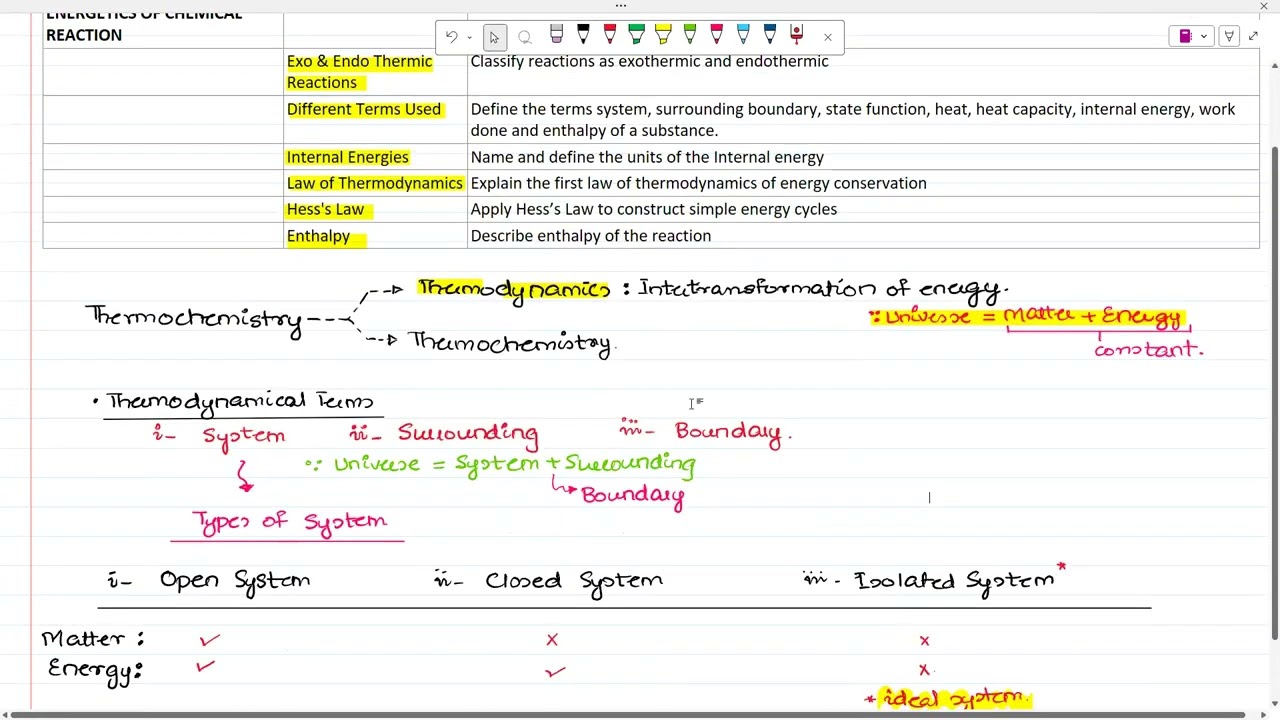
Thermodynamics is the science of heat flow, developed during the Industrial Revolution, based on four empirical laws that govern equilibrium systems. The Zeroth Law defines temperature through thermal equilibrium, the First Law establishes energy conservation, the Second Law introduces entropy and the direction of time, and the Third Law states absolute zero cannot be reached. Key concepts include systems (the part of the universe under study), surroundings, boundaries, and classification into open, closed, or isolated systems. Thermodynamic properties are categorized as extensive (scaling with system size) or intensive (independent of size). State variables describe equilibrium states without depending on history, enabling prediction of system behavior from minimal information.
Thermodynamics Lecture 1: Laws, Systems, and States | MIT 5.60
Added:the following content is provided under a Creative Commons license your support will help MIT open courseware continue to offer highquality educational resources for free to make a donation or view additional materials from hundreds of MIT courses visit mitop courseware at ocw.mit.edu thermodynamics all right let's start thermodynamics is the science of the flow of heat so Thermo is heat and Dynamics is the motion of thermodynamics was developed uh largely beginning in the 1800s at the time of the Industrial Revolution it's a Taming of the of Steel the beginning of generating uh Power by burning fossil fuels uh the beginning of the problems with CO2 in the atmosphere global warming in fact it's interesting to note that the first calculation on um the impact of CO2 on climate was done in the late 1800s by arenus beginning of the generation of power moving heat from fossil fuels to generating energy locomotives Etc so he calculated what would happen to this Burning of fossil fuels and um he decided in has calculation he basically got the calculation right by the way but he came out that in 2,000 years from the time that he did the calculations humans would be in trouble well since this calculation we've had an exponential growth in the amount of CO2 and if you go through the calculations of people have done these calculations throughout time since serenus the time that we're in trouble 2,000 years and the calculation has gone like this and so now we're now we're really in trouble that's a for a different lecture so anyway thermodynamics dates from the same period as as as as getting fossil fuels out of the ground it's Universal turns out everything around us moves energy around in one way or the other if you're a biological system you're burning calories burning ATP you're creating heat if you're warm-blooded animal you you need energy to move your arms around and move around mechanical systems obviously cars boats Etc and even in astrophysics when you talk about stars black holes Etc you're moving energy around you're moving heat around and you're changing matter through uh thermodynamics and the concepts of thermodynamics have even been applied to economics systems out of equilibrium like big companies like it's like Enron you know completely out of equilibrium Crash and Burn right it's can apply thermodynamic or non-equilibrium thermodynamics to to economics it was developed before people knew about atoms and molecules so it's a science that based on macroscopic properties of matter since then since we know about atoms and molecules now we can rationalize the concepts of thermodynamics using microscopic properties and if you are going to take 562 that's what you learn about you learn about statistical mechanics and how the atomistic concepts rationalize thermodynamics it doesn't prove it uh but it helps to getting more intuition about U the consequences of thermodynamics so it applies to macroscopic systems that are in equilibrium and how to go from one equilibrium state to another poan State and it's entirely empirical in its foundation people have done experiments Through the Ages and they've accumulated the knowledge from these experiments and they've synthesized these experiments into a few basic empirical rules empirical laws which are the laws of thermodynamics and then they've taken these laws and added a a structure of math upon it to build this edifice which is very solid edifice of thermodynamics as a science of equilibrium systems so these empirical observations then are U summarized into four laws okay so um these laws are they're really deep pillars they're they're not proven but they're not wrong they're very unlikely to be wrong let's just go through these laws okay very quickly there's a zero law the zero law every one of these laws basically defines a quantity in thermodynamics and then defines a concept the zero law defines temperature that's a fairly Common Sense idea but it's important to Define it and I call that the common sense law okay so this is the common sense law the first law ends up uh defining energy which we're going to call you and um the concept of energy conservation energy can't be lost or gained and I'm going to call this the you can break even law you can break even you don't lose energy you can't gain energy energ you break even the second law is going to Define entropy and it's going to tell us about the direction of time something that conceptually we clearly understand but it's going to put a mathematical foundation on which way does time go clearly if I take a chalk like this one here and I throw it on the ground and it breaks in little pieces if I run the movie backwards that doesn't make sense right we have a concept of time going forward in a particular way how does entropy play into that concept of time and I'm going to call this the um you can break even at 0 degrees Kelvin law okay you can only do it at 0 degrees Kelvin the third law is going to give a numerical value to the entropy and the third law is going to be the depressing one and it's going to say you can't get to 0 degrees okay these laws are universally valid they cannot be circumvented certainly people have tried to do that and every year there's a newspaper story in Wall Street Journal or New York Times about somebody that has invented a device that somehow goes around the second law and makes more energy than it creates and this is going to be well first of all for the investors this is going to make them very very rich and for the rest of us it's going to be wonderful and they go through these arguments and they find Venture money to fund the company and they get very famous people to endorse them Etc but you guys know because you have MIT degrees and you later and you've taken 560 that that can't be the case and you're not going to get fooled into investing money into these companies but it's amazing that every year you find somebody coming up with a way of going around the second law and somehow convincing people who are very smart that this will work okay so Thermo in is also a big tease as you can see from my descriptions of these laws here it makes you believe initially and the feasibility of perfect efficiency right the the first law um the first law is very upbeat it talks about the conservation of energy energy is is conserved in all of its forms you can take heat energy and convert it to work energy and vice versa and it doesn't say anything about that you have to waste heat if you're going to transform heat into work it just says it's energy it's all the same thing right so you could break even if you were very clever about it and that's that's pretty neat so in a sense it says you know if you wanted to build a boat that took energy out of the air out the warmth of the air to sale around the world you can do that right and then the second law comes in and says well that's not quite right right the second law says yeah energy is pretty much the same in all its form but if you want to convert one form of energy into another if you want to con convert work uh heat into work with 100% efficiency you got to go down to 0 degrees Kelvin to absolute zero if you want to do that otherwise you're going to waste some some of that heat somewhere along the way some of that energy okay so all right so you can't get perfect efficiency but at least if you were able to go to Z degrees Kelvin then you'd be all set right you just got to find a good refrigerator on your on your on your boat and then you can still go around the world then the third law comes in and that's the depressing part here it says well it's true if you could get a 0 degrees Kelvin you'd get perfect efficiency but you can't get to 0 degrees Kelvin you can't even if you have an infinite amount of resources you can't get there okay any questions so far so thermodynamics based on these four laws now requires an edifice and it's very it's a very mature science and it requires that we Define things carefully so we're going to spend a little bit of time making sure we Define our our Concepts and our words and what you'll find that when you do problem sets especially at the beginning very uh understanding The Words and the conditions of the problem sets is most of the way into solving the problem okay so we're going to talk about things like systems okay the system it's that part of the universe that we're studying these are going to be fairly Common Sense definitions but they're important and when you get to a problem set really nailing down what the system is not more not or less in terms of the amount of stuff that's part of the system it's going to be often very crucial okay so you've got the system for instance it could be a person I'm the system I could be a system it could be a a hot coffee and a thermos okay so the coffee and the milk and whatever else you like in your coffee would be the system a glass of water with ice in it it's fine system a volume of air in a part of a room take a four liters on this corner of the room that's my system then um after you define what your system is whatever is left over of the universe is the surroundings so if I'm the system then everything else is the surroundings you are my surroundings Saturn is my surroundings right as far as you can go in the universe that's part of the surroundings and then between the system and the surroundings is the boundary and the boundary is is a Surface that's uh real like the outside of my skin or the inner wall of the thermos that has the coffee in it or could be an imaginary boundary for instance I can imagine that there's a a boundary that surrounds the four lers of air that's sitting in the corner there it doesn't have to be a real container to contain it it's just an imaginary boundary there and where you place that boundary becomes important so for instance for the uh the thermos with the coffee in it if you place the bound be in the inside wall of the glass or the outside wall of the glass and the inside of the thermos that makes a difference different heat capacity Etc so this becomes where defining the system and the boundaries and everything becomes important got to place the boundary at exactly the right place otherwise you've got a bit too much in your system or a bit too little okay more definitions the system can be an open system or it can be a closed system system or can be isolated the definitions are also important here okay an open system as the name describes allows mass and energy to freely flow through the boundary mass and energy flow through boundary okay mass and energy I'm an open system right water vapor goes through my skin I'm hot compared to the air of the room or cold if I'm somewhere that's warm so energy can go back and forth the thermos with a lid on top is not an open system hopefully your coffee is going to stay warm or hot in the thermos right it's not going to get out so the thermos is not an open system in fact the thermos is an isolated system the isol isolated system is the opposite of the open system no mass and no energy can flow through the boundary the closed system allows energy to transfer through the boundary but not mass so a CL system would be for instance a glass of ice water with an ice cube in it with a lid on top right the glass is not very insulating energy can flow across the glass but I put a lid on top and so the water can't get out that's a close system and you goes through the boundary but nothing else okay important definitions even though they may sound really kind of dumb all right but they're really important because when you get the problem figuring out whether you have an open closed or isolated system what's the surroundings what's the boundary what is the system that's the first thing to make sure that is clear if it's not clear the problem is going to be impossible to solve and that's also how people you know find ways to break the second law it's because somehow they've messed up on what their system is right and they've included too much or too little in the system and it looks to them that that the second law is broken and they've created more energy than than uh than it's been brought in that's usually the case questions okay let's keep going um so now that we've got a system we've got to describe it so let's describe the system now it turns out that um when you're talking about macroscopic properties of matter you don't need very many variables to describe a system completely thermodynamically you just need a few macroscopic variables that are very familiar to you like the pressure the temperature the volume the number of moles of each component the mass of the system if you've got a magnetic field maybe the magnetic susceptibility the electric field we're not going to worry about these mag magnetic fields or electric fields in this class so pretty much we're going to focus on this set of variables here you're going to have to know when you describe the system if your system is homogeneous like your coffee with milk in it or heterogeneous like water with an ice cube in it so heterogeneous means that you've got different phases in your system I'm a heterogeneous system soft stuff heart stuff liquid stuff the coffee is homogeneous even though it's made up of many components many different kinds of molecules make up your coffee there's the water molecules the flavor molecules the milk proteins Etc but it's all mixed up together in a homogeneous macroscopic fashion if you drill down at the level of molecules you'd see that it's not homogeneous but thermodynamics takes a bird's eye view looks pretty uniform okay so that's a genous system one phase you have to know if your system is an equilibrium system uh or not if it's an equilibrium system then thermodynamics can describe it if it's not then you're going to have trouble describing it using thermodynamic properties thermodynamics is talks about equilibrium systems and how to go from one state of equilibrium to another state of equilibrium and what does equilibrium mean it means that the properties of the system the properties that describe the system don't change in time or in space so if I've got a a gas in a container the pressure of the gas has to be the same everywhere in the container otherwise it's not in equilibrium right if I place my container of gas on the table here and I come back an hour later the pressure needs to be the same when I come back otherwise it's not in equilibrium so it only talks about equilibrium systems what else do you need to know you need so you need to know the variables you need to know if it's heterogeneous or homogeneous you need to know if it's an equilibrium and you also need to know how many components you have in your system so a glass of ice water with an ice cube in it which is a heterogeneous system has only one component which is water H2O two phases but one component uh latte which is a homogeneous system has a very very large number of components to it right all the components that make up the milk all the components that make up the coffee and all the impurities Etc cadmium heavy metals arene whatever they are in your coffee okay any questions all right so we've described the system with these properties now these properties come in two flavors you have extensive properties and intensive properties the extensive properties are the ones that scale with the size of the system if you double this system they double in in their numerical number for instance the volume you double the volume you double v doubles right I mean that's obvious the mass if you double the amount of stuff the mass will double intensive properties don't care about the scale of your system if you double everything in the system the temperature is not going to change it's not going to double temperature stays the same so temperature is intensive and you can make intensive properties out of the extensive properties by dividing by the number of moles in the system so I can make a quantity that I'll call V bar which is the m volume the volume of one Mo of of a component in my system and that becomes an intensive quantity a volume which is an intensive volume the volumes per mole of of that stuff okay so as I mentioned thermodynamics is is the science of equilibrium systems and um so we need it you need it also describes the evolution of one equilibrium to one another equilibrium how do we go from one to the other and so the set of properties that describes the system uh in equilibrium doesn't change okay so these unchanging properties that describe the state of the equilibrium state of the system uh are called State variables okay so the state State variables describe the equilibrium State and they don't care about how the state got to where it is they don't care about the history of the state they just know that if you have water at 0 degrees CSUS with ice in it that you can Define it as a heterogeneous system with a certain uh certain density for the water or certain density for the ice etc etc okay doesn't care how you got there we're going to find other properties that do care about the history of the system like work that you put in a system or heat that you put in a system or some other variables but you can't use those to define the equilibrium State you can only use the state variables independent of history and it turns out that for a one component system one component meaning one kind of molecule in the system uh all that you need to know to describe the system is the number of moles for one component system and to describe one phase in that system one component homogeneous system you need n and two variables for instance the pressure and the temperature okay or the volume and the pressure if you have the number of moles and two intensive variables then you know everything there is to know about the system by the equilibrium state of that system there are hundreds of of quantities that you can calculate and measure that are interesting and important properties and all you need is just a few variables to get everything out and that's really the power of thermodynamics is that it takes so little information to get so much information out so little data to get a lot of predictive information notes okay so um as we're going on with our definitions um we can summarize a lot of these definitions into a notation a chemical notation that that will be very important and um so for instance if I'm talking about three moles of hydrogen at one bar 100 degrees C I'm not going to write given three moles of hydrogen at one bar and 3 degrees blah blah blah right I'm going to write it in a compact notation I'm going to write it like this three moles of hydrogen which is a gas one bar 100° C okay this notation gives you everything you need to know about the system tells you the number of moles tells you the phase tells you what kind of molecule it is and gives you two variables that are State variables you could have the volume on the temperature you could have the volume and the pressure but this tells you everything I don't need to write it out in words and then if I want to U tell you about a change of state or a let's let's first start with a mixture suppose that I wanted that I give you a mixture like this is a homogeneous system with two components like five moles of H2O which is a liquid at one bar 25° C plus 5 moles of ch3 ch2 which is a liquid at one bar 25° okay this describes rough something that is fairly common place it's a 100 Proof vodka right half water half ethanol that describes that macroscopic system okay you're missing out the impurities all the little flavor molecules that go into it but basically that's that's the hom homogeneous system here described two component homogeneous system then you can do all sorts of predictive uh uh stuff with that system all right that's the equilibrium system now we want to show a notation how do we go from one equilibrium State like this describes to another equilibrium state so we take our two equilibrium States and we just put an equal sign between them and the equal sign means take go from one to the other so if we took three moles of our three of hydrogen which is a gas at 5 bar and 100° cus and which is a nice equilibrium State here and we say all right now we're going to change the equilibrium state to something new we're going to do um an expansion let's say all right we're going to drop the the pressure the volume is going to go up I don't need to tell you the volume here because you've got enough information to calculate the volume the number of moles stays the same close system gas doesn't come out stays a gas but now the pressure is less the temperature is less I've done some sort of expansion on this I've gone from one equilibrium state to another equilibrium and the equal sign means you go from this state to that state it's not a chemical reaction right that's why we don't have an arrow here because we could go back this way too can go back and forth between these two kilog states they're connected this means they're connected and when when I put this I have to tell you how they are connected I have to tell you the path if you're going to solve a problem for instance you want to know how much energy you're going to get out from doing this expansion right how much energy are you going to get out and how far are you going to be able to drive the car with this expansion let's say let's say that's the problem right so I need to tell you how you're doing the expansion because that's going to tell you how much energy you're wasting during that expansion goes back to the second law right nothing is efficient you're always wasting energy into heat somewhere when you do a change that involves a mechanical change all right so I need to tell you the path when I go from one state to the other and the path is going to be the sequence intermediate States going from the initial state to the final state so for instance if I draw a graph of pressure on one axis and temperature on the other axis my initial state is at a temperature of 100° celi and 5 bar my final state is 50° C and one bar so I could have a uh two steps in my path I could decide first of all to keep the pressure constant and lower the pressure when I get to 50 degrees C I could choose to keep the temperature constant and lower the pressure I'm sorry my first step would be to keep the pressure constant lower the temperature then I lower the pressure keeping the temperature constant so there's my intermediate State here this is one of many paths there's an infinite number of paths you could take you could take a continuous path where you have an infinite number of equilibrium points in between the two a smooth path where you drop the pressure and the temperature simultaneously in little increments right so when you do a problem the path is going to turned out to be extremely important how do you get from the initial state to the final State Define the initial State Define the final State Define the path get all these really clear and you basically solve the problem you got to spend the time to make sure that everything is well defined before you start trying to work out these problems okay more about the path there there are a couple ways you could go through that path if I look at this smooth path here I could have that path be very slow and steady so that at every point of the along the way my gas is in equilibrium so I've got this this piston here it's compressed and I slowly slowly increase the volume drop the temperature I can go back the gas is in equilibrium at every point of the way it's called it that's a reversible path I can reverse the process I expand it and I reverse it no problem so I could have a reversible path or I take my my gas and instead of slowly slowly raising it dropping the pressure I I go from Five Bar to one bar are extremely fast right what happens to my gas inside well my gas inside is going to be very unhappy it's not going to stay in equilibrium parts of the system are going to be at Five Bar parts of it are one bar parts of it may be even at Zero Bar if I go really fast I'm going to create a vacuum so the system will not be described by a single state variable during the during the path right if I look at different points in my container during that path path I'm going to have to use a different value of pressure or different value of temperature at different points of the path of the container that's not an equilibrium State and that process turns out then to be an irreversible process do it very quickly now to reverse it and get back to the initial point is going to require some input from outside uh like heat or extra work or extra heat or something because you've done an irreversible process you've wasted a lot of of of energy in in in doing that process okay you have to tell them tell us whether I have to tell you whether the path is uh reversible or irreversible and the irreversible path also defines the direction of time right you can only have an irreversable path go one way in time not the other way chalk breaks irreversibly and you can't put it back together so easily you got to pretty much take that ch and make a slurry out of it put water and dry it back up put it in a mold and then you can have a chalk again right but you can't just glue it back together that would not be the same state as what you started out with and then there are a bunch of words that describe these paths words like adiabatic which you'll be very familiar with adiabatic means that there's no heat transfer between the system and the surrounding the boundary is impervious to transfer of heat like a thermos anything that happens inside of the thermos is an adiabatic change because the thermos has no connection in terms of energy to the outside world there's no heat that can go through the walls of the thermos whereas like isobaric means constant pressure so this path right here from this top red path is an isobaric process right constant temperature means isothermal so the this part here is an isothermal process so the going from initial to final uh state state Ates with a red path you start with an isobaric process and you end with an isothermal process again these are words that are very meaningful when you read the text of of a problem or of a process any questions before we get to the zero flaw pretty much done with our definitions here yes agatic can be either reversible or not and we're going to do that probably next next time or two times any other questions yes is there a boundary between reversible and irreversible a boundary between reversible and irreversible like uh something is almost reversible and almost irreversible no pretty much things are either reversible or irreversible uh now in in practice it depends on how good your measurement is right um and probably also in practice nothing is truly reversible right so uh it depends on your error bar in a sense right it depends on what you define exactly defining your system becomes a great area but it should be pretty clear if you can treat something as reversible or irreversible questions other questions it's a it's a good question okay so the zero law we're going to go through the laws now the zeroth law talks about defining temperature and it's um it's the common sense law you all know how when something is hot it's high it's got a higher temperature than when something is cold but it's important to Define define that and Define something a thermometer so what do you know what's the empirical information that everybody knows everybody knows that if you take something which is hot and something which is cold and you bring them together make them touch that heat is going to flow from the cold from the hot to the cold right I make them touch and he flows from hot to cold that's common sense this is part of your DNA right and then the final product is an object AB which ends up at a at a temperature or Warmness which is in between the hot and the cold so this turns out to be warm right you get to a new equilibrium state which is in between what this was and what a and bware so um then how do you know that that it that it's changed temperature or that heat has flowed from A to B practically speaking you need some sort of of property that's changing as heat is Flowing for instance um if a were metallic you could measure the conductivity of a or the resistivity and at heat as heat flows out of a into B the resistivity of a would change right or you could have something that's colorometric that changes color when when it's colder right and so you could see the heat flowing as a changes color or B changes color as he flows into B so you need some sort of property some of something you can see something you can measure that tells you uh that heat has flowed now if you have three objects if you have a b and c and you bring them together and a is the hottest B is the medium one and C is the coldest so from hottest to coldest a b c if you bring them together and make them touch you know intuitively that heat will not flow like this right you know that's not going to happen you know that what will happen is that heat will flow from A to B from B to C and from a to c that's common sense you know that right and the other way and the circle will never happen that would that would give rise to a perpetual motion machine breaking of the second law can't happen but that's that's an empirical observation that he flows in this direction and and that's the zero flaw thermodynamic it's pretty simple right the zero flaw says that if a and b it doesn't exactly say that but it implies this right it says that if a and b are in thermal equilibrium if these two are in thermal equilibrium meaning that there's no heat that flows between them so that's the definition of thermal equilibrium no heat flows between them if these two are in thermal equilibrium and these two are in Thal equilibrium then a and c will always be will also be in thermal equilibrium but if there's no heat flowing between these two and no heat flowing between these two then you can't have heat flowing between these two so if I get rid of these arrows there's no heat flowing because they're in thermal equilibrium then I can't have an arrow here that's what a zero FL says they're all the same temperature that's what it says if two objects are in the same temperature temperature and two other objects have the same temperature then all three must have the same temperature that sounds pretty silly but it's really important because it allows you to define a thermometer and temperature okay because now you can say all right well now B can be my thermometer I have two objects I have an object which is in Madagascar and an object which is in Boston right and I want to know are they the same temperature so I comment with a third object B I go to Madagascar I put B in contact with a then I insulate everything you know take it away make see if there's any heat flow let's say there's no heat flow okay then I insulate it and back get back on the plane to Boston and go back and touch B with C if there's no heat flow between B and C then I can say all right A and C were the same temperature B is my thermometer that tells me that A and C are the same temperature and there's a certain property associated with heat flow with b and it didn't change right and that property could be color it could be resistivity could be a lot of different things could be volume and the temperature then is associated with that property and if it had changed then the temperature between those two would have changed in a very particular way so Theos slw then allows you to define the concept of temperature and the measurement of temperature through a thermometer okay let's very briefly go through stuff that you've learned before so now you you have this object which is going to tell you whether other things are in thermo not what do you need for that object you need um you need that object to be a substance to have to be something so the active part of the thermometer could be could be water could be alcohol Mercury could be a piece of metal you need a substance and then that substance has to have a property that changes depending on the heat flow I.E depending on whether it's it sensing that it's the same temperature or a different temperature than something else and that property uh could be the volume like if you have a mercury thermometer volume of the Mercury could be temperature could be resistivity if you have a a um a thermal couple um could be the pressure all right so now you have an object you've got a property that changes depending on the heat flow he's going to tell you about the temperature now you need to define a temperature scale so you need some reference points to be able to tell you okay this temperature is 550 de Smith whatever right so you assign values to very specific states of matter and and call those the reference points for your temperature for instance freezing of water or boiling of water this the standard ones and then an interpolation scheme how do you you you need a functional form that connects the value at one state of matter the freezing point of water to another phase change the boiling corn of water you can choose a a linear interpolation or quadratic but you've got to choose it and it turns out not to be so easy and if you go back in the 1800s when thermodynamics were starting there were a zillion different temperature scales everybody had their own favorite temperature scales the the one that we're most familiar with is the Centigrade or Celsius scale with Mercury was the substance and the volume of Mercury is the property the reference points are water freezing or boiling and the interpolation is linear then that morphed into the Calvin scale as we're going to see later the Fahrenheit scale is is an interesting scale turns out the US and Jamaica are the only two places on Earth now that used the Fahrenheit scale Mr Fahrenheit Daniel Gabriel Fahrenheit was a German instrument maker and um the way he came up with his scale was actually he borrowed um the RoR scale which came before him the RoR scale was RoR was a Dane and he defined freezing of water a 7 and a half degrees RoR and um 22.5 degrees RoR as blood War that was his definition all right two substances blood water two reference points freezing and blood warm in your human body a linear interpolation between the two and then some numbers associated with them TW 7 and a half and 22 and A2 why did he choose 7 and a half as the freezing point of water because he thought that would be big enough that in Denmark temperature wouldn't go below zero that's how you pick seven and a half why not right didn't want to use negative numbers to measure temperature in Denmark outside well Fahrenheit came along and thought you know 7 and a half that's kind of silly 22 and a half that's kind of silly so let's multiply everything by four all right then becomes I think it becomes 90 and uh 30 degrees for the freezing of water and 22 and a half time 4 which I I don't know what it is 100 or something no was 92 or 990 I think and then for some reason that nobody understands he decided to multiply Again by 165s and that's how we get 32 for freezing of water and 96 in his words for the temperature in the mouth or underneath the armpit of a living man in good health what a great temperature scale right turns that 96 wasn't quite right then he interpolated and found well water boy is at 212 but you know his experiment wasn't so great and you know maybe he had a fever when he did the reference point that 96 whatever turns out that it's not 96 to be in good health it's 98.6 whatever that's how we got to the Fahrenheit scale all right next time we're going to talk about a much better scale which is the ideal gas thermometer and how we get to the Calin scale
Up Next

TSPSC AEE Thermal Engineering: Preparation Strategy & Imp Qs
@aceonline-appsctgpsc
4.8K views•2022-12-21
Ultrasonic Transducers: Resonant Frequency Measurement and Horn Design
@imajeenyus42
229.9K views•2017-02-22

Refractive Index Plasma Diagnostics: Wave Propagation & Schlieren Imaging
@mitocw
1.2K views•2024-08-20
How a Student's Question Saved a NYC Skyscraper from Collapse
@veritasium
22.8M views•2025-04-26
Related Study Plans & Knowledge Roadmaps
Structured learning paths in Engineering