















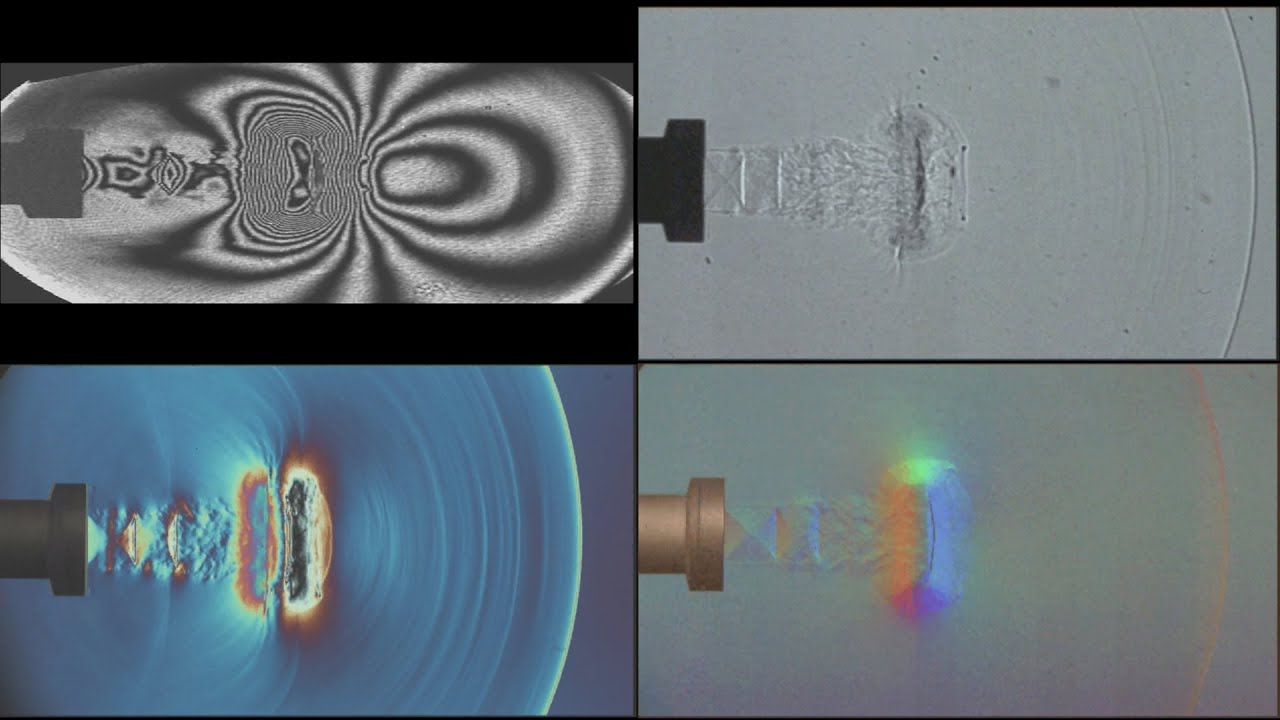





Schlieren imaging is a refractive index diagnostic technique that visualizes density gradients in plasma by placing a stop at the focal plane of a lens system; rays passing through plasma with density gradients are deflected from their original path, and the stop filters these deflected rays to create contrast between regions with and without density gradients, making it particularly useful for visualizing shocks and turbulent structures in plasmas.
Refractive Index Plasma Diagnostics: Wave Propagation & Schlieren Imaging
Added:Fundamental electromagnetism and Maxwell's equations, specifically wave propagation in dielectric and conducting media.
Basic plasma physics concepts, including plasma frequency, free electron density, and the cold plasma approximation.
Wave optics principles, particularly refraction, dispersion, and the physical definition of refractive index.
Basic geometric optics and the behavior of light passing through media with spatial refractive index gradients.
Quantitative plasma interferometry techniques (e.g., Mach-Zehnder or Faraday rotation) for precise electron density mapping.
Laser-plasma interactions in high-energy-density physics, including relativistic self-focusing and wakefield acceleration.
Application of Schlieren and shadowgraphy techniques in aerospace engineering for hypersonic flow and shockwave visualization.
Alternative diagnostic methods such as Thomson scattering and emission spectroscopy for measuring plasma temperature and species concentration.
1.2K views12likes1:27:05Original Release: 2024-08-20
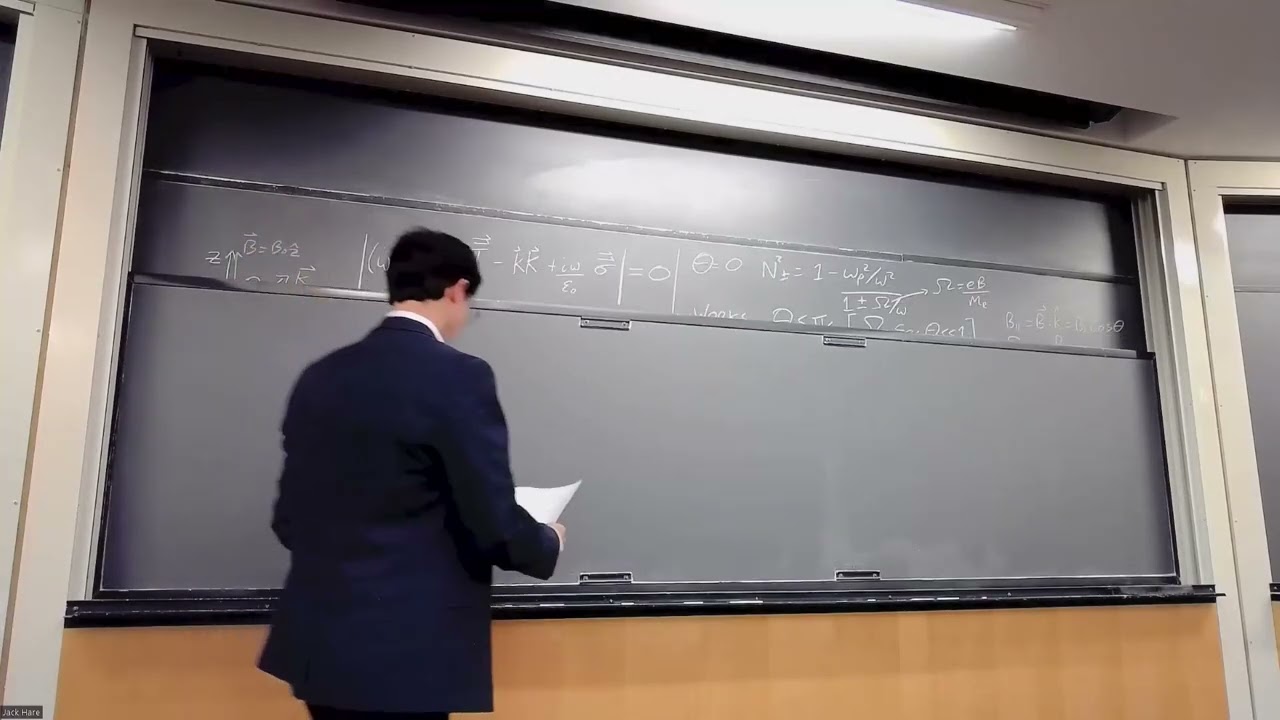
right so today we are going to start a series of several uh lectures on refractive index Diagnostics so these are Diagnostics which use the fact that the refractive index of a plasma is not one uh in order to make measurements about the plasma so first of all what we're going to do is a very quick recap of electromagnetic waves in a plasma and you have doubtless seen this before in some courses that you've done like it's in Chen um there's also a very good expanation of it in Hutchinson um and I am going to give like a little taster of how this derivation goes just to sort of remind folks of how this actually this result actually comes about and I'm going to do it in a rather restrictive way here so that we can make some rapid progress and we'll go back and add in more bits of theory later on as we need it okay so for our electromagnetic waves in a plasma we have two fields we have e and B like this and we have Maxell equations so we have that the curl of e is equal to minus B Dot and we have c^2 * the the curl of b equals e dot plus J over Epsilon KN you might be more used to seeing this equation with a mu I just mov the c s over the other side because it makes the math a little bit easier on the next step here and so these equations are just true they're true in any medium um and so what we want to do is try and reduce them down a little bit and then put some plasma physics in so the first thing we normally do when we're D deriving electromagnetic waves is we say what if all of our vectors um had some sort of time and space variation that looked like exponential of I some wave vector k do some position Vector x minus Omega the frequency time time like that and so this is a little bit like Foria Transforming Our equations here and we end up with oh uh K cross E equals I Omega B and we have c^ 2 K cross B = minus I Omega e plus J upon Epsilon and the astute amongst you have noticed I made a sign error in the first equation here so this is plus I Omega B not okay very good and so we could call these equations one and two and we can note that if we do K cross with equation one that is equal to iega upon c^2 of equation two so what we're doing here is we're just looking at this term and this term and being like hey they've both got B in them we can probably make them look the same so then we can equate we can do this calcul we can equate the two sides of the equation and with a little bit of vector magic Vector calculus magic we would end up with something that looks like k k dot e plus k^ 2 e is equal to I Omega J over Epsilon c^ 2 plus Omega 2 upon c^ 2 e like that now we are searching for transverse waves here electromagnetic waves that tend to be transverse and that means that k. e is zero so we're just going to look for transverse wave Solutions here we can drop that and that means that our equation can be Rewritten as Omega 2 minus c^ 2 k^ 2 * E equals minus I Omega J upon Epsilon like that and I just want to point out there's absolutely no plasma physics in this at the moment right all we've done is manipulate maximal equations we haven't said anything about the planting so if I take a standard limit here say I let the current equal zero which is what would be in the vacuum of space where there's no particles to carry any current then we' simply send up end up with an equation for light INF space and it would have a dispersion relationship Omega s = c^2 k s like that so those are light waves so life is good any questions on that before we put some plasma physics hopefully you're dredging up your memories of Griffiths and Jackson and all sorts of wonderful things like this this is all making sense so let's keep going uh the next thing we want to do then is add in some plasma physics and we're going to add in some plasma physics with some serious assumptions which let us make significant progress quickly uh and these assumptions can all be justified uh for most plasmas um and if you can't justify it for your plasma you may want to revisit these a little bit okay so the first assumption we're going to make is that we're at using high frequency waves here here and high frequency this is kind of a wishy-washy term uh we want to make that more precise by having a dimensionless parameter and so we're going to say that Omega is much much larger larger than Omega Pi here so the frequency of our waves is much higher than the uh ion plasma frequency what does that condition physically respond to what are we saying about the ions and their interaction with this Wave by putting this condition in well you're saying you're saying they essentially don't interact at that point yeah so the ions are frozen in place and they are not going to participate in any of the physics that we're interested in here and again you can work out the ion plasma frequency for um you know some density that you're interested in and you'll find out it's pretty low so this is kind of pretty reasonable but if you start using very low frequency waves it won't be reasonable so another thing that we're going to do is make the cold plasma approximation and again we can't just use the word cold we have to say what we mean by cold and we're going to say the thermal of the electrons is much much less than the speed of light here and this condition is equivalent to us not worrying about the maxwan distribution of the electron so all the electrons are just going to sort of be moving with no they will be moving unlike the ions which are frozen but they will be moving uh all at the same speed there's no spread of velocities here so um we have like a Delta function of velocities and we do not have our maxwan distribution that we might normally think about and the final condition we're going to write down is unmagnetized now this is the one which I think is most complicated because in fact there are like a dozen different ways you can write down a dimensionist parameter for unmagnetized and they all mean subtly different things we could think about collisionality we could think about pressure balance all sorts of things like that for the purposes of this derivation unmagnetized means Omega is much much larger than Capital Omega I know it's confusing and I'll put a little subscript e here because we've Frozen the ions but this is the gyro motion of the electrons so the electrons may be gyrating around field lines there may be some magnetic field it doesn't have to be zero but on the time scale that the wave goes B and does its stuff the electrons do not move appreciably around their gyro orbit so we don't have to care about their gyro motion this is one of the places we will definitely have to relax later on when we want to do Faraday rotation Imaging which relies on that gyro motion to give us the effect okay so this is the final condition any questions on those three assumptions okay so then we can write down that the current inside our plasma is simply going to be equal to the charge on the electrons the number of electrons and how fast they're moving and so we've simply transferred our lack of knowledge about J into our lack of knowledge about V so we better do something about that and we're going to do that using the electron equation of motion and that electron equation of motion looks like M dve DT is equal to minus E the charge times capital e the vector electric field like that okay so we could rearrange that so that we have V is equal to e Vector e over I Omega we've done the same for transform trick that we did with all the other quantities we assume it's going to be oscillating in some way substitute that back into our equation for e and we'll get Omega s minus c^ 2 k^2 e as we had before is equal to NE e^2 over Epsilon me capital E sorry was there a question I had someone speak no that was an accident sorry oh no right all good um and just to be clear here this equation of motion doesn't have the uh V crossb term in it which should be like the magnetic field term because we've dropped it because we're making this uh unmagnetized approximation but that's where you put it back in you put in a little term that was like plus b cross B in here and put little brackets around but for now we're just setting that equal to zero okay good and the solution to this equation that we've got now is Omega s equals Omega p^ 2 plus c^ 2 K 2 so this looks an awful lot like what we had before which was just these two terms but now we've got this additional term which includes some plasma physics and I could write that this is omega PE s um and you know make it clear it's the electrons but remember we've dropped the IR motion already so there's only one uh plasma frequency that's very interesting the electron plasma frequency for this derivation here and then we can go ahead and do all the standard things we do with a um one of these uh functions which is to try and write down the phase velocity and the phase velocity squ is just equal to Omega 2 upon k^2 and so that means our phase velocity is C upon 1 minus Omega p ^ 2 upon Omega s so a half and then we can write down the refractive index because our refractive index capital N is just equal to C over the phase velocity and that is going to be equal to 1 - Omega p^ 2 over Omega 2 and we we often write this not in terms of frequencies but in terms of densities because the plasma frequency has inside it an electron density we write 1 minus NE Over N critical like this where n critical is some critical density and we'll get on to why it's so critical in a moment but if you want to approximate it then n critical in centimeters to minus 3 so particles per cubic centimeter is roughly 10 21 over Lambda when Lambda is in microns here so if you're using like a laser beam at one micron that would be a very standard laser wavelength from a near demium yag or near demium glass laser then you have a critical density about 10 to 21 which depending on which your field you're working in is either hilariously high and unreachable or crazy low and happens all the time so again this is one of the exciting things about doing plasma Diagnostics course where we span 60 OD of magnitude in density um any questions on yeah what's the critical density Point again as in what is its physical significance yeah like why why do you choose that number we're gonna we're gonna look look into that in a moment it's a good question it's a solid question but it's just to be clear I can the reason I've got there is I've taken this Omega p squ and this Omega squ and I've noticed that Omega p^ s has inside it the electron density and I've Rewritten all the other terms so uh this n critical now has inside it things like uh Omega squar I made a critical mistake in my equation up here this is Lambda squared here for approximating this in terms of sort of symol quantities so the the N critical now depends on the uh laser wavelength or the the frequency of your probing electromagnetic radiation so it's different for every frequency um but that's the only it depends on the rest of it is all like fundamental constants like e and the electron mass that don't change so this is a parameter there's a critical density for every single uh laser wavelength or electromagnetic wave frequency I'm going to talk about lasers a lot of course this also applies like mic waves and things like that as well but some sort of source of em radiation so I'm going to get on to what n critical is in in just a moment uh but any other questions on this before we keep going okay so we just said that n is equal to theare root of 1 minus NE Over N critical if we work in a regime where NE is much much less than n critical so we work far from the critical density we can do a tailor expansion and which is what we often end up doing and we write one minus NE over two and critical like this so my questions for you now and we will try and work out what and critical is doing together for n for a density which is greater than the critical density what happens to M the refractor index the wave becomes right yeah well so that's the result yeah so what happens to n itself Big N it's imaginary right exactly yeah yeah you you you you've got the right answer I just wanted to take in a few more steps so n is imaginary because it's going to be the square root of a negative number which we can see here and so that means our wave becomes evanescent so it's going to have properties which decay in time so it's going to look like e minus alpha x e minus gamma T like this so it dies off okay so that means that we can't propagate a wave at densities greater than the critical density what happens to all the energy then because this wave is carrying energy abor no absorption mechanism in our equations actually yeah so that I mean from the math we have it the only option is reflection right yeah so reflection is indeed the answer so we will get reflection of this wave that will bounce off the critical surface and go somewhere else um we'd only be able to have absorption if we put for example collisions into the equation of motion all the way back there and then we could have what's called inverse brmr which is effectively the electrons get oscillated by the wave and then they collide with some ions and transfer the energy to the ions and that's a damping mechanism there could be other damping mechanisms like landal but in the equations we've got so far we we don't actually have those so reflection is the only thing that can happen now we also had this equation for the phase velocity which was that VP is equal to C over 1us Omega p^ 2 upon Omega s to the half does anyone want to comment on what happens to the phase velocity as we go above the critical density there's a go to Infinity oh I mean we'll do that eventually yes yeah yes I guess right there at that point diverges extremely large yeah yes yeah so this is this is going to start doing very silly things here and those things don't seem very physical of course because we don't want things traveling FAS than the speed of light um fortunately this isn't a big problem um because the phase velocity doesn't carry any information the limitations on things going faster and the speed of light have to do with information and the information is encoded in a quantity called the group velocity and the group velocity just looks like this c times the square root of 1 minus Omega p^ 2 upon Omega squ and so as we get close to the critical density here all that happens is the group velocity goes to zero and effectively we transmit no information through that evanescent region so we don't have to worry about the fact phase velocity is super luminal because our group velocity is still subluminal as you know we'd like sh so if the waves being reflected here and the group velocity is going to zero to me that seems like the wave information is sort of stagnating at the Reflection Point how do we see from these equations that the wave information is actually being reflected back out it's very good question I think you um excuse me I think you need to like impose boundary conditions to to do that so because there' be some sort of discontinuity right yeah I suspect the model I'm presenting is a little bit too simplistic to handle this stuff um so we would need to bake in some more information I think so there certainly as you get very very slow group velocities you're going to start we've been making some assumptions about the homogeneity here and so we're effectively there's going to be some length scale in here which is going to be like K the size of the wave Vector of the light at a given point and we're going to be comparing that to the length scale associated with how quickly the electron density changes this gradient length scale here and as the group velocity gets very very low that K is going to get uh very very long and uh we're going to start violating our our assumption that K is let's see let me maybe I can write this as Lambda that Lambda is going to be much much less than this uh change in the gradient so for any realistic system our density has to ramp up right it can't just immediately get up to the critical density this could be the critical density here and we're going to find out that there's some region where some of the approximations we've implicitly been making break down and then you not need to start doing like uh wbk and all that sort of stuff and doing everything properly so I think effectively this simple model breaks down but if you do it properly and I think Hutchinson does this in the reflectometry section so we may end up doing it um you you can get the answer about the reflection there it's a good question this is very handwavy at this point I agree thanks cool any other questions on this because this this equation here we are now going to use an awful lot so I'd like you to agree that it's valid within the assumptions that we've made and if you don't agree we should have talk about it okay good so let's keep going so there is a series of different measurements that we can make and these are the refractive index Diagnostics so I'm going to just call these n measurements or n Diagnostics because they rely on the change in the refractive index here so one type is when the refractive index is not equal to one there's a refractive index inside our plasma is not equal to one which is true anytime there's any density inside the plasma this sort of diagnostic causes a phase shift so the plasma ends up the the the laser beam going through or the electromagnetic radiation going through plas ends up with a different phasee than it would have done in the absence of the plasma and we can measure that phase shift using a technique called interferometry and with interferometry we can therefore say something about the density inside the plasma another technique is when the gradient of the refractive index is not equal to zero so this is when there is any change in the refractive index and in a plasma that corresponds very clearly to just changes in the electron density so gradients in the electron density but of course in general this technique could be used for any medium weather refractive index changes so air if you heat it up the refracted index changes and so you could use these techniques these are not specific to plasma physics and these Diagnostics tend to be called refraction Diagnostics because the light refracts and it bends and we end up doing techniques such as schen and ography and then the final type that I'm going to talk about are ones where actually the polarization uh the the the medium is B refringent it treats different polarizations differently and so we can have polarizations of Light which are circular we can have the left-handed and the right-handed polarizations which we sometimes refer to as plus and minus and here we would say that the refractive index for the plus wave is not equal to the refractive index of the minus wave here and so there here we measure the polarization and this is using a technique called Faraday or Faraday rotation which we briefly discussed in the context of magnetic field measurements using ver glass um and in fact it turns out that you need to have magnetic fields that are nonzero and we also need to relax our assumption that the plasma is unmagnetized in the sense that the light frequency is much larger than the electron cyron frequency so those are three different types of refractive index Diagnostic and we're going to start with what I think is conceptually the simplest but still often causes us lots of problems which are the refraction Diagnostics here I see some people rising so I'm just going to pause on this slide for a moment oky do now I just want to have a little aside and this is on conceptual models for electromagnetic propagation because I'm going to be switching quite a lot between different ways of thinking about electromagnetic radiation and how it moves through a plasma because sometimes some models are easier to work with than others sometimes models are simplifications and they throw away physics um but they make the intuition much simpler so I just want to show you two different models that we be going to be using in these next few lectures so that you have an idea of what's going on one model will be a model of wave fronts so this is based on the idea that as we said our electric and magnetic fields can be written as just a single Foria component so there's some strength and polarization of the electric uh field here and this is multiplied by the exponential of what we call the phase Factor so i k Dot x minus Omega T like this which we could write as e0 exponential of I times some scalar quantity which is the phase here and so if we think of our electromagnetic wave as having a phase and the electromagnetic wave still exists in all places at all points in time blah blah blah blah blah um but that's a very difficult thing for me to sketch on my iPad here or on the board in front of you so what I'll end up sketching are what we call isophase Contours so these are Contours along which the phase is constant and so for example it could be at some integer multiple of Pi right for yes M belonging to Zen so this might look like some waves like this this would be electromagnetic wave which is diverging here actually it could be an electromagnetic wave which is converging to the left but you know at the moment it looks like it's diverging to the right okay so that's one way I could draw a wave here another way I could do it is with array model and this gets into a topic which is called geometric optics and it turns out what you can do if you have some isophase Contours like the ones I just drew say these Contours here they're doing something slightly strange because but perhaps there's a plasma there which is like you know moving the phase Contour around right we said if there's a change in refractive index that affect the phase the Rays that we draw here I can just take these phase contols and I can draw Rays such that they are everywhere normal to the isophase Contours so this Ray would look like this this one would look like this and this one would look like that so they are perpendicular to the wave fronts conveniently they're also parallel to the pointing Vector least I'm pretty convinced they are If someone knows more about geometric optics and thinks I'm wrong please shout out because this was a very hard fact to check um in like 10 minutes before the lecture but I'm pretty certain they represent the direction of the energy flux in electromagnetic wav so they're quite conceptually useful as well they tell us where the power is Flowing now when we think about these Rays here we can start thinking them a little bit like it's a particle trajectory and I put particle here in speech marks so I don't think you really need to think about these as photons but you can think about them as little Point particles that move around inside a plasma and we'll find out some rules for how they move inside a plasma in a moment and if you sort of track their trajectory that's where the Rays gone and then you also know some places where you'll have lines which are normal to the wavefront so maybe you can reconstruct the wavefronts later on um but it's important that when we're doing this we ignore the wave effects so we no longer track the phase of each particle right it's now just a little billiard ball and Billiard balls don't have phase and so we're we're gonna get rid of effects like interference and uh defraction and we're going to keep effects only like refraction here so no interference no defraction just refraction so this is our Ray model so does anyone have any questions on these models before we start trying to use them um I was just wondering so if the pointing Vector right is e cross B does that mean that if we have any parallel electric field to hey like I was wondering um the your point about the pointing Vector would that break if there was like a parallel e to the main back background magnetic field or is that just the oscillating D there that question make sense it does actually and I know the answer to it that's good right so if you had some background magnetic field like in the toac and then your e was parallel to it um well let's put it this way the the pointing flux uh oscillates right and so you when you're averaging it time averaging it that's what gives you the actual power that's moving if you've got a static magnetic field your average power will go to zero okay y thank you so you'll only get power flow from oscillating components here because that's what's transporting the electromagnetic energy but it's a really good question than like I said I'm not completely 100% sure that Rays follow the trajectory of the pointing Vector but I I'm pretty certain have to thinking about it for about 10 minutes that they do so if someone finds out that's wrong please let me know and I'll take it out okay so everyone is going to be pretty happy if I start drawing Ray diagrams and they'll understand that these Ray diagrams represent the sort of trajectory of little beamlets of light and you could also reconstruct the fa wave fronts from them and therefore you could sort of reconstruct visually what the entire electromagnetic field looks like and we're implicitly assuming everywhere here that our magnetic field is perpendicular to our electric field which is a pretty good approximation for the assumptions we've made so far okay so now let's try putting electromagnetic wave through a plasma and it's not going to be any old plasma here I'm going to choose a slab of plasma like this and this slab is going to be much denser at the top than it is at the bottom which I've tried to really closly do is some shading here right so it's going to have a gradient of electron density going up like that and of course you remember our Formula 1 minus NE over 2N critical for our refractive index we're going to work in this regime where the density is much less than the critical density so we don't have to worry about what happens if we get close to the critical density and so you can see then that if the gradient in the electron density is in this direction then the gradient in the ref active index is in the opposite direction like that and we're going to start by putting through some phase fronts and we're going to start with a plain wave right so this is a wave in which the phase fronts are flat and parallel and uh uniformly spaced so those are my uh wave fronts I'll put a little coordinate system in here I'm going to tend to put the Zed coordinate in the direction waves are going and so there'll be two transverse coordinates y and x and I'll probably just write y on most of these I'll try and do things in like a one-dimensional sense but everything I say you can imagine could be applied to a threedimensional picture here I'm going to say that this plasma slab has some length L and it's homogeneous within that length apart from the gradient in the uh density here so does anyone know what happens to the phase fronts as they emerge out from this plasma the wave fronts all the Rays I don't mind bent and uh wait Upp down what sorry yeah Daniel oh yeah um they're bent down word right because you've got a lower refractive index in the upper half yeah you're absolutely right so these rays will emerge or these wave fronts will emerge bent like this and so the rays which I didn't draw on before but I meant to so here are some rays for you here you see how they're all normal the wave fronts here are some rays for you here okay and they're going to be bent by some angle which we'll call Theta here and it turns out if you go and look how to do this Theta is going to be equal to D phase Dy time Lambda over 2 pi and so we can actually put that all together and we can say it's going to be equal to D Dy times the integral of capital n d z like that which for our plasma is min-1 / 2N critical integral of gradient of the electron density d z and this DZ here is going to be running from zero to L now I don't know how clear this is to everyone that the the Rays should bend or that they Bend downwards or why they Bend there's lots of different ways of thinking about it you can go and just solve a load of equations if you want to I like to think of it and you may laugh at me for this uh as a bunch of soldiers marching arm in-arm through some mixed terrain here so here's my soldiers I'm looking them from above you can see how I'm lining them up nicely with the wave fronts very suggestively and maybe some of the soldiers over here have got some sort of marsh they've got to walk through and these soldiers are going to fall behind and because they've all linked arms they've still got to stay in a straight line with each other and so as they go they turn more and more round like this and this is what leads to our bending here and you can make this a bit more uh you know rigorous if you start thinking about the Rays as particles and you think about their velocity and you think about the speed that they're going at inside the plasma and you realize that they're actually going slower in the denser regions and that's going to start giving you uh twist sorry they're going faster in the denser Regions they're going slower in the regions with high refractive index and that's what gives you the bending here so this is just like a little uh mental model to think about when you're trying to work out why it is that the the Rays of light are turning but there's many many different ways to get this oh hello hi there is there a gradient in density along the uh the Z axis the way it's drawn it looks like it's only within the y axis it is only in the y axis yes so then integral of the gradient of density along Z wouldn't that be constant then what is it is there no is there a density change in Z the what I'm asking not in this really simple model I'm proposing of course in general there can be a density change really this should read um radiant of density dot DL where L is an infimal uh no sorry ignore that um yeah there was there was no gradient and density in Z and we don't need one to get any bending in fact if there was a gradient and density in Z it wouldn't have any effect on the light it would just forwards at a different speed but it wouldn't get bent all right and then so but then that roll that it's just uh grum and l oh yes for this very simple model you're absolutely right I'm just introducing generality because we may have something different but you're quite right so we could write this as minus 2ncr time L and maybe I put a subscript Zed so that I know that it's like my length scale in Zed and Times by the gradient in NE and if this uh is like some simple density ramp so I would have any 0 * 1us X upon ly or something like that I could simply put this in and say that the entire beam is now Twisted by a nice linear angle which has an LZ inside it an ne0 and an uh minus one upon ly like this so this is if I give you some analytical result you can then go and work out what the angle would be and that's a super useful thing to be able to do uh as I segue perfectly into my next remark which is to do with the first problem that this causes so this is issues with deflection the first issue is if you've got some plasma and you're trying to put some electromagnetic radiation in it you you want to collect that radiation you want to put it onto a detector maybe that detector is a camera or it might be like a wave guide that you're collecting microwaves with uh and so that camera has some physical size right and so maybe the camera is represented by this lens here it's got some physical size d and if your rays get deflected that was a terrible straight line okay if your rays get deflected by an angle greater than Theta Max where tangent of theta Max is equal to D over 2 * L I forgot to put in this L here there we go then your ray is going to be lost so for Theta greater than Theta Max you lose your rays so that means you can't collect them you can't detect them anymore so this causes big problems because it means that we're going to start losing lights here and just for most situations we can use the small angle per aular approximation and just replace the tan Theta with Theta here so that means you want to keep your deflection angle Theta um which is equal to as we said ddy of the integral of ndl that wants to be less than beta Max so there's a few things that you can do to try and do this you can have a nice big lens uh you can have a close lens you can put it nice and close in or you can use a shorter wavelength because if you go to a shorter wavelength uh you get a smaller deflection angle uh which you can see if you go back to maybe this formula here a shter wavelength corresponds to a larger and critical and so you'll get a smaller Angle now not all of these things are possible in a standard experiment if youve got a toat uh you may have a limit on how big your detector can be because it's got to fit in a gap between some magnets you'll certainly have a limit on how close you can put it to the plasma because you don't want to stick it right inside um and you may not be able to choose whatever wavelength you want perhaps you're doing looking at electron cyron emission and you've got no choice but to use the wavelength that's admitted that so this can cause big problems and so if you're doing some electromagnetic probing of your plasma one of the first things you should probably do is check whether the density gradients are going to make it hard to actually measure anything any questions on this all right so we're now going to plunge in our first Diagnostic and the point I want to make here is although deflection can be frustrating it can also be useful because we can use it to measure something about the plasma the first thing we're going to talk about is schen Imaging this word schen people often assume refers to a person it does not um so it doesn't have a capital S despite what Obel will tell you uh and it's actually after a German word Scher which is like streaks because this was first used for looking at small imperfections in Optics uh and so looking at these little streaks here so it's a way we of Imaging things which would otherwise be impossible to see uh because they cause small gradients in refractive index so let's have a little example building up towards and imaging this first thing I'm going to show you is not SCH and imaging this is just Imaging but my impression is that some folks need a refresher with some Optics so we're going to start with a solid object it's going to be this nice little chalice here and we're going to put in some rays of light like this now this object is solid and so it blocks any rays of Light which hit it these two Central ones and allows through rays of light going past it no allows through rays of light going past it very good and what we would probably do here if we're doing a standard Imaging system is we would have a lens right so this is how you form an image so we'll put our lens here it's going to have a focal length F and we're going to place it at a distance which is 2f away from the object we're trying to image I'll just put that f up there now behind this lens if we're doing a standard 2f Imaging system we're going to have a focal point and that's going to be at F away and then we're going to have an object plane which is also an F away H sorry an image plane this is the object play and this is the length with focal length F so hopefully some of you have seen this sort of thing before you know that the Rays will pass through the focal point here he says drawing them carefully and what we'll end up with you can't do this on a CH board is a copy of our image of our object here but it's going to be inverted and you can tell that because you can see the Rays have changed place so this is a nice one toone image it's at magnification one and it is inverted so this is this simplest I think the simplest possible Imaging system you could possibly develop right it simply takes whatever is at the object plane and puts it at the image FL some distance away this could be a microscope this could be a camera all sorts of things like that yes Vincent uh I I think I missed what was F again I think what what was F like the focal length of the lens thank cool any other questions okay let's make this more interesting let's put a plasma here instead okay and we're still going to have our lens there's still going to be a focal point and there's still going to be an image plane here but the plasma doesn't block the Rays of light as long as we've got for example any much much less than the critical density here so that the Rays can pass through easily instead what we're going to have is rays that come in and then they're going to be deflected slightly inside this plasma so I haven't draw drawn the density gradients we can imagine we've just got a whole range of exciting density gradients that cause some deflections so they deflect this Ray slightly downwards they deflect this Ray slightly upward they deflect this bottom Ray what have I done for this one let's how this one go straight for some reason there's no density gradient exactly there so the r just goes through and this bottom one gets deflected downwards as well and let's say it just about makes it onto the lens and I'll move the lens downwards to make that true don't do that on the CH board either okay good so what will the lens due to these Rays now well it's still going to deflect the Rays and it's going to deflect them let's start with this one that actually didn't get deflected at all so it angle hasn't changed it's going to go straight through the focal point as as you'd expect this one that was deflected upwards is going to be deflected down but it's going to slightly miss the focal point it's going to be slightly above it like that this one that was deflected downwards is going to be the opposite way it's going to be slightly below the focal point and this one was reflected uh downwards is also going to be uh slightly below the focal point and that was a mistake there we go there we go it's not a very good image compared to the one I was hoping to draw but there we go nothing quite works out so we should have an image of our plasma here this image of the plasma should still be one: one mag one and inverted the fact that I haven't quite managed to get to work is probably just a flaw is how I managed to draw the Rays this time around not quite sure what what went wrong there looks good on my notes anyway this stuff gets a little bit tricky the point is although the Rays here look like they've all gone upwards slightly they should actually still end up in the same places that they did before and the fact that I can't get it to work right now just means that I've made a mistake while drawing it live okay good Jack Jack this said a very basic question but what what's the point of having all the Rays go through the the trouble of going through the lens when we could just have them go straight through and hit our image plane like I I guess I missed that up you know what I mean oh yeah absolutely um so in the top case with the solid object the Rays could go if the Rays went straight through and hit the image plane they will be deflected slightly at the edges and so you'll end up with something fuzzy so it'll be out of focus okay so you need a lens to bring it to focus which effectively is mapping the Rays from where they came from back to the same place on the object plane if you if in the case of the plasma if you don't have the lens and you just put if you don't have the lens and you just let the Rays propagate to the screen that's a technique called shog graphy which we'll talk about next lecture which I actually think is more difficult even though it's simpler to draw and so I want to talk about it after this one um so we haven't done anything here at the moment and in fact if you do this with a plasma you won't see anything at all because all of the rays are mapped back to where they started from and that means that you are going to end up with uh just the same laser beam that you originally started with or the same microwaves you originally started with so this will be uh invisible so the only way we can make this visible is to notice that the Rays do not all pass through the focal point now you saw in the case where we did the Imaging that all the Rays did indeed still pass through focal point but here some of them gone above and some of them gone below and in fact the distance they've gone above and the distance they've gone below is directly proportional to the angle with which they exited the plasma here and so we can learn something about the angle they can selected uh exited the plasma by placing a filter at this focal PL and this filter maybe looks a little bit like this this filter for example here is like a little aperture and it lets through these two rays let me color code them this one and this one and it blocks off these two rays and so lights coming from that bit of the plasma where the density gradients were large will be blocked it will no longer appear on our final image and this is what schan Imaging is so we place a a stop at the focal play and we filter by angle I'm going to do some exhaustive examples of this to try and build some intuition for what's going on if you're a little bit confused right now any questions on this before we keep going I have sort of a overall conceptual question I feel like the highest gradients a lot of the time are well maybe this isn't quite true but I can imagine a lot of cases it's going to be affected most by the edges where it's entering and leaving the plasma because you're you know depending on how uniform things are so just curious what you actually get an image of I mean if you especially you don't have a great sense of where the the gradients are or if you have the gradients inside don't know about or yeah absolutely um these images are difficult to interpret so this is not a generic diagnostic technique that will immediately tell you what's going on you need to know something about your plasma maybe you have a simulation and you do a synthetic diagnostic on it or maybe you've set up your experiment such it's particularly simple and we'll talk a little bit about some simple distributions and what patterns they make and that will give us an idea for what sorts of things we might be able to measure with this but like a a turbul like turbulence in the edge of a toac or something like that is maybe not the ideal diagnostic for it fair enough yes and and just I want to make very clear because I I don't know if it came across um when we were talking about it before but we're we're we only get deflections from density gradients which are perpendicular to the direction here so if our Ray is going in this direction in the Z direction we sense D Dy of NE and D DX of NE but we do not sense d d z of NE so if there's density gradients in the direction the ray is propagating the ray will slow down or speed up but it won't actually deflect from that and so that helps you a little bit you're only sensitive to gradients perpendicular to the probing direction that might also tell you if you've got a plasma which you think has some geometry there may be a good direction to send the probing beam through there may be a bad Direction so you want to think about that a little bit so let's have a talk about some of these uh stops right so I've said that we can place these stops here let's have a chat about what sort of different stops are available to us so types of stop the first type is to decide whether our stop is going to be dark field or light field so I'm putting dark in Brackets because it will save me writing in a moment the difference between dark field and light field is that the dark field blocks undeflected Rays so ones that do pass through the focal point and the light field blocks deflected Rays ones which do not pass through the focal point so you can either look for Regions where there are density gradients or where there aren't density gradients we can also choose the shape of our stop because our stop uh is sort of a two diens dimensional plane at the focal plane here so we could have a circular stop and that doesn't care what direction the ray is deflected in it only cares on the size of the angle so the size of theta so that is basically are there any large density gradients or we could have what's called a knife edge which is linear uh like this and that is sensitive to density gradients in Only One Direction and it still cares about the size of the density gradient I'll WR that it's like X hat here so we could for example have a scop at the focal plane no it's not going to do it okay fine I can't get a nice round circle we could have a stop which is an opening inside an opaque sheet of material here and this opening could be positioned such that the focal spot in the absence of any plasma sits inside it what sort of stop would this be light field so this is a light field stop and what shape is it the best yes okay Circle thank you uh we could also have a stock that looks like this and we can position it such that the focal spot is actually within the opaque region and what sort of slot would this be dark field dark field okay dark field and what shape is it linear so a knife edge here yeah we call it a knife edge because actually using a razor blade is a pretty good thing to have because you get a very nice sharp uniform Edge to it okay and so depending on these stops you can think of as filters in angle space right so they allow through certain angles you can think of arbitrarily complicated versions of this there's a a technique called um angular not Fringe angular filter refractometry which has a set of nested anuli which let through uh light which has been deflected by certain specific angles so you know the world is your oyster you can come up with all sorts of exciting different stops if you want to one thing I will note is that the D dynamic range of your diagnostic which we'll talk about more later depends a great deal on your focal spot size so I've shown these focal spots to be relatively small here uh but that focal spot size at least in a defraction limited sense it covers an angle which is equal to the wavelength of your light over the size of your lens the diameter of your lens here and so you might end up having focal spots which are are not small but actually could be rather large and then part of the focal spot could be obscured and part of the focal spot could be clear for some given deflection angle so and in general when we've got a plasma here we have say a small focal spot before we put uh any Plasma in the way when the Plasma's gone in the way different rays of Light have being deflected by different amounts so this thing may take on some complicated shape here and this is the shape that you're filtering you might be filtering it with your knife edge like this or you might be filtering it with your circular stop like this so we're basically filtering the Rays based on how far they've been deflected but the focal plane there's no information about where the Rays came from inside their plasma so their spatial information has been lost the only thing we know about them is their angular uh position so rays which are deflected by an angle Theta one from at the top of the plasma and rays which are deflected by the same angle from the bottom of plasma end up at the same place in the focal plane um even though they came from different parts of the plas this is the magic of geometric optics so any questions on this or should we do a a little example okay let's do our example so let us consider a very simple plasma this plasma will have the coordinate system y vertically and we'll have Zs in the direction of propagation as we discussed before um we'll have Rays oh well I'll draw the plasma first so the plasma is going to have a density distribution that sort of looks gaussian is some sort of nice Peak function so this is density and so you can think about this for example as like a cylinder so you've got a cylinder of plasma like a z pinch and you're probing down the axis of this Z pinch and it's got a gouon distribution of density to it um anything like that and then we'll have the Rays of light coming through so we'll have rays of Light which are sampling very small density gradients at the edges here and these rays will just go straight through there's also be a ray that goes through the center which also sees a very small density gradient here right right at the center of this distribution the density gradient is zero but the edges here where the density gradient is large will have some deflection and if we place our lens as we did before some distance away it's going to focus those Rays onto our focal plane and in our focal plane we're going to put some sort of stop here so the undeflected rays are just going to go uh straight through the focal point that but the deflected rays are not going to go through the focal point right the deflected rays are going to go above and below so now we can put a series of stops inside here so we could have a stop and that blue dash line that looks like a light field knife edge we could have a stop that looks like dark field life Edge we could have a stop that looks like a light field Circle and we could have a stop that looks like a dark field Circle and what we're going to do is sketch out what we expect the intensity to look like from each of these different uh knife edges here so if I plot one I'll just draw the density distribution [Music] again like that so that's our density now we want to know what our intensity distribution looks like so this is now intensity we have our initial intensity one and we have zero intensity corresponding to all the Rays being blocked so where for the light field knife edge do we see no intensity sorry I didn't have that proper can you say it again so I think what you said was in the upper side uh where there's the largest density gradient right so this this is where the density gradient is very large so we expect outside of that region our intensity would be pretty much constant but inside that region we'd expect the intensity would drop to zero because we're blocking the rays which have a large deflection angle uh in One Direction upwards and the rays which have a large deflection angle in One Direction upwards corresponds to that specific density gradient there okay anyone want to have a go at telling me what happens with this one what's happening at the edges what's happening out in these regions here where the density gradients are small they're cropped out because they mostly go through the focal fcal spot right yeah so these are going to be zero right so zero zero is there any region where it's not zero uh I think it's not zero for the uh High gradient region that's lower in y it's deflected below so you think it's not zero for this region here yeah yes does anyone agree with sir or does anyone disagree I think that looks right okay so we're talking about this Ray here yeah so this Ray is indeed passing low down compared to the knife edge so we'd expect this to show some intensity here not for the upper one which passes higher up okay good we're getting that what about for the circular light field anyone want to tell me what the intensity looks like here you'd probably get Three Peaks so on the edges where the density isn't really where the density is just low and then right in the middle where the density is high but not really changing too much yeah so you say three Peaks I'm going to think about them as two notches but I agree with what you're saying so these notches here correspond to the points where the density gradient is largest here and so those those Rays got a big deflection angle they're being blocked out what about for the final one here darkfield circular aperture well there there your basically notching out all the uh un the minimally deflected arays so you lose the uh ones on the edges and Center yeah so we'd have something that looks like this right so we would just see light where there was a significant deflection angle okay um this may still seem a little bit abstract so we're going to try try one more thing and I hope that you don't hate me for spending so much time on Shin but I absolutely love it so um that's your loss um which is going to be a two-dimensional example here I'll just draw on this uh distribution function there we go density function down that last one just so you've got it so this actually goes back to a sketch that I did during the B dot lecture where we stuck a little B dot inside the plasma and we have plasma flow coming from left to right and because it collides with this we get some sort of bowel shock like this and we as we all know from our shock physics at the bow shock we have strong density gradients like this where the density jumps across the shock here so if we look at this system when we have our probing laser coming towards us right so our laser is looking towards us like this we are the camera what would we see about this bow shock what could we tell about it so maybe the first thing we could do is ask for like a light field circular aperture what do we think we would see here and if you're not quite sure at each of these places where I've drawn this little arrow you could say that the density maybe as a simple model looks like sort of hyperbolic e Tangy type thing like that it's got some region where the density is NE Z some region where the density is any1 and then some region where the density changes rapidly that's not true for a shock but yeah it's a model just to get us thinking about what this looks like so what would I see on my image I've got this expanded laser beam going through this shock and I've decided to use a circular light field stop I might be doing this backwards but from it looks like what we drew above that would mean that you're not getting your speep gradient sections so it should be dark where the bow shock is and yeah so you'd actually have an image yeah you'd have an image which you know if I was on a chalk board I could do with an eraser was actually quite hard here if you imagine this is filled with green laser beam beautiful nice laser beam image then you would have a region where no the Eraser is not very good if I could make the Eraser smaller that would work much better you would have a region where there was no light whatsoever and there was just darkness right so You' just have this dark region here corresponding to the bow shock and if you did this with a dark field circular aperture then you'd have the opposite you'd have complete darkness and you would just have a region where the bow shock shows up very nicely like this uh and so this is actually typically what we use for uh shock measurements is dark field circular aperture if you do happen to do something like a dark field with a knife edge and you put your knife edge like this so you were measuring density gradients that were in this direction you would end up seeing something a little bit like just one half of the bow shock like that so if your set your probe was was sitting here you would just see a little bit of the B shop you wouldn't see this section because the density gradients wouldn't be in the correct direction so you wouldn't be able to observe those but the knife edge might be a better choice for some Shock geometries if you're only interested in gradients in One Direction Aiden I see your hand oh yeah I'm curious how distinct um the the the actual image gradients would be um given that this is like a cylindrical phenomenon right the shock so I assume there's some some density gradients that they slowly become um parallel to your propagation direction as you rotate to the yeah so you won't see those density gradients but you will see the ones on the edges of the shock yeah it it depends on the exact shock morphology whether it's some extended like a bow shock that's extended like this or whether it's a bow shock sort of rotated like the tip of the a nose cone on an aircraft or something like that so it will it will make a difference but this is just to try and get a feel for what this looks like in terms of Imaging here I can send around some papers later which have some very nice images of schen of shock structures that show you know what sort of quality of data you can get out from this so any other questions on schen and will then just summarize exactly how to use it and when not to use it and things like that but if anyone has any questions on these sort of worked examples we've done please go ahead and Shout out okay so schen is good for visualizing density gradients right and in particular it's good for visualizing strong density gradients so in particular it's good at visualizing shocks so if you're looking at shocks in plasmas this is a nice Diagnostic and it's particularly nice because it's very simple to set up as I showed you it's just got at minimum a single optic you need to form a focal point so you need to have an optic you need a focal point and you need a stop so this is a very simple thing to set up you can do it very very quickly the trouble is although it's simple it's very difficult to be quantitative we can say there is some sort of density gradient there we think the density gradient has to be larger than some certain limiting value but other than that we can't really say much more than that so it's useful for seeing where shocks are and their morphology but it's not useful for measuring gradient of NE so we can't measure graad NE e we can measure shape and location of the density gradients now there are some ways where you can make this more quantitative so imagine you've got a little beam of light coming in like this this is going in this direction and you have a knife edge that looks like this that knife edge is going to be entirely blocking what's coming through we'll have zero light coming through but if we have a beam that comes through and it's lined up like this you can see that now about half the light is going to get through and if we have a beam come through that's lined up above the knife edge we'll have all of the light coming through and it turns out that if you have a large enough spot that you can actually see this partial obscuration of the focal point you end up in a regime where the intensity that you see on your detector I is in fact proportional directly to the gradient of the electron density I'm putting it in Brackets because you need a large uniform focal spot and I'll talk in a moment about why that's actually extremely difficult uh using a laser which is what we normally use here okay if you can't guarantee that you have a nice large uniform focal spot you could also use a a graded neutral density filter so a neutral density filter is sort of smoky glass that blocks light and you can change the amount of impurities in it to block more light so we could carefully fabricate for ourselves a neutral density filter that has a changing absorption so we can have a gradient and say we'll call the absorption Alpha here and then the idea is that different rays of Lights at different points of your stop will either come through uh not at all or very attenuated or they will come through partially attenuated or they will come through basally not attenuated at all and so if you have a really good graded neutral density filter you can again up in this regime where you actually get some sensitivity to uh the position of the beam and that can get you back into this nice regime up here where the intensity of your signal is actually proportional to the gradient of the electron density so that would be a very nice um place to be but this is hard to make and you still need a uniform beam to start with which is also hard to make so these techniques a lot of schen was actually developed um using light sources which are very different from the light sources that we have to end up using in um our experiments with plasmas uh and so you end up yes so I just looking at the beautiful pictures that uh Matthew put in the chat here these pictures here are absolutely glorious and you can see there's a huge amount of detail on them and this detail uh is due to the fact that actually I think for these ones they're using the Sun as the backlighter I may have forgotten this exactly but the light source is the sun and the sun is actually quite large it's an extended object you may have noticed in the sky um and this gives you really nice clearing Imaging but we don't tend to use nice large objects uh for our um our experiments with plasmas we tend to use things like lasers and lasers are not a good scharen source and if you want to read in more detail why lasers are actually a really bad idea you should go read the book that's listed in the bibliography by settles which is an absolutely cracking book has lots of lovely pictures like the ones which we just posted in the chat and also a very detailed description of this stuff um but can anyone tell me why if lasers aren't very good why do we end up up using lasers as the light source for schin Imaging in plasma physics what property of a laser is it that we particularly want monatic time is monocromatic so monochromatic is somewhat useful actually it turns out you can do really cool showing techniques with a broad band light source as well and filters because the different wavelengths will be deflected by different amounts and so if you have like multiple cameras with different filters you can really carefully reconstruct the reflection angles so monochromatic is a good guess but actually will be okay with Broadband uh what else when you think laser what do you think coherence coherence actually coherence isn't good for this and uh we've been using a ray picture and the coherence screws up our nice simple picture it's going to cause problem so we really want coherence for interferometry and we absolutely hate it for um schen and that's another that settles has in his book so coherence is a bad thing so I'm going to put coherence no we actually don't want it what else do we think about lasers well they tend to produce nice round spots so it's also easy to deflect them without a changing that nice beam yeah you can do that with other light sources but fine it is a nice beam anyone ever sha a laser pointer in their eye if not why not high energy density they're very bright should we put it that way okay so lasers are extremely bright why do we want a bright light source when we're dealing with plasmas the Plasma's glow yes so we need to overcome the plasma glow should we call it or should I say a mission here so when you're working with like jet planes flying around and you're taking um schan images of them using the Sun as your background you don't actually have to worry about the the the plasma or the the shock shocked air around the plane glowing and ruining your measurement was a plasma you really do it makes an awful lot of light so you need an incredibly bright light source and so despite the fact lasers are terrible for schin it's the brightest light source that we have available so we end up using that but the trouble with lasers is that they have a very small focal spot so they're in fact incredibly easy uh to focus down to a point and we don't want that we want a nice large focal spot and it's actually very difficult to get a laser to decco here enough to get a nice big focal spot but maybe there are some t techniques you can do and because we've got a small focal spot laser schen is effectively binary and I'll explain what I mean by that when I remember how to spell schen what I mean by that is the spot is so small the laser schin it is either completely blocked by the knife edge or it is completely visible unblocked by the knife edge and so when you do a laser SCH and image you get an image which is either dark or light zero or one no intensity or full intensity and so you don't get those nice images that we were just looking at that were linked and we also um don't have the ability to use the change in intensity to measure the gradients in the electron density because the intensity is either zero or one so uh we have very very limited dynamic range you can think about it that way we have no dynamic range we even though the density gradient is larger than a number or it's smaller than a number and that's it so it makes very good shock pictures but you can't do all the beautiful techniques that people use schen for in standard fluid dynamics where they have access to different sources so someone came up with a nice bright incoherent large area laser that we could use that would be absolutely great I have a few ideas along this direction um but I haven't had a chance to try them out yet um so yeah they they have some serious limitations so schin is a lovely technique for plasmas it's very limited it's obviously useful when you have shocks so you need to be having fast moving plasmas and so this is not really a technique that we normally use inside say a toac or magnetically confirmed device but it is very good when you have larger densities all right so any questions on this Nigel yeah so did we ever say how exactly the critical uh density was determined is that for a lecture oh do you mean like what is a numer what is an analytical result for the critical density yeah when when we had like one minus NE Over N critical like where that was over determined or is it just like kind of guess and check when oh no it's absolutely you can you can write it down it's a function and I I I neglected to write it down here and I'm not going to try and remember what it is but it is a function which has inside it the frequency of the laser light Epsilon not e and me and the no not the density definitely another density inside it so it is effectively comes from rearranging the plasma frequency here and you can find this in Hutchinson's book and I really should have written in my notes but I just didn't okay so um and I'm not going to try and you and look it up now so yeah the the critical density is a number that we can defin it is uniquely defined for every uh electromagnetic wavelength and that is the density which you cannot go above and if you're sensible you'll work well away from the critical density because if you get anywhere close to it it really screws up most of these calculations so most of the time we relying on this approximation that the density we're using is much less than the criticality and we'll come across that approximation very strongly when we deal with interferometry in a little bit but we did also use it already when we were ding the schan angle when we got to this point here we used this linear approximation where the density is much less than the critical density any other questions yeah so uh you were can you hear me I can hear you yeah Okay cool so um would it not be possible to use the quote unquote glow of the plasma itself to use lein in some other part of the plasma that isn't glowing itself or that it's glowing at some other frequency I thought about this I think it's a really cool idea um you definitely have to arrange your plasma so there's a bit that's glowing and a bit that isn't if the bit you want to measure is also glowing that's going to make things very very difficult um so yeah you could potentially have something like that like a ICF hotspot backlighting the whole Ram plasma uh that sort of thing could could work yeah but I don't know of anyone who's done okay thank you all right we're we're past the hour now so I think we'll leave it here I will be back in the classroom next Tuesday Tuesday I look forward to seeing all of you there and all the Columbia folks online and yeah enjoy your weekend and bye for now
Up Next

46:02
DIY Background Oriented Schlieren Imaging: Step-by-Step Guide
@JoshTheEngineer
29.2K views•2019-10-21
30:21
Damped Free Vibration of Structures: Viscous Damping Theory
@IITKanpurNPTEL
23.4K views•2019-08-26
45:59
Nuclear Reactor Construction and Operation | MIT 22.01
@mitocw
1.2M views•2019-09-26
33:39
How a Student's Question Saved a NYC Skyscraper from Collapse
@veritasium
22.8M views•2025-04-26
Related Study Plans & Knowledge Roadmaps
Structured learning paths in Engineering
engineering
Structural Dynamics (DIY TMDs & Shake Tables)
01Foundations of Structural Dynamics & Resonance
02Designing and Building a Motorized Shake Table
03Constructing the Scale Building & Tuned Mass Damper
+ 2 more learning modules
35h5 modules
Explore Roadmap
engineering
Building Acoustic Levitators: Physics & Arduino
01The Physics of Sound and Standing Waves
02Piezoelectric Transducers and H-Bridge Drivers
03Arduino Programming: Generating 40 kHz Signals
+ 2 more learning modules
14h5 modules
Explore Roadmap
engineering
Building Peltier Cloud Chambers: Particle Tracks
01Cosmic Rays & Cloud Chamber Physics
02Thermoelectric Cooling (TEC) Fundamentals
03Custom Liquid-Cooling Loop Design
+ 2 more learning modules
18h5 modules
Explore Roadmap
engineering
Yagi-Uda Antennas: Modeling, Build & VNA Test
01Introduction to RF and Antenna Fundamentals
02Yagi-Uda Antenna Design Principles
03Antenna Modeling and Simulation in 4NEC2
+ 2 more learning modules
18h5 modules
Explore Roadmap