






![Phonology: Intro to linguistics [Video 3]](https://i.ytimg.com/vi_webp/1JYahvKUvPU/maxresdefault.webp)











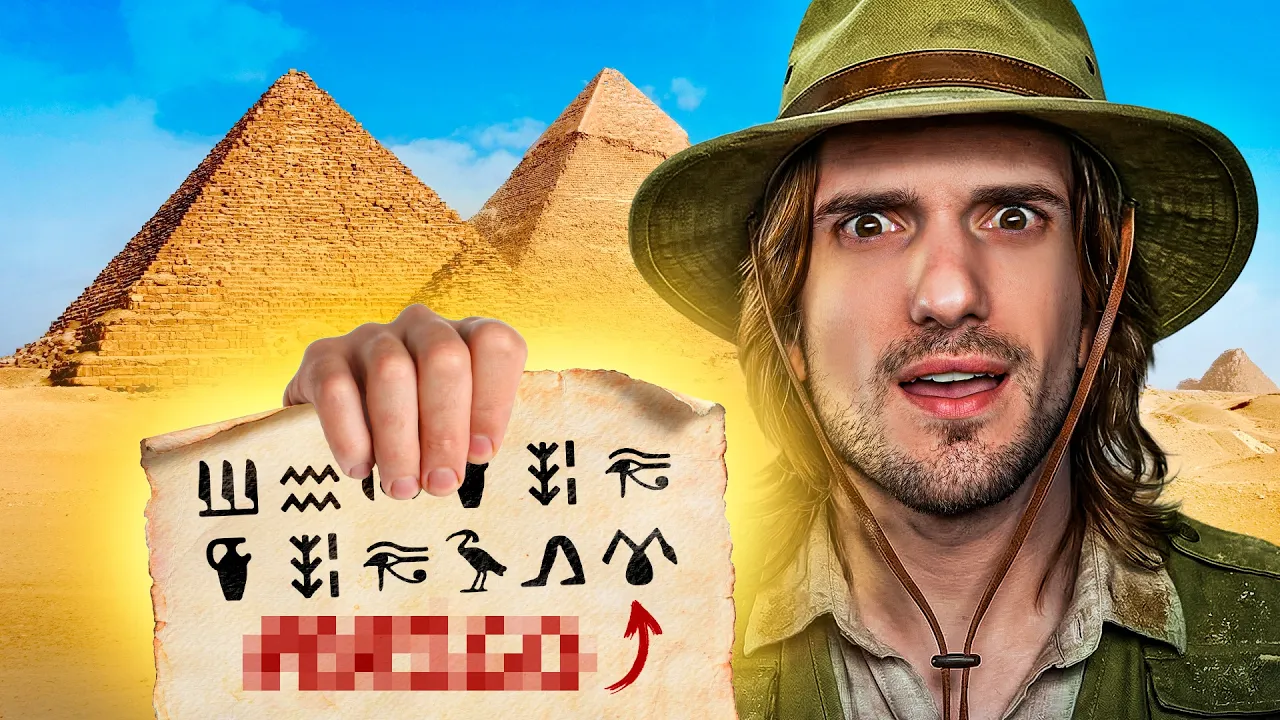
Egyptian hieroglyphs function in three ways: phonetically to represent sounds, as determinatives at word endings to clarify meaning, and as ideograms standing alone to represent concepts; the ancient Egyptian alphabet consists of 24 consonants (including vulture for A, foot for B, hand for D, and owl for M) with no vowels L, O, V, or X, and hieroglyphs can be transcribed into names through transliteration by matching sounds to appropriate symbols.
Learn Hieroglyphs: Egyptian Alphabet & Writing Names
Added:Understanding the difference between phonetic scripts (sound-based) and ideographic or logographic writing systems (idea-based).
Basic historical context of Ancient Egypt, specifically the role of scribes and the societal importance of written communication.
Familiarity with basic linguistic terminology, such as phonemes (individual speech sounds) and transliteration (representing characters in another script).
Mastering biliteral and triliteral signs, which represent combinations of two or three consonant sounds respectively.
Understanding the function and placement of 'determinatives'—silent classifiers used at the end of words to clarify their meaning.
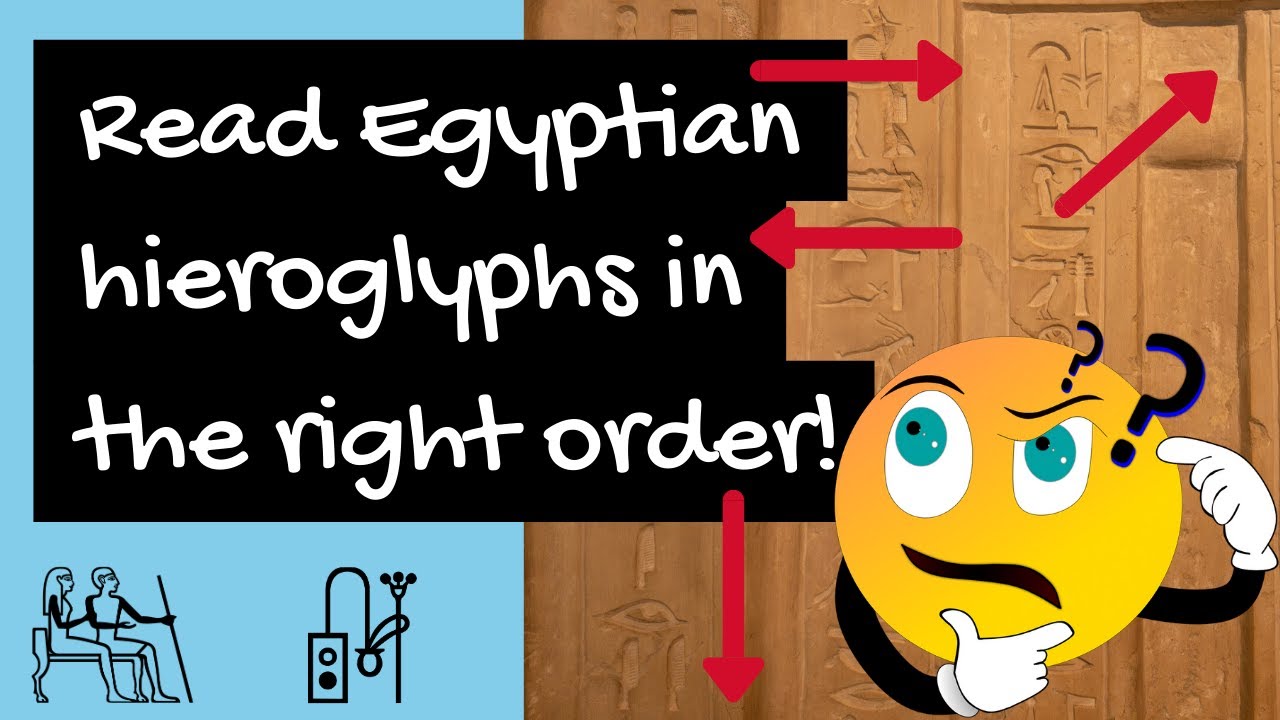
Learning the rules of reading direction, as hieroglyphs can be written left-to-right, right-to-left, or vertically, depending on which way the figures are facing.
Studying basic Middle Egyptian grammar, including word order, gender agreement, and noun-adjective phrases.
Exploring the history of decipherment, particularly the breakthrough role of the Rosetta Stone and the work of Jean-François Champollion.
827.4K views15.9Klikes29:06Original Release: 2016-12-12
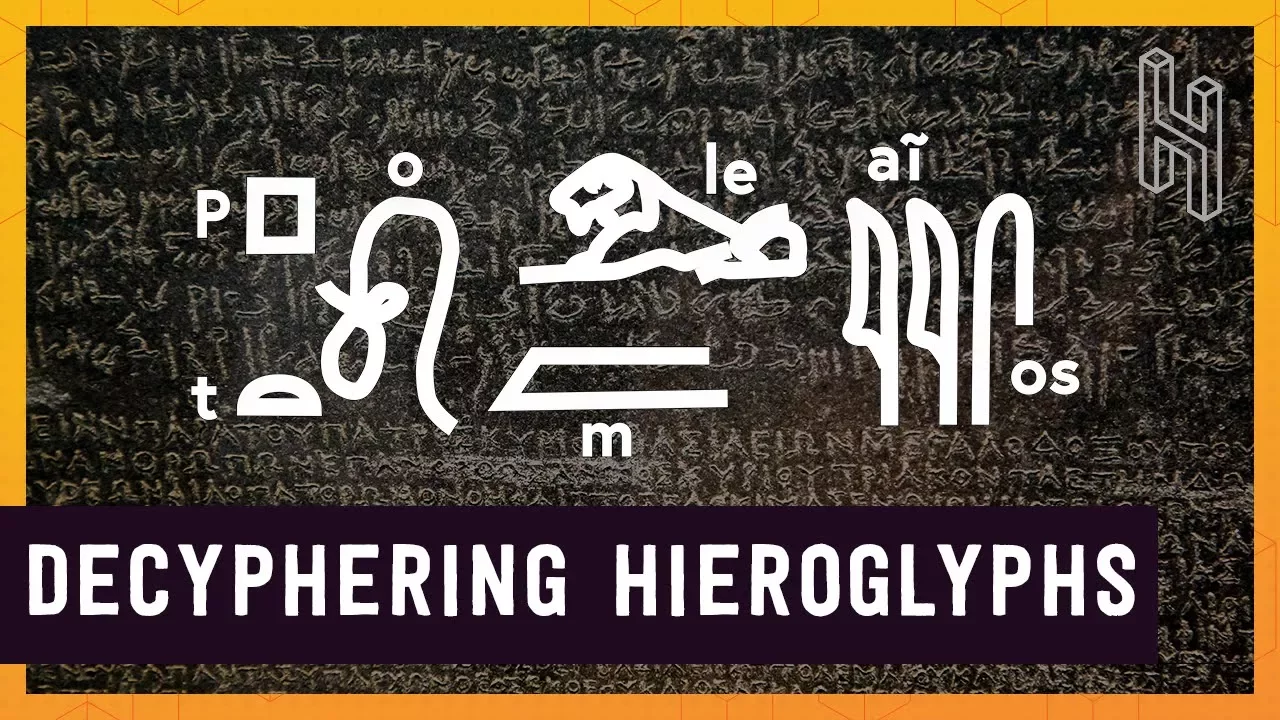
[Music] [Music] welcome back today we're going to begin our study of hieroglyphs by learning the Egyptian alphabet and how to write our names in hieroglyphs but first first I have to give you the answer to the homework question what does this ancient Egyptian sentence say I've been teaching this course for 40 years and I'm always surprised at how consistent the guesses are almost everyone thinks it's about birds and going somewhere which is perfectly reasonable since we see birds feet and so on but reasonable is not necessarily correct the sentence has nothing to do with feet walking or Birds everyone is making the same mistake that the scholars trying to decipher hieroglyphs were making assuming that the hieroglyphs are 100% idiographic that is picture writing that when you have a bird the text is talking about birds it's not this is what I call the big mistake in fact this sentence translates to the sun is shining in the sky let me explain why hieroglyphs for the most part are phonetic and represents sounds the first bird is a quail chick and it represents the sound W the foot has a sound b a b and the wavy line is an N this circle at the end though is idiographic it represents the Sun and helps make clear the meaning of webon it's the word for shine so two things to note about our first Egyptian word first it's mostly phonetic with no vowels and often we don't know which vowels were used second an idiographic sign at the end provides a clue to the word's meaning the second word in our sentence is made up of three hieroglyphs a mouth sign ER an arm e and our sun Circle again which has no sound but helps make the meaning clear so the sound is re and it means Sun next comes an owl that's pronounced M and it means in our last word has a rectangle which is a p and a semicircle which is a t so it's pronounced pet the hieroglyph under it represents the sky the Egyptians viewed the sky as a canopy held up by four pillars and the word means Sky note how the word for sky is formed two small hieroglyphs together above a longer one the Ang Egyptians were very concerned with Aesthetics they wanted their words and sentences to look good if you strung out the three hieroglyphs on one line it wouldn't look nearly as good so our sentence means the sun is shining in the sky nothing about birds feet or arms we should also notice that the verb Shine Comes at the start of the sentence verbs come first in ancient Egyptian I should point out that sometimes in Egyptian just as in English there is some ambiguity the word webbon to shine also means to rise so your sentence could also be translated as the sun is rising in the sky in our sentence hieroglyphs are actually used two ways phonetically to represent sounds but also as pictures to help us determine the meanings of phonetic words like the sun and Sky hieroglyphs these signs are called determinatives because they help us determine the meaning of a word there's one more way that hieroglyphs can be used and that's as idiograms idiograms are hieroglyphs used pictorially but not at the end of a word rather idiograms stand alone to help you recognize that they're standing alone they are often flagged in the ancient Egyptian language with a stroke so we could do some speed writing and for sun we could write this the sun with a stroke so to summarize hieroglyphs can be used in three ways first phonetically representing a sound second as a terminative coming at the end of a word to clarify its meaning and third as an idiogram where the picture represents a concept all by itself we will get lots of practice with all three uses of hieroglyphs and they'll become familiar with repetition so don't worry now it's time to learn the ancient Egyptian alphabet that I'll show you how to write each hieroglyph step by step but just a heads up there's no letters l o v or X in Middle Egyptian I'll show you how to draw an L lion that was used much later during the toic period but don't be surprised when we script right over some other letters now get some paper and a pencil or pen let me give you one tip to improve your hieroglyphic penmanship use a fine point felt tip pen hieroglyphs were intended to be drawn with a brush a felt tip pen will approximate the brush let's start with a now I know I said that the Egyptians didn't write vowels and I'm showing you an a it's not exactly the sound of RA a philologists call it semi vocalic like the Arabic Ain it may have sounded a bit like the O in Auto even now for this sound we're going to draw a vulture watch the steps and then follow along when I draw it a second time we start with the beak something like that next we go with the front of the body then give him front legs we come down for the back give him the back Wings come up for his leg give him something to stand on and you've got a vulture now let's do it again I'll do it slowly you'll see the sequence start with your beak do the front give him his front legs come down with the back back Wings come over up with the leg and always the bird stand on something that's our letter A A this is one of the most difficult of the alphabetic hieroglyphs don't worry if you're having trouble you'll get it everyone does remember our exercise book also shows you how to draw it step by step B is a foot start with a line down then you're just going to need a triangle coming over here come back and then you've got the back of the foot b line down triangle come back and bring it down and you've got a foot it's very stylized there's no real C but we have a CH sound like in the Scottish Lo it's a placenta you just draw a circle and put three lines across and you've got it sometimes there's four lines across it doesn't matter which and that's our CH sound D is a hand it's stylized not realistic now start with an oval then draw the wrist like that and now comes the thumb it almost looks like a mitten so you do the oval the wrist and the thumb and that's d e is an arm it's one of those semi vocalic sounds not quite a vowel now start with the fingers of the hand like that then go with the arm and then the shoulder the shoulder isn't a square it's got a little bit of a down like that and that's the E so remember you just do the thumb you do the hand underneath it you bring the arm all the way out and then you go up and you've got the shoulder and that's the e sound f is a snake the horn Viper start with the head and body like that and then just give him the two horns and that's it he's very stylized so you just give him the body and then two horns and you've got it the f G is a jaar stand it's not a TP it's a hard G sound as in guarantee often desert civilizations created round bottom pots that they could set upright in the sand indoors you needed a stand for the pot usually made of clay the bottom of the pot would rest in it the triangle cutout is to allow a breeze to go through and cool your water in the jar now let me show you how to draw the jar Stand start with two vertical lines like that now the curved bottom it's a little bit of perspective put in the top and then your little triangle so you get the breeze to cool your water and that's the jaw stand once again two vertical lines the nice curved bottom do the top straight across and your triangle so you have cool water and that's your letter G now for H there are actually two different H's in the Egyptian alphabet the Reed Hut H is a simple structure made of reads so the farmer can get out out of the blistering Sun for a while it's all straight lines let me show you you go up across down across and up again like that simple straight lines and that's one of the H's the other H is a twisted flax and it's surprisingly difficult to draw it represents two strands of flax Twisted together now it looks like three Loops one on top of the other but don't draw it that way it just doesn't come out right right let's do it the way the ancient scribes did it start with a curve at the top bring another one down and then finish the bottom that's your Twisted flax H start with a curve at the top bring another one down and finish your bottom and that's it the difference between the two hes is that the Reed Hut is more emphatic as in hot where you expel your breath forcefully the flax h is not so emphatic it's more like the H in hello now onto I another semivowel I is a reed Leaf the kind that Flowers By The Seashore it probably was vocalized like the i in it now start with a straight line then give it a rounded top like that then come down parallel and then finish it off with another curved line and that's your read Leaf let's do it one more time down curve at top straight down and then give it another curve and that's it for J we have a snake we think it's a cobra it's really a DJ sound as in Judge first start with a head come down across and down and that's it the key is getting the angles it's really right angles almost so start with a head come down across and down and that's your J or DJ K is easy it's a basket with a handle draw a sight of a circle and then just do the handle at an angle coming down like that and that's your K let's try it again just drew your slice of a circle and the handle coming down looks like a coffee cup but it's a it's a basket as I said before there's no l in the ancient Egyptian alphabet this would be added later we're studying middle Egyptian the language spoken around 2,000 BC later the Greeks would use a lion for their L's in their names like tmy and Cleopatra if your name is Lily you'll want to know how to draw it so let me show you one now for the lion start with the rectangle for the head then do the main next you can do the body give him a tail and then you're going to do hind quarters front legs and if you have time you can give him a nose it's kind of cartoony but you can do it quickly that way let me show you one more time start with the rectangle for the face then his man next the body the tail back legs front legs and you can even give them a nose and that's your lion l so there you go Lily m is another bird an owl the key thing is to start with the head which looks like this it's an un unusual bird because it's looking frontally at you usually the birds you can't see frontally now we do everything exactly the same as the a the vulture we start with the front we give him his front legs we come down with the back feathers the back we come up for the leg and give them him something to stand on and if you have a little time give him his distinctive beak and you've got an owl let's try it again start with the rectangle up here the unfinished rectangle then go for the front of the body the front leg now come down just like the vulture for the back come across and up for the tail feathers and give them something to stand on and we'll give him his beak that's your M sometimes instead of the owl Egyptian scribes used another hieroglyph it's a base upon which a statue stood we'll see it later in the course and I'll remind you about it but let me show you how to draw it it's very simple you just come across and front and back and that's the statue base so it's just across down at an angle and back either the owl or the statue base same thing and now for n it's simple up and down Peaks the word for water was nun so it's not surprising that the ideogram for water also represents the sound M now let's do it here up and down up and down down there's no specific number of Peaks you can do four or five but the important thing is the ends have to go down so let's do it one more time and that's your N I believe that the water sign may have been the first hieroglyph there are early water jars with wavy line designs it's the first label ever from this we can go on to create the Nora pallet remember it's all labels for Nora the servant the vizir and now back to our alphabet like L there's no o in the ancient Egyptian alphabet so we'll skip over o and go straight to p p is a rectangle not a square and represents a woven readed mat it's simple just do a rectangle and you've got it let's do it one more time that's P you may be wondering how we know that this rectangle is a read mat well on Tomb walls when the hieroglyph is drawn in detail we often see the weaving Q is just a hill it has a slightly different sound from the basket K we just learned think about the difference in the initial sounds of Queen and kid the Q is almost a KW sound let me show you how to do it draw the bottom line of the hill then the top and then it's curved down to the bottom like that that's Q so again just do the bottom come up and curve it down to the bottom and that's your que our is a mouth first just do the top and then the bottom and that's it just the top and then the bottom and you've got R the letter s looks like a cane but it isn't it's a bolt of folded cloth don't try to draw it in one single line it just does doesn't come out well that way do it in three Strokes we know that the scribes did it that way because we can see brush strokes and even where the ink in the brush began to run out so start with a vertical line then do a shorter parallel line and then connect the two and that'll always come out nicely again your vertical line you're parallel connect the two and you've got it t is real easy it's just a semicircle it's a loaf of bread start with the bottom and just do the top and that's your letter T one more that's your letter t the U is our third and last bird in the alphabet he's a quail chick now start with the head and then when you do the body the thing about the Quil trick is it's mostly straight lines so when you come down do it like that you can come across for here do it here and now you've got the feet put in a wing give him his beak and you got your Quil chick let's try him again start with the head then we can come down here now if you want you can draw the parallel line here first then connect now you give him feet he's going to walk put him on something complete the face with with the beak coming down and give him his wing and that's your quail chick there's no V in our alphabet so we go to w but W is also the quail chick that we used for you now there's also no X why is the read written twice it has the sound of a long e like in Mary so just with our I we start with a straight line we give him a curve at the top come down and then give it the other curve and we're going to do it twice straight line curve come down and that's the Y sound we'll do one more time straight line curve at the top come down like that straight line up at the top come down curve and that's the Y sound Z is a bolt on a door the kind that slides when written it's simply this do it again just you'll see it it's a line like that now when you actually see it you'll see that it's much more complicated but for writing it they just did it this way now there are just two more hieroglyphs to complete our alphabet they're for sounds for which English doesn't use a single letter the sound sh is really one sound but in English we have to use two letters to represent it S and H the ancient Egyptians used the pool of water for the sh sound just draw a rectangle and that's your pool of water so it's just a long thin pool and once in a while they put two lines in it to indicate water so that's the sh sound last is the sound CH this is represented by a tethering ring it was used to keep animals from running away put each Loop over a hoof and your donkey isn't going anywhere let me show you how to do it start by drawing the two Loops this is what's going to fit over the donkey's Hooves and then the string and that's your tethering ring so two loops and then that's it that's SH now let's write our names in the Egyptian alphabet note that we're not translating our names we're not working at the level of meanings we're just transcribing our names from one alphabet to another this is transliteration let's say your name is Andrea Schwarz well for the a sound we start with the vulture next we have an N the water sign then we have the hand D we start with the oval do the wrist the thumb we're getting there next we have an R right now I put one sign on top of the other if you have two short signs they can go one on top of the other because remember the Egyptians liked it to look good so now we have the mouth hieroglyph which is easy and then we need the arm for the F we're going to stack him again there's our Andre and now we have an a at the end maybe so that's the Andrea now for Schwarz let's go by the sound right now Schwarz is a sh sound really so I think we can use something like the sh good now we can have a quail trick maybe a right now next we're going to have an rtz so we're going to have three short signs let's stack them up sometimes the Egyptians would do that so we got the SH now we have the T we have an R the T and the Z together that would be your Schwarz there you can see how I've stacked the three hydroglyphus just because they would like it because it looked better that way that's how we write Andrea Schwarz in hieroglyphs well it's been a big lesson we've learned the three ways that a hieroglyph can be used the hieroglyphic alphabet how to write hieroglyphs and how to position them that's quite a lot we just have to practice a bit to let it all sink in let me give you a homework assignment on line paper practice writing one line of each hieroglyph do a line of vultures then the foot and so forth don't rush it enjoy it our exercise book will show you how to draw the alphabetic hieroglyphs just follow the step-by-step instructions for each one I think you'll really enjoy the process I find drawing hieroglyphs to be a therapeutic escape from a frantic day or when I'm stuck listening to a not so interesting lecture I take out my felted pen and I draw hieroglyphs I have a hunch that I'm not the only one of my colleagues who does that I'll see you next time
Up Next
9:07
How to Read Egyptian Hieroglyphs: Direction & Order
@VoicesofAncientEgypt
68.6K views•2020-02-18

12:54
Triumph of Orthodoxy Icon: Byzantine Art & History Explained
@BenCallan
2.1K views•2024-08-06

9:49
FastAPI vs Flask vs Django: Choosing the Right Python Web Framework
@TechWithTim
302.5K views•2024-05-26

1:42
Game of Thrones Opening Credits: A Cinematic Analysis
@gameofthrones
46.3M views•2011-04-18
Related Study Plans & Knowledge Roadmaps
Structured learning paths in General & Interdisciplinary Studies
general-studies
Elevator Engineering: History, Physics & Cities
01From Hoists to Safety Brakes: The Dawn of Vertical Lift
02Hydraulic vs. Traction: The Engineering Physics of Elevators
03Modern Speed, Safety, and Algorithms
+ 2 more learning modules
12h5 modules
Explore Roadmap
general-studies
Rubber: Material Science, History & Geopolitics
01Origins of Natural Rubber & Mesoamerican History
02The Chemistry of Natural Rubber & Vulcanization
03The Geopolitics of the Rubber Boom & Colonization
+ 2 more learning modules
12h5 modules
Explore Roadmap
general-studies
Containerization: Evolution, Logistics & Trade
01Ancient Trade & Bulk Cargo: Amphorae to Barrels
02The Industrial Revolution & Cardboard Packaging
03The Containerization Revolution: Malcom McLean
+ 2 more learning modules
12h5 modules
Explore Roadmap
general-studies
Textile Tech: Evolution, Labor & Global Impact
01Pre-Industrial Textiles: Handloom & Cottage Industry
02Mechanization: The Spinning Jenny to the Power Loom
03The Factory System & Global Labor Transformation
+ 2 more learning modules
10h5 modules
Explore Roadmap