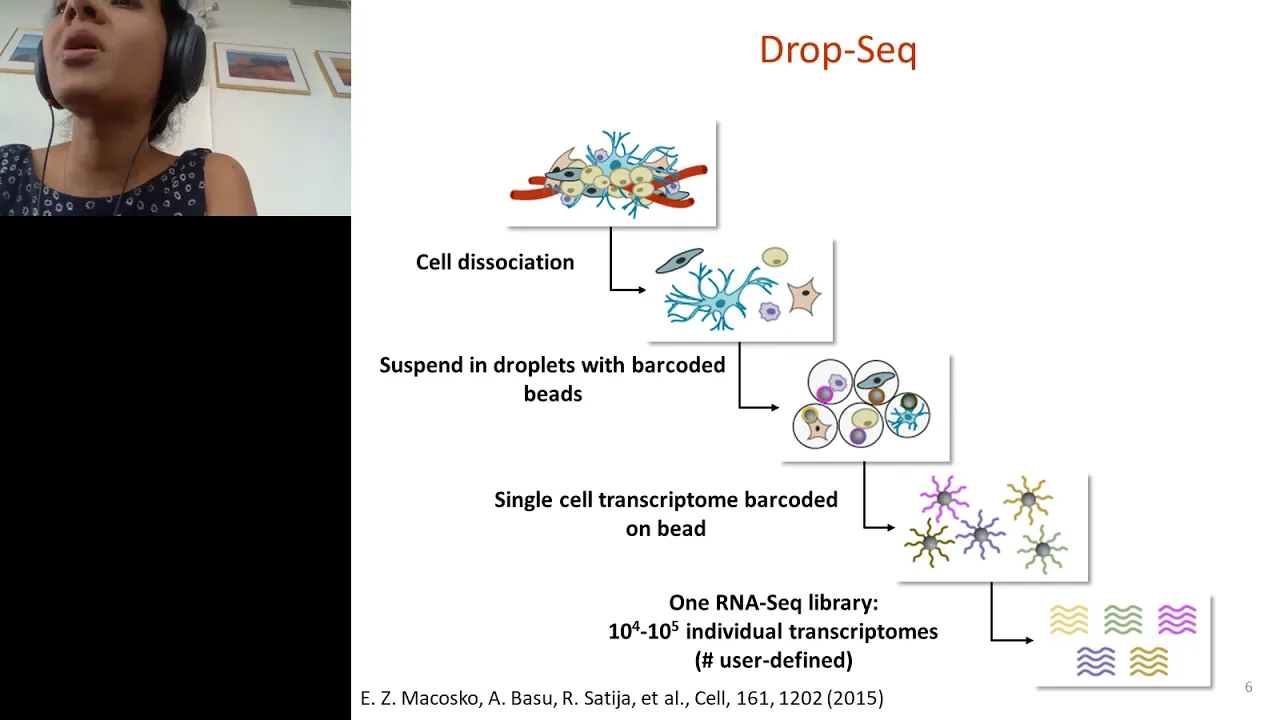



This video demonstrates how microfluidic droplet sorting technology enables ultra-high throughput screening of millions of enzyme variants simultaneously, allowing researchers to rapidly evolve oxidase enzymes with desired properties such as high stereoselectivity and catalytic efficiency. The presenter shows how this approach was used to engineer a cyclohexylamine oxidase variant (PT1) that achieved 1,000-fold improvement in catalytic efficiency and 4,200-fold selectivity for synthesizing the S-enantiomer of tetrahydrozoline, which is a key building block for pharmaceuticals like Fenderson. The methodology involves encapsulating single enzyme variants in aqueous droplets, performing the enzymatic reaction, detecting activity through hydrogen peroxide production, and sorting positive droplets for further enrichment. This approach significantly accelerates the directed evolution process compared to traditional screening methods.
Ultra-High-Throughput Screening for Oxidase Engineering
Added:so the first speaker is R&D bomb from eating Zurich were he were finally in creation and on Hill verse lab he's main interest for finding new ways to prove biology and creating functions and with that in mind he's been exploring micro fluidics since he's buckless qts studies a day easy aids and and now he's moved to applying there with its evolution and his PhD work and today what he's gonna tell us about is about how he has applied microfluidic droplet sorting strategies to engineer oxidase enzymes and other classes of enzymes and I kind of on a personal errand enjoys hiking so I hope you have a really good weekend hiking hiking and mountain so without further ado are on their resume use your okay I'll start sharing my screen I hope you can all see my presentation great well thanks for the introduction Anja and thanks for organizing this seminar here so as we've already heard my talk is gonna be about ultra high throughput screening with what you see in the background moving here these are aqueous droplets and an oil face and what we have done is we've used these droplets to engineer oxidases oxidases and other enzymes of course are a prime target for green chemistry and in the industrial chemical manufacturing we can use them to make catalysis more environmentally friendly and first I'm gonna show you three examples of compounds that people have used oxidase is to make building blocks to make these compounds the first one both separately which isn't HCV inhibitor protease inhibitor we have this by cyclic amine here which the Turner lab and Merck have used Mowen as a monoamine oxidase from a spiritualist nitro variant to dis limit rice this molecule with very high specificity the second one solely Fenderson we have a deer a sensation which is done by combining an oxidase here the same as before another variant though with a reducing agent which is nonspecific so we can by specifically oxidizing the racemic mixture and non specifically reducing the product we can demean we can form we can do semis a racemic solution and in the last example which is a fairly recent example is most people probably familiar with is galactose oxidase being used in cascade which almost synthesizes all of this molecule as lots revered by enzymatic steps and the first step is got those oxidase deselect rising this alcohol here and with enzymes we can carry out reactions at room temperature aqueous solutions and also make chemistry that is very difficult to carry out by normal synthetic methods the only problem is as I've already pointed out none of these enzymes are wild-type enzymes all of these enzymes had to be engineered and involved towards being useful in the given conditions that these reactions take place and I just wanted to give you the number of mutations that people have put into these enzymes to adapt into the process and that's a fair amount of mutations that you have to put in so we thought that by speeding up the way we screen and the way we evolved oxidases will provide a further method to enhance the usage of oxidases and industrial biases and the way we end up with all of these mutations all of you are probably going to be familiar with this directed evolution or you take a wild-type or a variant we select certain residues that we want to target for a mutation and we have to make every single of these variants to test them in the end and we have to gauge the fitness or how good our enzyme carries out the function that we're interested in and with that process by going cycles we can slow the climb the fitness peak that we want to climb and our desired way of improving or making the cycle go faster is of course by increasing the throughput and by applying the science strategies of libraries that fit our throughput and you can see here how oxidases are usually being screened you can have a microtiter plate assay where we isolate single clones into wells in the 96-well plate as seen here we have colony based assays where we stay in colonies that are partially lized and we spray them with the substrate and what we are going to add is a microfluidic approach where we have a schematic droplet here as you've seen on the title slide which acts as a boundary for diffusion of the genotype and the phenotype and this way we can in principle screen millions of enzyme variants in a single experiment and what's special about microfluidic said oftentimes people use tagged substrates so it would have a fluorescent tag on here it would be cleaved and we would measure this tag but with oxidases we have a kind of unique outside here that the oxidation recycle their cofactor using molecular oxygen to produce hydrogen peroxide in the process and we can use a couple of enzyme assay to monitor this reaction through the side product and this way we are uncoupled from the substrate we don't need to tag the substrate and also any oxidase will produce hydrogen peroxide if it carries out the reaction so we can also screen any oxidation principle and the enzyme that we chose to evolve was cyclohexyl mean oxidized short ciao it does what the name says 'add oxidize a cyclohexyl amine and does so at around 10,000 per molar per second k can't over km we chose a substrate which was the one phenol tetrahydrozoline and what we wanted is an our selective cho variant which was not described in literature before actually no activity towards his compound was described in the literature before even though it has been tested and through having an our selective variant we could make the S enantiomer of tetrahydrozoline variant here which would be a building block of solar fencing which I showed you in the first slide and this is how we're gonna sort or how we gonna SATs droplets because fluorescence activated cell sorting or short fats we have microfluidic chips where we have built in certain functions that serve the purpose a of generating a an emotion you can see down here this is happening at a speed of around one kilohertz services slowed it down fair bit you can see an oil face coming from here and a twist face coming from here it's being sheared off into droplets and what we can do is here in the stream we can combine multiple aqueous phases in this case we have ourselves and we have our reactants the reactants contain the substrate and HRP and the detection cascade and lysis agent so we're going to break open the cells in this droplets to release at the enzyme and if we dilute down the cells long enough these droplets should contain single cells so we can we can si single variants and in the second function we have to incubate the droplets for a certain amount of time for the reaction to take place so you can see here so you can also see that these droplets are very homogeneous which is important so we have very similar reaction conditions for each variant that we test at the very end of the chip we have a sorting junction which you can see here and what we do is we measure the fluorescence with a laser at the point here and if the fluorescence exceeds a certain threshold then we said we will give an electric impulse to this electrode which will deflect the droplet to the positive side and these droplets will of course gather and analyze further so we wanted to update the libraries design a bit for this given task because we can we have certain features in our enzyme that we can harness to make library design more specific a the active site is completely internalized into the enzyme and very hydrophobic so what we did we design new codons dyt and b YT they code for different size of aliphatic sidechain residues and residues that can hydrogen bond and these are the dyt Coenen are targeting all of these residues whereas for this prolene here we decided to use PYT which also codes for polling in case this problem had a structurally important role we could conserve its during the evolution so what this yields is 8 residues that we target all simultaneously and we have million members in this library and since every every single one of these amino acids is encoded by just one single code on in these codons we have no stop codons and we have no bias towards one residue and now everything is coming together we have the substrate that we chose we've made a library and what we did is we encapsulated them on chip and we incubated them to have the reaction cascade taking place and after sorting we collect the positive droplets and what we then can do is we can either iteratively sort to enrich the library more which is what we did three times and we can also analyze the clones single clones after every round I'll give you an example how this would look like here in the microfluidic sorting device on the y-axis we have a barcode dye that we are at - all of the droplets so we can detect all of them and on the x-axis we see the activities though the reporter died and we are interested of course in droplets that contain more reporter dye then the ones that probably contain no enzyme or are dead clones and on the right hand side you can see here a plate si on top of the unsorted library and as you can guess of course it's very unlikely to find a very active clone out of a million clones and here after three three rounds of enrichment we can see we find many active clones no we did is we picked the most active clone off of this plate and we are we sequenced it and we found that it had five mutations so here you can see the wild-type crystal structure and here a computational model that we made by in silico mutating these five residues and then docking the substrate what you can see is that with reducing the size of these residues here we've created a second pocket where this isoquinoline ring can fit in and here we have two additional mutations on the exit channel so the substrate is believed to come in here and the product is believed to leave at the same place this one is in the literature sign into three and is described to enhance substrate uptake we can also see the positioning of the substrate with the hydride that's going to be transferred to the fa D being placed in very good proximity towards the fa be interactive center here with kinetically analyzed this variant and we can see in red here is the wild-type you can see that for the our enantiomer of one phenyl tetra hydro isoquinoline with fairly low activity and for the S enantiomer we have no no detectable activity at all but after just one round of evolution we've improved the cake at over km of this enzyme by almost a thousandfold and furthermore the selectivity of PT one the variant that we created is as an S vector of 4200 so it is very specific for the RN on simmer which is exactly what we desire and as a quick comparison again we have the wild-type with the native substrate cyclohexyl amine which has a cake either became of roughly 10,000 so we are actually in the range of a wild-type enzyme here within a single round of epigenesis we were interested in analyzing our model how could explain this huge selectivity and what we found through docking the less desirable enantiomer is that compared to the RNN shipper here we have a bidentate hydrogen bond being formed with the newly mutated and mutated serine residue here and with the backbone here which forces the substrate into a conformation where the hydride the hydrogen points away from the f80 making it catalytically non-relevant we used our PT 1 variant then to carry out this deer assimilation reaction with phenyl tetrahydrozoline we challenged it with the racemic substrate and we added the borohydrate here as a reductant we conceived the wild type which we've even measured for multiple days afterwards there's no enrichment of the S enantiomer in this reaction at all whereas the PT 1 variant carries out this reaction very selectively it reaches 99% ie after approximately 9 hours and this all happened at 0.05 percent catalyst loading was also very efficient and if we analyzed further to substrate scope of these enzymes you can see in red here the wild type of course the activity for the wild type but a native substrate and here for primary amines we can see four primary means with small substituents here we have high activity for there s enantiomers and as we grow this moiety here for example and propyl or dispara chlorophenol we lose a lot of activity and what we've seen with PT 1 we have completely changed the activity profile of this enzyme and we've killed it for its native substrate and we see that we also diminished reactivity towards the small primary means a lot but as we then incorporate higher I can incorporate bigger moieties over here me restore the activity also we see that we have a switch in an NGO cell activity as you can see here we prefer the are and answer over the estimates in there and the same here mmm-hmm for secondary amines we can see that we have low activity for all of them with the wild-type enzyme however through evolution with of course already discuss this part with the phenyl tetrahydrozoline we also have increased activity for one ethyl tetrahydrozoline but almost no no increase in activity towards the methyl substituent so for some of these substrates we only had racemic substrates available so we were wondering what is the selectivity of these what we carried out was further dere a stimulation experiment where we combine all of these we combine all of these substrates with our enzyme and the derealization compounds and we analyzed with chiral HPLC after certain amount of time what what the unanxious selectivity was we can see as we've observed for this one we have a selectivity switch for the our enantiomer but it's fairly unselective we only have 50 percent EE here whereas for them and for the methyl one where we saw no increase in activity from the wild-type to PT 1 we have completely unselective reaction here probably probably the reaction is not really taking place for the F will substitute substituted tetra or isoquinoline we restore activity and also selectivity and are able to recover this at high yield and high EE we cannot distinguish the chlorine substituted ben's hydrilla mean here we cannot distinguish Laurie hydrogen here so I already come to my conclusion what he saw is we have two microphones as they developed we screened around a million variants of cyclohexyl amine oxidase with it and we found this new variant which has five mutations in a single round of evolution we took a enzyme that was unreactive towards our substrate and made us button to a Bible catalyst that be used for synthesizing to api's very high stereo selectivity so with this essay in hand we have future targets so a we can use it to further diversify cyclohexyl amine oxidase because we already have library a library in hand and for example this piperidine is one methyl substituted piperidine it's completely an activist in wild-type enzyme whereas we already detected activity by screening our library and we want to see if we can distinguish the chlorine from hydrogen here it would also be interesting to go into the tetra hydro go it's green tetra hydro queen Olins with this essay also we can use different oxidizes glucose and galactose oxidase are well described in literature and when you do a quick blast search of ciao for example you can see a lot of predicted oxidizes which haven't been characterized yet so this assay could also be useful for screening metagenomic libraries so with this I want to thank my advisor don't he'll vert for having me as a PhD student my collaborators and people that continue this work our whole group here in Zurich and that's enough for the funding and then I'm open for any question of course thanks for the invitation to present here all right let's give her a virtual round of applause thank you so much for a great time hey we're waiting for questions maybe I can ask you for something very interested in oxidation reacts it is oxygen delivery and the cofactor delivery and EQ for the micro fluidic system when you roll the enzyme not that I know of so in this case we didn't add any more cofactor at all to the reaction yeah it just by just there from purification of course you could add more cofactor in to look at if you look at the design of our microfluidic chip of course you could imagine adding more cofactor tear a reactant channel of course cofactor uptake will take some time probably but incubation can be multiple days even so I don't know if that answers your question yeah but others like well thank you okay and we've got multiple questions coming to clean this one ridges I'm just gonna allow people to speak so first of all ever and Peter when Yama I should now be able to talk are you able to hear me yes you know okay yeah the first question just out of curiosity how did you determine this tro chemistry of you are you are an angel pure compounds then too when you you you identified the gene you are responsible for that is there a way you can you can play with the system so that you can the opposite stroke chemistry okay yeah so the first question for for these two substrates we simply bought pure pure enantiomers and we also carry out chiral HPLC analysis and we correlate the peaks that we see to the box and to literature values and for the rest of them we also simply compared them to literature values their retention so you want by Carol HPLC you bunch a semi mix just right yeah no Nigel pure u-bolt racemic mixtures right of these we bought a Nancy pure and an anti peer mixtures not make sure sorry your compounds and of these we only had racemic mixtures but these which is let carried out the reaction and we purified we extracted the product and carried out chiral HPLC analysis so let me understand you hit pure in Angela's weak you compared with your reaction mixture right yes hello okay you had to pure nine to mass which you compare to the reaction mixture right yeah well in this case we had pure enantiomers so we could analyze the kinetic kinetic variable for for both of them individually and for these which is carried out this reaction so if it's selective we will enrich one antemer and this we can analyze by extracting this product and analyzing its bile by a chiral HPLC this will tell us which enantiomer we have okay then that's okay and then the second equation of course you answer but now I can you also maybe try to to to give that enzyme a substrate that you don't know distro chemistry and see how it will behave of course you can so I think your first question was can we can we also get the other stereoselectivity and yes the answer is yes we can challenge our we can challenge our library with the converse enantiomer here and during the screening process we will then filter out enzymes that have a different selectivity hopefully if they are in the library and you could put any substrate here that you were interested in that's what he also did with the substrates that I showed you on the outlook we've already seen activity we already have activity with our variant here but unselective and we've seen activity in the droplets organ system for other substrates okay so just move on so we've quite a few questions clear on you so when you let me know when we have to stop this so we have a question from Benjamin bus answer so you should now be able to talk Benjamin can you hear me yes yes great talk Aaron thank you very much so it's very interesting he's muted again okay you are muted for a second time okay can you hear me now yeah okay yeah I notice you did take into consideration the the one of the native amino acids pearling there if I understand correctly because you you thought it might have an important structural roll so would you would you care to comment a little bit on in general what your approach is to the the type of mutations and positions you you you allow do you just choose things around the the active site do you avoid a certain type of residue or secretary structure and if you could design your ideal structure to put a binding site in what would you like it to be so I think in this case but our goal was was actually to limit our code on set as as much as we can and still have a certain diversity in there so we have small hydrophobic large hydrophobic and this pocket is all inside the enzyme so all of these residues are very hydrophobic so that was the first design thought that we have and by limiting these coatings that's two very set of amino acids instead of just six codons with the goal of this project was to target a large part of the active site actually here you can see these are almost all residues that make up this side of the active site and the other consideration is of course if you just use time all for example you can place your substrate such that the hydride that has to be transferred to the F ad needs to somewhat point in to direction of the ad you can figure out where you expect clashes I see I see
Up Next
Industrial Enzyme Biocatalysis: Evolution & Applications | Lecture 5 by Andrés Illanes
@ppgequfscar
155 views•2013-08-30

Triumph of Orthodoxy Icon: Byzantine Art & History Explained
@BenCallan
2.1K views•2024-08-06

FastAPI vs Flask vs Django: Choosing the Right Python Web Framework
@TechWithTim
302.5K views•2024-05-26

Game of Thrones Opening Credits: A Cinematic Analysis
@gameofthrones
46.3M views•2011-04-18
Related Study Plans & Knowledge Roadmaps
Structured learning paths in General & Interdisciplinary Studies