





















Prime numbers are integers greater than 1 that have exactly two distinct factors: 1 and themselves, such as 2, 3, 5, 7, 11, and 13; since there are infinitely many prime numbers, any composite number can be uniquely expressed as a product of prime factors through prime factorization, a process that breaks down numbers until only prime numbers remain, demonstrating the fundamental theorem of arithmetic.
Divisibility, Prime Numbers, & Prime Factorization | Math Basics
Added:Proficiency in basic arithmetic, specifically multiplication and long division of whole numbers.
An understanding of factors and multiples, meaning what it conceptually means for one number to divide another without a remainder.
Familiarity with basic exponent notation, as prime factorization often represents repeated factors using powers.
A clear distinction between even and odd numbers as a foundational pattern in divisibility.
Calculating the Greatest Common Divisor (GCD) and Least Common Multiple (LCM) of numbers using their prime factorizations.
Applying prime factorization to simplify algebraic fractions and find lowest common denominators.
An introduction to modular arithmetic and the Euclidean Algorithm, which extend divisibility theory.
Exploring real-world applications in computer science, specifically how prime numbers and factorization form the basis of RSA cryptography.
158.6K views3.6Klikes5:53Original Release: 2017-08-20
Hey it’s Professor Dave; let’s talk about prime numbers.
After learning about division, it’s only natural to talk about the concept of divisibility.
Numbers are only divisible by certain other numbers, which means that they can only be divided evenly in certain ways.
Take the number ten.
Ten can be divided by one, which just gives ten.
In this way, every number is divisible by one.
Ten is also divisible by two, because it is an even number.
Even numbers are the ones that are divisible by two, like two, four, six, eight, and so forth.
However, ten is not divisible by three.
If we try, we get three remainder one.
Three does not go into ten evenly.
So while one and two are factors of ten, three is not.
Four also is not.
Five is a factor of ten, because five is half of ten.
Ten divided by five is two, so five is a factor of ten.
But from there, no number bigger than half of the larger number will be a factor except the larger number itself, so six, seven, eight, and nine are out.
And lastly, we say that ten is a factor of ten, because ten divided by ten is one.
One, two, five, and ten are the factors of ten.
How about twenty?
For twenty we see that one works as always, two as well because it’s an even number.
Three does not, but four does, as well as five.
Then we jump all the way to ten, since it’s half of twenty, then twenty itself, and that’s the end.
Those are the factors of twenty.
This brings us to an obvious question.
Are there any numbers that have no factors whatsoever?
Technically no, because any number will have as factors both one and itself.
But what about beyond that?
Are there any numbers that have no factors besides one and itself?
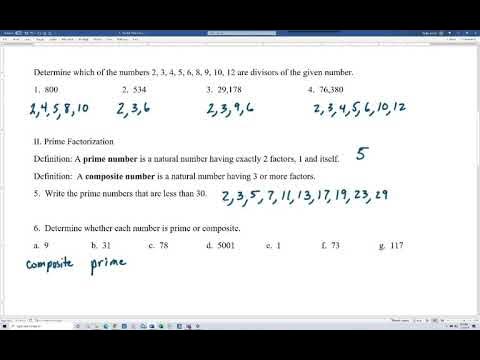
There are indeed many, and numbers that fulfill this criterion are called prime numbers.
What are the prime numbers?
One doesn’t count, because one and itself would be same thing, so let’s start with two.
Two counts, as does three, because these are so small that there can be no other factors.
But once we get to four, four is divisible by two, so four is not a prime number.
In fact, no even numbers except for two can be prime numbers, because they are all divisible by two.
Only odd numbers can be prime numbers.
Five is a prime number, as is seven.
But nine is not, because it is divisible by three.
Eleven works, as does thirteen, but not fifteen, since that’s the product of three and five.
Seventeen works, and so does nineteen, but not twenty-one, since that’s seven times three.
Twenty-three works, and so on and so forth.
One would think that this can’t go very far, because once numbers get big enough there have to be some factors in there.
But there are some astoundingly huge prime numbers.
The largest one discovered so far has millions of digits, which is mind-boggling, and it took thousands of computers running simultaneously for days to find this number.
In fact, there are infinitely many prime numbers, so no matter how big the biggest one we’ve found, there’s always a bigger one.
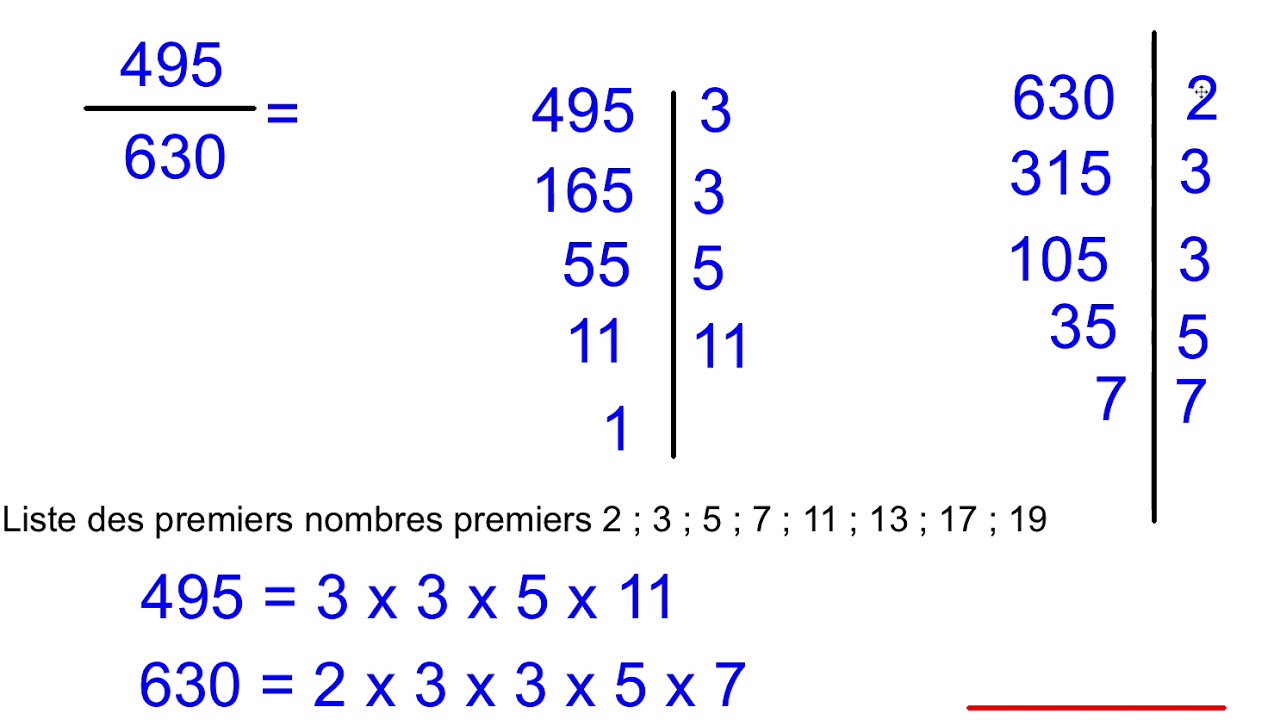
So now that we know what prime numbers are, we can understand why we must factor numbers until only prime numbers remain, since that’s the farthest we can go.
Take twenty for example.
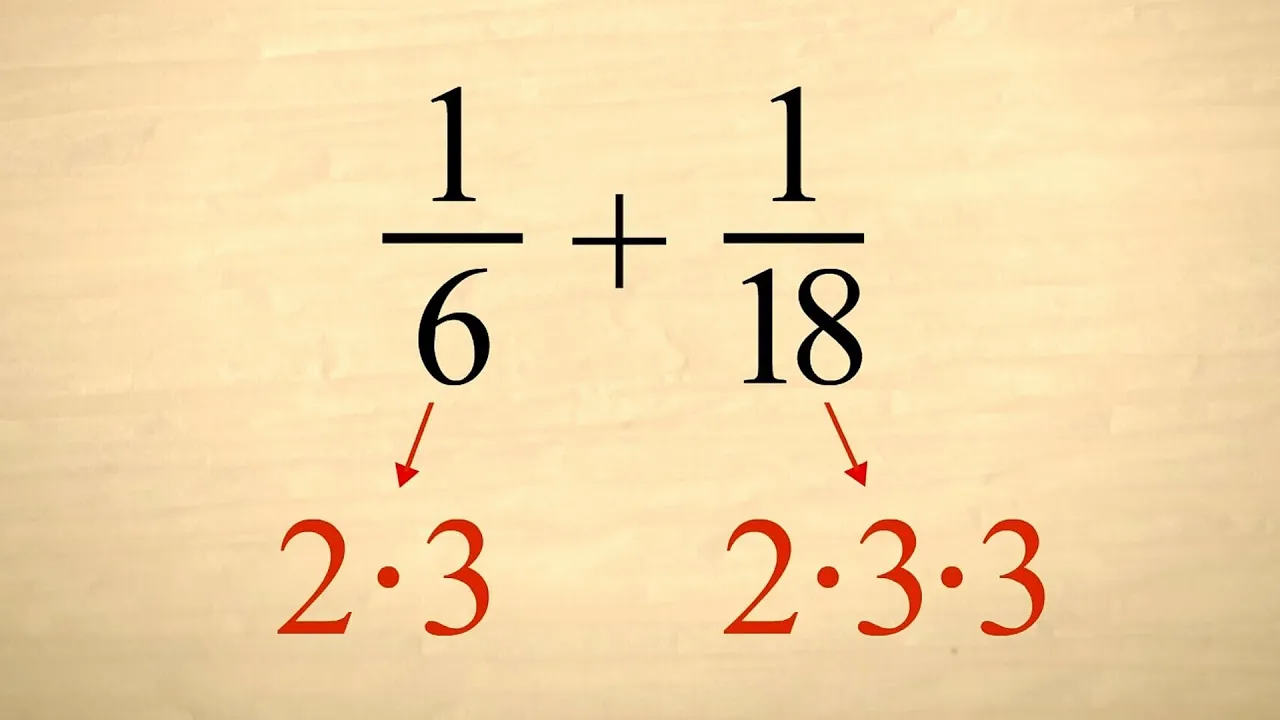
We could represent that as five times four, and four can be represented as two times two, so factoring twenty gives us five times two times two, which are all prime numbers.
How about thirty-six?
We can split that into nine times four, nine can be three times three, and four can be two times two, so three times three times two times two.
Notice how we are never done until we are left with all prime numbers.
Let’s try ninety.
First we can get nine times ten, break that into three times three and five times two, and there we go.
What if instead we started with thirty times three?
Thirty becomes ten times three, ten becomes five times two, and we end up with the same thing anyway.
This is because there is only one unique set of prime factors for any number, and this important notion is called the fundamental theorem of arithmetic.
Now that we’ve got the hang of prime factorization, let’s check comprehension.
Up Next
21:49
Dirichlet Convolution: Arithmetic Functions as an Algebraic Ring
@EssentialsOfMath
5K views•2020-07-20
4:43
Elliptic Curve Cryptography Explained: ECC, ECDSA, ECDH
@PracticalNetworking
28.5K views•2024-10-21

15:36
Vector Fields, Divergence, and Curl | Calculus Tutorial
@ProfessorDaveExplains
288.7K views•2019-09-18

6:00
The Mathematical Impossibility of Accurate World Maps
@Vox
23.3M views•2016-12-02
Related Study Plans & Knowledge Roadmaps
Structured learning paths in Mathematics
mathematics
Tensor Calculus: Vectors to Riemann Curvature
01Mathematical Foundations: Linear Algebra & Calculus
02Covectors, Dual Spaces, and Tensor Basics
03The Metric Tensor and Index Gymnastics
+ 2 more learning modules
40h5 modules
Explore Roadmap
mathematics
Gödel's Incompleteness: Logic, Proofs & Limits
01Introduction to Formal Systems & Hilbert's Dream
02Set Theory, Cardinality, and Cantor's Diagonal Argument
03Arithmetization and Gödel Numbering
+ 2 more learning modules
14h5 modules
Explore Roadmap
mathematics
Galois Theory: Fields, Groups & Solvability
01Foundations of Abstract Algebra: Groups & Fields
02Polynomials & Field Extensions
03Splitting Fields & Symmetries
+ 2 more learning modules
24h5 modules
Explore Roadmap
mathematics
Non-Euclidean Geometry: Models & Geodesics
01Euclid's Fifth Postulate and the Birth of New Geometries
02Hyperbolic Space and the Poincaré Disk Model
03Geodesics: Defining Straight Lines in Curved Spaces
+ 2 more learning modules
15h5 modules
Explore Roadmap