




![वैश्वीकरण और भारतीय अर्थव्यवस्था [Full Chapter] : कक्षा 10 अर्थशास्त्र अध्याय 4 | class 10 Economics](https://i.ytimg.com/vi_webp/s_bGgamn5_0/maxresdefault.webp)

![송백석 사회 [세계의 정치와 경제] 제5강 초국적 기업 (장시복 강의)](https://i.ytimg.com/vi/9bu-0F71MK0/hqdefault.jpg?sqp=-oaymwEmCOADEOgC8quKqQMa8AEB-AG-AoAC8AGKAgwIABABGGkgaShpMA8=&rs=AOn4CLALDXJXhI1f2HD8nbw0wJRgAt-42g)


















Free trade is not a neutral, apolitical economic arrangement but is deeply intertwined with power, politics, and historical exploitation; while classical economic theories like comparative advantage suggest trade benefits all parties, empirical evidence shows trade agreements often favor the wealthy and powerful while harming workers in less competitive economies, and modern trade deals contain provisions that allow corporations to override national regulations and environmental protections, demonstrating that trade policy must be understood as part of broader political and social governance rather than as a purely technical economic matter.
The End of Free Trade: What Globalization Is Becoming
Added:The economic theory of Comparative Advantage, which forms the theoretical foundation for free trade and international specialization.
The history and expansion of modern globalization, particularly the rise of multinational corporations and global supply chains.
Basic instruments of trade policy, including tariffs, import quotas, export subsidies, and non-tariff barriers.
The role of global trade governance institutions, specifically the World Trade Organization (WTO) and the General Agreement on Tariffs and Trade (GATT).
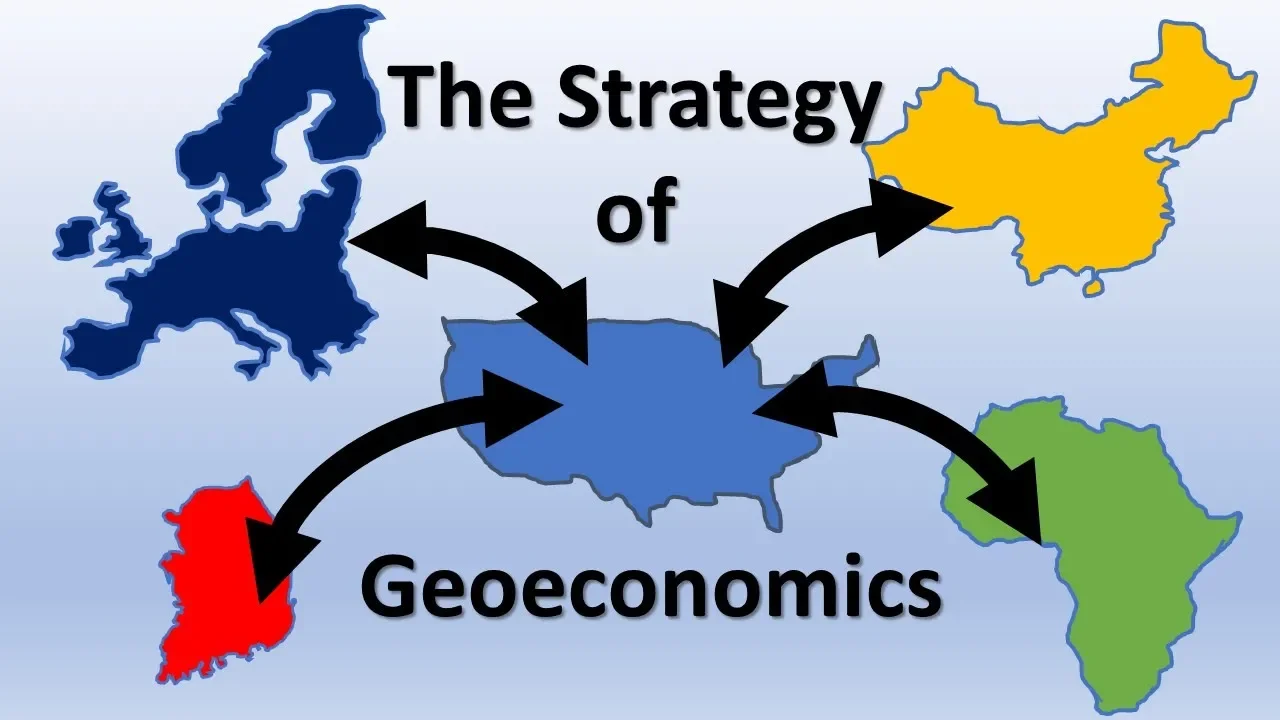
The concept of 'Geoeconomics' and how nation-states use economic instruments to achieve geopolitical goals.
The shift toward 'friend-shoring', 'near-shoring', and 'de-risking' in modern supply chain management.
The resurgence of state-driven industrial policies, such as the U.S. CHIPS and Science Act or the European Green Deal, and their impact on global markets.
The consequences of trade weaponization, economic sanctions, and bilateral trade agreements on developing economies.
177.8K views8.9Klikes1:07:18Original Release: 2025-09-22
The US president has increased tariffs on China dramatically. In some cases, the rate is as high as 100%, a truly unprecedented intervention in the modern economy. Prices will undoubtedly rise for American consumers in the short term, though with the hope of boosting American industry over the medium-term. This is designed to increase American self-sufficiency and reduce reliance on their biggest geopolitical rivals. The year is 2024 and the president is... Joe Biden. Got you? Maybe. It does seem that even before Trump 2.0, we were moving towards a new paradigm for globalisation. "New paradigm for globalisation" being the type of thing people I hate say. I have become them. Excuse me, but proactive and paradigm. Aren't these just buzzwords that dumb people use to sound important? Not that I'm accusing you of anything like that. I'm fired, aren't I? Oh, yes. Backlash against globalisation is hardly new. We saw numerous protests across the world in the nineties and naughties, taken up by lefties who saw globalisation as dominated by corporations and the financial sector. People in Poland protested their joining of the EU; people in Seattle protested against the IMF and World Bank; and people in Porto Allegre in Brazil established the World Social Forum, a counterpoint to the elite meetings in Davos.
During the 2010s, we saw rising anti-globalisation sentiment once more, but this time from the right. The campaign for the UK to leave the EU succeeded in 2016, the same year Donald Trump 1.0 was elected on a promise of putting America first. Since 2010, Viktor Orbán has ruled in Hungary. In 2018, Jair Bolsonaro, sometimes called the Tropical Trump, was elected in Brazil. And we've had resurgent nationalist movements even in stereotypically progressive countries like Germany and Sweden. There does seem to be a shift in how we manage trade and especially in the ideas behind it. Whereas countries sung the hymn song of globalisation before, they are now open that they want to be self-reliant. Indian Prime Minister Narendra Modi has taken up the motto of Atmanirbhar bharat or self-reliant India. China's Xi Jinping also advocates zili gengsheng or self-reliance. In response to Western sanctions from the invasion of Ukraine, Vladimir Putin declared that "Russia is a self-sufficient country in every sense of the word." Donald Trump equally declared the 'economic independence' of the United States and the EU is making similar moves, though they'd never say it out loud, at least not before 5 years of preparing their statement. Despite all of this talk, the reality has been that no country has truly departed from free trade. In the UK, we left the EU, but joined the Trans-Pacific Partnership, and we are slowly reintegrating with the EU anyway, albeit at a pace that people won't notice. Nationalist movements have proven harder on immigrants than on goods, which had already been the case in the past. Even Trump 2.0 has had trouble repainting the world in his image. He has made a series of aggressive threats for tariffs on not just China, but on the UK and EU, who are supposed to be American allies, before walking back on his policies repeatedly after learning that it's just difficult to wind back the clock on globalisation. In response to Trump, Brazil and China have reaffirmed their commitment to the idea of free trade, as have other countries. New Zealand and India revived their once-dead negotiations following Trump's tariff mayhem. It seems that globalisation will continue, though it may no longer be US-led. What I want to do in this video is not so much to review the ups and downs of contemporary trade policies, which I'm sure will have changed since I recorded this. Instead, I want to go into the idea of free trade and how it has been challenged by contemporary political developments. As we will see, the rosy and apolitical notion of free trade promoted by politicians, technocrats, and economists has always been something of a lie. As with seemingly every video essay of this type, I'm going to start in the 19th Century. But first, I'm going to ask you to consider joining my Patreon. If you like my videos and want me to keep making them, please sign up. [Music] Our ideas about free trade owe much to the 19th century economist David Ricardo. Ricardo was a financier who made a lot of money trading stocks. As trade had benefited him so handsomely, he decided to formulate a theory of how it could benefit everyone. To prove this, he created a famous model to illustrate the point with hard numbers. This was largely unprecedented at the time, one of the precursors to the economic models we know and love today. Before Ricardo, economists had been quite worldly, reflecting on the emerging capitalist system as part of a broader set of reflections about morality in society. The epitome of this was Ricardo's predecessor, Adam Smith, who is often considered the father of economics. His 900-page treatise, the Walth of Nations, is full of arguments for why trade is beneficial, but also confronts its drawbacks and is filled with broader questions about the human condition. His earlier theory of moral sentiments has a self-explanatory title. Some of Smith's best known reflections on the economy are about the division of labor. Smith thought that the productivity of a pin factory could be massively improved by dividing up the tasks. He claimed that one person working alone could "scarce with his utmost industry make one pin a day." Whereas in the factories of his time the task was split into "18 distinct operations." This would mean that "one man draws out the wire, another straightens it a third cuts it" and so on. Right, that's enough of that. Yes. Smith was Scottish. This often gets lost. Smith claimed that 10 men working in a factory could make 48,000 pins or 4,800 pins each, a number that dwarfs the single pin one man could make in a day. According to Smith, the efficiency gains from splitting up a task are potentially enormous. Going from a small factory to a large one may multiply the number of pins produced by a factor of 100. That's a lot of pins. Smith's argument for trading with other countries was just an extension of this insight. If we could split up tasks to maximise productivity within a factory, why not do it globally? This means greater specialisation and greater wealth. It is the maxim of every prudent master of a family, never to attempt to make at home what it will cost him more to make than to buy. What is prudence in the conduct of every private family can scarce be folly in that of a great kingdom. For whatever reason, we all have different skills and interests, so we make different things. Why bother making what you can't and don't want to make when you can just do what you're good at and trade with others? This is a pretty basic argument in favor of universal free trade. That is: trade at the level of the individual but by the same argument, trade at the level of international markets. The gains from the division of labour are clear in each case and follow the same logic. Furthermore, different countries have different climates and cultures and histories. So, it's been true throughout human- (There goes some pins.) So, it's been true throughout human history that others grow and make things that we just can't. That's why Italians are always mad at food, even though their food isn't- it's not that good. I'm just saying, it's not that- it's not THAT good. Smith had a number of caveats to his ideas, as he always did. Above all, he was worried about a mass of workers being reduced to something less than human by the division of labor. Engaging in increasingly minute tasks over and over would take its toll on people and should be countered by government education, which was a radical proposal when Smith was writing in 1776. He was surprisingly modern in his views. He seemed to think that free trade was a powerful beast which, if harnessed correctly, could benefit the majority of the population but which needed government intervention to ensure the gains were distributed fairly. This isn't far from the views of most economists today. As expressed in polls, the vast majority agree or strongly agree with the statement, "Freer trade improves productive efficiency and offers consumers better choices. And in the long run, these gains are much larger than any effects on employment." The comments add nuance. Economists often understate short-term employment costs, which are significant and unequally distributed, but probably less than benefits. Gains and losses are not spread evenly. Retraining programs are an important part of trade policy. Note that not everyone is better off. Still, like modern economists, when pushed, Smith tended to on the side of trade and commerce and was against restricting them too much. By means of glasses, hot beds, and hot walls. Very good grapes can be raised in Scotland and very good wine too can be made of them at about 30 times the expense for which at least equally good can be brought from foreign countries. Would it be a reasonable law to prohibit the importation of all foreign wines merely to encourage the making of Clarit and Burgundy in Scotland? I'm not sure what's more offensive, me trying to do a Scottish accent or me pretending Adam Smith was English. Tell me in the comments! David Ricardo came to similarly positive conclusions about free trade, but had a different approach which ended up burying the caveats. Instead of engaging in observations about the economic and moral world, Ricardo decided to formulate precise theories of how the economy works. He was one of the first to create a proof of how free trade can benefit everyone. This was known as comparative advantage. Ricardo's proof of the concept was a simple 2x two matrix which depicted trade between England and Portugal, each of which produced both wine and cloth. Two countries each producing two goods. Ricardo set out to prove the counterintuitive result that even if one country was better at producing everything than the other, trade was still beneficial. In his example, Portugal produces both wine and cloth more cheaply than England does. The rows show each country, while the columns show the hours of labour required to produce each commodity. England can make a box of cloth with 100 labour hours, or alternatively make a barrel of wine with 120 hours. Portugal can make a box of cloth with 90 labour hours, or a barrel of wine with 80. Clearly, Portugal is better at both. It takes fewer labour hours to make the same amount of cloth and of wine as England. As the converse of what Adam Smith said about outsourcing things you're not as good at, why go elsewhere if you're better at everything? Common sense would guess that Portugal should just produce wine and cloth and not trade with England. Ricardo proved that common sense is wrong. It's kind of easy to see that England should go for cloth. This is the most productive they can be, even if they're worse than Portugal. So, I mean, what's the interesting part? The more interesting insight is that Portugal is more productive when it makes only wine because that takes fewer labour hours. Portugal can produce one box of cloth and one barrel of wine with 170 labour hours, which is much better than England. It would take 220 labour hours for my country to produce the same. Ricardo's counterintuitive insight was that if Portugal instead produces two barrels of wine with only 80 workers each, it can trade one of its barrels for a box of cloth. Now it will have one barrel of wine and one box of cloth again, but it will only have expended 160 labour hours. Compared to producing one of each, it will have saved 10 hours of labour for other uses. This can be hard to wrap your head around. In his best-selling economics textbook, Greg Mankiw reframes this as an individual issue. He asks if LeBron James should mow his own lawn instead of playing basketball. Presumably, LeBron's athleticism would imply he is better at the task than many lawnmowers. Yet, it's clear LeBron's time is best spent playing basketball through which he can earn the money to pay a lawnmower. Just like Portugal in our example, even though he is universally better at both tasks, specialising and trading is the most efficient use of his time. The family name is my legacy to you. I got it from my father and he got it from his father and he traded a mule for it and that mule went on to save spring break. There were several advantages Ricardo's argument for free trade had over Smith's. One, the use of numbers lent an air of science to his work. This rode the coattales of the increasingly successful physical sciences which Ricardo wanted to emulate and which made heavy use of mathematics. Two, the theory was clear in its conclusion. Whereas Smith seemed somewhat contradictory on the topic and could be interpreted in multiple ways, the model's message was one of unambiguous support for free trade. Three, Ricardo's arguments were very much in line with what the powers that be wanted to hear. Whereas Smith had been somewhat critical of the British Empire, Ricardo more or less ignored it and arguably provided a smokescreen for the British to pursue their own interests. More on this later. The consequence is that it's difficult to overstate quite how influential comparative advantage has been. Mankiw, who was also an adviser to George W. Bush wrote, "The central argument for free trade has not changed much in the past two centuries and is still largely based on the principle of comparative advantage." In 1990, Paul Krugman called comparative advantage 'Ricardo's difficult idea', stating that most critics of free trade simply didn't understand it and pleading with economists to do a better job explaining it to the ignorant critics like they were children. In an earlier article reflecting on free trade, Paul Krugman had written, "If there were an economist's creed, it would surely contain the affirmations," I understand the principle of comparative advantage and, "I advocate free trade." As late as 2017, the economic historian Deirdre McCloskey claimed, "The pattern of trade is determined solely by comparative advantage." There were critics from the days of Ricardo to the present day, but they were all swept up by the tide of triumphalism about the global economy during the 1990s and 2000s when Ricardo's ideas were being lifted up. The benefits of free trade. Food is cheaper. Yes, food is cheaper. Clothes are cheaper. Steel is cheaper. Cars are cheaper. Phone service is cheaper. You feel me building a rhythm here. That's cuz I'm a speech writer. I know how to make a point. Toby. The lowest prices, it raises income. You see what I did with lowers and raises there? Yes. That's called the science of listener attention. We did repetition. We did floating opposites. And now you end with the one that's not like the others. Ready? Free trade stops wars. And that's it. Free trade stops wars. Shows like the West Wing celebrated the age of US-led globalisation, governed by technocratic bodies committed to free trade. As Tobias reminded us, free trade is often very good for consumers and it can help relationships between countries, too. His dismissiveness of the protesters is a perfect representation of how economists saw critics of free trade. But since that era of nineties and noughties optimism, a few facts have become undeniable and now seem to have sparked big policy changes. It seems that trade both reflects and reinforces the power of different groups. Domestically, trade agreements have favored the richest, with many communities in rich and middle-income countries suffering while those at the top prosper. Workers in traditional manufacturing lose their jobs; corporations gain the right to sue governments for regulating them. On the international level, modern globalisation has led to the rise of China as a geopolitical entity, with its economic and military power threatening the US-led global order. It is likely that some of modern US policy is motivated by the desire to hurt China, even if it costs the US, too. This has highlighted that power and politics are never far from a trade deal. Inequality, politics, and power, all of which are notably absent from Ricardo's 2x2 matrix. Let's go over the evidence for them in more detail. [Music] You know what the trouble is, Brucey? We used to make [ __ ] in this country. Build [ __ ] Now we just put our hand in the next guy's pocket. There has been plenty of cultural commentary about the decline of manufacturing in the USA. The underrated Series 2 of The Wire, set in 1990s Baltimore, depicts ports that are starved of work with insufficient hours causing individual workers to turn to petty crime. while insufficient revenues cause unions and bosses to turn to organized crime. Of course, such casual observation was never good enough for economists, who remained cheerleaders for free trade throughout this period. This was despite the fact that they had built on Ricardo's ideas and most contemporary models of free trade did show that it could hurt workers as certain industries were out competed. Economist Dani Rodrik has long been a careful critic of what he calls hyper- globalisation, which he argues is damaging to democracy. According to Rodrik, countries should be allowed to pursue their own political goals. And if this means spending, regulation, or even some tariffs, there's no reason a commitment to free trade should override democratic desire. In addition, such desire may reflect genuine problems caused by free trade that are missed by the model. Rodrik summarised economist attitudes better than anyone else. He asked what would happen if a news reporter were to phone an economist and ask whether free trade is a good idea. We can be fairly certain about the kind of response he will get. Oh yes, free trade is a great idea, the economist will immediately say, possibly adding, and those who are opposed to it either do not understand the principle of comparative advantage or they represent the selfish interest of certain lobbies such as labour unions. Rodrik then asked whether if reporters infiltrated a graduate school seminar on trade and asked the exact same question, they'd get a similar answer. I doubt the question will be answered as quickly and succinctly this time around. The professor is in fact likely to be stymied and confused by the question. What do you mean by good? She may ask. Good for whom? If the reporter/student looks puzzled, she will add, as we will see later in this course, in most of our models, free trade makes some groups better off and others worse off. If this gets disappointed, look, she will then expand. But under certain conditions, and assuming we can tax the beneficiaries and compensate the losers, freer trade has the potential to increase everyone's well-being. Whether protesters, journalists, or heradox economists, critics of free trade were roundly dismissed. Soft cultural commentary like The Wire would have been deemed fun but inadmissible as evidence. This is despite the fact that most economists knew in their hearts that things were more complicated than Ricardo and that other values may reign over economic efficiency. As Rodrik has stated, there is a difference between what economists teach and what they preach. I'm telling you this because it is necessary context for the study I'm about to show you by David Autor and Co. The study is a heavily quantitative look at the impact of increased trade with China on workers in the USA. They find that Chinese imports have a substantial negative impact across a whole bunch of indicators, mostly for low paid workers in manufacturing. Without the affforementioned context, this can seem like much to do about nothing. Why should we go over a paper 'proving' that globalisation has negatively impacted poorer workers, especially in former manufacturing communities? That seems quite obvious. People lost their jobs because their jobs were outsourced, which led to unemployment, poverty, and health issues. We might wonder why economists like Paul Krugman didn't pay these places a visit as opposed to just reaffirming their understanding of comparative advantage. Obviously, their perspective seems both blind and arrogant from 2025. We can all agree that economists should get their shoes dirty once in a while. But to steelman, there are good reasons for investigating these questions in depth. Firstly, what seems obvious to our eyes may simply be untrue. During the 2024 US election, Democrats suffered because people overestimated crime while underestimating the performance of the economy. Complain all you like in the comments - this was just true. Going back to globalisation, the outsourcing of manufacturing may have happened even without trade deals with China. This figure shows the share of manufacturing in employment in the USA from 1939 to 2014. There is an obvious downward trend, but it's not immediately obvious where the China shock is. Would manufacturing just have declined anyway, either by moving to other countries than China, else by factories closing down if they couldn't relocate? Second, these approaches allow us to be precise. What exactly is affected by trade? Unemployment, wages, health, suicides? Who is affected? Manufacturing workers, related industries, low-income workers, everyone? What are the magnitudes of these effects? Third, sometimes being systematic and using data reveals things we didn't know were there, especially policy solutions. Homer, that's your solution to everything, to move under the sea. It's not going to happen. One of the difficulties with research like this is that so much is going on in the global economy at once and it's all interlinked. As the authors - or Autors - point out, trade deals like NAFTA, which was with Mexico, were only agreed after a massive increase in investment. Corporations lobbied for the deal only after the investment took place. So, it's hard to say the increase in trade was solely due to the agreement. The agreement happened because trade was growing. In the case of China, things are a little different. China entered the global market quite suddenly after decades of isolation under Chairman Mao. As the study documents, observers underestimated China with economists and newspapers guessing that trade with the country would only be small. In actuality, China's entry into the global economy was massive. Plus, it was concentrated in manufacturing, which again helps with isolating the impact. China was therefore a big, sharp, sudden, unexpected shock to US manufacturing. This graph shows you the US current account balance, exports minus imports, and China's current account balance from 1985 to 2012. You can see that around the turn of the millennium, the US starts importing much more than it exports and that around the same time, China starts exporting much more than it imports. The current accounts mirror each other, which is expected because we know this is when China started exporting more to the USA. As China's exports were the US's imports, and as this was a substantial part of the trade for both countries, this graph is intuitive, although it doesn't prove anything, nor does it tell us anything about the consequences. What they do in the paper is to look at small regions in the US, which are called commuting zones. (That's right, even American datasets are somehow annoying.) What this little map shows are the areas that are the most exposed to trade, which are darker brown. Naturally, manufacturing tends to be more exposed to trade because it's 'stuff'. This map actually shows which type of manufacturing industries are more exposed to trade from China. As the authors put it, Alabama has a lot of heavy industry which isn't that vulnerable to foreign trade, whereas neighboring Tennessee has a lot of furniture manufacturing, which is exposed to Chinese competition. By looking at which areas are more exposed to trade, they can see the impact on workers, industries, and communities. And it's bad news. Autor et al find that a $1,000 increase in imports from China in a given commuting zone reduces employment in manufacturing by 0.6 percentage points. (Percentage points means you can compare this easily to total population. So if 20.6% of the population were employed in manufacturing in Tennessee, $1,000 more in imports from China would reduce that to 20%.) Increases overall unemployment by 0.22 percentage points. (For context, unemployment usually hovers around 5 to 10% in the USA.) Increases the number of people out of the labor force by 0.55 percentage points. (That means they've given up on finding work altogether.) Reduces average annual wages by $213 among the employed concentrated on the low earning. Increases government transfers by $60 per person. This last one relates to my third point about quantitative research and policy. It allows us to design government spending to ameliate the specific negative effects of these trade deals. They unpack this further in this figure by looking at each item of government spending. As you might expect, unemployment benefits and other income assistance rise. So too do disability and retirement benefits rise as people basically give up the ghost and drop out of work entirely. But the biggest impact is on medical benefits, which is extremely important from a policy perspective. All in all, trade with China may have cost 2 million American jobs. And some of these effects fall on things we might not expect, not just employment and wages, but on health and retirement. We can imagine a trade agreement which boosted or adapted these government policies to help those who lost out. That's why this research is not entirely stating the obvious. Though I do have to reiterate that watching dopick will tell you basically the same thing and be much more enjoyable than reading this paper. Yes, I am doing a bit where I imply that watching TV series will make you more right about the economy than the average public-f facing economist was in the '90s and naughties. Plus, you can't help laughing at economists sometimes. The paper contains this gem. Allowing for geographic labor immobility runs counter to the belief that US regional labor markets are integrated seamlessly. However, there is mounting evidence that the movement of labor across US cities and states in the aftermath of changes in regional labor demand is slow and incomplete. In English, they assumed for a long time that displaced workers could move seamlessly from manufacturing jobs in Alabama to tech jobs in California. But as of 10 years ago, they're realising that's not always possible. Thanks, economists! Of course, it's not just America. Autor et al note that similar analysis has shown that British workers have struggled with lower employment and earnings after being exposed to competition from China as have those in Denmark. These effects were concentrated on those with lower incomes. Germany has done relatively well owing to its globally competitive manufacturing industry, but that too has been waning as Germany falls behind in the electric vehicle race. Contrary to popular narratives, it's not just richer countries, either. Latin America has struggled with the rise of China, with countries like Brazil going from a promising manufacturing hub to stagnant, highly unequal and corrupt. Brazil hugely expanded its manufacturing sector from 1960 to 1980, over which time GDP per person increased by 140%. Had this continued until 2000, Brazil would be richer than most European nations today. In reality, its GDP increased by only 20% as the country's industry flatlined. Brazil was a leader in both vehicles and electronics and although these industries remain, they are nowhere near the powerhouses they once promised to be. The country has instead relied on booms in raw commodities such as iron, meat, soy, and oil, some of which directly fueled industrialisation in East Asia. Many will be screaming that we shouldn't treat China's growth solely in terms of its negative consequences for other countries. That's true. Its rise has been seismic and has lifted a billion people out of poverty. China makes an outsized contribution to most of the global poverty reduction that has been celebrated over the past few decades. At the same time, treating the negative consequences as incidental or inevitable dodges the crucial question we are raising in this video: what if trade policies were designed to harness the good while vanquishing the bad? Free trade hurts workers. Hurts workers in Detroit. It hurts them in Sao Paulo. It hurts them in Copenhagen. It hurts them in rural France. You see me building to a rhythm here? Free trade lowers incomes and raises prices. We've done repetition, w've done floating opposites, now, are you ready for the one that's not like the others? [Music] If economists ruled the world, there would be no need for a world trade organization. The economist's case for free trade is essentially a unilateral case. A country serves its own interests by pursuing free trade regardless of what other countries may do. Economists across the aisle have been united on this view of trade as a neutral, technocratic agreement that doesn't require those pesky human institutions. Milton Friedman thought that the average free trade deal should be only one page long and basically just say "we will trade freely." In Ricardo's dream, Nat Dyer traces all of these arguments back to David Ricardo and his barebones 2x2 matrix. Comparative advantage appears as an ahistorical, pseudomathematical proof of the benefits of trade. And yet there's a bit more to the story. Recall that the 2x two matrix contained England and Portugal selling wine and cloth. This wasn't accidental. As he looked back over the previous century from the vantage point of 1807, Ricardo picked an example that was historically relevant. The Methuen Treaty had been signed in 1703 and specified that tariffs should be removed for English cloth in Portugal and lowered on Portuguese wine in England. In other words, the Methuen Treaty was the basis of Ricardo's model. Krugman and Friedman would have been very happy with the Methuen Treaty. It was a free trade agreement that was only a few pages long. Economist Tim Harford once described it as "one of his favourite trade deals." Pure economic efficiency. Right? One could argue that there were a couple of things missing from both the Treaty and Ricardo's representation of it. As far as places go, Brazil and West Africa were missing. And as far as goods go - you may see where I'm going with this - they were missing gold. And slaves. You see, trade at the time was a complex network that involved multiple trips across the Atlantic. British ships would sail to Africa and buy or capture slaves. These captives would be transported to Brazil, where they would be forced to mine for gold, usually until they died. That gold was transported to Portugal where it was used to pay for the cloth from England. The classic example is this England and Portugal exchanging cloth and wine. And you do the sums and it shows that both countries gain and there's a gain in productivity overall. But as you say, that excludes the entire real history of England and Portugal and these treaties and the fact that England was massively the more dominant naval power and used its naval power to essentially extract the terms that it wanted from Portugal. So Portugal did start to export more wine, eventually port to the UK and England exported tons of cloth, but there was a massive, you know, trade gap for decades and decades. And Portugal made that up through Brazilian gold. There was this huge gold rush. And the Brazilian gold, this is the story I tell in the first third of the book, was actually dug mainly by enslaved Africans. And even some of the cloth that came down to Portugal only kind of touched base in Portugal before then going down to the West African coast. So I came to see this England and Portugal trade actually as a bit of an appendix to the triangular trade to the Atlantic economy rather than this sort of shining example of um why trade is good for everyone. Once you know this history, how significant does the cloth and wine part seem? Like imagine if you had a 4x4 matrix which included gold and slaves as commodities and West Africa and Brazil as locations. Imagine showing this to introductory economics students. And if your response is that's too complicated to show to first year students or to journalists, then you're missing the point. Just have gold, slaves, West Africa, and Brazil. That's a 2x2 matrix. Why is this less relevant than just cloth, wine, England, and Portugal? The magnitude of the things Ricardo left out is striking. In the year the Methuen Treaty was signed, several tons of gold, around 2.3 million pounds worth in today's money, was transported from Brazil to Portugal after being mined by slaves. And this continued to grow every year. 5 million slaves were taken from West Africa to Brazil, 10 times more than landed in North America. Once in Brazil, the average lifespan of a gold mining slave was 12 years at most. 12 years! In Brazil, they still regularly find human remains where slaves were buried on mass, and a majority of the population can trace their heritage back to slaves. The country was the epicenter of the transatlantic slave trade, more so than the USA at this stage - although the USA would go on to have more home-born slaves over the next few hundred years. As well as moral significance, is how indispensable all of this was to the trade between England and Portugal. Portugal simply would not have been able to pay for the cloth without the gold. It would not have had the gold if not for the slaves. And once Portugal bought English cloth, it re-exported large quantities of it, up to 85% at its peak, to pay for more slaves in West Africa. That just sounds like slavery with extra steps. The parts Ricardo left out were an integral part of the trade system, and they raised questions that he wanted to gloss over. My point isn't that all trade is literally slavery, although watching the West Wing may be. If you do want to learn about Brazil's relationship with the global economy, just watch the Invisible City instead. My point is that from before the days of Ricardo, trade was hopelessly intertwined with power and politics. To his credit, Adam Smith spoke out against the Methuen Treaty, which he considered unequal. He claimed that it locked in a pattern of trade which benefited a narrow set of producers but would harm the general public. Smith also pleaded for the European countries to free their colonies. He despised colonial corporations like the East India Company. Ricardo, for his part, tended to ignore all of this and just cheerlead for free trade - although he was against slavery. But the thing is: his view is untenable even if you restrict your purview to Europe. As many historians have noted, despite Portugal and Spain's brutal subjugation of Latin America, they didn't really get rich from colonialism. The gold and silver went straight through their countries to Britain and France. Although Portugal did not see its people enslaved and its natural resources pilfered, it was also, in many ways, a victim of English colonialism. The amount of gold circulating in England tripled over the 18th century. while Portuguese manufacturers were decimated and the country's per capita income stagnated. Why did they accept this? It turns out that the seemingly concise Methuen Treaty was signed at a time when Europe was constantly a war. Specifically, the context of the Scond Hundred Years War between France and England meant that Portugal needed protection. As political economist Susan Strange documented, the freer exchange of British wool and woolen goods for Portuguese wine was acceptable to the Portuguese government only because it perceived an urgent need for the defensive protection of the Royal Navy. The Portuguese must have guessed that the result of the increased trade with England would be the ruin of many honest, hardworking Portuguese weavers. Yet, the price had to be paid because the treaty promised greater security for the state. It was not primarily a commercial agreement. In fact, the Methuen Treaty was the last of three. The first two were military agreements in which Portugal pledged 28,000 troops for the war on France, subsidised by England. The first of these subsidies was paid only after the third cloth and wine trade deal had been signed. So the supposedly neat, few page long trade agreement between England and Portugal in 1703 wasn't really a few pages. There were two preceding agreements and these were not for trade, but for military alliance. What's more, Portugal signed it knowing that their textiles industry would suffer because they put politics before economics. All of this was done under the protection of Britain, which then controlled the seas. Hardly sounds like free trade at this point, does it?
I am one of the unfortunate souls who has played Victoria 3. I do gaming streams on my second channel every Friday and you should come and watch. We can chat about economics. Under capitalism, the produce belongs to the capitalist and then they pay you, right? Whereas under feudalism, it belongs to you and then it's appropriated. Understandably, many of my viewers like it when I play economics-y games, so I've given Victoria 3 a go. You play as the disembodied spirit of a country and manage it politically, economically, and militarily. I have been toying with the idea of invading Uruguay and maybe Paraguay. There's a lot of thought and detail gone into it. It has some realism. For instance, you can easily have a supply chain crisis. All sounds like a good fit for me- except that the game does my head in. The endless notifications. The unnecessary complexity and minutia. But we can import, right?
Whoa. What's just happened to my budget? The one more DLC, bro. I swear. Just one more expansion and it will be playable. Anyway, one of the options in Victoria 3 when you're engaging in diplomacy is to damage relations with a country. I like the way the Netherlands are still really nice to us. Damage relations. Damage relations. Belgium. Got to damage rel- You've got to damage relations, haven't you? I always wondered what this would look like in reality. I guess I envisionaged a physical attack on a line drawn between two countries, but that doesn't make much sense now that I say it out loud. Like you can't actually do that. So if you look at that... Donald Trump has resolved my confusion by openly damaging relations with a number of countries, including his allies. His strategy seems to be a combination of insulting countries and enacting tariffs on them. You know - the stick and the...stick. What Trump 2.0 has shown is that we have exited the era of politically neutral trade. Of course, you now know that trade has never been politically neutral. Short technocratic commercial trade agreements are merely the surface of a deep sea of shifting political and military alliances. What's clear is that Trump has seen the political nature of trade and is treating it as such. That doesn't mean what he's doing doesn't represent a massive shift, let alone that it's good. But it does mean that we have to reframe our ideas about neutral technocratic trade because them days is over. In Debt: the First 5,000 years, anarchist David Graeber describes trade among the Nambikwara of Brazil. They are a hunter-gatherer society and are split into bands of up to 100 people. These different bands sometimes trade with one another. Occasionally, if one band spots the cooking fires of another in their vicinity, they will send emissaries to negotiate a meeting for purposes of trade. If the offer is accepted, they will first hide their women and children in the forest, then invite the men of the other band to visit camp. Each band has a chief. Once everyone has been assembled, each chief gives a formal speech, praising the other party and belittling his own. Everyone puts aside their weapons to sing and dance together, though the dance is one that mimics military confrontation. They then play a game where they pretend that the axe someone else wants is very dull. Oh god, this this axe is old and worthless. Nobody could want this. They then argue angrily with each other. It culminates in them snatching the items from the others hands. Naturally, there is ample opportunity for misunderstanding if you snatch an axe too soon. And it's not unheard of for the trades to break out into fights. Plus, even once the actual trades are concluded, the ceremony is not over. The whole business concludes with a great feast at which the women reappear. But this too can lead to problems since amidst the music and good cheer there is ample opportunity for seductions. This sometimes leads to jealous quarrels. Occasionally people would get killed. Today we trade all the time without thinking about it. There is little chance of you and your local shop owner getting into a quarrel or fight nor of you concluding your purchase of chewing gum with a great feast. Digital transactions are even more impersonal and contractual payments take place regularly without us even noticing. The money comes out of your account for 12 streaming services and you can't even be bothered to take 2 minutes to cancel it on the website, let alone go to war. Although, after trying to cancel my Adobe Creative Cloud subscription, that may change *grabs axe*. In any case, it's trade deals between countries that have always struck me as more similar to the Nambikwara. Like the chiefs of the tribes, leaders meet in grand settings and pose for all to see. They praise each other's countries and assure them that they are reliable and trustworthy allies. People pore over the minutiae of the deals to make sure everyone is getting what they want. After all, getting what you want is the basis of trading, no? It's also hard to see the current tariff war with China as not hopelessly intertwined with the possibility of real war. Or not to see Brazil and China's commitment to free trade in 2024 as a political statement about moving away from a US-led world. As I write this, Trump has tried to use tariffs to interfere in Brazil's domestic affairs and get Bolsonaro out of jail. To which Brazil responded by putting an ankle bracelet on him so he couldn't leave the house. I [ __ ] love Brazil. Bolsonaro will be there until he dies, which from the looks of things will be quite soon. As for the sex, you can't convince me World Trade Organization meetings don't get a bit randy. Come on, these guys [ __ ] Yet, as Paul Krugman said, maybe there shouldn't be a WTO. Maybe trade should just be brief technocratic agreements - or no agreements whatsoever because each country unilaterally abandons any tariffs or trade management policies because total free trade is in their individual interest? Maybe all of this ceremony is just a relic of a bygone era of human society where we didn't understand comparative advantage? You might not be expecting this, but I think he has a point. Modern trade agreements are prohibitively long and filled with impenetrable legalease. What's more, while they often tend to hurt workers, hide power relations, and leave economies unprepared for catastrophe, these days they have a whole bunch of explicit clauses favoring the rich. Western companies have been pushing for stronger intellectual property laws for a long time. In 1995, their wish was granted with Trade Related Intellectual Property rights or TRIPs. This pushed the length of patents to 20 years where it had previously been as low as 14. In many poorer countries, the laws were not enforced, but the WTO agreement changed that. This led to life-saving drugs being denied to the poorest in the world because patent laws kept prices high. Brazil, South Africa, and Thailand allowed the import of low cost drugs and were legally punished by the US and WTO. Score one for free trade! Concessions were made after public backlash, most notably about treatment for AIDS. But the issue resurfaced with COVID when the vaccine was pulled from poorer countries rather than waiver the intellectual property rights. There are still lingering health and financial costs from these restrictions, a situation experts have called vaccine apartheid. Another, even more on the nose example of trade agreements favoring the Illuminati is the investor state dispute settlement mechanism which allows corporations to sue governments for reducing their profits. More than 650 cases were filed between 2000 and 2015, including the Keystone oil pipeline cancellation in 2021 in the US. $7 million in damages for Bilcon when the Canadian government stopped them from blasting bassalt in an area with an endangered species of whale. $90.7 million awarded to American company Cargill after the Mexican government taxed them to protect Mexican industry and consumers. $1.3 billion awarded to Churchill Mining Company in Australia after the Indonesian government withdrew forged mining licenses from them. Forged! Lowering of environmental standards in Hamburg, Germany so that Swedish company Vatenfall could build a coal fired power plant. It's not that none of the 650 cases are legitimate. Governments can treat businesses unfairly, but overriding environmental regulations to build a coal plant? Fining poorer governments for enforcing anti- fraud laws? Plus the whole thing uses a secret process outside official legal systems known as shadow courts. John the Duncan has a good video going into more detail on this. If you think this is some kind of leftist conspiracy, it was acknowledged by the free trade loving Economist magazine that the ISDM could convince the public that international trade agreements are a way to let multinational companies get rich at the expense of ordinary people. Mainstream economist Jagdish Bhagwati, a longtime cheerleader for free trade, publicly criticised these deals on similar grounds in 1998. He called the elites who designed these deals the Wall Street Treasury Complex and charged that they'd hijacked free trade. He said that the WTO had been distorted and deformed into a royalty collection agency and charged "the pretty face presented to us is in fact a mask that hides the warts and wrinkles underneath." Credit where credit's due! While Bhagwati and to a lesser extent Paul Krugman might have spied that the lengthy trade deals struck in practice funneled money to a wealthy elite, they would still like to see shorter trade deals that live up to their ideal. Like I said, I've got some sympathy for this, but ultimately it's a fantasy. Just like the Nambikwara, global trade is done by humans. And as humans, we tend to be concerned about what the impact of the trade will be on us, what it implies about us, and whether or not we are being treated fairly. Many economists believe that Ricardo's ideas about comparative advantage represent a decisive break with the old ideas. Mentioning slavery, the classic economist's response would be, "Oh, that was nothing to do with the free trade era. That was the bad old mercantalist era when people- when states were just motivated by gold and everyone fought each other and everyone was trying to grab each other's resources and then Ricardo and Smith came along and then they completely revolutionised policy. So then we had this enlightened state of win-win trade where you gained by exchanging rather than conquest." Mercantalists believed that a country gained from exporting because that brought in precious metals, while imports were a loss as you had to pay using gold and silver. So importing depleted precious metals while exporting augmented them. For Ricardo and for economists today, importing goods utilises the resources of another country to free up your own resources for more efficient use. Is this not just true? Should we not just go for this? In 1703 when the Methuen treaty was signed, this was a mercantile and slave-based system. Yet 100 years later, when Ricardo was writing, Britain was once again forcing a whole bunch of new arrangements onto Portugal and Brazil to keep the slaves and gold flowing. In a situation that very much echoed the Methuen Treaty. The Portuguese royal family fled Lisbon in 1807, guarded by the British Royal Navy. Before leaving, the Royals had signed a secret deal with the British. When the Portuguese King arrived in South America, he made good on the agreement by declaring the country's ports open to the ships of any country. This ended Portugal's monopoly of Brazilian trade. Two years later, in 1810, the two countries signed a preferential trade deal that reduced import duties on British goods entering Brazil. The British would only pay 15% compared to 16% for the Portuguese and 24% for everyone else. British goods excluded from Europe due to Napoleon's blockade flooded into Brazil, including, according to legend, ice skates, shark fin corsets, and bedwarming pans. In exchange, Brazil provided raw materials produced with enslaved labor, much to the benefit of its white agricultural elites. There's an argument that we never truly left the bad old days. Observers have long been aware that the pattern of trade is not neutral. Those who create the high-tech goods almost always have an advantage over those exporting raw materials. Ditto for those who control finance. Developing the cloth industry was a goal of Britain's for centuries and it didn't come easily. Once the industry was developed, Britain was the 'workshop of the world' and everyone relied on them for their cloth. Meanwhile, India was de-industrialised and its once famous cloth was no longer produced and sold. When Ricardo was supporting apparently free trade, he was actually promoting the economic interests of the UK. And so I see much more continuation between mercantalism and free trade. You can even see it in the way that Ricardo personally was supporting British manufacturers, exporting huge amounts of cloth to India at a time when Britain was the colonial power. Again, ignoring- ignoring the power imbalances. As primary goods like raw materials can usually be found elsewhere, Something like cloth in the 18th Century fetches better terms of trade than something like wine. As one politician put it of Great Britain, "There would always be a limit to our greatness while we were growing our own supply of food, but we should always be increasing in wealth and power whilst we obtained part of it from foreign countries and devoted our manufacturers to the payment of it." A mercentalist charlatan? Hardly! This quote was none other than David Ricardo. Among the things Ricardo's 2x2 matrix does not leave room for is the fact that a country can become more capable of producing cloth - or any good. The labor hours required for production are static and fixed, with no development of industries over time in his model. Nor is there any room for quality. Apparently, Portugal's cloth at the time sucked. Nor is there any room for terms of trade: how countries reach some kind of agreement about what exchanges for what. Ricardo just assumed that. In other words, most of the interesting questions about trade policy are absent. Tell you what, Bart, I'll trade you the weight of a bowling ball on the eighth moon of Jupiter from my lunch for the weight of a feather on the second moon of Neptune from your lunch. Well, okay... There you go! In the 17th Century, Britain used to complain that the Dutch were imposing free trade on them. So they put up numerous tariffs and barriers to nurture their own industry, preventing them from being flooded by Dutch goods. Then in the 19th century, the US complained about Britain imposing free trade. And the Americans put up numerous barriers to nurture their own industries. Now, after decades of its own protectionism, China is preaching the virtues of free trade and criticising the USA for no longer pursuing it. Now that it doesn't suit the US, they're disobeying the same WTO rules that they laid down! They can do this because they have the economic and political power. (And to be fair, they had actually disobeyed WTO rules long before Trump.) Again, this applies equally to finance. The reason Jagdish Bhagwati called the deals the Wall Street Treasury Complex was that the Financial Services Agreement in 1997 locked in American and Western banks, who set up a unified lobby next to the WTO headquarters in Geneva. The agreement allowed them to do business unimpeded across the world, including in developing countries that were trying to nurture their own finance and industry, but had to face corporations with larger incomes than their countries. You notice a pattern? Free trade generally suits countries that have internationally competitive industries. Like Portugal signing the Methuen Treaty in the 18th Century, less competitive nations may find their industry overrun by these other countries and be locked into stagnation, stuck exporting raw materials to those who have high-tech industries. They may understandably be a bit miffed about this, which is why they typically only sign such agreements when they're under pressure. It's hard to say that even a short agreement is apolitical and efficient when British gunships are stationed outside the city where it's being signed. And it's the third of a series of military and commercial agreements. Plus, it doesn't include the slaves and gold that are being taken from the rest of the world by force to fuel all of this! You can pretend there's no politics, but it defies credul. And before too long, the politics will come back and bite you, as it has. Often it was seen also that thought that free trade would lead to sort of greater global peace. But as Ha-Joon Chang and others have argued that ignores the fact that a lot of these free trade deals with countries like China or elsewhere were only signed at the end of a barrel of a gun, you know, gunboat diplomacy. And then I look at how America which had generally been hostile to free trade right up until main you know the 1930s and the 1940s when they became the dominant power in the global system after - you know, 1945 - embraced a freer type of trade. It's fitting that the age of technocratic policy and free trade has taught us unequivocally that trade is above all a political beast. It should not be treated as separate from the rest of society and governance. The timeline throughout this video shows left-wing protesters and intellectuals pointing out the limits of trade in practice, then being dismissed and ignored by centrist technocrats who proceeded with the free trade model. Years or decades later, the far right rose up with some similar criticisms and Autor et al eventually extended their analysis to show that trade with China and with Mexico was a predictor of Trump winning in 2016. With Trump 2.0, economists like Justin Wolfers have taken to the news to reiterate basic arguments for the benefits of trade. Part of Trump's announced strategy, it seems, is to balance out trade deficits with countries, or at least one aspect of this, a def- balance out deficits with countries where we have one. But- but is there a legitimate economic future to negotiating through tariffs here, whether it's by the August deadline or or if that one ends up moving too? Yeah, so the underlying rationale for this is really quite extraordinary. The- the large tariffs are going on nations from whom the United States buys a lot and they don't buy a lot of our stuff. In Trump's mind, that's being ripped off. Um, but here's the thing to understand. In my local economy, I go to my local Trader Joe's all the time. I buy a lot from them. And on the way out, I say, "Hey, would you like to buy some economics lectures from me?" Trader Joe's never says yes. So, I buy a lot from them. They buy nothing from me. I have a massive trade deficit with Trader Joe's. But I guarantee you what won't help it is if I impose an extra tax on myself every time I go to Trader Joe's. And that's what a tariff is. Colorado Governor Jared Polis similarly stated, "Tariffs are bad outright because they lead to higher prices and destroy American manufacturing. Trade is inherently good because both parties emerge better off from a consensual transaction."
Branko Milanovic has an interesting post where he chides his fellow economists for failing to make sense of Trump's policies. Like Wolfers and Polis, many have been reaffirming the basic Ecom 101 principle that tariffs will hurt consumers and businesses. While partially true, this may miss a crucial point: Trump is trying to hurt China more than he is trying to benefit the USA. He probably knows about the negative impacts on the US, but most modeling finds that the tariffs will hurt China more. They are still extremely dependent on exports of consumer goods to America and have been struggling to build up their own domestic consumer economy for a good decade or so. If Trump hurts China more than he hurts his own country, he may impact the relative rankings of their respective economies, which will give him political power even if the economy declines. This kind of consideration is just not a part of mainstream economic thinking. And missing it is missing yet another key feature of modern globalisation. You can say again and again that free trade is beneficial overall, but all you're doing is asserting one value over others, efficiency over security, justice, and freedom. Plus, you're ignoring the countless economic phenomena which are absent from theories like comparative advantage. From the political context to the rest of the trade system to the development of capacity over time. Thanks economists. [Music] Is the point of this video that trade is bad? Some people will interpret it that way because some people are idiots. The point of this video is that trade is political. Free trade is an idea that simply doesn't make sense. In practice, trade has always come with risks and limitations. Negotiating trade deals means bringing these issues to the fore in a manner similar to the Nambikwara, who understood human nature better than most technocrats. Seemingly simple free trade agreements were only made possible by ignoring the stark political realities underneath them. If every country had an equal footing, we'd see plenty of trade. But it would rarely come without caveats and concessions based on democratic demand. If we don't bring these processes out into the open, then shadowy forces will rig trade in their interests. If you ignore the needs of the public when designing trade deals, you end up with political backlash. Not because the public are stupid and uninformed, as Tobias from the West Wing or 1990s Paul Krugman would have thought, but because cheerleaders for free trade have missed key information about trade deals. As Nat Dyer points out, some of the Seattle protesters depicted in the West Wing actually had pretty sophisticated critiques of trade deals which are somehow never acknowledged. For the organizers of the Seattle gathering, such as American trade lawyer and campaigner Lori Wallach, they were not protesting closer global ties themselves, but the specific set of rules and powers shaping that integration. Alternative paths of globalisation were possible, they argued, and the mandate for the WTO, despite its name, went far beyond trade. Negotiators were considering how national laws or rules about how products were manufactured or sold might impede trade. These non-tariff barriers might relate to domestic food safety, to environment and product safety rules, financial regulations, investment policy, patent and copyright rules, and more. The new agreements established by the WTO were, Wallach said, '800 plus pages of one-size-fits-all rules.' These rules could be used to challenge national laws as quote illegal trade barriers at the closed door WTO tribunal. They weren't anti-trade as such. They were pro-democracy. That's why they literally had signs showing democracy pointing one way and the World Trade Organisation pointing another. Naturally, this baffled observers such as Paul Krugman, who believed that they were driven by "leftist mythology" and that the WTO was a "bizarre target." Perhaps he should have spent more time reading the actual trade agreements and less time explaining comparative advantage. Krugman has apologized for some of this, but as historian Adam Tooze has noted, he was the policeman of orthodoxy in the 1990s. If we are to move forward with a globalised economy - which I will reiterate is both desirable and unavoidable - we need to abandon the idea of free trade and begin to understand commercial trade as one part of a series of interlocking alliances and agreements. Arguably, most politicians, negotiators, and diplomats on the ground have long understood this because they've been forced to. But our commentary and analysis rarely has. For too long, misleading fables like comparative advantage have let people become cheerleaders for free trade without truly understanding its history or its present. These models can be useful for narrow insights, but they are never a good guide to policy in the real world and should not be treated as such. The WTO's website devotes plenty of space to explaining comparative advantage rather than the actual details of trade deals. Politics isn't just a negative thing, either. This is why I've always been a supporter of the EU despite its flaws. In a continent that has historically been at war with itself, having countries come together to negotiate politics, economics, and foreign policy is incredible. The trade within the EU includes harmonisation of regulations and compensation for poorer areas that are hurt by trade. These all help to manage trade in the democratic interest. The EU has achieved remarkable things from a political perspective. After the UK left, our cost of living crisis was worse because of Brexit. So don't underestimate the benefit to the economy either. It does matter. As the scholar Charmaine Chua observed, ports and naval power were always a centerpiece of economic history. In the days of the Methuen Treaty, ports used to be in the center of London, but today, like this one, they are outside of cities and rendered less visible, and they won't even let us in to film closer to them. This doesn't change their significance. They still carry 80% of global trade. But it's a good metaphor for how our ideas about trade have moved from it being an integral part of politics and society to being deemed neutral and disconnected from broader considerations. Thus, it is the idea of free trade that is dead. We should stop calling it free trade. I used to call them trade deals, but I actually prefer Nat Dyer's idea of treaties. Commerce is just one aspect of international relations and the word treaty communicates that succinctly. Of course, such a minor pedantic change in language is not enough. As far as specific policies go, international institutions like the WTO should not be dominated by Western countries, let alone by multinational corporations within those countries. They should be directly democratic and crucially, all countries should have an equal seat at the table. They may do so formally right now, but in practice, money and power mean that the wealthy interests have outsized influence. One desirable consequence of changing this, which is also an end in itself, would be to weaken or abolish some of the agreements surrounding financial services, intellectual property, and the investor state dispute mechanism. Domestic policies that protect workers one way or another are also indispensable. On the other hand, if we stopped using the term free trade, it might help more than you think. You'd be surprised how deep the language we use can go. After all, Portugal? Port? Im-port? Port?
*glugs port* Makes you think!
Hey everyone, hope you enjoyed the video! Haha, back to UE roots with a video about free trade and how bad Paul Krugman is. Wonder how many of my other previous videos I can basically just redo? Probably- probably just keep doing it forever. That's the way this channel's going now. There will be no effort anymore. I'm like one of those companies that buys up all the rights to content and then just farms it- farms it out, you know, like Disney with Marvel and Star Wars. Except it's my own content. Anyway, that's what my next video is going to be about. So, love you all. Thanks to Hobbie for helping me record, including at the port. Sorry about the audio, uh, and me looking at the autocue. There's a whole bunch of complications with doing something like that that I now know but didn't before. But, you know, I think it's kind of cool. And thanks to Ben as well for editing. Thank you to everybody in my Patreon and Discord who helped with the script. Thanks to Nat Dyer and his excellent book, Ricardo's Dream. And thank you to my patrons. um had a big boost in Patreon membership recently because I put a call out and I'm really grateful for that. So yeah, I will say again if you're still listening and you really like the video and you're not already a Patreon, then just sign up. Just do it.
Up Next
15:02
Nursing Home Profit Motives: A Financial Analysis
@HowMoneyWorks
300.1K views•2024-02-10

46:36
Retention Habits of Top DTC Ecommerce Brands Revealed
@SendItPodcast
44K views•2026-03-03

15:23
Decoy Effect: How Pricing Psychology Influences Consumer Spending
@bobinvestsUS
90K views•2026-01-05

17:30
The Planned Obsolescence of Light Bulbs and Tech
@veritasium
25.3M views•2021-03-26
Related Study Plans & Knowledge Roadmaps
Structured learning paths in Business
business
Pop-Up Retail: Strategy, Design & Execution
01Introduction to Pop-Up Retail & Strategic Goal Setting
02Budgeting, Site Selection, and Legal Essentials
03Experiential Retail Design & Visual Merchandising
+ 2 more learning modules
15h5 modules
Explore Roadmap
business
Reg CF: Startup Funding, Marketing & Launch
01Introduction to Equity Crowdfunding & Reg CF
02Platform Selection & Legal Preparation
03Crafting High-Converting Campaign Assets
+ 2 more learning modules
14h5 modules
Explore Roadmap
business
Productized Services: Scaling Solo Freelance
01Foundations of Productized Services
02Packaging and Scope Definition
03Pricing and Subscription Models
+ 2 more learning modules
15h5 modules
Explore Roadmap
business
Gov Procurement: Find, Bid & Win Contracts
01Introduction to Government Procurement & Business Setup
02Small Business Certifications & Set-Asides
03Finding and Analyzing Contract Opportunities
+ 2 more learning modules
14h5 modules
Explore Roadmap