




![[Discrete Mathematics] Modular Arithmetic](https://i.ytimg.com/vi_webp/d-n92Ml1iu0/maxresdefault.webp)






![[D25] Exploiting Token Based Authentication - Dr Nestori Syynimaa](https://i.ytimg.com/vi/b-9d5UXOcaA/maxresdefault.jpg)


![dr. T. Vaněk: Kryptografie a síťová bezpečnost (B0M32KSB) – 05 [24. 10. 2024, ZS 24/25]](https://i.ytimg.com/vi/322r5M92Vak/maxresdefault.jpg)
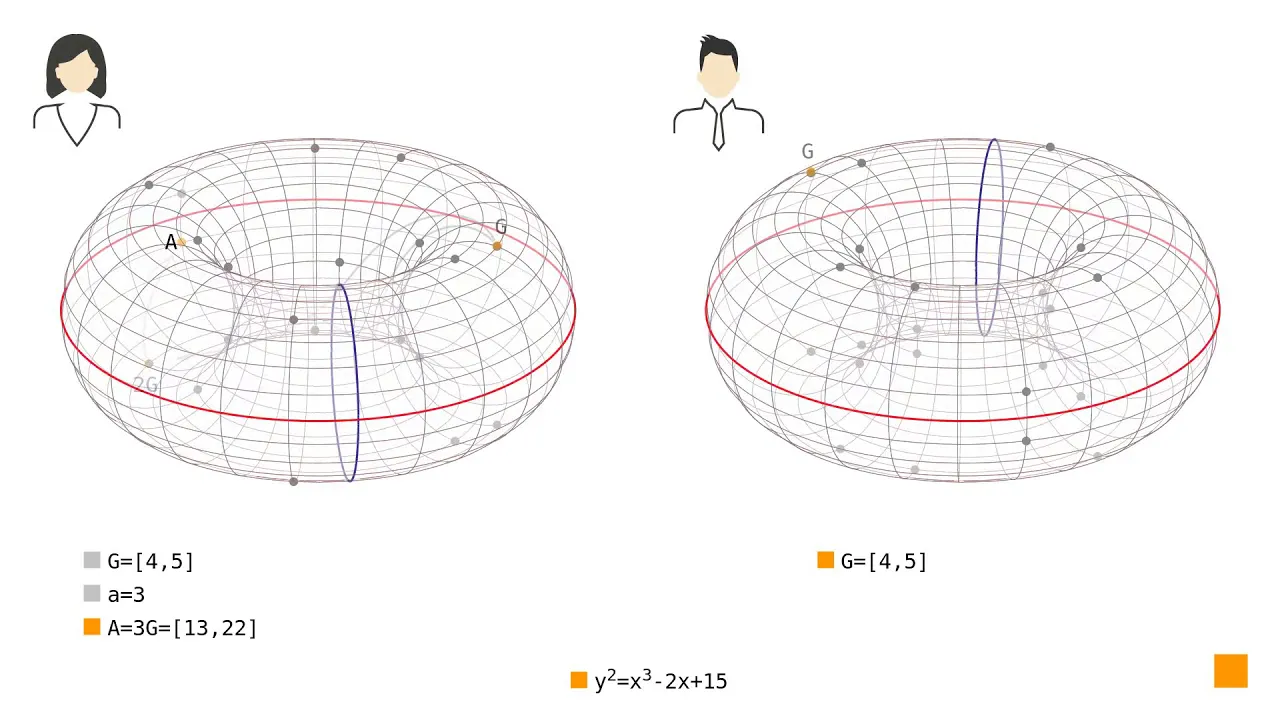






The Diffie-Hellman key exchange algorithm, invented by Whitfield Diffie and Martin Hellman in 1976, enables two parties to securely establish a shared secret key over an insecure channel without having previously shared any information. The algorithm leverages the mathematical properties of modular exponentiation and the discrete logarithm problem, which is computationally easy to perform in one direction (exponentiation) but extremely difficult to reverse (logarithm), allowing Alice and Bob to arrive at the same shared secret while preventing an eavesdropper from determining the secret even with access to all public communications.
Diffie-Hellman Key Exchange Explained (Public Key Cryptography)
Added:Basic Cryptographic Concepts: Understanding the difference between symmetric and asymmetric cryptography, and the concept of a 'shared secret'.
Modular Arithmetic: Familiarity with the modulo operator and basic calculations under a modulus, which forms the mathematical foundation of the algorithm.
Prime Numbers and Group Theory Basics: Understanding prime numbers, generator elements, and why they are mathematically useful for secure operations.
The Concept of One-Way Functions: Comprehending mathematical functions that are easy to compute in one direction but computationally infeasible to reverse (the Discrete Logarithm Problem).
Man-in-the-Middle (MitM) Attacks and Authentication: Exploring how unauthenticated Diffie-Hellman is vulnerable to interception and how digital certificates/signatures resolve this.
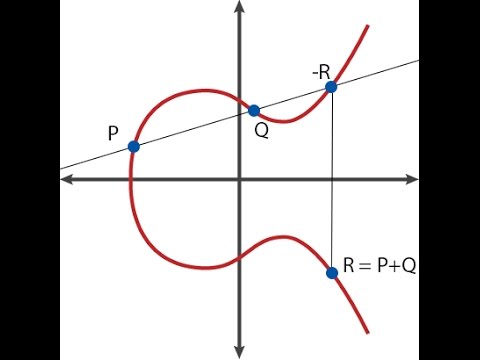
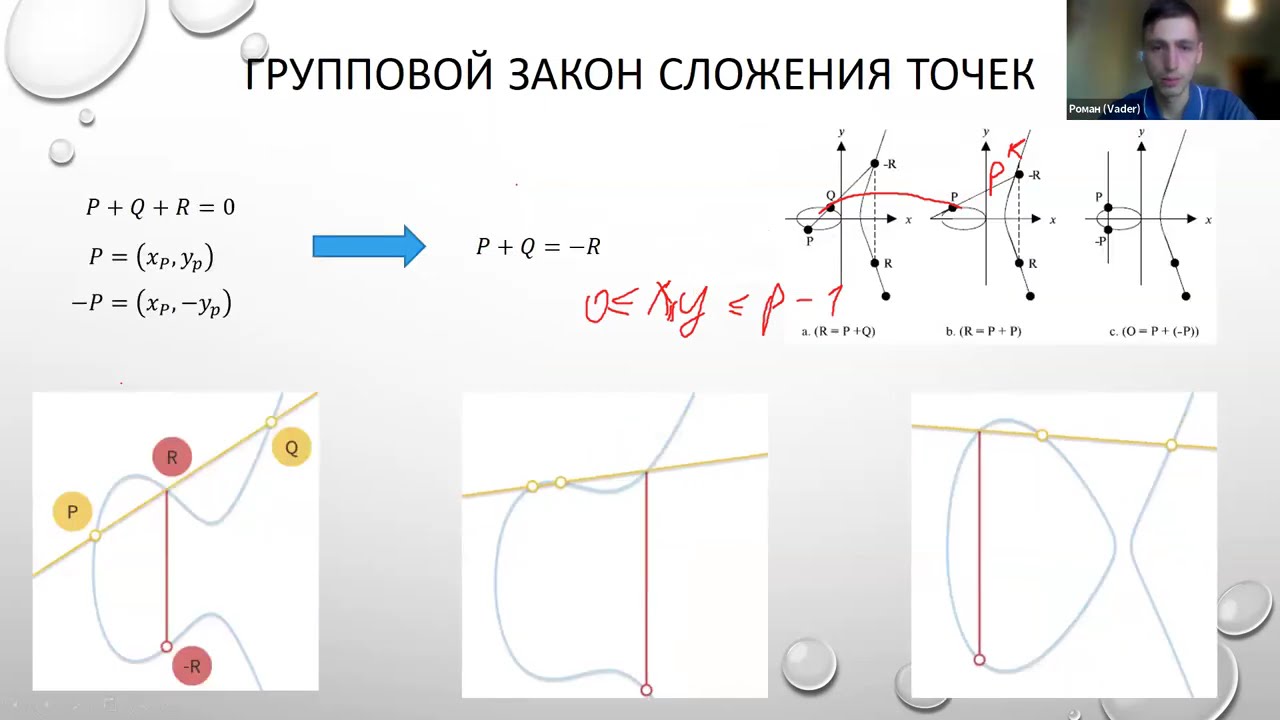
Elliptic Curve Diffie-Hellman (ECDH): Learning how elliptic curve cryptography (ECC) is applied to DH to provide stronger security with smaller key sizes.
The RSA Cryptosystem: Studying another foundational public-key algorithm used for encryption and digital signatures, comparing its mechanics to DH.
Implementation in Real-World Protocols: Investigating how DH/ECDH is utilized in secure network protocols such as TLS/HTTPS, SSH, and VPNs (IPsec).
924.4K views15.8Klikes8:38Original Release: 2012-07-31
♪ ♪ >> (narrator) After World War II, with most of Europe in ruins, tension grew between the Soviet Union and the United States.
It was clear that the next global superpower required the ability to both launch and successfully defend nuclear attacks from intercontinental ballistic missiles.
In North America, the most vulnerable point of attack was over the North Pole.
So in 1958, a joint effort between United States and Canada was established, known as NORAD, or "North American Aerospace Defense Command."
An important line of defense was the Semi-Automatic Ground Environment.
It was an automated system of over 100 long-distance radars scattered across North America.
They were connected to computerized radar stations that transmitted tracking data using telephone lines or radio waves.
All of this radar information was fed into a primary warning center buried a mile deep inside Cheyenne Mountain in Colorado.
This application of machine-to-machine communication, allowed operators to make split-second decisions using information transmitted and processed automatically by computers.
This idea of being "online" was quickly adapted and advanced by universities in the following years as they understood the potential of computer networking.
>> The thing that makes the computer communication network special is that it puts the workers, the team members who are geographically distributed, in touch not only with one another, but with the information base with which they work all the time.
And this is obviously gonna make a tremendous difference in how we plan, organize, and execute almost everything of any intellectual consequence.
If we get into a mode in which everything is handled electronically and your only identification is some little plastic thing you stick into the machinery, then I can imagine that they wanna get that settled up with your bank account right now and put it through all the checks.
And that would require networking.
>> (narrator) Money transfers were just one of a growing number of applications which required encryption to remain secure.
And as the internet grew to encompass millions around the world, a new problem emerged.
At the time, encryption required two parties to first share a secret random number known as a "key."
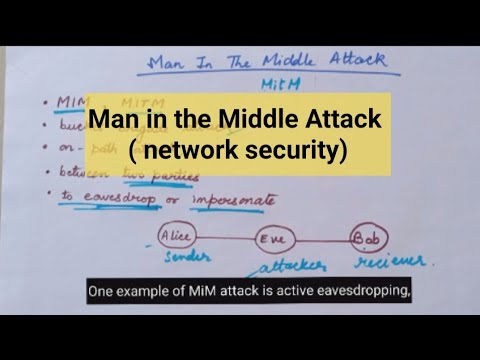
So how could two people who have never met agree on a secret shared key without letting Eve, who is always listening, also obtain a copy?
In 1976, Whitfield Diffie and Martin Hellman devised an amazing trick to do this.
First, let's explore how this trick is done using colors.
How could Alice and Bob agree on a secret color, without Eve finding it out?
The trick is based on two facts.
One, it's easy to mix two together to make a third color.
And two, given a mixed color, it's hard to reverse it in order to find the exact original colors.
This is the basis for a lock-- easy in one direction, hard in the reverse direction.
This is known as a "one-way function."
Now, the solution works as follows.
First, they agree publicly on a starting color, say yellow.
Next, Alice and Bob both randomly select private colors, and mix them into the public yellow in order to disguise their private colors.
Now, Alice keeps her private color, and sends her mixture to Bob.
And Bob keeps his private color, and sends his mixture to Alice.
Now, the heart of the trick.
Alice and Bob add their private colors to the other person's mixture, and arrived at a shared secret color.
Notice how Eve is unable to determine this exact color, since she needs one of their private colors to do so.
And that is the trick.
Now, to do this with numbers, we need a numerical procedure, which is easy in one direction, and hard in the other.
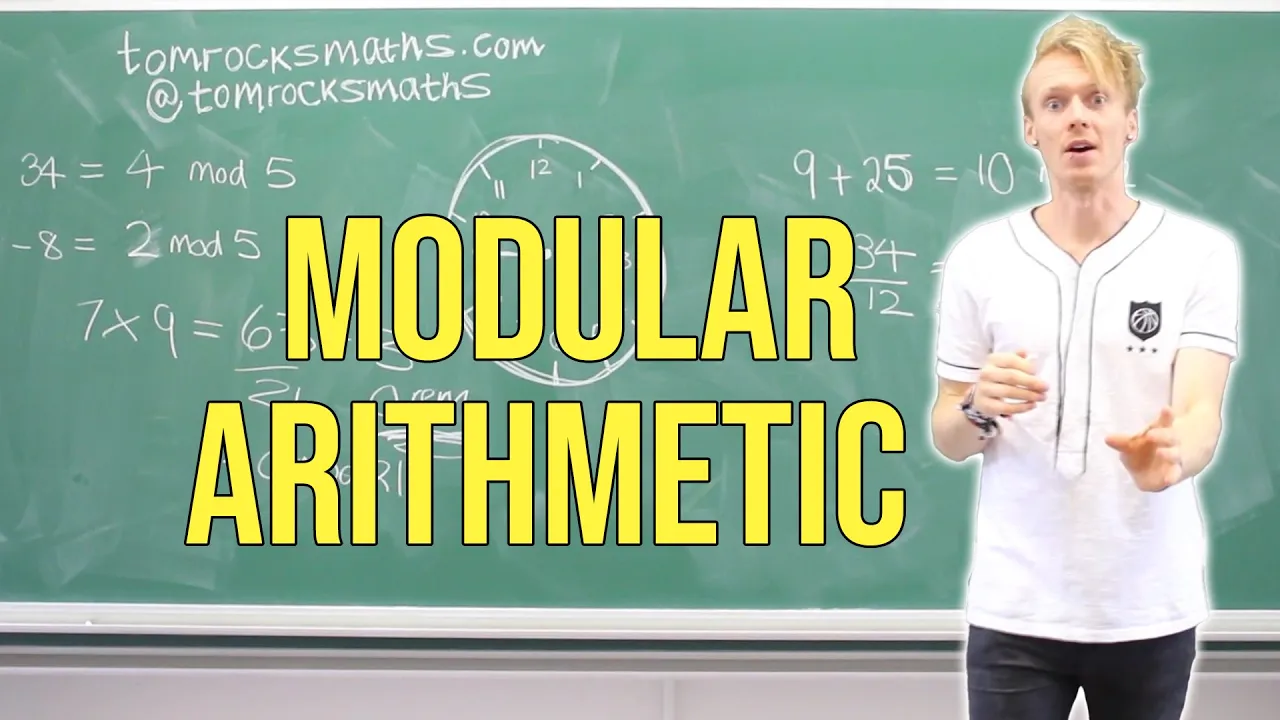
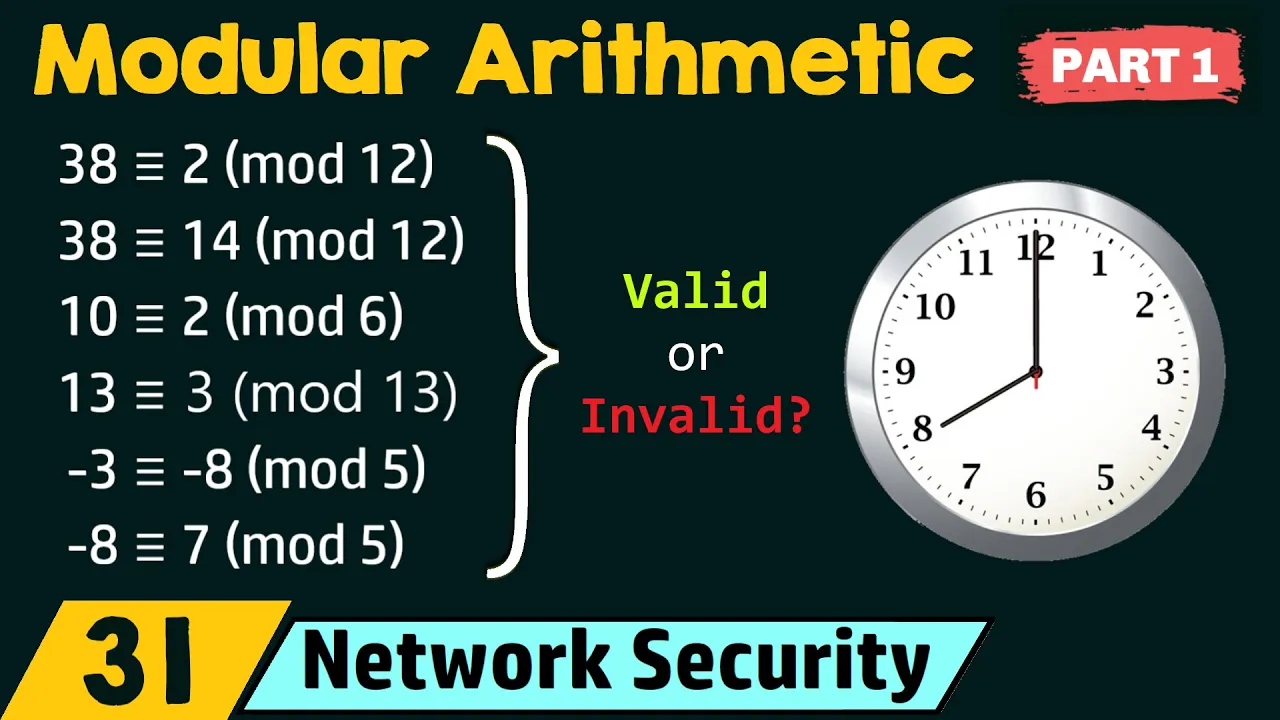
This brings us to modular arithmetic, also known as "clock arithmetic."
For example, to find 46 mod 12, we could take a rope of length 46 units and wrap it around a clock of 12 units, which is called the "modulus," and where the rope ends is the solution.
So we say 46 mod 12 is congruent to 10.
Easy!
Now, to make this work, we use a prime modulus, such as 17, then we find a primitive root of 17, in this case 3, which has this important property that when raised to different exponents, the solution distributes uniformly around the clock.
3 is known as the "generator."
If we raise 3 to any exponent X, then the solution is equally likely to be any integer between zero and 17.
Now, the reverse procedure is hard.
Say, given 12, find the exponent 3 needs to be raised to.
This is called the "discrete logarithm problem."
And now, we have our one-way function.
Easy to perform, but hard to reverse.
Given 12, we would have to resort to trial and error to find matching exponents.
How hard is this?
Well, with numbers, it's easy, but if we use a prime modulus which is hundreds of digits long, it becomes impractical to solve.
Even if you had access to all computational power on Earth, it could take thousands of years to run through all possibilities.
So, the strength of a one-way function is based on the time needed to reverse it.
Now, this is our solution.
First, Alice and Bob agree publicly on a prime modulus and a generator, in this case, 17 and 3.
Then, Alice selects a private random number, say 15, and calculates 3 to the power 15 mod 17, and sends this result publicly to Bob.
Then, Bob selects his private random number, say 13, and calculates 3 to the power 13 mod 17, and sends this result publicly to Alice.
And now, the heart of the trick.
Alice takes Bob's public result, and raises it to the power of her private number to obtain the shared secret, which, in this case, is 10.
Bob takes Alice's public result, and raises it to the power of his private number resulting in the same shared secret.
Notice, they did the same calculation, though it may not look like it at first.
Consider Alice, the 12 she received from Bob was calculated as 3 to the power 13 mod 17.
So her calculation was the same as 3 to the power 13 to the power of 15 mod 17.
Now, consider Bob.
The 6 he received from Alice was calculated as 3 to the power 15 mod 17.
So his calculation was the same as 3 to the power 15 to the power 13.
Notice they did the same calculation with the exponents in a different order.
When you flip the exponent, the result doesn't change.
So they both calculated 3 raised to the power of their private numbers.
Without one of these private numbers, 15 or 13, Eve will not be able to find the solution.
And this is how it's done.
While Eve is stuck grinding away at the discrete logarithm problem, and with large enough numbers, we can say it's practically impossible for her to break the encryption in a reasonable amount of time.
This solves the key exchange problem.
It can be used in conjunction with a pseudorandom generator to encrypt messages between people who have never met.
Up Next
7:05
Diffie-Hellman Key Exchange: The Mathematics Explained
@Computerphile
553K views•2017-12-20
4:43
Elliptic Curve Cryptography Explained: ECC, ECDSA, ECDH
@PracticalNetworking
28.5K views•2024-10-21

7:04
Shannon's Information Entropy Explained with Yes/No Questions
@ArtOfTheProblem
152.1K views•2013-11-27

6:00
The Mathematical Impossibility of Accurate World Maps
@Vox
23.3M views•2016-12-02
Related Study Plans & Knowledge Roadmaps
Structured learning paths in Mathematics
mathematics
Tensor Calculus: Vectors to Riemann Curvature
01Mathematical Foundations: Linear Algebra & Calculus
02Covectors, Dual Spaces, and Tensor Basics
03The Metric Tensor and Index Gymnastics
+ 2 more learning modules
40h5 modules
Explore Roadmap
mathematics
Gödel's Incompleteness: Logic, Proofs & Limits
01Introduction to Formal Systems & Hilbert's Dream
02Set Theory, Cardinality, and Cantor's Diagonal Argument
03Arithmetization and Gödel Numbering
+ 2 more learning modules
14h5 modules
Explore Roadmap
mathematics
Galois Theory: Fields, Groups & Solvability
01Foundations of Abstract Algebra: Groups & Fields
02Polynomials & Field Extensions
03Splitting Fields & Symmetries
+ 2 more learning modules
24h5 modules
Explore Roadmap
mathematics
Non-Euclidean Geometry: Models & Geodesics
01Euclid's Fifth Postulate and the Birth of New Geometries
02Hyperbolic Space and the Poincaré Disk Model
03Geodesics: Defining Straight Lines in Curved Spaces
+ 2 more learning modules
15h5 modules
Explore Roadmap