





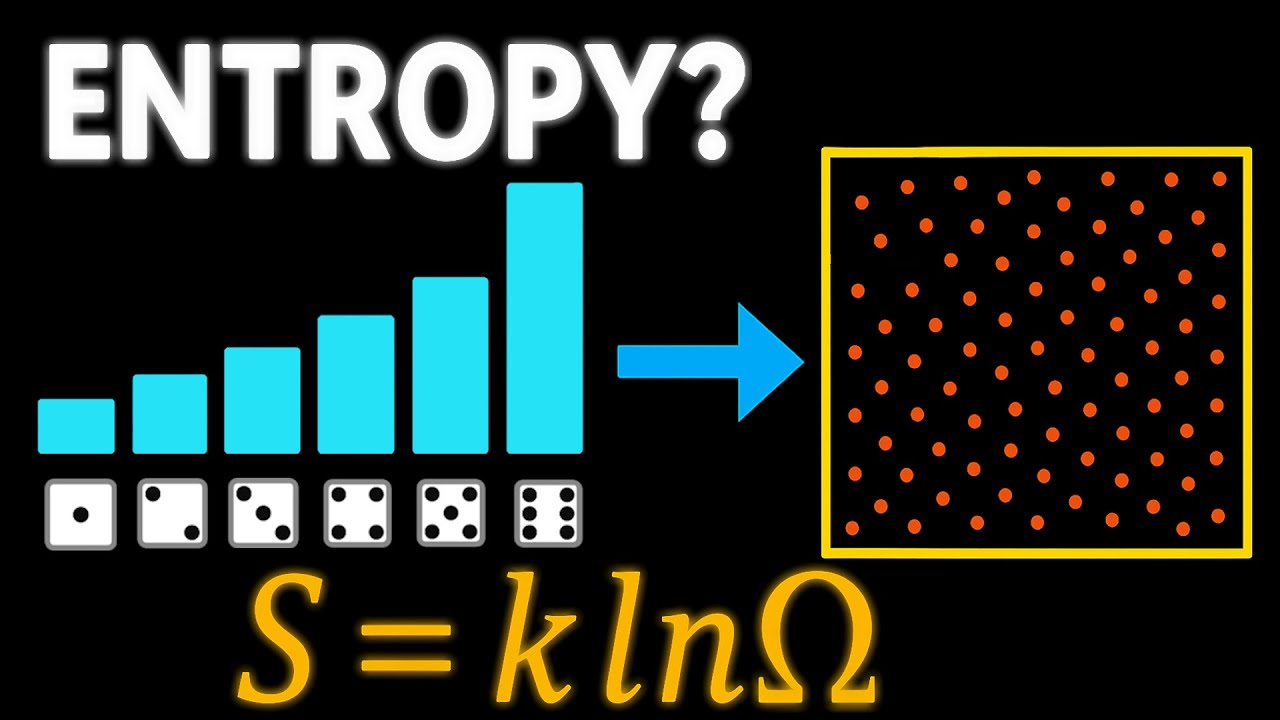





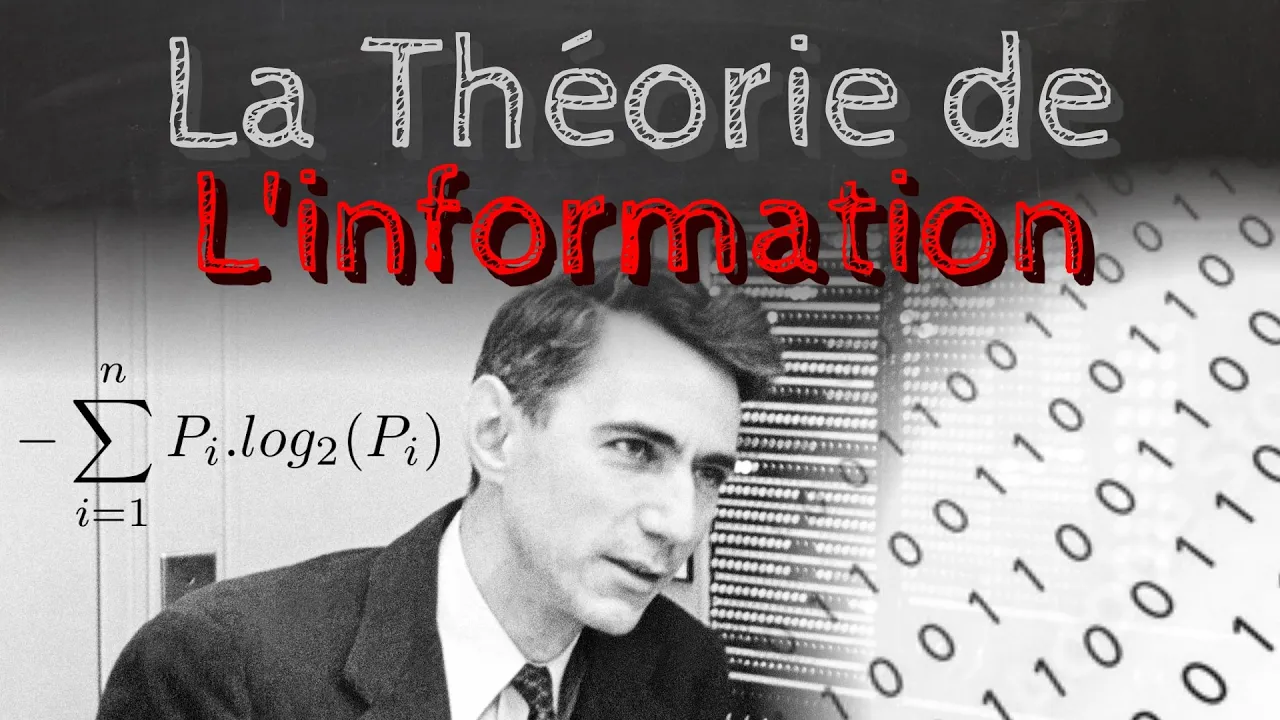
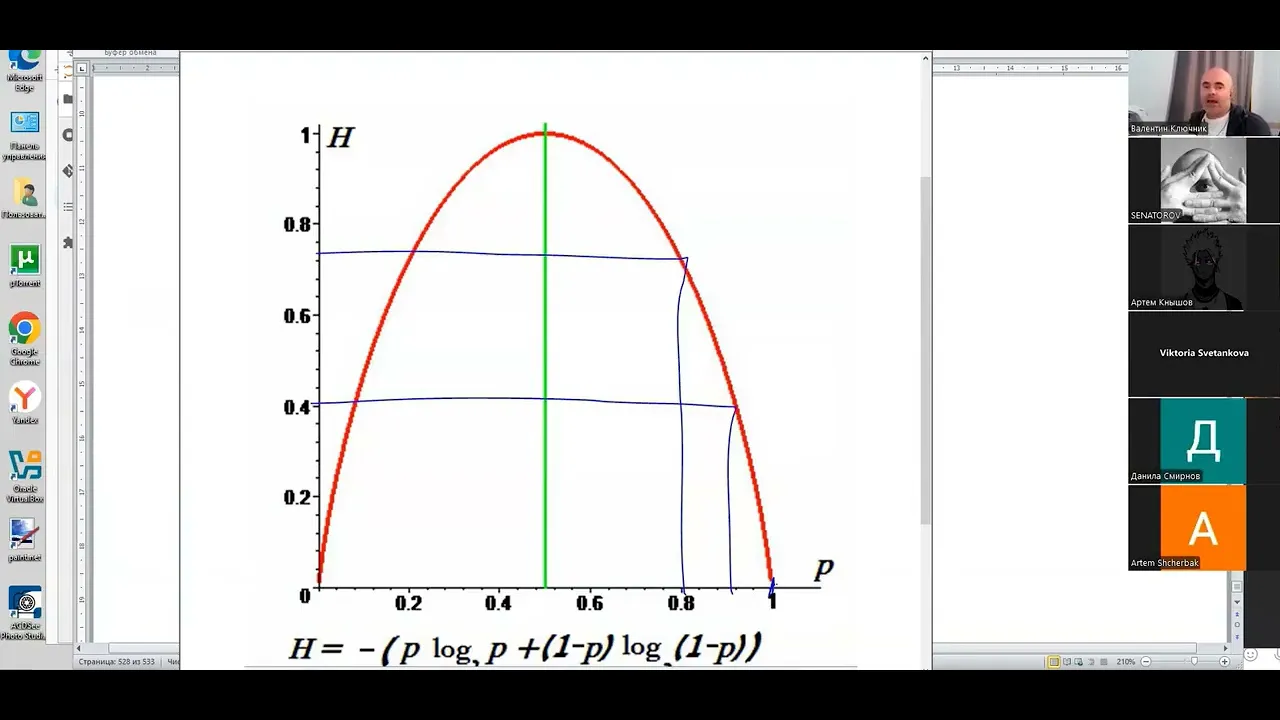






Shannon's information entropy measures the average uncertainty or surprise in a random variable, calculated as the weighted sum of probabilities multiplied by the logarithm of their reciprocals (H = Σ P(x) × log₂(1/P(x))). Higher entropy indicates greater uncertainty and more information content, while lower entropy indicates more predictable outcomes requiring fewer questions to determine. The unit of entropy is the 'bit,' representing the uncertainty of a fair coin flip.
Shannon's Information Entropy Explained with Yes/No Questions
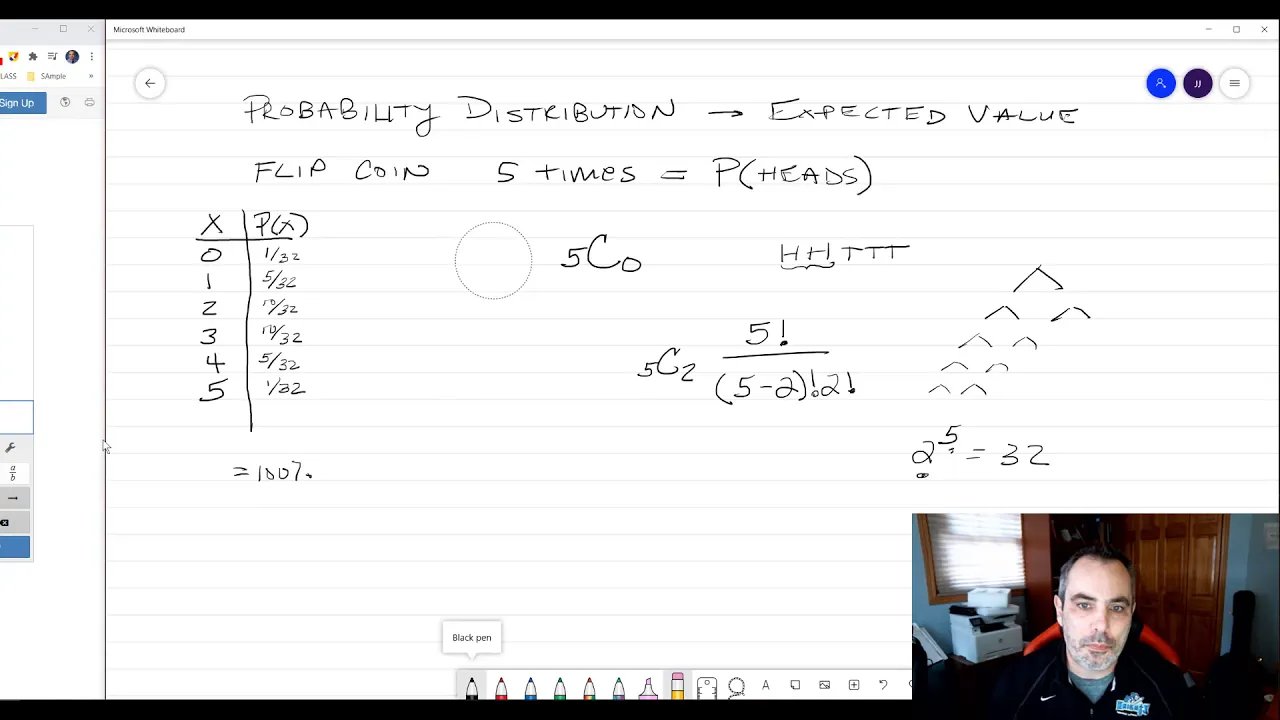
Added:Basic probability theory, including probability distributions and the concept of expected value.
Logarithmic functions, specifically base-2 logarithms (log2), which are fundamental to calculating bits of information.
The concept of binary search or decision trees, where choices are split into binary (yes/no) outcomes.
An intuitive grasp of uncertainty and 'surprise' (i.e., that less probable events convey more information when they occur).
Huffman Coding and Shannon-Fano Coding, which apply entropy limits to practical data compression.
Cross-Entropy and Kullback-Leibler (KL) Divergence, critical tools in training machine learning models.
Mutual Information, which quantifies the amount of information shared between two random variables.
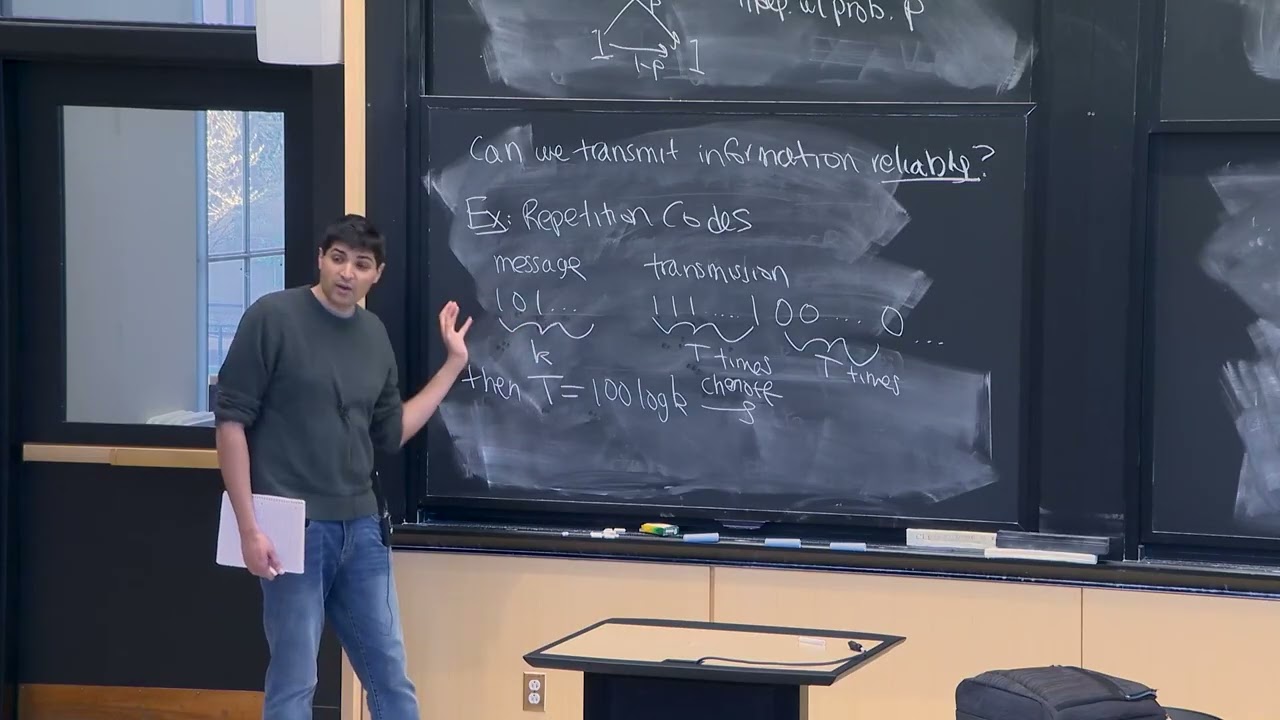
Shannon's Noisy-Channel Coding Theorem, exploring how to transmit information reliably over a noisy medium.
The relationship between statistical mechanics (thermodynamic entropy) and informational entropy.
152.1K views2.5Klikes7:04Original Release: 2013-11-27
Imagine 2 machines.
They both output messages from an alphabet of A, B, C, or D.
Machine 1 generates each symbol randomly.
They all occur 25% of the time.
Machine 2 generates symbols according to the following probabilities.
Now, which machine is producing more information?
Claude Shannon cleverly rephrased the question.
If you had to predict the next symbol from each machine, what is the minimum number of yes or no questions you would expect to ask?
Let's look at Machine 1.
The most efficient way is to pose a question which divides the possibilities in half.
For example, our first question, we could ask if it is any 2 symbols-- such as, is it A or B?
Since there is a 50% chance of A or B and a 50% chance of C or D. After getting the answer, we can eliminate half of the possibilities.
And we will be left with 2 symbols, both equally likely.
So we simply pick one-- such as, is it A?
And after this second question, we will have correctly identified the symbol.
So we can say the uncertainty of Machine 1 is 2 questions per symbol.
Now, what about Machine 2?
As with Machine 1, we could ask two questions to determine the next symbol.
However, this time the probability of each symbol is different.
So we can ask our questions differently.
Here A has a 50% chance of occurring, and all other letters add to 50%.
So we could start by asking-- Is it A?
If it is A, we are done.
Only one question in this case.
Otherwise, we are left with 2 equal outcomes-- D or B and C.
So we could ask-- is it D?
If yes, we are done with 2 questions.
Otherwise, we have to ask a third question to identify which of the last 2 symbols it is.
On average, how many questions do you expect to ask to determine a symbol from Machine 2?
And this can be explained nicely with an analogy.
Let's assume instead we want to build Machine 1 and Machine 2.
And we can generate symbols by bouncing a disk off a peg into 1 of 2 equally likely directions.
Based on which way it falls, we can generate a symbol.
So with Machine 1, we need to add a second level or a second bounce so that we have 2 bounces, which lead to 4 equally likely outcomes.
And based on where the disk lands, we output A, B, C, or D.
Now, Machine 2.
In this case, the first bounce leads to either an A-- which occurs 50% of the time-- or else we lead to a second bounce, which then can either output at D-- which occurs 25% of the time-- or else it leads to a third bounce, which then leads to either B or C-- 12.5% of the time.
So now we just take a weighted average as follows-- the expected number of bounces is the probability of symbol A times 1 bounce plus the probability of B times 3 bounces plus the probability of C times 3 bounces plus the probability of D times 2 bounces.
And this works out to 1.75 bounces.
Now, notice the connection between yes or no questions and fair bounces.
The expected number of questions is equal to the expected number of bounces.
So Machine 1 requires 2 bounces to generate a symbol while guessing an unknown symbol requires 2 questions.
Machine 2 requires 1.75 bounces.
We need to ask 1.75 questions on average.
Meaning, if we need to guess 100 symbols from both machines, we can expect to ask 200 questions for Machine 1 and 175 questions for Machine 2.
So this means that Machine 2 is producing less information because there is less uncertainty or surprise about its output.
And that's it.
Claude Shannon calls this measure of average uncertainty "entropy," and he uses a letter H to represent it.
And the unit of entropy Shannon chooses is based on the uncertainty of a fair coin flip, and he calls this "the bit," which is equivalent to a fair bounce.
And we can arrive at the same result using our bounce analogy.
Entropy, or H, is the summation for each symbol of the probability of that symbol times the number of bounces.
Now, the difference is-- how do we express number of bounces in a more general way?
And as we've seen, number of bounces depends how far down the tree we are.
And we can simplify this by saying that the number of bounces equals the logarithm base 2 of the number of outcomes at that level.
And the number of outcomes at a level is also based on the probability, where the number of outcomes at a level equals 1 divided by the probability of that outcome.
Number of bounces actually equals the logarithm base 2 of 1 over the probability of that symbol, which gives us our final equation.
Entropy, or H, is the summation for each symbol of the probability of that symbol times the logarithm base 2 of 1 over the probability of that symbol.
And Shannon writes this slightly different, which just inverts the expression inside the logarithm, which causes us to add a negative, though both formulas give the same results.
So let's summarize.
Entropy is maximum when all outcomes are equally likely.
Any time you move away from equally likely outcomes or introduce predictability, the entropy must go down.
Now, the fundamental idea is that if the entropy of an information source drops, that means we can ask fewer questions to guess the outcome.
And thanks to Shannon, the bit-- which is the unit of entropy-- is adopted as our quantitative measure of information or measure of surprise.
Up Next
9:07
Expected Value Explained: A Practical Guide to Probabilistic Decision-Making
@GalakBreaksItDown
54.2K views•2020-11-05
4:43
Elliptic Curve Cryptography Explained: ECC, ECDSA, ECDH
@PracticalNetworking
28.5K views•2024-10-21

8:38
Diffie-Hellman Key Exchange Explained (Public Key Cryptography)
@ArtOfTheProblem
924.4K views•2012-07-31

6:00
The Mathematical Impossibility of Accurate World Maps
@Vox
23.3M views•2016-12-02
Related Study Plans & Knowledge Roadmaps
Structured learning paths in Mathematics
mathematics
Tensor Calculus: Vectors to Riemann Curvature
01Mathematical Foundations: Linear Algebra & Calculus
02Covectors, Dual Spaces, and Tensor Basics
03The Metric Tensor and Index Gymnastics
+ 2 more learning modules
40h5 modules
Explore Roadmap
mathematics
Gödel's Incompleteness: Logic, Proofs & Limits
01Introduction to Formal Systems & Hilbert's Dream
02Set Theory, Cardinality, and Cantor's Diagonal Argument
03Arithmetization and Gödel Numbering
+ 2 more learning modules
14h5 modules
Explore Roadmap
mathematics
Galois Theory: Fields, Groups & Solvability
01Foundations of Abstract Algebra: Groups & Fields
02Polynomials & Field Extensions
03Splitting Fields & Symmetries
+ 2 more learning modules
24h5 modules
Explore Roadmap
mathematics
Non-Euclidean Geometry: Models & Geodesics
01Euclid's Fifth Postulate and the Birth of New Geometries
02Hyperbolic Space and the Poincaré Disk Model
03Geodesics: Defining Straight Lines in Curved Spaces
+ 2 more learning modules
15h5 modules
Explore Roadmap