







![喫茶[結] 斎藤環先生登場! コミュニケーション-精神科医ではないあなたの子どもとの向き合い方](https://i.ytimg.com/vi/mLN06pp5V-0/maxresdefault.jpg)










Claude Shannon's 1948 proof established that for any noisy communication channel, there exists a fundamental limit called channel capacity C, below which it is possible to communicate with arbitrarily small error probability using appropriate coding strategies; this means that even over noisy channels, information can be transmitted reliably at rates approaching C, provided sufficiently long messages are used, which underlies all modern digital communication systems.
Information Theory's Most Surprising Result Explained
Added:Basic Probability Theory: Mastery of random variables, conditional probability, and expected values.
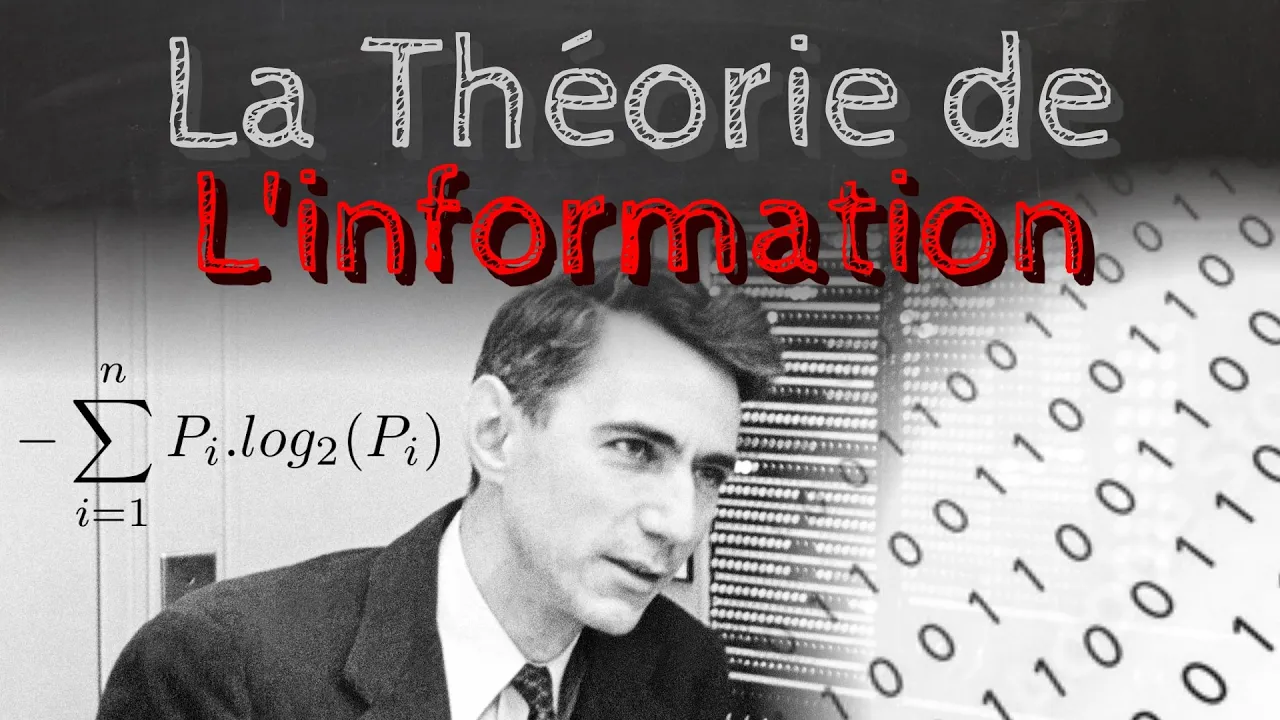
Concept of Shannon Entropy: Understanding entropy as a mathematical measure of uncertainty and the average information content of a source.
Mutual Information: Comprehending the measure of the amount of information that can be obtained about one random variable through another.
The Communication System Model: Familiarity with the basic framework of transmitter, noisy channel, and receiver (such as the Binary Symmetric Channel).
Practical Error-Correcting Codes: Exploring modern coding schemes that approach the Shannon limit, including Turbo codes, LDPC (Low-Density Parity-Check) codes, and Polar codes.
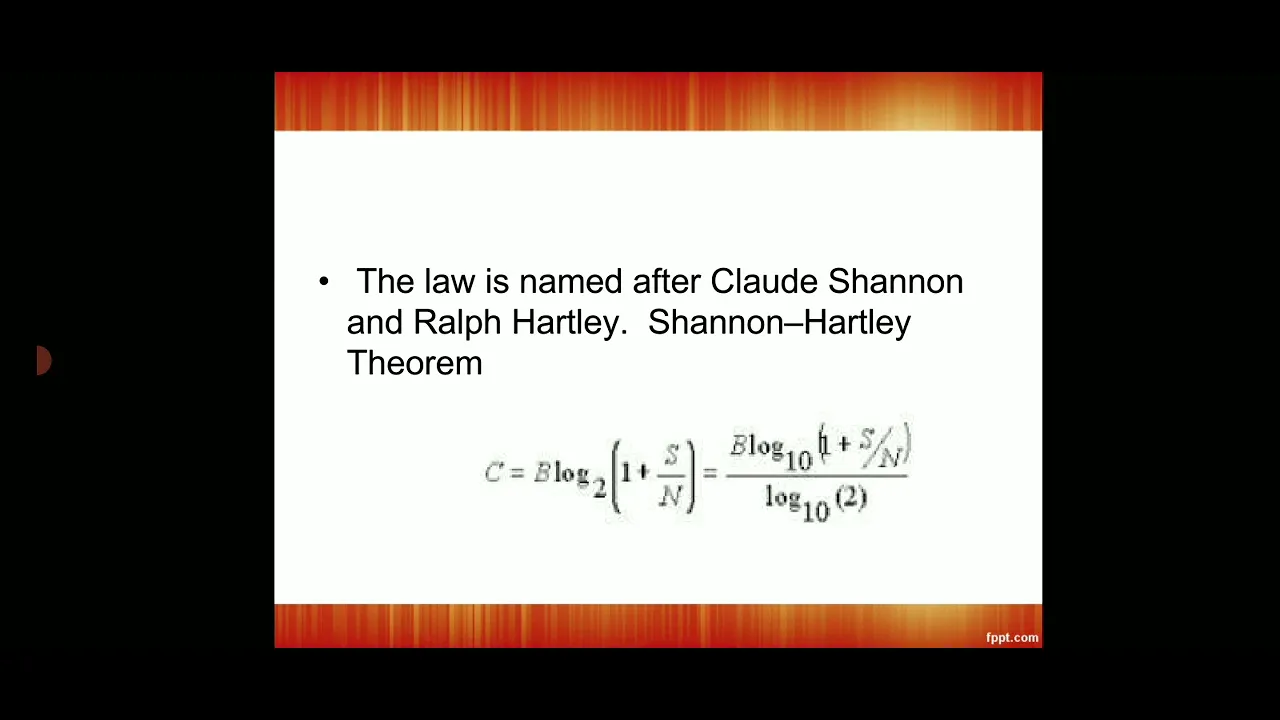
The Shannon-Hartley Theorem: Investigating capacity limits in continuous channels with additive white Gaussian noise (AWGN) based on bandwidth and power.
Source Coding Theorem: Studying the fundamental limits of data compression and how it mathematically pairs with channel coding.
Network Information Theory: Extending the concept of point-to-point channel capacity to multi-user systems, broadcast channels, and interference channels.
105.2K views5.1Klikes9:09Original Release: 2023-10-16
let's say you need to send a binary message but it must be sent over a noisy Channel by noisy we mean the channel will randomly flip each bit with probability F so if f is 0.1 the message received will have about 10% of its bits different from the original message sent that's the problem now to handle this you and the receiver can agree upon some procedure before you start sending messages that is you will encode the message in a special way so that it can handle noise once received the receiver will decode the noisy message to determine what you intended so how might you do this well one simple way is to just repeat each bit say three times and have the receiver interpret each block of three with the most common bit in our example this means we'd encode our original message as a redundant string repeating each bit three times the encoded message is then passed through the noisy Channel which flips some bits now the receiver knows we're repeating bits bits three times but doesn't know which bits are flipped so they interpret each chunk of three as the most common bit since that's the most likely intended bit so the first three bits are all ones so that's interpreted as a one the second chunk has two zeros so that's read as a zero and this continues now if we compare the original and decoded messages we see we've made no errors in general over a lot of messages this strategy creates few fewer than the 10% errors we'd expect if we just sent the original messages straight through but errors can still happen on another pass through the channel we might have gotone unlucky with two or more bits flipped in one chunk and that would create an error in the decoded message so the error probability is reduced but not eliminated now the question is is this the best we could have done when it comes to the error probability no if we repeated bits 10 times instead of three times that would have a much smaller error probability but that's not all we care about doing that also slows our message down by 10 times so we also care about speed so let's imagine two Dimensions along the horizontal axis is the rate measuring the speed of the message and along the vertical is the probability of a bit error I'll Define these terms exactly in a second but first let's label the coding strategies we say Rd is the coding strategy where we repeat each bit D times and the receiver reads the most common bit in each size d chunk earlier we saw R3 and talked about the slower but safer r10 also R1 is the no coding strategy that's where you just send the message straight through now we can place these R1 goes here it has a rate of one and a bit error probability of 0 one which is the Channel's flip probability for this to make sense we need to define the axes the probability of bit error is the average probability a decoded bit does not match the intended message bit this is what we were bringing down earlier next the rate is the ratio of the original message length to the encoded message length which is a relative measure of speed for R1 no encoding that ratio is one for R3 it's 1/3 because we're encoding the message as something three times longer so it's slower but it enjoys a better bit error probability in fact this is what all the repeating strategies look like in general coding strategies are better in this direction okay now here's the literal trillion doll question out of all coding strategies what region in this space is achievable that sounds hard we need to consider all possible coding strategies damn well here's a reasonable idea whatever the separation is between achievable and unachievable it goes through the origin so maybe it looks like this or this or this whatever it is the separation goes through the origin meaning if you want an extremely small error probability you'll need to suffer extremely slow rates seems totally obvious and yet is totally wrong in 1948 Claud Chan surprised Everyone by proving it looks like this where this length is known as the channel capacity C and it's what makes this result remarkable what this says is you can communicate at an arbitrarily small bit error probability at a rate up to the Channel's fundamental limit C consider our example with flip probability 0.1 that means the capacity is about 0.53 which comes from an enty calculation which I won't get into okay now suppose we make the ridiculous demand of a bit error probability of 10 Theus 25 an extremely small number how slow will we have to send our messages Shannon says Hey as long as it's not zero there are coding strategies out there that will get you up to a rate of 053 so you only need to double the message length and then you say wow that's great what's the coding strategy and Sharon says I don't know but they're out there you figure it out this is what was shown in Shannon's 1948 paper a mathematical theory of communication the significance of this paper is hard to overstate not only because he proved what we just saw but because Shannon realized this simple case generalizes to all forms of communication and so his paper unleashed the promise of error correcting codes that digital information could travel across broken messy physical systems with essentially no corruption at tolerably fast rates this video you see the sound of my voice anything you download virtually all digital information you interact with none of it originated where you're sitting all of it passed through a flawed Channel but yet all of it manifests perfectly as intended that's what he showed was possible okay we're all very impressed now but a skeptic knows to ask what's the trick whenever a mathematical statement looks magical it never actually is so what's going on well before I get into that I have something else to offer if you like my educational content you can find more of it at my website true Theta there I have articles on a range of topics in machine learning and statistics if you like this channel you'll probably like this site as well writing is easier than video production so this is going to help me communicate more information faster Shannon would understand also truth data is my applied math Consulting business so if you're at a company that could use some help developing algorithms whether that's for General machine learning or forecasting causal inference Dynamic pricing or something related you can reach me from this site okay back to it to extinguish the magic regarding this region we have to know that a coding strategy is going to take the original message break it up into chunks of some size k encode them as redundant chunks of some larger size n and then pass them through the channel and this will have a rate of K Over N as we know K Over N can be made close to the channel capacity the trick is this can be done by potentially making n very large in other words this only applies when we pass very long messages that get encoded as something even larger so if you only want to send say 20 bits Shannon can't give you an arbitrarily small error probability still this is okay because in the real world we do send very long messages okay now to caveat we're only scratching the surface here if you want to understand things deeply I suggest the late David McKay's textbook information Theory inference and learning algorithms this video is based on his explanation from chapter 1 and a bit from chapters 9 and 10 and if you don't want to crack open a textbook his lectures are actually here on YouTube in those lectures you'll see him build up all the pieces to to proving the result we saw which is called the noisy Channel coding theorem when you watch him it doesn't take very long to realize he was a brilliant mind and teacher I'll link to his materials in the description and now the only thing left to do is to say thank you first thank you to my patrons it's awesome to get this support and it gives me great confidence to keep this going also thank you for watching and until next time points over here were achievable but conventional wisdom probably was assuming that the boundary went somewhere here and Shannon proved an absolutely remarkable result and this is going to be this the heart of this sequence of lectures to prove this result Shannon proved that you can get the error probability arbitrarily small without the rate having to go to zero so Shannon proved that the boundary between achievable and non- achievable points is a line that looks like this
Up Next
21:20
Hodgkin-Huxley Model of Voltage-Gated Channels: Gating Variables n, m, h
@sciencewithtal
30.1K views•2022-12-13
4:43
Elliptic Curve Cryptography Explained: ECC, ECDSA, ECDH
@PracticalNetworking
28.5K views•2024-10-21
10:44
Fourier Series Introduction: The Big Idea Explained
@DrTrefor
387K views•2021-05-03

6:00
The Mathematical Impossibility of Accurate World Maps
@Vox
23.3M views•2016-12-02
Related Study Plans & Knowledge Roadmaps
Structured learning paths in Mathematics
mathematics
Tensor Calculus: Vectors to Riemann Curvature
01Mathematical Foundations: Linear Algebra & Calculus
02Covectors, Dual Spaces, and Tensor Basics
03The Metric Tensor and Index Gymnastics
+ 2 more learning modules
40h5 modules
Explore Roadmap
mathematics
Gödel's Incompleteness: Logic, Proofs & Limits
01Introduction to Formal Systems & Hilbert's Dream
02Set Theory, Cardinality, and Cantor's Diagonal Argument
03Arithmetization and Gödel Numbering
+ 2 more learning modules
14h5 modules
Explore Roadmap
mathematics
Galois Theory: Fields, Groups & Solvability
01Foundations of Abstract Algebra: Groups & Fields
02Polynomials & Field Extensions
03Splitting Fields & Symmetries
+ 2 more learning modules
24h5 modules
Explore Roadmap
mathematics
Non-Euclidean Geometry: Models & Geodesics
01Euclid's Fifth Postulate and the Birth of New Geometries
02Hyperbolic Space and the Poincaré Disk Model
03Geodesics: Defining Straight Lines in Curved Spaces
+ 2 more learning modules
15h5 modules
Explore Roadmap