

















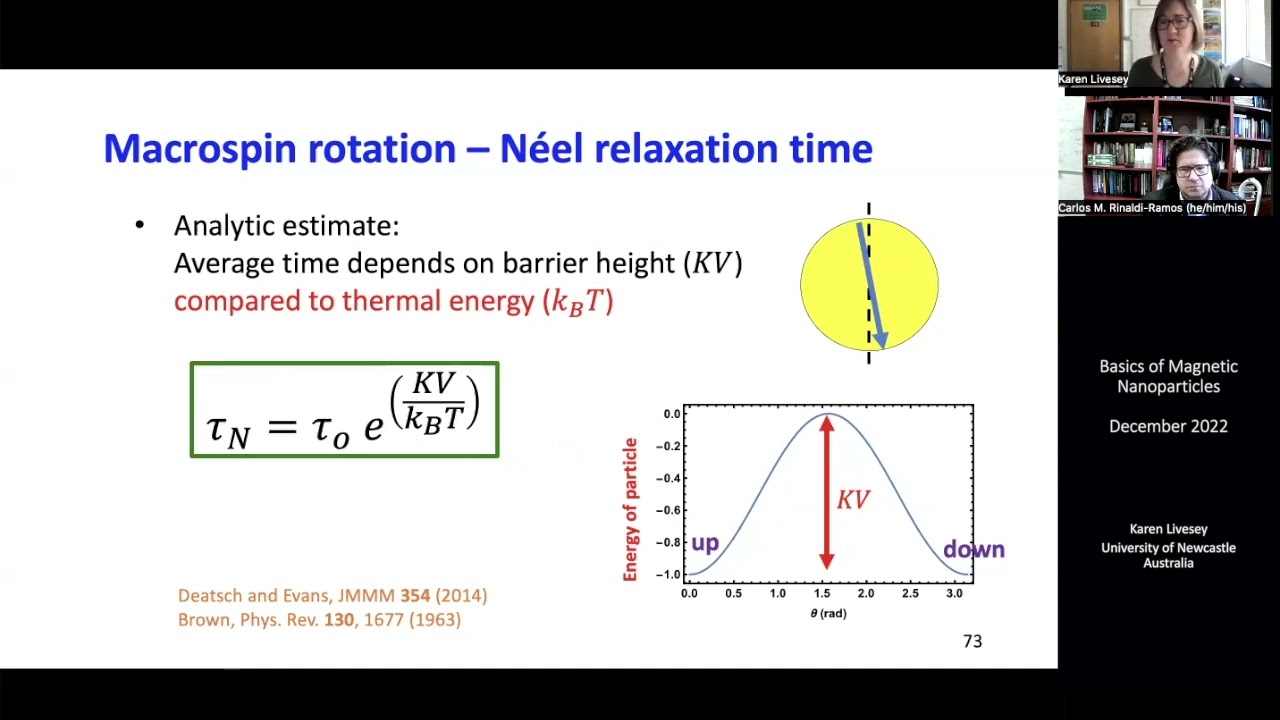





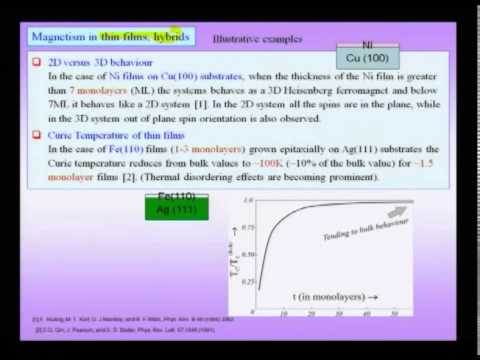


Superparamagnetism is a magnetic phenomenon exhibited by ferromagnetic or ferrimagnetic nanoparticles with diameters less than 100 nanometers, where the magnetic moments of single-domain nanoparticles fluctuate randomly due to thermal energy overcoming the energy barrier; below the blocking temperature (TB), nanoparticles enter a blocked state where their magnetic moments remain fixed in a particular direction, while above TB they exhibit superparamagnetic behavior with zero coercivity, making them unsuitable for data storage applications unless their blocking temperature exceeds room temperature.
Superparamagnetism in Nanoparticles | Basics Explained
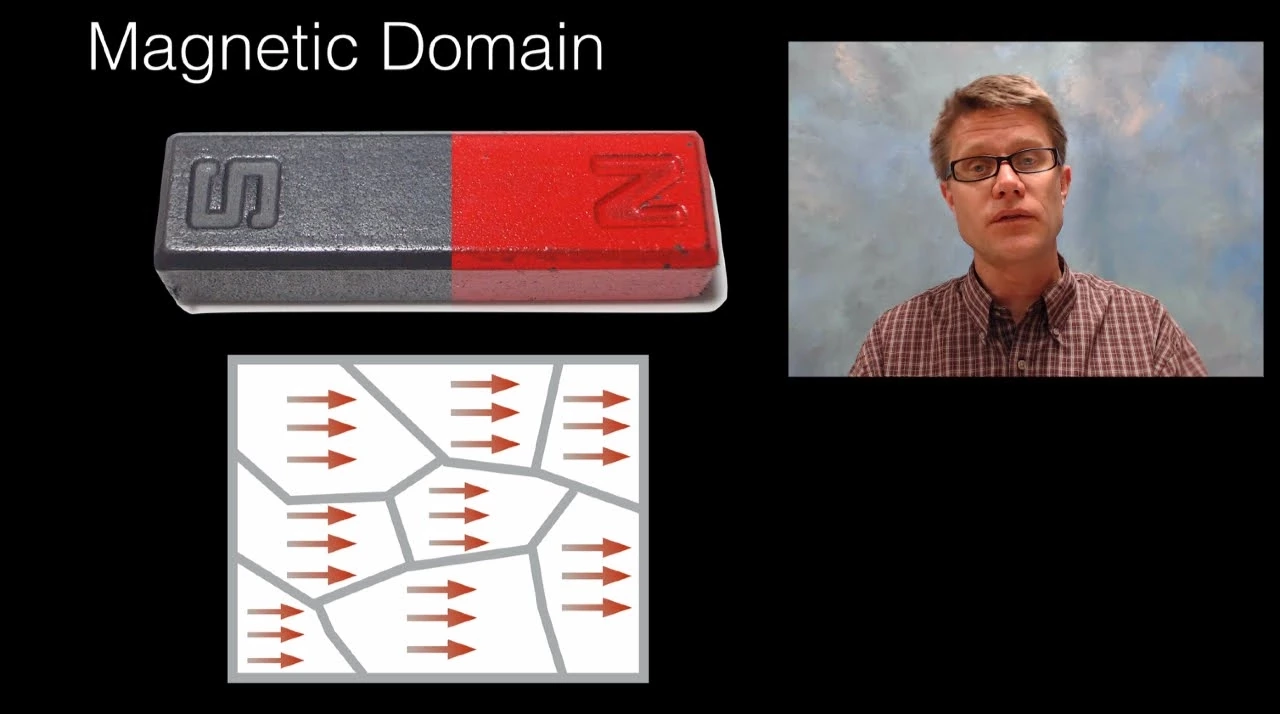
Added:Ferromagnetism and Magnetic Domains: Understanding how atomic spins align in bulk magnetic materials to form magnetic domains.
Magnetic Hysteresis: Familiarity with terms like saturation magnetization, remanence, and coercivity in a magnetic material's response to an external field.
Thermal Energy and Boltzmann Distribution: How thermal fluctuations (proportional to k_B*T) influence state transitions in microscopic physical systems.
Nanoscale Material Properties: Understanding how scaling down materials to the nanometer range dramatically alters their physical and magnetic behavior (such as transitioning from multi-domain to single-domain structures).
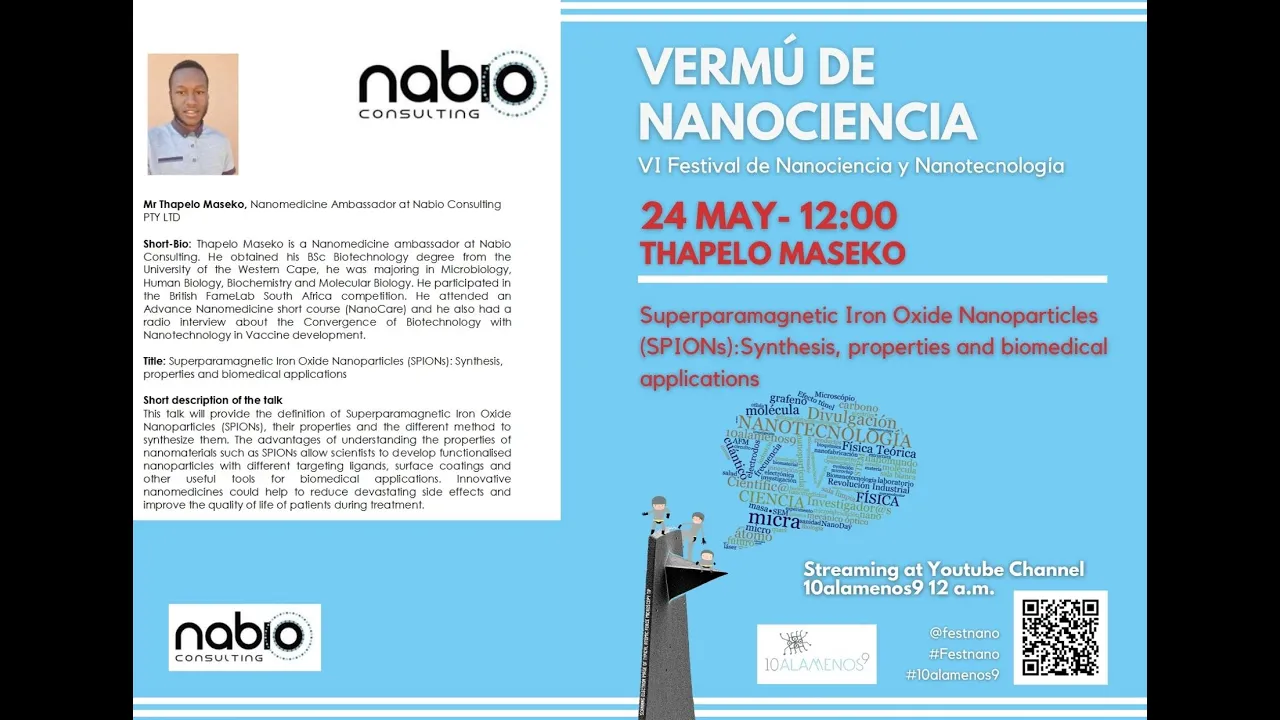
Biomedical Applications (SPIONs): Exploring how Superparamagnetic Iron Oxide Nanoparticles are used for targeted drug delivery, MRI contrast agents, and magnetic hyperthermia in cancer treatment.
The Superparamagnetic Limit in Data Storage: Investigating how superparamagnetism restricts the storage density of traditional hard drives, and how technologies like Heat-Assisted Magnetic Recording (HAMR) overcome this.
Néel and Brownian Relaxation Dynamics: Studying the physical relaxation mechanisms governing magnetization reversal in fluid-dispersed nanoparticles.
Exchange Bias and Core-Shell Engineered Nanoparticles: Learning how combining ferromagnetic and antiferromagnetic materials at the nanoscale can stabilize magnetization against thermal fluctuations.
1.3K views17likes11:39Original Release: 2023-07-06
so assalamualaikum students welcome to lecture number five of advanced nanomagnetism in this lecture we will talk about the super paramagnetic effect we want to I'll learn about super paramagnetism in the narrow materials at Atomic level magnetism can be described through the overlap of electron wave function as we already understand last lectures when talking they're taking their spin introduction into account on the nanoscale it becomes more difficult to predict the behavior of the magnetic nanoparticles due to the surface effects and the finite size effects when reducing the size of the magnetic material the number of domains within the material will be reduced and we only have a single domain for the nanoparticles less than 100 nanometer in diameter by having only single domains it is possible to produce strong magnetic magnets permanent magnets however if the size is reduced Beyond a certain limit foreign [Music] to fluctuate the magnetic movement of the huge flow so ferromagnetic or very magnetic here is a very magnetic magnetic nanoparticle is represented which is will behave similar to ferromagnetic nanoparticles so nanoparticle consists of very magnetic of ferromagnetic aligned coal which gives similarly to its counter back material and this order surface spins and in the basics of nanomagnets in lecture we already see how the surface pins are different from the coarse pin the code is similar to the bulk material the so therefore the disorder surface spins have the different orientation of spins as compared to the bulk material and at the nanoscale due to the increase in surface to volume ratio the surface becomes very important in determining the magnetic properties of the nanoparticles therefore we must understand its dependence so with reduction in the size of the ferromagnetic nanoparticle the single domain nanobiology cannot be fixed after certain temperature known as The Blocking temperature which is below the TC which means that there is uh and also a dependence of the applied temperature in which we are working so if we uh so we every every particle every material has uh you know an nanoparticles has a certain temperature below which they behave like a super paramagnetic uh above which sorry above which maybe of like superpower magnetic and if you decrease the temperature below this temperature in the huge coarse spin can be blocked some certain direction so in both these blocked and paramagnetic states are below the TC we we are still in the ferromagnetic state of the nanoparticle and Below TB nanoparticles core magnetic movements is fixed in some anastopia direction and above DB it is free to move and we are in the Super paramagnetic States so this is the also a big hurdle in for the application of data storage because usually the blocking term this blocking temperature is well below the room temperature so for the data storage you must need a meet nanoparticle which have double DB above room temperature so that we can use them in data storage and we can block their block their spin in some certain direction so which depends on on the volume of the particle the TB depends upon the volume of the particle and the energy of the particle therefore we need to understand this blocking temperature So Below TB we have a block State and above TB we have a super paramagnetic state if the temperature is further increase above the tbv we will have a TC after which the system will go on the nanoparticles will fall in the uh paramagnetic region and the even and then the ferromagnetic alignment within the core destroys and nanoparticles go in the paramagnetic region so here's the figure you can see that with decreasing the particle inside the coarsivity is increasing if you are moving from right to left to multi-domain into single domain and then at a certain limit after reducing a certain ingredient size limit we add up in the circle paramagnetic region so therefore the size of another article is very important in determining this magnetic properties so here you can see we are in the ferromagnetic region and then the single domain region and then we have a superpower magnetic hm so super paramagnetism is a form of magnetism exhibited by small ferromagnetic or primary and non-particles sizes of less than 100 nanometers usually the nanopartic is a single domain and all this phenomena or the studies macro spin approximation called so when the nanoparticles are small enough the energy burial also reduces and the particle can easily change this direction and Cancer pass this energy barrier with thermal enough thermal energy the Magnesium can flip uh Direction randomly over short period of time and the time between two flips in a direction is called the needle or accession time the super biomagnetic state it refers to how the average magnetization of the nanopartic level is to zero when no field is applied so here is a two well model as I told you if the the barrier is high for large particle and the battery is small for small particles so this energy barriers changes with the size of the to be the size of the nanoparticles so with in in the super paramagnetic region the particle course when is not fixed in some certain direction and we can and if you want to and if you want to uh use them for data storage we must reduce the temperature below its TV and and then we can use them in the block States and the one of the important parameters which distinguish it from the Block state is the cursivity at the super paramagnetic in the superpower magnetic region the Corsa Verity diminishes and then we have no crossovertable in the system the image Loop of the some systems are presented and you can see the paramagnetic image Loop and then we have a ferromagnetic Ms Loop the super paramagnetic MH Loop is as light shape is not linear like paramagnetism Loop because we still have a ferromagnetic alignment in the core but we have zero cosivity so if you have a super paramagnetic State you will end up with the S like MH loop with zero cosivity and in the block State you will get a image Loop like a ferromagnetic system so here is example of my image Loops in the super paramagnetic State and also in the block state which is the ferromagnetism state so above TB you will get a pseudo caramagnetic like image Loop and Below TV you will get a block state or thermometeric state so block State and super paramagnetic State can be understand but if we reduce the size of the system from multi-domain to single domains in the singular domain we can observe these two phenomenas the black State and the super paramagnetic State and in the superpower magnetic State you can see the magnetic movement of the core is fluctuating well if we have we can lift less the temperature to and less than the TB the it will be blocked in some certain direction so here you can see the blocks blocked nanoparticles for the superpower magnetic Network particles this means I'm moving in in the direction so it can be also explained with the monument time if if we have a measurement time less than the flip time then its spin will not flip and we have a block State and if our minimum time is too much in which the atom in which term has a spin of the nanoparticle flip very much then we have uh super parallel so magnetic blocking can be understood if you understand by the zero feel cool curve and this we will understand in the coming lecture in this curve we have a tool if we have a peak we which represents it is between the magnetician and the temperature in the in the at the peak both anastropy energy of the system and the thermal energy are nearly equal below this we are in the block State and above this we are in a super paramagnetic uh State So Below TB the anastropy energy is sufficient to block the particles in some certain direction and stop redirection while above the TB the thermal energy is more than the and stop energy the thermal is dominant and the particle is free to move so this blocking temperature curve can be taken by a magnetometer so here's the example of magmite nanoparticles 0 feet vehicle curves at 50 Austin and here you can see the the curve coming below is the zero field cool curve and the curve which shows a plateau is a field cooker so at TB these two curves take different paths so thank you students I think it's enough for today and wait for the next lecture
Up Next
13:45
Magnetic Nanoparticles Explained: Superparamagnetism & Applications
@tonyacoffey5568
32.5K views•2017-06-16

12:53
21cm Hyperfine Transition in Neutral Hydrogen: Radio Astronomy Basics
@AaronRobertParsons
12.4K views•2011-10-13

32:32
NMR Spin Physics I: Zeeman Effect, Resonance Condition & Larmor Frequency
@nptel-indianinstituteofsci8064
2.3K views•2024-01-17

27:14
Entropy and the Second Law of Thermodynamics Explained
@veritasium
27.5M views•2023-07-01
Related Study Plans & Knowledge Roadmaps
Structured learning paths in Physics
physics
Nuclear Physics (Decay, Fission & Reactors)
01Atomic Structure and the Binding Force
02Radioactive Decay and Half-Life
03Nuclear Fission Mechanics and Chain Reactions
+ 2 more learning modules
12h5 modules
Explore Roadmap
physics
Soft Matter (Polymers, Colloids & Rheology)
01Foundations of Soft Matter & Thermal Forces
02Polymer Physics and Macromolecules
03Colloids, Surfactants, and Self-Assembly
+ 2 more learning modules
38h5 modules
Explore Roadmap
physics
Analytical Mechanics: Lagrangian & Hamiltonian
01Mathematical Foundations: Calculus of Variations
02From Newtonian Mechanics to Constraint Dynamics
03The Principle of Least Action & Lagrangian Mechanics
+ 3 more learning modules
28h6 modules
Explore Roadmap
physics
General Relativity (Spacetime & Cosmology)
01Foundations of Relativity: Special Relativity
02The Geometry of Spacetime: Equivalence Principle & Curvature
03Einstein's Field Equations: The Mathematics of Gravity
+ 2 more learning modules
55h5 modules
Explore Roadmap