


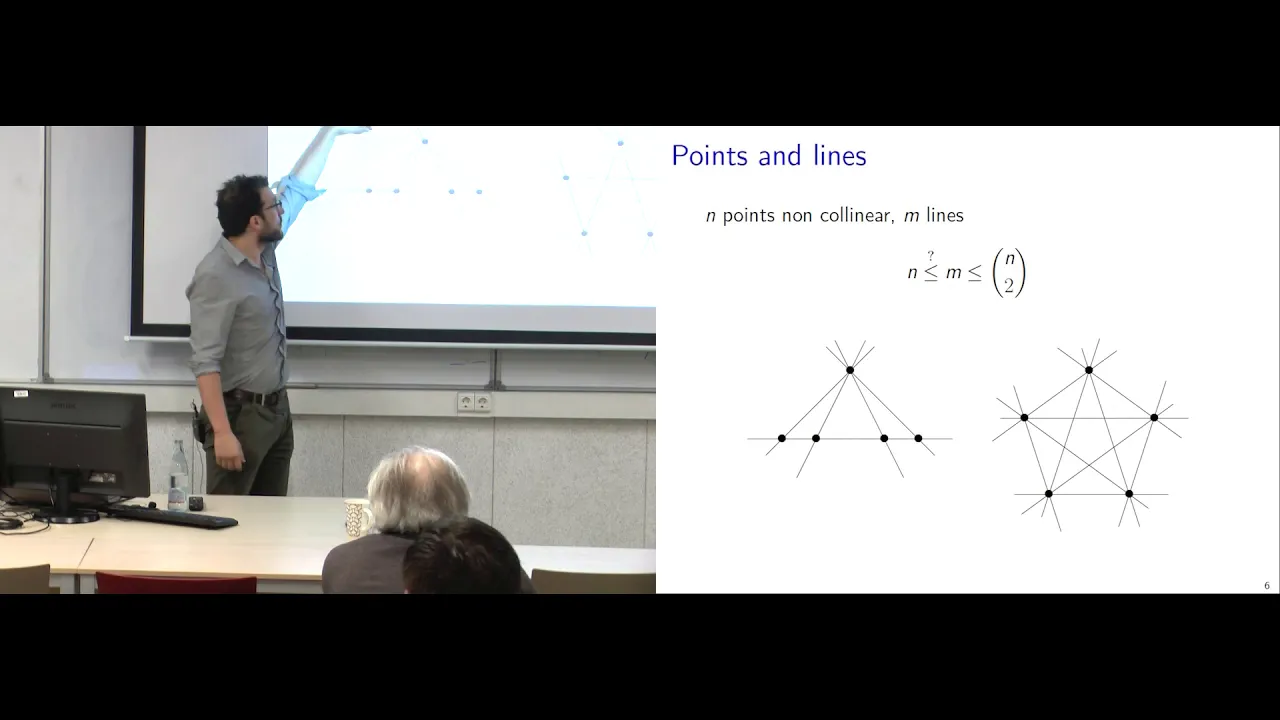


Melchior's 1940 proof of Sylvester's theorem demonstrates that any set of n points in the plane, no three collinear, must contain at least three ordinary lines (lines passing through exactly two points). The proof uses duality to transform the problem into finding ordinary intersections in the dual space, then applies Euler's formula for the projective plane (V - E + R = 1) to show that the number of vertices of degree 4 (ordinary intersections) must be at least 3, thereby proving the existence of at least three ordinary lines.
Proving Sylvester's Problem: Melchior's Three Ordinary Lines Proof
Added:The statement and formulation of the Sylvester-Gallai Theorem, which asserts that any finite set of non-collinear points in the plane determines at least one line containing exactly two points.
The principle of projective duality, specifically how points and lines are dual to each other and how incidence relations are preserved.
Euler's polyhedral formula (V - E + F = 2) and its application to cell decompositions of the real projective plane.
Basic graph theory concepts, including planar graphs, vertices, edges, faces, and vertex/face degrees.
Leroy Milton Kelly's metric proof of the Sylvester-Gallai theorem, which uses Euclidean distances and projection rather than projective topology.
The De Bruijn–Erdős Theorem, which generalizes the concept to linear spaces, stating that any non-collinear configuration of n points determines at least n lines.
The behavior of Sylvester-type problems in complex projective spaces, including counterexamples like the Hesse configuration.
Advanced topics in topological graph theory and the study of line arrangements, including the enumeration of cells and ordinary points.
106 views1likes7:39Original Release: 2015-01-22
at the final proof of sylva's theorem that shows there are at least two ordinary lines to do this proof we need to use Duality as well as a projective plane as well as a ER pank formula in the projective plane we'll get to each step in turn imagine we start with a set of points shown on the left by using Duality we'll get a set of lines shown on the right to prove that there are at least three ordinary lines in the left picture we'll need to prove Pro that there are at least three ordinary intersections or points in the right picture an ordinary intersection is where only two lines intersect Willer pankar formula in the projective plane says the following that the number of vertices minus number of edges plus number of regions equals 1 to understand this formula we will need to understand the concept of vertex the concept of an edge and the concept of a region let's look at each one in turn a vertex is intersection of two lines the first five vertices are easy to spot 1 2 3 4 5 however notice that there's also six vertex which is the intersection of the parallel lines all these three parallel lines intersect at a common Infinity vertex which we label it by six also know that the six at the left and the six at the right are both the same point because two parallel lines intersect only at one infinite vertex now let's look at the concept of edges Edge is a line segment that lies between two vertices let's look at the first edge here one that lies between the end point red and the end point yellow notice that as this Edge continues to infinite it appears from the other side and ends at the yellow end point the infinite edge two is the same it starts from the green end point and ends at the gray end point The Edge three is also interesting it starts from red ends at black and it's different from agge number four which starts at Green and ends at black edges five and six are also interesting they both start from Blue and ended black but they're not the same vertex the same Edge to see this imagine starting from the blue vertex and going to the right he will end at the in at the vertex at the infin which is black and will conclude the ver The Edge five the other Edge continues from the black which is the vertex at infinity and ends at Blue edges seven and eight are also similarly defined and these eight edges will be all the infinite edges that we have in this picture in addition to these eight infinite edges we have six finite edges in two triangles 1 2 3 1 2 3 and that will raise the total number of edges to 14 now let's look at the regions the first infinite region shown in this picture continues to Infinity in this directions and also appears over here so this part of the picture and this part of the picture all considered the same region same holds for the region number two it goes to Infinity in this direction and appears from Infinity from this direction and so this part of the picture and this part of the picture are all part of the same region Region Three is similar regions 4 6 7 9 are also infinite regions that are bounded by different segments in addition to these infinite regions we have also two finite regions five and8 in total we have nine regions if you look at this formula you will see that 6 - 14 + 9 = 1 so o formula holds in this picture this concludes the description of our U pronard formula and let's see how we'll use this to prove the existence of three ordinary lines uh in the Sylvester's problem we can start by writing the number of vertices using the following formula where V4 represents number of vertices with degree 4 V6 the number of vertices with degree six we at the number of vertices with degree 8 and so on notice that each ver vertex has an uh even degree because vertices appear when the lines intersect and they can only make even degrees also notice that there is no vertex of degree too because it does not make sense the number of regions can also be written as number of regions where there are three surrounding edges number of regions where there are four surrounding edges and the number of regions where there are five surrounding edges and so on the number of edges can be counted in two different ways a region with three surrounding edges counts three edges a region with four surrounding edges counts four edges and so on notice that the region with three surrounding edges is a triangle which could also be infinite for example in this picture one two and three edges surround this infinite region which will make it a triangle the other infinite region is surrounded by four edges 1 2 3 and four observe that these two infinite edges were already counted because they're the same as these two other ones then wrate there are two ways to write the number of edges one using the number of regions and the other one is using the number of vertices vertex of degree four counts four edges vertex of degree six counts six edges a vertex of degree 8 counts eight edges and so on and this again counts a number of edges double because each Edge is adjacent two vertices by having these equalities we can now look at the UL formula we can write o formula in the following Way by multiplying by three and then rearranging the terms and finally getting it as 3 V - e + 3 r - 2 e = 3 now what is left is just to plug in the values from the above equalities 3v equals this 3 * v4+ 3 * V6 and so on minus E equals this which we use this line we only divide it by two so we'll get - 2 V4 - 3 V6 - 4 V8 and Etc plus 3 R is used uh from here minus 2 e we use this line so we get to this equality if you simplify this equality you will notice that V4 is the only term that is positive on the left side of this equality all the remaining terms are negative since this equality equals 3 it follows that V4 must at least be three because otherwise this equality cannot hold remember that V4 is a number of vertices of degree 4 a vertex of degree 4 can only happen when two lines intersect and thus this proves that there are at least three vertices where exactly two lines intersect in the Primal space that will mean the the existence of three ordinary lines and this proves this this proof concludes the last proof of the sylvus theorem that we'll see here
Up Next

102:01
Visual Navigation for Flying Robots: 3D Geometry and Sensors
@cvprtum
19.2K views•2013-04-28

8:17
JEE Maths | Circles: Pole & Polar Explained with Equations
@TargetPublications
14.4K views•2019-02-23
10:44
Fourier Series Introduction: The Big Idea Explained
@DrTrefor
387K views•2021-05-03

6:00
The Mathematical Impossibility of Accurate World Maps
@Vox
23.3M views•2016-12-02
Related Study Plans & Knowledge Roadmaps
Structured learning paths in Mathematics
mathematics
Projective Geometry: Coordinates & Conics
01From Euclidean to Projective Space
02Homogeneous Coordinates
03Duality and Projective Transformations
+ 2 more learning modules
14h5 modules
Explore Roadmap
mathematics
Tensor Calculus: Vectors to Riemann Curvature
01Mathematical Foundations: Linear Algebra & Calculus
02Covectors, Dual Spaces, and Tensor Basics
03The Metric Tensor and Index Gymnastics
+ 2 more learning modules
40h5 modules
Explore Roadmap
mathematics
Gödel's Incompleteness: Logic, Proofs & Limits
01Introduction to Formal Systems & Hilbert's Dream
02Set Theory, Cardinality, and Cantor's Diagonal Argument
03Arithmetization and Gödel Numbering
+ 2 more learning modules
14h5 modules
Explore Roadmap
mathematics
Galois Theory: Fields, Groups & Solvability
01Foundations of Abstract Algebra: Groups & Fields
02Polynomials & Field Extensions
03Splitting Fields & Symmetries
+ 2 more learning modules
24h5 modules
Explore Roadmap