

















Exchange correlation functionals in DFT approximate the complex many-body electron interactions by incorporating increasingly sophisticated mathematical forms (from local LDA through gradient-corrected GGAs to meta-GGAs and hybrid functionals), with each level providing better accuracy for predicting material properties like band gaps and weakly bonded systems, though computational cost increases accordingly.
Exchange-Correlation Functionals: LDA, GGA, Meta-GGA & Hybrids
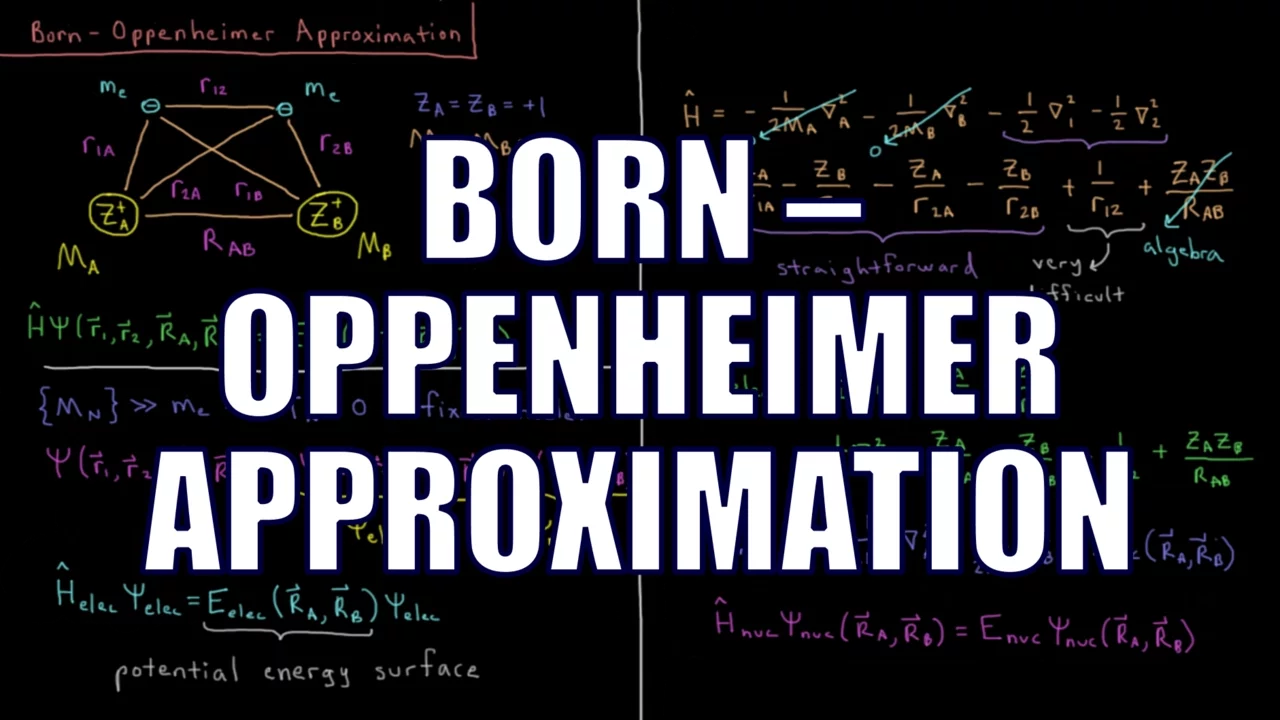
Added:Fundamental principles of quantum mechanics, including the Schrödinger equation and the Born-Oppenheimer approximation.
Basic foundations of Density Functional Theory (DFT), specifically the Hohenberg-Kohn theorems and the Kohn-Sham equations.
The physical significance of electron density and how it replaces the many-body wavefunction as the primary variable.
The conceptual definition of exchange and correlation effects arising from the Pauli exclusion principle and electrostatic repulsion.
Advanced density functional approximations, such as double-hybrid functionals and the Random Phase Approximation (RPA) (the fifth rung of Jacob's Ladder).
Van der Waals (dispersion) corrections in DFT (such as DFT-D3 or vdW-DF) to model weak intermolecular interactions accurately.
Hands-on application of DFT software (e.g., VASP, Gaussian, Quantum ESPRESSO) to benchmark and select functionals for specific properties like band gaps or reaction barriers.
Time-Dependent Density Functional Theory (TD-DFT) for calculating electronic excited states and optical properties.
7.7K views200likes53:54Original Release: 2021-06-25
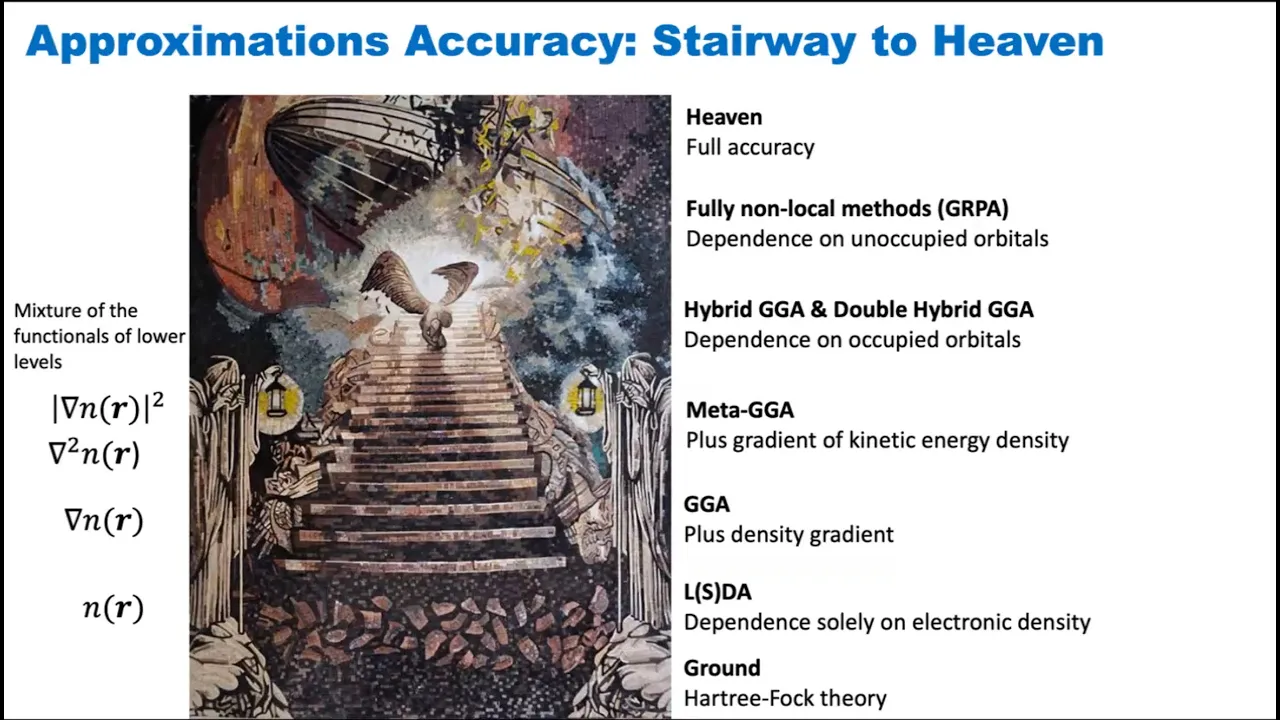
bridge yes all right um so i'm joining you here from the united states and i'm located right here in the middle of the u.s so right now here it's seven o'clock in the morning so that's why my room is still a little dark so just to let you know where i'm located so i'm in a town called colombia missouri at the university of missouri which is which looks like this and this is the first time i'm participating in this in the school and i am uh you know i thank you for for the invitation to participate and i hope that um you will find this lecture useful so here's a brief outline of what i'm planning to do in the next perhaps 45 minutes or so um so i will start with a brief recap of cone sham dft and of course from previous lectures you have already heard uh you know the basic framework and i'll talk about the strategies for approximating exchange correlation functionals i'll talk about ggas and then all of this is a recap of things of material that you have already heard before but i suppose it doesn't harm to hear certain things more than once then we'll talk about method ggs hybrid functionals a little bit beyond i'll show you some examples and hopefully all of this will be useful and teaches you something about dft so if anyone has questions during my talk please do not hesitate to interrupt there is no problem otherwise you can ask your questions later so let's start so density functional theory um is a reformulation of many body theory entirely in terms of the probability density so the great thing is that the many body wave function which is a complicated object is no longer the center of the theory you don't try to do you don't try to calculate this thing but instead it's only the one body density which is a function of one variable and which is much simpler to calculate so all of this was in essence invented by walter kohn and to make all of this work in practice you have to work or we usually work with the cone-sharp theory so with the konshan equations and in essence what you do is you solve the equation that's here in this yellow box which is an equation which is a single particle schrodinger equation so you you solve for these single electron orbitals and the hamiltonian has in addition to the external potential which could be the potential of the nuclei it has a hard tree and exchange correlation potential now these two depend on the density as input the density is obtained from the orbital so you have to solve this whole equation itself consistently the exchange correlation potential itself is formally defined as a functional derivative of the exchange correlation energy exc so this exc if if this is known you can get the vxc we'll talk about that in a second and once you are done with solving all this so for example you are you are finished running quantum espresso or whatever code you have you can for example calculate the total ground state energy and you get this there's a formula here you get this from the from the epsilons and then there's additional terms there's a coulomb interaction term and then two terms that depend on exchange and correlation and if you knew what the exact functional was then the ground set energy would be exact so now that's in a nutshell what you do in dft but the problem of course is we don't know what the exchange correlation functional is so what is it really in a sense the exchange correlation functional is like a library where you have many many books and for any given nfr you can go to the library to you know the shelf that corresponds to that density and you can look up what the exc is so that's in essence what a functional is it's like a big library but of course what the hohenberg cone theorem or what the basic theorems of dft guarantee is that this library exists but unfortunately the library is locked so we can't get in we don't have access to it um because that would have implied that we had solved the exact many body problem for all possible densities and that is not not not feasible so okay instead we have to approximate and of course there are literally hundreds of exchange correlation functionals that have been developed over the years the question is where do these come from and what do they do and how do we use them so we'll talk about a few of those today you've heard already about things like lda lsda pbe i will say a few more words about those and then we go a little further so for example we talk about b3 lip a little bit today so what are then the strategies so as i said before the exact exchange correlation functional would require solving the many-body problem that cannot be done in general can only be done for extremely simple toy models that are not really useful in practice so instead we have to find approximations and to do that there are two avenues that are available to us so we can do it empirically or non-empirically an empirical approximation basically uses fitting parameters and the non-empirical approximation does not it uses exact constraints and conditions there's also mixtures so in in practice there are many so-called semi-empirical functionals that use one or two parameters but also exact conditions and constraints so both all of these philosophies have been very successful and you will you will see examples of both type of functionals in the following so what are examples for some of those constraints um so first of all if we have slowly varying densities if you have a density that is almost or that is constant or almost constant then it should reduce to the limit of the homogeneous electron gas so that is one exact condition because the homogeneous electron gas is a system that we can solve exactly at least numerically exactly [Music] here's another constraint the asymptotic behavior if you have a finite system such as an atom or a molecule and you go far away from that system so r going to infinity then we know that the exact exchange correlation potential must go like minus one over r it's important too that constraint is related to the so-called self-interaction of freedom so the exact exchange correlation functional cannot have self-interaction in it so that means the system cannot interact with itself and one way of formulating this is to say that in the limit where you have only one electron the exact exchange correlation potential must behave like a must reduce to minus n over r minus r prime d r prime so minus so that cancels the hard tree potential for one electron there are many more constraints that i will not list here so that have to do for example with gradient expansion certain scaling relations and and others which however are important and have been used extensively so we'll come back to this now here is an image that you have probably heard before as well so there is this so-called jacob's ladder which is a way of thinking about functionals in in a density function of theory now this whole this image which i took from wikipedia comes at least the way it is introduced here it's a biblical image where there was a dream where it was shown that there is a ladder that goes all the way from from the earth all the way to heaven now interestingly this image is also known to other cultures so i have seen for example similar very similar images in india and elsewhere so it is pretty much a universal way of thinking um and it has been helpful for dft because the way we think about this in this context is to say that well earth that's uh sort of the the lowest level is where we have no exchange in correlation at all so that is the hartree world only in between as you climb up the ladder if you go higher and higher that means the approximations become better and better and if you reach heaven which of course you cannot really because it would be solving the exact problem that would be the exact functional so we think in terms of this uh this ladder of approximations so here is a somewhat uh more um you know somewhat more reduced um schematic representation of this letter so as we said down here at the bottom is the approximation where we would have no exchange in correlation at all then the first rung the first step is the local density approximation the lda and i believe you heard about that yesterday perhaps even before that the second second step are the gradient approximations the ggas the third step are the meta gta's so we will i will tell you about those today also about the hybrid functionals which are on the fourth step then step number five are the so-called rpa-like functionals and then up here in this cloud is the exact function which of course as i said is not known so as you go up the functionals become in a sense more complicated there are more building blocks the computational cost in general increases so in other words your calculations will take longer and may require more resources but the results are better generally speaking so you have to decide then how many resources you can expend and what kind of accuracy you would like to achieve so let's talk about a little bit so to understand the classification of these different functionals it is useful to think for a moment about the meaning of the words local and non-local local semi-local and non-local so um to explain this let us think about a system so you see this this cloud here this this blob which is um um you can think of like as the electron cloud in an atom all right and the exchange correlation energy exe is defined as the integral over the little exe little exc is the exchange correlation energy density so there's a function of space and when you integrate over it you get the exchange correlation energy so now in a local functional the exc is a function of r but it depends only on the density at the same point r okay so it depends only on the density at the same point r so that is a local function and by contrast there are semi-local functions where the exchange correlation energy density depends on the density and orbitals in a little neighborhood of that point so uh in practice that means it depends on the density or on the of your end densities or orbitals at point r and their gradients so you need a little bit of information not just at that point are but also in a small neighborhood and finally a non-local functional depends on the density or the orbitals everywhere so you need information about the entire system when you work out when you when you construct exe at point r so local functionals are the easiest and semi-local and non-local functionals are more complicated now i don't know if you all see this red line here i don't know why that came in so i will just continue so let us move on so again we have the jacobs ladder here and now you see each of these steps has now been assigned the label local semi-local or non-local so you see the lda is local functional gga and meter meta gga are semi-local functionals and hybrids and rpa-like functionals are non-local so you see local semi-local non-local means it becomes more complicated and here you can also see the building blocks that go into these functionals so the lda only depends on the local density the the gga have gradients of the densities the meta gtas can have the laplacians you can also have the towel i'll show you later what that is that's the kinetic energy density hybrids have the exchange and rpa functionals have unoccupied orbitals so let's talk about let's take a few minutes to review gradient approximations so formally one can write the one can write down a taylor expansion of the exchange correlation energy density you can write that as exe0 plus exe1 exc2 where exc0 the zeroth order term has no gradients and that is the local approximation exe1 contains first order gradients of the density and exe2 contains second order gradient so that means either second derivative or the gradient of n squared and so on so formally you can do that and we in fact know what these terms are but it turns out unfortunately that this is not a really good idea in the sense that when you try and do that and then you put it in your computer and you run calculations the results are really bad um it doesn't improve the lda and often makes things worse the ultimate reason for that is is one of mathematics because this is an asymptotic series and it um it has trouble converging so in practice one does different things so one doesn't practice and that is an idea that has been around for 30 years and more one develops so-called generalized gradient approximations where basically what you do is you say okay i define an exchange correlation energy which contains the densities and here the spin up and spin down densities and their gradients and i define this using certain known constraints and perhaps some empirical parameters and i optimize it as best as i can so there are empirical and non-empirical gta's so this idea has been around for many years has been extremely successful and i'll show you a couple of examples now so the first example is the b lip or blip functional and i'll just show you because this is not something you should memorize but just so you have seen these what these functions look like because they are built into many codes so for example there is the beke88 exchange functional which is the lda plus a term here that looks like that so there is an empirical parameter here so you see it's a semi it's an empirical functional and this quantity x is the gradient divided by the density to the power of four thirds now that doesn't look so complicated uh there is a the matching correlation functional is called the li yang and par functional which is also from 1988.
it looks like this it has a bunch of parameters a b c d so it is also an empirical functional and it contains there is a second order gradient here there is a t sub w that is the first order gradient so you see it's a gradient corrected functional and it looks it's not that complicated but um you know you don't really want to do functional derivatives of this thing so putting these two together gives you the b lip function then of course um the pbe functional which certainly you have heard about so that's a functional that was developed by john perdue kirin berg and matthias ernsterhoff in 1996 so that has been around for 25 years now and by now it is the most widely used functionals and if you go to google scholar you will discover that this paper the original paper has over 130 000 citations so has been extremely has made an extremely high impact and here's what it looks like so the exchange part looks like this so it has a couple of parameters the kappa and the beta though they are not empirical they are not fitting parameters kappa and beta are determined from first principles s is a quantity that contains the gradient of the density and from this you can also you can also make the spin dependent using the so-called oliver produce spin scaling that's not important right now but this is an entirely non-empirical function there's a correlation part the correlation part looks like this and again it has a few numbers there's a quantity a c naught these are again not empirical parameters but these are determined from first principles so um taken together then so the ex plus the ec is the pbe exchange correlation function and that is a functional that is for instance built into quantum espresso and it is built in essence into every dft code that is nowadays being used and i will show you results in just a little bit um but before i do that i just wanted to get another bit of theory out of the way so let's move on right away to the so-called meta ggas so the menta ggas contain yet another building block so they contain well they contain the laplacian of the density the second derivative strictly speaking some of the ggas have been also built in just just a practical remark in practice the laplacian of the density is sometimes a little problematic numerically because the the electron density close to a nucleus has a cusp so for example if you have a diatomic molecule then the density will have a peak in the vicinity of the nucleus so so there is a sharp spike and when you calculate the second derivative of that that spike would be would would be discontinuous so with an all electron theory it's a bit problematic with pseudo-potentials of course all of this is not an issue the other thing here the tau is the kinetic energy density so the way this is defined is you take the gradient of the orbitals you square that and you sum over all the orbitals so that's the tau that that part okay so the question is then what is it how is that useful so why should one add the kinetic energy density well there are reasons for that it turns out that the kinetic energy density is sensitive to the degree of localization of the electrons so that it helps us to this it helps to distinguish covalent single bonds and metallic bonds and it also incorporates it helps us to incorporate additional exact constraints of one and two electron densities so in other words having this additional building block in functionals makes them a little more sensitive and helps us to in to build in more exact conditions so what is there in the literature and again john perdue has been the pioneer for all of this so there is an early meta gga which is called tpss from 2003 and there's a more recent meta gga that's called scan scan which stands for strongly constrained appropriately normed and i will tell you a little bit about that because scan satisfies all of the 17 known exact conditions that a meta gga can satisfy it is a non-empirical functional which is from from a physicist's point of view quite satisfying and it performs quite well so let's look at finally at a few results so i'm going to start out by discussing this table right here table of numbers and i got this table from this publication here in 2015.
so let me explain what this table shows so what the what the authors of this paper have done is they have taken so-called molecular test so-called test set excuse me test sets and databases which are um comp with where where people have compiled exact uh meaning experiment high very precise experimental data for many different molecules and also solids so you see here g3 is the name of that molecular data set g3 hc are just hydrocarbons then bh stands for chemical baria heights s22 stands for certain weakly bonded complexes and lc stands for lattice constants of a number of solids okay so these are results with which you compare your calculations so then there's m e that stands for mean error and m a e that stands for mean absolute error so there are lots of numbers so let's only look at the mean absolute errors and we compare the performance of different functionals so here's the lda or ls local spin density approximation then we have three ggas that is blip pbe and pbe sol pbe sol is just a slightly different variant of the pbe functional then we have tpss and scan and mo6 uh is an empirical functional so let's not look at that right now and you see here that in all of these the scanned functional performs the best so lsda has the largest mean absolute error then pb reduces that error by half and scan reduces it further likewise for the other indicators like barrier heights um the energies of weakly bonded complexes you see here scan performs particularly well and even for the lattice concept of solids the error that is made with this meta gga is the smallest but keep in mind that pbe still performs really really well and i will show you more results later on but for now i just want to highlight that the meta gga scan is is successful so for example what is plotted here and that's a way of plotting results that you have also seen previously where one compares computation with experiment and if the data fall on this diagonal line that means you're reproducing the experimental data exactly so you would like your data to be as close as possible to this line so this is experiment and what this is is the so-called formation enthalpy which basically means the energy that is contained in one unit cell of us of of the crystal or per atom so this is experiment is theory and you see pbe is a little bit off from that diagonal it's still very very good but not not quite uh on top where a scan is is doing much better um so you see here um one thing uh that you would like to so sort of one one benchmark that is important here is the so-called chemical accuracy and that is about 0.04 electron volts per atom and it's called chemical accuracy because that is basically the level of accuracy that you can obtain in uh in an experimental chemical characterization of of energetics so this is all very good so scan is very close to chemical accuracy not quite uh pbe is a bit further away but still pretty really good uh less accurate for transition metal compounds but but still good to show you another example this is a calculation that studies water so you take water molecules and you ask if i take six water molecules how will they arrange themselves so you see here in this image you have one two three four five six so do they form a ring like this or do they will they arrange themselves in structures like that prism cage book or cyclic now all of these functions all of these structures which are small molecules are weakly bound because water forms hydrogen bonds and there's also van der waals interactions so this is medium so-called medium range van der waals interaction hydrogen bonds these are weakly bonded systems which are challenging and it turns out that pbe predicts the wrong structure it predicts the presence of the structure whereas the exact structure should be the the ring and we know this because there's a ccsd which is a very accurate quantum chemistry calculation that predicts this structure and the scan functional agrees with that prediction um the pink line here is the pbe function of pbe0 which is something i'll tell you about in just a moment plus a one an empirical van der waals correction which also predicts the right structure so all of that is pretty good so now there is a little bit of a summary what i've told you so far so we know that non-empirical exchange correlation functionals are constructed so as to satisfy certain known exact constraints following from this the ggas and meta gtas have been very successful in the sense they are reliably accurate and they can predict materials properties efficiently and as i said reliably so remember ggas and meta ggas were classified as semi-local functions so the question then is can we sort of say when in general semi-local functions are okay so the answer is yes there is something we can say and that has to do with what is known as the exchange correlation hole and i will not go into any of the mathematics here i just want to give you a feeling for how to think about it and the exchange correlation hole the exchange correlation hole expresses ways in which electrons can avoid each other so electrons as you know are negatively charged particles so they will repel each other through coulomb interaction so if you have two electrons one here and one there they feel the classical coulomb force so negative and negative charge will push each other away uh but but electrons are quantum particles so the electrons also have there's there's also quantum effects that cause the electrons to avoid each other so one of them is the pauli principle and that is the so-called exchange interaction between parallel spins that effect is not there for classical charges but it is important for quantum particles and then there's also correlation effects which is in essence everything else besides poly and that affects electrons both parallel and antiparallel spins so what does that mean and how do we have to think about that you can think about it in the in a sense if you if you take a snapshot of a configuration of a many electron system where at a given time the electrons and think of them as electronic wave packets are more or less localized in certain places then a given electron will have a region where it is less likely to find another electron so a nice way to think about this in times of covid is that electrons practice social distancing so they don't like to have other electrons close and nearby and some of that social distancing comes simply from classical coulomb forces but others other parts of it come from exchanging correlation effects so it is then important to get this kind of exchange correlation effect right now the problem is that there are situations when this exchange correlation hole sometimes extends very far away from from the electron so sometimes this exchange correlation hole is just confined to a small region around the reference electron but sometimes it can reach quite far semi-local functionals then they will they tend to work well whenever the exchange correlation hole is sufficiently compact and localized on the other hand uh when the exchange correlation whole extends very far away and their problems and when does that happen that happens for weakly bonded systems it happens for strongly correlated systems and it also uh has to do well the band gap calculations now of course are a different story but um um these two so weekly bonded and strongly correlated systems can be characterized through delocalized exchange correlation holes so in other words we would like to do better than that so let's now come finally to the hybrid functionals so we go up another rung we go up to step number four in the ladder and now go to non-local functions so let me explain how hybrid functions work um there is one thing that we know exactly in dft and that is the form of the exchange energy so we can write down the exchange energy as a function of the cone sham orbitals a functional i should say so this expression that you see here involves a sum over all the occupied orbitals in this way then you divide by r minus r prime you integrate over r now prime so this object is also called the fog exchange and it is uh um [Music] it is what gives rise to the hartree fog theory of course but in this case these things are not hard to reform orbitals but they are conchae orbitals so we know this function exactly okay wonderful so we know something exactly why not use it um the thing is if we make this thing part of our theory then we can immediately get rid of self-interaction errors at least for the exchange and we can also immediately satisfy the requirement of the exact asymptotics so that's fantastic and let's see how we can do this so the first guess would be to say all right why not take the exact exchange energy meaning this part right here and combine it with lda or gga correlation then i know the exchange part exactly and correlation okay fine we approximate it problem is this is very bad this does not work why does this not work the answer is the answer is error cancellation now in ldas and ggas there is something funny going on when you look at closely at uh the different contributions to the energy so there is an there is an lda exchange and there's an lda correlation and it turns out that both of them have errors but the errors go in the opposite direction so the errors tend to tend to cancel out at least partly and this is one of the reasons why lda and gg work so well because the errors of exchange and correlation tend to compensate so we are really lucky that this is happening so now you see what's happening in in our guess the exact exchange has no error but the correlation has a large error which then remains uncompensated and therefore the hybrid function that we construct in this way will will not be very good so that's disappointing but there's a way around it and the way around it is to say all right well let's play with this a little bit and perhaps we can we can make it better so the idea was then to construct the hybrid functional by introducing a mixing parameter a which can be a number between zero and one so we take perhaps thirty percent of exact exchange and then seventy percent of gga exchange plus gga correlation so the fit the parameter a can be either optimized by fits to data sets there can also be some first principle some theoretical arguments but in the end what when you do it this way you still benefit from error cancellation at least in part and you also take advantage of the nice properties of the exact exchange so if you will this is a compromise um just i'm looking at the time i have another 10 slide so i will finish in another maybe five to seven minutes good so let me give you a couple of examples here so uh one example is the pbe zero functional which goes back to 1999 and the pbe zero is exactly a functional of this type where one takes one quarter of exact exchange three quarters of pbe exchange and all of pbe correlation so that's pb zero a little before that was the b3 lib functional which is a function of the three comes because we have three parameters a b and c which were fitted to a molecular data set so you have one minus a lda exchange a times so 0.0.2 exact exchange then a little bit of becke 88 exchange then a little bit of lyp correlation and then 1 minus c lda correlation so there's a functional that mixes together different things and the mixing is optimized by fitting so let's see how well this works so i'm going to show you now a couple of tables and this and in the next slide so the first table comes from chemistry so these are calculations for molecular data datasets and again we have here total energy for formation enthalpy is basically total energy ionization potential equilibrium bond length vibrational frequencies hartree fog is very bad that is known because far too far has no correlation and correlation is important lda is much better than alden archery fog and the gtas are are better yet and it turns out for molecules blip is is actually much better than pbe so it gives much better energies and but the winner here is clearly the hybrid functional b3 lip so for molecules um it clearly gives the best answer i don't have any scan i own the only meta gga that i have here is tpss which is quite good but it is not as good as b3 label so the numbers you see in this table are in essence the reason why everybody in chemistry uses b3 on this slide i show you a number of a table that come that is relevant for solid so this is now this is from this paper and what you see here is cohesive energy and lattice constant of certain solids um again lda is is kind of the worst the lattice constants of lda are actually quite good the cohesive energies have you know somewhat of an error the gta's and here pbe is much much better than blip and for the hybrid functionals pbe zero is also better b3 lip is actually very bad for solids so you see here it gives terrible energies the lattice constants are worse than lda scan is here the winner but pbe is in terms of energies just as good as scan so for solids pbe is the best you can do really as the best compromise and you do not want to use b3 lips lip for solids at least not for structures so in the end the message of all of this is that pbe and b3 lib are the most widely used functions of dft and this figure that i'm showing here is from an old well it's a paper it's not 10 years old so what this shows just to give you an impression of the the the number of papers that have been published over the years so this is and this is year all the way to 2012.
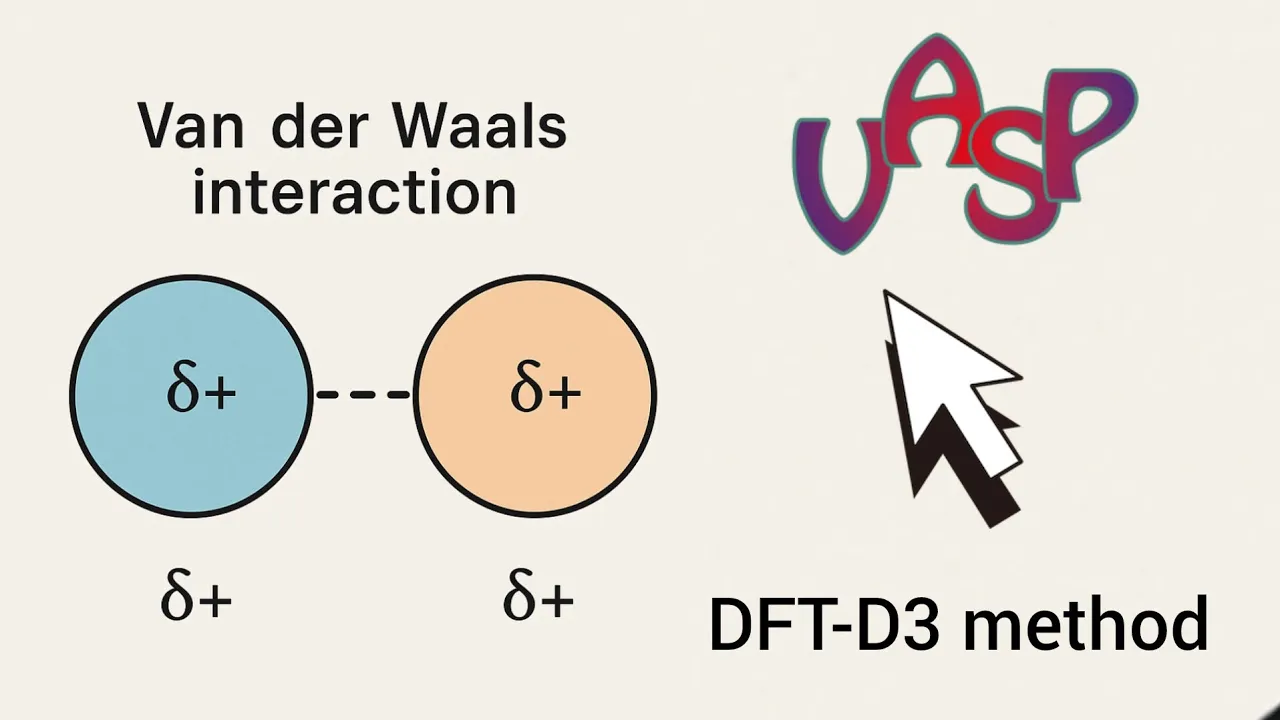
um this is kilo papers meaning thousand papers and you see here by by the year 2010 about 10 years ago you had almost 10 000 papers and nowadays in 2021 it will be probably many many more so this curve has probably increased i don't have any more recent data but the colors show that the the blue papers are in chemistry and they use b3 lip the green papers are in solid state physics or material science they use pbe and everything else all the other papers use other kinds of functionals so you that tells you the significance of pb and b3 for dft and for material science and for computational electronic structure okay here's a little bit of a summary of um uh you know what what i would like to say about hybrid functionals so hybrid functionals again contain a fraction of hartree fog exchange the mixing parameter can be determined empirically as in b3 lip or semi-empirically as in pbe zero hybrids are non-local orbital functionals and when you when you actually do cone champ theory with them okay wait i'm just okay just one moment i i'm sorry i was just looking at the chat and i will look at the chat and the questions in let me let me finish with let me finish with the presentation and then i go to the chat questions so i'm sorry so i was saying generalized conchamp theme scheme that means when you in practice when you do a hybrid calculation you have to treat the exchange similar to hartree fog with a non-local exchange correlation exchange potential you can also alternatively solve it post-self consistency that means solve cone sham with lda and gga and plug into the orbitals but usually the way these functionals are treated are using a generalized conscious scheme so hybrid functionals how do they perform they're very good for the energetics of molecules they give good geometries lattice constants but gga and meta gga are often better uh hundred fork exchange can be expensive for solids depending on on the method and they give good band gap so in the remaining couple of minutes i will just say something about band gaps maybe you have heard this before so one issue that one has when one does a dft calculation and one calculates the band structure one usually finds using lda or pbe that the band gap is too small so here again is one of those plots where we cut where we compare experimental band gap with calculated gap and you see that for pbe those are the light the empty squares uh all of the data are pretty far away from the line so that means the band gap is too small so for example i don't know gallium nitride instead of a band gap of 3.5 it only has a band cup of two electron bonds that's too small uh hse and lc are two kinds of hybrid functionals and you see that they perform much better so hse gives us really good band gaps for uh semiconductors uh hlc gives us what can put good band gaps for covalent and ionic solids here's another set of data for example pbe 0 gives us good band gaps and there's other ways in which you can construct functional hybrid functionals that give good band gaps across the board so well the problem is of course hybrid functions are expensive you have to think twice before you run them for for solid states okay i am almost done the only thing that is left to do is now to to ask well how about going even higher up on the ladder so so far we talked about local semi-local functionals hybrids so now the last ladder that's the step number five are the so-called rpa type functions so these things i will not show you formulas these things are complicated and that they depend not only on the occupied but also on the unoccupied orbitals they are highly non-local so that means they involve complicated integrals um and of course they tend to give good results so for example if you have certain types of correlation that is difficult to describe using all the other functionals things like phenomena like screening dissociation of molecules weak bonds dispersion interactions that means van der waals type interactions all of those things can be very well described using these rpa type functionals which is great unfortunately that's computationally expensive so these type of functionals up here are not really mainstream they are they can be used for materials but these calculations are only uh usually only done by specialists there are some alternatives if you are interested in these kind of complicated effects so for example van der waals interactions can be put in by hand these are so-called dispersive corrections if you are doing calculations in chemistry you will often use these dispersion corrections that works quite well but that's empirical if you are a solid-state physicist you may want to do something that's called lda plus u this is something that helps shift open up the band gap and describe strongly correlated materials better or even better you can use so-called quasi-particle-based theories or many-body-based theories such as gw and i believe you will hear about gw more next week these things are extremely good for band gaps but they are also expensive now quasi-particle-based theories are not part of the of the jacob's ladder here um that's a different kind of it's a different kind of theory and but of course you know it is it is somewhat expensive okay so i'm going to wrap up uh by thanking you for your attention so i'm just wrapping up with a couple of pretty pictures that were done using dft and i think now we can go ahead and look at questions and i can see here that there were a few things going on in the scan so in the in the chat so i don't know how should we proceed um
Up Next

9:09
Thermal Transfer: Conduction, Convection, and Radiation
@khanacademy
576.7K views•2015-07-23

12:53
21cm Hyperfine Transition in Neutral Hydrogen: Radio Astronomy Basics
@AaronRobertParsons
12.4K views•2011-10-13

32:32
NMR Spin Physics I: Zeeman Effect, Resonance Condition & Larmor Frequency
@nptel-indianinstituteofsci8064
2.3K views•2024-01-17

27:14
Entropy and the Second Law of Thermodynamics Explained
@veritasium
27.5M views•2023-07-01
Related Study Plans & Knowledge Roadmaps
Structured learning paths in Physics
physics
Nuclear Physics (Decay, Fission & Reactors)
01Atomic Structure and the Binding Force
02Radioactive Decay and Half-Life
03Nuclear Fission Mechanics and Chain Reactions
+ 2 more learning modules
12h5 modules
Explore Roadmap
physics
Soft Matter (Polymers, Colloids & Rheology)
01Foundations of Soft Matter & Thermal Forces
02Polymer Physics and Macromolecules
03Colloids, Surfactants, and Self-Assembly
+ 2 more learning modules
38h5 modules
Explore Roadmap
physics
Analytical Mechanics: Lagrangian & Hamiltonian
01Mathematical Foundations: Calculus of Variations
02From Newtonian Mechanics to Constraint Dynamics
03The Principle of Least Action & Lagrangian Mechanics
+ 3 more learning modules
28h6 modules
Explore Roadmap
physics
General Relativity (Spacetime & Cosmology)
01Foundations of Relativity: Special Relativity
02The Geometry of Spacetime: Equivalence Principle & Curvature
03Einstein's Field Equations: The Mathematics of Gravity
+ 2 more learning modules
55h5 modules
Explore Roadmap