


![The DEMOGRAPHIC TRANSITION MODEL, Explained [AP Human Geography Review—Unit 2 Topic 5]](https://i.ytimg.com/vi_webp/-gf4hakk_WY/maxresdefault.webp)





























Population aging is an inevitable consequence of demographic transition, resulting from declining birth rates and increasing life expectancy. While initially beneficial through a 'demographic bonus' of a larger working-age population, it eventually creates challenges including increased dependency ratios, labor shortages, and pension system strain. The severity varies by region, with Southern Europe and East Asia facing the most severe aging due to very low fertility combined with high life expectancy. However, population aging can be managed through policy interventions such as increasing retirement ages, improving workforce participation, enhancing productivity, and implementing rational pension reforms, rather than being an insurmountable disaster.
Population Aging: Trends, Causes, and Policy Responses
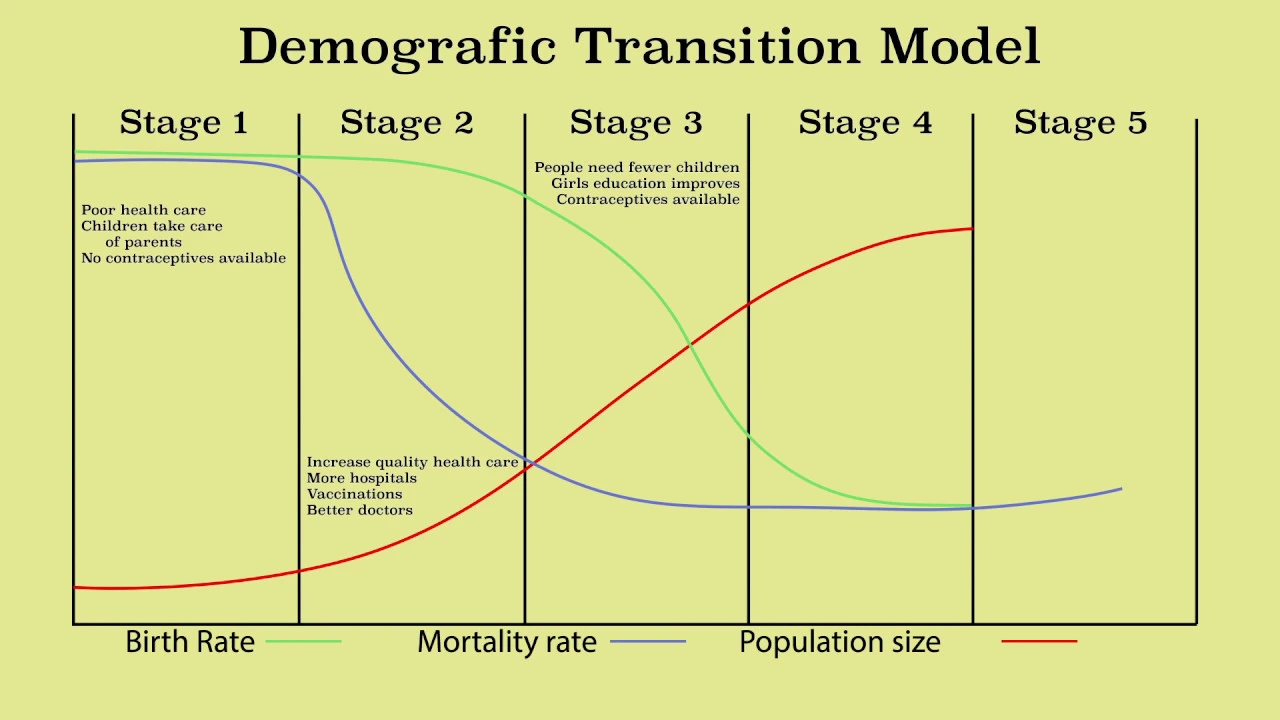
Added:population ageing is very much in the news as you may have gathered it is about among other things part of the great package of reforms which is being forced upon the unhappy people of southern Europe and elsewhere in the eurozone as a consequence of trying to contain the costs which population aging and previous rather over generous attempts to compensate for it have generated in their economies and so it's a matter great topical interest and if you ever bother turn on your televisions and look at the news or read a newspaper to understand your rather averse to doing then you will see it splurged all over the front page is very much an issue of the present time has been engaging us for quite a long time and we're going to do so for quite a long time into the future important realise that it is totally unavoidable some degree of population aging is absolutely inevitable there's nothing we can do about it short of bombing ourselves back into the Stone Age and it is a consequence of too highly desirable trends and that is to say the achievement of control over over fertility to a very large extent to bring down birth rates to a manageable level one where children we brought up in conditions of security and material comfort and and prosperity the the very also very desirable effective control to some extent of mortality we haven't quite abolish it yet but mortality is now well into the future as far as you're all concerned babies born today have a 97% chance of surviving to to age 65 also babies born today may well have a cohort life expectation only a few short years 100 of correlations projection centenarians are going to be commonplace in the future unless something quite unexpected and disagreeable happens to the risks of mortality so two very good things which we hope we will keep for the rest of the history of humanity but they have the consequence the payoff of population aging and man is unavoidable important to realize though that to begin with population ageing is highly beneficial if you are talking about a simple society with very high proportion of population aged under under age 15 dependent children and as is the case still in some parts of tropical Africa and was the case until quite recently very widely throughout the world but then of course population aging which reduces rapport ssin of dependent children and increases the proportion of adults is very beneficial well what happens is of course in the early stages of demographic transition that the number of babies becomes more modest the number of old people does not expand because they're a course of born 60 70 80 years ago and therefore the namsan still quite small so for awhile for some decades we have this demographic bonus this concentration of population in the nominal working ages between say 15 and 60 or or thereabouts which if there are institutions appropriate in the economy enabled a very considerable improvement in living standards to be generated because the workforce becomes a relatively high compared with the rest of the population that is what the industrializing and developing nations of Asia are in the middle of at the moment and many calculations suggest that perhaps the perhaps a third of their prosperity increase over the last few decades has been due to this demographic bonus in due course it has to be paid for we've enjoyed our demographic bonus of a much more modest kind in the late 19th and 20th centuries we are paying for it now the 21st century with population ageing they will pay for it in turn in the coming decades for the moment they can as well enjoy it and add a concept country which their prosperity you can only do so of course important to add if the institutions are present to enable that the workforce to be employed that this means stable government the rule of law enforcment racks workable infrastructure roads South Sudan has 58 miles of metal Road not very helpful precursor for enjoying a demographic bonus a work ethic all these things have to be in place before this this this enlargement of the work working age population can be usefully devoted to increasing national prosperity otherwise it'll simply turn into disaffected unemployed and possibly violent young men also important realize that population aging doesn't go on forever if we ignore the death rate for the time being if birth rates stabilized at some low level then a replacement or whatever it might be population aging does not go on getting worse and worse and worse you'll recall perhaps from previous discussions about these matters that eventually the population age structure will stabilize are determined entirely by the current levels of birth and death that's all that determines that the age structure in the long run so if birth and death rates remain constant Devers they're quite different from what they were in the past population aging will proceed until until the new age structure has become stable and then it will remain constant for as long as the birth and death rates remain constant it doesn't always get worse and worse it does come to an end this is just a reminder they knew about this back in the 1930s this is a diagram from the population investigation committee which publishes population studies back in 1936 just to show what they thought might be happening up to 2050 five very adventurously long range projection here showing the change in the proportion of young people in in in red changed the proportion of people of working age in white and and unfortunately elderly in black a very pessimistic projection but they were aware of it even if then the primary concern in relation to lower birth rates related to population decline and not population ageing of which more later if we wanted to go back to previous patterns if he wants to abolish population aging because we thought it was it was too ownerís too difficult too expensive then this is a kind of a structure we'd have to go back to this is a population age structure about 1700 at that time before the demographic transition population aging wasn't a problem there was a certain element of youth dependency here we have the proportion of persons aged under 15 is about 60 is about 35% proportion over 65 is about 5% so no population aging some youth dependency but that is bought at a cost and expectation with life at Birth of 37 infant mortality ratio of about two hundred and zero growth rate so it's not a very desirable population age structure to go back to given the cost of being there in terms of low expectation of life at birth and the high birth rate which have to be sustained to processes of population aging to causes the up till now the most important cause of population aging has been relatively low birth rates so called aging from the bottom now is to say that fewer and fewer individuals are added at the bottom of the population pyramid and that causes it to become a narrower at the bottom than it is in the middle that's that's so-called aging from the bottom and that always makes populations over learn mortality also can make populations older because of course it means more people are living to a longer ages but to begin with it always makes populations younger it's very important to grasp it's apparently paradoxical fact that in traditional societies that when the birth when the death rate starts to go down assuming the death rate is going down generally across the board then that makes the population younger because of course in traditional societies the the the high proportion of deaths are concentrated in the younger age groups infant mortality may be 200 or 300 infant deaths per thousand live births per year survival to age 15 may be nearly 50% in the nation of things even if mortality is improved at all at all ages that the great effect is going to be at the younger ages there will be more children surviving more young people surviving more young women will survive to compete their families more births and consequently reducing the death rate making people live longer will make the population younger not older until the population reaches an expert even life of about sixty once you go beyond that threshold then and only then will further improvements in mortality actually do what you expected it would do right at the beginning that is to say make populations older and not younger here is the basic process involved with the transition from from these are crude birth and death rates of about 35 back in 1750 to much lower levels at the present time the sort of pattern which has been followed throughout Europe more or less and which is being followed by the greater part of the of the developing world in all developing countries the death rates gone down and the problem of course is that in some of them birth rate has not gone down so we still have two or three percent population growth as you know in some parts of Africa and we haven't got yet two of the final stages of transition not we know exactly what the final stages are because it is not yet stable but that's another question for another time just an example of two contrasting populations a traditional one here which has experienced some reductions in mortality this is Uganda 1991 but not yet a reduction in fertility very youthful population no no trace of population ageing there because no trace of fertility control and a contrast with Italy which could be replicated in many other developed developed countries in Spain Portugal Greece and elsewhere with a very severe population ageing arising from two sorts of processes primarily aging from the bottom as you see that the the birth cohorts being successively smaller than the preceding ones but also the case of Italy Spain and the other countries of southern Europe ageing from the top at the same time becoming more and more important as time goes on because the expectation of life at birth is is is so favorable and we're now in a position where further improvements in mortality are mostly concentrated in survival milder ages because that survival out of age 60 is nearly perfect anyway if you abolished mortality out to age 60 it really wouldn't make much difference the age structure of all all the impetus is happening here the patterns of fertility are well known just to rehearse and very briefly because patterns of fertility are appear to be stabilizing to some extent in a highly differentiated pattern this is generating unless things change very radically very significant differences in expected patterns of population aging in the developed world generally speaking of course the higher the birthrate up to the limits move around - as you can see here here's - on the graph up to about - it gives you a reasonably favorable future in population ageing it doesn't stop population ageing of course but it is less severe here in terms of the burden of old age dependency down here where the birth rates about or the TFR is equipment to about 1.4 that implies a much more substantial levels of population aging and also bar very high levels of immigration a population decline as well which has already begun as you'll recall in Germany in Japan in Ukraine in various other countries in in Europe and elsewhere some are doing better the new Europe's Scandinavia the UK some are doing less well here's his Far East with rather little improvement in in in facility yet apparent and right down the bottom with with Taiwan the lowest at about one point naught there TF are important realize that birth rates and go up and here are some selected ones approaching the TFR of two point not nearly a period replacement rate no one really expects the birth rates in developed countries will go much about two and in fact most of my colleagues feel that they probably won't even reach that and say if they were able to MIT disconcerted by this this this trend to a somewhat higher birth rate parties do with populate with the tertiary cooperation partly to do with immigration expectation life at birth of course that has been increasing impressively as time goes on robber falteringly to begin with this is 1850 1860 1870 only very modest improvement as population moved into the high-risk urban areas very rapid improvement at between the two world wars and then steady changes were more modest kind after the present time with particular improvements as I mentioned above age 65 in recent years from 1850 to about my team 20 or so almost no improvement in survival a 65 very very very modest changes and then first of all among the females that then among males progressively improvements in in was in in survival this is where all the action is these days given that mortality that really is very modest indeed after about the age 65 and this keeps on going up and up and up and we don't yet know what the limits going to be these are the latest projections of expectation of life at Birth for the UK the the actual figures from 1985 up to 2010 projected figures from 2010 onwards this is fairly typical of developed countries and as you can see that the the pattern is always different between males and females with females having the females in red and in orange experiencing fate more favorable survival than males in dark blue and pale blue the pale colors the the orange and the blue at the bottom are period expectations of life at birth this is as you know simply the the calculation of the the expectation of the life of birth which you would get if a person experienced the current age specific mortality rates of the particular calendar year in question you imagine for example that someone's living through the age of specific mortality rates which are obtaining in even Wales at the present time and that's and that's what this period of calculation is if however you build in assumptions about future improvements in survival survival improving by about 2% per year in the life table then you can create a projected cohort life table what would be the expectation life at Birth of children born in a particular year were they to experience age specific mortality rates improving at say 2% per year as they have been over the last few decades and if you do that this is what you get that if if you take babies born about 2010 according to the projected cohort expect the expectation of life which are these two lines here for females and for males then then you already have a figure of about 94 the theme and about 80 about mighty four males are projected to 2035 which is not that far in the future - about 97 for females and about 94 for males so really approaching that the possibility of a normal expectation life at birth for babies born around now very close to 100 this may not come to pass it's a projection projections are always wrong but nonetheless they may not be very wrong and this opens up all sorts of really interesting possibilities for forum for aging at the top from what from the reduction of mortality at older ages and therefore forum for the questions of old age care very much dependent of course upon the extent to which these additional years of life are going to be years of active life where people continue to work older and older as they lived on a longer and longer or alternatively if they're going to be confined drooling in wheelchairs for a high proportion of this expectation of the life increase it's got to be the former not the latter this is just an historical sequence to show the sort of pattern change which we've experienced in many European countries particularly those with low birth rates at over last hundred years or so this is Austria going from 1869 to two in this in these three - 1934 this is a traditional kind of Christmas tree aged structure before much has happened in the demographic transition this is a 1910 by 1934 things have started to happen first of all there's been damage the the aid structures of European countries in the 20th centuries are all terribly damaged with a very few exceptions by by warfare and by depression you can see here the bite taken out of the male aid structure in 1934 rising from military deaths in the First World War from 1914 to 18 not paralleled by a reduction on the other side these are the death of birth the reduction in the birth rate occasioned by the the first world war 1914 to 1918 these these being now about age 18 in 1934 and here is the reduction in the birth rate after the First World War are causing causing aging from from the bottom in in the man that I described earlier on this is the middle of the of the 20th century by 18th 1951 we've experienced more damage here's here the multi casualties in the First World War here is the birth death of the First World War and here is the birth death of the Second World War and here's further reductions in its in infertility causing more aging from the bottom then we have a partial reversal by 1971 we have the evidence the baby boom the baby boom this once for all transient increase in the birth rate rising partly out of the greater popularity of marriage which began in the in the 1950s end in the 1970s a one-off event quite impossible to repeat I think but creating this bulge further disruption in the population age structure what this bowels does is to work up through the age structure causing problems wherever it arises problems here for maternity hospitals and forum and for overcrowded primary schools and then it moves up for causing problems for youth unemployment I mean it could be an advantage if the economy can expand fast enough to absorb the extra workforce it was difficult because the barrage was so big well might liken this in terms of shape to a fat Python swallowing a goat and here's the goat yeah moving up the gut as it were as it ages and causing difficulties indigestion as it were of a socio-economic kind wherever it goes and here is here is the goat approaching retirement age in 2015 starting to provoke an accelerated form of population aging and here it is in 2030 well established in retirement age and adding to the reversal of of the ratio of people's are productive a to people of consuming age who are retired and eventually of course like all goats in pythons if it passes out of the city classes at the pearly gates and we have a more stable age structure of 2050 showing a transition from a Christmas tree of 1890 to a kind of coffee in the shape of 2050 while appropriately so because this population is of course also declining that that's a typical pattern of a low fertility a country in in in like Austria a TFR at 1.5 not like northwest Europe this is a different kind of evolution while not by it's the same kind of evolution but one which is less dramatic here's the UK 2006 it's still sitting in the middle of a sort of demographic bonus this voucher from the baby boom is still in the working ages although the the older working ages in 2006 in due course it'll pass up to retirement age of course and reverse the advantage here it is in 2050 6 not quite as bad as the Austrian one partly because the the fertility rate is is here assumed to be continued higher than in Austria partly because of migration which which helps to contribute this pouch here in these Middle Ages so not all patterns that are the same here's a severe case this is an extreme example of population ageing in Japan very low birth rate about 1.3 5 TFR very high expectation of life the highest in the world of any national population both conspiring to make the Japanese population evolve from from here which is the year 2000 still quite favorable for the having the demographic bonus here to here where the bonus has turned into the onus and a very unfavorable a structure this of course is a typically pessimistic Japanese projection the Japanese projections invariably assume the TFR will remain fixed in concrete at about 1.35 for the foreseeable and even our foreseeable future I think is very unrealistic nonetheless that's the pessimist outlook by the way don't be fooled by this that there is a particular concentration of individuals age 100 the the top age category of all these pyramids is an open-ended one so this is the whole population age 100 and above not not a five-year one it's a 15 or even 20 year one that's why it sticks out in this unrealistic fashion don't be fooled by it it's not real it's a it's cumulative here's another possibly even worst-case population career so he's very rapid evolution from a traditional population edge structure in in in 1960 very rapidly growing high TFR at that time through recent years the demographic bonus again and here it is projected to 2040 just 28 years into the future I'm showing the movement of the bonus into old age again a pessimistic projection but the TFR in Korea is offensive even even lower considerably lower than it is in Japan what this means of course is that in in geopolitical terms neighbouring rival countries if one call India and China rivals thank you many ways you can because they've had demographic transition in different times will experience the bonus and the onus if I can use these these terms are different at different periods and therefore at any given point in time one will have an advantage over the other and here is China and India projections of 2050 with age structure this is like a pyramid half terminal on its side if you could rotate it by 90 degrees you see here the the Chinese population in red smaller birth cohorts coming along here a peak of people about to move into into retirement and worse than the dependency ratio already quite bad at 64 in China and here you are in India a dependency ratio just 49 in blue the majority of the population in the working age is smaller numbers of youth dependents coming along because by that time it's projected the Indian birth rate would have fallen even further his in the moment is an adjustable replacement the present time so far not yet very many people in old age so an advantage of an economic kind if it can be exploited in India / China by 2050 which may reverse the advantage which those two countries currently have on the world economic and political seat it doesn't take too much imagination to see there are lots of difficulties arising out of population ageing I don't want to exaggerate them an awful lot of writing about population aging is devoted to gloom and doom and exciting tabloid headlines of economic disasters I don't believe it because these tend to discount the possibility of any kind of adaptation of a kind of human populations not the normally really rather good at but more of that in a moment but this is a list of the sorts of problems which quite logically follow from from population ageing the dependency ratio if he only goes up there is a relief from a lower level of youth dependency but it's generally reckoned as a very coarse rule of thumb that an elderly dependent is about three times as expensive as a youth dependent this is a controversial estimate but it's that's a very frequently used rule of thumb and so there isn't a perfect compensation the the reduction of youth dependency doesn't compensate for the increase in old dependency but for this reason this is generally thought to affect the economy because the productive part of the population that which is in work generating money paying taxes is relatively new ministry compared to that part of the population which is spending money and receiving welfare to various different degrees that goes hand in hand with that with a relative labor shortage either an absolute one or relative one increased need for care arrangements for the elderly adequacy of pension provisions particularly as we will see if they're based on a pay-as-you-go system where money is taken out of the pockets of workers and put into the pockets of pensioners if the numbers of workers is going down a pensioners then of course pension systems on a pay-as-you-go system start to become insolvent you either got to increase the contributions from workers reduce the pension entitlement of pensioners or both and these not neither of these things are ever popular as we will see in a little while just a brief reminder of the dependency ratios how they're calculated perhaps that unnecessary reminder the total dependency ratio is is is merely the the population of notionally dependent age nor 2:14 and 65 and ever divided by the population of notionally working age 15 to 64 times 100 these are traditional boundaries they're no longer realistic many people don't enter the workforce until their twenties until recently many have retired before age 60 the Eurostat for example uses the boundaries 22 to 59 as working age population these are nominally this is a demographic calculation it's not an economic one one always has to remember this when making an economic calculation that quite a lot of the people of nominal working age are not in fact working quite a lot of them are retired and also some extent quite a lot of people of normal retirement age aren't retired like me for example more interesting I think is the the number at the bottom here the the aged potential support ratio the adjustment very different age structures from from yemen UK Italy and 2025 2050 the problem of dependency and the Yemen of course is a youth dependency because almost half of populations Asian or 88 under age 15 the problem in Italy is dependency because in 2025 record 26 percent by 2050 projected to be 36 percent I think the more intuitively useful way of looking at dependency is to reverse that offensive ratio turn it upside down and look at the number of people of nominal productive age there are per pensioner and so you get a figure like this in yeah it's 21 people of nominal working ages for every pensioner God knows how many are working and God knows family getting a pension that's a different matter in the UK it's about for the present time for people of nominal working age for every person of nominal pensionable age and that's part of the course for European countries to the present time going down in in in in the case of if he's a 2 and a half by 2025 to 1.4 by 2050 so exactly example of the projected severity of population ageing in a low fertility country adult me that already what's going to happen to this potential support ratio well of course it depends upon the future pattern of fertility mortality and migration here are some projections made by the government actors Department based upon slightly old a demographic parameters in 1998 not not current but it illustrates the point that the fat black line is their central projection of the potential support ratio going down from the just over four which I mentioned down to a stable level of about 2.5 approximately two point five note as I said before that the population aging doesn't go on forever it goes on for about 40 or 50 years and then will stabilize other things being equal these colored lines on the on each side of the the black fat black line indicate what will happen given the application of the the garbage department's assumptions about different levels of fertility migration and mortality this one here in red is high fertility and high migration for example improving the support ratio because of course it means that there are more people of working age here is no facility and low migration a rather a rather less favorable support ratio arising for the reverse reasons naturally different levels of fertility generate different levels of future support ratio these two bars here show the support ratio the 2000 in pale blue the support ratio in the 2,050 in in in a dark maroon color for UK France Germany Spain Italy these data aren't quite up to date but they they give some a basic picture of the change which is likely as a consequence of the different birth rates in these different countries primarily the different birth rates all over in in due course of course as birth rates have stabilized improvements in survival we've got more and more important as you see with the exception Italy they all start off at about 4 on this projection they're going down 2.6 in the UK two point one in the case of France two in Germany one point five in Spain in 1.45 in Italy these aren't quite current anymore but they give you a picture of the sort of level of difference which one can expect and generally speaking lower birth rates bring more severe aging here is a graph showing the projected support ratio in 2060 according to the United Nations a comparable the total fertility rate in 2010 at the present time as usually generally speaking the higher the TFR more favorable support ratio here's Belgium Netherlands USA Norway France okay down here we've got South Korea Japan Italy Germany the usual suspect in thing can we solve population aging the brief answer is no he can't for reasons expressed right at the beginning only by going back to to a traditional population age structures involving quite a disagreeable levels of mortality and fertility can we a solve population aging that would not be desirable we can manage it we can moderate it we can't solve it I think is quite important to keep that firmly in mind first of all right immigration it's clear that migration does moderate population aging as long as most migrants are moving into that part of the population which is a working age typically speaking this this is correct in in most countries receiving migrants most migrants are on average about aged about 35 also the or 30 they are younger than the average age of the population into which they are moving there are a few exceptions the the movement to retired people from Germany and England into the cost of a geriatric care in Spain of course makes that population over but that's rather an unusual kind of circumstance not not more so migration can moderate a population aging can't solve it well unfortunately it can't despite some excitement generated by a very famous United Nations publication in 2000 which we set the world ablaze with with stories of Europe meeting 40 million new migrants the earth in order to save itself from population aging the problem is of course that migrants themselves age what it can do is to without too much civility it's a stopped population declining and here are projections by Eurostat showing various different European countries their population change between 2008 and 2015 5 over half a century or so with migration and without migration again please remember these early projections but this these are the the implications of what would happen if the assumptions turn out to be correct the the blue bars are the the present of projected population change either increase above the line decrease below the line with migration the dark like the bars are the cent projected population change increase above the line decrease below the line without migration as you can see with migration Norway UK Sweden Spain France Denmark Finland Netherlands and even Italy in increase somewhat not very much Germany declines even no matter how much migration he read it seems Germany will will decline even with migration and Italy is on the on the cusp without migration Norway increases UK increases a bit a Sweden not much France increases all the others decline because their birth rates are assumed to remain low and so migration can stop population decline at an appropriate level of course it does mean the population coming in is different the population which is there and it will mean prevent rly replacing that poverty in the very long run if the birthrate doesn't increase that's a different story this is the the reason why migration typically helps the moderate population aging this these hollow bars are the age structure of migrants into Europe around about 2008 this is the population age structure of the overall EU population please note these are percentages these are not absolute numbers the number of migrants coming into Europe is not colossal compared with the population of working-age in Europe this is just a percentage distribution showing that the way in which migration generally speaking has this favored effect upon a population ageing but as I mentioned migrants age you can see this aging happening in the in the Indian population age structure here from 2001 in the UK not yet in the Pakistani population where the birthrate remains remains higher the previous Home Secretary and said he saw no further limits to immigration because this is at a time when migration was being encouraged this is the effect based on some calculations by the government - news department about the effect upon the UK population sorry of potential support ratio of migration at different levels here is the black line that I showed you before getting down from for the present time roughly speaking to about two and a half that was on the assumption of 95 thousand migrants per year if you Jack that up at ten times for a million migrants fear and in net terms that indeed you you boost the support ratio for a bit after five not much if you go silent then it goes down inexorably and starts converging with the original projection even a million migrants a year it doesn't solve the problem this is the annual immigration which you would require to keep the UK population support ratio please what ratio at four point one in millions up for the rest of the century as you see it is highly variable because of the fluctuation of the age structure it a ver ajiz just over 1 million per year by mid-century and then it goes to much higher levels peaking about 5 million per year by the end of the century with very considerable consequences of population size the red line here shows the consequence of population size of that level of migration which will keep the PSR at about 4.1 as you can see it would take the population from about 63 million the present time - this is about 120 million by mid-century this is 306 million by the end of the century and as you can see it is increasing exponentially - very very high levels indeed and wood has already almost it was taken the population of the u.s. and was neighbors of course with that many people do all sorts of things we can't do by ourselves we're 306 million people we could invade Iraq all by ourselves for example but it might not be very nice living a population where the population density was six times the present level the reductio ad absurdum of this was calculated by the United Nations in that 2000 publication what they calculated was and what would be the consequences of migration sufficient to keep the support ratio in the Republic of Korea at the the then high level and the answer would be that we'd all have to pack our bags and go there because it would take more than six billion people to move to Korea by mid-century in order to preserve the support ratio and that probably isn't going to happen likewise can infertility solve population aging once again it can moderate it as in the case of immigration but can't solve it if the replacement total fertility which i think is about the most you can expect a given modern levels of mortality would raise the PSR to about three but it's not not not unfavorable and without without migration they've no population growth I think with your bonus if you wanted to preserve the PSR of four you have to increases in the TFR to three and a half ladies in England and France and the u.s. you have to have three and a half babies each which i think is probably not the regard as being very desirable and of course it would generate almost two percent population growth be a bit like that the the migration assumption so neither of those options is is it's possible it seems to me that the aspects of the fertility increase are easier to manage than the migration increase but neither of them will actually solve the problem we can probably avoid that I think I've made these points already I regret to say given my profession that demography in this matter is not everything there are many many other highly important aspects of the social and economic structure of countries and their politics as well as the the demography which affects population aging and the impact of population aging this is an impact of the an estimate rather of the vulnerability to population aging at various different countries estimated by Jackson and how in the from the CSIs think tank in Washington DC as you see published in 2003 what they did was to look at the log refer at the current and the projected level of population aging arising out of assumptions to have birth and death rates as we dealt with already and then they also looked at the various other aspects of the population the extent to which the elderly had savings the extent to which the retirement age was high or low the extent to which the the solvency of the of the the the country's pension schemes were high or low the extent to which to which the pension schemes required requires support from general taxation as initially which of course makes the country more vulnerable as we've seen in the euro crisis and they created this this pattern here which we tread rather gratifyingly the english-speaking well-being being at the top in terms of low levels of vulnerability and various other countries at different levels but levels below and these being in the kind of danger area and another curiously when you take into consideration these these aspects of retirement age of the fiscal solvency of the form of pension of the the eccentric people save their old age and so on then countries which you might have thought would have done well because of their demography do badly like France for example very favorable demography very unfavorable a system of high pH you go pension costs Japan which has got very unfavorable demography does much better than you would expect because of its high propensity to save late retirement and other aspects of Japanese culture and social habits what this leads to of course is is the realization that population ageing can be managed as long as birth rates aren't too disastrously low by all kinds of changes to workforce participation and retirement age and productivity and the idea that these will not happen seems to be highly unrealistic one sometimes thinks when present you with disaster scenarios in the papers about population ageing that that it's assumed that no further rational decision-making is possible on the part of the human species or its individuals or as governance it's as though it's as though a person should be driving a car and broad daylight along along a clear road and season in front of a big sign say danger a cliff ahead turn right instead of taking steering wheel and the obvious thing which is turn right he carries straight on smashes through the billboard and goes over the cliff that's the kind of assumption on which disaster scenarios and population ageing are based and there'll be no increase in retirement age no increase in workforce participation no increase in labor productivity that no possibility of adjusting rket forces rational decision making the price mechanism and all arrests will occur which of course it will occur although sometimes with considerable pain of these possibilities the most efficient one is increasing the average age of retirement because what that does of course if people cease working later is to reduce the the dependent part of the equation and at the same time increase the productive part of the equation so you get a double a double effect and it can one can see that that type the the retirement age has really quite an impressive effect upon calculation levels of population dependency productivity is going to be an important change as well and may well follow naturally if workers become there's his guess then the rational response by employers and capitalists ought to be to improve the ratio of capital labor to include increased productivity in other words which would be a beneficial thing to happen anyway because Europe has got rather low productivity compared to other parts of the industrial modern world the increase in productivity required to compensate for population ageing is nonetheless quite high at the moment productivity increases by something like two or two-and-a-half percent per year the European Commission calculated that an annual increase of productivity of an additional nought point six percent will be required to compensate for the cost of population ageing that may seem like a small number it's naught point six percent compared with say two point five percent which in percentage terms of the increase of the total ala is is really rather a lot I think I've discussed all of this if we could increase the labor force of the EU 15 by applying Danish participation rates to the whole of the EU 15 area that that's a traditional European Union then you would add 32 million people to the workforce which is calculated to be the deficit which which is likely to arise by 2050 you ready do that once of course you can't get more than 85% workforce participation rate that shows another approach to moderating the effect of Asia now where you can get the whole of the European Union in in the south of Spain in in the Algarve or even in parts of the UK to work like dames and retire like Danes is a different matter nonetheless that's what would happen if we're possible this is what happens to the UK potentials of what ratio with high retirement ages that the black line is is the one we saw before the support ratio came from what four five months to five if retirement is increased to 68 which is this purpley line here then the PSR is is improved to into just over three it can't go back to four point one but three is a good deal better than two and a half if retirement is at 72 which of course is a lot more than that in the present time is 10 years older than the current actual retirement age then the PSR indeed remain at 4.1 that's a long way off when we're not most people some people do worse 72 and Beyond but most people would not want to do so it's no longer beyond the calculus of conscious choice as it were just recently the Swedish Labour Minister was cited as saying that that retirement day you will have to go to 70 in in due course in order to compensate for population ageing to some extent and so what was previously fantasy may well not be in due course no yes the actual age of retirement at the moment is worthwhile keeping in mind these blue bars show the asia retirement in the middle of the last decade it's now somewhat higher this is 55 60 65 and 70 and you see this is Mexico Korea either Iceland Japan New Zealand Israel and Portugal have quite high retirement ages in reality the blue dot is the official pension entitlement age for thought for the aphasia great state pension and you can see that in some cases of people work longer than the official retirement age particularly in Japan and Korea and Iceland in other cases they they still retire earlier and over here we have the potential casualties where the official retirement age is about 65 or in some cases lower it's lower here in France at the 60 the time this this graph is what was produced and all these countries here are people here are retiring earlier than the official retirement age and also here is this is this is Greece Finland Germany Spain Belgium France Austria so you can see where the vulnerability lies important have a brief word about pensions I've been speaking mostly so far away pears you go pensions this is the normal system of pension applying on the continent where the the state only the state can run paragraph pension schemes confiscates money takes money but by taxation in our case it's called national insurance out of the pockets of workers and transfers it via bureaucrats into the pockets of pen is very simple a cheap administer system which is perfectly fine as long as the age structure isn't changing and when those systems were invented of course many decades ago the age structure was quite favorable and page where pension schemes work fine two problems one is they're highly vulnerable to changes in the age structure arising out of population aging for reasons which are entirely obvious secondly because they're government control there's a powerful moral hazard in the sense that governments are strongly inclined when it comes to election time to start promising about increasing pensions because the pensions are as it were in their gift and what they've tended to do quite often is to say we will we will increase the pension by X and without saying to the workers we will increase your contributions by Y because of the former get some votes in the latter would lose them votes and that is one of the several reasons why pension systems were this kind of nominally insolvent because the liabilities are considerably greater than the the current and projected payments coming into into the scheme that means they gotta be funded from from general taxation that reduces the amount of tax money for other purposes and it means that borrowing has to go up and that's part of the problem of the eurozone crisis the other side of it is occupational or other kinds of funding schemes whereby money is it's contributed either by a self-employed person entirely by themselves to a pension pot or in the case of occupational pensions contributed both by the employee and by the employer that used to be the normal deal in the anglo-saxon countries where the pay-as-you-go system of the state pension is any account topper that's generally regarded as much more favorable despite the fact that of course it does include management charges and does mean that the investments into which the on which the pot is based are naturally vulnerable to economic change because they're in the stock exchange in in shares in in government debt various things of that kind those have fallen on evil days in the last decade or so partly because of of turmoil in stock exchanges partly because in this country of tax raids by the previous government on the tax relief available to pensions and partly because actuaries consistently underestimated the extent of survival in older age that's have a bad effect on paragraph schemes sort of have a bad effect on funded schemes so what was in the case of the UK a highly enviable very favorable system of them of a pension system from funded schemes is not very much less desirable and if you read the papers on the matter you'll see there's very considerable disquiet people are no longer saving in a way it may be adequate to pay for their their retirement so there's a problem there and reform is certainly needed but difficult and in particular whatever happens retirement ages it has really got to go up and keep pace to a considerable extent with the increase in expectation of life at birth that is being tried in many many European countries is invariably encounters serious opposition of a understandable kind but in the end of the day a short-sighted kite so this is just a illustration of the way in which of funded pensions assets have fallen below their liabilities in in recent years if they were fine up to about 10 years ago the projected costs of paying out pensions to existing contributors have gone up and the value of the assets has gone down in many cases no longer technically solvent well this is what happens when you try and put up pension age this is 2008 you'll have seen more excitements on your telly last night where as part of a reform package the protest against reform package 50 buildings were burnt and in the centre of Athens although that was not just a question of pension and Welfare I hid here are some here's some more one's protests against austerity here is Italy protesting against pension and retirement reform back in 2004 a general strike here is France in France of course protesting against carbon decisions is a normal part of politics and you can even see what what's going on here the people here aren't actually dead there there are people waiting in the in the departure lounge a child a girl Airport for the airline pilots and traffic control people graters you to return to work in one of the more recent strikes against pension entitlement and this is in a country where the pension age is 60 not 65 which it ought to be and this is a protest of last year not only two years ago rising out of President Sarkozy attempt to increase the pension ation were very very low 62 a fairly low 62 and still the nation grinds to a halt as usual in protest Germany likewise slightly more decorous if grumpy protests going on against the socialist government's attempts to reform pension in their so called agenda 2010 and eventually of course people may forget all these things as population aging really takes a grip but that's perhaps a little way off so one in conclusion just remind you that there's no solution it can be managed it's not I think going to be disaster as long as birth rates remain reasonably high or can be encouraged to become reasonably high and as long as rational systems of improvement in pension or increase in pension age although explores forceful anticipation pension reform and so on are implemented this seems to me something which will follow naturally from the rational behavior of governments which asked on a rational and also individuals some parts of Europe much more affected by population aging than others but because of a unfavorable combination in southern Europe and in East Asia of very low fertility very long long life particularly Italy and Japan in the case of southern Europe also traditional high levels of early retirement low levels of of official pension age I'm so recently and very high levels of compensation rate whereby the official pension was 80 percent of average wage which is not an affordable level has to come down hence the pain of adjustment that pain will will pass and I'm reasonably optimistic about about the future given rationale changes of the kind that I've outlined here thank you
Up Next

Navigating Subtle Ageism in Modern Job Markets: Strategies for Tenured Professionals
@imbradleyrichardson
247K views•2024-06-29

Triumph of Orthodoxy Icon: Byzantine Art & History Explained
@BenCallan
2.1K views•2024-08-06

FastAPI vs Flask vs Django: Choosing the Right Python Web Framework
@TechWithTim
302.5K views•2024-05-26

Game of Thrones Opening Credits: A Cinematic Analysis
@gameofthrones
46.3M views•2011-04-18
Related Study Plans & Knowledge Roadmaps
Structured learning paths in General & Interdisciplinary Studies