






![[Full Course] Hydrogen Storage Fundamentals Lecture 6: Metal Organic Framework](https://i.ytimg.com/vi/MuqconrsuiY/maxresdefault.jpg)





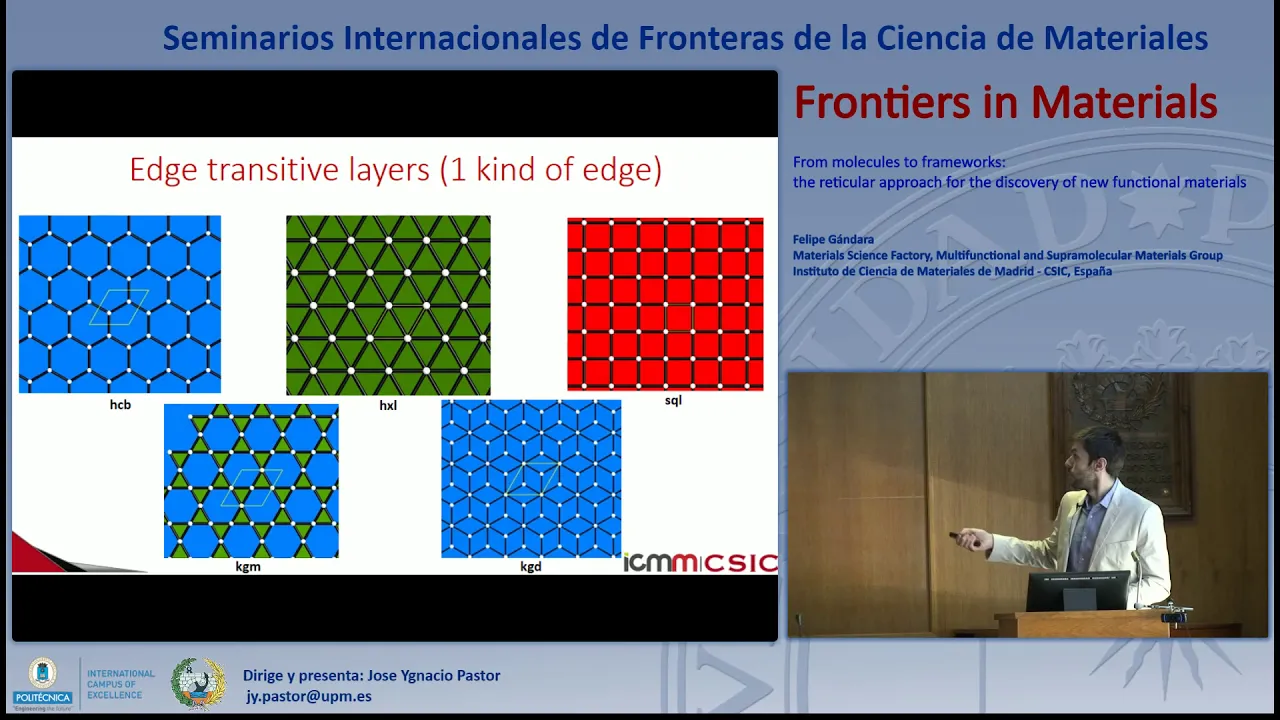


Metal Organic Frameworks (MOFs) are crystalline porous materials composed of metal centers (nodes) connected by organic linkers (spacers), forming three-dimensional networks with enormous surface areas (up to 40,000 m²/g), which enable diverse applications in catalysis, gas storage, drug delivery, and biomedical imaging due to their tunable pore sizes, high stability, and ability to incorporate various metals and ligands for customized properties.
Introduction to Metal-Organic Frameworks: Synthesis & Applications
Added:Coordination Chemistry: Understanding coordination bonds, transition metal chemistry, and how metal ions interact with organic ligands to form complexes.
Basic Solid-State Chemistry: Familiarity with crystalline lattices, unit cells, and the physical concepts of porosity and surface area.
Organic Chemistry Fundamentals: Knowledge of functional groups (such as carboxylates, phosphonates, and nitrogen-containing heterocycles) that act as organic linkers.
Post-Synthetic Modification (PSM): Exploring chemical methods used to modify the organic linkers or metal nodes of an already synthesized MOF to tailor its properties.
Advanced Characterization Techniques: Learning how to analyze MOFs using Powder X-ray Diffraction (PXRD), Thermogravimetric Analysis (TGA), and gas adsorption isotherms (BET surface area calculation).
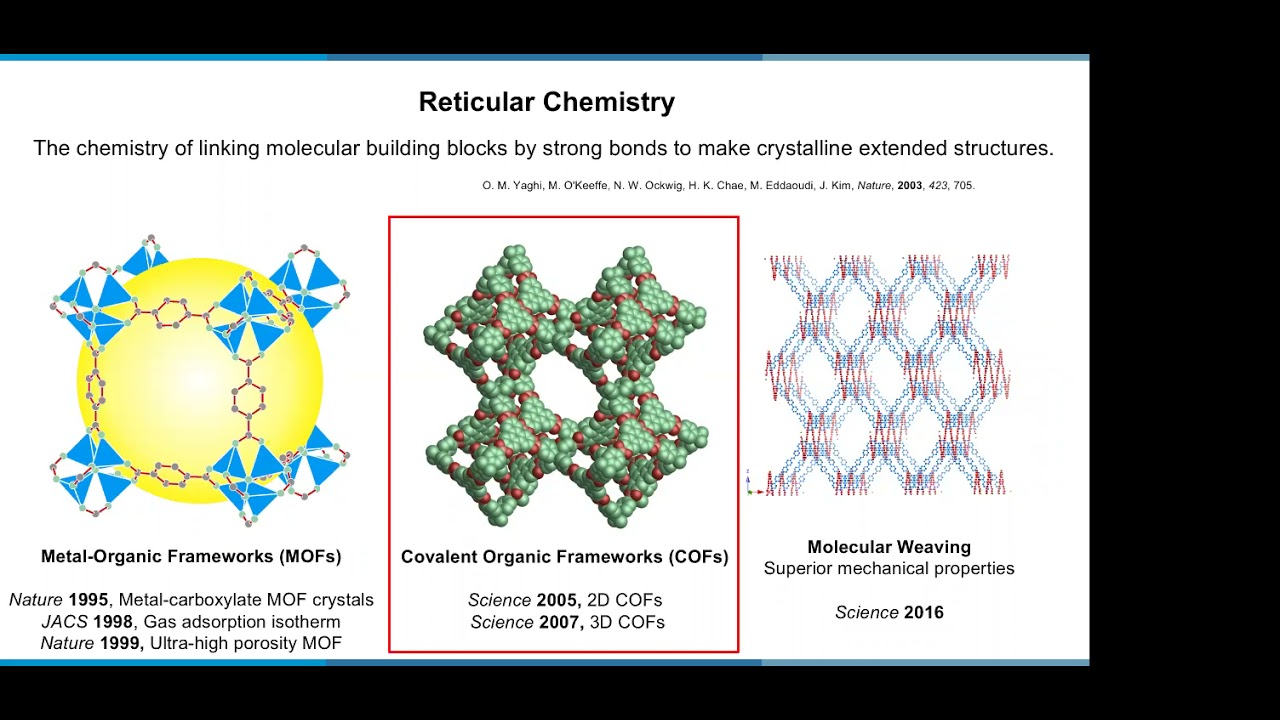
Covalent Organic Frameworks (COFs): Investigating metal-free, crystalline porous materials constructed from organic precursors and comparing their properties to MOFs.
Targeted Environmental and Biomedical Applications: Studying advanced case studies in carbon capture, water harvesting, selective gas separations, and nanoparticle-functionalized MOFs for drug delivery.
4.7K views84likes53:35Original Release: 2020-07-08
and for the future metal organic frameworks are polymers so it is not a person so this is a 3d polymer in which in instances so these are the same porous materials whereas the other materials which are polymers which are 3d and most of them were not crystalline if they are slender honest it is very difficult for us to see a strength property as well as Boris property and these can at least metal organic frameworks or basically synthesize 500 carboxylic acid with by and rival metals a little difficult to understand all the systems in the coming slides are let's find one by white people so these are usually synthesize and solve with different conditions and they're very important and very interesting property of this parabolic framework is think I saw ridiculousness so the device an articular means retaining the same structure and enhancing its property you can see if there is a local diagram and this diagram conveys what is ISO reticular properties the yellow column is the cavity inside these chambers and by keeping the shame which is the cubic structure we can increase the size of the cavities so this is called as I selectable a synthesis and are not many materials as such quite often property so this is one of our very first engine that an important property of commit recording framework which is processes so I think middle of money framework consists of a three important aspects in then one is unknown the other is a space is a cavity so cavity is nothing but an empty space so these empty space makes us to be a porous material and nodes are nothing but the metal centers so metal centers called stupid nodes so the each metal center is connected by a linker or it is called a spacer so these fascia connects these two metal centers so we solve the cube instruction or mq place for videos these are the cosign for as materials so it has got a definite shape on the crystal structure whereas the other is non-porous materials though we have this hole in our charcoal or carpenter hiding that mean all those all those forest carbons does have a lot of authenticity is done whereas it is not crystalline so this metal organic frameworks is crystalline in the same way this porous in nature and the parent of this so ed Lavandera gloves are born from zeolites so zero rates are already existing for us the same substrate which is present in nature as well as in aluminosilicates composites where aluminum in the silicates form together form of porous polymers which are used mainly as catalyst under subs orphans come across low lights in many forms but no one knows the burning framework the dental patients do name so it does not have very very high stability as compared to the capacity of its demanding for they one of the development which is from sigma-aldrich and variation with our company's burning framework the surface area which is equality in one gram of a substance it was absent the active surface which is available for molecule to work on is around 40,000 square feet so one gram of material has such a huge surface area which is like a benchmark the surface materials the metal the metal organic frameworks refer to nothing phenomenal so I thought I should produce metal what is the matter so matter so this is this is the periodic table of elements which are north of an time so in most of the blue color highlighted are metals and those who stare at local the highlighted of non metals and metals constitutes most of the for further other nonmetals more material to us so an one important metal which we all know which are familiar of soul as well as silver so this gold and silver are used in the native state which is thick nor metal oxide or in any other context it is used percent similarly they have copper let in a stinking liquid also used in its eight extent so when and possesses some unique properties with this little unsure which is called as training so in the Middle's as the property for shine it has a property to be valuable and that values can be fitted the sheets or drawn into oil and metals are good conductors of heat as well as electricity so the other important property water other important property for a fatalist celerity so when else contained consists of in the very difficult out which we call the scenario arrived at Alex on the middle tends to form a positive ion by giving up electrons the other one is metals are metals of ionic as well as covalent bonds and here are a few examples of metals which we come across daily or which we take in our coordinate when the sodium the other is potassium another is I am so these are the very typical forms of metals which we intake in a per daily food which a very radiation cell for the life of the so degrees in the quantity of any sense decrease or increase in the quantity of any of these three matters can have a severe effect service so sodium sodium will be being taking the form of a sodium current which is follows an ionic compound CIN goes into a body in the form of a heel so whatever proteins we eat generally contains iron in the form of an e so these are the two forms of metals which is popularly and the one is like ionic form the other is been complex metal complex so here we have the concentration what is many complex so metal complex consists of and metal center in this case it is an iron and this is the this scheme is essentially purpose which is present in everything work Rubin also so this is an x and i said that as well as an organic moiety which is called a silicon so middle metal complex that is a better center as well as organic compound organic moiety which is called a silicon then many subjects are more stable there is ionic form as well as metallic form so if i take a metal and keep it in its original form dan when a company converted into an metal complex the metal complex tends to be more stable when expand it is compared to the metal its moment in the ionic forms organic organic says the apart so the liquors are made up of organic molecules so remember the organic compound which contains hetero atoms in the ventricle acts as a building block on the binding sites to form the metric on business so these are other ways that we can present and create sites in which these hetero atoms functions and the negative sign and then bond to the metal centre so the most common a to-do items which are present as the regards our oxygen nitrogen and sulfur here are the few examples one is hydroxide cyanide water ammonia is good yes water can also act as a ligand so he coordinates to a vendor Center PI of the oxygen bond an ammonia which is very important free of urea can also want to the middle way our nitrogen and carbon monoxide as well as is inside it so then we say the carbon monoxide is from boxing equipment because we meeting here further alongside the carbon monoxide bonds a very very strong bond with a heat which we are we said showed it in the previous life the carbon products eight-balls very strong to then kick him so that these nitrogen's are removed which means that the hemoglobin stops functioning which means the intake of oxygen is reduced so that's how this happened one of Eddie's Thomson filaments so because of the binding nature because he carbon monoxide binds more strongly than the him proteins the gas can be classified in many different ways and based on the number of magnetic signs which is like binding sites the gun can be classified into go rodent a right in and right and a few guns as well as if you have more than three sites it can be consolidated bigger for example here we have full particles one is benzoic acid in business if you have burden now what we call this Co ovens the oxygen yd can bond to the metal the oxygen quality has gone to a better stand then if you have a bed earlier the metal center similarly similarly we have gotten panic as we just got a two binding sites so it is fun to survive it take become three binding sites so because it is right in Africa so you can also be termed as Delta city so which is think more or anything violent aid and protect a chicken's so these are very important terms for the to understand what is metal organic frameworks and although we see the seismograph in it so these are more oriented ligands binding the arrogance and pride and arrogance and these are the other examples of pirate ninja clans so in this case if escape retirement in which medicine in act as an anchoring site for the formation of complexes similarly these are same be written similarly oxygens can also act as a benefit to the middle sentence which is polish acetate and this is form is obsolete and choice of returns for the preparation of metal organic frameworks example if we take if I take a picture a cancer remember I said like metal organic frameworks or 3d polygons so they need to extend in all three directions so if I take a leak on door bill so I can set and then I am trying to make a complex so let's assume like this impeller is this part and then the blue color is the other organic part so this is the anchoring pillar is the anchoring side whereas the blue color is the daily paper so defender centre - - and I am getting far and since the metal can coordinate with three other middle same distance as you like the metal and cottony or can attach to three other anchoring sides so now this is saturated cannot extend to the other dimension whereas if you have a terephthalic acid which has two anchoring sites so this is one click on so we have got an organic path and after both ends you have got an entering sense so now this can this one Lecompton and between two sites so similarly Carozza overtaking sites and can be expected this game similarly I can put on my metal set in here and which can be extended and extended and this structure can be expedited whereas this structure with this so if you have some development close or in works I have this is differences it is present in its 1 2 1 3 positions which is present in 1 2 1 1 3 years of the positions so if I have it in now if it happened in this form it can be and these the different metals and that's can again be different so which can be 2 comma 3 it can be saturated here only cannot extend this way for this mean this is my ass fellows is that dimensions so if you have to choose this is this this could be the choice of metal organic frameworks whereas this cannot record yourself again repair only a metal complex not in the three-dimensional structure so if you have to prepare a 3d God which has gotten symmetry between them like we should have into incidentally in the world in the Monday night the other [Music] they said we have got any doubt that you can comment in the comment box I will be later will immediately he still free to stop in between so that others can also understand they are will improve so the little choice of metals for the aluminum calcium chromium iron and zinc and zirconium so these are the cheap metals which are not noble metals so kind of very cheap manners prepare many modern structures you can see like these are the examples of the guns or which are available which are available this is called this vintage books the crafts it previously was named this means filtering gassing so these in this structure is same but you have got it different in its one position you can see there is a small small substitution which I have presented all these places so these make them be DC it will be simple PVC now if I use a bit Hollywood today introduce on it I may not use again different electronic property for a different chemical property to it so we are altering the small changes in its positions we can order this physical properties as far as properties physical properties like the material can observe molecules or observe molecules chemical properties are the catalytic properties on a desktop Zipcar non-toxic i called SOS mine Oh watch the molecule can be see observe this in this regard I introduce hydrophobic properties over the hydrophobic property can be increased by introducing this molecule whereas hydrophilic property can be hydrophilic water loving property can be introduced by in water and this water is metal salt has Philippine ligand is dissolved in water and if we heat that solution to a temperature of the solid other than EMF or DMA see something like that right at the bottom I take a solution of such kind of a compound and then it can be called a solver the thermal heating of that solution and now it's boiling on is called a solvent analysis so if we eat the solution above its boiling point it is corners on both it when synthesis and these are all symbols in the spread unis highly porous materials and highly stable materials whereas the growth chemical method is just grinding of two substances it can be related to solids or to liquids so these can be bulleted and mortar and and grind it to a fine powder so these fine powders can also give us an opening frameworks or a theory porous materials and the porosity is not as cute as that of solve other collectives solvent Emily prepared metal organic frameworks are more stable as cholesterol conditions whereas normally the glow chemically prepared up in 25 words or less porous and less less porous it is also not really stable should not was chemically stable and here is one such example of committing frameworks and they must attack I am coming from and then substitute that benzene dimer box because it the R stands for the substitution previously we sonic over substitution we are substitution or substitutions so these are positions can be referred as are you so with this I can prepare another examples which is given as name is ma la vie so this L stands for materials from Institute of loves so these materials if we discover new members these can be named after the lab name so it has gotten in such kind of another context so these are this is the Institute of flowers which is it friends so in the structure of material is like this so it has gotten porous structures then I am lot of voids in it and then are this moiety is the one which you see it in color and those are the metacenter scale so this is one set examples I want to so when we see the structure of the molecule and the microscopes and these look like this in snake and spindle shaped molecules so this is this molecules especially has got at one important property like he can vary size in different solvents they make this material it will fill up our instruction shape and if if it is printed with small amount of water in style he can swell up to 700 nanometer if the water was substituted by methanol in can sell up to 800 of these I put it another soreness time at the bottom where it can swell up to 900 nanometers so this is one property of aquatic chambers which can be exploited also so these this compound is thermally stable as well as chemically stable so the applications of recovering frameworks from various speeds thank our super capacitors lithium-ion batteries electro catalyst photocatalysis and it is for the production of fine chemicals addresses for the production of immigrants as well as sins in so I am going to give you a few examples of very famous in its application so these can be used for the production of wraps if your body uses contact anybody so this bedrock unique frameworks can access and carrier for the delivery in case of cancer cell line it has to be very very targeted chemotherapy if delivery is very tough return the gas the spinning the minimize and the robots in hears of chemotherapy so these technological fail Mexican acts act as a loading material for the drugs delivered in such a way that it goes to a particular spot after it delivers difference and these frameworks is biodegradable and non-harming in human beings so did so with the help of ice and declare synthesis a large metal organic chamber can be synthesized in a small and can also be synthesized with small size so with a built folding the chemical and physical properties for example I try to Medtronic framework business of lot size and in mind if efficient delivery system but the bolts in the sense of mariner sighs so this can also be reduced with the help of a nice reading flat surfaces metal organic frameworks we can with the help of suitable agents and transition metals it can reduce the toxicity of a human body so when we make into a human body and the toxicity can be nullified also like if you take an iron compound which cannot be toxic America because when it degrades in producers as I am as well as a Turkish tannic acid which are the operands of given body so which can be absorbed in forgiving so this lower doses also extend the time of medication in our body length since it is a very targeted mechanism the exposure or the healing of the cancer cells are very effective and the side effects are highly reduced because the cells are highly targeted and it is treated so as I said like the large the large moths or mid no guarding favor expanding and then even animals so this nano site reduction allows them to be systematically circulated throughout the body but it does go to the property even vinícius design secretin nano me nanometer scale it removes the properties of the bulb across but it is small size so that it can be circulated innovator spray the plant cells this is mid-level in facebook Cornelis emailing in Mal 1 0 1 a.m. was used for the imaging purpose so this is this whenever the drug is introduced we can find out where the Turkish exactly reviews and what was the other part of the vital organs in which the present suppose if I have if you have a particular type of cancer and throughout the body but it cannot affect the whole body so we can monitor the movement of drugs with the help of the money so the help of this the images can be proved essential aging or MRI imaging and then if you can find where exactly the track star which which in other words is it if you locate where the better connect same books we can locate where the correct sir if next are loaded onto the Metro going back so that for the future it we know we can we can follow it from Paris he can also be used as in molecular Tufts we have seen machines or agents which happens in all vehicles all vehicles and there are molecule emissions which are also a presenter and this was made to be possible with the help of boss so these replays is a liquid for cells for the outer electrode in the studies so it can be called as a light stimulus say if we apply a mechanical force these molecules convey to them for example we have inner self refining polymers so these cells preparing particles are basically which has got a molecular properties so these simplified apologize or self repairing ions which we use in peels are of such head of the chemical properties so many local examples and we use certificate of obligations so so so so so can bestow similarly the development of fuel cells are currently limited so he feels as if he could successfully stored hydrogen so part of it so exactly in 2018 from you guys have published an article saying that they have reached the highest point in which Medtronic so so [Music] [Music] [Music] [Music] [Music] [Music] [Music] [Music] [Music] [Music] was like oh we should say like the Quran us whereas for the navigation of the ocean using bipedally framework just took 17 minutes missing from 600 appearance it has become these 70 minutes so increase increase in the surface area has improved the reaction man similarly the previous reaction with single measurement robotic frameworks becomes around - and now it just takes around 40 minutes so the activity can be by introducing of change with the moment so with such capacity you will engineer so that the properties can also be and it's limitless potential in many fields length it has got myself a CGI can be used in biomedical application it can be used for the kinetic application and for the solid so it can be and these are both chemical methods has to be improved for that the activity for the stability of the molecules are starina so very unique [Music] [Music] [Music] [Music] [Music] [Music] thank you [Music] in the mailbox there got a question like distinguish between like meant learning frameworks this mosque validation polymers and metal openness metal mechanics then because classification is the coordination polymers so all these comes in the coordination polymers if we have a wonderful session in the previous slide till a few touch nation metal organic frameworks are three different polymers which is take if you have one time is generally called as one day mr. quantization qualify or demos the quality sleep whatever if we have a three-dimensional structure it can be termed as a metal body tremble and these structure has to be limiting or it's more it has to be crystalline nature Thank You Santa [Music] [Music] there is a particularly the application of the compounds ones are chosen on the basis of middle is only comes so I think it is the combination of both so it depends on the activity in which you went to study this it has to be balanced properties of both Mandela as well as aleikum if I have to prepare a cheaper catalyst have to go for its dependence if I have to go for it now very very advanced your high active metals it will be like cost-effective it is not be cost effective whereas d'Elegance if we have to choose biomedical application these has to be from six the length in has to be filtered of DMF it shouldn't rain amount of cells or molecules or negative multiples so these can the toxicity of the ligand has to be taken into account then we use it for a biomedical application if the toxicity of metals has to us also we take it but I think it is the balance of both in which where it has to be [Music] [Music] so there is a person like could you please explain about ISO reticulum synthesis again so in this slide we can see there are lot of similar structures we have seen a cube like structure so these future has single unit of metal-organic frameworks but when we see this this is the smallest view and it goes down and it becomes a largest you so this is the smallest one response to you love this view so buying this target the cavity size is love but the shape of the cube is always depends so this cube is called s and larger form of this form small of me so such kind of a synthesis where the chemical properties physical properties and these structures are kept away but the whole size is larger so instead of SSS I should take the next plane inner thank you any more questions it makes platinum by compatibility of course biocompatibility on pop that's what acai is acting for the latest fashions biocompatibility bring into account immediately take this the new yarn is going to become sick preferences what about the size of the metal organic frameworks so I think these all it has to be taken into account to take the biocompatibility and though if you take all these paper literature it cannot be biocompatible and only when we list it if we can know we can be hundred patients you are about to expire in the community or award or to make sure it is biocompatible we can have a smaller box we can take a listen toxic or at the pendant pendant and then those ligands which are not hostile to bodies thank you thank you ladies and gentlemen or heavy mobs or magnetic in nature here I want to select not all ions are magnetic in nature there are very few magnetic moths are available and the one in the center if he moves is not magnetic in nature which is that can't be a man magnet these are not magnetic in nature because these are just having copious amounts either it has to be like in0 compound or and the combination of a people-person Fe three-plus they use magnetic property [Music] [Music] [Music] [Music] this city has a very distinct Westin he has a sling how come single pedal and fixed middlemost a stable structure we could see like iron and nickel two different mittens and how it can form a single firm home based on this lift we have to think for the ionic radius of these mittens so here you can see like the one is maybe two plus sorry Nikolas in Fe 2 nickel is in fest to stay and I innocent Leslie steam it is like the ionic radius of a stiffness and the ionic radius of nickel 2 plus or close to each other so this is why it is able to form a similar structure so if they take and only three metals are compared to be like this what is heavy thickness nickel 2 plus this or the ionic radius of all these metal ions are similar it's similar in radius so that's the structure is reading I have to inform one more thing that if any have to prepare one Lilith weakened I will not get civilization when we will be substrate when you when we can instead of 1 million billion them if we substitute to repel in front of you I am like the stretcher is not we have left with few more minutes so if you have any questions you can just go ask me questions in the arcade go on ask me which is there is no compulsion that you should this put it on chat go on ask me equations [Music] okay what's up I guess people are done with equations okay so what what is the next kind of thing probably that you're going to take it on next Sunday okay so we will be having the eeo the extension part of this particular entire thing plays happen to me an introduction kind of thing so the next Sunday you will be having the detailed one so thank you so much for joining with us people thank you so much for taking on this and yes thank you you check the chat here so we have back link as well as the review link of easy so please post your feedback on this particular webinar link will be active till midnight and you can this review as on google page also so that we will be having the motivation to improve ourselves also thank you so much everyone thank you so much person so we wait for the next presentation session on Sunday wasn't all participants thank you for this thank you stay stay safe thank you so much but a good thing thank you so much people will meet you tomorrow evening I brought in another when Megan are of the same kind then bye good night
Up Next
90:11
Turning Air into Alcohol: A Chemistry Experiment
@NileRed
302.6K views•2026-08-05
83:56
Biocatalysis and Catalysis in Islatravir Synthesis | Merck Webinar
@SCIwheresciencemeetsbusiness
675 views•2020-10-08
10:06
1H NMR: Determining Number of Peaks from Structure
@MSJChem
59.2K views•2017-04-06
17:31
Edible Water Bottles: A DIY Guide to Sodium Alginate Spherification
@ryan
10.5M views•2019-06-21
Related Study Plans & Knowledge Roadmaps
Structured learning paths in Chemistry
chemistry
Nuclear Chemistry: Decay, Meds & Fuel Cycle
01Introduction to Nuclear Structure and Radioactivity
02Decay Dynamics and Kinetics
03Radiation Interaction and Detection
+ 2 more learning modules
24h5 modules
Explore Roadmap
chemistry
Supramolecular Chemistry: Forces & Machines
01Foundations of Chemical Bonding and Intermolecular Forces
02Introduction to Host-Guest Chemistry
03Thermodynamics and Dynamics of Self-Assembly
+ 2 more learning modules
16h5 modules
Explore Roadmap
chemistry
Photochemistry: Excited States & Reactions
01Foundations of Light-Matter Interactions
02Molecular Orbitals and Electronic States
03Photophysical Processes and Jablonski Diagrams
+ 2 more learning modules
18h5 modules
Explore Roadmap
chemistry
Coordination Chemistry: Bonding & Properties
01Introduction to Transition Metals and Ligands
02Crystal Field Theory (CFT) and Geometry
03Magnetic Behavior and Spin States
+ 2 more learning modules
14h5 modules
Explore Roadmap