







![[2BAC SM] [L’Arithmétique partie 03][Bezout- Gauss - Fermat -corrigés nationaux :2024 N+R et 2023 R]](https://i.ytimg.com/vi/On1fPvaRpsw/maxresdefault.jpg)
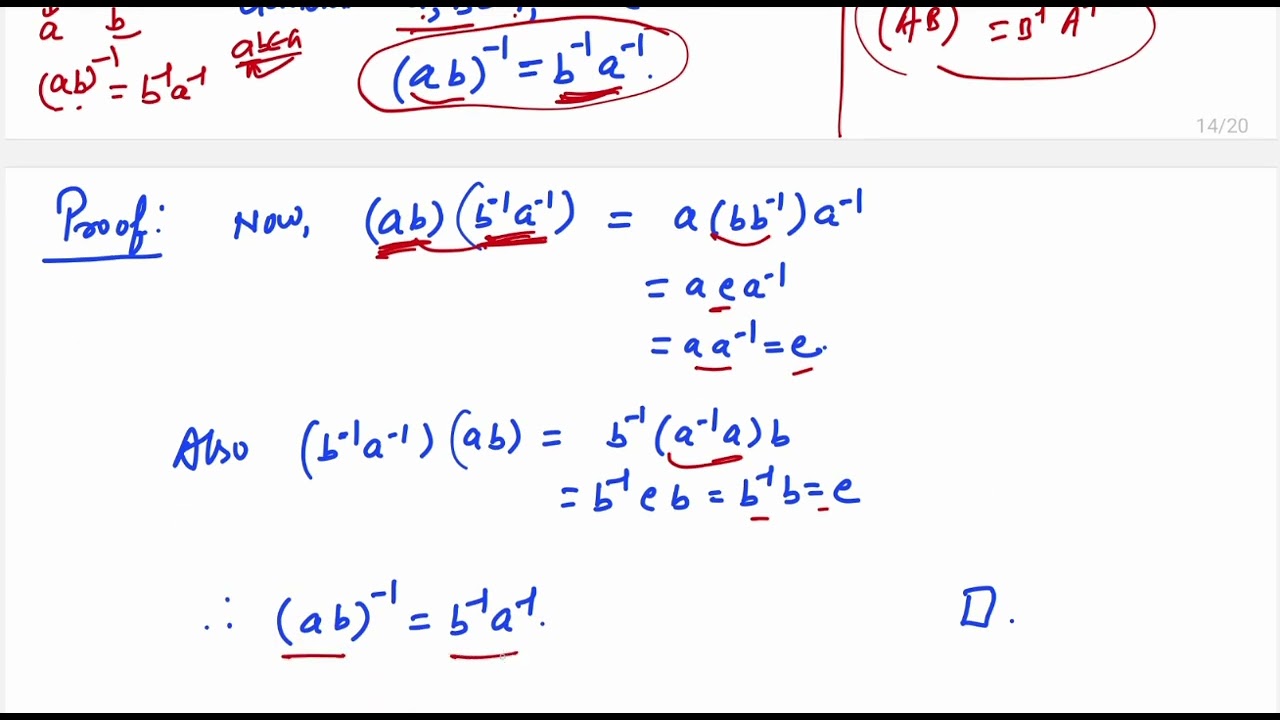

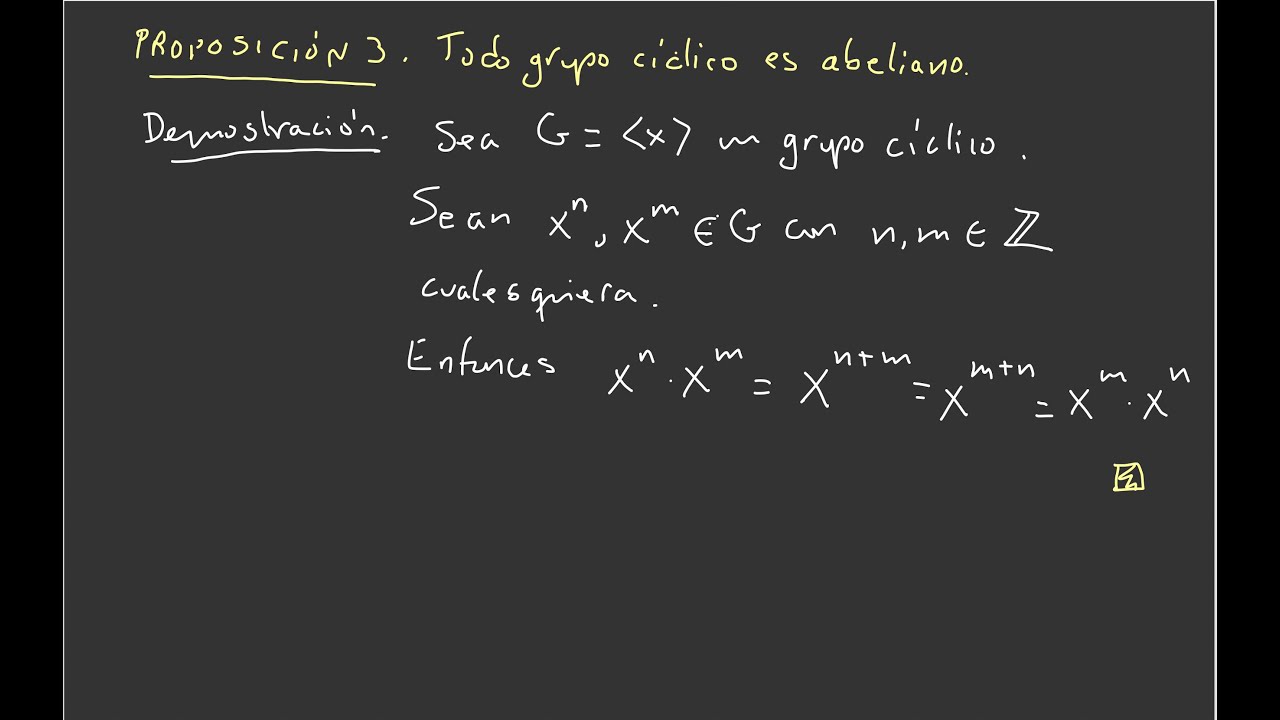




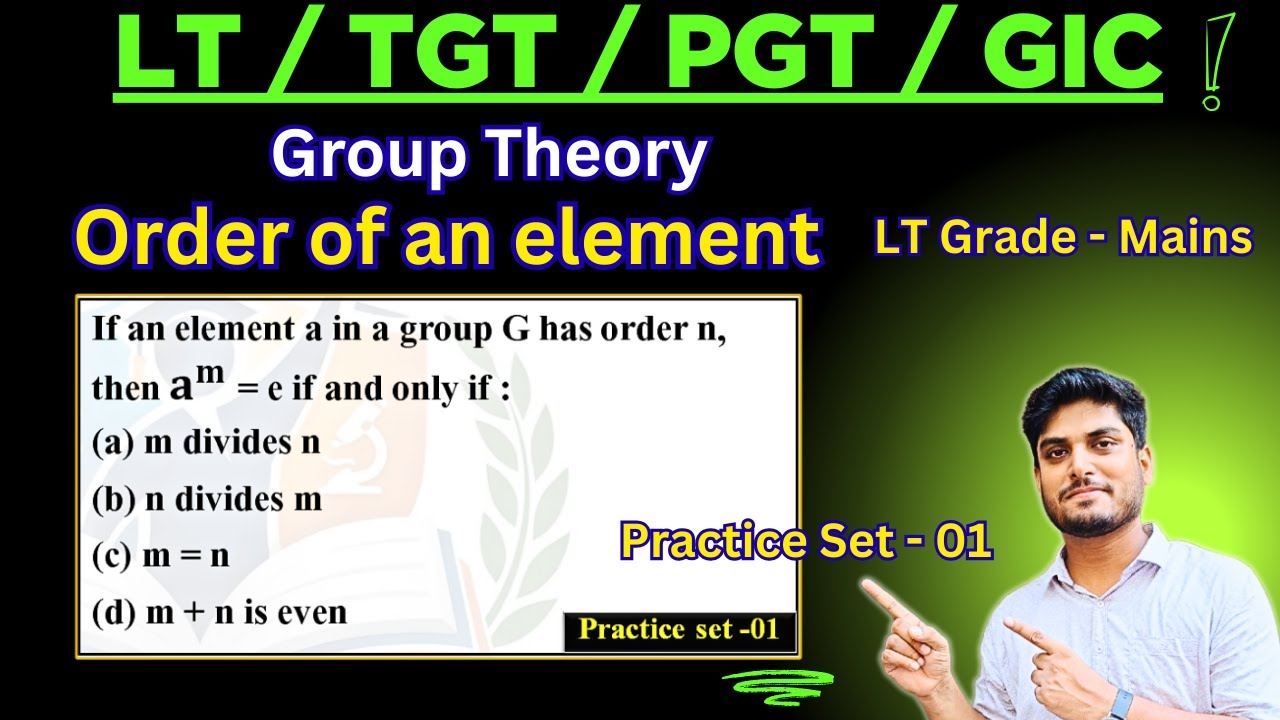






A cyclic group is a group that can be generated by a single element, meaning every element in the group is a power of that generator; every finite cyclic group of order n is isomorphic to the integers mod n (Zn), and every infinite cyclic group is isomorphic to the integers, while every subgroup of a cyclic group is itself cyclic, formed by all powers of some element in the group.
Cyclic Groups, Generators, and Cyclic Subgroups | Abstract Algebra
Added:The formal definition of a group, including the four fundamental group axioms (closure, associativity, identity, and inverses).
The concept of a subgroup and the standard methods (like the one-step or two-step subgroup tests) used to prove a subset is a subgroup.
Basic number theory concepts, particularly modular arithmetic, divisibility, and the greatest common divisor (GCD).
Understanding group notation, specifically the difference between additive notation (e.g., multiples of an element) and multiplicative notation (e.g., powers of an element).
The Fundamental Theorem of Cyclic Groups, which characterizes all subgroups of a cyclic group and their generators.
Lagrange's Theorem and how the order of an element (which is the order of the cyclic subgroup it generates) divides the order of the finite group.
Properties of Euler's totient function and how it is used to determine the number of generators in a finite cyclic group of order n.
Applications of cyclic groups in modern cryptography, such as the Diffie-Hellman key exchange and the ElGamal encryption system.
55.5K views868likes10:38Original Release: 2022-10-31
we're going to introduce cyclic groups we'll see the definition a few examples and then an important isomorphism concerning cyclic groups then we'll briefly introduce cyclic subgroups and a theorem concerning those let's get into it here's the definition if G is a group consisting only of the powers of some element a then we call G a cyclic group and we call a it's generator so the entire group is generated by this single element a we write it like this G is the cyclic group generated by a these angle brackets denote a cyclic group and within the brackets is the generator so that's what this notation means G is the cyclic group generated by a now notice just because G has all the integer powers of a that doesn't mean that g is infinite since a could be an element of finite night order so even though we might have all integer powers of a a bunch of them might in fact be the same so our cyclic group could have all sorts of different orders let's see some examples then of cyclic groups a very basic example is the set of integers the set of integers is generated by one under addition when we're using multiplication notation we talk about the powers of a but if we're talking about the integers and addition we would be talking about the multiples of one and certainly all of the integers are generated by the multiples of one so the integers are a cyclic group with one as the generator so we could write that another example is the integers mod 8 all eight elements of this group are generated by one interestingly we could also generate this sick click group with a different element like three for example let's just check that by going through the multiples of 3 mod 8. the first multiple of three would be three then we would have six then we would have nine mod eight which is one and then four and then seven and then 10 mod 8 which is two and then five and then eight which of course mod 8 is 0. so we see how the multiples of three generate the entire group of the integers mod eight indeed they are generated by one and three see if you can find a third generator for the integers mod 8. next we're going to move on to discussing an isomorphism concerning cyclic groups for that discussion it will be important that you're familiar with this result that an element of order n has exactly n distinct power hours and if an element has order Infinity then all of its powers are distinct I'll leave links in the description to my lessons proving these results okay let a be a cyclic group generated of course by a where a has order n that means this cyclic group generated by a will have the N distinct powers of a from the identity Element e or a to the zero all the way through a to the N minus one then we could consider a correspondence with this cyclic group and the integers mod n the integers mod n of course contain 0 1 2 and so on all the way through n minus 1.
it is plain to see that there's a bijection a one-to-one correspondence between these two groups we could say that this function Maps the integers mod n onto the cyclic group generated by a and the function is defined like this F of I is simply equal to a to the i f of 2 brings us to a to the 2 for example this function has an interesting property which is the F of I plus J by the function's definition is equal to a to the I plus J but then by our exponent laws a to the I plus J is the same as a to the I times a to the J but then again by definition of our function that's equal to F of I times F of J so in fact by definition this bijection between the groups is an isomorphism let me take a moment now to discuss notation see inside the function we we wrote I plus J because I and J came from the integers mod n which we are treating with the operation of addition however we write F of I times F of J because for the cyclic group generated by a we've chosen to use the multiplication notation regardless we see that combining the elements in the integers mod n so doing I plus J and then sending it through the function gives us the same result as sending I and J through the function first and then combining them under the operation that is in the cyclic group generated by a so by definition this is an isomorphism it does what we sometimes call preserves the group operation so we could write that the integers mod n are indeed isomorphic to this cyclic group of order n generated by a and the only thing we assumed about this cyclic group was that it's generated by an element of order n so here are our big takeaways for every positive integer n every cyclic group of order n is isomorphic to the integers mod n pretty cool similarly every infinite cyclic group is isomorphic to the integers this is a very similar result so I'm not going to go through the details here you would just need this result I mentioned earlier that if an element has order Infinity then all of its powers are distinct that way you would be able to draw a bijection from the infinite cyclic group it generates to the set of integers this of course also means that every infinite cyclic group any two infinite cyclic groups are in fact isomorphic to each other because they're all isomorphic to the set of of integers one more thing before we go certainly the integers mod 15 is a cyclic group for example it's entirely generated by one but it also contains some subgroups that are cyclic for example consider the powers of three the zeroth power or in this case we're talking about addition so let's say multiple the zeroth multiple of three would be zero then 3 then 6 then 9 then 12 and then 15 which is zero so we'd actually just come right back around if it wasn't already clear that's why these are called cyclic groups because at least in the case of finite order a generator will eventually complete an entire cycle and then just keep looping through the group repeatedly a couple things you might notice here is that if we combine any of these multiples of 3 3 we get another multiple of three three plus six for example brings us to nine nine plus twelve brings us to 21 mod 15 is 6. if we combine multiples of three we get another multiple of three the second thing you might notice is that if we take the inverse of any of these multiples of three like negative 6 for example this is also a multiple of three negative six mod 15 is congruent to nine the third multiple of three what if we take twelve the inverse is negative 12 which is congruent to three mod 15. this means that in fact all the multiples of three actually make up a cyclic subgroup of the integers mod 15 and this is the last fact I want to point out here is a more General discussion of what we just went over if G is a group and a is an element of G then the product of any two powers of a is certainly a power of a as well notice we're now using multiplication language and notation we could see for example the a to the m times a to the N the product of two powers of a is of course another power of a it's a to the M plus n secondly the inverse of any power of a is also a power of a if we take a to the N its inverse is a to the N to the negative one and this is just another power of a it's a to the negative n so we have closure we have inverses therefore the set of all powers of a is a subgroup of G called the cyclic subgroup of G generated by a so we could write the cyclic group generated by a this is a subgroup of the group G which contains a and in fact this leads us to an interesting theorem which is that every subgroup of a cyclic group is itself cyclic and we'll prove that next time hope this was helpful let me know in the comments if you've got any questions [Music] killing us [Music]
Up Next
17:29
Bézout's Identity Explained: Finding Integer Solutions via Euclid's Algorithm
@blackpenredpen
110.6K views•2018-04-25
4:43
Elliptic Curve Cryptography Explained: ECC, ECDSA, ECDH
@PracticalNetworking
28.5K views•2024-10-21

13:50
Real Analysis: Definition of Supremum and Infimum of a Set
@WrathofMath
173.6K views•2020-11-02

6:00
The Mathematical Impossibility of Accurate World Maps
@Vox
23.3M views•2016-12-02
Related Study Plans & Knowledge Roadmaps
Structured learning paths in Mathematics
mathematics
Tensor Calculus: Vectors to Riemann Curvature
01Mathematical Foundations: Linear Algebra & Calculus
02Covectors, Dual Spaces, and Tensor Basics
03The Metric Tensor and Index Gymnastics
+ 2 more learning modules
40h5 modules
Explore Roadmap
mathematics
Gödel's Incompleteness: Logic, Proofs & Limits
01Introduction to Formal Systems & Hilbert's Dream
02Set Theory, Cardinality, and Cantor's Diagonal Argument
03Arithmetization and Gödel Numbering
+ 2 more learning modules
14h5 modules
Explore Roadmap
mathematics
Galois Theory: Fields, Groups & Solvability
01Foundations of Abstract Algebra: Groups & Fields
02Polynomials & Field Extensions
03Splitting Fields & Symmetries
+ 2 more learning modules
24h5 modules
Explore Roadmap
mathematics
Non-Euclidean Geometry: Models & Geodesics
01Euclid's Fifth Postulate and the Birth of New Geometries
02Hyperbolic Space and the Poincaré Disk Model
03Geodesics: Defining Straight Lines in Curved Spaces
+ 2 more learning modules
15h5 modules
Explore Roadmap