




















![[s2 | 2025] Математический анализ, К. В. Правдин, лекция 25](https://i.ytimg.com/vi/kBUpNIgXNzY/maxresdefault.jpg)
![[s2 | 2025] Математический анализ, К. В. Правдин, лекция 26](https://i.ytimg.com/vi/0nwjqd7GkVI/maxresdefault.jpg)
The supremum (least upper bound) of a non-empty subset S of an ordered field is the smallest element b₀ such that every element of S is less than or equal to b₀, and if b is any other upper bound of S, then b₀ ≤ b; similarly, the infimum (greatest lower bound) is the largest element b₀ such that every element of S is greater than or equal to b₀, and if b is any other lower bound of S, then b₀ ≥ b. Importantly, the supremum and infimum may or may not belong to the set S itself, and their existence depends on the ordered field under consideration, as demonstrated by the example where the set {x ∈ ℚ | x² < 2} has no supremum or infimum in the rational numbers but does in the real numbers.
Real Analysis: Definition of Supremum and Infimum of a Set
Added:Basic set theory and notation, including subsets, intervals, and the representation of the real number line.
The concepts of bounded sets, specifically what it means for a set of real numbers to be bounded above or bounded below by a constant.
Mathematical logic and quantifiers (specifically 'for all' and 'there exists'), which are crucial for formal epsilon-definitions.
The ordering properties of the real number system (such as the trichotomy law and transitivity).
The Completeness Axiom (Least Upper Bound Property) of real numbers and how it distinguishes the real numbers from rational numbers.
The Archimedean Property and the Density of Rationals, which are fundamentally proved using the supremum.
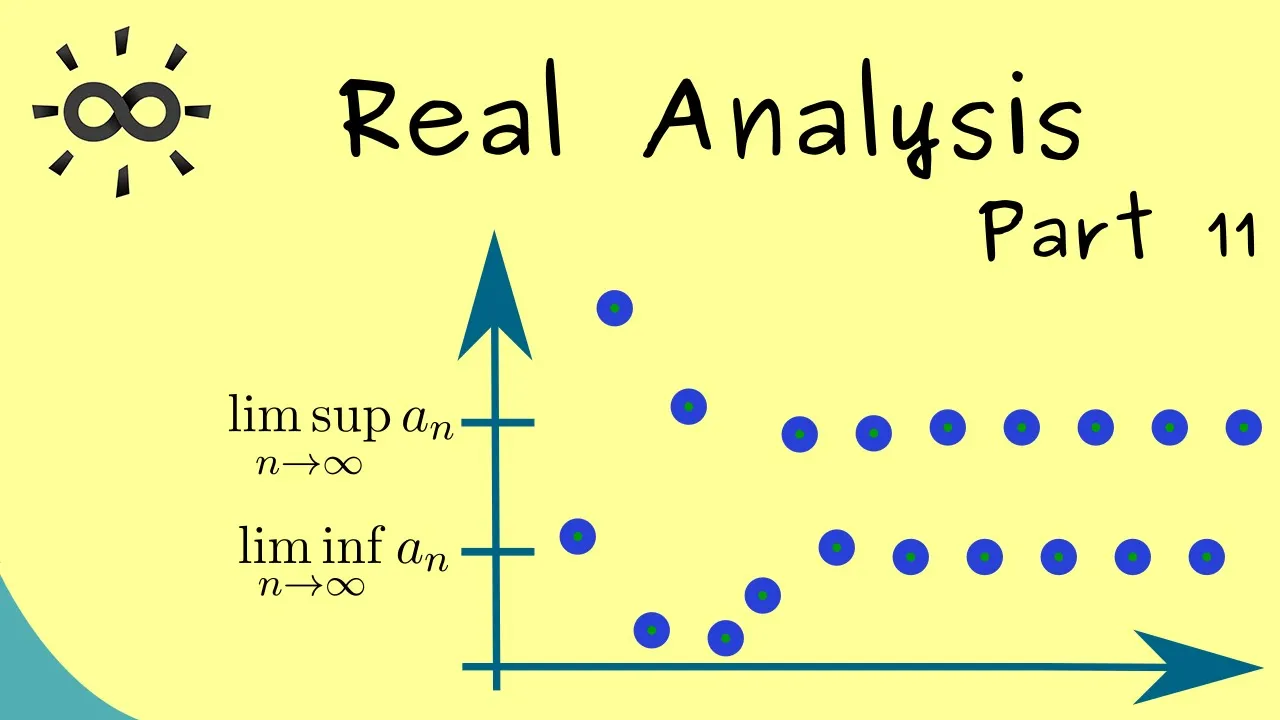
The definitions of Limit Superior (limsup) and Limit Inferior (liminf) of sequences of real numbers.
The application of suprema and infima in defining Darboux sums and the Riemann integral of a bounded function.
173.6K views3.1Klikes13:50Original Release: 2020-11-02
what are the supremum and in femum of a set that's what we'll be going over in today's wrath of math lesson these are very important concepts in analysis so i'll do my best to make them crystal clear to you today we'll take a quick look at the definitions and then we'll get into some examples to help clarify what they mean quickly first let me just offer you these three word explanations of what the supremum and in fema are they really do get the point across effectively the supremum of a set is the least upper bound of the set if it exists a set may have many upper bounds among all upper bounds the least upper bound the smallest one is the supremum similarly the infemum of a set if it exists is the greatest lower bound a set may have many lower bounds among all of them the greatest one is the enthemum of the set now let's read the definition of supremum let f be an ordered field and s be a non-empty subset of that ordered field if ordered field doesn't really mean much to you just read this as let f be the set of real numbers that's often the ordered field that we're most interested in then the supremum of s that non-empty subset of the ordered field the supremum of s if it exists is some b0 from the ordered field such that 1 b 0 is an upper bound of s and 2 if b is any other upper bound of s then b 0 the supremum is less than or equal to b that other upper bound that should make sense because the supremum is the least upper bound so if b0 is the supremum and b is any other upper bound b0 must be less than or equal to that other upper bound b if the supremum of s exists it's denoted like this soup of s for a visual representation of what we're talking about suppose this down here is the real number line and maybe this orange part s is a subset of the real numbers then certainly this number here is an upper bound of s every element of s is less than or equal to this number up here however it's not the least upper bound so it's not the supremum there are upper bounds much less than this one represented by this orange line we could get a lot closer to s say right there that is what the least upper bound might look like visually and so that is a representation of the supremum of s the least upper bound we've got all these other upper bounds up here but that's the smallest one alright now for the infimum let f be an ordered field and s be a non-empty subset of that ordered field again you can just think of s as the real numbers if you want the enthemum of s if it exists is sum b 0 from the ordered field or from the real numbers that satisfies two conditions 1 b 0 is a lower bound of s and 2 if b is any other lower bound of s then b 0 the infimum is greater than or equal to that other lower bound b again that should make sense because b the infimum is the greatest lower bound so if we've got any other lower bound b then the enthemum b0 must be greater than or equal to that other lower bound so if the enthemum of s exists it's denoted like that inf of s let's again represent that visually with this number line certainly this number back here is a lower bound of the set s every element of s is greater than or equal to this number back here however it's not the greatest lower bound so it's not the enthemum of s the greatest lower bound would look something like that of all lower bounds this is the greatest one and so visually that's a representation of the enthemum of s notice these definitions don't explicitly state the supremum and in femum of a set are unique but it turns out they are and i'll leave a link to a proof of that in the description remember these three word descriptions and you should be good to go the supremum of a set if it exists is the least of all upper bounds the enthemum of a set if it exists is the greatest of all lower bounds one last thing to point out before we move on note that both the infema and supremum they do not have to belong to the set s they just have to belong to that ordered field f that s is a subset of so the supremum and in femum of a set may or may not actually belong to the set there are examples of both additionally we could consider a set to be a subset of many other sets for example the natural numbers are a subset of the integers however the natural numbers are also a subset of the real numbers so the ordered field under consideration in a given problem can change whether or not the subset s will or will not have a supremum and in femum that's an important technicality of the definition but of course for many of you the ordered field you're considering will probably be the real numbers but let's get into the examples and we'll see an instance of where the ordered field chosen does matter right near the end alright let's get into it here is the set of natural numbers does this set have a supremum well no it doesn't because remember the supremum is the least upper bound if it exists the natural numbers have no upper bound you could give me any natural number say 10 to the power of 6 and i could guarantee you well that's not an upper bound of the naturals because 10 to the 6 plus 1 is also a bigger natural number so the supremum of the naturals does not exist what about the infimum remember that the infimum is the greatest lower bound certainly zero is a lower bound of the naturals zero is less than or equal to n for every n in the natural numbers however 0 is not the enthemum of the natural numbers because it's not the greatest lower bound 1 is also a lower bound of the naturals because it is less than or equal to n for every n in the naturals too and so we can certainly include that the enthemum of the natural numbers inf of the naturals is equal to one any number bigger than one would not be a lower bound of the naturals because one would be less than it so certainly the enthemum of the naturals is one and note for this example it doesn't matter whether we're considering the naturals to be a subset of the ordered field of rationals or if we're considering the naturals to be a subset of the ordered field of real numbers either way it doesn't have a supremum and it does have an infimum one is both a rational number and a real number so we're good to go either way all right next example how about the real numbers of course the real numbers are a subset of themselves so we might consider the real numbers to be the subset and the broader ordered field under consideration here but certainly neither the infem nor the supremum of the real numbers exists the infemum is the greatest lower bound the real numbers have no lower bound the supremum is the least upper bound the real numbers have no upper bound the reals are an unbounded set below and above so the reals have no enfemium and no supremum alright second to last example got some set builder notation going on here this is the set of all numbers 1 over n where n is a natural the set looks something like this one over one one over two one over three and so on you may quickly notice that the biggest number in this set is one over one which is just one the numbers just keep getting smaller after that so 1 is an upper bound of this set is it the least upper bound is it the supremum yes it certainly is if we consider any number smaller than 1 it wouldn't be an upper bound because one is in the set so you can't get an upper bound smaller than one so one is the least upper bound thus the supremum soup of this set i'll just paste it into our soup function soup of this set is equal to one it is the least upper bound all right now how about the infemum of this set does the infemum exist well certainly the elements of this set are just getting smaller and smaller for larger values of n however they never get negative in fact what they do is get closer and closer to zero we know that zero is a lower bound of this set because zero is less than or equal to the reciprocal of every natural number and certainly if we consider any number say epsilon greater than 0 we would be able to find an n big enough so that 1 over n is less than epsilon and thus epsilon wouldn't be a lower bound so of all lower bounds zero is certainly the greatest one and is thus the infimum so the enthemum of this set is zero and don't worry if you didn't understand that fully i'm not trying to give you rigorous proofs of these results just rough explanations and we'll go over some more rigorous proofs of this sort of thing in future lessons it's just important that you have a feel for why zero is the enfemium of this set notice in this example the supremum of the set is in the set whereas the femum of the set is not in the set all right now we've got our last most interesting example this is the set of all rational numbers whose square is less than two and for now let's consider this set to be a subset taken from the ordered field of the real numbers we know that all elements x from this set satisfy this inequality their square x squared is less than 2.
this means that the absolute value of x has to be less than the square root of 2.
remember that x squared and negative x squared are both equal to x squared which is why we have to involve the absolute value bars here in a previous lesson which i'll leave a link to in the description we showed that an inequality like this implies the following that x must be less than the square root of 2 and must be greater than negative square root of 2.
so clearly negative square root of 2 is a lower bound on the elements of our set and positive square root of 2 is an upper bound on the elements of our set then since x can be any positive number less than the square root of 2 we could conclude that the supremum of our set is the square root of two similarly since x can be any negative number greater than negative square root of two we may conclude that the greatest lower bound the infimum of our set is negative square root of two but remember the supremum and enthemum of a set have to be elements of the ordered field that we took this set from going back to our definition remember we take a set s from the ordered field and the supremum has to be in that ordered field we take a set s from an ordered field the infimum has to be in the ordered field for our final example this seems totally fine the square root of 2 is an element of the real numbers negative square root of 2 is also an element of the real numbers so then all i want to point out is that we could have taken this set to be a subset not of the real numbers but of the rational numbers the rationals are also an ordered field that this is a subset of however in this case the set has no supremum and it has no infimum because neither the square root of 2 nor negative square root of 2 are elements of the rational numbers because of course the square root of 2 is irrational and so for further reading if you're not already familiar with it i recommend looking up the completeness axiom in a nutshell if we consider a set containing all rational numbers but also guaranteeing the existence of infema and suprema of all bounded subsets that is the completeness axiom it completes the rationals to get us to the real numbers and once i do a lesson on the completeness axiom i'll try to remember to leave a link to it down in the description so i hope this video helped you understand what the supremum and enfemium of a set are remember the supremum if it exists is the least upper bound the infemum if it exists is the greatest lower bound let me know in the comments if you have any questions need anything clarified or have any other video requests thank you very much for watching i'll see you next time and be sure to subscribe for the swankiest math lessons [Music] is
Up Next

18:49
Upper and Lower Riemann Integrals with Examples | Real Analysis
@gajendrapurohit
412.1K views•2021-02-10

4:43
Elliptic Curve Cryptography Explained: ECC, ECDSA, ECDH
@PracticalNetworking
28.5K views•2024-10-21
10:38
Cyclic Groups, Generators, and Cyclic Subgroups | Abstract Algebra
@WrathofMath
55.5K views•2022-10-31

6:00
The Mathematical Impossibility of Accurate World Maps
@Vox
23.3M views•2016-12-02
Related Study Plans & Knowledge Roadmaps
Structured learning paths in Mathematics
mathematics
Tensor Calculus: Vectors to Riemann Curvature
01Mathematical Foundations: Linear Algebra & Calculus
02Covectors, Dual Spaces, and Tensor Basics
03The Metric Tensor and Index Gymnastics
+ 2 more learning modules
40h5 modules
Explore Roadmap
mathematics
Gödel's Incompleteness: Logic, Proofs & Limits
01Introduction to Formal Systems & Hilbert's Dream
02Set Theory, Cardinality, and Cantor's Diagonal Argument
03Arithmetization and Gödel Numbering
+ 2 more learning modules
14h5 modules
Explore Roadmap
mathematics
Galois Theory: Fields, Groups & Solvability
01Foundations of Abstract Algebra: Groups & Fields
02Polynomials & Field Extensions
03Splitting Fields & Symmetries
+ 2 more learning modules
24h5 modules
Explore Roadmap
mathematics
Non-Euclidean Geometry: Models & Geodesics
01Euclid's Fifth Postulate and the Birth of New Geometries
02Hyperbolic Space and the Poincaré Disk Model
03Geodesics: Defining Straight Lines in Curved Spaces
+ 2 more learning modules
15h5 modules
Explore Roadmap