













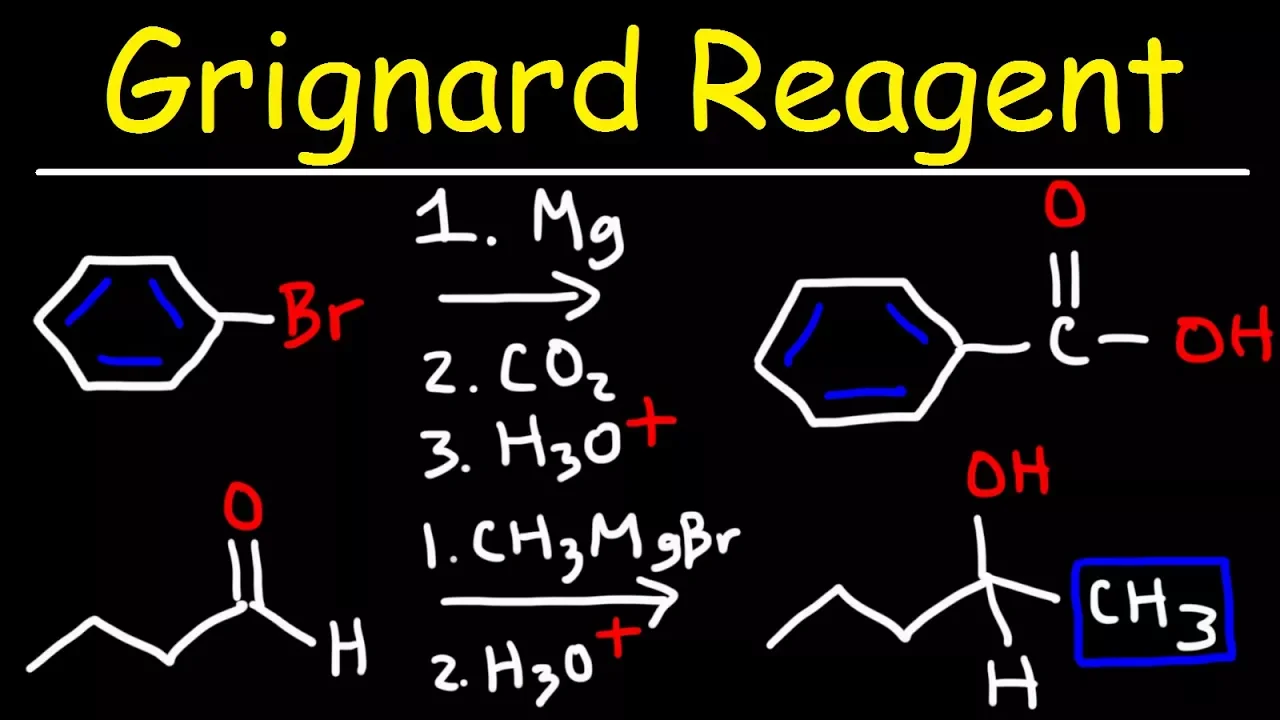



The Grignard reaction, discovered in 1912 and Nobel Prize-winning, involves inserting magnesium into the carbon-halogen bond of alkyl halides to create nucleophilic carbon-magnesium bonds; these reagents react with carbonyl compounds (aldehydes, ketones, esters) to form new carbon-carbon bonds, ultimately producing alcohols after acidic work-up, though they must be handled under strictly anhydrous conditions as water destroys the reagent.
Grignard Reaction: Synthesis of Alcohols and Carbon-Carbon Bonds
Added:Structure and reactivity of carbonyl groups (aldehydes, ketones, and esters) as electrophiles.
The fundamental mechanism of nucleophilic addition reactions in organic chemistry.
Polarity of carbon-metal bonds and the concept of 'umpolung' (reversal of carbon's typical polarity).
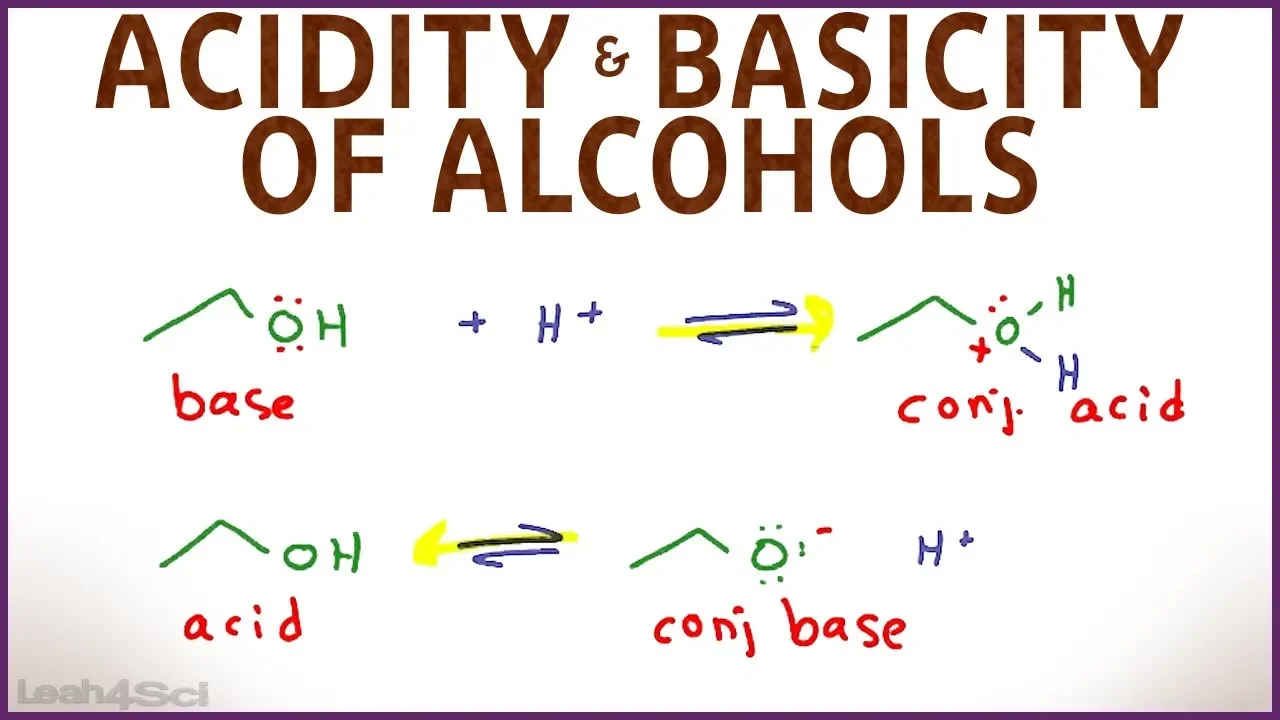
Acid-base chemistry, specifically the high reactivity of strong bases with protic sources like water and alcohols.
Retrosynthetic analysis to plan the synthesis of complex alcohols by strategically disconnecting carbon-carbon bonds.
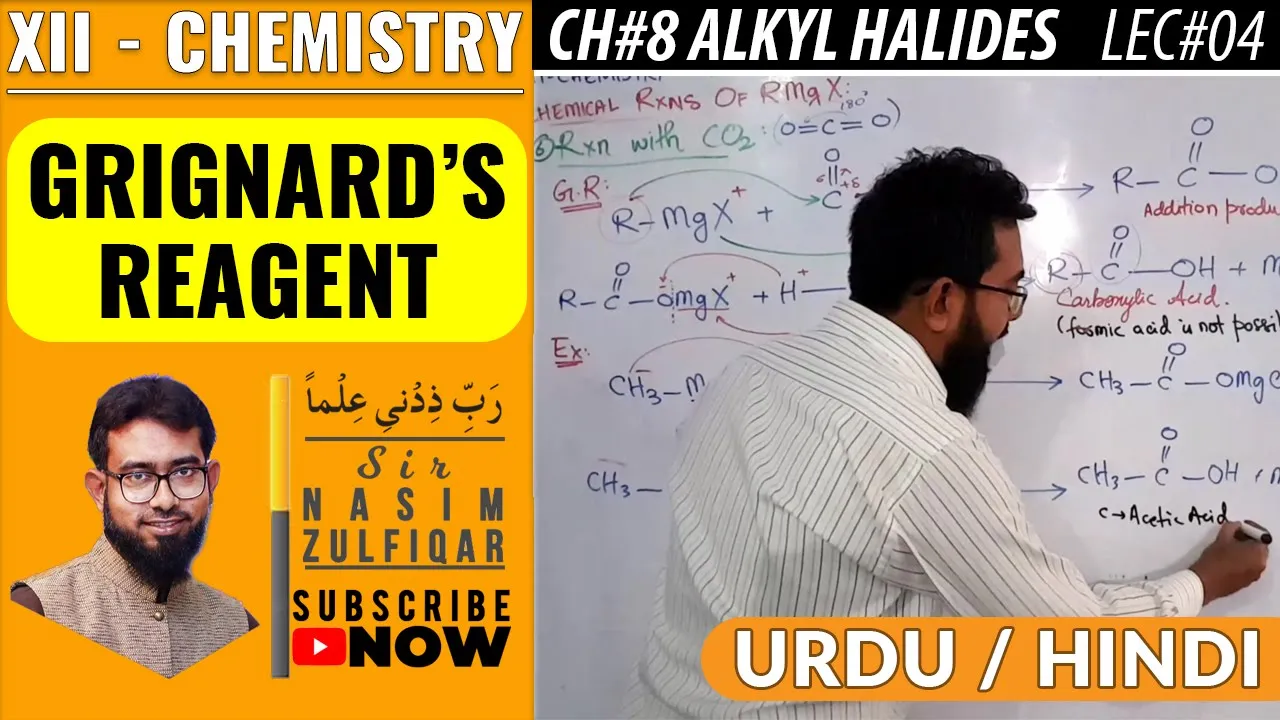
Grignard reactions with alternative electrophiles, such as carbon dioxide (to form carboxylic acids) and epoxides.
The strategic use of protecting groups (e.g., silyl ethers) to shield incompatible acidic functional groups during synthesis.
A comparative study of other organometallic reagents, including highly reactive organolithium reagents and milder Gilman reagents.
389.5K views7.6Klikes8:10Original Release: 2015-01-05
professor Dave here, let's talk about grignard reactions so as I said before it's very important for us to develop techniques in which we can generate new carbon-carbon bonds now nature has its own ways of doing this but there are some that we have invented all on our own so let's take a look at one called the grignard reaction that was developed in 1912 and won the nobel prize because is a very important reaction that we use quite a bit today so let's look at what's going on here let's say we have a typical alkyl halide, let's say it's an alkyl bromide well we know that a carbon-halogen bond is polar right because the discrepancy in electronegativity and the electrons are polarizable so we're going to have a partial positive charge and a partial negative charge over here and that is what we are typically looking at when we're looking at a carbon-halogen bond now what grignard discovered was that this interacts with magnesium in a very interesting way in anhydrous conditions so this is diethyl ether as the typical us a solvent for the grignard reaction on and so magnesium is somehow able to insert itself into the carbon-halogen bond so this works for alkyl bromides we use alkyl chlorides as well and so magnesium is able to insert itself directly into these bonds and now we have carbon connected to magnesium which is connected to bromine okay and now what that does that is interesting is it actually inverts the polarity of that bond because magnesium is actually less electronegative than carbon so now all of a sudden carbon is the one with the partial negative charge and magnesium is the partial positive charge so this is a very interesting situation because typically carbon is partially positive in most organic compounds whether it is a carbonyl carbon or is attached to halogen or something like that so this is a rare source of nucleophilic carbon right we have a carbon that can behave as a nucleophile because it has some electron excess this is called the grignard reagent is an alkyl halide with magnesium inserted into the carbon-halogen bond grignard reagents react with carbonyl containing compounds like aldehydes and ketones so let's take a look what happens let's say we have a three carbon grignard reagent here and let's say this reacts with the two carbon aldehyde so I've got the three carbons the three red carbons here and the two carbons on the electrophile here the aldehyde so what happens is the partially negative remember that now this is a nucleophilic carbon this carbon with its electrons to the magnesium will go ahead and attacked the carbonyl carbon we know that carbonyls also have a dipole, we know that the carbonyl carbon is partially positive and oxygen is partially negative because the oxygen is more electronegative than the carbon so partial negative reacts with partial positive all we need is some electron excess and some electron deficiency we have a chemical reaction so this carbon attacks this carbon pushes the pi bond up here to generate the oxyanion and now look at what has happened, we have this three carbon fragment and this two carbon fragment and we have generated a new carbon-carbon bond between those two carbons now with the grignard reaction it will always always always be the carbon that is bound to the magnesium which is the nucleophilic carbon is forming a new covalent bond with the carbonyl carbon so this and this are now connected so there's our new bond there and then the other carbon is there too and then an oxyanion and this will have the MgBr plus will kinda hang out near the oxyanion and so this is one step real quick we've generated this and then a little bit of aqueous acidic work up and we'll protonate that and we will get are five carbon alcohol so this is a very powerful technique because in one step we can assemble a larger carbon skeletal structure we've got a three carbon fragment and a two carbon fragment and now we have a 5 carbon alcohol so this can be very powerful so the one thing that we want to summarize is that a grignard reagent will react with a carbonyl containing compound in order to generate an alcohol so grignard products are alcohols they must have a hydroxyl group in them and then the one thing that we want to understand here is that grignard reactions must be done in strictly anhydrous conditions there can be no water at all to mess with this reaction because if a water molecule comes into contact with a grignard reagent so here's a general grignard reagent, R just means alkyl, could be anything right a couple carbons whatever it is then this nucleophilic carbon, the proton in a water molecule is just acidic enough that this is gonna go ahead and interact with that proton you'll get an alkane and you'll completely destroy your grignard reagent and then this is an unusable byproduct so a grignard reagent will be destroyed if it comes into contact with the water molecule even in the atmosphere so certainly the the solvent itself must be completely anhydrous there can be no water molecules in solution must be something like a like a diethyl ether so these are the general characteristics of a grignard reaction now let's look at a couple more specific examples to make sure we understand so grignard reagents can react with many carbonyl containing compounds. before we saw a grignard reagent reacting with an aldehyde now let's look at when reacting with a ketone it's basically the same thing so here is our carbonyl containing compound, it's a ketone and now let's say we have a methyl grignard reagent, so we have CH3MgBr so this is gonna be the partially negative carbon go and attack the carbonyl carbon and will get the oxyanion and then acidic workup and we'll have our alcohol product so this carbon was there and remains there can be either these and then one more carbon is going to be attached and so here's our alcohol product now grignard reagents will not react with carboxylic acids because that is not going to work but esters actually are generally a pretty interesting thing let's say we have the same grignard reagent and we have this ester, now what can happen is that this methyl can attack here, will generate the oxyanion now instead of going ahead and neutralizing what can happen is this can reform the carbonyl right there but then kick off this alkoxy group this alkoxy group could be stable in solution and so what we've done is we added the methyl group here's that new methyl group that came from this grignard reagent, that's there and then this went and kicked off the alkoxy group we've reformed the carbonyl right there now if we have this grignard reagent in excess what's gonna happen is we can add another equivalent grignard reagent because we have a ketone here, we already saw that a grignard reagent can react with this and so we're gonna be able to add another equivalent of the grignard reagent there generate the oxyanion acidic work-up and go ahead and get this product just as we have here so there's different pathways and what's powerful with an ester substrate is that you can add two of the same grignard reagents to the same molecule possibly generating a much larger molecule in the process thanks for watching, guys. subscribe to my channel for more tutorials and as always feel free to email me with questions
Up Next
18:51
Choosing Between SN1, SN2, E1, and E2 Reactions
@ProfessorDaveExplains
1.3M views•2015-01-05
83:56
Biocatalysis and Catalysis in Islatravir Synthesis | Merck Webinar
@SCIwheresciencemeetsbusiness
675 views•2020-10-08
10:54
Intermolecular Forces and Boiling Points Explained | Chemistry
@ProfessorDaveExplains
2.7M views•2015-11-05

17:31
Edible Water Bottles: A DIY Guide to Sodium Alginate Spherification
@ryan
10.5M views•2019-06-21
Related Study Plans & Knowledge Roadmaps
Structured learning paths in Chemistry
chemistry
Nuclear Chemistry: Decay, Meds & Fuel Cycle
01Introduction to Nuclear Structure and Radioactivity
02Decay Dynamics and Kinetics
03Radiation Interaction and Detection
+ 2 more learning modules
24h5 modules
Explore Roadmap
chemistry
Supramolecular Chemistry: Forces & Machines
01Foundations of Chemical Bonding and Intermolecular Forces
02Introduction to Host-Guest Chemistry
03Thermodynamics and Dynamics of Self-Assembly
+ 2 more learning modules
16h5 modules
Explore Roadmap
chemistry
Photochemistry: Excited States & Reactions
01Foundations of Light-Matter Interactions
02Molecular Orbitals and Electronic States
03Photophysical Processes and Jablonski Diagrams
+ 2 more learning modules
18h5 modules
Explore Roadmap
chemistry
Coordination Chemistry: Bonding & Properties
01Introduction to Transition Metals and Ligands
02Crystal Field Theory (CFT) and Geometry
03Magnetic Behavior and Spin States
+ 2 more learning modules
14h5 modules
Explore Roadmap