









![[실리콘 위의 논리 1기] 1차 논리를 토대로 등호의 추이성에 대한 자연연역 증명](https://i.ytimg.com/vi/t-fYRR2bnhI/sddefault.jpg)



![Элементарная геометрия с точки зрения логики [3] // Лев Беклемишев](https://i.ytimg.com/vi/c6YXXx1UN_g/hqdefault.jpg)


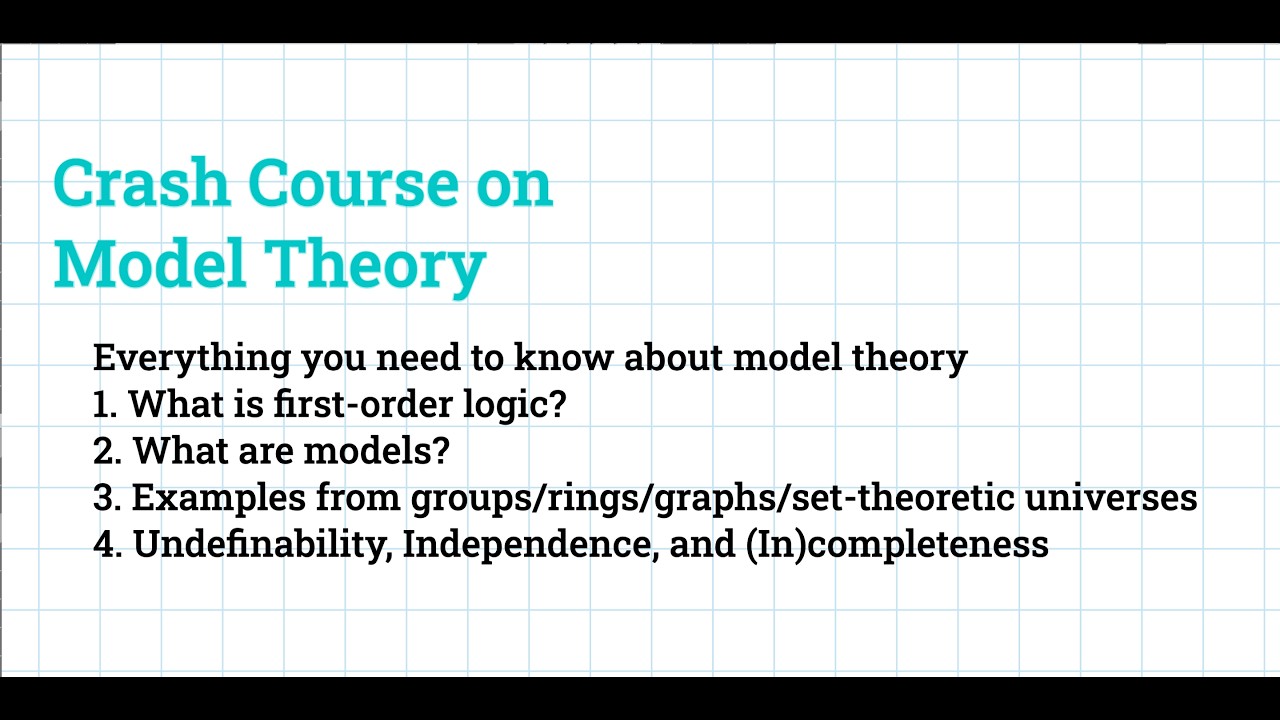



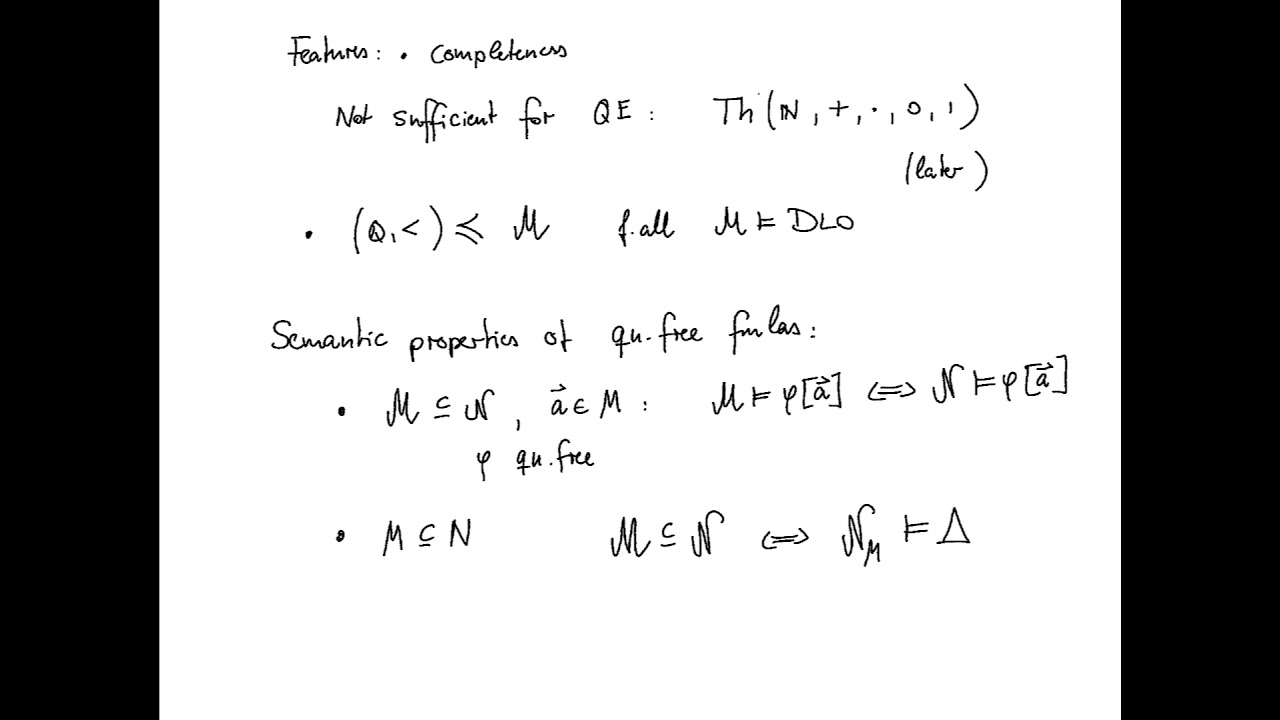


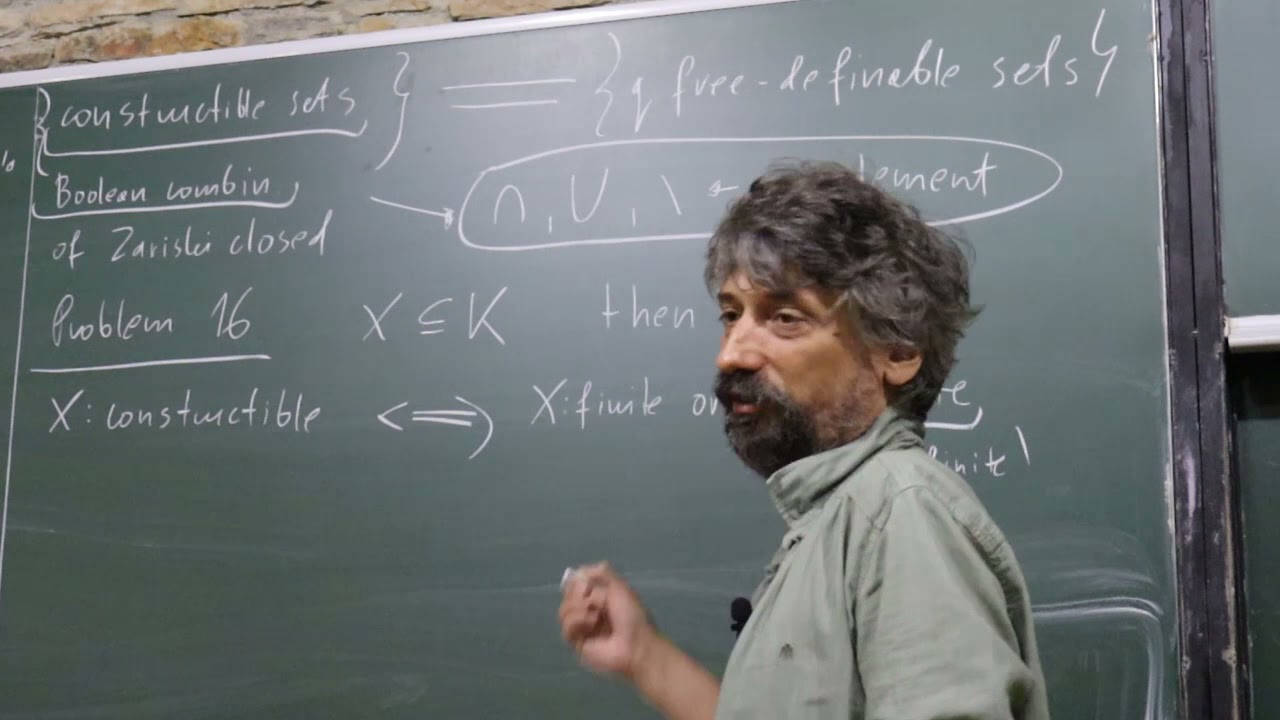



Model theory is a branch of mathematical logic that studies classes of mathematical structures (such as groups, fields, and graphs) from the perspective of formal languages and logical systems, examining the relationship between syntactical elements (formulas, theories) and semantical elements (models, structures); it explores fundamental concepts including signatures, Σ-algebras, first-order logic, axiomatizability, quantifier elimination, and categoricity, with key theorems like the Löwenheim-Skolem theorem and compactness theorem providing foundational tools for understanding how logical theories relate to their mathematical models.
Model Theory in Mathematical Logic: Key Concepts
Added:First-order logic syntax and semantics, including variables, quantifiers, and truth under an interpretation.
Basic set theory, specifically the concepts of sets, relations, functions, and cardinality.
Introductory abstract algebra, to understand how algebraic structures like groups, rings, and fields are defined and studied.
The distinction between syntax (formal languages, proofs) and semantics (interpretations, truth) in mathematical logic.
Deep dive into the Compactness Theorem and its use in constructing non-standard models, such as the hyperreal numbers in non-standard analysis.
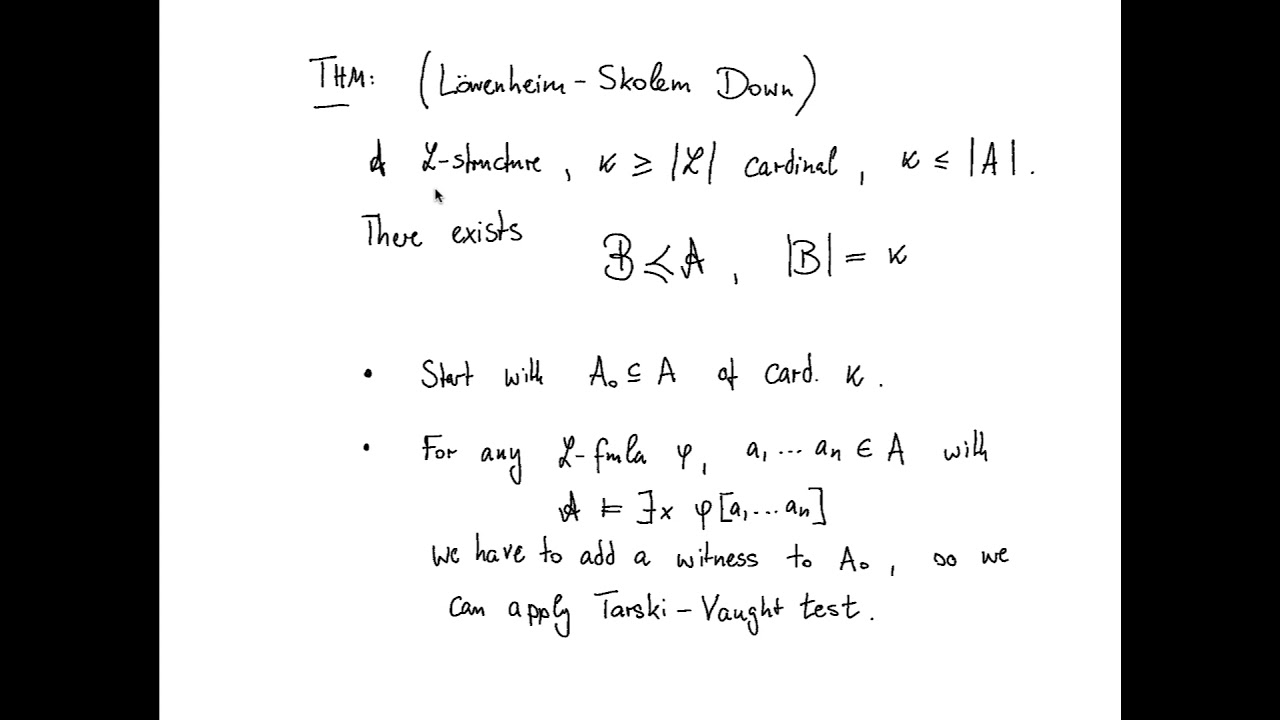
The Löwenheim-Skolem Theorems, exploring the limitations of first-order logic in controlling the cardinality of models.
Quantifier elimination techniques and their application to proving the decidability of specific mathematical theories.
Classification theory and stability theory, which classify first-order theories based on the structural complexity of their models.
The intersection of model theory and algebraic geometry, such as the application of model-theoretic methods to algebraically closed fields.
246 views0likes18:58Original Release: 2016-01-22
in mathematics model theory is the study of classes of mathematical structures from the perspective of mathematical Logic the objects of study are models of theories in a formal language we call a set of sentences in a formal language a theory a model of a theory is a structure that satisfies the sentences of that theory model Theory recognizes and is intimately concerned with The Duality it examines semantical Elements by means of syn tactical elements of a corresponding language to quote the first page of Chang and kaisler universal algebra plus logic equals model theory model theory developed rapidly during the 1990s and a more modern definition is provided by Wilfred hoders model Theory equals algebraic geometry minus Fields although model theorists are also interested in the study of fields other nearby areas of mathematics include combinatorics number Theory arithmetic Dynamics analytic functions and non-standard Analysis in a similar way to prove theory model theory is situated in an area of interdisciplinarity among mathematics philosophy and computer science the most prominent Professional Organization in the field of model theory is the association for symbolic logic branches of model Theory this article focuses on fin first order model theory of infinite structures finite model Theory which concentrates on finite structures diverges significantly from the study of infinite structures in both the problems studied and the techniques used model theory in higher order Logics or infinitary Logics is hampered by the fact that completeness does not in general hold for these Logics however a great deal of study has also been done in such languages in formally model Theory can be divided into classical model theory model Theory applied to groups and Fields and geometric model Theory a missing subdivision is computable model Theory but this can arguably be viewed as an independent subfield of logic examples of early theorems from classical model Theory include God's completeness theorem the upward and downward lenheim scolum theorems vorts 2 Cardinal theorem Scot isomorphism theorem the emitting types theorem and the real Nardi theorem examples of early results from model Theory applied to Fields atari's elimination of quantifiers for real closed Fields axis theorem on pseudo finite fields and Robinson's development of non-standard analysis an important step in the evolution of classical model Theory occurred with the birth of stability Theory which developed a calculus of dependence and rank based on syntactical conditions Satisfied by theories during the last several decades applied model theory has repeatedly merged with the more pure stability Theory the result of this synthesis is called geometric model theory in this article an example of a theorem from geometric model theory is rsk's proof of the Mel Lang conjecture for function Fields the ambition of geometric models theory is to provide a ography of mathematics by embarking on a detailed study of definable sets in various mathematical structures aided by the substantial tools developed in the study of pure model Theory universal algebra fundamental concepts in universal algebra are signature Sigma and sigma algebras since these concepts are formally defined in the article on structures the present article can contend itself with an informal introduction which consists in examples of how these terms are used the standard signature of rings is Sigma ring equals times plus minus 0 1 where times and plus are binary minus is unary and zero and one and nerie the standard signature of semi Rings is Sigma SMR equal time + 0 1 where the arities are as above the standard signature of groups is Sigma grp equal time Min - one 1 where times is binary Min - one is unary and one is nuller the standard signature of monoids is Sigma MMD equal Time 1 a ring is a sigma ring structure which satisfies the identities U + = + w u + v = v + u u + 0 = u u + e = 0 U * = * w u * 1 = u 1 * u = u u * = plus and * U = plus a group is a sigma grp structure which satisfies the identities U * = * w u * 1 = u 1 * u = u u * u - 1 = 1 and u - 1 * u = 1 aoid is a sigma MN D structure which satisfies the identities U * equals * w U * 1 = U and 1 * u = u a semigroup as of times structure which satisfies the identity U * equals time w a magma is just a Time structure this is a very efficient way to define most classes of algebraic structures because there is also the concept of Sigma homomorphism which correctly specializes to the usual Notions of homomorphism for groups semigroups magmas and rings for this to work the signature must be chosen well terms such as the sigma ring term T given by plus are used to define identities T equals T but also to construct free algebras an equational class is a class of structures which like the examples above and many others is defined as the class of all Sigma structures which satisfy a certain set of identities berkoff's theorem States a class of Sigma structures is an equational class if and only if it is not empty en closed under subalgebras homomorphic images and direct products an important non-trivial tool in universal algebra are Ultra products where I is an infinite set indexing a system of Sigma structures I and U is an no Ultra filter on I while model theory is generally considered a part of mathematical logic universal algebra which grew out of Alfred North whiteheads work on abstract algebra is part of algebra this is reflected by their respective MSC classifications nevertheless model Theory can be seen as an extension of universal algebra finite model Theory finite model theory is the area of model Theory which has the closest ties to universal algebra like some parts of universal algebra and in contrast with the other areas of model Theory it is mainly concerned with finite algebras or more generally with finite Sigma structures for signatur Sigma which may contain relations symbols as in the following example the standard signature for graphs is Sigma GPH equals e where e is a binary relation symbol a graph is a sigma grph structure satisfying the sentences in a sigma homomorphism is a map that commutes with the operations and preserves the relations in Sigma this def definition gives rise to the usual notion of graph homomorphism which has the interesting property that a bjective homomorphism need not be invertible structures are also a part of universal algebra after all some algebraic structures such as ordered groups have a binary relation less than what distinguishes finite model Theory from universal algebra is its use of more General logical sentences in place of identities the Logics employed in finite model Theory are often substantially more expressive than first order Logic the standard Logic for model theory of infinite structures first order logic whereas universal algebra provides the semantics for a signature logic provides the syntax with terms identities and quasi identities even universal algebra has some limited syntactic tools first order logic is the result of making quantification explicit it and adding negation into the picture a sentence is a formula in which each occurrence of a variable is in the scope of a corresponding quantifier examples for formulas a i to Mark the fact that at most X is an Unbound variable in F and side defined as follows it is intuitively clear how to translate such formulas into mathematical meaning in the sigma smmr structure of the natural numbers for example an element and sat safies the formula f if and only if N is a prime number the formula s similarly defines irreducibility Tashi gave a rigorous definition sometimes called tashi's definition of Truth for the satisfaction relation so that one easily proves is a prime number is irreducible a set te of sentences is called a theory a theory is satisfiable if it has a model I.E a structure which satisfies all the sentences in the set T consistency of a theory is usually defined in a syntactical way but in first order logic by the completeness theorem there is no need to distinguish between satisfiability and consistency therefore model theorists often use consistent as a synonym for satisfiable a theory is called categorical if it determines a structure up to isomorphism but it turns out that this definition is not useful due to Serious restrictions in the expressivity of first order Logic the lenheim scolum theorem implies that for every Theory T which has an infinite model and for every infinite Cardinal number Capper there is a model such that the number of elements of is exactly kapper therefore only finitary structures can be described by a categorical Theory lack of expressivity has its advantages though for model theorists the lenheim scolum theorem is an important practical tool rather than the source of scholem's paradox in a certain sense made precise by lindstrom's theorem first order logic is the most expressive Logic for which both the lenheim scolum theorem and the compactness theorem hold as a coroller the compactness theorem says that every unsatisfiable first order theory has a finite unsatisfiable subset this theorem is a Central importance in infinite model Theory where the words by compactness are common place one way to prove it is by means of ultra products an alternative proof uses the completeness theorem which is otherwise reduced to a marginal role in most of modern model Theory axiomatizability elimination of quantifiers and model completeness the first step often trivial for applying the methods of model Theory to a class of mathema matical objects such as groups or trees in the sense of graph theory is to choose a signature Sigma and represent the objects as Sigma structures the next step is to show that the class is an elementary Class I.E axiomatizable in first order logic EG this step fails for the trees since connectedness cannot be expressed in first order logic axiomatizability ensures that model Theory can speak about the right object quantifier elimination can be seen as a condition which ensures that model Theory does not say too much about the objects a theory T has quantifier elimination if every first order Formula F over its signature is equivalent modulo T to A first order formula I without quantifiers IE holds in all models of T for example the theory of algebraically closed fields in the signature Sigma ring equals has quantifier elimination because every formula is equivalent to a buan combination of equations between polom a substructure of a sigma structure is a subset of its domain closed under all functions in its signature Sigma which is regarded as a sigma structure by restricting all functions and relations in Sigma to the subset an embedding of a sigma structure into another Sigma structure is a map f a b between the domain which can be written as an isomorphism of with a substructure of every embedding is an injective homomorphism but the converse holds only if the signature contains no relation symbols if a theory does not have quantifier elimination one can add additional symbols to its signature so that it does early model Theory spent much effort on proving axiomatizability and quantifier elimination results for specific theories especially in algebra but often instead of quantifier elimination a weaker property suffices a theory T is called Model complete if every substructure of a model of T which is itself a model of T is an elementary substructure there is a useful Criterion for testing whether a substructure is an elementary substructure called the tari v test it follows from this criteria that a theory T is model complete if and only if every first order formula five over its signature is equivalent modulo T to an existential first order formula IE a formula of the following form where size quantifier free a theory that is not model complete may or may not have a model completion which is a related model complete theory that is not in general an extension of the original Theory a more General notion is that of model companions categoricity as observed in the SE ction on first order logic first order theories cannot be categorical I.E they cannot describe a unique model of to isomorphism unless that model is finite but two famous model theoretic theorems deal with the weaker notion of CAPIC categoricity for a cardinal Kappa a theory T is called Capa categorical if any two models of T that of cardinality kapper are isomorphic it turns out that the question of CAPIC categoris depends critically on whether kapper is bigger than the cardinality of the language for finite or countable signatures this means that there is a fundamental difference between cardinality and Kappa cardinality for uncountable Kappa a few characterizations of categoricity include for a complete first order Theory T in a finite or countable signature the following conditions are equivalent T is categorical for every natural number number n the stone space SN is finite for every natural number n the number of formulas F in N free variables up to equivalence modulo T is finite this result due independently to angular real Nardi and svenonius is sometimes referred to as the real Nardi theorem further categorical theories in the countable models have strong ties with oligomorphic groups they are often constructed as frase limits Michael moley's highly non-trivial result that there is only one notion of uncountable categoricity was the starting point for modern model Theory and in particular classification Theory and stability Theory Morley's categoricity theorem if a first order Theory T in a finite or countable signature is Cap categorical for some uncountable Cardinal Kappa then T is Kappa categorical for all uncountable Cardinals kapper uncountably categorical theories are from many points of view the most well- behaved theories a theory that is both categorical and uncountably categorical is called totally categorical model Theory and set theory set theory if it is consistent has aable model this is known as scholem's Paradox since there are sentences in set theory which postulate the existence of uncountable set and yet these sentences are true in our accountable model particularly the proof of the independence of the Continuum hypothesis requires considering sets in models which appear to be uncountable when viewed from within the model but accountable to someone outside the model the model theoretic Viewpoint has been useful in set theory for example in Kurt God's work on the constructible universe which along with the method of forcing developed by Paul Cohen can be shown to prove the independence of the Axiom a choice and the Continuum hypothesis from the other axioms of set theory in the other direction model Theory itself can be formalized within zfc set theory the development of the fundamentals of model Theory rely on the Axiom of choice or more exactly the Boolean Prime ideal theorem other results in model Theory depend on set theoretic axioms beyond the standard zfc frame work for example if the Continuum hypothesis holds then every countable model has an ultra power which is saturated similarly if the generalized Continuum hypothesis holds then every model has a saturated Elementary extension neither of these results are provable in zfc alone finally some questions arising from model Theory have been shown to be equivalent to large cardinal axioms
Up Next
34:57
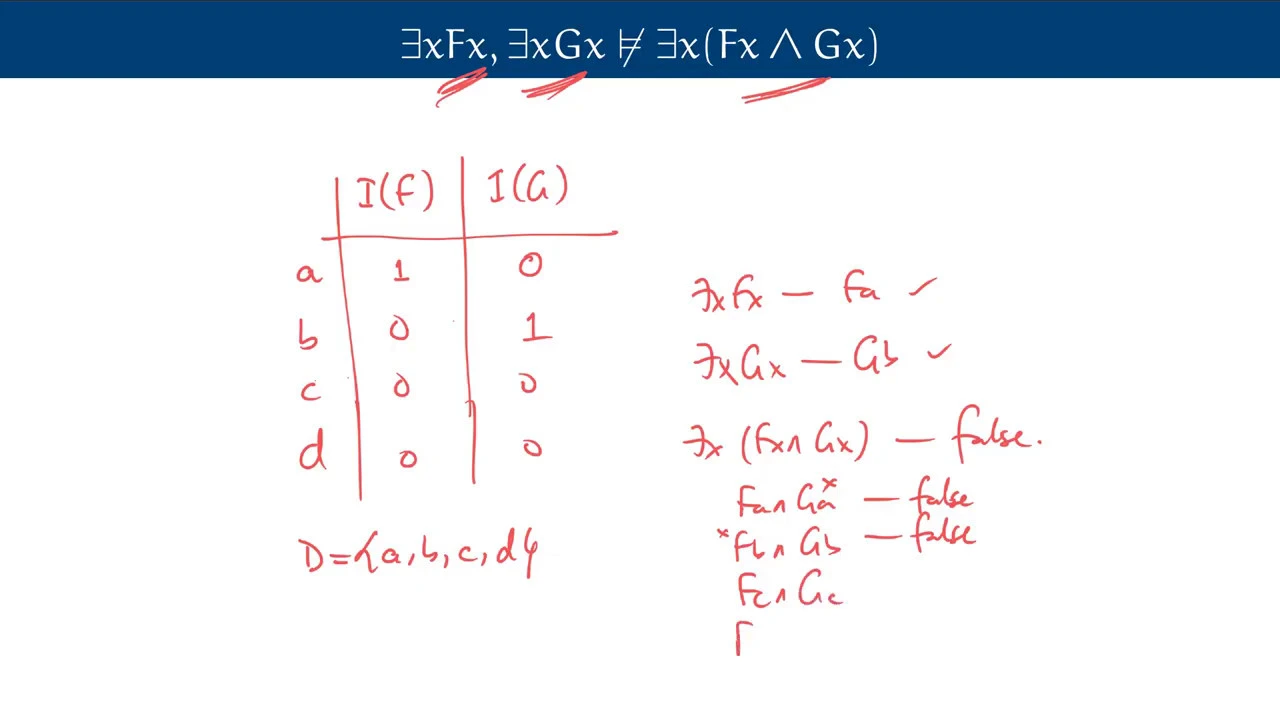
Models & Soundness in Predicate Logic: Proof-Theoretic Verifcation
@gregrestall
1.5K views•2020-04-10

4:43
Elliptic Curve Cryptography Explained: ECC, ECDSA, ECDH
@PracticalNetworking
28.5K views•2024-10-21
10:44
Fourier Series Introduction: The Big Idea Explained
@DrTrefor
387K views•2021-05-03

6:00
The Mathematical Impossibility of Accurate World Maps
@Vox
23.3M views•2016-12-02
Related Study Plans & Knowledge Roadmaps
Structured learning paths in Mathematics
mathematics
Tensor Calculus: Vectors to Riemann Curvature
01Mathematical Foundations: Linear Algebra & Calculus
02Covectors, Dual Spaces, and Tensor Basics
03The Metric Tensor and Index Gymnastics
+ 2 more learning modules
40h5 modules
Explore Roadmap
mathematics
Gödel's Incompleteness: Logic, Proofs & Limits
01Introduction to Formal Systems & Hilbert's Dream
02Set Theory, Cardinality, and Cantor's Diagonal Argument
03Arithmetization and Gödel Numbering
+ 2 more learning modules
14h5 modules
Explore Roadmap
mathematics
Galois Theory: Fields, Groups & Solvability
01Foundations of Abstract Algebra: Groups & Fields
02Polynomials & Field Extensions
03Splitting Fields & Symmetries
+ 2 more learning modules
24h5 modules
Explore Roadmap
mathematics
Non-Euclidean Geometry: Models & Geodesics
01Euclid's Fifth Postulate and the Birth of New Geometries
02Hyperbolic Space and the Poincaré Disk Model
03Geodesics: Defining Straight Lines in Curved Spaces
+ 2 more learning modules
15h5 modules
Explore Roadmap