





![11. CS50 на русском: Лекция #11 [Гарвард, Основы программирования, осень 2015 год]](https://i.ytimg.com/vi_webp/owNJ5PYj7s4/maxresdefault.webp)





![12. CS50 на русском: Лекция #12 [Гарвард, Основы программирования, осень 2015 год]](https://i.ytimg.com/vi_webp/w0mo-_smP9M/maxresdefault.webp)


![[알고리즘] 제11-1강 이진검색트리(Binary Search Tree)](https://i.ytimg.com/vi/4RmfHRZasoY/maxresdefault.jpg)



Memory in C/C++ programs is divided into four segments: text (instructions), static/global variables, stack (function calls and local variables), and heap (dynamic memory). The stack is fixed in size and automatically manages memory allocation/deallocation when functions are called and return, while the heap is flexible and allows programmers to control memory allocation and deallocation using malloc/free in C or new/delete in C++. Stack overflow occurs when the call stack exceeds its reserved memory, and heap memory must be manually freed to prevent memory leaks.
Pointers and Dynamic Memory: Stack vs Heap in C/C++
Added:Basic syntax of C or C++, including variables, data types, and function definitions.
Fundamental understanding of pointers, including the address-of (&) and dereference (*) operators.
The concept of variable scope and lifetime (local vs. global variables).
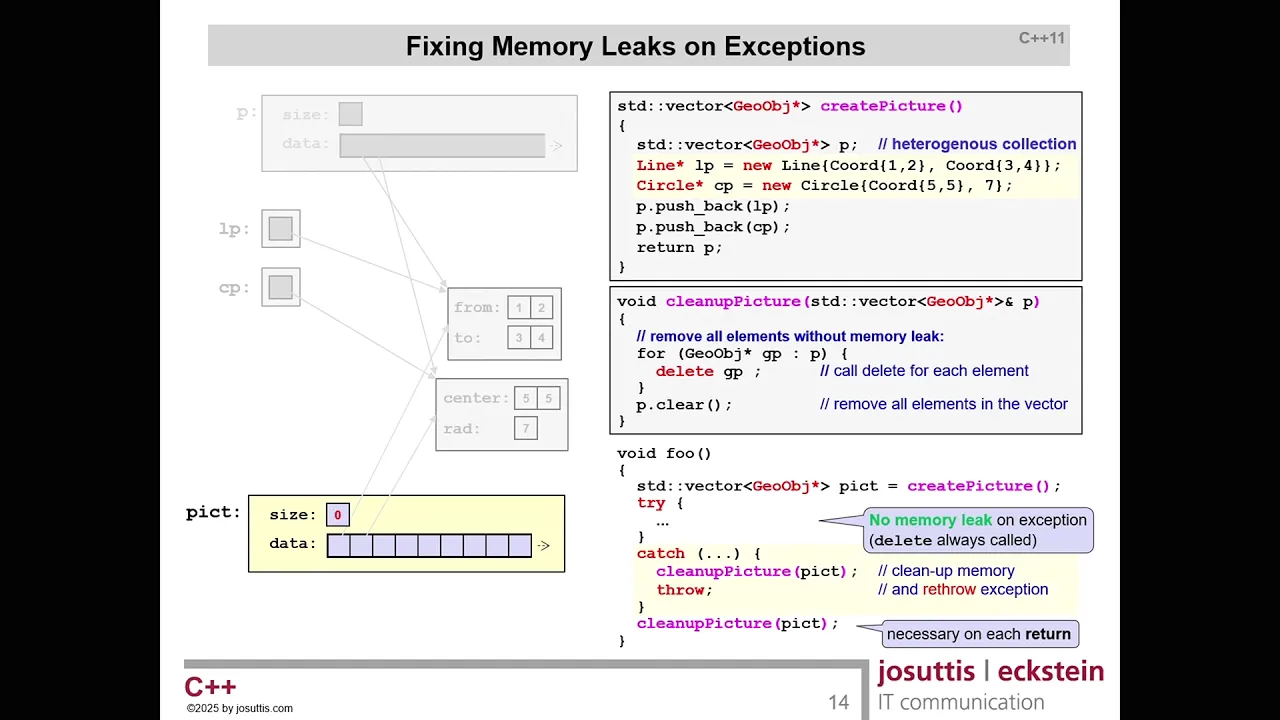
Identifying and debugging memory issues such as memory leaks, dangling pointers, and segmentation faults.
Modern C++ memory management concepts, specifically RAII (Resource Acquisition Is Initialization) and Smart Pointers (std::unique_ptr, std::shared_ptr).
Implementing dynamic data structures such as linked lists, binary search trees, and dynamic arrays.
Using memory profiling tools like Valgrind or AddressSanitizer to detect runtime memory errors.
1.6M views33Klikes17:25Original Release: 2013-02-23
Memory, is one important and crucial resource on our machine and it is always good to know the architecture of memory, the way operating system manages memory and the way memory is accesible to us as programmers.
In this lesson we will discuss the concept of dynamic memory and we will see how to work with dynamic memory using C or C++.
The memory that is assigned to a program or application in a typical architecture can be divided into four segments.
One segment of the memory is assigned to store the instructions that need to be executed.
Another section stores all the static or global variables, the variables that are not declared inside a function, and that have the whole lifetime of an application, they are accesible anywhere during the whole life cycle of the application as long as the application is running.
One section of the memory is used to store all the information of function calls and all the local variables and we have also talked about stack in our lesson on Call by Reference.
Local variables are declared inside a function and they live only till the time the function is executing.
The amount of memory set aside for these three segements: the text segment, the global variable segment and the stack, does not grow while the application is running.
We will come back to why we use this fourth segment- heap, in a while.
Let us first understand how these three segments of the memory are used when a program executes.
I have a simple C program here.
We have a function square that gives me the square of a number.
We have another function Square of Sum that is given two arguments x and y, and it returns us the square of x plus y.
And, in the main method, I am just calling this function Square of Sum passing it two arguments a and b.
Let us now see what happens in the memory when this program executes.
Let us say this rectangle in green here is memoryreserved as stack and the rectangle in orange is the memory reserved as Static or Global variable section.
When the program starts executing, first the main method is invoked.
When the main method is invoked, some amount of memory from the stack is allocated for execution of main.
And this total is a global variable, so it should sit in the global section.
The amount of memory allocated in stack for execution of main can also be called the stack frame for the method main.
All the local varibales, arguments, and the information where this function should return back to, all this information is stored within this stack frame.
The size of the stack frame for a method is calculated when the program is compiling.
Now, when main calls Square of Sum method, let's write shortcut SOS, for Square of Sum, then a stack frame is allocated for the call to Square Of Sum, all these local varibales x, y and z will sit in this particular stack frame.
Now, Sum of Square calls Square,lets again put a shortcut here for square, so another stack frame for square and it will have its own local variables.
At any time during the execution of the program, the function at the top of the stack is executing and rest are kind of paused, waiting for the function above to return something and then it will resume execution.
I have drawn these play and pause button here, in case you do not understand.Ok, so this total is a global variable, it's here in this section.
Global variable because it is not declared inside a function.
We can access it anywhere, and then we go to this particular statement where we call Square of Sum, and Square of Sum is calling Square and so this is called our call stack.
This program may not be the best way to implement this logic.
I have written this program this way so that I can have some nested methods calling each other.
Let's say right now we are at this particular statement, we are executing this statement.
So, at this stage the call stack will have these three methods.
Now, when this method finishes, we will return back to this particular statement.
As soon as Square function will return, it will be cleared from the stack memory and now Square of Sum function will resume.
Once again when Square of Sum finished, the control will come to this particular line total is equal to Square of Sum and main will resume again.
Now, main will call printf, so once again printf will go to the top of the stack.
Printf will finish and the control will come back again to main and now main will finish.
And, now main finishes, program will also finish.So, In the end, our global variables will also get cleared.
There was no need in this program to keep this variable total as global.
We should assign a variable as global only if it is needed at multiple places in multiple functions and it is needed for the whole lifetime of the program, otherwise it is a waste of memory to keep a variable for the whole lifetime of program execution.
We had kept one global variable in this program just to understand the concepts.
Here, I must point out one more thing, when our program starts, our operating system allocates some amount of reserved space, let's say OS allocates 1 MB of space as stack, but the actual allocation of the stack frame and the actual allocation of the local variables happens from the stack during runtime and if our call stack grows beyond the reserved memory for the stack like for example, if a method A calls B, B calls C and we go on calling and we exhaust the whole space reserved for the stack, then this is called stack overflow and in this case our program will crash.
One common case of stack overflow is when you write a bad recursion and your program goes infinitely into recursion.
So, as we can see, there are some limitaions of stack.
The memory set aside for stack does not grow during runtime.
Application cannot request more memory for stack.
So, if it is 1 MB, then if the allocation of variable and functions in stack exceeds 1 MB, our program will crash.
Further the allocation and deallocation of memory onto the stack happens by a set rule.
When a function is called, it is pushed onto the stack, when it finishes, it is popped out of the stack or removed from the stack.
It is not possible to manipulate the scope of a variable if it is on the stack.
Another limitation is that if we need to declare a large data type, like an array as local variable, then we need to know the size of the array at compile time only.
If we have a scenario like we have to decide how large the array will be based on some parameter during runtime then it is a problem with stack.
For all these problems, like allocaing large chunks of memory or keeping variable in the memory till the time we want, we have heap.
Unlike stack, application's heap is not fixed.
It's size can vary during the lifetime of the application and there is no set rule for allocation or deallocation of the memory.
A programmer can totally control how much memory to use from the heap, till what time to keep the data in the memory during the applications lifetime and heap can grow as long as you do not run out of memory on the system itself.
That is a dangerous thing also and we need to be really careful about using heap for this reason.
We also sometimes call heap, free pool of memory or free store of memory.
We can get as much as we want from the heap.
How heap is implemented by the operating system, language runtime or the compiler, is something which can vary, which is a thing of computer architecture.
But an abstracted way of looking at the heap as a programmer is that this is one large free pool of memory available to us that we can use flexibly as per our need.
Heap is also called dynamic memory and using the heap is referred to as dynamic memory allocation.
Let us now see how to use the heap in out C or C++ program.
I will clear this code in the left and I will draw one more rectangular block here for heap.
there is one more thing that I must point out before moving forward.
Heap is also one data structure and if you do not know about this data structure Heap yet, you will learn about it in your Data Structure course.
But this nomenclature here has nothing to do with heap data structure.
The term heap is being used only for the large free pool of memory.
Heap data strcutre does not come anywhere in this context.
This term often confuses a lot of people when they know about heap data structure.
Stack is also one data strcutre but the stack segment of the memory is actually an implementation of the stack data structure but heap is not an implementation of the heap data structure.
To use dynamic memory in C, we need to know about four functions malloc, calloc, realloc and free.
To use dynamic memory in C++, we need to know about two operators new and delete.
These four functions can also be used in C++, as C++ has backward compatibility.
It is only a superset of C. But C++ programmers use mostly these two operators, new and delete.
We will see some code examples and try to understand how things happen when dynamic memory is used.
Let us first pick up some code examples in C. Let us write a C program.
I will clean up some of the stuff in the right.
1 MB for stack, this was just an assumption.
In reality, the size of the stack will be decided by the operating system and the compiler.
It is a thing of computer architecture.
Coming back to the code, if we declare a variable like this, then this variable is a local variable.
It goes on the stack.
Memory for this particular variable a' will be allocated from the stack frame of the main method.
Let us say we want to store an integer on the heap.
To reserve, or get some space allocated on the heap, we need to call the malloc function, something like this.
The malloc function asks for how much memory to allocate on the heap in bytes.
When we say malloc and pass as argument size of integer, then we are saying that "Hey, give me a block of memory, which is 4 bytes. 4 bytes is the typical size of the integer.
So, one block of 4 bytes will be reserved or allocated on the heap and malloc will return a pointer to starting address of this block.
And, malloc returns a void pointer.
Let us say, the starting address of this block of 4 bytes is 200, then malloc will return us address 200.
Now, we have a pointer to integer p, which is a local variable to main.
So, this will be allocated in the stack frame of the main method.
We have done a typecasting here, because malloc returns pointer to void, sorry, void pointer and p is an integer pointer.
Now, p stores the address of this block of memory which is 200.
So, we have got some block of memory on the heap which we want to use to strore an integer.
Right now, we do not know what's there in this particular block of memory.
If we want to fill in something here, we need to dereference this location using the pointer p and then put in some value.
In fact the only way to use memory on heap is through reference.
All the malloc function does it, looks for some free space in the heap, books it or reserves it for you and give back the pointer.
And the only way you can access this particular block by keeping a pointer variable which will be local to your function.
Now, let us write something like this.
After writing 10 in this particular block, i will go ahead and make one more call to malloc.
When I make one more call to malloc, one more block of 4 bytes is allocated on the heap and let us say the address is 400 for this block.
Now, the address that is returned by the second call to malloc, we store this address in the variable p.
So, what happens is, that p is now pointing to the address 400.
The next line writes address 20 to this address.
We allocated one more block and we modified the address in p to point to this block.
The previous block will still sit in the heap.
This memory we are still consuming, it will not be cleared off automatically.
At any point in our program, if we are done using some block of memory which is dynamically allocated using malloc, we also need to clear it, because it is unnecessary consumption of memory which is an important resource.
So, what we should have done here is that once we were done using this particular block of memory at 200, we should have made a call to the function free.
Any memory which is allocated using malloc, is cleared off by calling free.
And to free, we pass the pointer to the starting address of the memory block.
So, now with this code this first block of memory will first be cleared and then we will be pointing to anohter memory address.
It is the responsibility of the programmer to clear anything on the heap if he has allocated it and does not need it any further.
So, you see, in terms of the scope of the variable, anything allocated on the heap is not automatically deallocated when the function completes like on the stack.
And, it does not need to live for the whole lifetime of the application like a global variable.
We can control when to free anything on the heap, when to deallocate anything on the heap.
If we wanted to store an array in the heap, like let's say we wanted to store an integer array into the heap, then all we do is make a call to the malloc asking for one block of memory equal to the total size of the array in bytes.
So, if we want an integer array of 20 elements, then we will make a call to malloc asking 20 X size of int which will be 4 number of bytes.
So, what will happen now, is that one bit of contigous block of byte for 20 integers will be allocated on the heap and we will get the starting address of the heap.
So, we kind of get the base address of the array.
This p will point here, to the base address of this block.
And then in our code we can use this, 20 integers as P[0], P[1], P[2] and so on.
As we know, P[0] is same as saying value at address P, and P[1] is same as saying value at address P+1.
This is what it means.
One more thing, if malloc is not able to find any free block of memory, is not able to allocate some memory on the heap, it returns null.
So, for error handling, we need to know this and we need to write our code appropriately.Malloc and Free.
The use of malloc and free is C style code.
If we want to write the same code, same logic in C++, there is not much difference.
Instead of using these two functions, malloc and free, we will use two operators: New and Delete.And, we will write our code something like this.
So, instead of malloc, we are using the New operator here and instead of using free, we are using delete here.
If we want to allocate an array, we use something like this where we put the size in brackets here.
And, if we want to free an array, we use this particular operator delete and two brackets, sorry, one bracket.
With C++, we do not have to do all these typecastings, like malloc returns void and we need to typecast it back to integer pointer.
New and Delete operators are type safe.
What it means is, that they are used with a type and return pointers to a particular type only.
So, here p will get a pointer to integer only.
We will be talking about dynamic memory allocation and other library function in more detail in the coming lessons.
So, Thanks for watching!
Up Next
16:24
Modern C++ Memory Management: Smart Pointers and Vector Containers
@DavesGarage
184.1K views•2023-04-29

57:07
BitTorrent Protocol Explained: Piece Selection & Peer Choking
@StevenGordonAU
481 views•2013-02-22
19:27
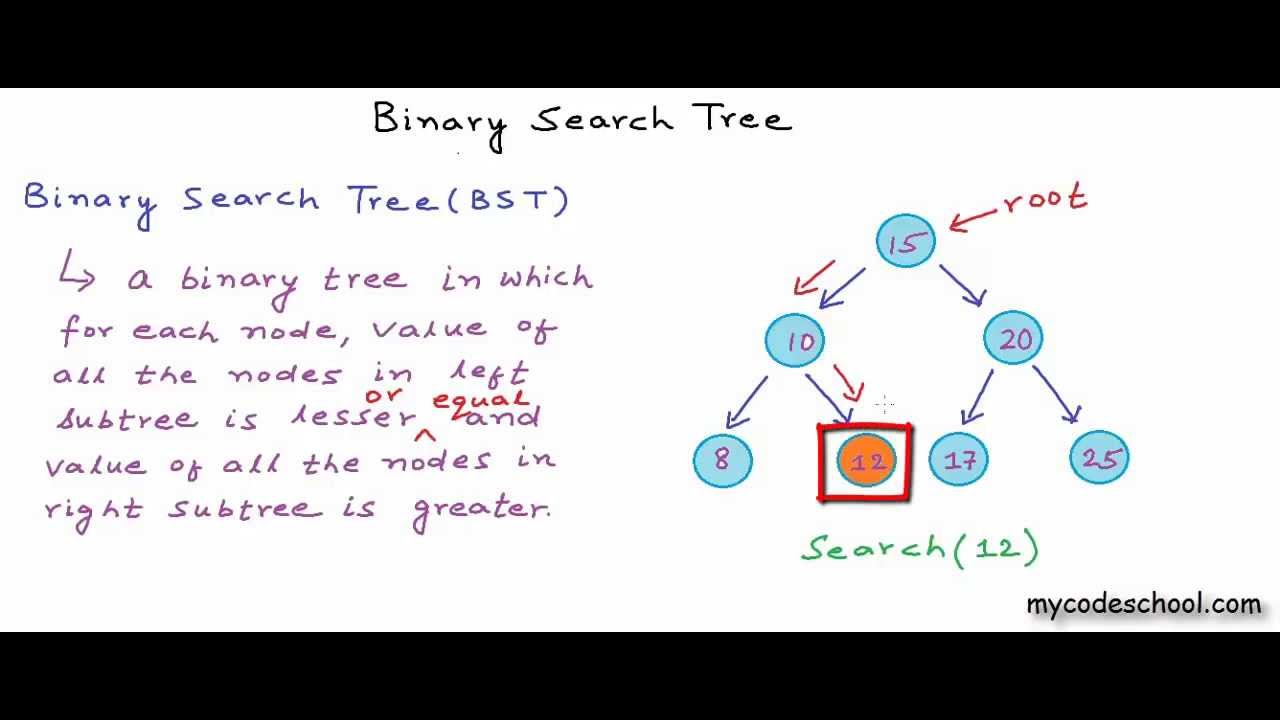
Binary Search Tree Data Structure Explained | BST Operations
@mycodeschool
1.4M views•2014-01-25
19:25
Enigma Machine Mechanics: WWII Encryption Explained
@JaredOwen
13.2M views•2021-12-11
Related Study Plans & Knowledge Roadmaps
Structured learning paths in Computer Science
computer-science
Building BitTorrent: Go, P2P & Concurrency
01Go Fundamentals & Concurrency
02Networking Foundations & P2P Architecture
03Bencode Parsing & Torrent Metadata
+ 3 more learning modules
26h6 modules
Explore Roadmap
computer-science
Actor Models (C++ Concurrency & Lock-Free)
01C++ Multi-Threading Foundations
02Thread Pools and Task Scheduling
03Atomics and Lock-Free Queue Design
+ 3 more learning modules
45h6 modules
Explore Roadmap
computer-science
Coding HM Type Inference: Algorithm W & OCaml
01Introduction to Functional Programming & OCaml
02Abstract Syntax Trees & Language Interpreters
03Type Systems & Lambda Calculus
+ 2 more learning modules
28h5 modules
Explore Roadmap
computer-science
Building OAuth 2.0: Node.js OIDC Server
01Web & Security Foundations
02Authentication vs. Authorization & JWTs
03The OAuth 2.0 Protocol & Grant Types
+ 3 more learning modules
25h6 modules
Explore Roadmap