The speed of sound in gases is given by v = √(B/ρ), where B is the bulk modulus of elasticity and ρ is the density of the medium. Newton initially calculated the speed of sound in air at 0°C as 281 m/s assuming an isothermal process, but experimental measurements showed 332 m/s. Laplace corrected this by recognizing that sound propagation in gases is an adiabatic process, yielding the correct value of approximately 331.8 m/s. The general wave equation for a wave traveling in the positive x-direction is y = a sin(ωt - kx), where y is particle displacement, a is amplitude, ω is angular frequency, t is time, and k is the propagation constant.
NEB Physics Crash Course: Sound & Wave Propagation (Day 4)
Added:Deep Dive
Understanding of Simple Harmonic Motion (SHM), including periodic motion, restoring force, and oscillation equations.

OSCILLATION in 1 Shot || All Concepts & PYQs Covered || Prachand NEET
271.3K
Periodic motion repeats after fixed intervals (Earth's rotation), while harmonic motion oscillates back and forth (pendulum). All harmonic motions are periodic, but not vice versa. Circular motion is periodic but not harmonic. For motion to be harmonic, restoring force must be proportional to displacement and opposite in direction (F = -kx). Force equations must be F = -kx^n where n is odd positive integer (1,3,5,7...). Only F = -kx (n=1) is simple harmonic motion. SHM equations include x = A sin(ωt), x = A cos(ωt), x = A sin(ωt + φ), x = A cos(ωt + φ). Functions like sin²(ωt) and cos²(ωt) are SHM with frequency 2ω.
Click to watch →

Simple Harmonic Motion (বাংলা) | Periodic Motion • Oscillation • Restoring Force • Eq. of SHM #1
163
Simple Harmonic Motion (SHM) is a type of periodic motion where a body oscillates about an equilibrium position with a restoring force that is always directed toward the equilibrium position and proportional to the displacement from it. The key characteristics include: (1) Periodic Motion - motion that repeats at regular time intervals; (2) Oscillation - periodic motion where the body moves back and forth along the same path; (3) Complete Oscillation - one full cycle from starting point to extreme and back; (4) Time Period (T) - time taken for one complete oscillation; (5) Frequency (f) - number of oscillations per second, where f = 1/T; (6) Amplitude - maximum displacement from equilibrium position; (7) Restoring Force - force that always acts toward equilibrium and is proportional to displacement (F = -kx); (8) Equation of SHM - F = -kx or a = -(k/m)x, where acceleration is proportional to displacement and directed opposite to it.
Click to watch →

Oscillation One Shot | Complete Chapter | NEET 2024 Physics | Vijeta Batch #neetkijeet
50K
Simple Harmonic Motion (SHM) is also known as Oscillation. It is a fundamental concept where an object moves back and forth about a central equilibrium position. The instructor introduces the topic using a spring-block system. Key concepts include: (1) Natural length - the length of the spring when no mass is attached, (2) Mean position or equilibrium position - where the mass comes to rest when attached, (3) Static deviation or initial stretch - the displacement from natural length when mass is attached, calculated as Δ = mg/k. Oscillation is defined as 'to and fro motion' - the motion of going away from a position and then returning to it. Periodic motion is motion that repeats itself after a fixed duration. Oscillation is only possible when two conditions are met: (1) There must be a restoring force that always acts opposite to the displacement, and (2) The system must be in stable equilibrium. The fundamental equations of SHM include: (1) Force equation: F = -kx, (2) Acceleration equation: a = -kx/m = -ω²x, (3) Angular frequency: ω² = k/m, (4) Differential equation: d²x/dt² + ω²x = 0. The negative sign indicates force and acceleration are always directed opposite to displacement.
Click to watch →

SHM One Shot 🔥 | Simple Harmonic Motion Full Chapter | Class 11 Physics | JEE / NEET
116
Simple Harmonic Motion (SHM) is the fundamental concept underlying half of physics, applying to springs, pendulums, waves, and alternating current. Periodic motion repeats itself over the same path after regular time intervals, like Earth's revolution around the Sun. Oscillatory motion is back-and-forth movement about a fixed point along the same path, like a pendulum bob. All oscillatory motion is periodic, but not all periodic motion is oscillatory. Harmonic motion is oscillatory motion expressible as sine or cosine functions. The restoring force follows F = -kx^n where n must be odd for oscillatory motion. Only n=1 gives Simple Harmonic Motion (SHM), the simplest case where F = -kx. For motion to be SHM, three conditions must be satisfied: (1) Total mechanical energy must remain constant, (2) Extreme points must be well-defined and fixed, (3) Restoring force must be proportional to displacement. The hierarchy is: SHM is a special case of harmonic motion, which is a special case of oscillatory motion, which is a special case of periodic motion. Amplitude is the maximum displacement from the mean position. Time period (T) is the minimum time for one complete oscillation. Frequency (f) is oscillations per unit time, with f = 1/T.
Click to watch →

JEE Crash Course 2026 | Physics, Chemistry & Mathematics | Bilingual | Day 19
1.5K
Periodic motion repeats at regular intervals (period T). Oscillatory motion moves to and fro about a mean position. Simple Harmonic Motion (SHM) requires: (1) oscillatory motion about mean position, and (2) restoring force proportional to displacement (F = -kx). The displacement equation is x = A cos(ωt + φ), where A is amplitude, ω is angular frequency, and φ is initial phase. The differential equation is d²x/dt² + ω²x = 0.
Click to watch →
Deep Dive
Basic parameters of waves, such as amplitude, wavelength, frequency, time period, and the fundamental relation v = f * lambda.
Limitation of Rutherford atomic model and EM waves
145
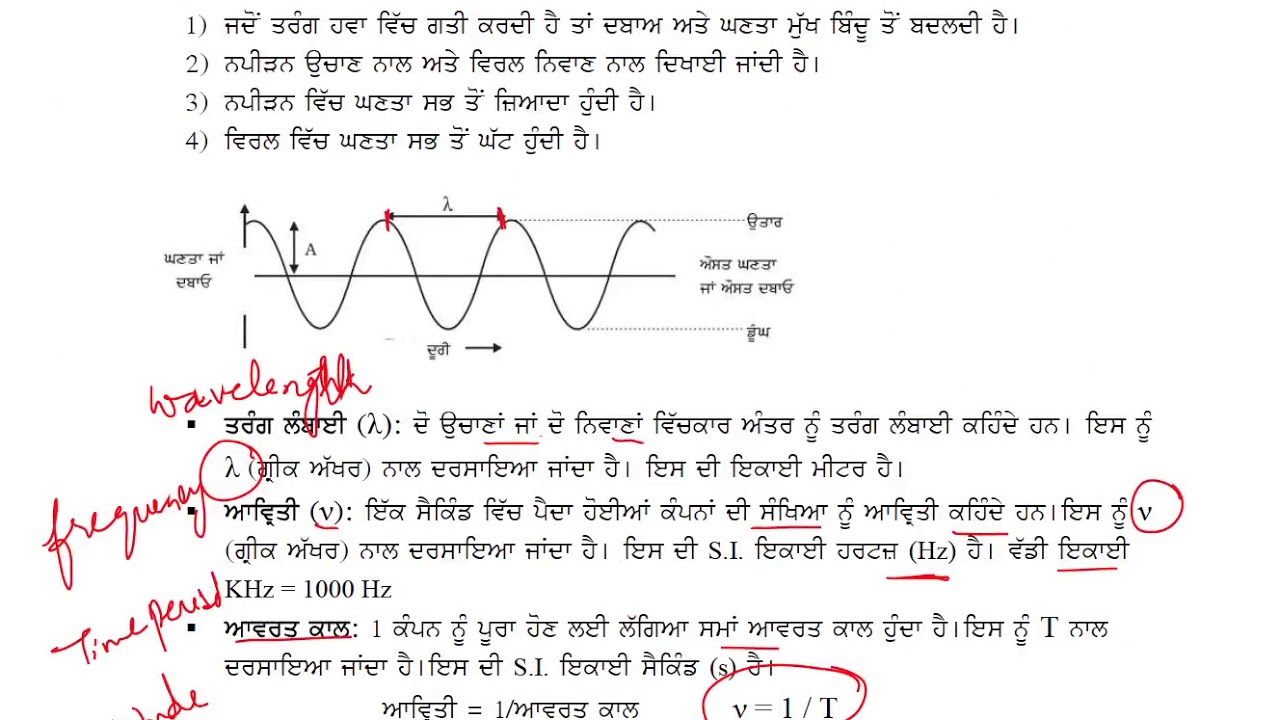
A wave is a mode of energy transfer in periodic manner. Key parameters: (1) Amplitude (A) - height of crest/depth of trough, measured in meters; (2) Wavelength (λ) - distance between consecutive crests/troughs, measured in meters; (3) Frequency (ν) - number of waves passing a point per second, measured in Hz; (4) Time period (T) - time for one complete oscillation, measured in seconds; (5) Velocity (v) - speed of wave propagation, measured in m/s; (6) Wave number (ν̄) - number of waves per unit length, measured in m⁻¹. The fundamental relationship is v = νλ, showing wave velocity equals frequency multiplied by wavelength.
Click to watch →

🔥Applied Physics -2nd || One-Shot || बस इतना कर लो || 2nd Semester || All Branch || By-Anurag Sir
76K
Five fundamental parameters describe wave motion: (1) Amplitude is the maximum displacement from equilibrium position, indicating wave intensity, (2) Time period is the time for one complete oscillation, (3) Frequency is the number of oscillations per second (reciprocal of time period), (4) Wavelength is the distance traveled during one complete oscillation, (5) Wave speed is the distance traveled per unit time. These parameters are related by the fundamental equation v = fλ, where wave speed equals frequency multiplied by wavelength.
Click to watch →

BASIC OF SUPERPOSITION OF WAVES | Physics Chapter | Class 12th + MHT-CET | By Mukesh Sir #dsms
134
Waves are characterized by several fundamental parameters. Amplitude is the maximum displacement of a particle from its mean position, measured in meters, and directly relates to wave energy. Wavelength (λ) is the distance between consecutive points in phase (crest to crest or trough to trough), representing one complete wave cycle. Frequency (f or n) is the number of complete cycles passing a point per second, measured in Hertz. Time period (T) is the time for one complete cycle, being the reciprocal of frequency. These parameters are interconnected through the wave equation v = fλ, where v is wave velocity.
Click to watch →

物理の第一歩 Ⅲ 基礎の振動・波動 1
325
Key wave parameters include: (1) Wavelength (波長, λ) - the distance between two points in the same phase, such as crest to crest; (2) Amplitude (振幅) - the maximum displacement from equilibrium; (3) Period (周期, T) - the time for one complete wavelength to pass a point; (4) Frequency (振動数, f) - the number of oscillations per second, where f = 1/T; (5) Wave velocity (波速, v) - the speed at which the wave pattern propagates. The fundamental wave equation is v = λ/T = fλ, which relates these parameters. The unit of frequency is Hertz (Hz), equivalent to 1/second. This equation can be verified experimentally using a rope.
Click to watch →

Waves || Lecture-02 || Waves For 11th, JEE & NEET | Navneet Sir
1.5K
Amplitude is the maximum displacement from equilibrium, always taken as positive. Wavelength (λ) is the distance between consecutive points in the same phase (e.g., two crests). Frequency (f) is the number of complete cycles per second. Time period (T) is the time for one complete cycle. Frequency and time period are reciprocals: f = 1/T. These parameters define the fundamental characteristics of any wave.
Click to watch →
Deep Dive
Fundamental concepts of mechanics, specifically density, elasticity (modulus of elasticity), and Newton's laws of motion, which govern medium behavior.

भौतिक विज्ञान Physics #1 ll तरंग Wave part-1 ll BY Pateer sir
604
Mediums have four main properties: elasticity, temperature, inertia, and density. Elasticity is the property that allows materials to return to their original shape after deformation, like a rubber ball returning to its shape after being pressed. Inertia is the property that resists changes in motion, directly related to mass—objects with greater mass have greater inertia and resist motion changes more strongly. Density is the amount of mass contained in a unit volume, calculated by dividing mass by volume. These properties determine how waves propagate through materials and how objects respond to forces, forming the foundation for understanding wave mechanics and material science.
Click to watch →
Lesson 9 | Density and Elasticity
313
This comprehensive section covers the foundational concepts of density and elasticity. Density (ρ) is mass per unit volume, calculated as ρ = m/V, with SI units of kg/m³ or g/cm³. Water has a density of approximately 1,000 kg/m³. Specific gravity is the ratio of a substance's density to a standard (water for liquids, air for gases). Elasticity is the property allowing a body to return to its original shape after deformation. Stress (σ) is force per unit area (σ = F/A), measured in Pascals. Strain (ε) is fractional deformation (ε = ΔL/L₀), a unitless quantity. The elastic limit is the maximum stress before permanent deformation occurs. Young's modulus (Y) measures tensile elasticity as stress divided by strain. Bulk modulus (B) describes volume elasticity under pressure: B = -P(V/ΔV). Compressibility (K) is the reciprocal of bulk modulus. Shear modulus (G) describes shape elasticity under tangential forces. Practical applications include calculating gasoline density (680 kg/m³, SG = 0.68) and oil density (745 kg/m³) using mass and volume measurements.
Click to watch →

C.G. PET Exam Privious Year Questions Solutions Part 01 #cgpetexam2026
555
This segment explains material properties: Pressure formula P = F/A. Elasticity concepts: Steel is more elastic than rubber due to higher Young's modulus. Glass is brittle, not elastic. Newton's laws: Constant velocity means zero acceleration. Velocity can be positive, negative, or zero. These concepts form the basis of mechanics.
Click to watch →

Plus One Physics | Mechanical Properties of Solids | Chapter 8 | Eduport Plus One
14.8K
Elasticity is the property enabling materials to regain original shape after deforming force removal. Elastic materials (rubber) return to original shape; plastic materials (wax) do not. Stress is restoring force per unit area (Force/Area), measured in N/m² or Pascal. Strain is fractional change in dimension (ΔL/L), dimensionless. Three fundamental stress types exist: longitudinal stress (force along length causing stretching/compression), shearing stress (force parallel to surfaces causing layer sliding), and volume stress (fluid pressure causing compression without shape change). Corresponding strains are longitudinal strain (ΔL/L), shearing strain (ΔX/X in radians), and volume strain (-ΔV/V). Within the elastic limit, stress is directly proportional to strain (Hooke's Law). The modulus of elasticity is the constant of proportionality (Stress/Strain). Three main moduli describe material stiffness: Young's Modulus (longitudinal stress/strain), Shear Modulus (shearing stress/strain), and Bulk Modulus (volume stress/volume strain). Compressibility is the reciprocal of Bulk Modulus. Steel has higher Young's Modulus than rubber, making it more elastic and preferred for heavy-duty applications.
Click to watch →

GIC & UPPGT PHYSICS || Mechanics-25 || Elasticity and Elastic Constants by Anup kushwaha
19K
Elasticity is the property of solid materials that enables them to return to their original shape and size after deformation. Materials are classified based on their elastic behavior: perfectly elastic bodies recover 100%, plastic bodies show no recovery, and real materials fall between these extremes. No material is perfectly elastic or perfectly plastic in practice. Steel is more elastic than rubber because it resists deformation more effectively under the same force. Every elastic material has a limit of elasticity beyond which it cannot return to its original shape. Stress is the restoring force per unit area: Stress = Normal Force / Area, with units of N/m² (Pascal). Strain is the fractional change in dimension: Strain = Change in Dimension / Original Dimension, and is dimensionless. Three types of elastic moduli describe material behavior: Young's modulus (Y) measures resistance to length change: Y = (F/A) / (ΔL/L₀). Bulk modulus (B) measures resistance to volume change: B = (F/A) / (ΔV/V₀). Shear modulus (G) measures resistance to shape change: G = (F/A) / (Δx/h). Compressibility is the reciprocal of bulk modulus, with gases being most compressible and solids least compressible.
Click to watch →
Deep Dive
Introductory calculus and trigonometry for grasping wave function representations, such as sine and cosine wave equations.
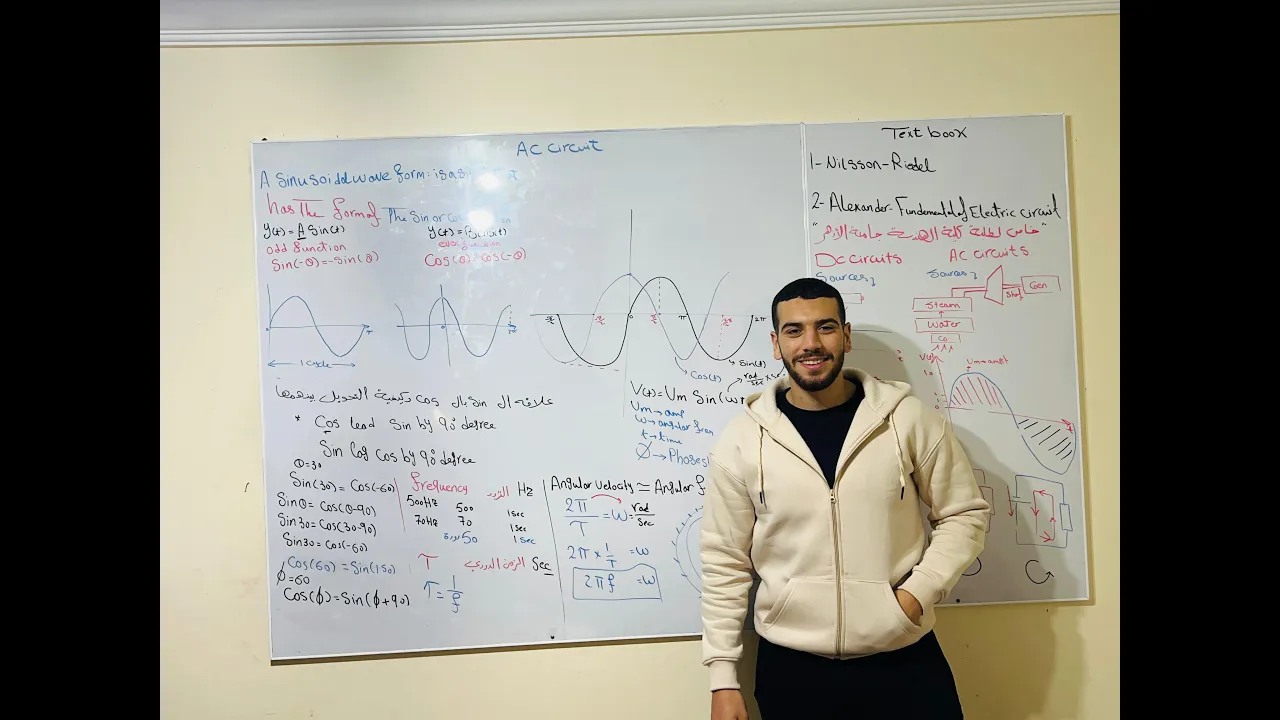
lec(1) Introduction of Ac Circuit
779
Sine and cosine waves are periodic functions that repeat indefinitely. A sine wave starts from zero, increases to maximum, decreases back to zero, then decreases to minimum, and returns to zero. The sine function is odd: sin(-θ) = -sin(θ). Sine and cosine waves are the same wave shifted by 90 degrees: cosine leads sine by 90 degrees, or sine lags cosine by 90 degrees. The mathematical relationship is sin(θ) = cos(θ - 90°) and cos(θ) = sin(θ + 90°).
Click to watch →
ENGINEERING PHYSICS II OPTICS II Interference II @japrgsclasses @Ishqhaiphysics
38.7K
This section covers the mathematical representation of waves using sine and cosine functions. The general form is y = A sin(ωt + φ) or y = A cos(ωt + φ), where A is amplitude, ω is angular frequency, and φ is the initial phase. The section explains how the choice between sine and cosine depends on initial conditions and demonstrates how to write wave equations with specific initial conditions.
Click to watch →
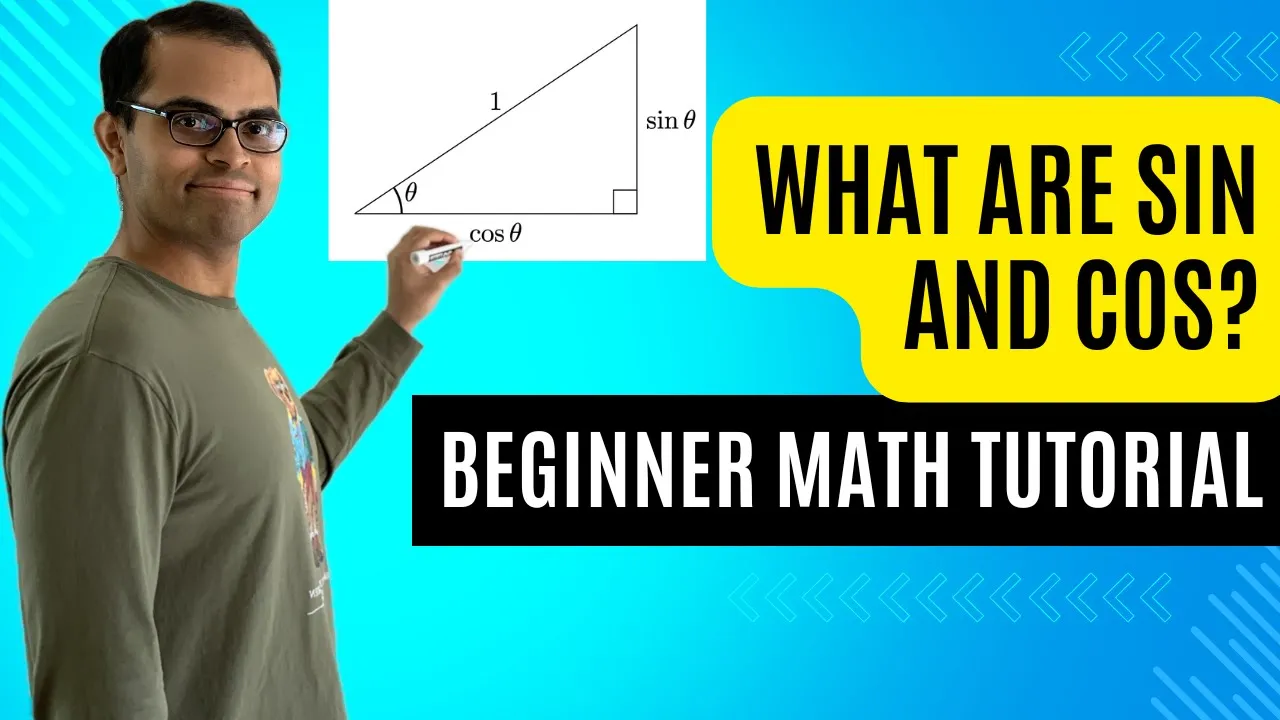
First Introduction to SINE and COSINE in TRIGONOMETRY!
250
Sine and cosine are trigonometric functions that describe the relationship between angles and side lengths in right triangles. For a right triangle with hypotenuse length 1, cosine of an angle θ equals the adjacent side length, while sine of θ equals the opposite side length. These functions can also be defined as ratios: cosine θ = adjacent/hypotenuse and sine θ = opposite/hypotenuse. The unit circle extends these definitions to all angles (0-360°) by defining cosine θ and sine θ as the x and y coordinates of a point on the unit circle at angle θ. Key values include: sin(0°)=0, cos(0°)=1; sin(90°)=1, cos(90°)=0; sin(180°)=0, cos(180°)=-1; sin(270°)=-1, cos(270°)=0.
Click to watch →
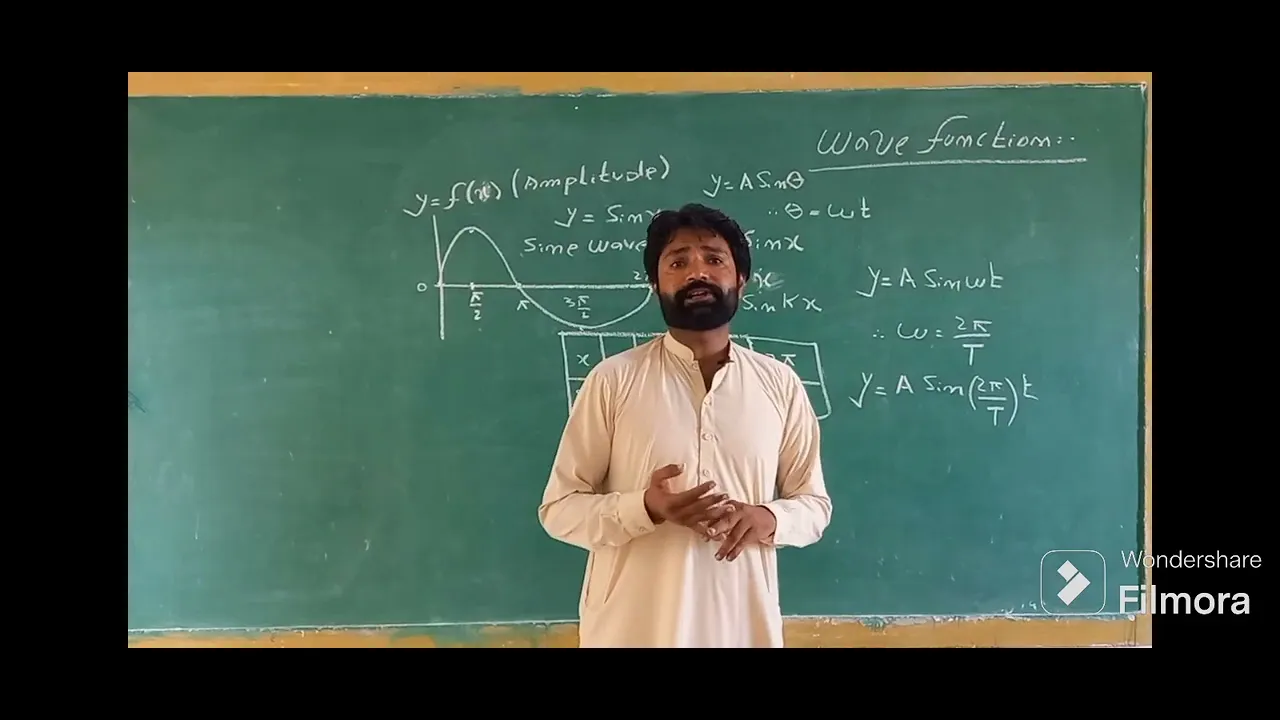
Crack numerical MCQs on Wave Functions and Wave equations
169
Wave functions describe how amplitude varies with position or time. In mathematics, y represents vertical displacement (amplitude). Sine waves start at zero, reach maximum at π/2, return to zero at π, minimum at 3π/2, and complete a cycle at 2π. Cosine waves start at maximum, decrease to zero at π/2, minimum at π, and back to maximum at 2π. Both are sinusoidal waves. The general equations are y = a sin(kx) for sine and y = a cos(kx) for cosine, where 'a' is amplitude and k is the wave number.
Click to watch →

Lecture by Dr. H.C.Verma on Wave Motion in Hindi Part 3/4,
86.8K
Understanding trigonometric functions is essential for evaluating wave equations. Key values: sin(π/2) = 1, sin(π) = 0, sin(3π/2) = -1, sin(2π) = 0. The sine function is positive in the first and second quadrants (0° to 180°) and negative in the third and fourth quadrants (180° to 360°). For cosine: cos(0°) = 1, cos(90°) = 0, cos(180°) = -1, cos(270°) = 0, cos(360°) = 1. The sign of cosine depends on which side of the y-axis the angle falls: positive for angles between -90° and +90°, negative for angles between 90° and 270°.
Click to watch →
Prerequisite Knowledge
- Concept 01Understanding of Simple Harmonic Motion (SHM), including periodic motion, restoring force, and oscillation equations.
- Concept 02Basic parameters of waves, such as amplitude, wavelength, frequency, time period, and the fundamental relation v = f * lambda.
- Concept 03Fundamental concepts of mechanics, specifically density, elasticity (modulus of elasticity), and Newton's laws of motion, which govern medium behavior.
- Concept 04Introductory calculus and trigonometry for grasping wave function representations, such as sine and cosine wave equations.
Subsequent Learning
- Step 01The Principle of Superposition and its applications in wave interference, beats formation, and standing waves in strings and pipes.
- Step 02The Doppler Effect in sound, including frequency shift calculations for moving sources and observers.
- Step 03Acoustics of buildings, focusing on reverberation, absorption coefficients, and ultrasound applications like SONAR.
- Step 04Laplace's correction to Newton's formula for the speed of sound, understanding adiabatic vs. isothermal thermal processes in gases.
Phase Delta
Wave Equation
Wave Constants
Direction Analysis
Wave Speed
Sound Process
Speed Corrected
Transverse Speed
Phase Delta
3:43Playing Section
- 1
Examines phase difference for a traveling wave.
- 2
Explains angular displacement relationships in degrees.
Quantum Acoustics and Phonons
While classical physics models sound as continuous waves propagating through a medium, modern physics introduces a quantum perspective known as quantum acoustics. In this framework, sound waves are quantized as quasiparticles called phonons. Similar to how light is composed of photons, sound at the atomic scale behaves as discrete packets of vibrational energy. This quantum viewpoint is essential for understanding thermal and electrical conductivity in solids, as well as phenomena at extremely low temperatures, where classical wave equations and continuous medium approximations fail to accurately predict physical behavior.
Deep Dive
The Principle of Superposition and its applications in wave interference, beats formation, and standing waves in strings and pipes.
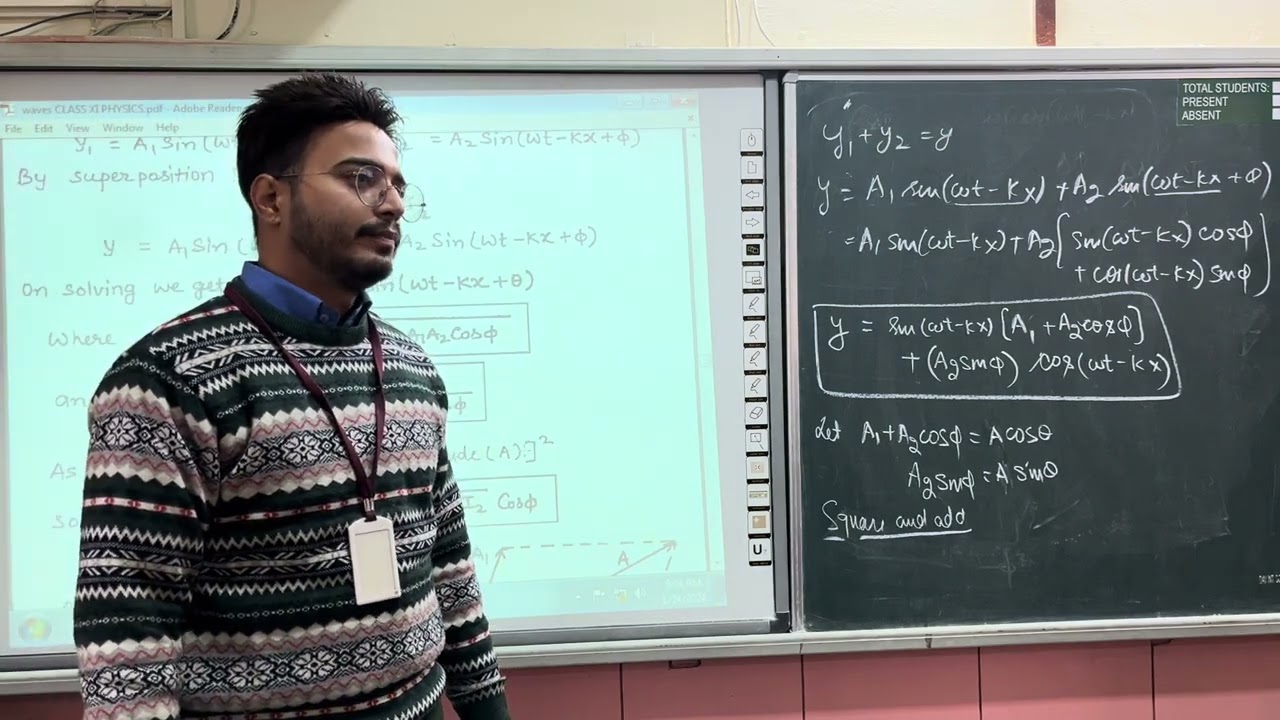
Waves and sound video 4 class 11 physics
115
The superposition principle states that when two or more waves meet at a point, the resultant displacement equals the algebraic sum of individual displacements. When waves travel in the same direction, displacements add (constructive interference); when in opposite directions, they subtract (destructive interference). This principle applies to three phenomena: interference of waves, formation of beats (when two sound waves of slightly different frequencies interfere, with frequency difference less than 10 Hz), and formation of stationary waves (when identical waves traveling in opposite directions interfere). Energy is conserved but redistributed during superposition.
Click to watch →
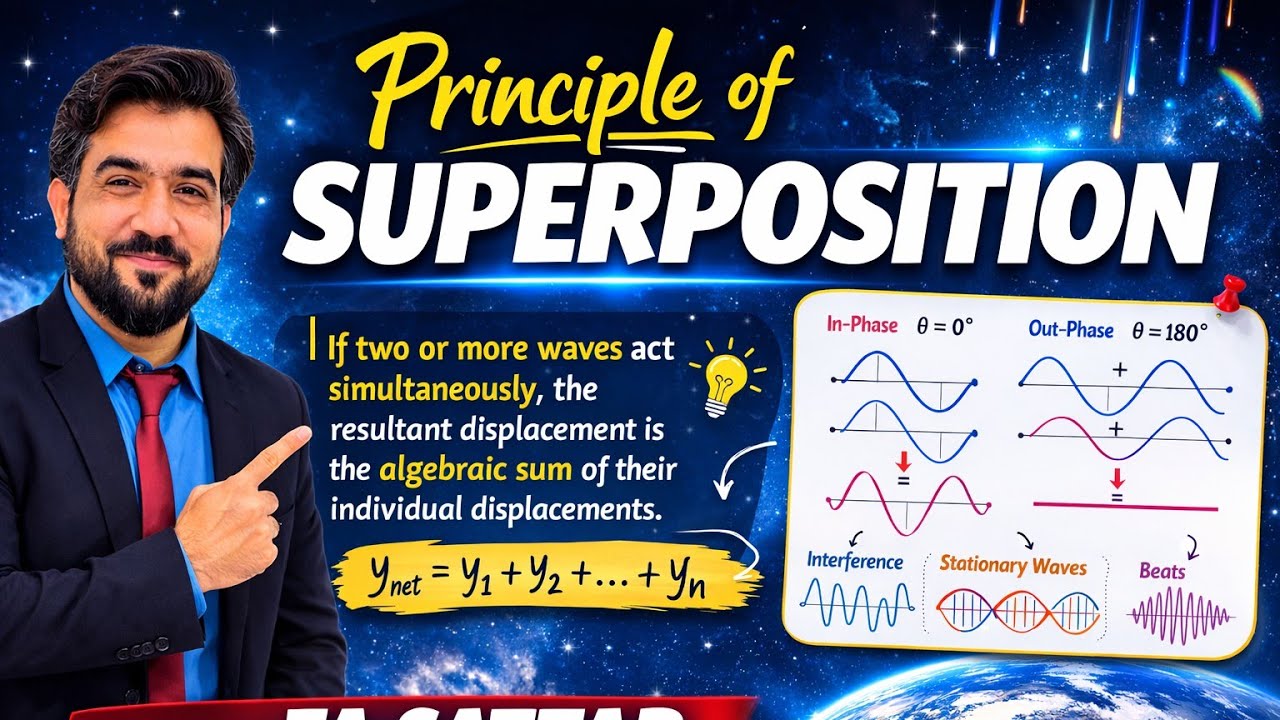
FSC Physics Book-1 Ch#07 Principle of SUPERPOSITION
142
The principle of superposition gives rise to three important wave phenomena: (1) Interference - occurs when two waves of same frequency and direction overlap; (2) Stationary/Standing Waves - occurs when two waves of same frequency but opposite direction overlap; (3) Beats - occurs when two waves of slightly different frequencies but same direction overlap. Each phenomenon requires specific conditions of frequency and direction relationships between the overlapping waves.
Click to watch →

Principle of superposition | class 11 physics | physics ka safar
39K
The Principle of Superposition states that when two or more waves or displacements meet at a point, the resultant displacement is the algebraic sum of individual displacements. When waves travel in the same direction, constructive interference occurs (displacements add up). When waves travel in opposite directions, destructive interference occurs (displacements cancel out). After interference, waves continue traveling in their original directions without permanent change. The mathematical representation is Y = Y1 + Y2. For observable interference, waves must have the same frequency and travel in the same direction. Stationary waves form when two waves with the same frequency and amplitude travel in opposite directions and interfere. This principle applies to all wave phenomena and is fundamental to understanding wave behavior in physics.
Click to watch →

Superposition Principle || Superposition Principle for B.Sc. 2nd Year || L-6
12.1K
The Superposition Principle states that when multiple waves meet at a point in a medium, the displacement of the resultant wave equals the vector sum of the displacements of the individual waves at that point. This principle has three main applications: (1) Interference - when two waves of the same frequency traveling in the same direction superpose, they produce constructive or destructive interference patterns; (2) Standing Waves - when two waves of the same frequency travel in opposite directions, they form stationary wave patterns with nodes and antinodes; (3) Beat Formation - when two waves of slightly different frequencies superpose, they produce periodic variations in intensity called beats. However, the principle is not applicable to waves with large amplitudes or sudden changes in amplitude, such as those produced in explosions or earthquakes.
Click to watch →

PK CLASSES : WAVES :: LECTURE-3 (STANDING WAVES AND MODES OF VIBRATION)
112
Standing waves are stationary wave patterns formed when two progressive waves of the same frequency travel in opposite directions and interfere. The Principle of Superposition states that when waves overlap, the resultant displacement is the algebraic sum of individual displacements. This principle explains interference phenomena, standing wave formation, and beats. Standing waves have nodes (points of zero displacement) and antinodes (points of maximum displacement), with the distance between consecutive nodes being λ/2.
Click to watch →
Deep Dive
The Doppler Effect in sound, including frequency shift calculations for moving sources and observers.

FR UTBK 2021 Gelombang Pertama
187.8K
The Doppler Effect describes the change in frequency of a wave in relation to an observer who is moving relative to the wave source. The formula is f' = f × (v ± vo)/(v ∓ vs), where f' is the observed frequency, f is the source frequency, v is the speed of sound, vo is the observer's velocity, and vs is the source's velocity. When the observer moves toward the source, vo is positive; when moving away, vo is negative. When the source moves toward the observer, vs is negative; when moving away, vs is positive. For example, if a bus (source) moves away at 20 m/s and the observer (motorcyclist) moves toward the bus, the observed frequency is f' = 720 × (340 + vo)/(340 - 20).
Click to watch →

Doppler effect | class 11 physics | BS physics | physics ka safar
78.6K
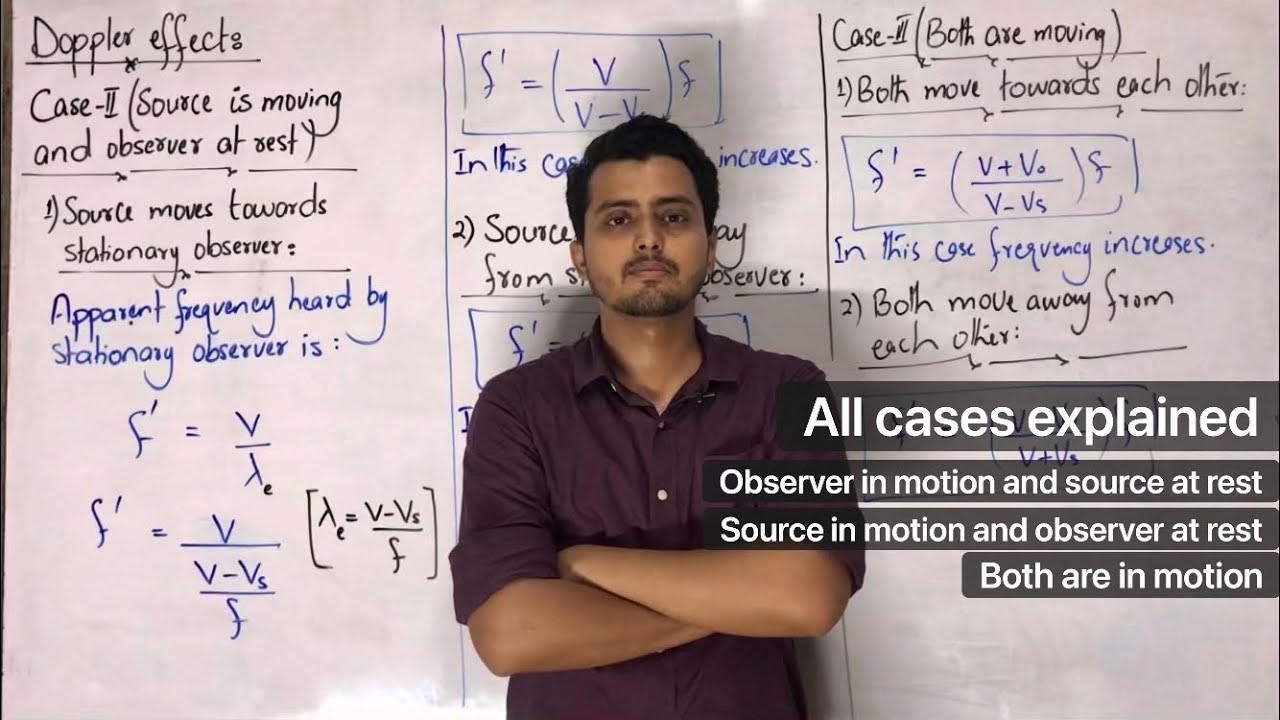
When the sound source moves and the observer is stationary, the Doppler Effect occurs due to changes in wavelength. When the source moves toward the observer, the wavelength decreases in front of the source (λ = (v - v_s) / f), causing more wave crests to reach the observer per unit time. When the source moves away, the wavelength increases behind the source (λ = (v + v_s) / f), causing fewer wave crests to reach the observer. The apparent frequency is given by f' = f × (v / (v ∓ v_s)), where v is the speed of sound and v_s is the speed of the source. The minus sign applies when moving toward, and the plus sign when moving away.
Click to watch →

November 2022 Physical Science Paper 1
182K
For a stationary source and moving observer, the Doppler effect formula is f_L = f_S × (v_sound ± v_L)/v_sound, where f_L is observed frequency, f_S is source frequency, v_L is observer speed, and v_sound is speed of sound. The plus sign is used when the observer moves toward the source.
Click to watch →

Sound Waves | 45 Days Crash Course | JEE | Abhilash Sharma | Unacademy Atoms
45.6K
When both source and observer move, use the master formula f' = f(v ± v₀)/(v ∓ vₛ). If both move toward each other, use + in numerator and - in denominator. If both move away, use - in numerator and + in denominator. The sign convention ensures the observed frequency increases when they approach and decreases when they separate.
Click to watch →
Doppler effect || relative motion of source of sound and observer || frequency of sound || Physics
286K
When the observer moves toward a stationary source, the apparent frequency is calculated using the formula: f' = f × (V + Vo) / V, where f is the original frequency, Vo is the observer's velocity, and V is the speed of sound. When the observer moves away, the formula becomes f' = f × (V - Vo) / V. The plus sign indicates approaching motion, while the minus sign indicates receding motion. This formula accounts for the relative velocity between observer and source.
Click to watch →
Deep Dive
Acoustics of buildings, focusing on reverberation, absorption coefficients, and ultrasound applications like SONAR.

APPLIED PHYSICS MOST IMP ONE SHOT REVISION | GTU DIPLOMA SEM 1&2 EXAM IMP | PHYSICS IMP |
140
This section covers sound properties and ultrasonic applications. Sabine's Formula calculates reverberation time (RT) in a room: RT = 0.161V/A, where V is room volume and A is total absorption. Reverberation time is the duration for sound to decay by 60 dB after the source stops. For good acoustics, RT should be appropriate for the room's use (shorter for speech, longer for music). Characteristics for good acoustic buildings include: avoiding parallel walls, proper corner treatment, and ensuring uniform sound distribution throughout the space. Ultrasonic waves have frequency above 20,000 Hz (beyond human hearing). Properties include: high frequency, short wavelength, highly directional beam, and propagation through solids and liquids. Applications include: industrial cleaning (ultrasonic cleaners), medical imaging (ultrasound scans), and non-destructive testing.
Click to watch →
Polytechnic Physics Semester 2 // Exam Special // 2021 Revision Based // Part 5 // Short Notes pdf!!
10K
Acoustics of buildings is the science of designing spaces for optimal sound quality. Reverberation is the prolongation of sound after the original source stops. Reverberation time is the duration sound persists after cutoff. For best sound effects, reverberation time should be small. This time depends on room volume and absorbing materials, not source and listener positions.
Click to watch →

Building Acoustics
4.1K
Reverberation time—the decay rate of impulse sound—is determined by space volume and absorption quantity. More people in a room increase absorption since humans are absorptive. Historic churches and swimming pools exhibit long reverberation due to large volumes and minimal absorption. Absorption materials (spray-on, fiber cement, acoustical panels) dissipate sound energy, measured as coefficients from 0 to 1, with frequency-dependent performance. Non-absorptive materials include wood, concrete, gypsum board, and glass. Designers must balance aesthetic preferences (like exposed CLT finishes) against acoustic requirements, sometimes adding absorption behind visible surfaces. Room acoustic modeling now enables prediction of reverberation, reflections, and diffusion before construction, allowing designers to experience proposed acoustics virtually.
Click to watch →
Acoustics of building-Dr Smita Sharma
3.2K
Building acoustics focuses on how sound behaves in enclosed spaces like auditoriums, with reverberation time being a critical parameter determined by the Sabine formula RT = 0.161V/A, where V is room volume and A is total sound absorption; optimal reverberation time varies by use (1.5-2 seconds for music, 0.5-1 second for speech), and proper acoustic design requires balancing sound intensity, clarity, and reverberation through strategic placement of sound-absorbing materials and reflective surfaces.
Click to watch →
NTSE Sci Assignment Ch12 sound
1.2K
Reverberation is repeated reflection creating continuous sound, reduced by sound-absorbing materials. Ultrasound (above 20,000 Hz) is used in medical imaging, detecting metal cracks, and cleaning. Animals like dogs, dolphins, and bats hear ultrasound. SONAR (Sound Navigation and Ranging) uses ultrasound to find underwater objects: Distance = (Speed × Time) / 2. Applications include detecting underwater mountains, sunken ships, and navigation.
Click to watch →
Deep Dive
Laplace's correction to Newton's formula for the speed of sound, understanding adiabatic vs. isothermal thermal processes in gases.

Physics Mcq For BSc Nursing Exam | BSc Nursing Entrance Exam Physics Pyq Solution | BY ER GS SIR
104K
Newton calculated sound velocity assuming isothermal processes, but Laplace corrected this by noting that sound propagation is adiabatic (no heat exchange). The correct formula is v = √(γP/ρ), where γ is the adiabatic index (1.4 for air). This correction increased the calculated velocity from ~280 m/s to ~331 m/s, matching experimental values.
Click to watch →

Laplace|Correction|Physics 11|Tamil|MurugaMP
188.3K
Newton's original formula for the speed of sound in air (v = √(P/ρ)) assumed an isothermal process, but Laplace corrected this by recognizing that sound propagation is actually an adiabatic process where temperature changes during compression and rarefaction. The corrected formula is v = √(γP/ρ), where γ (gamma) is the adiabatic index (approximately 1.4 for air), P is atmospheric pressure, and ρ is air density. This correction accounts for the rapid nature of sound waves, which prevents heat exchange during compression and rarefaction cycles, making the process adiabatic rather than isothermal.
Click to watch →

Sound | Acoustics | One Shot Lecture | Revision | Boards | MDCAT | ECAT | Boards
35.6K
Newton assumed sound propagation is isothermal (constant temperature), but Laplace corrected this by recognizing it is actually adiabatic (no heat flow during rapid compression/rarefaction). The corrected formula is v = √(γP/ρ), where γ is the adiabatic constant. For monatomic gases γ = 1.67, for diatomic gases γ = 1.40, and for polyatomic gases γ = 1.33. The speed of sound does not depend on pressure because pressure and density are directly proportional.
Click to watch →

Waves, One Shot Video NCERT Class 11 Physics Chapter 15 Waves CBSE Board Term II 2022
117K
Sound propagation in gases is an adiabatic process because the compression and rarefaction occur so rapidly that there is no time for heat exchange with the surroundings. This is why Laplace's correction (using γ instead of 1) is necessary. The adiabatic nature means the temperature changes during sound propagation, unlike the isothermal assumption Newton made.
Click to watch →
Derivation Newton’s Formula and Laplace Correction Class 11 Physics Wave || Longitudinal Wave #wave
14.4K
Laplace corrected Newton's formula by recognizing that sound propagation is adiabatic, not isothermal, because compression and rarefaction occur too rapidly for heat transfer. For adiabatic process, PV^γ = constant, where γ is adiabatic index. Differentiating gives γP dV + V dP = 0, so bulk modulus K = γP. This correction accounts for the rapid nature of sound waves where no heat exchange occurs. The adiabatic index γ for air is 1.4.
Click to watch →
Phase Delta
Wave Equation
Wave Constants
Direction Analysis
Wave Speed
Sound Process
Speed Corrected
Transverse Speed
Phase Delta
3:43- 1
Examines phase difference for a traveling wave.
- 2
Explains angular displacement relationships in degrees.
Quantum Acoustics and Phonons
While classical physics models sound as continuous waves propagating through a medium, modern physics introduces a quantum perspective known as quantum acoustics. In this framework, sound waves are quantized as quasiparticles called phonons. Similar to how light is composed of photons, sound at the atomic scale behaves as discrete packets of vibrational energy. This quantum viewpoint is essential for understanding thermal and electrical conductivity in solids, as well as phenomena at extremely low temperatures, where classical wave equations and continuous medium approximations fail to accurately predict physical behavior.
Understanding of Simple Harmonic Motion (SHM), including periodic motion, restoring force, and oscillation equations.
Basic parameters of waves, such as amplitude, wavelength, frequency, time period, and the fundamental relation v = f * lambda.
Fundamental concepts of mechanics, specifically density, elasticity (modulus of elasticity), and Newton's laws of motion, which govern medium behavior.
Introductory calculus and trigonometry for grasping wave function representations, such as sine and cosine wave equations.
The Principle of Superposition and its applications in wave interference, beats formation, and standing waves in strings and pipes.
The Doppler Effect in sound, including frequency shift calculations for moving sources and observers.
Acoustics of buildings, focusing on reverberation, absorption coefficients, and ultrasound applications like SONAR.
Laplace's correction to Newton's formula for the speed of sound, understanding adiabatic vs. isothermal thermal processes in gases.
2.1K views37likes1:21:55@ClampHookOriginal Release: 2022-05-22
omega t is foreign and what will be the value of delta foreign foreign abcd foreign i am measuring time from very good 270 degree okay 270 degree this is 270 degree delta 1 oh yeah your 270 degrees are three pi by two and so there are circles um very good [Music] sorry foreign foreign this pendulum foreign taken by wave to reach at p rasa guru may to foreign let y be particle displacement or displacement of particle or simply displacement of point p at [Music] foreign foreign foreign wave is traveling in this direction foreign substitute foreign it omega t minus omega where it is called propagation constant it is called propagation omega y constantly foreign foreign foreign wave is propagating y equals but wave is moving in this direction with v velocity wave is moving in leftward direction with v velocity particles just for displacement foreign foreign m you have to find equation of this wave which of the following is correct y equals to a sine omega t minus kx b epsilon y equals to a sine kx sorry yeah omega t plus kx omega t plus kx c option bio y equals to a sine [Music] is foreign foreign is [Music] okay foreign foreign foreign is is foreign [Music] clear longitudinal solid medium even ago it is modulus of elasticity it is modulus of elasticity medium density elasticity of that medium divided by density of that medium our ferryman solid liquid regards mother cosmo sound of your velocity of sound some of the two nodes huh so very simple modulus of elasticity for liquid or gas for by density liquid regardless of the root over bulk's modulus of elasticity on the maximum solid liquid gas method foreign foreign propagation of sound wave through gases isothermal process according to newton right according to newton propagation of gas sound through gases isothermal process isothermal process will foreign students the differentiating both sides we get this p into dv equals to minus v into dp electronic so p can be written as minus dp divided by dv divided is b 281 meter per second 281 meter per second newton's isothermal it was found 332 meter per second experimentally but but experimentally it was found it was found 332 meter per second 281 meter per second experiment okay so foreign foreign foreign foreign club foreign foreign foreign minus cross here this must have a value 331.8 meter per second i o and which is nearly nearly equals to 332 meter per second sorry so is foreign my oh your arbitrary timer so foreign okay speed of transverse wave foreign okay from geometry it can be proved you from geometry it can be proved the angle centered [Music] what [Music]
Up Next

7:26
Bremsstrahlung Radiation: X-Ray Production Explained
@CloverLearning
174.6K views•2023-06-28

12:53
21cm Hyperfine Transition in Neutral Hydrogen: Radio Astronomy Basics
@AaronRobertParsons
12.4K views•2011-10-13

32:32
NMR Spin Physics I: Zeeman Effect, Resonance Condition & Larmor Frequency
@nptel-indianinstituteofsci8064
2.3K views•2024-01-17

27:14
Entropy and the Second Law of Thermodynamics Explained
@veritasium
27.5M views•2023-07-01
Related Study Plans & Knowledge Roadmaps
Structured learning paths in Physics
physics
Nuclear Physics (Decay, Fission & Reactors)
01Atomic Structure and the Binding Force
02Radioactive Decay and Half-Life
03Nuclear Fission Mechanics and Chain Reactions
+ 2 more learning modules
12h5 modules
Explore Roadmap
physics
Soft Matter (Polymers, Colloids & Rheology)
01Foundations of Soft Matter & Thermal Forces
02Polymer Physics and Macromolecules
03Colloids, Surfactants, and Self-Assembly
+ 2 more learning modules
38h5 modules
Explore Roadmap
physics
Analytical Mechanics: Lagrangian & Hamiltonian
01Mathematical Foundations: Calculus of Variations
02From Newtonian Mechanics to Constraint Dynamics
03The Principle of Least Action & Lagrangian Mechanics
+ 3 more learning modules
28h6 modules
Explore Roadmap
physics
General Relativity (Spacetime & Cosmology)
01Foundations of Relativity: Special Relativity
02The Geometry of Spacetime: Equivalence Principle & Curvature
03Einstein's Field Equations: The Mathematics of Gravity
+ 2 more learning modules
55h5 modules
Explore Roadmap