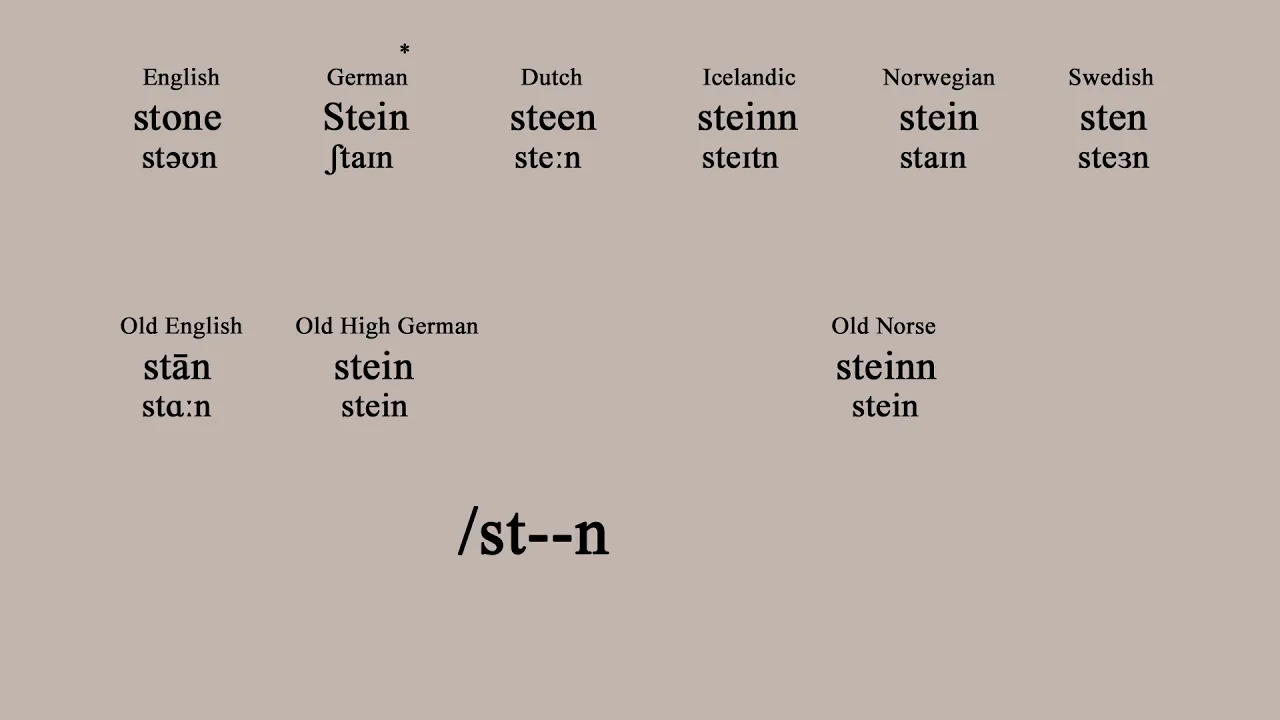














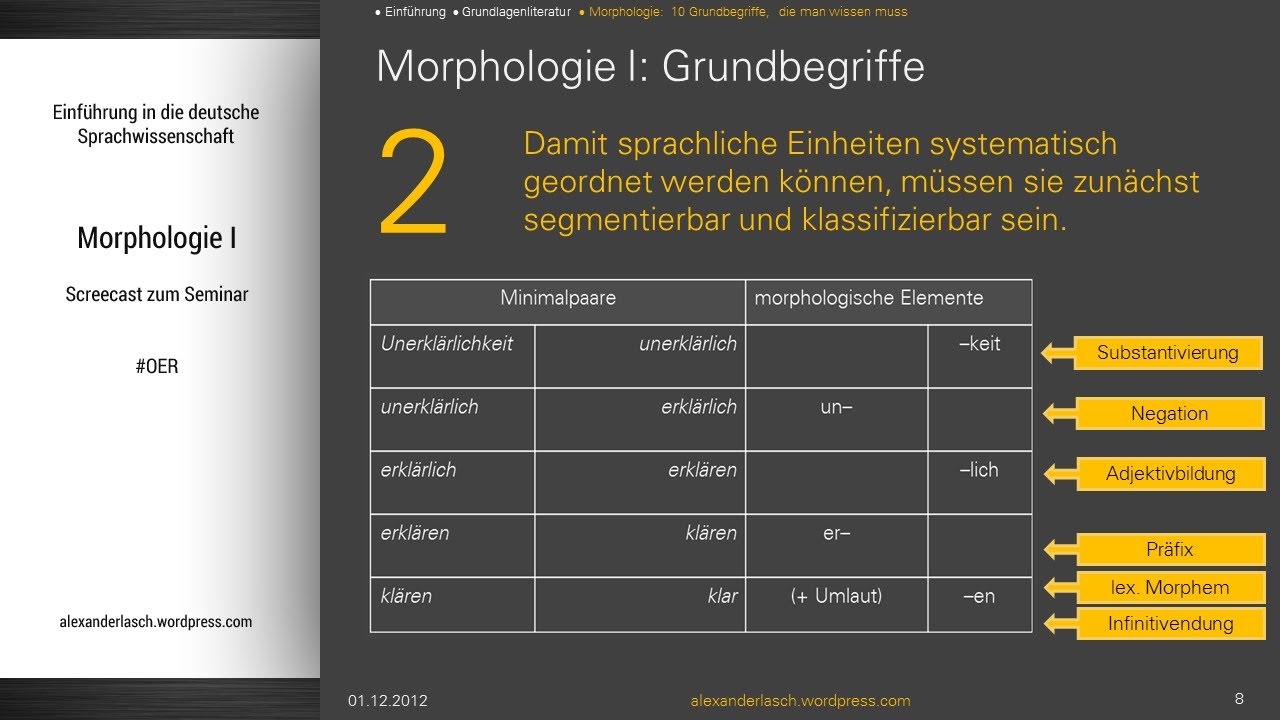


Linguists reconstruct Proto-Indo-European using specific conventions: all reconstructions are preceded by an asterisk (*) to indicate non-attested forms, followed by dashes to show root syllables rather than complete words; laryngeals H1, H2, H3 are conventionally represented with H numbers, with H used when uncertain; Proto-Indo-European distinguishes palatal vowels (ä, â) from regular vowels, with Satam languages preserving this distinction while Centum languages merge them; the s-mobile phenomenon shows initial s may be arbitrarily dropped or retained in different branches; and the root template uses e as the default vowel with various grades (full, lengthened, o, zero) that are preserved in English strong verbs.
Writing Proto-Indo-European: *gʷr̥h₃-dʰh₁-o- & More | Etymology
Added:Understanding of the comparative method in historical linguistics used to reconstruct ancestral languages.
Basic familiarity with the concept of Proto-Indo-European (PIE) as the hypothetical common ancestor of the Indo-European language family.
A foundational grasp of phonetics and phonology, specifically phonetic notation and terminology regarding consonants (such as labiovelars and aspirates).
Familiarity with the general linguistic concepts of morphology, including roots, stems, and suffixes.
In-depth exploration of Laryngeal Theory and how these reconstructed sounds influenced vowel quality and length in daughter languages.
Advanced study of PIE Ablaut (vowel gradation) patterns, specifically the mechanics and grammatical functions of e-grade, o-grade, and zero-grade mutations.
Application of historical sound laws (such as Grimm's Law, Verner's Law, or sound shifts in Indo-Iranian) to trace PIE roots to modern vocabulary.
Analysis of PIE nominal and verbal inflectional systems, focusing on how reconstructed roots are declined or conjugated.
22.5K views1.8Klikes19:28Original Release: 2023-12-01
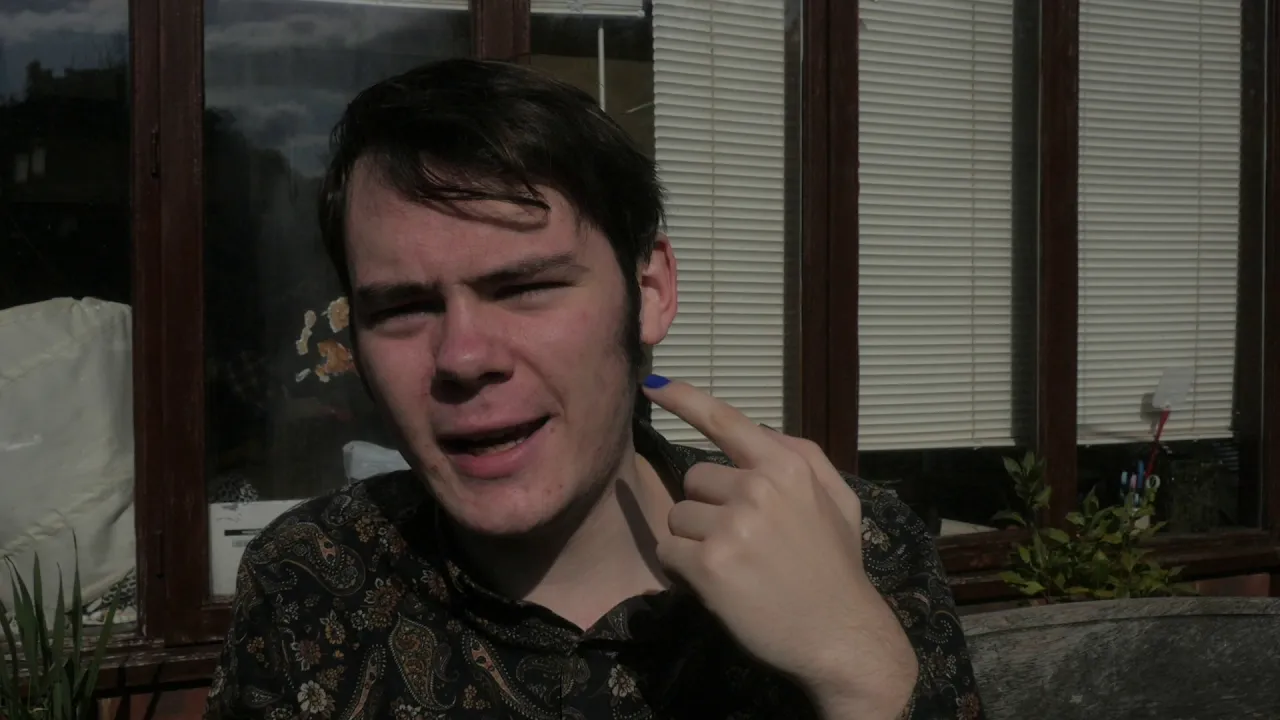
hi I'm old North specialist Dr Jackson Crawford back today with another video on my channel usually dedicated to nor Smith and language but often taking side quests into the bigger picture of Indo-European languages especially with the series of shorts that I've been doing about Indo-European roots and the monthly check-ins on Indo-European studies news with Professor Tony Yates so today I want to talk about a kind of a meta question that often comes up in these discussions or rather in the kind of comments and questions I get about these discussions which is how Proto IND European is represented on the page on your screen of course this is a language that was not written down by its speakers or if it was I mean it's highly unlikely but uh we have no trace of it so how are we representing it in writing well there's a few differences you know just like Old Norris a language that was written by it speakers uh gets represented in different ways by modern editors there are some differences in how people write Proto IND European but also some common conventions so I want to especially talk about the ones that I use which I think are most usual in the present day world of Indo European [Music] studies [Music] so first things first of course all citations of Proto induran words or Roots should be preceded by an asterisk this is a Convention of linguistics we always write words Roots whatever in reconstructed languages with asterisks preceding them that indicates this is not a form actually attested in writing by someone who spoke this language natively asteris are also used in other contexts and Linguistics for example in showing incorrect sentences that are used in examples so an English sentence like me watch the snow would be preceded by an asterisk in some Linguistics context to to show this is not something a native speaker would say all right so our roots in citation will be preceded by asterisks typically followed by dashes those dashes show that these are not complete words very seldom do we cite complete words in proto IND European because in a sense that's not all that useful uh typically it is the root syllable or root two syllables that we're going to be interested in because descendant languages will form their own specific words from those roots with a lot of different formats those formance May themselves go back to Proto IND European so if they're suffixes they'll actually start with a dash when we site them in proto IND European so for example we might say you know the masculine nominative singular of an ostem noun in protran we might cite that as asterisk Das o but most of the time we're not going to be all that interested in the specific formation that make specific words in put inpn but rather the roots that give us the root vocabulary of descendant languages so typically these citations preceded by an asterisk followed by a dash all right let's talk about a few other things one of the most uh perplexing and vexing issues about Proto European studies are the class of sounds that we conventionally refer to as lenal they might not actually have been lenal and a lot of Scholars disagree about what the exact meaning of these sounds were but there were three of them that Were Somehow distinct conventionally these are represented as H1 H2 H3 that is almost always how I'm going to represent them and they can function as consonants or as vowels I'm going to come back to that in just a second now if we don't know which of the three to reconstruct the convention that I follow that I think most Scholars today follow is just write it as a capital H indicating it's some lenal we don't know if it was one two or three typically the way that we reconstruct whether it was one two or three is by uh coloring so I'll come back to what coloring means in a moment uh coloring can be most obvious in Greek um in some ways it is least obvious in a language like Sanskrit which is otherwise extremely valuable for reconstructing Proto IND your PN because Sanskrit has some some vowels that collapse together uh another place where we get lenel the most valuable adastation for them is the Anatolian languages such as hittite and luian where we actually have lenel preserved as lenal whatever the exactly that means some sound that's H like um and uh writing done by speakers of those languages okay so one other issue with lenel is that in nonanol languages where lenal are not preserved as lenal um in a sense there's no reason to reconstruct the lenal for the last common ancestor of those languages the non Anatolian uropean languages now probably Anatolia split off before the other IND European languages so there's some sense in reconstructing a ancestor to the non-indo European languages where uh FL angels are not present but it can cause confusion as to what you mean by Proto European do you mean the common ancestor of um just to take three languages from different branches an example hittite English and Sanskrit or does it mean just the common ancestry of English and Sanskrit but not hittite so this can cause confusion if you look at a really good reference work in proto European that's easily available but I think underappreciated probably under bought um that is the American Heritage dictionary of Indo-European Roots by calt Watkins wonderful scholar wonderful man the late Calbert Watkins the entries in bold that that dictionary is actually alphabetizing are the PO hittite post lenal Indo-European Roots again common ancestor of say English Sanskrit Latin Greek Russian but not of hittite that has the lenal already gone evidenced only by coloring so let's look at what the difference is between um those roots with lenal would be and those roots without lenal would be let me just give you a quick word from my friends and partners at Grim Frost and I'll come right back to talking about some specific Roots what they'll look like in those different citational forms yeah okay so for example a root that I would usually cite as de DH being its own consonant in prot European eh H1 showing the lenal number one Watkins will site as t with the long e that's not coloring exactly but what's happened is that after the lenal is lost and post Anatolian into European um it just lengthens the preceding vowel H2 however will color that e to a so a root that I would normally site as PE PE lurel 2 uh Watkins will site as as P P long a you get that lengthening but also you get coloring H2 colors the E that it's adjacent to into an a same thing if it proceeds so for example a roote that I would cite as hent lenal 2ent T Walkin sight says ant the uh ancestry of things like anterior uh same way de de third lenal Watkins will cite as doe uh D long o you get lengthening you also get coloring uh or uh proceeding the vowel HEC a root for C or I like what I see with uh walk insil site that is Oak so the coloring happens whether H2 or H3 predes or follows the E uh the lengthening happens also if it follows the E now e is typically the vowel that we're going to cite any Proto induran roote as having even though Proto induran also has o but it looks like the way Proto IND European worked is that the the template of the root and way that might kind of remind you of a language like Hebrew Al although working differently the template of the root is the consonants that prede and follow the vowel now those consonants may include lenal of course but the basic form of the root has the vowel e so we call that full grade there's also lengthen grade where the E is long uh this can happen uh without comp compensatory lengthening like what happens when you lose a lenal there there is also just long e in protan there's also o grade where the E is replaced by an O and then there's lengthened o grade where it's a long o and then there's zero grade where the vow is completely gone now the alternations between these vowels e long e o long o and no vowel are called obl out and they are preserved in English strong verbs as well as in a lot of other places throughout the IND European languages but the most obvious place in English is is in the strong verbs so there's a roote we can reconstruct as s that's the full grade lengthened e grade would be sang o grade would be song Length and O grade would be S and then zero grade would be now what's happening in Su in at zero grade is that the N itself being a resonant functions as a vowel l m r and N so L and R uh resonance sonance and then MN which are specifically called nasals can function as vowels in protran as they can in English right so in English words like at least in American English a word like um Earth R is really the vowel there's no valve preceding our Earth um uh pull and a lot of people's pronunciations including mine the bowel is an L um uh something like button the N at the end is really functioning as a vowel um column the m at the end is really functioning on its own as a Val same thing can happen in protein it very often does in zero grade now on a dramatic language like English those those sonants functioning as vowels get a preceding U so you might notice that in the uh forms of a strong verb in English like sing what we've got sing saying sung is actually continuing the full grade the O grade a short o always become short a in a dramatic language and then the zero grade so English actually Faithfully preserves as a quote unquote irregularity something that was very regular in its protol language about 5,000 years ago or whatever exactly the time back to that is all right another thing to notice about how uh Watkins might site a form or other people might cite a form is Proto European distinguishes so-called palal veers from regular veers that means that there's some kind of a distinction it's probably something like G and Q from just regular G and C that G and Q are represented by most writers with a kind of aute accent above them but you'll sometimes see people use a circumflex accent above them um if that's just what their you know keyboard allows and then in some books like like say watkins's dictionary um the main entries don't distinguish those palal veers from the regular veers you're just going to see G or k so for example the root for for acre or or Agro uh Walkin the sites as Agro I would typically write this hego with the G uh indicating that it's palal because that does make a difference in some descendant languages like for example in Sanskrit those palal feelers are uh still they they give you different results than the regular feelers that's because Sanskrit or say a veston or the Baltic and Slavic languages these are so-called satam languages is where the palal veers remain distinct from the regular veers but the labio veers the qu and gu sounds fall together with the regular C and G uh languages like English Latin Greek are so-called Kum languages where the pal ofers fall together the regular veers but the lab ofers remain distinct so uh K and C fall together but qu remains distinct so in a dramatic language like English and C from prot both become H but Q distinctively becomes H and of course in most people speaking now just a w or another dramatic language is typically just a v an iic uh so those are called Kum versus satum languages because you have U protoform uh protran kto something like that in Latin that becomes Kum right the C becomes regular C but in aeson that becomes SA that's a sattim language so it's just named for the the different outcomes of that 100 root in uh Latin versus aest Kum versus satum languages respectively another thing to keep in mind um there is something called so-called S mobile S mobile this just means that the s that starts a root in protein European may be kind of as far as we can tell arbitrarily dropped in some branches or in some individual words and individual branch is my favorite example of this is the root steg which means cover so English thatch is an exact uh thecenter of this route with uh Grim's law t g and then palatalization eventually affrication of kacha in some context in English that is cognate with Latin toga which is the same roote in ograde and uh doesn't have the S also but then the Greek sto roof does have the es mopa so you get stegosaurus right the roofed lizard the lizard with a roof on it was how the plates on it were originally perceived other roots with ESOP include for example uh snag meaning snow so English maintains the S Latin Nix root n uh does not maintain the S the S just apparently it's kind of arbitrarily lost or think of um like uh Czech slug is something like slimak slimak um but in Latin or Greek that's liox lame MOX without the S so s Mobil s is often written in apostrophes to indicate they may or may not show up and descended languages words another thing to keep in mind is different ways people write I and U and their consonantal forms Y and W I should have mentioned that these are also o sonant resonance that can function as um well the Glides but they can also like the sonant that can function as vowels or as consonants so so the vowel e written I can also function as consonant y usually today people write that in its consonantal form as a y following English practice just like people usually write the consonantal form of the b o as a w following English practice but you'll find some older writers who might write that consonantal I as a J or as an i with an accent under it same thing you'll find some writers who will write that uh consonantal U that W as a um as a u with an accent under it so these are some of the things to watch out for in looking at reconstructed Proto indoeuropean words and Roots as they will be cited in scholarly sources or and my YouTube videos and uh no doubt other the things that I've forgotten about I have noted on screen and text I hope this has been somewhat useful to you uh if it has been I appreciate your support uh of course support in the form of buying books I've translated a lot of important Norse myths and sagas and the original Old Norse forms into English and also another probably principle way you can support this channel is via patreon so and by the way if you are on patreon you get to attend these live monthly interviews that uh I do with Tony Yates about IND European news as well as a lot of other interviews with great experts and different subjects and language myth and other things and uh you get stuff like a Christmas card which maybe this will be posted before Christmas so maybe you can still request one of those all right well my ears are starting to freeze um but I've enjoyed the snowy background here the snake and uh I'm wishing you well wishing you all wonderful holiday seasons out there and from beautiful Wyoming please know I am as always wishing you all the [Music] best
Up Next

12:14
Proto-Indo-European S-Mobile and Laryngeals Explained
@watchyourlanguage3870
111.1K views•2023-02-07
36:52
Constraint Interaction in Optimality Theory: Epenthesis & Deletion
@Vidyamitra
180 views•2018-08-20
10:37
Grimm's Law & Sound Change: Historical Linguistics Explained
@JacksonCrawford
66.2K views•2017-05-03

21:32
Accent Expert Explains U.S. Regional Dialects | Part 1
@WIRED
9.3M views•2021-01-21
Related Study Plans & Knowledge Roadmaps
Structured learning paths in Linguistics
linguistics
Optimality Theory: Tableaux & Constraints
01Phonological Basics: Sounds, Syllables & Rules
02Foundations of Optimality Theory: GEN, CON, and EVAL
03The Constraint Inventory: Markedness vs. Faithfulness
+ 2 more learning modules
15h5 modules
Explore Roadmap
linguistics
Morphosyntactic Alignment: S, A & P Systems
01Foundations of Syntax: Transitivity and Arguments
02The Linguistic Variables: Mapping S, A, and P
03Nominative-Accusative Alignment
+ 3 more learning modules
12h6 modules
Explore Roadmap
linguistics
Analyzing Sign Language: Phonology & Syntax
01Foundations of Sign Language Linguistics
02Phonology: The Five Parameters of a Sign
03Morphology: Word Formation and Classifiers
+ 2 more learning modules
14h5 modules
Explore Roadmap
linguistics
Pragmatics: Speech Acts, Grice & Politeness
01Introduction to Pragmatics: Meaning in Context
02Grice’s Cooperative Principle & Implicature
03Speech Act Theory
+ 2 more learning modules
14h5 modules
Explore Roadmap