



















![[Studia] Rozwiązania, Wykresy Równań Różniczkowych 2 Rzędu Liniowych rozwiązanych metodą Przewidywań](https://i.ytimg.com/vi_webp/mlnRPva1UK8/maxresdefault.webp)




Complex numbers, expressed as z = x + iy where i is the imaginary unit satisfying i² = -1, are essential for solving polynomial equations and appear ubiquitously in physics and engineering, particularly in oscillating systems described by differential equations. Basic operations include addition/subtraction (combining real and imaginary parts separately) and multiplication/division (with division requiring multiplication by the complex conjugate). Euler's formula, e^(iθ) = cos(θ) + i·sin(θ), reveals that sines and cosines are the imaginary and real parts of complex exponentials, making complex numbers invaluable for representing oscillatory phenomena. Complex numbers can also be represented in polar coordinates as z = r·e^(iθ), where multiplication becomes simple multiplication of magnitudes and addition of angles, greatly simplifying calculations.
Complex Analysis Lecture 1: Motivation, Arithmetic, and Euler's Formula
Added:welcome back everyone so today i'm going to start a mini lecture series on complex analysis which is essentially the study of numbers and functions of complex variables z where z has a real part and an imaginary part we write this usually as x plus iy x is real uh y is also real but i y is imaginary and in my kind of college math class this would usually take up about two weeks the series i'm about to to give you right now uh i think i'm hoping to do this in about 12 or 13 little mini lectures i'm really hoping it ends up being 13.
the inauspicious and occasional number of lunar months that fit into a solar year okay so complex functions and complex variables come up all the time in differential equations ordinary differential equations odes like when we deal with pendulum swinging or if we have a a mass on a spring that is oscillating pretty much anything in physics that oscillates that moves back and forth is going to involve some kind of complex function usually we think of this motion as periodic so it's going to be described by sines and cosines and what we're going to see very very quickly is that sines and cosines are actually the imaginary and real parts of a complex exponential function so very cool stuff um good now when um when i start i like to to kind of define what i mean by i this imaginary number most of you know this from you know from high school or grade school you've seen this before we say that uh you know i equals or is defined as the square root of negative one so we know what the square root of nine is it's it's you know three but it could also be minus 3 because minus 3 times minus 3 is positive 9. and very quickly uh in school you realize that these negative numbers don't have a real valued square root there's no real number that when squared will give you a negative number and so you have to introduce this imaginary this this i this other variable i that is defined as the number that when squared equals negative one this has bothered humans for centuries um all the way back in the 1500s actually i think all the way back to alexandria it was recognized that you needed other numbers uh to take these square roots but especially in the 15 16 and 1700s lots of mathematicians really wrestled with what this meant they didn't like this number descartes called this imaginary in kind of a derogatory way and it wasn't until euler and gauss you know a bit later that this really started to become an established part of mathematics and if you think about it you know even negative numbers for a long time were not really seen as real i could of course owe someone you know five apples which is kind of like negative five apples but you know the idea of multiplying two negative numbers and getting a positive number is still kind of unintuitive for for kids you need to get a lot of intuition and build up a lot of experience of how numbers work and how subtraction works before you can make that leap and this is kind of the same way but i want to point out that this is very much not an imaginary number in my mind these are extremely concrete quantities again that are everywhere in our solution to ordinary and partial differential equations so i'm going to walk you through bit by bit piece by piece how to think of complex variables how to think of complex numbers and functions of these complex variables and we're going to use these over and over again in differential equations you know to solve the wave equation the heat equation spring mass system things like that now in the uh bronze age when when i went to school this whole series on complex analysis would have been an entire you know 10-week class there is a huge amount of depth that you can study complex variables in my class that i teach to my students at university of washington i've condensed this down to one week of essential material and then one week of kind of extra advanced material that i think most students should know it's almost like you take you know art and history classes uh so that you have a well-rounded education kind of a liberal arts education i almost think of complex analysis that second week as like a liberal science education it's something that people should know even if we don't use it as much as we did 50 years ago okay good so i'm going to keep going through this so we're talking about these complex numbers that have a real and an imaginary part and we have defined this imaginary number i as the number that when squared equals negative one so it is the solution the solution to the polynomial equation x squared equals negative 1.
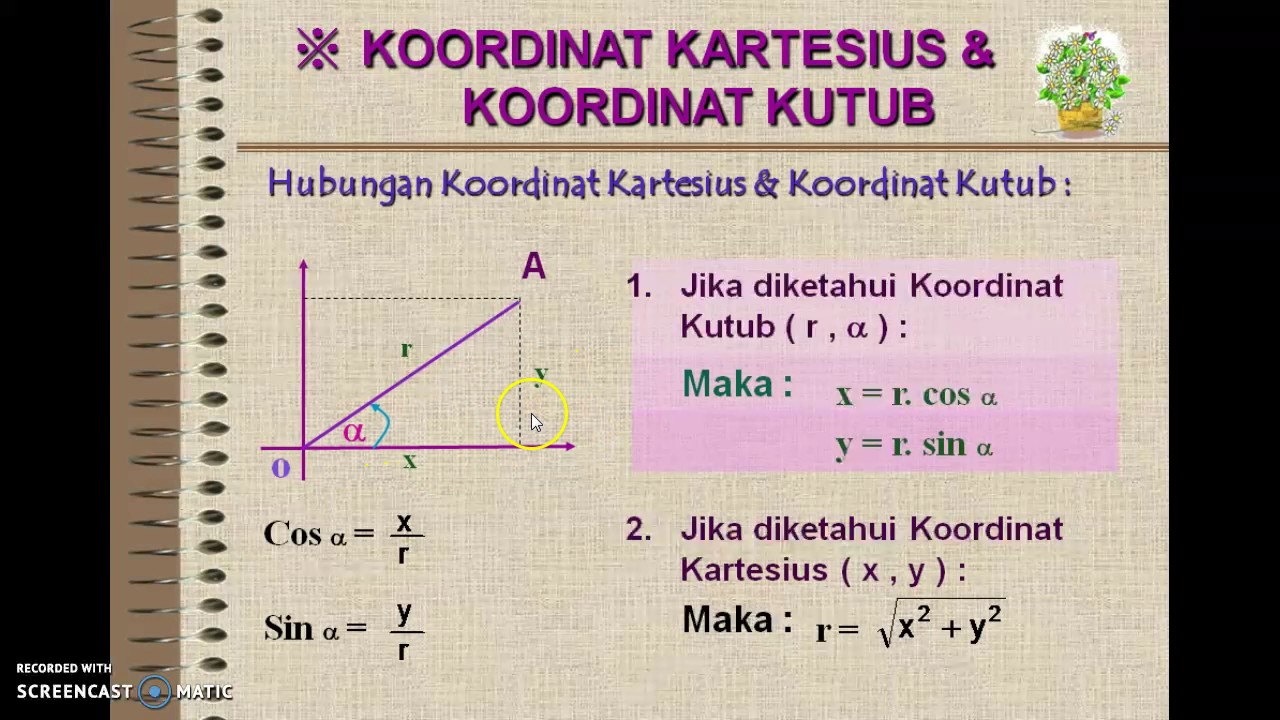
and again for a long time people realize that there are polynomials you can write down that don't have real valued solutions okay this bothered people for hundreds of years there's actually a great veritasium video on the history of the imaginary number i'll put a link in the in the description below but it was recognized at some point down the line i'm guessing probably gauss formalized this that you need these imaginary numbers to to write down the solution of a generic polynomial so if you have any polynomial i can write down its solution the roots of that polynomial will generically need complex valued numbers to express those roots for example this is a polynomial where x has to equal i or minus i to satisfy this polynomial okay and so in some sense that means that these imaginary numbers are necessary so if we want all of the solutions of these polynomials uh then we need these imaginary these complex numbers to represent these solutions and it wasn't until quite some time that people also proved that these are sufficient i can write down any polynomial any any real coefficient polynomial and i can represent all of the solutions in this form so that means that there i don't need some other variable plus j z where j is some other quantity to represent the solutions a real and an imaginary valued number like this is sufficiently rich enough to capture the solution of all polynomials and in fact that's even true if i had complex coefficients on these polynomials if i had i times x squared equals negative one that would also have roots that are uh representable by complex numbers so that's kind of an interesting and important mathematical fact that these numbers are are are necessary to represent the roots of polynomials but they are also sufficient uh they are rich in us enough class of numbers uh we would say that the the solutions of these polynomials are closed under under the complex numbers okay good so we know that these uh come up all the time in ordinary and partial differential equations uh things like this also write down that these are important in partial differential equations things like uh the wave equation so if we have you know the the motion of a guitar string this is going to be written in terms of sines and cosines and oscillating quantities we're going to need complex functions the heat equation this comes up all the time in the heat equation again the fourier decomposition that we use to solve the heat equation is naturally written in terms of complex variables this comes up in fluid dynamics so potential flows it comes up in quantum so the schrodinger quantum the schrodinger equation natively has is a complex valued uh is a partial differential equation in terms of a complex valued wave function electromagnetism the electric and magnetic fields can be thought of as the real and imaginary components of a complex function so really these are not imaginary at all they come up all the time in the physical world now part of the reason this is so confusing and it has been it still is and it has been for hundreds of years is because even though when we write down the mathematical solution of ordinary and partial differential equations we get complex valued functions all the time everything we have ever measured in the real world are real valued i can only have a real valued angle theta this can go from you know minus pi to pi but it can't be i pi same thing with the velocity of this mass that is a real quantity in terms of real meters per seconds and so that's still kind of one of the things that's a little bit confusing is trying to really disentangle how everything we ever measure in the real world is real but under the hood kind of in the the mathematical representation of these things we need complex numbers uh to write them down and i think a lot of this can be understood in terms of this complex exponential function i'm going to come back to this over and over and over again this function e to the i theta so euler's formula euler wrote this down and it's one of the most important formulas in all of math is e to the i theta can be written as cosine of theta plus i times sine of theta and so essentially e to the i theta for a real valued or imaginary is let's say for a real value theta this is a complex number that has a real part given by cosine of theta and an imaginary part given by sine of theta and so all of these oscillating quantities here like this mass on a spring or this oscillating pendulum i could think about the position of this pendulum or the position of this mass as being given by the real part this cosine of theta and we know that the velocity of the pendulum the theta dot or the you know y dot of these quantities are 90 degrees out of phase those are the sine theta the imaginary part of this function and so again everything we ever measure is written in terms of these real numbers x and y but those are the real and imaginary part of a complex valued function okay good so we're going to be covering this again 12 or 13 lectures on this we're going to get pretty deep into how to do calculus with complex variables numerical sorry differentiation and integration we're going to talk about special functions of complex variables z but today i really want to get into you know how do you actually manipulate these quantities how do you do simple things like addition subtraction multiplication division how do you write these imaginary these complex numbers in polar coordinates um and you know and at the end i'll give you kind of a road map of where we're going to go with this short lecture series okay good uh so i think at this point what i'm going to do is just go into you know basic basic things like how do you do addition and subtraction so let's just get started so addition and subtraction and i'm going to say um let's say that we have you know z 1 equals x 1 plus i y 1 and we're going to say that z 2 equals x 2 plus i y 2. good so addition subtraction if i have you know z 1 plus or minus z 2 then that is going to equal x1 plus or minus x2 plus i times y1 plus or minus y2 so if i add two complex numbers z1 plus z2 the real parts add and the imaginary parts add and if i subtract two complex numbers z1 minus z2 then i subtract the real parts x1 minus x2 and i subtract the imaginary parts y1 minus y2 very very simple if i do let's say multiplication multiplication i'll do multiplication and division so multiplication this was addition subtraction multiplication would be z1 times z2 and we're going to just multiply this out so we have x1 plus iy1 times x2 plus i y 2 and we know that that is going to equal so just like in you know algebra class you multiply every single pairwise combination and add them up so you get four terms x1 times x2 plus x1 times iy2 plus iy1 times x2 plus iy1 times iy2 and we're going to collect all of the real parts and all the imaginary parts so i get x1 x2 that's a real number and i y1 times iy2 remember i squared is negative 1 so that's just minus y1 times y2 so those are the two terms that are real plus there will be two terms that are imaginary and that is x1 times iy2 plus y1 times x2 so x2 y1 and those are both imaginary so this is uh how you do multiplication with complex numbers i'm going to show you that this is actually way easier to do using the polar uh coordinate representation of these numbers but i'll get to that in a second uh let's say we do division okay so division would be let's say i take z1 divided by z2 so that's x1 plus iy1 divided by x2 plus iy2 and again from your kind of high school or middle school math class you probably remember that if you want to get rid of a complex number in the denominator you multiply on the top and the bottom by its complex conjugate by x to minus iy to x2 minus iy2 and when you do that the term on the bottom becomes a real number so if you expanded this all out just like here you would find that this equals on the on the denominator this equals x squared minus i squared that's minus minus that's plus y squared and this is x2 and y2 and on the top i'm just going to say that this is z1 times z2 complex conjugate and we define complex conjugate by this over bar i'll write this down in a minute just so that you know what that means uh and so this is z1 z2 bar over this quantity here is kind of the length or the the the size of this z2 the norm of z2 quantity uh squared okay so now i'm going to define what this means just make a little note here note that z bar equals x minus i y is the complex conjugate and the length of a complex number z is equal to kind of its radius which is x squared plus y squared square root okay good good uh so now what we've seen essentially is that we can do you know all of the basic things we want to basically be able to do algebra with these complex numbers we can add we can subtract we can multiply divide you can multiply these by a constant you know 5 times z you just multiply 5x plus 5i [Music] and we did this in this kind of cartesian coordinate system where you have the real and the imaginary part but it turns out it's actually way way easier to do multiplication and division if instead of writing it like this you write these numbers in a polar coordinate system so i'm just going to do that really quickly i'm going to say that this equals instead of x plus iy we're going to say that this equals some radius maybe i'll derive this first okay this is going to be some radius times an e to the i theta i'll tell you what this means in a minute but let's actually just draw this here so the idea is that any complex number x plus iy can be written in terms of the real part of z and the imaginary part of z and we can put these on coordinate axes we can have a real axis and an imaginary axis that are kind of perpendicular to each other this is called the complex plane and usually i'll denote this by this kind of script c and any number z that i want to represent any number z that has a real part and an imaginary part essentially the real part uh is its position in this x-axis and the imaginary part is its position on this y axis so x in the real direction y in the i direction let's say this is kind of the you know i direction here but of course i can also represent these in terms of polar coordinates just like you know and normally i can represent a cartesian vector x plus x comma y i can also represent this in terms of a radius and an angle theta so if i do that here i would say that the radius is r and the theta the angle is theta so i can just as well represent this complex number in terms of a radius and an angle theta and the way that we write that is r times e to the i theta and i'll explain why this is true in a minute so essentially if this is the angle theta of z then we know that this uh position here this x is r cosine theta and this y direction is r sine of theta and remember from euler's formula e to the i theta is cosine theta plus i sine theta so i can write this r cosine theta plus i times r sine theta as r e to the i theta this is how we write this in complex polar form now i'm going to derive this uh in the next lecture so essentially what we're going to do is we're going to take the taylor series the taylor series for uh e to the let's call it e to the z and then we're going to plug in i theta in for z and we're going to find that all of the real parts add up to cosine and all of the imaginary parts add up to sine so just take my word for this right now this is called euler's formula again one of the most important formulas in all of mathematics euler's euler's formula and this is we're using this kind of to write down this complex number in polar form but what i really wanted to show you is that complex multiplication is particularly easy when we write it down in polar form so let's do that let's say that again i have a few vectors and i'm going to use different colors for these so let's say i have some vector let's call this z1 and then i have another vector that is let's say z2 and i want to multiply these and i'm going to say that z1 equals r1 e to the i theta 1. so this is theta 1 and its length is r1 and z2 is going to be r2 e to the i theta 2. so again the length of this vector is r2 if that's its radius in this you know if i had a circle that would be the radius r2 and this has a angle theta 2. now if i multiply those two quantities maybe i'll do this in blue here so i take r 1 e to the i theta 1 times r 2 e to the i theta 2 that is going to by just multiplication be r1 r2 e to the i theta 1 plus theta 2. and so this is i think what's really really neat is that in polar coordinates it's instead of multiplying this all out and collecting the real and the imaginary parts which gets to be kind of a pain if i multiply two complex variables that are already written in polar coordinates then their radii multiply r1 times r2 like the the new vector that i'm going to get out of this this is let's say z1 z2 the radius of this is going to be r 1 times r2 so those multiply and the angles the angle of z1 and the angle of z2 just add so this uh third angle here is theta 1 plus theta 2. so this is e to the i theta 1 plus theta 2. and that's just a property of how exponentials multiply if i multiply two exponentials then the arguments just add so e to the i theta 1 times e to the i theta 2 is e to the i theta 1 plus theta 2. so that's kind of nice okay so multiplication and you could kind of verify that this is also true of division this is if i wanted to divide these quantities this would be r1 divided by r2 times e to the i theta 1 minus theta 2 something like that okay so it's way way easier to multiply or divide when i think about my complex numbers in this polar coordinate system and i mean this is also going to be true when we do physics when we do ordinary differential equations and partial differential equations just like i showed you down here it's going to be very very natural sometimes to think about instead of writing things in real plus imaginary part just to think about it in terms of you know this kind of polar form e to the i theta that's going to be more useful when we think about the wave equation when we think about oscillating variables in physics as well okay good um Let me see... what else do I want to tell you. Maybe I'll tell you what's coming next.
So this is just the very basic tip of the iceberg, where we have talked about why we care about complex numbers: they come up all the time in any kind of oscillating solution of ordinary or partial differential equations. We've talked a little bit about what these complex numbers are: complex numbers are the necessary ingredients to the solution of polynomials... things like, if I want a square root of -1 I have to introduce this "i". We've talked a little bit about the "how": How do we add? How do we multiply? How do we divide? And specifically that it is easier a lot of times to do this multiplication and division when we use the polar form... this R*e^{i*theta}... I'll just write this out really explicitly. This z = R*e^{i*theta} = R * [ cos(theta)+i*sin(theta) ].
And again R*cos(theta) is the real part "x" and R*sin(theta) is the imaginary part "y". These are totally equivalent representations of this complex number.
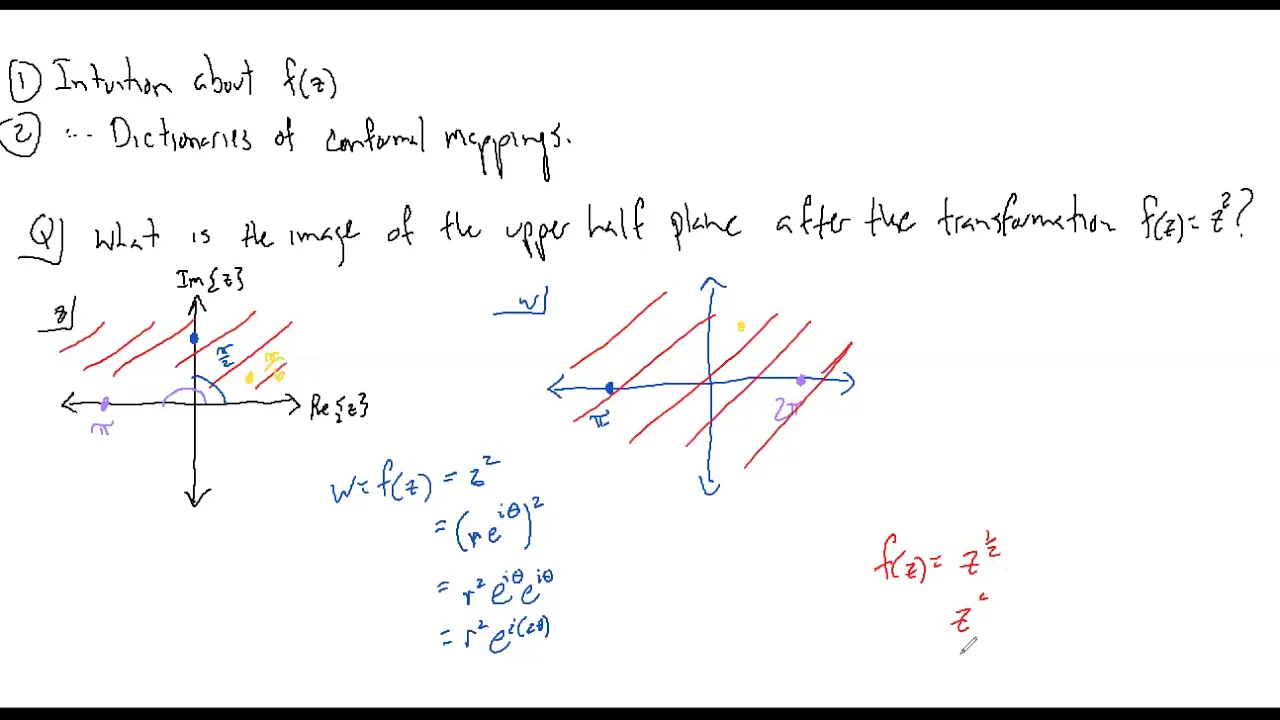
And what's coming next... the next piece of all of this is that we'll be thinking about functions of a complex variable. So functions like: what if I take you z^2... if i take this complex number "z" squared, you can verify that this will equal x^2-y^2+i*2xy: that is a complex function z^2. And you can write down lots of interesting functions that are going to be useful in the solution of ordinary and partial differential equations.
Polynomials like z^n; you can write down sin(z), cos(z), e^z... we've already seen e^{i*theta}... so all of our favorite functions from real analysis, from real valued function theory, like sine and cosine and exponential -- logarithm is a hugely important one, Log(z) (I give it a capital "L" to distinguish it from the real valued log of z) -- all of these can be extended to be functions of a complex variable, not just a real variable "x" but a complex variable "z".
So this is just one example here and what we're going to find is that there is a huge class of what are called analytic analytic functions, like z^2 or z^n or e^z, sines and cosines... these are analytic functions. And what that means is that the real part and the imaginary part this function of x and y ... these functions of x and y are solutions to Laplace's equation. del squared of let's say the real function phi equals zero and this again is hugely important: these are the solutions, the building blocks of electromagnetism, of the heat equation, of the wave equation, of all of partial differential equations.
Much of partial differential equations is built on Laplace's equation and the solutions of Laplace's equation are the real and the imaginary part of these analytic complex functions.
So this is all coming up in the next, let's say 12 or 13 lectures.
We're going to talk about how to do calculus, how to define functions of complex variables, how to do calculus on those functions, derivatives and integrals, how to understand how these are solutions of Laplace's equation... we're going to derive Euler's formula for the Taylor series e^{i*theta}, and all of that.
So again this is about a two week course. The first week I would say is essential to understanding how complex variables work. The second week is interesting but pretty advanced material so I highly recommend the first part but if you're interested stick around for the whole thing. All right thank you!
Up Next

Prime Numbers Explained: Definition & Examples | Pre-Algebra
@khanacademy
1.6M views•2011-05-12

Elliptic Curve Cryptography Explained: ECC, ECDSA, ECDH
@PracticalNetworking
28.5K views•2024-10-21

Div, Grad, and Curl: Vector Calculus Foundations for PDEs
@Eigensteve
496.2K views•2022-04-01

The Mathematical Impossibility of Accurate World Maps
@Vox
23.3M views•2016-12-02
Related Study Plans & Knowledge Roadmaps
Structured learning paths in Mathematics