










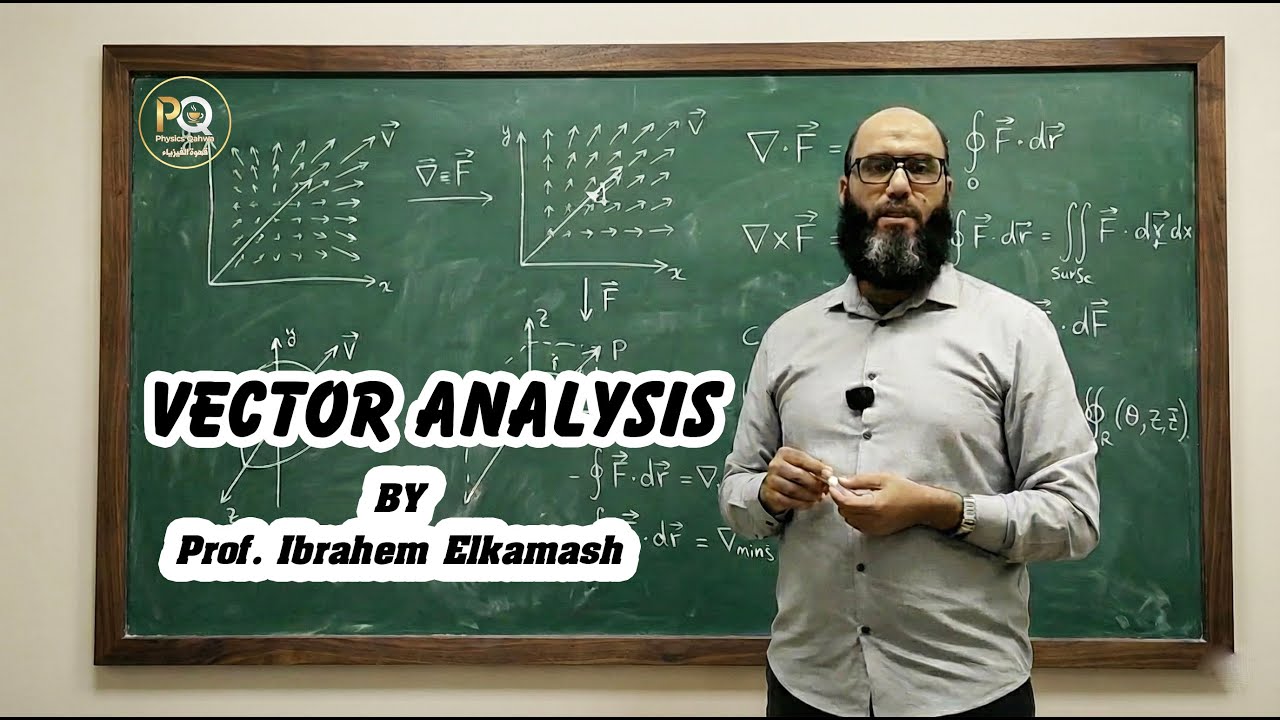









The del (nabla) operator ∇ = (∂/∂x, ∂/∂y, ∂/∂z) forms the foundation of vector calculus, enabling three essential operations: the gradient (∇f) converts a scalar field f into a vector field representing the direction and rate of maximum increase; the divergence (∇·F) converts a vector field F into a scalar field measuring local expansion or contraction (positive divergence indicates outward flow, negative indicates inward flow, and zero indicates incompressibility); and the curl (∇×F) converts a vector field F into another vector field measuring local rotation or circulation. These operators provide the mathematical framework for deriving partial differential equations that describe physical phenomena such as fluid dynamics and electromagnetic fields.
Div, Grad, and Curl: Vector Calculus Foundations for PDEs
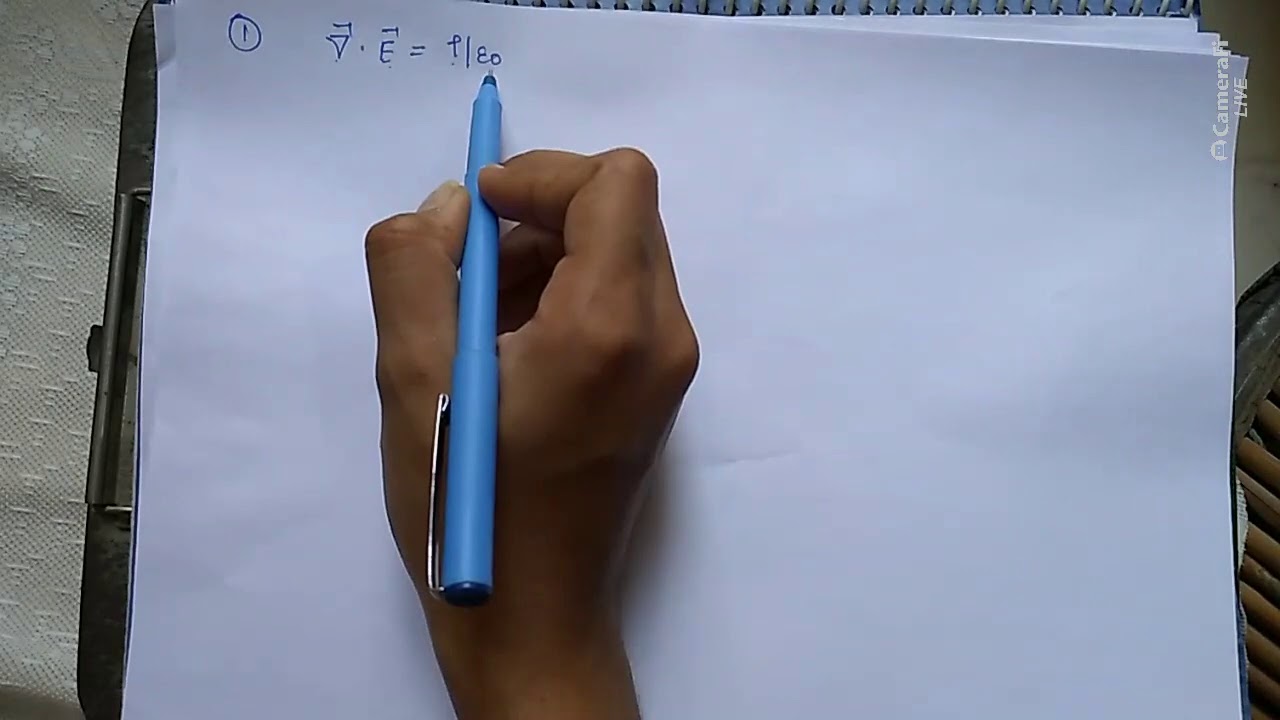
Added:welcome back so we're talking about vector calculus namely the gradient divergence and curl operators and how we can use those to derive partial differential equations and encapsulate kind of physics into equations so i want to start today by really just zooming into these operations of div grad and curl and in particular this all starts with this kind of dell or nabla operator depends on how old fashion you want to get this kind of greek delta symbol i guess a upside down delta so del or nabla and this is literally defined as a kind of vector of partial derivatives so we're going to think about taking the derivative of something as an operator or an operation and so if you want you could put a little arrow over this sometimes i do sometimes i don't i'll do it right now but if i drop this arrow it always means the same thing this del or nabla operator these are the same word for two words for the same thing and this is literally let's say we have a three dimensional del operator this is going to be a partial partial x in the i direction plus partial partial y in the j direction plus in the k direction we're going to have partial partial z or zed okay i just learned that americans pronounce zed as z because it rhymes in the abcs a b c d e f g blah blah blah rhymes with z not zed everyone else in the world calls it z so this is the del or the nabla operator and another way to write it is as a vector and then we can take the dot product or the cross product of that vector with other vectors so this could also be written equally as del equals the partial partial x partial partial y partial partial z or z vector and if i took this and dotted it with another vector it would take partial partial x of that first component plus partial partial y of that second component plus partial partial z of that third component this can be treated like a vector and if you like this i hat kind of i hat j hat and k hat just refer to the first second and third components of my vector just like if i had a vector v and i called it a b and c that would be the same as a in the i direction b in the j direction and c in the k direction and i could draw this in uh you know coordinates in my eye j k coordinates i could draw this vector as i take a steps in the i direction b steps in the j direction and k step or c steps in the k direction and that would determine my vector v okay so i just want to just demystify anything here if you have an i j and k out front you can write it as a sum like this in these unit vector directions you can write it as a column vector like this where it's assumed that the first component is in the x or i direction the second component is in the y or j direction and the third components in the z z or k direction just like any other normal vector you would ever write totally fine okay good and this grad operator so so del or nabla sometimes this is also called grad maybe i'll put it up there this is also the gradient or the grad operator it is a linear operator and i'll tell you kind of how to compute the grad the div and the curl in a minute so i don't know what what the history of dell versus nabla is um yeah nabla the homie uh funky homo sapien uh it would sound a little weird or like nabla tron 3030. so okay let's look at these operators so the gradient operator maybe i'll switch colors here so the grad operator essentially takes a scalar field f and it turns it into a vector field okay so it takes a scalar f and it returns a vector field and it does it in the following way so if i have grad of f and little f is uh let's say f is a function of x and y and z or z okay then grad of f is just partial f partial x partial f partial y partial f partial z in a vector and for every point in space there will be a literally a vector direction with these partial derivatives determining that vector okay that's what the gradient does is it computes the rate of change of f in the x direction y direction and z direction good and we already showed uh that you can think of this as like the gradient of a temperature distribution it will tell you in what direction the temperature is rising the fastest that's what the gradient of the temperature would do it would give you a vector direction at every point of how that temperature is increasing the fastest along what direction the divergence and i'm just going to alternate colors so it's easy to see the divergence takes a vector f let's call this vector f and it returns a scalar field so it's kind of the almost exact opposite so if i take the um the divergence it's literally defined as the dot product of my del operator my noble operator with my vector valued f function and we assume that this vector f has three components f1 in the i direction f2 in the j direction and f3 in the k direction and all of those f's are functions so this would equal maybe i'll write it up here so vector f is literally uh f1 in the i direction plus f2 in the j direction plus f3 in the k direction where each of these f's is a function of x y and z in three dimensions then this divergence is going to be partial okay i'll write it out because it's going to get ugly it's partial partial x partial partial y partial partial z that's del dotted with f1 f2 f3 okay that's what del dot f is it's literally taking this operator and dotting it with my function f and so we know how to take the dot product this is easy it's just the partial of f1 with respect to x it's partial f1 partial x plus partial f2 partial y plus partial f3 partial z okay pretty simple it's just a sum and now because we've sum this up this is just a scalar function of x y and z so it took my vector field and i returned a scalar field and specifically it's going to compute how much my vector field is kind of instantaneously or locally expanding outward or contracting inward so this divergence is going to be greater than zero if my vector field is kind of sourcing out blowing stuff away from a point and it's going to be negative if it's pulling stuff in or kind of attracting stuff in into the vector field and a divergence free vector field a vector field where this is equal to zero is called incompressible and it literally means incompressible in a fluid dynamic sense okay the last one i want to show you is the curl and the curl is also kind of cool so the curl takes a vector f and it returns a vector field okay so all of these are a little different the grad takes a scalar and returns a vector the div takes a vector and returns a scalar and the curl takes a vector and returns a vector same f as before and literally the curl is just nabla or del cross product with my f function okay now kind of a mess i don't really want to do this but i'm going to uh remember how to take the cross product it's pretty easy you take literally the determinant of a matrix where you have the i j k directions and then you have the vector representation of del here which is partial partial x partial partial y partial partial z and then the vector representation of f1 f2 f3 and you literally just compute its determinant and it's not that bad i'll write it out in the i direction you have i times partial f3 partial y minus partial f 2 partial z minus in the j direction you have partial f 3 partial x x uh minus partial f1 partial z and then plus in the k direction you have i guess partial f 2 partial x minus partial f 1 partial y so again you can tell that this is a vector field because it has an i a j and a k component and the curl roughly speaking maybe i'll draw a picture for the divergence the divergence of course measures how much stuff is kind of sourcing out from a point the curl is going to measure how much stuff is kind of swirling around in a circle it measures kind of the circulation around a point like this okay so a positive curl means we're rotating around positive divergence means we're kind of expanding out and the gradient of course measures if i have like a temperature distribution from uh hotter to colder it's going to give me directions where i maximally go from hot from cold to hot So really simple... this is like the alphabet. These are the building blocks of vector calculus it's all based on taking the derivatives of things and measuring rates of change remember we love calculus because we can measure how things change in space and in time that's how we think about differential equations that's how we think about partial differential equations is how things change in space and in time. These are the building blocks that we're going to use to quantify things like conservation laws to derive these partial differential equations so in the next few lectures I'm going to go into great detail we're going to zoom into the gradient operator and get physical intuition for what this means and how to compute it. Same thing with divergence. Same thing with curl.
And then we're going to start deriving our vector calculus kind of integral formulas, like Gauss's divergence theorem and Stokes's theorem how these behave under integrals. Really cool stuff and especially when I learned it, there was no motivation for why we were learning it... we just had math on a board you are learning this specifically so that you can translate physics -- the language of the universe -- into math the language of differential equations. All right, more to come. Thank you.
Up Next
Contravariant vs Covariant Vectors: Transformation Laws & Examples
@FacultyofKhan
68.3K views•2019-03-24

Elliptic Curve Cryptography Explained: ECC, ECDSA, ECDH
@PracticalNetworking
28.5K views•2024-10-21
Complex Analysis Lecture 1: Motivation, Arithmetic, and Euler's Formula
@Eigensteve
159.2K views•2023-01-27

The Mathematical Impossibility of Accurate World Maps
@Vox
23.3M views•2016-12-02
Related Study Plans & Knowledge Roadmaps
Structured learning paths in Mathematics