
























Bacterial motility and chemotaxis represent a classic example of evolutionary optimization where natural selection balances the costs and benefits of motility investment. The system demonstrates that bacteria cannot optimize all functions simultaneously due to resource allocation constraints—investing in motility (which consumes several percent of cellular protein budget and energy) competes with other cellular processes like protein biosynthesis. Experimental evolution shows that bacteria can improve motility performance through mutations in flagellar export apparatus proteins, but these improvements follow a hyperbolic trade-off curve where increased swimming speed eventually plateaus due to physical limitations (additional flagella create drag that counteracts thrust). Natural isolates of E. coli exhibit diverse motility strategies adapted to their specific ecological niches, with some maintaining low motility in liquid environments while activating motility specifically in viscous media like intestinal mucus where gradients are stable and beneficial. This illustrates how evolutionary optimization produces context-dependent solutions rather than universal optima, with bacteria investing proportionally in motility according to anticipated environmental benefits.
Bacterial Motility: Physics, Physiology, and Evolutionary Optimization
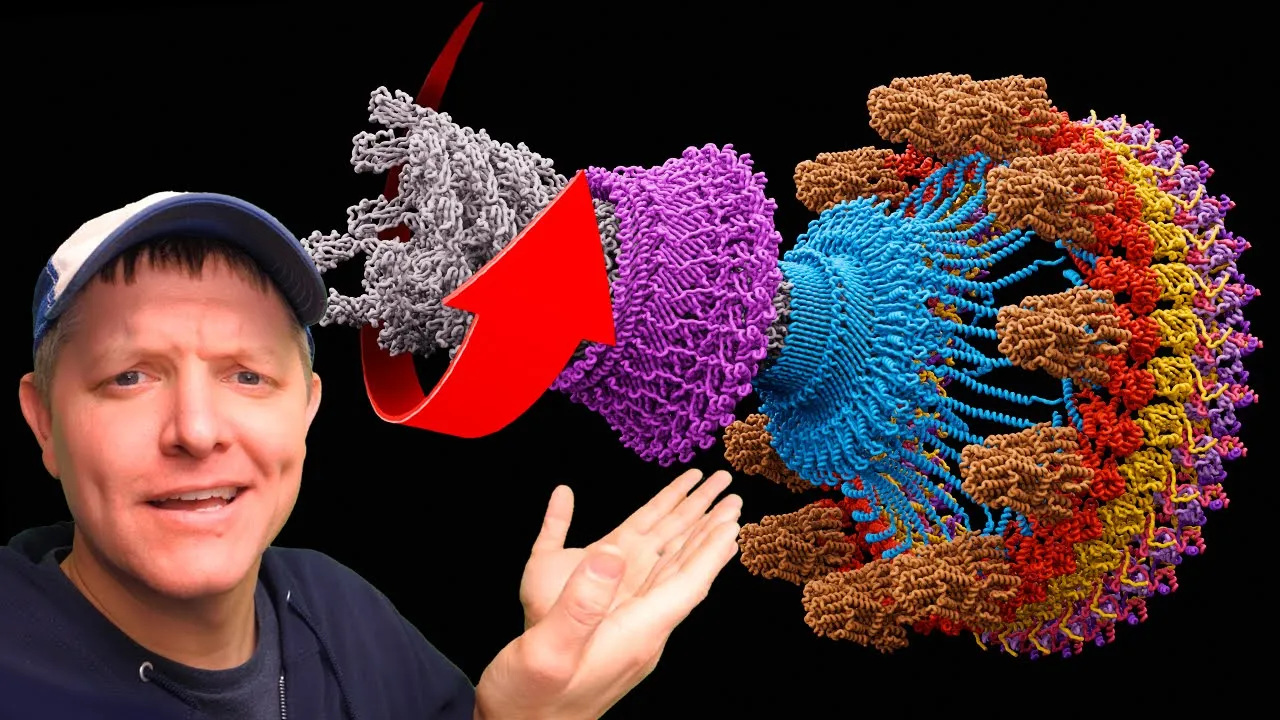
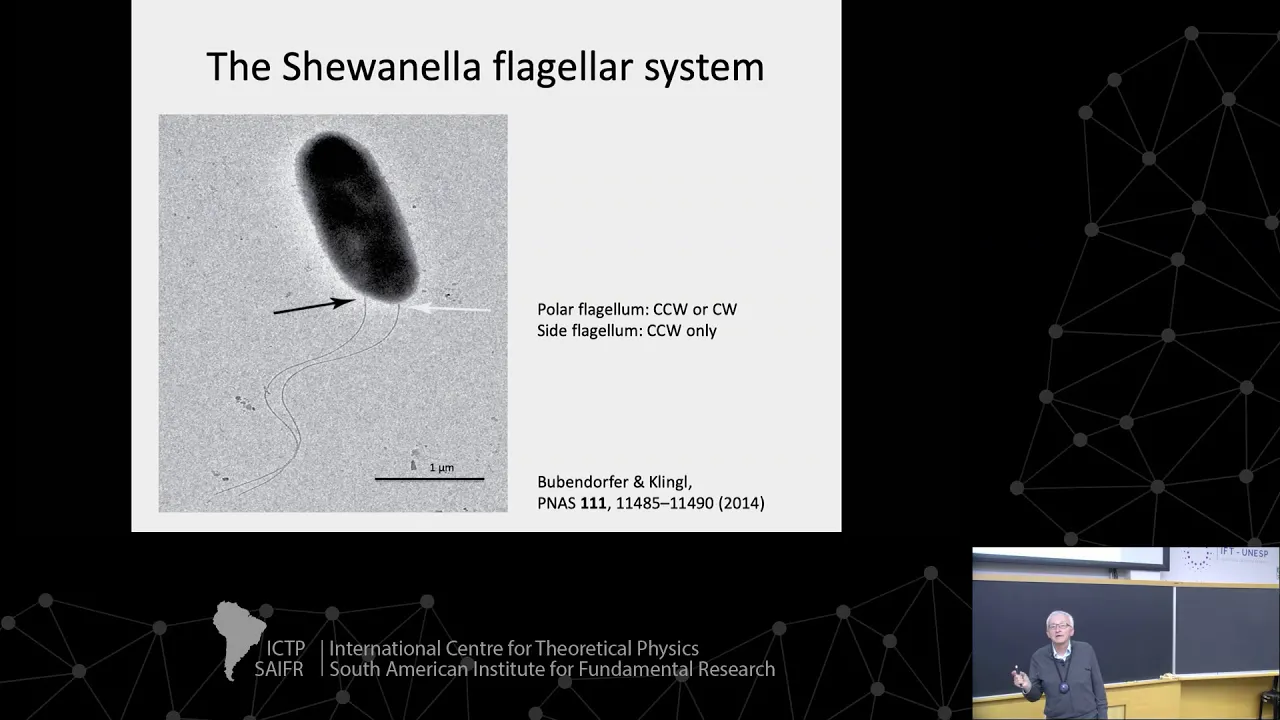
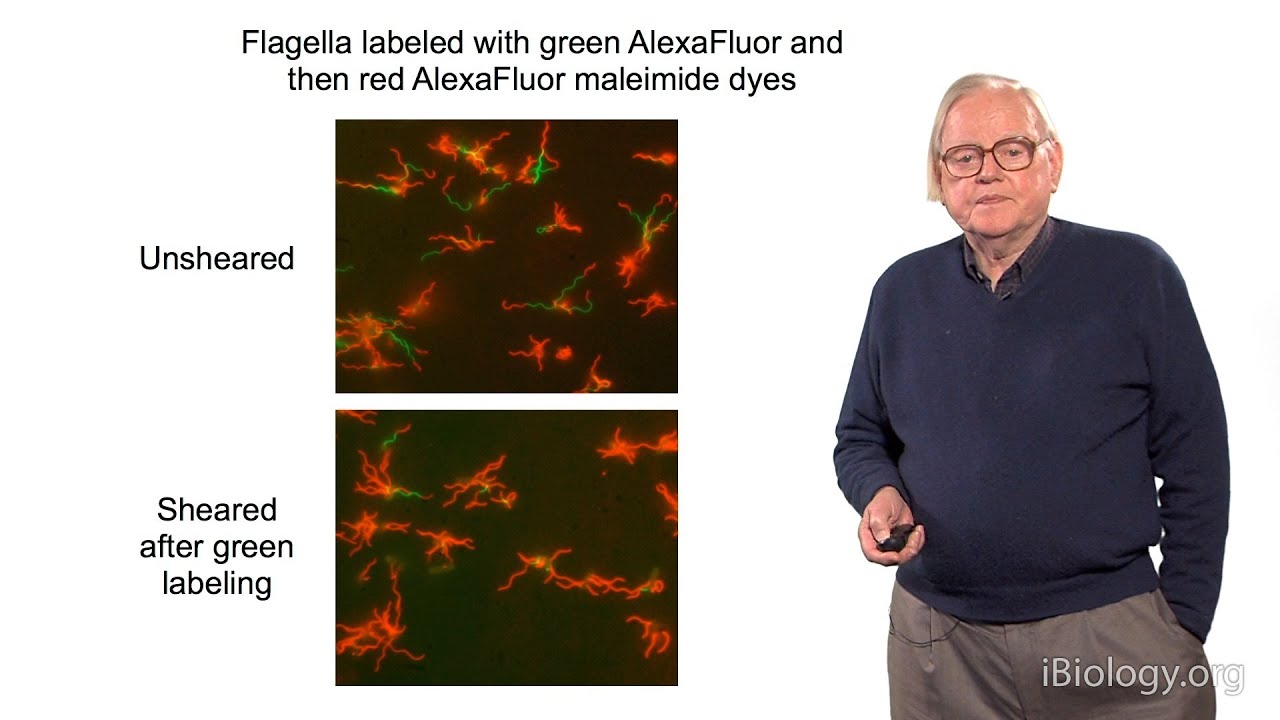
Added:um yeah so thank you very much for coming back Mr seminar it's my great pleasure to introduce Victor searching from the max plan for investor microbiology and Marburg where you hit the view director of the department for assistant zeddic microbiology and uh yeah so his research area is the design principles of transaction regulatory Pathways and microbes I think mostly organisms and yeah so I know him from roughly from 2005 that he collaborated with my postdoc supervisor and Adventure entrance University um Texas and there was also a portion I was working on um yeah it said time Victor Boss It's a Sin MBH in University of Heidelberg and before that it was a postdoc in Harvard his hard work where he developed some really nice friend program Ming in living so this stuff very excited that you're here and over to you that's the title very excited yeah well thanks a lot robots for uh give me a chance to to speak here I think it was already maybe 10 years ago that I was that I I gave I gave a seminar here last time but I was uh was a year and a half when when Robert was giving his inaugural lecture uh here for to introduce Robert but uh I'm glad that I also have a chance to talk about science now um so in our group we are quite diverse in in the range of topics we are interested in um but most of them are related to physiology physics and also since more recently evolution of microorganisms and the topic I'm going to focus on today I think nicely combines all of this um and this is a very very general question uh whether we can understand their solar networks or generally biological processes um as products of evolutionary optimization and that for that um you might actually know this famous phrase forms because it doesn't biology makes sense except in the light of evolution I think that's very true and uh By the way when researching for this phrase I realized that that he was born uh in their town next to the village where my father's family in the Ukraine is coming from small world and so if you want to understand or even to address this question of evolutionary optimization of a network or process uh what we need to know is not only their molecular composition and the basics of a network we also need to understand for what was this network actually optimized so we need to know physiology of the pathway in uh say if you talk about the signal and pathway not only in the lab but ideally also in their natural environment where this network has been shaped by Evolution um we need to know historical constraints of the networks um because essentially what evolution does and maybe it's not that different from what also as humans do is primarily Tinker with the bus phase so that nature keeps improving or tuning uh the process that has been already invented once and maybe that's not that different again from say combustion engine which been optimized for plus whatever 200 years right now maybe will become obsolete at some point soon but so that's the same thing with with the natural optimization right it's there but if you are signal and network has been invented once it has been tuned or uh to match one or the other tasks then another important constraint on the evolution of biological system and I think it's a particularly prominent in microbes as a cost-benefit trade-offs so what you typically find if you look carefully that biology cannot optimize the functions independently so what is frequently there is essentially conflicts in optimization so the nature can optimize or say enhanced performance of one network as a cost of another Network or process in the cell so it's in a way kind of maybe analogous to say mass or energy conservation and physical system so there is there is kind of conservation of resources to resource utilization in biological systems and last but not least what we need to understand and I think that's not that much at least actually recently has not been that much appreciated in biology that they also need to think about the physical constraints on biological systems and I'll give few examples later on that the performance of the system is really limited by by physics by and again this particular truly micro so I think this phrase at least needs to be extended that we need to understand those Evolution but also physics of the system and microbes are really nice model systems for that and as Robert mentioned we primarily work with E coli and what is the two best understood and more studies organisms just dissolves their genome of E coli uh outside of this uh of this lecture room and the advantages of microorganisms are several food first of all they're relatively simple I mean they're still amazingly complex but certainly more simple than high eukaryotes um there at least sometimes the functions and constraints on their networks are better defined than on the eukaryotic networks and maybe most importantly um microbes had much longer evolutionary time time span of uh optimization so forth no microbiologists among you for most of its history the our Earth has been populated exclusively by microbes and they also have typical shorter generation times that higher organisms meaning that Evolution bends through thousands of millions of of cycles of optimization of a particular Network in microbes which is certainly not true for higher organisms and so there our most favorite model in the lab uh is majility and chemotaxis of bacteria and specifically E coli and I guess you know the basics of bacterial motility from robots work and also from from a biologist the more you for work from work of Morgan BB um and here's the Imperial and but just a quick update so we call it like like most others of bacteria can swim by rotating helical filaments and cola has several of them and you see them nicely from a movie there's been produced and Howard bags group and I was a postdoc there so they're here filaments and the cell bodies are labeled with the fluorescent dye which is non-specific Central labels all the Amira groups that there and the cell surface and then you see that kind of similar of bacteria here can be right roughly separated in two phases um sometimes this flagella formal bundle behind the cell and this is this propels the cell forward um and in other instances this bundle falls apart and the cell tumbles and these are associated with the two directions of rotation of flagellum water and which is itself already a very formidable molecular machine I would say requires 40 different proteins to be constructed um expands there and buy a cell envelope and it's been powered by proton flux so it's like an engine proton flow in and the stator complexes rotate with which proton passes through and this induces rotation of the rotary part of the of the flagellum and this is then transmitted to rotation of this filament which is substantially longer than the cell itself and here's the aquarium structural reconstruction of flagell water again you see that this is very very beautiful machine and it also includes maybe I should mention it here and Export operators so it's also evolutionary related to so-called type 3 secretion system so this is a secretion system bacteria use uh to to um translocate affect us into mammalian cells for example so it's also related to to infection systems um and this is their export Machinery as a base of the flagellum and all the subunits uh to construct this loan flagella has to be transported through the through the core of the filament so so the century flagellum is assembled at the outside so it's distorted but we understand pretty well not only molecular biology of flagellum biogenesis we also understand the physics of sliven again this is large extent it due to the work of of Howard Burke who was was amazing postdoctoral Mentor regretfully passed away about a year and a half ago but they're very respectful age of 88.
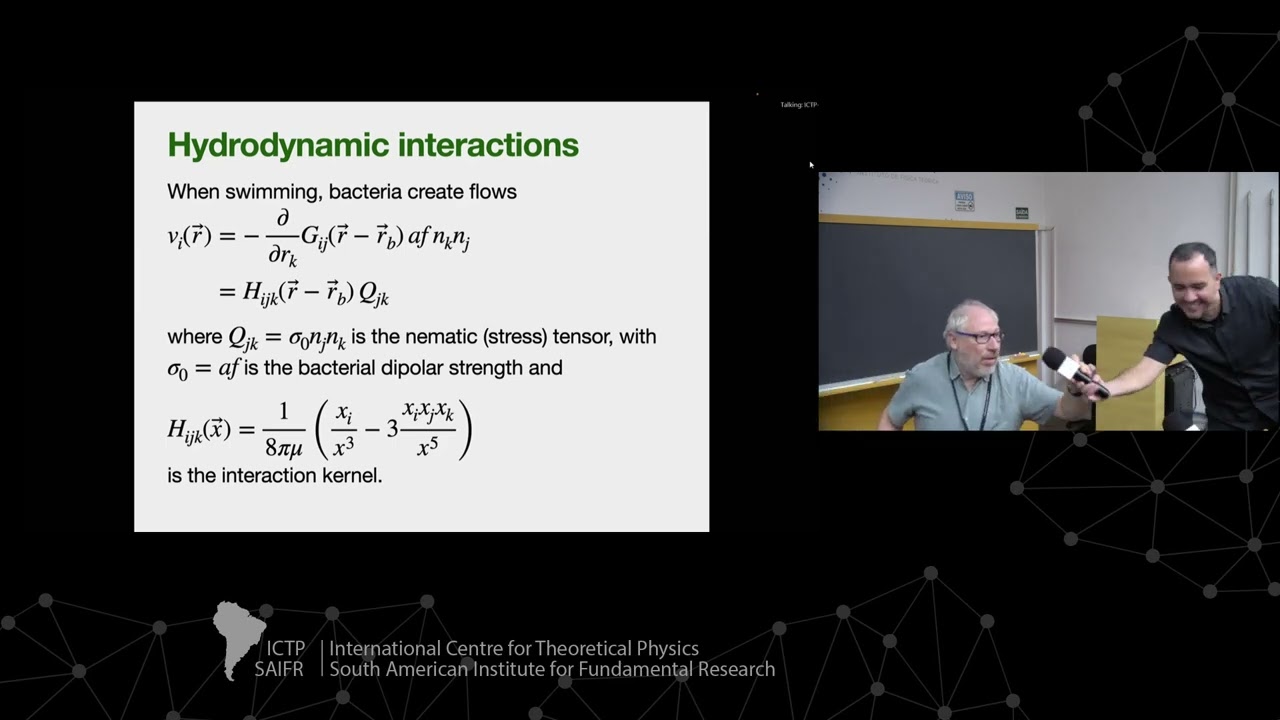
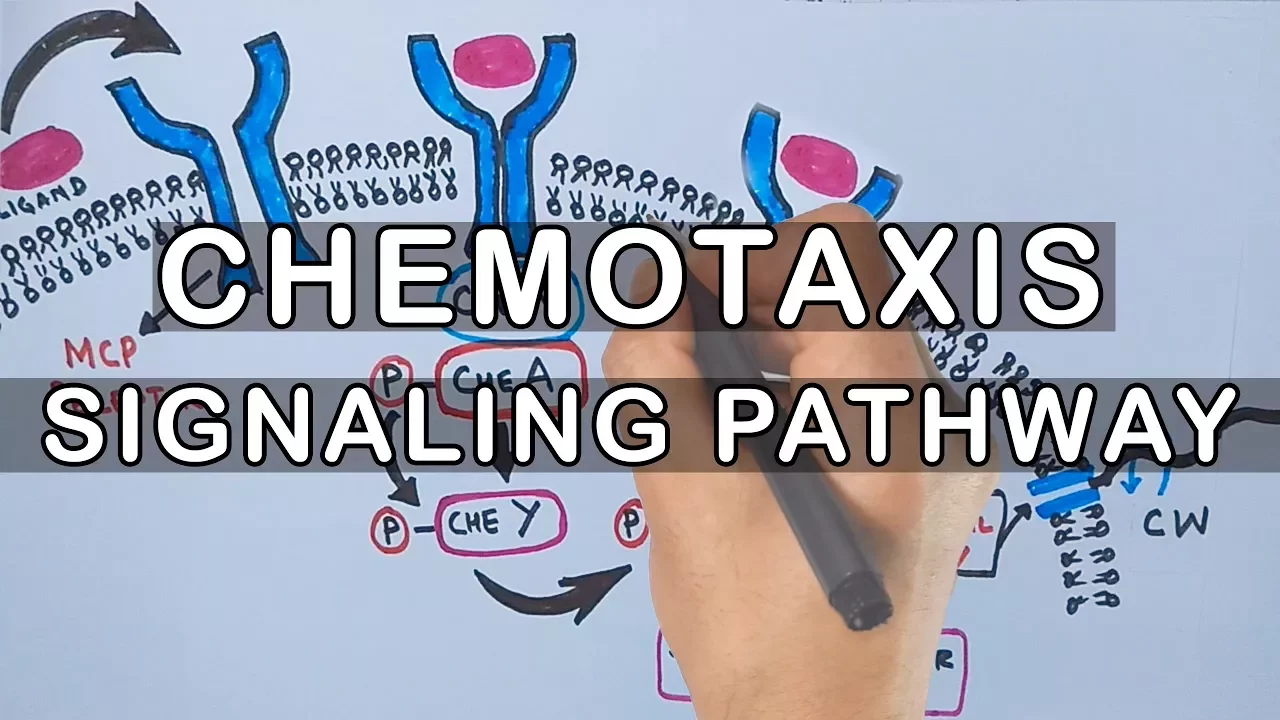
um and um so we know that there um cell body uh propulsion is is essentially induced by thrust generated by rotating Flagyl filaments because um there of the ethnicity of the filament it pushes at a liquid a liquid at an angle and this essential creates a force alone there the long axis of the flagella bundle and this this scan generates a Thrust to push to push the cell forward and it can be mathematically described by so-called resistive Force Theory we also know there kind of the basic pattern of motility for E coli or for other bacteria where it looks fairly simple or similar um so this alternating periods of running and Dumbo generate something that looks very similar to a random work so this is the simulation we did a long time ago of bacteria is actually pretty realistically uh moving released at at one point here and then they're sprighted in the environment which again looks like like Global diffusion can also be described using the same equations as is used to describe diffusion and so this kind of diffusion-like behavior can serve several things or tasks it can enables bacteria to generally explore the environment this is relatively slow as we know the diffusion is not very efficient our long distances but local exploration works pretty well um it is also important for interaction business offices so that you hear you see several cells are stuck to the surface that's probably it's not really specific interaction but but we know from from other experiments and other groups in our group that swimming can largely enhance bacteria interaction with the surfaces because it enables them to overcome the repulsive forces they can attach to the surface much better and also other interest in behaviors that water our bacteria can exhibit for example Collective motions bacteria and also hydrodynamically interact with each other in form it's kind of beautiful rafts or packs of cells uh moving around at higher densities towards the surface for example and probably most important part of the of the function of motility is to enable chemot access and came out access is again a behavior which is very well in the student became one of the best most thoroughly analyzed models of simple Behavior so it's describes the ability of bacteria or other organisms to follow chemical gradients in the environment and the way bacteria is doing doing that doing that is by temporal comparisons and that's again Howard's contribution to to the field to describe this strategy of so-called biased Trend work so bacteria chooses limit Direction randomly or more or less randomly and then compare environment and time because they are simply too small to be really able to measure gradient along the cell body efficiently in space so there was a kind of extends a comparison lens by measuring their environment and time and then if environment is getting more favorable than bacteria suppressed stumbles so they keep running in this direction or even if they tumble the only tumble a little bit are shown here to kind of try to find even more favorable Direction um and this strategy of tempo comparison is fairly efficient again this is a simulation but realistic one uh of same bacterial population uh spreading in the gradient so gradient is is pointing towards it uh the right side of the simulation field and and you you kind of appreciate that's right in this case is much faster zen zen is a previous simulation I show and in addition to the stumble control what bacteria also need is a short-term memory essentially they need to be able to uh to remember their environment because they compare in time several seconds ago and this is done by by molecular system that mesellates receptors receptor Covenant modification of receptor sources of memory to remember the past condition for several seconds and I mean Jonah was there Mariko passwords it mediates chemodactic behavior is is also very well understood and no new proteins at least in Nicola has been found been found in the last 40 years I think um so essentially we know all the functions pretty well and what um how signals and reduce here transduce here and again we might know from robot's work um it was also contributed to that receptors and associated with the kinase which then phospholates Ty which is a small protein can diffuse and infosphorylate it and bind to flagellum water and this induces their switch for of rotation and flagellum water form counterclockwise to clockwise and this induces a tumble so KY phosphorylated Qi is a tumble generator and then in addition you have a phosphatase disease which is a counter player of the kinase and you have another pair of the of the enzymes which oppose each other and this are against this reception isolation system which serves as a temporal memory and also allows bacteria to adapt to the to the particular environments and actually with the spares as a side note of a poles and enzymes are quite important so we worked on this later uh some a while ago to show that this air scan serves a function can enhance robustness of the pathway because essentially they counteract each other and this enables the cell to compensate effect of gene expression noise and temperature uh on their output of the password and yeah so and chemotaxis as I mentioned already can enable bacteria to full gradients and spread in the environment find the sources of nutrients for example will avoid harmful conditions such as the balance so we know molecular biology Rebels there it's physics we know the basics of pathway Behavior and other things that I I mentioned already before which is important to know to better understand evolutionary kind of optimization of the pathway is a physiologist so what's the password actually doing in the natural environment and for cable taxes even the Nicole is a surprisingly not that well understood but there are probably three areas where cannot access plays an important role one of them is nutrient acquisition um again many of their chemothers are nutrients another one are collective behaviors so chemotaxis also plays an important role in say formation of biofuels um and and other Collective areas of bacteria so bacteria can also secret chemo affect us that that attract other bacteria in the group and enable them to form uh to form Aggregates kind of force nice example of self-organization um and last but not least their remote access and motility was important for host microbe interactions so bacteria can use gradients are emitted for example by the plant fruits uh who are buying epithelial layer in in the intestine or by some like particles of marine snow or eukaryotic uh organisms in the ocean to be attracted to them and to and they go either beneficial or photogenic interactions with the host and this different types of of behaviors we cannot access plays a role might also put different optimization constraints on the system right so then optimization for Collective interaction is not necessarily it's the same as optimization say for fine nutrients and so in the rest of my talk I'll focus on this particular are physiological function of keynote access which is probably also the most important in bacteria at least and and again as as I mentioned the evidence for that that major attractants for E coli are amino acids and sugars and you even see clear correlation between nutritional and chemotactic preferences so see amino acids which are most valuable metabolically nutritionally are also the best chemo effect lessons the same is true for sugars and the function of key remote access and motility in there in increased nutrient uptake is is obvious right it's defined by bacteria can use chemotaxis and materiality to find higher concentration of nutrients they could benefit for their growth um now the other hand so we need to consider the costs of material behavior and they are substantial again I mentioned that this is their flagellum water is a huge structure and several of them in the cola and if you count the amount of proteins that goes into into uh biosynthesis of flagella and also it's the chemot access system it's several percent of the total protein budget of the cell which is quite quite substantial and um and a similar calculation can be done for amount of energy spent for motility and this is again several percent of their uh proton gradients this is dissipated by a bacterial cell uh goes into students why is there um extraction of motility genes is steady regulated those organized in several classes and separated by special checkpoint so essential happens is the base of flagellum water is synthesized first and this is already large investment but not a major investment because most of the protein will go into the filament itself and it's the chemotaxis system as this genes for for flagella filament and chemotaxis system are only expressed when the base of the water has been already synthetized and then this negative controller anti-sigma factor for GM is getting secreted through support So support normally secretes flagella subunits but but it also secretes this negative regulator and only when the export operators in the base is constructed negative regulator is removed from the cell and positive regulator of this clustering Genesis active becomes active and and the synthesis takes place so it's quite elaborate system so given that potential benefits and the costs and complexity of regulation of the system we need also to think about the afraid ofs right so essentially on the same I think it would be nutrition for a nutritional environment bacteria can use chemotaxis and motility to find better nutrients but they'll also pay a price and then the question is what is their balance between the price and the benefit and kind of nice illustration of that comes from experimental evolution of motility system which can be done relatively simple and this was award by by being here Post Oak in the group so you can take wild type strain particular laboratory wild type we have been working with with that back then and you can let it spread on this soft tiger plate for bacteria can swim through the pores of the environment um in in the agar and full of chemotactic radians as they create themselves um and then you can keep re-inoculating taking back bacteria from The Edge inoculate again and go on and on kind of classical design of experimental Evolution and that was what you see indeed after 30 well actually already after 15 passages or so uh bacteria substantial improvements are strident um and this enhancement can be about 50 or so and you can also synthetic yeah strident compared to the wild type so I guess one it just normalizes the one normalized to the wild type to the original straight century is this divided by this yes yes yes which can also be the essentially strident is linear with time so you could also uh you can get more or less the same number if you if you measure the rate of spreading it's small as the same yeah so the source of Music creates themselves so essentially what what happens when bacteria Colony starts growing so it's a it's a rich media in this case but to be tripped on Broad soft targets a mixture of amino acids um and when bacteria start growing they degrade nutrients in the middle and then this creates a gradient to the outwards and since they can swim in the soft Tower as they chase this gradient so if you do the same for known chemotactic strain they can spread a little bit but they spread much less efficiently and then it's not really linear as as in the case of the wall type or the centuries away like travel and wave um that that you get spread in all fourths but it's a combination indeed of metabolism motility and chemotaxis so it's and girls so essentially so important then we can we can also look at the mutations um that that's been published already sometimes it also just briefly that we get here action to our surprise what we saw that most mutations we go through are in the export operators and their flagella base but that's why I I mentioned the 20 signal Factor thanks to what what we think what's happening what is happening actually in this mutant that they increase the efficiency of their negative factor secretion from the cell and at the same time this also increases the efficiency of flagellum secretion so they can assemble fluid better or longer flagella and they can also secrete this anti-sigma factor and then this releases the sigma factor in this upper glazed flagellum activity a kind of a wondering why it happens this way and not say for example by introducing mutation in anti-sigma factor or increase in expression of Sigma Factor but but then I I remember there were quite inspirational talks about John Doyle I don't know whether maybe familiar to some of you the engineer engineering professor at Caltech very bright guy and he was proposing that many biological networks have a structure of a bull diverse since you have like complex processes Upstream Downstream and then you have you have their some like intermediate process where which connects the upper and the lower part of the bow tie so I think something like that is also is also happening here so we have their century Flagyl exporter for office that consists of many proteins and essentially you can mutationally modified uh five six proteins to to increase the efficiency of anti-sigmal factor secretion and then Downstream again it regulates a large group of genes um so it might be we actually even showed by simulation that this kind of ball type structure has higher evolvability so it might be be been selected for for uh nature to be able to tune it more efficiently and so so another nice result of this work was this beautiful trade-off line between growth and swimming so it's a cement velocity where you can also float gene expression um but then it's not it's not a nice line and then it's more like hyperbolic um but so here uh if you plot swimming velocity as a function of the of the girls fitness or growth Fitness as a functional student velocity that would end here is the wall type then what you see all of the mutants we were getting and given individual mutations so individual single mutations when we cross the wind back the Move Along along the same line with couple of exceptions and also the Knockouts for example of flagella genes we do not synthetize any any flagella at all or fly see Knockouts a Flagyl in occult is also more or less on the same line so it seems to be really very nice trade-off line between growls and seven that's which which I think illustrates um the point of of the gross motility trade of Fitness trade-off yeah I guess and here the nutrients are really limiting right because yes yes so this is removed without any benefits of that since there in in the liquid with the shaken so that's only uh cost as a function of of motility foreign good question I don't think so why so again so if you if you're ported against gene expression there's not linear it's more like hyperbole right yeah but why is this numerous linear with women uh yeah it's a great spot where trade-offs come from right this is maybe maybe just uh quickly to to uh to mentioned here that that was there were also another other two papers around the same time doing similar experiments and different backgrounds and the different conditions and they Source similar trade-off as they actually got different mutations which was interesting but sensual phenotypic changes were same genotypic changes Were Somehow different because they use different backgrounds and different conditions yeah so this is what Robert was mentioned where we also collaborated uh on their motility growth trade-off and and this is there it was inspired by Terry quas idea of proton partition which some of you are familiar with I assume so there that's your idea is simple it's the kind of full conservation law you can you can say in in bacteria there's a number of proteins you can actually put in the bacterial cell is limited and bacteria is indeed extremely full I think about the sort of their space and die bacterial cell are proteins so there's not much more space uh and you also need some space for the chromosome and for rnas essentially there is no free space no less than bacteria um so meaning that if you want you can divide proteom in several sectors and if you want to increase the size of one sector you need to decrease the size of another sector there is no way around it unless you change their size of a bacterial cell which has its own limitations as well and the idea here why motility can affect growth is essentially if you increase the size of the sector for chemotaxis motility then you would decrease the size of the sector which is responsible for protein biosynthesis ribosomes right so that's um that's essentially uh in in a nutshell the nature of this trade-off now that's doesn't really answer the question why is it linear with the sermon velocity uh and Northwest whatever gene expression right um yeah we can talk about this later um but so so in this direction there is a trade-off in this Direction one can also see it in an opposite direction um that houses there number of fraction of materiality and chemot access genes in the proteome would be affected by different growth conditions right and and this is related to Classic catabolite repression which some of you I guess biologists among you but I guess also systems but all just among you would probably knows of us classical examples from mono in the 60s uh or already what he observed back then some genes say for Transporters for like like transporter for example are repressed by glucose by good carbon Source right and and this can be generalized s has been also done done by writer require and essentially saying if the cell a good carbon Source wants to grow faster to be able to grow faster it needs to increase the fraction of ribosomal genes right to synthesize proteins on also ribosomal RNA and this has to push against the other sectors of the proteom and then you have a constant uh the sector of the proton which is needed for for homeostatic functions in the cell and so the fraction you can decrease is the metabolic fraction so for some known necessary metabolic pathways which maybe are not required if you grow on glucose and what we kind of assume and that motility and chemot access would also belong to this fraction because in principle it has a very similar function right so here you have alternative Pathways for some nutrients metabolize utilization that you can vary dependent on the growth conditions and multilating cannot access do kind of the same so they also increase availability of additional nutrients and indeed if we assume that and this was worked by Robert then then we can get nice um dependence of expression of motility and chemical access genes on the growth rate so here's the growth rate uh compared to uh well it's just actually per uh per hour um and this is a model compared to experimental data so that's actually model was not fit to the data the three prediction uh from from this this protein partition and more so indeed if E coli grows in a poor carbon sources ribose it expresses uh much higher levels of motility genes than if it grows in glucose and good carbon source as again expected from this proton partition slope [Laughter] um how quickly the so is there some sort of enormous apparently the sensation would work very well I don't know oh yeah essentially was a reset Mass biogenesis right for unit of time which is related to the growth rate and then I guess you need that and that maybe so you have efficiency of protein synthesis by surribosomes which then kind of autocatalytic right it also synthetize themselves and then they synthesize the rest of their uh of the proteomes if you no total amount of protein you have in the cell and you know the efficiency of the ribosomal fractions and I guess you get oops sorry yeah Okay so going beyond the gene expression um so what else depends on there on the growth rate in a similar way we see increase in Flagyl a number at low growth rate increases also flagellinence and also in cylindrical citizens essentially it's not only that Flagyl expression is elevated either um at four nutrients or same and four carbon sources but but indeed motility is is enhanced proportional so that's all um as expected then if we think about cost-benefit trade-off we want to be able to measure both and we can even call again Nicole is a nice nice system for that and we can do it by using flow setometry where we just pour um core culture it's a wild type with different uh local strains so flhc uh synthetizer expresses more flagella genes so essentially this gives us the value of the cost in absence of any chemotaxis benefit or we can do experiment in presence of chemotactic gradients where E coli also it can benefit from chemot access but then we compare the wild type with kiwano called qy was The Stumbling generator I mentioned um so it still Slims perfectly well but but it doesn't do chemot access and then we can by using two colors we can we can then separate the cells in the flow cytometer and compare their numbers of wild type against knockout and the different growth conditions right and what you see here for example in Google's there numbers are comparable say but the rivals with fluctuate Expressions higher um the wild wild type is almost completely old completed by the local Street which synthesizes North Flagship right and thus we can plot as a function again of the growth rate and indeed in four carbon sources the cost increases the law and this is really the function of expression level it's not not that in ribose somehow Flagyl are more expensive per se is because flagella expressed at higher levels that are more expensive because if we have the strain these are considered high expression of flagella then the cost is is also High even in glucose so it's really a question of expression a lot of the carbon Source itself now we can also look at the benefit um again so in this case we complete wild type and against non-chemotactic dot mortal strain which pays similar cost but has no gets no benefit um and then we provide bacteria with the source of amino acids in the medium um to which wild type can accumulate and and profit from for Hawaiian nutrients events and what we then see is what's nice then in the four carbon Source ribose there is indeed High benefit of being able to find additional nutrients amino acids in this case and there is essentially almost no benefit uh fine and additional amino acids if the cells are growing in glucose which is already an excellent carbon source and in this case actually it's not that much the expression level because you know it's a constitutively high Express and strain doesn't get much benefit it's only slightly higher than the wild type or expression is low and years essentially the open symbols and closed symbols follow each other which means to us that it's really a question in this case the question of nutrient Source if you have four nutrients carbon Source it's important to find additional nutrients if you have for each carbon salt roof carbon Source then it's not important um and what is nice when we plot their expression level against their keyboard Arctic benefits we get a nice we get a straight line essential which to us indicates that E coli indeed invests in expression to all flagellogenes in proportion to their anticipated benefit it can obtain if the gradient is available so it's not causal relation because even under conditions where in a shaking flask in the culture wait wait uh has no benefit whatsoever from chemotaxis gradient that still invest so it's expression now doesn't depend on the presence of the gradient but it is proportional to the benefit that E coli would obtain if the gradient of nutrient additional nutrients are available in the media so it's really an anticipatory investment which again proportional to potential benefit so the next question we asked again this was was also published a few years ago so next question we asked them what we are investigating now is about absolute levels right so in the slide here so in the slide here essentially we see proportionality but that tells us nothing about the absolute level of expression um so how much expression is there some absolute units is actually optimal and um so to address this question then and then um the project has been taken over by but you know uh PhD student has placed flagella regulon so the entire regulon and the usable control we can tune by levels of ipg um and so this allowed us to actually measure both benefit or at least performance in this case the swimming um and and the cost as a function of flagella expression models and what we saw is actually quite nice I think um so with increase in the expression of flagella genes of agility initially increases but then at some point it saturates and high levels and if you look with the wild type this it's already kind of indicative right why the wild types could be there um and indeed this is not only a at least a more laboratory strains we we are starting from um special forces in g1655 sorry which is our standard or more standard E coli strain but we can also look at other strains and they have similar levels of of flagellogene Expressions similar levels of motivity but just um I guess it's suggesting you're not at the platform part of it but maybe well I'll get to that so we maybe we can wait there's a discussion until a few slides down the road so so quite I mean question is I guess what it is is also why why does it saturate right so right why but but here we'd be it's not related to growth right so here growth doesn't play a role I mean there is obviously at high Expressions I'll show it also later there is some effect of growth but on girls but it's not uh it's uh relatively minor but the question is why uh E coli doesn't swim faster uh even even at high expression of flagella genes and one trivial explanation might have been the decoy can will do much with more maybe there is a limit of flagella proteins that it can make use of and if it has too much of that maybe it cannot simply could not build more flagella for whatever reason that doesn't seem to be the case we can also again nicely stained flagella filaments and and count them and what we see indeed a number of flagella filaments keep growing at high expression now so this is a wild type which is around five as it should but but if you increase uh expressional flagiology and so on higher you also get more filaments meaning that cells here actually have did more flagella but they don't swim faster um also flagella seemed to be uh have the same land so if you look at the number uh dependence of number of flagellum the number of uh amount of the external flagellin into the media or say outside of the cell and it's essentially all the Flagyl and protein here um it's pretty linear um suggesting to us that the flagella are essentially the same so as the same lens and just a number of flagellin flagellar increases proportional to the amount of flagellum media because media is the soft hitting all right no no this isn't the liquid so that wasn't the liquid that's something which I guess I also well the next slide essentially here right so that's that's this is velocity as a function of flagella number in the liquid so uh then it's kind of shows a situation function questions why I mean here is this the fourth series that was was exercised by by Remy called it an excellent biophysicist in in our department so if you put down the numbers and resist the force Theory uh you do get a saturated function it's absolute levels are here somewhat higher than what we measure experimentally about this is a very relatively simple treatment um of of bacterial sediment this multiple flagella but but essential you get a situation uh with the number of flagella filamenton and reasons for that is Andrew that if you add more Flagyl they increases thrust indeed but at the same time you also increase the drag force on flagella filaments themselves because you have multiple flagella and this takes away much of the of the additional thrust fragility rate and that's why you since you get a saturated function saturating function with the number of the filaments foreign you know it might even flatten up earlier you mentioned you know the level doesn't yeah fully match yeah yeah so this again this is a very simplified treatment which assumes that all flagellite independent structure doesn't even consider bundling so it assumes all flagella independent and then each flagella contributes sensual stride thrust but also contributes the drag as increasing similar velocity um the more precise treatment would require Rio is to consider effects abundant effects of energy dissipation from flagellar uh essentially interacting with each other in the bundle and rotating problems also interactions of flagellum is the cell body also dissipate in energy so I just say you brainstorm is a very simple model you can actually get get some kind of saturated function of with the number of fragile so it looks like this situation we see experimental is really due to the physics source and bacteria for at least E coli will can more benefit much from having substantial morphological than the wild type cells have already so it looks like the number of flagellar E coli has is relatively optimal um now we get back to the course question so if we measure the cost under the these conditions um of logical expression bytes we get again relatively straight line and the wall type is here somewhere meaning that if we increase expression again we increase the keep increase in the cost but but we don't really improve the functioning if possible because it's saturated already due to physics right and then if you kind of plot both these functions together normalize to the wild type in both cases you get nice crossover which is really indicating where Where the wild type should be if we assume that the wild type has been optimized to maximize motility while minimizing the cost right so that's that's exactly the point here and this actually reminded me of of the paper I was reading years ago about evolutionary optimization Theory which has been in the 80s and in the 90s I think pretty hotly debated uh in evolutionary biology field how much can we understand biological systems as products of evolutionary optimization is the proponent of that was John minor Smith who was yeah I guess in UK in in Sussex was an engineer and biologist um and he was [Music] we would deliver in evolutionary optimization but there were also papers by uh uh why why other evolutionary biologists who are saying this is all uh wishful thinking and we cannot really build examples to convince some examples of evolutionary optimization but so example was John Mayer Smith was was was bringing um was completely unrelated from that was about birds Chase and insects livewings um and the curves of the benefit and the costs of how far left wing would need to fly to catch an insect and how much would it increase the benefits of flying farther would would increase the benefit but would not increase the benefit linearly whereas the course will increase linearly and then in the end you get it you get such kind of crossover and then an optimal how far birth would need to fly would be somewhere here depends on the relative importance of catching an insect and and and the cost could be points where the difference between benefit and the Costas is maximized but it could all can be essential anywhere here depending on the limitations right and that's looks in a way superficial with similar to what we see for the cost benefit trade-off uh in bacterial motility now we can also look at the median minimal Medias related to what I was showing before um and this here is a bit different so it's not the same as in the rich media uh before so for first of all for whatever reason we don't understand well there swimming dependence on expression level is in the minimum media is below the one we get in the rich media so for whatever reason bacteria with the same expression allow actual demolition quite quite as fast if they are grown in the minimum media also that's the dependence essentially the same for different carbon sources there's some some difference and another difference we see the cost is also higher um in the minimal media again regardless of the carbon Source the cost of expressing motility genes is the same expression level uh is high so in this case you don't really see this nice crossover uh what what you get instead is sensible those curves kind of going in parallel for constant benefit or function of motility and what we also see that the wild type is in this case it is not uh does not maximize motility this is wall type expression levels as I showed before depend on the carbon Source but in this case there are somewhere in the middle of this curve so for four sucsonate the rivals the poor carbon sources are higher for glucose they're lower but they are not maximized so what happens here so what what might be the reason for fixed in particular uh particular extraction though and here again comes there experiment with measurements the benefit of cable taxes actually the scale here is different because these experiments have been done earlier and was a different play Trader that was useful is ever to read out for sure Excursion but it's the same reporter and what we see again this is the cost right that's similar dependence as I showed before but then if you look at the benefit what we see is a benefit as a function of expression in succinate for carbon Source saturates at the higher level than in the glucose in a good carbon Source right and this is native expression levels here shown with the dashed line so what it suggests to us that again connected to anticipatory investment I showed before it's not one is a relative level which is tuned according to anticipated benefit of chemot access but likely when the absolute expression level is actually tuned according to anticipated benefit okay then last few slides we also looked at their natural isolates right this was all about the laboratory wild type K-12 strain against standard reference uh Wildlife the cola um what about E coli isolates you get from from patients or from nature nature environment and there is a nice Echo collection for photos the size of weights and we looked at at most of them and substantial fractional exam or Mortal but if you look at their um expression novel and swimming in this match of isolates the all kind of here Below in Jesus SMG our reference strain right and they're all have expression levels and motility roughly on the same curve as we saw from g string but lower than than in G expression and this again brings me back to to this kind of Journal optimization curved I showed before from John Miner Smith again the optimal would be somewhere here and this is exactly what the natural isolates are doing so they are Distributing here as the expression level and motility in this area where our nature should optimize motility dependent on on particular environment what we observe so when we put the same strains on the soft tiger plate against the Sagar say we use for evolution before then all of a sudden most of them became as good as mg so right so this is a liquid right the Sullivan and this is their strident which is also motility dependent in the soft Tower so this all all of these guys actually were going up uh to hire motility levels in the soft target could be maybe even nicer Illustrated here when the plot strided on the soft dagger as a function of the Lost motility in the liquid so the group of strains they are similar like in G strident and swimming similar to each other and then but their group of strains which only swim in the soft target and actually denotes them at all in the liquid and also another group of strains where motility is enhanced in the soft area and this is an interesting synonym we can actually describe it a couple of years ago for several isolates um that indeed now they can see in examples they don't doesn't swim in the liquid so this is mg you see tracks um this is there this is one of the Dr Jenny kokola isolate uh it doesn't swim you put it on soft target strain play that actual stress and you also see the gene expression is activated so this is gene expression um in mg it's the same on soft dagger and in the liquid in the in a pathogenic we call isolate motility is activated so my values classical schematics yeah so that's been already addressed in the 60s something 69 I think by you know sadly yeah so this is the outer ring is the keyboard access to Syrian so it's individual amino acids with their chasing so the gradient of serine the first time you know acetic always up and then chases and this is the second ring is aspartate second best sometimes you also see additional Rings the southern universes that are chased by color but yes okay well this is kind of a characteristic feature of camera boxes and yeah so with this activation of motility in software actually back then because we primarily observe this for for pathogenic isolates uh our interpretation was that they call the activists photogenic Cola can activate motility in the mucus which might help it to infect the host and might still be true but it's really seems to be very common among the natural isolates so maybe this is also a resource saving strategy uh we call it if it's somewhere and in the liquid under conditions maybe there's much turbulence and gradients are not stable um it's not beneficial to actually stream all the time but at the moment it's in the intestine and the gradients are more stable and predictable it activates motility to benefit from that so that's at least that could be a hypothesis okay so with that just summarizing so I think we have we can could see at least three strategies um e Colin most likely other bacteria can use to to optimize motility dependent on their on the environmental condition so if the rich media resources are not that limited it looks like the decoy which is our standard strain maximizes motility up to the physical limit but then and then later on it reduces expression uh to to to to what is necessary uh to minimize and grow the fitness growth effect in the minimum medium where benefit of motility is lower and the cost might be higher the strategy seem to be different than you call a really invest in motility proportional to what the benefit of motility might be is the gradient with this air of nutrients will be there and then for natural isolates or we see that the distribution of native expression levels in this range where Evolution can slave is there or with this optimal expression probably dependent on the condition in which this or that isolate evolved in there in the nature and some of them might have been might have moved under conditions so much it is more beneficial so the expression level is higher maybe similar to our left strain others might have removed under conditions from activities so that's beneficial and the extraction level is lower and for many of the size of ways again I just mentioned we see that motility is activated on porous media which might be adaptation to their so intestine might also be related that's something we're exploring now to um different dependence of motility on the number of flagella in the viscous medium so that's resistive Force Theory could also predict under certain assumptions that having more flagella in a business medium would be more beneficial then so the situation point would be at higher number of larger elements and in there in in water there's no discussed okay so is that finished um and yeah so this is that people um whose work time talk about and this is our recruiting 4D Mark work two years ago and I'll collaborate us on the project I mentioned robot uh and also harness link is the University of tubing and metabolomics with us yeah thank you for attention [Applause] I think why okay of their saturation exist because of yeah well I mean again so it's a fully legitimate question I agree I mean some some of the national isolates right again as as I showed right they have lower level so do not maximize motility so it's there somewhere uh in in this area where uh they are volatile but not as mobile as uh SMG 1655 was a reference train and we don't know why their flow or motility levels uh but one of their of the selection um they might have been been exposed to is indeed are there minimizing their risk of the stage attachment I mean also might be my partly explain why many of them are not multile in the liquid or I guess there the chances of uh often counting the phage is higher than than somewhere in the mucus wolves there also also aspects of the selection pressure E coli is exposed to four I mean one can probably do it maybe that's also what uh your question relates to and probably can also test it experimentally right so I mean probably look at E coli or a wolf E coli uh in presence of phages or say soft art of phase right but but then against and then I think the trade-off would really depend on uh on the relative I mean guess Theory would be easy to do for that right you can you can just uh simulate what the optimal expression of motility is humans there is some benefits say your final nutrient and at the same time some risk of being been Lies by a phage right and I guess depends right it's a risk to be killed by a phases where highs and the best Precision would be be non-motile right obviously if the the other way around the best strategy would be what I erected than their actual extraction level would depend on this relative risk can you just explain again for the people who don't maybe know so much about it I thought Lambda fetch is attaching to the land B receptor by the exposure or yeah so they're also there are also phages that attach to flagella will actually quite funny because then they they use flagell rotation to get to slide along the phage to find the cell body uh even so that's a quite refined strategy um so yes yes that's uh it depends on bacteria so you call it doesn't free we do it as far as twister sign or some possible but this has been reported that somebody bacteria can actually detached flagellar I don't know how efficient is I mean this will be obvious it would work on it very low titles of phages right uh because I mean or maybe flagella chemical can bacteria release so I don't think it has been it will be very efficient decoy I would say uh so I think release of flagellum might be for different reasons than than bacteria simply if they don't need it they don't want to rotate them and don't have that to dissipate energy and that's maybe more more important than uh play since Ms decoys for phages but I said it's quite late already but any other questions I mean we certainly has removed for a few more minutes okay just thank you very much [Applause] nice it works afterwards when my computer actually died but because the battery died exactly is the right moment yeah that's where I went a bit
Up Next

Controlling Active Matter with Liquid Crystals
@instituteforcomplexadaptiv2381
396 views•2022-01-22

21cm Hyperfine Transition in Neutral Hydrogen: Radio Astronomy Basics
@AaronRobertParsons
12.4K views•2011-10-13

NMR Spin Physics I: Zeeman Effect, Resonance Condition & Larmor Frequency
@nptel-indianinstituteofsci8064
2.3K views•2024-01-17

Entropy and the Second Law of Thermodynamics Explained
@veritasium
27.5M views•2023-07-01
Related Study Plans & Knowledge Roadmaps
Structured learning paths in Physics