

![Fisica Generale 2 - [La matematica della Forza di Lorentz e delle equazioni di Maxwell]](https://i.ytimg.com/vi/1MfAFiGBbyE/maxresdefault.jpg)









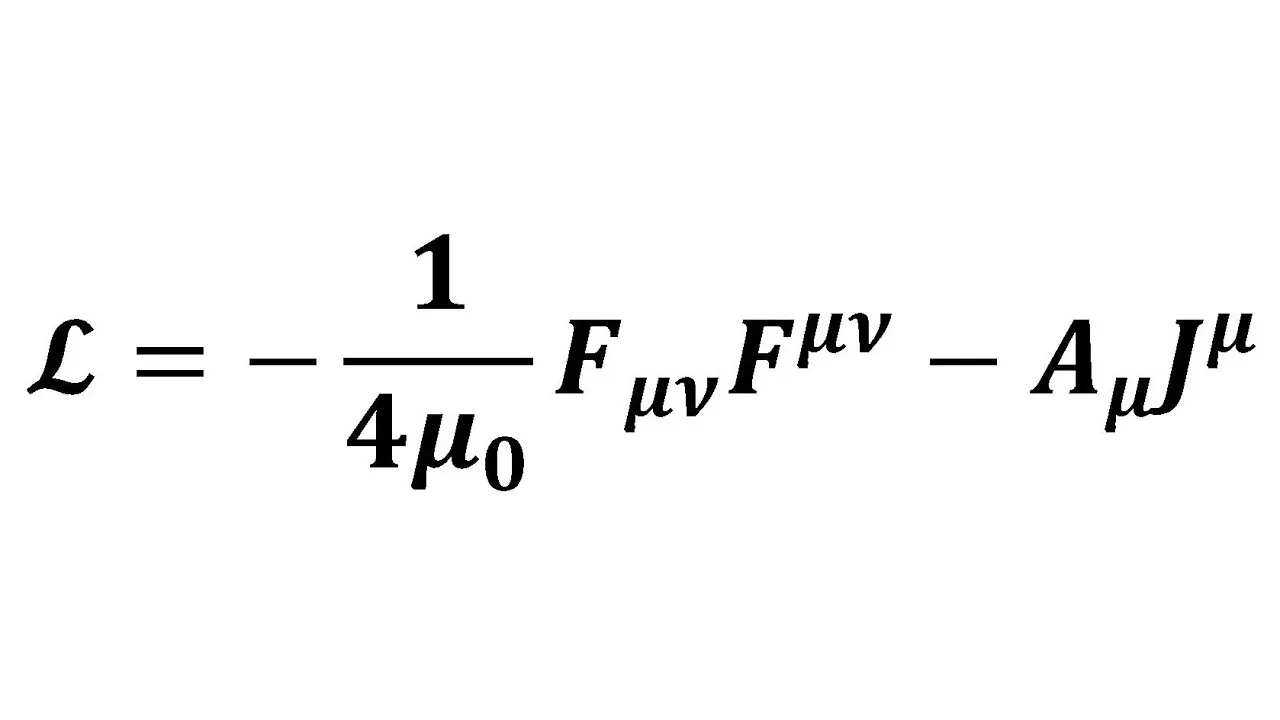





![64 - TEORÍA CUÁNTICA de CAMPOS [ Soluciones de Onda Plana en el Gauge de LORENZ ]](https://i.ytimg.com/vi_webp/VIZ7qmA6nvM/maxresdefault.webp)



In special relativity, the motion of a charged particle in electromagnetic fields is governed by the Lorentz force law, which emerges naturally from the principle of least action when the action is constructed from a scalar quantity involving the vector potential A_μ. The electromagnetic field itself is described by an antisymmetric tensor F^μν, whose components combine the electric and magnetic fields into a unified relativistic framework where electric and magnetic fields transform into each other under Lorentz transformations. This demonstrates how the fundamental principles of locality (fields depend only on nearby conditions), Lorentz invariance (physics is the same in all inertial frames), and gauge invariance (the vector potential is defined up to a gradient) provide the foundation for understanding electromagnetic interactions in a relativistically consistent manner.
Special Relativity Lecture 6: Electrodynamics & Tensor Notation
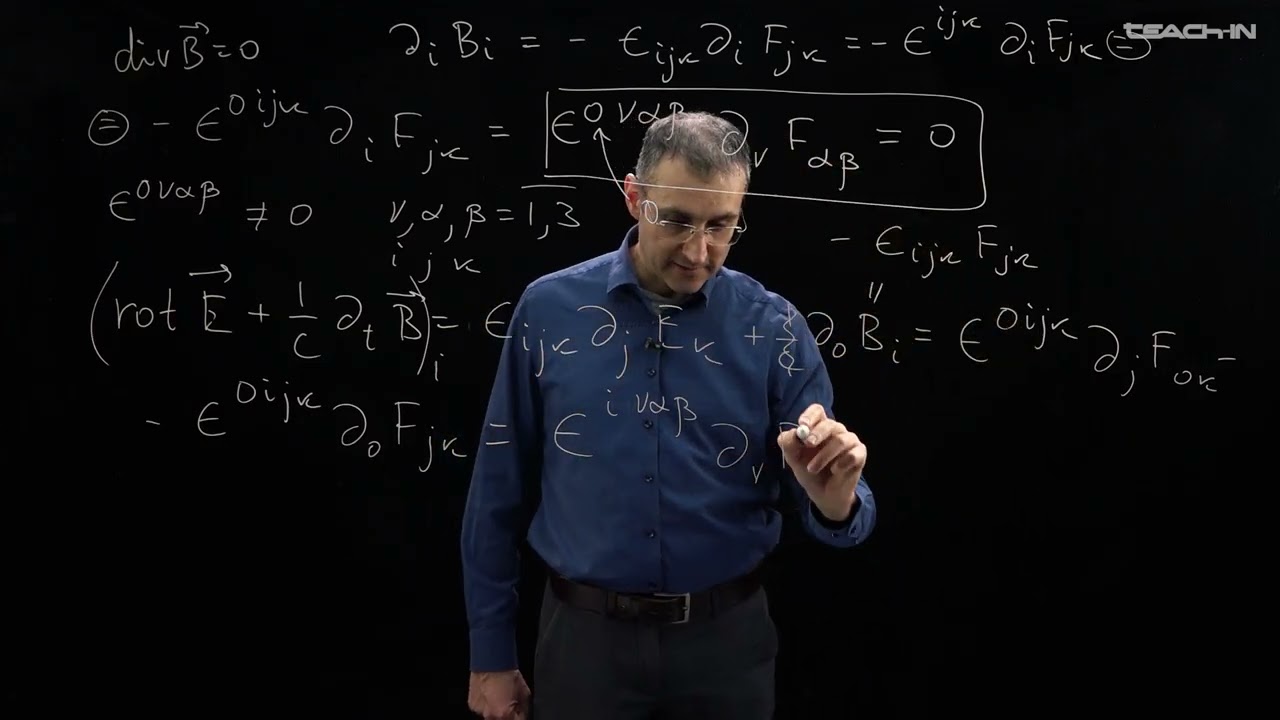
Added:[Music] Stanford University well we're going to talk about electrodynamics tonight we've talked about Scala theories Scala Fields we've talked about how particles couped to Scala Fields how Scala Fields influence the motion of particles in particular how the same lran the same action which um tells the field how to influence the particle also tells the particle how to influence the field we're going to do that again tonight for the electromagnetic field or at least part of it but before we do I I really want to nail in place the notational ideas oh boy what is that looks like quantum mechan to me we don't want any quantum mechanics on the Blackboard tonight just once more briefly I want to go over the notations of four vectors indices how you use them how you manipulate them now just by way of um philosophizing a good notation can be extraordinarily powerful good notations in mathematics uh the minus sign the zero sign the equal sign for goodness sakes EX extremely powerful more modern Vector notation again extremely powerful um what we're going to be talking about tonight a little bit is tensor notation the trick that I showed you last time of upper indices and lower indices that actually is due to Einstein it's completely due to Einstein upper indices and lower indices which mean nothing more than just changing the sign of the time component of a vector a vector with upper indices and a vector with lower indices are really no different except you change the sign of the time component of course that's a special case of something much broader it's a special case of manipulating uh vectors together with the metric tensor but we're not doing the metric tensor yet so for our purpose is now those things were just conventional um uh conventions and notations but notations which are quite powerful as you will see let's just go over them again quickly just to remind ourselves uh what those notations are all about oh the other anotation which is truly brilliant again due to Einstein is the summation convention but the summation convention is something that it's only to be used in the right way it's to be used when you have when you have two indices which are the same one of them upstairs and one of them downstairs that's the only time you use the summation convention with an upper index and a lower index when they're the same you can set or you set them equal to each other and sum over them uh that's the Einstein summation convention we use it all the time but will'll only use it in the special form in which Einstein invented it if we have summations to do and they're not of that special form I'll write summation okay so let's begin with four vectors again four vectors have four components three of which are space components one of which is a Time component and when we're interested in the four-dimensional geometry we write the components a mu but we can also remember that they consist of a Time component which is usually called a KN and three space components which are usually called a m m goes from 1 to three mu goes from zero to three all right now um I've written my Vector with upstairs index I guess it's called a contravariant index index the contravariant index is the sort of thing that you would attach to DX mu and the fact that you put it upstairs and not downstairs is purely arbitrary but uh you have to put the index someplace and Einstein chose to put the uh the index associated with a differential displacement like this in the upstairs slot okay and I guess I don't know who first call that a contravariant index and I don't know why it's called a contravariant index but it is and to go from a contravariant notation to a covariant notation this is pure definition a mu is the covariant counterpart of a it's the same Vector it's just another notation for it or another way of describing it and that is equal to AA mu a new I'll remind you what a to mu new is AD mu new is a collection of numbers it forms a matrix a 4x4 Matrix because mu and new go from 1 to four and Ada is just the Matrix its components Ada 1 one Ada 01 whatever are just the components minus one 0 0 0 0 1 0 0 0 0 1 0 0 0 0 1 it's almost the unit Matrix and in a certain sense with this relativistic geometry with a funny minus sign in front of times time it really does play the role of a kind of um uh identity Matrix but it is what it is minus one in one slot ones in all the other slots purely diagonal and what this complicated formula well it's kind of neat it's a nice neat uh simple setup but really all it says is that the time component of the covariant vector is just minus the time component of the contravariant vector that's this minus one over here and all the other components are the same all the other components are the same so we can write then a sub not is minus a super notot a subm is plus a super M and that's all this formula means but it's been written in a uh in a kind of neat way whether you find that neat or not at this point is not relevant the point is that as you start doing things with it you will find that you'll begin to find it very neat all right so uh let's uh let's take it for granted that it's a useful thing to do all right so first thing the formation of scalers from four vectors we talked about this at least twice let me just write it down on the Blackboard if you take two four vectors they could be the same four vector or two different four vectors and you take one of them to be Contra covariant and the other to be contravariant now this thing that I've written on the Blackboard aut atically sums over mu I do not have to write sum over mu here by Einstein's convention this means a sub one b super one you know sorry not one 2 3 and so forth this is a scaler in other words this is a thing which is a quantity which uh doesn't change from frame to frame another example incidentally I'll just give you another example the derivative sign let's just put it over here for a minute the derivative sign d by DX mu now this is a collection of four differential symbols derivative symbols derivative with respect to X not which means derivative with respect to time and the derivatives with respect to the other coordinates uh it is often just written as d sub mu okay another brilliant notation get rid of the subx and just write d sub mu this symbol by itself of course doesn't mean anything it's got to act on something right but whatever it acts on it adds another index if it acts on a scaler it creates a thing with an index mu that index or the D by DX mu or the D mu is a covariant index in other words for example if this were to act on a Scala field it would give you a collection of derivatives which form a covariant vector I won't give it a name it's just it's its name is D mufi all right so the derivative symbol yes sir so um it's DX sub mu so the MU on the isar so why thear because it's down because it's underneath the fraction bar why indeed all right so last time I explained why and I explained why if you take d by DX mu and you multiply it by DX mu what is that that's derivative of f with respect to time times D time and so forth and so on this is just the change in fi as you go from one point to another by differential displacement DX this is nothing but if we call this point 2 and.1 this is just F of 2 minus 5 of 1 uh divided by a little differential separation but it is just a difference of two scalers and therefore itself is a scaler so by a theorem that I didn't prove but I told you about if you have a contravariant vector and you multiply it by a collection of symbols with a script mu if the result is a scaler the theorem says that the thing that the other piece of it here is a covariant vector so there is a theorem which says that whenever you hit anything with or in particular a scaler but uh I'll give you some more examples in a moment if you hit a scaler with d by DX mu it gives you a four Vector everything I'm saying incidentally would also be true about three vectors the only thing that you have to remember about three vectors is if we're thinking in a purely three-dimensional language not four-dimensional everything is the same except wherever you see M's and news put M's and n's and the Ada Matrix is just the unit Matrix is just the components of ADA which sit in the spatial components and for that reason because Ada is the unit Matrix there's no difference between up and lower components so you don't have to say if you're talking about ordinary three dimensions it's unnecessary to say whether an index is covariant or contravariant they're both the same okay another example of forming a scalar out of a vector well one example of forming scalars out of vectors is just to take a mu B mu but another thing you can do is let's suppose we have a vector quantity which happens to depend on position and also time x mu it let's not write it that way it's a four Vector field it depends on space and time and I'll just indicate that by writing X here it depends on SpaceTime and therefore can be differentiated as it stands it's a four Vector it's a four Vector at each point of space differs from one place to another you can also differentiate it with respect to X and for example you can differentiate it with respect to X and sum over the index mu this means derivative with respect to time of the time component of b plus derivative with respect to X of the X component of b and so forth and so on this is also a scalar all right so that's another example of forming scalars from vectors by what we'll learn to call index contraction index contraction is the same as identifying of upper index with a lower index and summing that's called index contraction an index contraction in this kind of situation takes you from a vector well takes you from a quantity which has all sorts of components and leads to a scaler okay now tensor um scalers and four vectors transform and that's the that's their defining property the defining property is the way they transform scalers for example just transform into themselves as transform under Laurent Transformations and I'm going to give a a um a broader definition of what I mean by a Lorent transformation than we've used up till now Lorent Transformations we've talked about were along the x- axis we could have of course talked about a loren transformation along the y- Axis or the z-axis and so forth right but there's another class of Transformations which are also considered to be part of the collection of lorence Transformations and it's just rotations of space rotations of space is part of the collection of Loren transformation now once you say that then you can say that a Lorent transformation along the Y AIS is simply a lorence is simply a rotation of the lorence transformation along the x-axis you can compound rotations together with Loren transformations to make Loren transformations in any direction rotations about any axis and just the general set of transformations which uh physics is invariant under I'm not going to show you how to do that that's not important to us right now the important thing is just to keep in mind that physics is to be invariant not only um for Lorent Transformations along the xaxis or the Y AIS or the z-axis but more complicated things where you rotate space then transform then maybe rotate back again and uh you know there compound rotations with yeah so when you should say rotate space then time is not affected at all right when I say rotation I mean time not affected at all exactly right so what's a nice notation for the lench Transformations well let's take let's take the transformation of the contravariant vectors for example just X mu how does X mu transform X mu Prime in particular xn Prime that's the time component that's equal to x - V X1 / < TK of 1 - v^ 2 and so forth and so on just a good old Loren Transformations except that I've called time x not and X I've called X1 all right we can always write those transformations in the form of a Matrix acting on the components of the vector I'll show you what I mean uh we write a mu Prime that's the components of a certain four Vector in my frame of reference in terms of the components in your frame of reference are given by some kind of Matrix The Matrix has entries which you'll re you'll recognize in a minute right there's an upper index here I'm going to put a lower index down here it has two indices that makes it a matrix it has a value for every mu and every new it's a 4x4 Matrix and now it multiplies a new is this a properly formed equation over here yeah the leftand side has an index mu which can be any one of one to four the right hand side has an index IND mu an index new but the index new is summed over when an index new is summed over it's not an explicit uh variable in the uh in the equation and so yes this is a properly formed equation summation uh convention all right so let me give you an example of the Matrix L just for the simplest laoren transformation that we've written down I'll give you a couple of them uh for the Lorent transformation let's say along the x axis let's just write down what we would put in here we would put in here this is the time XYZ time in the first column in the first row XYZ so there's a 1 overk 1us v^2 here there's a minus and I think I better make this Matrix a little bit bigger okay let's make it bigger in the upper corner here we have 1 overun 1 minus v^2 and then we have minus V overun 1us v^ 2 how about the next one anybody want to guess zero zero what about down here minus V over < TK of 1 - V ^ 2 and in the next place here 1 over > 1 - V ^ 2 0 0 0 0 0 0 but what down here one and one one 0 01 this is a standard Loren transformation along the x- axis and if we write a column Vector txy Z which I could also write X not X1 X2 X3 but let's write it this way t x y z and we write that this is equal to T Prime X Prime y Prime Z Prime let's just see that that's correct this is a column Vector here this is a column Vector what does it say it says T Prime is equal to 1 over blah blah blah * T minus V over blah blah blah * X well that's the right transformation law for T Prime X Prime is minus V over s < TK * t plus 1 / < TK * X that's the standard lorence transformation on X and then Y and Z they do not mix with t and X Y and Z the unit Matrix down here tells you that y Prime is equal to Y and Z Prime is equal to Z good so this is an example of a lorence matrix a lorence matrix along the x- axis if we wanted to transform along the y axis we would just Shuffle these around a little bit I'll leave it to you to figure out what our Lorent transformation along the Y AIS looks like in this Matrix notation but let's uh let's consider instead a different operation a rotation in the YZ plane in which T and X are completely left alone this is one of these rotations which as somebody said don't involve T at all let's see what that would look like this is a different object now different transformation we would put ones here 01 that tells T and X do nothing but what would you put down here in this lower block down here anybody got a suggestion I want to rotate by angle Theta in the YZ plane now you all know the answer cosine Theta sin Theta minus sin Theta cosine Theta and this would just say y Prime is cosine Theta * y + sin Theta * Z and Z Prime isus sin Theta * y + cosine Theta * Z all right now you can take these matrices and start multiplying them and combining them to make much more complicated Transformations which for example are partly rotations along some axxis partly rotate partly Loren transformation along some other axis but this is the basic uh building building starting point uh and a formula like this all right so this is the transformation property of a four Vector with contravariant index I'm going to leave it to you to compute the transformation property of a four Vector with a lower index I'm going to tell you the answer and I'll let you work it out if you have a covariant vector and you want to know what it looks like in my frame given what it looks like in your frame then there is another Matrix this Matrix has to have a lower index mu because we have to come out with a lower index here an upper index new and an a sub mu I'm going to tell you right now what the Matrix M oh thank you new if the left hand side has a mu the right hand side must also have an un an un summed over mu so that's correct okay now we're talking about the same lorence transformation l and m represent the same physical transformation between coordinate frames and so M and L must be connected there must be a connection between M and L and it's really very simple m is just given by Ada L Ada I'll let you work that out I'll let you prove that incidentally Ada is its own inverse just like the unit Matrix is its own inverse sorry Ada to the minus1 is Ada it's its own inverse and that's because the entries here are such that they are their own inverses the inverse of one is one the inverse of minus one is minus one all right so you can prove this that uh for a given Loren transformation M and L are connected I'm not going to use this very much the main point is that what a four Vector is co covariantly or contravariantly what it stands for is an object which transforms from one frame to another in a particular and special way and the special way is uh in parallel with the way the coordinates themselves transform all right now let's come to tensors we're going to make heavy use of tensor notation what is a tensor a tensor is simply a thing with more indices actually a scalar and a vector are special cases of tensors a scaler would be called a tensor of rank zero which means it has no index the vector is a tensor of rank one and a tensor of rank two would be a thing with two indices so let me give you the simplest example of a tensor take two vectors in fact it would be enough to have one vector but let's take two vectors A and B now we can make a c we can make a product of A and B by and that's a Scala but now I want to consider a more General kind of product the more General kind of product has two indices mu and new uh let's uh let's begin with the contrarian version of it let's just take put it next to each other a mu and B new now this is an object how many components does this thing have 16 4 * 4 is a not b not a B1 a B2 a B3 A1 B not and so forth and so on there are 16 this is a symbol here stands for a complex of 16 different objects different numbers okay uh it's just the set of numbers you get by multiplying any component of a with any component of b it's got two indices and it's called a tensor I'm going to label it just generically I'm going to write t for tensor and it's a particular tensor team you knew not all tensors are of this form not all tensors are simply constructed out of two vectors this way right but two vectors Define a tensor in that way how does such an object transform how does this object transform team you know well if we know how a transforms and we know how B transforms which is the same way we can immediately figure out what let's call it a prime put a bracket around here mu B Prime new is all we have to do is transform the A and the B but we know how the A and the B transform let's rewrite this using the transformation here I'll tell you what I'm going to change the the symbol here instead of calling this new mu new Sigma remember it doesn't matter what you call a summation index as long as you're consistent you're summing over it and so it's just a thing uh that is a sort of dummy index okay uh and let's do it here also mu Sigma Sigma let's plug in here this is just equal to l mu Sigma put it over here a s a sigma but now we also have to put B Prime and B Prime is the same sort of thing L new and let's call it TOA a TOA L mu Sigma * a sigma that's a prime L * this a sorry excuse me B Sigma B Prime U Sigma right good to to good now we're now we're cooking Sigma goes with a to goes with b and now the equation is consistent so here we have a new rule about a new kind of object with two indices which which tells us how it transforms it transforms with the action of the lorence Matrix on each one of the indices so now we can abstract from that and say more generally the way a tensor transforms let's call it the tensor the primed tensor the Quant the set of quantities that you that I see are related to the set of quantities that you see by L mu Sigma L new to time T Sigma to a * B that's T Sigma to so this is the rule for example for the transformation property of a simple tensor with two indices tensors can have yeah would wouldn't this be a predicat on the idea that the L's the A's and the B's can commute because it would be L the L and the a go together and then the L Sig and the a we're not doing Quant mechanics so everything commutes okay and and this and there's only one Matrix here L every Matrix commutes with itself so there's no there's no issue of uh commutation here okay um you can invent more complicated kinds of tensors tensors with three indices mu new I don't know Lambda how would this transform and you can think of it by just thinking of it as the product of three vectors with index mu new and Lambda I won't write it down but the way that it transforms is straightforward for each index it's a transformer for each index new Tow and now we need one more L Lambda Kappa T Sigma to Kappa that would be the general transformation property of course you generalize the hell out of this any number of indices and that's the way a that's basically basically the definition of a tensor the definition of a tensor is a thing which transforms like this now not as I said not every tensor is formed from the product of two vectors for example supposing there were two other vectors Suppose there were two other vectors C and D we could take B mu a mu B new and add it to C mu d new adding tensors by assumption now adding tensors gives other tensors so if I take the tensor a * B with mu index and new index and add to it C * D that's something which cannot be in general written as the product of two vectors but it's a tensor it's defined by its transformation properties not by the fact that it may or may not be a associated with just a pair of vectors okay so now we know what a tensor is from its transformation properties how exactly does multiplying matrix by a TENS work well how does oh it it works exactly this way this is um sorry this way right here here's a matrix l and it acts on t write out write out what this means in detail there's a lot of components but I'll give you a hint for example T 3 uh one prime okay what is that that's equal to l now this is three sigma L1 to T Sigma to and now you start going through it yeah Sigma could be zero to could be zero there's 16 possibilities 0 0 you make that with t0 0 so one term would be l30 L10 t0 0 then there would be another term l30 l11 t01 and so forth and so on there will be 16 such terms one for each index here and in each index here and and you add them up right so that's the idea of the transformation property of a tensor and the thing about tensors vectors scalers tensors the thing about tensors is if they are equal in one frame they are equal in every frame that's easy to prove but to say that they're equal means all components equal if all components of a tensor are equal to all the components of some other tensor of course they have the same tensor but uh or another way of saying it is if all the components of a tensor are zero shift everything to the left side if all the components of a tensor are zero they are zero in every reference frame okay so to say that a tensor is zero is an invariant statement as I said it's not enough to look at some component and say that component is zero the whole thing is a tensor so it must be zero in every frame no if all the components are zero they're zero in every frame and that's the power of tensors it allows you to make statements and allows you to write down equations which if they're true in one frame will be true in another frame after transformation that's the basic power of it all right now I've told you how to transform a tensor with all of its indices upstairs I could start writing down The rules for tensors with some indices upstairs some indices downstairs but I think I won't and instead I will just tell you that once you know how a tensor transforms you can immediately deduce how its other variant an transform the other variants for example the other versions of the same tensor same tensor same geometric quantity but with some indices upstairs and downstairs for example am mu B new that would be some tensor with one index upstairs and one index downstairs how does a transform never mind you don't need to worry about it because I will tell you immediately that this tensor here is given by T mu Sigma which you understand and know about how to transform it times AA new Sigma to lower an index to take a tensor and to take an index from contravariant to covariant you multiply you do it exactly the same way that you do it for a vector you take that index and you lower it by the operation of ADA so again this is a well-formed equation or well-formed symbol Sigma is summed over and this here object is T mu new all right but there's another way to think about it an easy way to think about it given a tensor with all of its indices upstairs what do you do to p some of the indices downstairs and the answer is very simple if the index that you're pulling downstairs is a Time index you multiply by minus one if it's a space index you don't multiply at all that's what Ada does so for example here's the tensor T not not which is exactly the same as T not not because I've lowered two indices lower during two indices is two minus signs okay it's like the relation between a b not and a subn b subn there are two minus signs and going from a supern to a subn and going from B supern to B subn each one has a minus sign this is equal to this but what about this one a not B1 and how does that compare with a B1 sorry A B let's put one down let's put both of them downstairs b super one and B sub one are the same but a super knot and a subot differ by a minus sign so T not1 would be minus t kn1 because only one time component was lowered every time you lower or raise a Time component you get a minus sign and that's all there is to it but having a neat Matrix notation is a fast summary of that fact that uh the relation between covariant and contravariant is just every time a Time index is goes from upstairs to downstairs it's a minus sign question yeah why is it useful to have these two forms controverted just so you can write things like that how else would we write a B minus A1 B1 minus A2 [Music] B2 that's it sorry not this one but um yeah this complicated thing which requires four terms uh let's put the minus sign here plus plus one minus sign three plus signs and four terms Al together is just so you can do products of the signs work y that's all that's the reason H there [Music] is there is more but um the the uh the more to it is best described when we go to general relativity for us right now it's just a neat tool for manipulating indices it's a neat tool for manipulating indices and minimizing the number of indices we need would you asked earlier how many terms in a I said U you said 16 that's 16 in am mu yeah in a mu B new There are 16 so tensor always four or is it just in the context of Relativity right that's yeah in the context of relativity because there are four coordinates the indices run over four so this will work for any indices is yeah yeah but I mean no it's worthwhile keeping in mind that uh that it would work yeah that's right that's correct and in fact the anal analogous version of it for three-dimensional space is essentially the same but slightly simpler in that you don't ever have to distinguish upper and lower indices that's it okay can you get a more General description of Co I certainly can but not tonight okay right right it has a geometric significance but um you know the geometric significance is some something everybody figures out for themselves and then promptly forgets because you just really you never really think about it you just learn to manipulate the indices and it's so quick and so efficient and so fast that um but uh yes it does have a another uh it does have a geometric meaning uh the geometric meaning is well okay I I don't want to get into it now I wanted to tonight's lecture is really about electrodynamics and we ain't going to get there all right now let's uh let's talk about the different kinds of tensors now I'm talking about tensors with two indices let's talk about indic two indices here's an a tensor with two indices now this is not necessarily the same and in fact it is not the same in general as T new t uh T new mu changing the order of the indices in general counts for example a mu B new is not the same in general as a new B mu this could be a not B1 and that's not the same as a1b not just not the same right so in general tensors are not invariant under changing from one in on changing the order of the indices okay but there is a special case called symmetric tensors symmetric tensors are ones which do have this property the teamu new is equal to T mu T new mu let me construct one for you a mu B new plus a new B mu if you interchange mu and new this doesn't change what happens is this becomes this and this becomes this and it's the same quantity so you can construct out of any tensor a symmetric tensor by adding together the uh well by adding together some tensors are symmetric others aren't okay some tensors are symmetric others aren't a symmetric tensor has a special place in uh in general relativity not so important uh in uh in special relativity well it'll come up but more important for us tonight is the anti- symetric tensor let's call it fmu the tensor which when you interchange new and mu change a sign we could construct such a tensor by putting a minus sign here putting a minus sign there would construct a tensor which would change sign when you interchange mu and new if you interchange mu and new this gets swapped with this but there's an there's a minus sign so there are symmetric tensors and anti-symmetric tensors anti-symmetric tensors have fewer components than symmetric tensors and the reason is their diagonal components vanish for example one of the things this equation says is that F not is equal to minus F KN set mu and new equal to time f is minus F the only solution to that is zero so if you think of a tensor as an array a matrix if you like if you think of it as an array array then an anti-symmetric tensor is the one we're going to be interested in is completely zero on the diagonal and the off diagonal elements I'm going to give them names now I'm going to give them names I'm going to call this one minus E sub 1 this one minus E sub 2 and this 1 minus E sub3 and these names are of course chosen for future purposes but I'm just going to write them down now uh and they're just labels for now minus B3 B2 and minus B1 now what do I put down here I haven't written all the elements of it but I'm assuming that this F tensor is anti-symmetric if it's anti-symmetric it means that as a matrix it's anti- symmetric it means down here we put plus E1 plus E2 plus E3 let's see there's an element down here which must be plus B3 Min - B2 and plus B1 it's anti- symmetric which means you just flip the sign when you reflect it around the diagonal that's the notion of an anti-symmetric tensor and it plays a key role in electromagnetism where E's stand of course for electric field and B's stand for magnetic field the electric and magnetic field as we will see we're not there yet but as we'll see the electric and magnetic field combined together to form an anti-symmetric tensor in relativity the electric and magnetic field are not two independent things and in particular what that means is that under the when a loren transformation is performed the electric field can become magnetic field just like X can get mixed with t e can get mixed with B so what you see as a pure electric field I might see as having some magnetic component to it all right but we're not there yet uh that was just by way of um notation strictly notation all right let's now begin with the physics uh part of tonight's lecture this was all notation and uh abstract uh rather dry Well we'd all go crazy if I had to write not not 1 one 22 3 three every time I wrote an equation and so it's good to have this notation okay now we could begin either studying the Dynamics of the electric and magnetic field or we could begin by studying the motion of a particle in an electric and magnetic field the Dynamics of the electromagnetic field would be the equations of motion that electromagnetic field satisfy the Maxwell equations to put it uh briefly whereas the equations of a particle moving in an electromagnetic field are the lorence force law let me remind you what the lorence force law is and then we're going to derive it from something else we're going to derive derive it from a combination of relativistic ideas and the action principle all right I I'll just remind you mass times acceleration this is this is a low velocity version of it mass time acceleration well we don't have to worry about relativity too much mass time acceleration is equal now on the right hand side you have the electric charge of a Charged particle times the electric field mass time acceleration is electric field time electric charge and the other term is the magnetic charge the magnetic sorry not the magnetic charge the magnetic force which also involves an electric charge plus I think it is velocity of the particle cross product with the magnetic field all right cross product I assume you know how to think about cross products we'll use them over and over again I actually have a little section in here on cross products but I'm not going to do it tonight because I think uh we've done it enough times that's there are some speeds of light in there I'm going to set them all equal to one uh this is usually taken to be V over C the divided by C that's the only I think that's the only speed of light in that formula little e is just the electric charge measured in appropriate units uh measured in the appropriate units all right that's the that's the non-relativistic version of the lorence force law of which we're going to derive the relativistic version tonight and the fullblown relativity and we're going to find that these two terms are really part of the same term they're really part of the same thing written in a way where all reference frames uh will get the the same answer all right to so to ensure that um that our answers respect the rule that the law of motion of a charg particle is the same in every reference frame we want to write an action principle where the action is invariant under Lorent transformation that's the key action invariant under Lorent transformation uh for a single particle we had a formula let's go back I don't need this now we we'll come back to it for a particle without any field we just wrote down an action which was the integral along the trajectory from 1 to two one and two being the starting point and the end point of the trajectory minus the mass times the proper time interval proper time from one point to the next minus the masstimes the total proper time from 1 to two and we rewrote that as the square root of 1 minus X do SAR where X do let's remember what x do s is X do m is the MTH component of velocity here m is just a three Vector symbol XM do and X do SAR means X1 do2 + X2 do2 plus X3 do^ sared and so forth in other words the total square of the Velocity that's what x do^ s means here sum over 1 2 and 3 all right so that was that was the action integral DT and that identifies minus M * the square root as the lran of the particle we worked that out uh we found out what the momenta were what the energy was and we'll just leave that what do we add in an electromagnetic field well I haven't told you much about electromagnetic fields yet but the basic structure which enters an electromagnetic field is a four Vector a four Vector the electric and magnetic fields themselves are derived quantities the basic underlying quantity is a four Vector a mu and it's a function of position it's the and time it's the field describing electromagnetic waves if you like or electromagnetic fields in general and it's a four Vector the electric and magnetic fields are derived things which we're going to derive I think we're going to derive them tonight I'm going to try to derive them tonight but the basic starting point is a four Vector the four Vector is called uh the um the vector potential or the four component Vector potential and we'll learn what it has to do with electric and magnetic fields in a moment but what do you do with it to uh to construct an action for the particle in the electromagnetic field and the answer is very simple it's in many respects simpler than the thing that we did with a Scala field a mu is a field with a lower index the natural thing to do with it along a trajectory is to take a little segment of the trajectory described by DX mu a little for Vector from here to here and what can you do with such a four Vector if you have another four Vector in particular a four Vector with covariant indices to make a little scalar quantity associated with that little Gap there well you take the two vectors and you multiply them together with one upper index and one lower index I'll write in here that am mu is a function of X which means x and t and then you sum them all up you integrate from one end to the other from 1 to two and this is just another way of saying for each little Gap there take the differential distance along that uh segment and multiply it by a mu to form a scaler the X mu * D time a mu is a scaler everybody agrees about its value on each one of these little segments and we add them together you can add them as well as I can add them and we will get the same answer for the action because what I wrote here was a scaler I added them all up adding quantities that we agree about we'll continue to agree about them what more can I do with this not much the only other thing that I'm going to do to it is I'm going to multiply it by a constant and we're going to call that constant e it is the electric charge and because of a notation that was first put in place by Benjamin Franklin there's a minus sign here that's arbitrary it depends on our definition of electric charge and had the pro on B well and um yeah okay so there's a minus sign so here's the other term in the action of Port of particle particle moving in an electromagnetic field let's write it up here minus etimes an integral from the same point from 1 to two DX mu a mu of X now what do we want to do we want to write down lr's equations we want to write down lr's equations for the motion of the particle and really my goal is to write lr's equations and show that they're just Laurent Force law but I would like to do it in a way which is relativistically invariant um ma mass times acceleration is a very non-relativistic uh uh formula what for example is um is relativistic acceleration what does acceleration mean uh does it mean the second time derivative of the position with respect to time or does it mean the second time derivative of any one of the four coordinates with respect to time or does it mean the second time derivative with respect to proper time well I think we probably all can all guess that the invariant or the uh the best definition of acceleration in relativity is to differentiate the coordinates twice with respect to proper time along the trajectory right that's a guess right it is the right definition and in that form acceleration is a four Vector we want to write four Vector equations but we're going to begin with a uh uh thinking about about velocity being derivative with respect to time and later when we calculate the equation we'll go back and make it Loren and variant now we won't change it we'll rewrite it in a way which you'll recognize as an equation among four vectors okay so let's leave it this way for the moment uh this quantity in here would be the lran so this would be the lran for the free particle but there's another contribution to the action over here so let's write this in a form which would make it look like a l grangian this is very easy we just divide by DT and multiply by DT all right so let's see what we have here there DX by DT what is DX by DT X is T So DX not by DT is just one and the first thing we get get here is a KN DT and a not is a function of x and t so that's the first term DT by DT that's trivial now the next term is minus E E integral let's call this one now X so it's DX by DT which is x dot times a subx DT and likewise for Y and Z and so the rest of this is simply XM do am or XM dot the MTH component of velocity dotted into dotproduct x m component of velocity dotted with the MTH component of the vector potential that's what this is and the reason I wrote it this way with the DT here is to make it have the familiar look of a lran action an action written as an integral over DT okay so let's write it down now minus E integral a plus XM do a DT and now we can identify the lran let's calculate what's it's it's here the lran is here it's just everything inside the integral here the lran for this system for this particle in an electromagnetic field is just minus M Square Ro T of 1 - x do^ 2 which means x do2 + y do s + Z do^ 2 minus electric charge a not that's this one minus electric charge x. m a m of x and t the A's are just functions of x and t they're Fields just just like we did with a Scala part with a Scala field I'm going to imagine that somebody told us what a of x and t is somebody told us it's just a known function each one is a known function of x and t and now we're just exploring the motion of the particle in that known field and here's the action for it what do we want to do with it we want to write the oiler lrange equations and we want to show that they look like the Lorent Force laww okay so that's our goal take the sran and see if we can derive the lorence force law masstimes acceleration is equal to electric field plus you know electric and magnetic uh lorence forces all right so where do we begin let's consider the equation of motion for XM so we start with partial of L with respect to XM dot that's the starting point right there's obviously a contribution from the first term here and we've already done with that we know what that is it's m incidentally this m is not the same as this m this m is an index this m is a mass okay let's not get confused uh I apologize for that but uh I too late to do anything about it now this one is mass this one is the component m m time XM dot / Square Ro of 1 - x do^ 2 that's the derivative of this logian here with respect to the MTH component of velocity that's easy another uh that we've done that before incidentally this happens to be M times DXM by DT it's DX by DT but this extra Factor here just makes it the four velocity the four Vector of velocity this is M * the four Vector of velocity D XM by DT but we'll come back to that for the moment let's just leave it this way way and then what do we do with that we take the derivative with respect to time so we get m d by D time XM dot / Square < TK of 1 - x do^ 2 that's the left hand well sorry that's one term oh sorry this is not right is it no what's a y isn't it right yeah there's more stuff there there's more stuff there right over here let's put it back in what is it it's minus E * a subm from here derivative of the L grangian with respect to x dot gives us another term which is just the vector potential electric charge times the vector potential and so what we have to do is be careful first of all this is M * this minus e a m that's the leftand side that's the full leftand side of the oiler lrange equation how about the right hand side the right hand side the right hand side should just be DL by DXM right did we switch between Co and Contra yes I did but remember that this we can put it back um yeah I I did I did but remember that when you switch the space components it doesn't matter does that require a switch in the a it doesn't matter for a either right all threedimensional components it doesn't matter right question are are we summing on Latin indices only some over repeated indices and don't count the mass as an index but I mean Latin and Greek doesn't matter well if you if uh let's see where might have I done that yes over here I did yeah over here I did and so right with Latin indices it doesn't matter whether they're upstairs or downstairs and if they're repeated you sum over them but you only sum from 1 to three not from zero to three okay so that's yes that's a part of the notational trick all right so here we have the leftand side of the oiler lrange equation and what do we have on the right hand side on the right hand side we have the Del the the derivative of the lran with respect to XM all right so where does it where does it where does it depend on XM a not depends on X it's just thought of now as a fixed known function of the positions of the particles and so on the right hand side we will have minus E times the derivative of a KN with respect to XM now does that look familiar in any way on the left hand side something that's sort of like masstimes acceleration and on the right hand side something which is minus the derivative of something this is clearly e * a is clearly the electrostatic is the electro is is the potential energy is the thing which in mechanics we would ordinarily call V or U or whatever we call potential energy so this here is just familiar it's uh here left hand side here has something like masstimes acceleration if we didn't have this thing downstairs here which is after all it's very close to one for slow motion if the motion is slow this literally is mass time acceleration this term we'll worry about later and on the right hand side we just have minus the electric charge times the derivative of the electro U of the electrostatic potential okay so this is potential energy over here or the gradient of potential energy which is essentially electric field but we'll come back to that all right but now there's more the uh these terms also depend on X and I have to differentiate them with respect to X these terms are mixed they depend on both velocity and position we've already taken into account the fact that they depend on velocity that was on the left side of the equation on the right hand side of the equation we have to write minus E let's call this here n n n it's a summation index xn dot times the derivative of a n with respect to XM now why we had to do all this come from it doesn't matter whether I call this n or M it's some but by the time I got down to here the M index was not summed over so I don't want to call the summation index M I called it N I switched it all right why am I differentiating with respect to XM because the right hand side of the oil lrange equation is the derivative of lran with respect to XM so we have xn dot derivative of a n with respect to XM so look at this look at it carefully left hand side has an index M which is Unum over the right hand side has an index M which is UNS summed over not summed over but it also has an index n which is summed over this is the oiler lrange equation for each component of the position X1 X2 X3 and so forth it doesn't look like anything you might recognize yet let's see let's uh let's and unfortunately there's no simple way to uh to deal with it except to deal with it oh let's okay the this side over here that's easy that's just we don't we're not going to change that d by DT of M take M on the outside X do M or M doesn't matter upper or lower it doesn't matter over Square < TK of 1us x do^ 2 all right that's this term over here now how do we differentiate this thing with respect to time this doesn't it may it may it may depend explicitly on time but even if it didn't depend explicitly on time it still wouldn't be constant why because the position of the particle is not constant the position of the particle is moving and so even if M only depended on position and not on time a subm as it tracks the particle as it follows the particle would depend on time so there are two terms when you differentiate a subm let's see what they are is minus E and the first term is just the explicit derivative of am with respect to T a m of x and t but then there's another term and the other term is minus E times the change in a when X changes now let's see xn a m xn dot now if you haven't gone to sleep yet let's just see what we have we have the time derivative of a that's over here a depends on time explicitly if the field is changing with time but it also depends on time implicitly from the fact that the position of the particle is varying with respect to time all right so we differentiate a with respect to position and multiply by velocity this is a dummy index it's summed over this one is the index that appears on the left side of the equation so what do we have that's uh that's the that's this side of the equation and on the right hand side we still not finished we still have the right hand side a bit of a mess uh minus E times d a by DXM that's this term that's the potential energy and then there's this term over over here minus E xn dot d n by DXM that's a lot of stuff it's more stuff than I usually like to do on the Blackboard but no way around it so let's take this and call this ma mass time acceleration it's not literally acceleration but let's just call it let's think of it as masstimes acceleration leave it on the left hand side m d by DT x. M over square root and put everything else on the right hand side and then group things together we're going to group them together into two kinds of terms one kind of term is not proportional to a velocity this has no velocity multiplying it and here is another term which has no velocity multiplying it the second term here on the left hand side has a velocity and the last term on the right hand side has a velocity so we're going to group things by whether they have a velocity or don't have a velocity now just remember where we're going we're going to electric field times electric charge which is does not have a velocity and then V cross B which does have a velocity that's where we're going and we're trying to identify now those two terms all right so left hand side is let's just call it masstimes acceleration but put some quotes around it to indicate that it's not the literal second time derivative of x with respect to T just uh left hand side on the right hand side now we have the two terms which don't involve time uh velocities we have e times d m by DX KN d a m by DX I've now reverted to calling time x minus same e d a by DXM notice the nice symmetry here it has d a m by DX and it has d by DXM with a minus sign obviously this thing wants to be electric field it has no velocity in this term over here so if there's any sense to all of this this must mean mass time acceleration is electric charge time electric field and indeed it is the electric field the electric field has two terms one of them is the gradient the gradient of the uh uh of the time component and the other term is the time derivative of the space component all right so that's one thing we we will later see that this Falls nicely into place as electric field now what about the terms involving velocity let's get them uh we bring this one over on the right hand side so it's plus e we have both of them have xn Dot so let's put xn dot out here and one of them has let's see where is it put bracket one has d m by dxn and the other one has d n by dxn notice the pattern each term here oh yeah right the pattern apart from the x dot is each of these terms has a derivative of an a with respect to a coordinate anti- symmetrized notice that anti-symmetry there that it's a m by xus a by XM m a m by xn minus a n by XM interchange of N and M over here and interchange of M and not over here all right let me uh let me uh do something over here to make uh to make this term a little more parallel to this term I'm going to write something stupid here I'm going to write T dot here what on Earth is T Dot dot it's DT by DT it's just one huh yeah all right or I could also write it as X not DOT it didn't do anything it just uh I just threw in for free uh DT by DT which is just one but now it starts to look uh kind of uh symmetric with respect to space and time a little bit here we have a anti- symmetrized thing with an index m and n and here we have an anti- symmetrized thing with a not and M this is XM dot here sorry yeah that's right I got it right it's right okay so this is the form of the equation of motion this is electric field this of course is the magnetic field this is the magnetic field to ident identify in detail how the components of magnetic field what is this operation over here what mathematical operation have I done on the uh components of the vector potential the curl right it's the mathematical curl but we'll come to it we I didn't want to uh do that tonight this is these are the components of the curl of a and the curl of a is the magnetic field this here contains one term which is just the gradient of the time component plus another term and this constitutes the electric field good all right everybody uh everybody happy with this it's a bit much but I tell you now go through this this is something you know if you really care about this here's your lran where is it this is uh sorry top board there's your lran go through the oila lrange equations collect together the terms one side you'll call Ma the other terms have terms with velocities and terms without velocity this of course didn't have a velocity it was just one and group them together and show that this is the way they group together you learn a lot both about field theory about a little bit of calculus and especially about electrodynamics okay yeah at the very beginning for the or the electromagnetic part of the action this is of course just the action of on the particle of the particle motion right yeah why did you write that the integral of a over well you had a a four before but the thing on the right you now that's this integral is minus E times the integral of a mu DX mu so but why did you write that that's really my question this hundreds of years of experiment but but um what constrains it I think the right answer is not why did I write down exactly this that's partly experiment okay but uh what is it that this integral has what properties does it have which make it a good candidate first of all the action is an integral along the trajectory that's a role that up till now we've respected that the action is to be thought of as little incremental pieces so it's a bunch of incremental pieces and the other rule is simply that it should be a scalar that it should be composed out of scalers given a DX mu there are basically two things you can do with it to make a scaler one is to multiply it by itself and what is that that's just d to^ squared that's already in the L grangian here is the to is just the square root of that that's in the L grangian already it doesn't involve any field what's the other thing you can do you can dot the four Vector of Velo you can dot the DX or not dot but you can multiply DX by a and contract the indices if you can find another way to make a scaler you're welcome to play with it okay and there are't other ways ways there are other ways uh we have not got yet to the concept of gauge inv variance but I prefer to work with it at this level first and then to study its gauge and variance after we've uh gone this far so this is basically the simplest thing we could have written down you could write down you could multiply it by uh by a new a new you can take a scaler multiply it by another scal you can write down a lot of junk all right but this is very much the simplest so let's explore it let's do it in that um in that uh um frame of mind an exploration of a simple action what happens you start grinding it out you get a set of equations of motion which are the lorence force law okay made the right choice once that comes out of the yeah you know you've made the right choice right right but we haven't used we haven't used all the principles yet we but we haven't identified all the principles yet can you derive Maxwell's equations from the principal least action oh yes we're going to do it oh we will do exactly that but we will need another term in the action the other term in the action will be the field part of the action not the particle moving in the field but just the part of the action that governs the field by itself all right that's what we did for the scaler last time okay so let's so let's keep going in in that the last equation there can you um this one yeah yeah can you just uh show again explicitly where the summ are occuring okay there's no summation here this is the MTH component of the acceleration that's it it's the MTH component of the acceleration and there's no summation over here there's just an M index and that's all there's an N index over here that is combined together with an N index over here there's a repeated index xn d by dxn * xn Dot and d n * xn Dot N is the summation index so literally this is sum Over N if we wanted to put the summation sign sum Over N but the rule is repeated indices get summed over non-repeated indices are are explicit and they're you know they're on both the left hand side and the right hand side let's see if we can write this formula in a way which is manifestly that means obviously lorensen variant the moment it is not and the reason is that the leftand side and the right hand side are not themselves four vectors they're not four vectors but we can convert them to four vectors so let's do that excuse me yeah could you say something about why that ter is the Elric field well all right what would we write if it was electri what what do we want to write we want to write e defition yes we want to write e * the MTH component of the electric field what's special about this is it doesn't involve a velocity it just depends on a electric field which depends on space and time but this term does not contain a velocity and it's uh it's not a velocity dependent Force right Force doesn't depend on velocity it only depends on where the particle is and so here we have a term which is like that over here we have all the terms which multiply velocity and so it better be that that corresponds to the magnetic field but I think I think what you're saying is right I mean if we started from this principle if we started from the principle that of least action and we wrote down that action and we eventually got this equation we might look at it and say ah let's take this whole thing here it doesn't matter whether it's part this and part that let's just call that e and we would have invented or discovered the electric field so I think that's the that in fact really is the natural logic natural logic is to identify this and call it the electric field and in a like manner we will identify this with components of the magnetic field V times something okay but not yet because we uh I don't want to do that yet all right let's see if we can write this in a form first of all which is obviously Lorent invariant obviously invariant means that you should write it as the left hand side and the right hand side being tensors of the same kind well this obviously wants to be a vector type thing it doesn't want to be uh it has compon it has a component the component is a spatial component it sounds like it's part of some kind of four complex which you might identify as a four Vector but not quite and uh let's let's see what uh what we can do with it okay so what was it really what it really was M what it was was M times d by DT of d x mu by D XM by DT or XM Dot divided Square < TK of 1 minus let's just call it v^2 I called it X do s before this quantity x dot overare < TK of 1us V ^2 x dot means DX by DT this is DX by DT this happens to be exactly D XM by DT do you remember what we call that variable that quantity DXM by DT we called it the four velocity and it was a letter that I identified with it U of course there's also a fourth component there is a fourth component the fourth component would be DX knot by D to that would be U KN for slow particles this is very close to one but nevertheless it's there but at the moment what we have here is literally d by DT of DXM by DTA in other words the time derivative of the four velocity okay and that's equal to the right hand side the right hand side will also manipulate in a little while but I don't want to have a d by DT here I want to have a d by D TOA there why do I want a d by D TOA because TOA is the invariant quantity I don't want to have a non I don't want to have this kind of mixed thing with a tow and a t d by D TOA that's lorensen variant to doesn't change from one frame to another but T does so what do I do with this I multiply I'm going to multiply whatever is here all the stuff here all the stuff that comes from the right hand side of the equation wherever it is I'm going to multiply both sides of the equation by DT by D to DT D what do I get on the left side d by DT DT D to what's that that's just d by D to the t is cancel and this is just the rate of change with respect to to that's after I multiply by D by DT and this is a nice expression this is just a mass times a second derivative of the component with respect to to^ s this is part of a four Vector if I add the first three components X Y and Z if I add to that a fourth component which is the second derivative of time with respect to to^ squ that is a four Vector it's the four Vector M DC X mu with respect to to^ squared it's a kind of acceleration but it's an acceleration just as the Loren and variant concept of a velocity is to differentiate the four components with respect to the proper time the lenen variant notation of the lenen variant concept of an acceleration is to take the second derivative of all four components of position with respect to the proper time so we can do that on the left side all right that that's gives us what is standardly called the proper acceleration that's called the proper acceleration on the left side for slow moving particles it's close to the ordinary acceleration all right let's look what's on the right hand side let's go to the right hand side Here and Now multiply it by DT d right let's multiply it by DT d so we have there here it's DX not by D DT D is the same thing as DX not by DT just multiplying we multiplying the X not by D but what's over here this is DXM by DT now I'm multiplying by DT by D to so what does that make that term it just makes it DXM by D to now look at these two terms they have exactly the same form the same form with a different index here the index is0 0 here the index is M and N this can all be summarized into a single equation or a single term and the single term is e times the [Music] a m by DX mu minus d a mu by [Music] DXM times the X mu by D to on the left hand side on the right on the left hand side it's DC by d^ 2 m of XM equals this is XM not mu wouldn't it be nice if I could change this m to a mu this is an equation this is three equations for the space components of the proper acceleration on the right hand side we still have space components here wouldn't it be nice if there was a fourth equation this is three equations one for each m 1 2 and three wouldn't it be nice if there was a fourth equation which was just the time component of this same equation except with M being the time component over here and the time component over here if that fourth equation was correct then we could summarize the entire set of equations by basically one equation Mass proper acceleration all four components the X mu equals e time the derivative of a mu what do I have here um a mu with respect to X new minus derivative of a new with respect to X mu DX mu by DT no DX new by DT I think I should have X in here n in all right let me write that equation down again your homework is to go home and derive the following equations oh do I know that the fourth let's let's just rewrite it here it is this is a comple of four equations one for each mu 1 2 3 and four the first three of them or the last three of them 1 2 and three are just the equations that were written here when m is 1 2 and 3 I've added an equation the equation I've added is for the second time derivative of x not how do I know that it's true why should it be true Z whoa no no no the left hand side is literally a four Vector so is the rightand side this is a tensor this is a tensor with a mu index and a new index if you take a tensor and you combine it with a vector you get a vector this equation is a tensor equation in the sense because it transforms right so because we took care from the beginning to make sure that the equations of motion were Loren and variant and we did that by making sure that the action was a scaler this is the logic here's the logic it pervades everything in uh in field theory in particle physics in modern physics make sure that your lorian respects the symmetries of the problem if the symmetry of the problem is Lorent symmetry make sure you l is lenen variant once you do that you don't have to worry again about whether the theory is invariant with respect to Loren transformations in other words you don't have to worry about whether it looks the same in every reference frame okay once you know that the laws of physics Al Lenin variant and that the first three components of a certain four Vector are equal to the first three components of some other four Vector then you know automatically that the fourth components will also match the only way a system of equations can be lenen variant if the first three components are zero let's say is for the fourth component also to be zero so we can automatically conclude from the fact that we built a lorensen variant theory that the fourth equation must be true if the other three equations are true they'll just form a complex of equations which include all four components and another way to say it is if you took the equations for the first three components and then transform them you would simply pick up uh the fourth equation uh that way but you don't need to do that all you need to do is say I know my theory is Loren and variant and therefore if the first three components of of a vector equation are true so must be the fourth component yeah I follow exactly what you're saying in terms of the notation and how it was constructed and what he know in terms of the Symmetry and the tens that's fine that's great that's all there is but but putting blinders on you forgetting all the other things that we know we were just doing this derivation we could add in the fourth equation know that it was valid but how would we know that it was meaningful in a physical sense I'll tell you what it is it's it's energy conservation the um well okay it's it's sort of energy conservation the um the first three equations they're not energy they're not energy conservation I'll tell you what they are though the first three equations are of the form DP DT is equal to force you know dpdt is ma right I mean p is MV and dpdt is ma so they're roughly speaking the no not roughly speaking exactly the equations that the time derivative of the momentum is equal to the force the first three equations and the force being everything that's on the right hand side of the equations the fourth and they tell you not momentum conservation but they tell you how the change of momentum with time is due uh is responds to the existence of a force the fourth equation tells you how the kinetic energy changes with time okay how the kinetic energy changes with time how does the kinetic energy change with time the kinetic energy by DT let's call it K by DT well that's called work right and work is force times velocity that's what the fourth equation is the fourth equation is the equation that tells you that the energy changes in a way which is consistent with the amount of work being done and that's not too surprising that uh remember that the momentum and the kinetic energy form a four Vector okay so it's not surprising that uh that the uh four component equations are related if not to energy and momentum conservation at least to the way in which energy and momentum change uh in response to the existing of a force so that's what the fourth equation is it's the energy balance it tells you how the kinetic energy changes when you do work on the system and the work being done by the field that's what this is about [Music] um but the sort of exciting thing is that you can represent the equations in this very neat lenen variant form tensor form where the left hand side is a tensor namely a four vector and the right hand side is the product of a tensor with two indices times a four Vector again we contract the indices and the contraction of the indices produces a four Vector on the left hand side matching a four Vector on the right hand side that's the exciting thing about this that we used symmetry from the beginning that told us the kind of Lans we could write down that that would manifest the Symmetry and then we plowed through it and discovered in fact that the equations of motion really do reflect the symmetry of the problem the Symmetry being uh Lorenson variance now there is another symmetry the other symmetry is called Gage invariance and we haven't gotten to it yet we'll get to it next time but uh and I'll I'll tell you what it is next time but let me say that the three really fundamental principles that come time and time again which we'll see in this simple example three principles the first principle is called locality what locality says is that the way a thing changes only depends on what's going on nearby the thing that you're thinking about a field over here doesn't change due to a field over there having some value it changes because the field nearby has some value the motion of a particle only depends on the values of the fields nearby it also doesn't depend on the values of the fields that are later time or an earlier time the equations of motion are equ between things at a at a nearby and in a small vicinity of the time being related to other things in the same small vicinity of time uh and space how do we represent how does that how do we Implement that we Implement that that's called locality we Implement that by making the action the action should be an integral Over All all space and time dxdt of some kind of lrange density which only depends on the values of things at a particular point in the neighborhood let's call it x and t and well sorry depends on things and derivatives let's say fields and their derivatives in other words it depends on data which has to do with local nearby Concepts and you add up the action in point by Point by point in space and what comes out is differential equations differential equations are equations which relate how things change from one point to another to neighboring things you could imagine the action not having this form you could imagine the action has in it things which involve products of fields over here and products of fields far away but then you equations when you worked out the oila lrange equations they would have the form that the way things change over here depends on what's going on over here no that's not the way the action principle works the action depends on fields and neighboring Fields neighboring Fields now means derivatives so the way the field changes it one point is only determined by the value of the field at that point and neighboring points so that five sub is is four components der yes four components four components F sub mu represents the four derivatives of F and as I said it dep it says that Fields change in a way which depends only on what's going on nearby in space and time that's the principle of locality and it's no more and no less than saying that the action is an integral yeah how do you quantify nearby well in by making derivatives by saying it depends on fields and their first derivatives that's all yeah fields in their first derivatives now you could try putting in second derivatives and uh there's there's an interesting subject there but uh but uh let's uh let's not get into it too much uh action principle together with the idea that the action is built up out of incremental pieces Each of which depends only on a field in a neighborhood and it's and it's and its local neighbors what we've been doing here just depends on X and and BX right well the uh yeah when we're talking about the particle yes when we're talking about the particle motion then we can substitute the statement that the lran along the world line of a particle only depends on the positions of the particles and neighboring positions along the world line but also it depends on the values of the fields at the position of the particle the acceleration of a particle over here does not depend on the value of the field over here it depends on the values of the fields in the neighboring region that's the principle of locality that the response of either fields or particles depends only on what's going on infinite infinite tally close by right second Lenin variance lenen variance are in the in both cases for both the particle and the field the rule is build the lran out of scalers build the lran make sure that the lran itself is a scaler that's another way of saying that we'll all agree about the action uh uh within a certain volume of space and time lenon variance l equals scaler those two principles are very pervasive there is one more principle which we haven't worked out yet I have it in my notes and so I'll write it down but it's going to be the subject of next week gauge invariance and that means we'll find out next week these three principles are extremely pervasive every theory that we know about whether it's general relativity Quantum electrodynamics the standard model of particle physics Yang Mills Theory uh all conform to these three principles and basically I would say uh uh anything else on top of that that you need is sort of incidental and incidental not in the sense that it's not important but incidental in the or what's the right word that it varies from example to example in ways that don't really have to do uh with with such deep principles the fact for example that the standard model has three species of quirks well that's not contained in here that's a sort of random addition but the basic deep principles are these so next time we'll learn what gauge inv variance is as I said I advise you to go and go through these equations and figure out where the various things came from because I certainly don't expect that you uh got it all in one sitting for more please visit us at stanford.edu
Up Next

Cosmic Rays Explained: Supernova Remnants & AGN
@MonashPhysics
43.6K views•2016-12-09

21cm Hyperfine Transition in Neutral Hydrogen: Radio Astronomy Basics
@AaronRobertParsons
12.4K views•2011-10-13
Classical Mechanics: Angular Momentum and Poisson Brackets
@stanford
139K views•2011-12-16

Entropy and the Second Law of Thermodynamics Explained
@veritasium
27.5M views•2023-07-01
Related Study Plans & Knowledge Roadmaps
Structured learning paths in Physics