























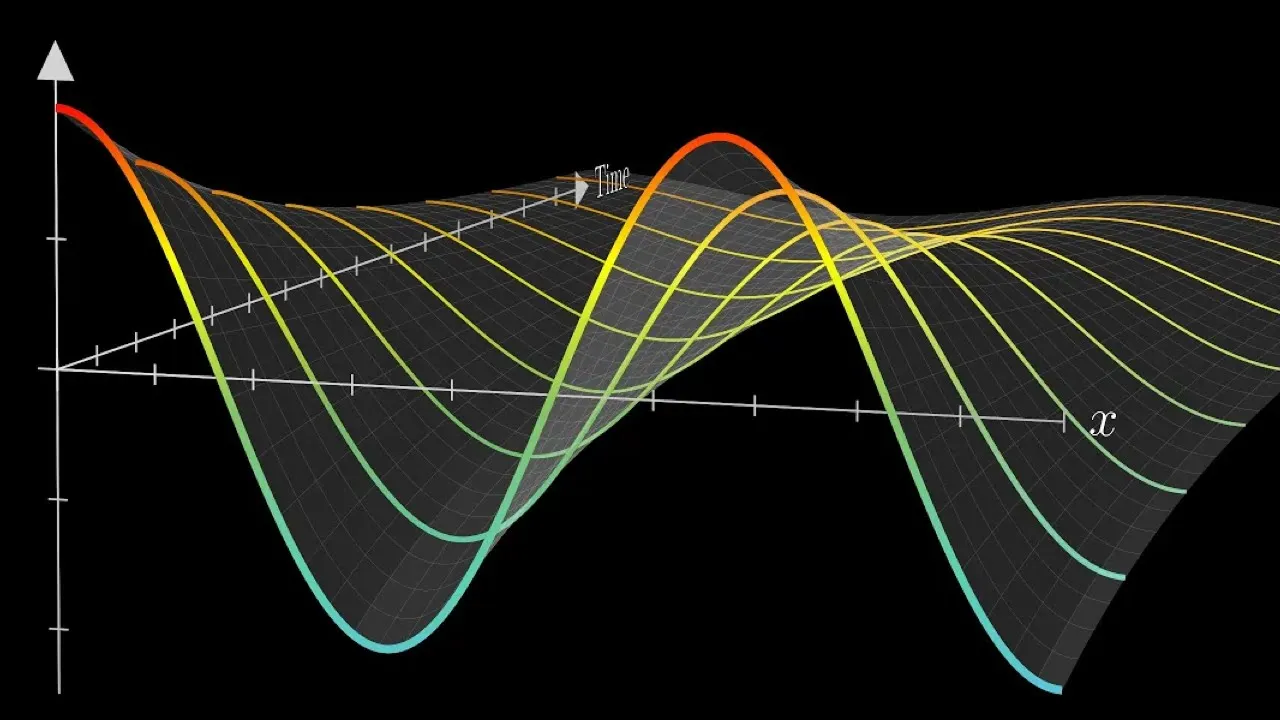

![[Lec 1] Everything is Functions and Functions are just fancy vectors | Intro to Functional Analysis](https://i.ytimg.com/vi/QzMKvXWkPXU/maxresdefault.jpg)


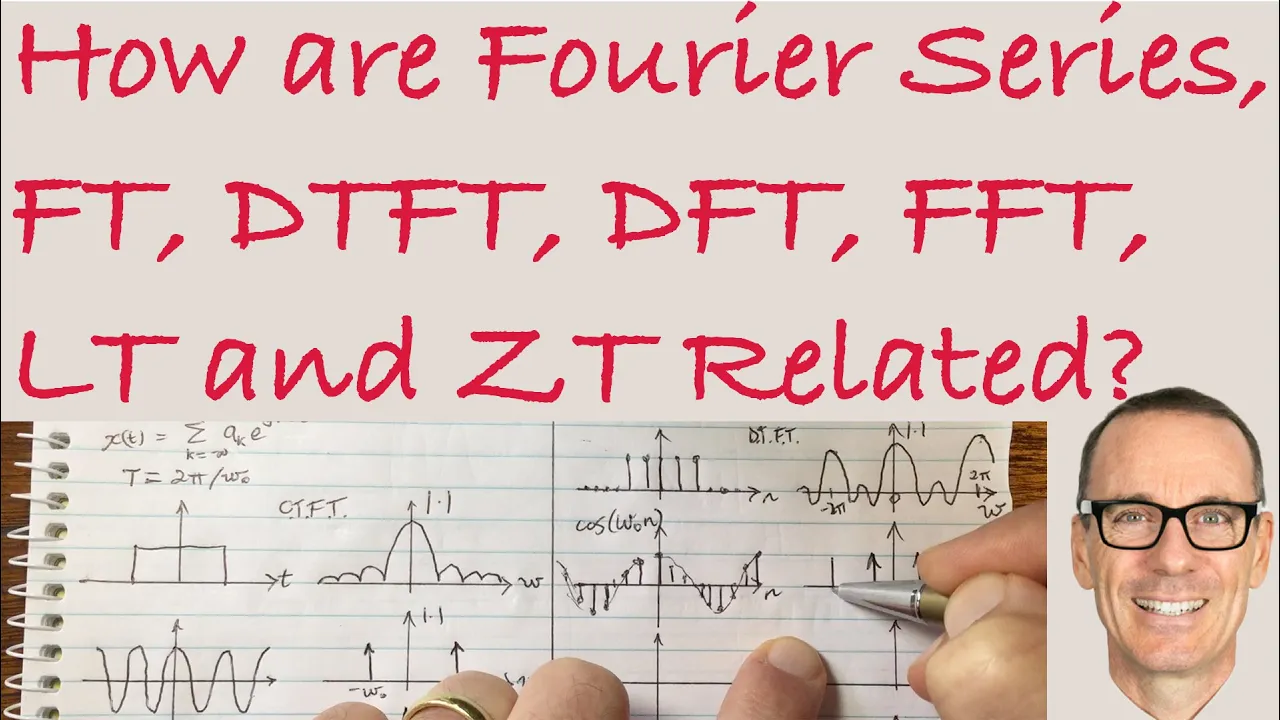


The complex Fourier series represents a periodic function as a sum of complex exponentials: f(x) = Σ Cₙe^(inx), where the coefficients are given by Cₙ = (1/(2π))∫[from -π to π] f(x)e^(-inx)dx. This is derived by substituting the complex exponential definitions of cosine and sine into the real Fourier series and combining terms to obtain a unified summation formula that includes both positive and negative frequency components.
Complex Fourier Series Derivation | Engineering Mathematics
Added:Familiarity with the standard trigonometric Fourier Series and its coefficients (a_0, a_n, b_n).
Euler's Formula and the mathematical representation of sine and cosine using complex exponentials.
Foundational complex algebra, including the imaginary unit 'i', complex conjugates, and polar representation.
Integral calculus, particularly the integration of complex exponential functions over a symmetric interval.
Transitioning from Fourier Series to the continuous Fourier Transform for analyzing non-periodic signals.
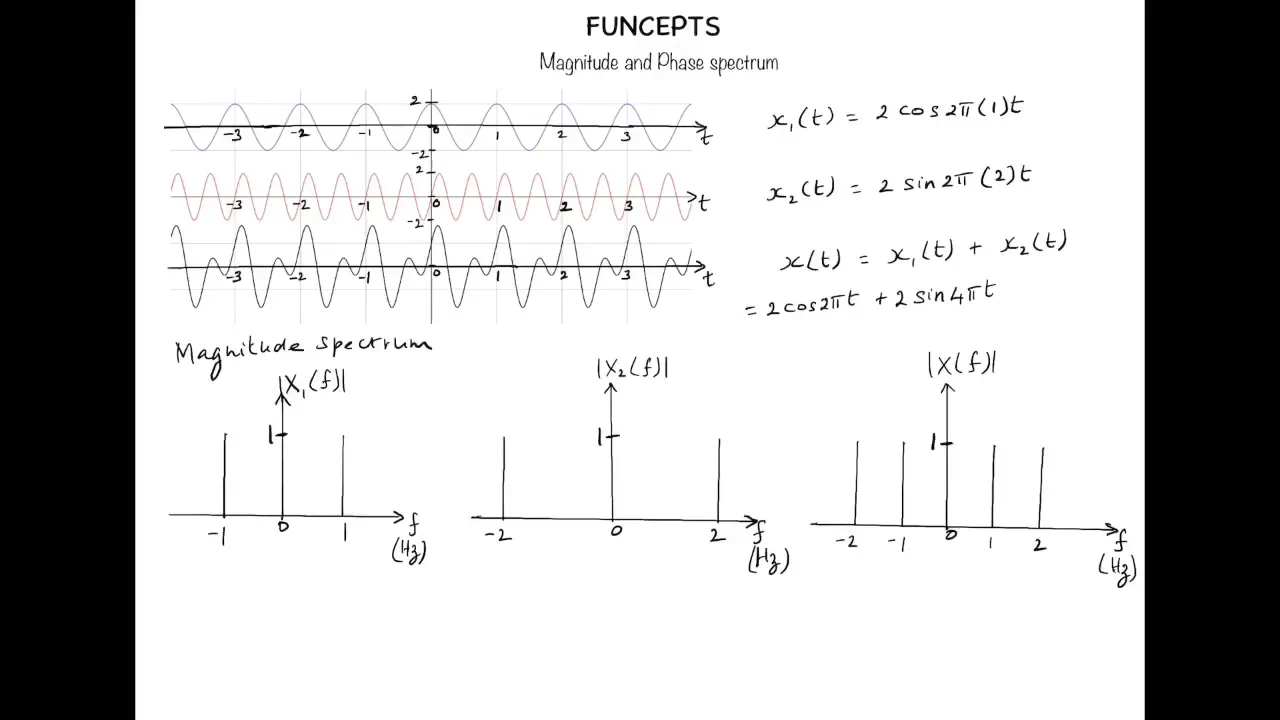
Plotting and interpreting the magnitude and phase spectra of a signal in the frequency domain.
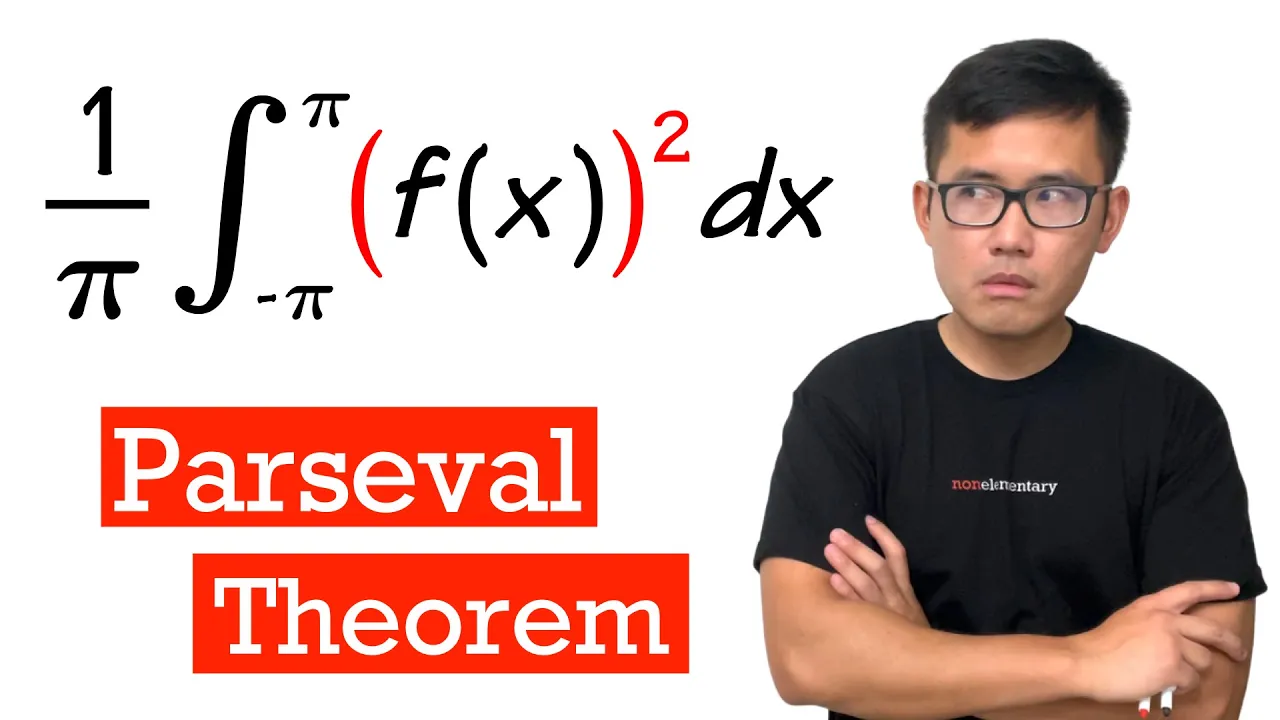
Understanding Parseval's Theorem and energy conservation in the context of complex coefficients.
Application of complex Fourier series in solving partial differential equations, such as the heat or wave equation.
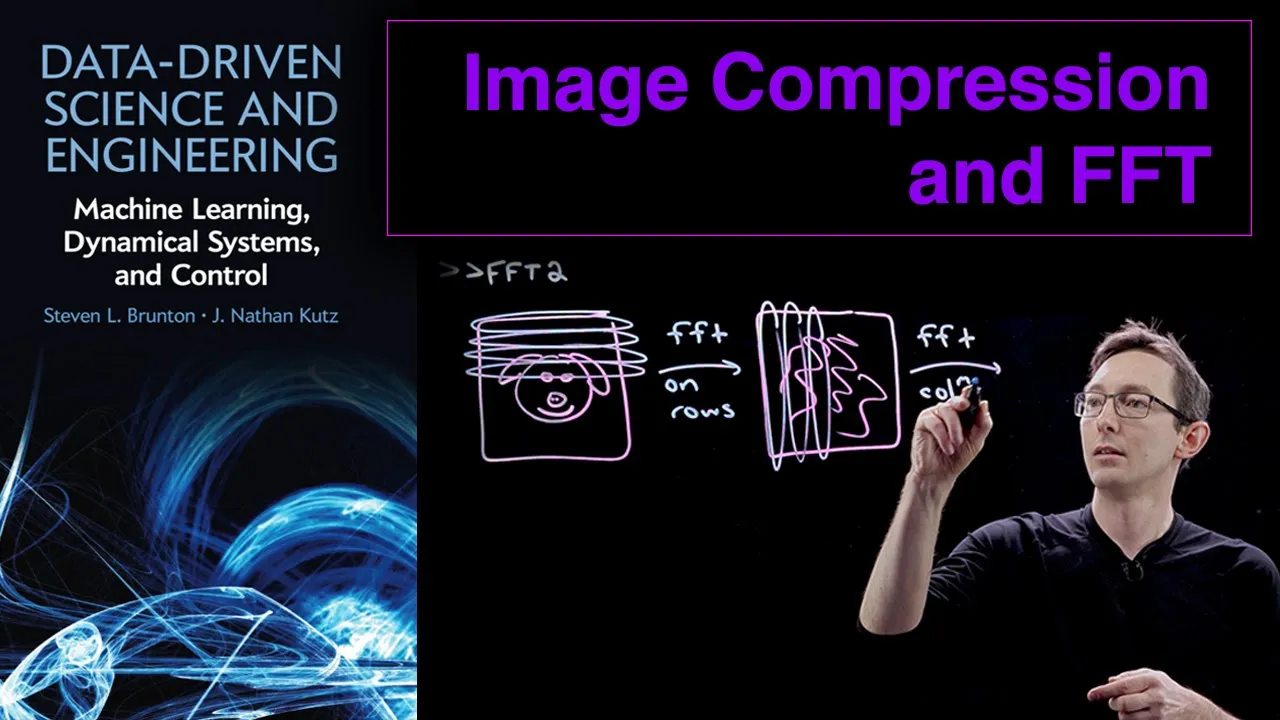
Exploring Discrete Fourier Transforms (DFT) and Fast Fourier Transforms (FFT) in digital signal processing.
179.3K views4.9Klikes12:57Original Release: 2019-01-07
okay last time we did the Fourier series and then we came up with a formula for this this and that and they are all in terms of integrals right and if you guys haven't seen the video please you guys go check that out well today we are going to make this complex and to do so look at we have cosine and sine and we did talk about the complex definition of cosine and sine in a past and if you guys haven't seen this video be sure you guys go check that out as well I will have the links in the description for your convenience so what we are gonna do is we will just cost out an X this is my fate huh I would just put that right here in here and now we'll replace this with the cosine and we will do the simplest thing for sine and they will continue from there and in the yet it's going to be really beautiful guess what love it and by the way if you guys haven't subscribed be sure to guess - so thank you guys so much my goal is to hit 200,000 subscribers by the end of this year and thank you guys for your support we can't do it together okay enough talking now let's see let's just write down the change that we are not going to touch so this right here a cero stage and this right here it's the sum as n goes from 1 to infinity and here we have a and then for this once again we just put an X and X therefore we are going to have pregnancies here we have e to the I times and X and we are going to add e to the negative I and an X and then divided by 2 so this is pretty much the complex version of cos alpha and X now for the second part right here yes look at this is also a summation from 1 to infinity you can put her getting 1 summation pi it's actually better if you write it down again so we add the sum as n goes from 1 to infinity here we have B add and to get the sine of an X well that do use this of course however this time I don't like to be on the bottom so I'm going to just multiply the top and bottom by I to fix the situation and notice I times I just negative one so here you have negative one so altogether you are just saying you're multiplying by negative I with the top pretty much so right here I'm going to write this down right here for you guys this is negative I multiplied with this you have negative i e to the I theta which is an X so we put on the an X right here and then negative I times negative becomes positive I and we will have the e to the negative I X and the denominator is still just a 2 because we took up this on the top earlier already so we departed by 2 like that so this is cool now what can we do next well here we have e to the iron X that was e to the iron X this per has e to the negative ion X and this per has e to the negative ion X welcome to just collect the similar terms right so that's C I'm going to once again write this down because we are now going to touch this yet so a 0 and then here I will just say we add the sum as n goes from 1 to infinity and perhaps let's collect all the terms that has e to the i NX first so that's my target I will put it down right here e to the iron X well from this part we know when you multiply am with this am will be right here right so we will have a N and yes it's over 2 and in fact right here it's also over 2 so we can just put together and to care the iron into the iron X from this part it's actually be n times negative I therefore you will have to have the minus I and then the BN like this and this right here is like a coefficient for this e to the iron X so that's what we have now we do the similar thing for the into the negative ion X and as I said we're going to write down the another summation by still uncle's from 1 to infinity so let's see this time my target is to get the e to the negative I and X and from this part is a n divided by two so we will have a n and then yes just put it over to like that from this part we will have BN times I and then divided by 2 we have 2 divided by 2 right here already so we'll just say we add I and then multiplied by B I like that cool huh now what can we do next well as we can see here we have e to the i NX and this right here is e to the negative ion X in fact I can make this into e to the iron XS well because here we have a summation all we need to do is rename the index and to do that let me just write this down right here for you guys I will just put all this right here so all we are going to do is we will change all the ends right here to negative urn so just kind of change it and you'll see right here for this part it's going to be e and imagine if you put a negative end right here for this add negative times that negative will give you parsnips all together you get I and X here which is very nice and you still have to do the same for the rest of the else right here so you put a negative end here and here so right here you get a stop negative end and then you add I times B sub negative N and then divide it by 2 well you also have to do the same right here originally and goes from past the one to pass the infinity now you're just negating the ends in other word you are going from negative 1 to negative infinity however we always write down a smaller number here right so in other word we all say and goes from negative infinity to negative 1 and this right here is so much better because this and that are the same now and in fact we can put this and that into one summation and this is how first look at this right here which is just like a coefficient for that right and we can rename this and we used a and B already so we'll just call this to be C and from this we are talking about C 1 C 2 C 3 and so on because n goes from plastic want to pass infinity well here we have this number H 0 why don't we just go ahead and call this to be C 0 sure right especially if you imagine you have e to the I times 0 X yes you can adjust McAleese to be C 0 and if you come here yes we can also call this right here to PC and not to be confused that this DN and that's the end even though they look different the idea is that the end right here goes from past they want to pass infinity but the end right here goes from negative infinity to negative 1 so right here you're talking about C+ was he passed he 2 and so on this right here you're talking about C negative 1 and C negative 2 and so on see positive one can be different and C negative 1 right that's the idea you're just calling this to be the sequence in fact see parsley 1 and C negative 1 they are the complex conjugate why because here you have the minus here you have a plus so see past the N and C off the negative wire and you know there are complex conjugate anyway now we can just write this down into one summation and here we go we will have the sum as n going from negative infinity including 0 and then up to positive infinity so let me just put this down right here and for the coefficients it's just all these so just put on stage n right here and we multiply this by e to the i-x like that well this is it ladies and gentlemen this is how the complex version of the Fourier series looks like so let me just write down F of X on the demand side right here for you guys well we are not quite done yet because we shall still figure formula for CN right otherwise this is just the look we cannot do any computations now this is how we are going to figure out this yet it's very similar to the situations that we are trying to figure out a NPN first let me just write this down what we'll do first is that we will multiply both sides by e to the negative I M X and you might be wondering why do we do the negative is so that we can almost end up with the complex conjugate and what we used M instead it's because similar reason than the situation from the previous previous video to figure a n we multiply everything by cosine M X and you will see we actually end up with a complex account you get rows from right here right but okay we multiply e to the I M X on both sides and we are of course integrate M and we will integrate this from negative PI to PI just I found the previous video and don't forget to put on with the X right here otherwise people will complain well assuming this comfor just the sum of the integrals is that integral to sums right so we can just say if you integrate this we can just put the inter coincide and that would be just a constant multiple so we'll just do cat integral right here negative and negative PI to pass the pie and you have that DX right here so we will focus on this integral right so look at this part because this is to be done and you are trying to figure out this right here this right here you have two possibilities I will write this down this is equal to either you have zero if and and M are different all right and in fact I have another video that works out the you know the computation for this if any mmm are different you end up with zero and the only time they will end up with now serial number is two pi when n is equal to n and of course when nm and my equal here we had I I and X and this is e to the negative I own X that's why it's the complex conjugate so that's very cool and here's the deal from here you only get one term then the two pi times C M because that's the time when n is equal to M right so you can just perhaps write this down right here just put on this right here so all this yeah all this of this is equal to 2 pi times C M right well here I use em yeah I used em but we are using n so we can just change the mmm two ends and with e by 2 pi on both sides so let me just write this down for you guys C n okay it's equal to put a 2 pi here you get 1 over 2 pi and you would integrate this from negative PI to positive PI and you have the function of course f of X times e to the negative I and X because once again you put the and back DX so yes you start to work on integral to get the coefficients but this right here now you may like it a lot more than the sine cosine once you may like it more than the real ones because I know that's what you guys like anyway so this right here is said who took me a while to record so please give me a like and leave a comment down below and let me know if you guys have any questions for any of this anyway as always that's it
Up Next

47:52
Fourier Transforms and Their Applications | Stanford Lecture 6
@stanford
103.9K views•2008-07-04
4:43
Elliptic Curve Cryptography Explained: ECC, ECDSA, ECDH
@PracticalNetworking
28.5K views•2024-10-21
17:29
Bézout's Identity Explained: Finding Integer Solutions via Euclid's Algorithm
@blackpenredpen
110.6K views•2018-04-25

6:00
The Mathematical Impossibility of Accurate World Maps
@Vox
23.3M views•2016-12-02
Related Study Plans & Knowledge Roadmaps
Structured learning paths in Mathematics
mathematics
Tensor Calculus: Vectors to Riemann Curvature
01Mathematical Foundations: Linear Algebra & Calculus
02Covectors, Dual Spaces, and Tensor Basics
03The Metric Tensor and Index Gymnastics
+ 2 more learning modules
40h5 modules
Explore Roadmap
mathematics
Gödel's Incompleteness: Logic, Proofs & Limits
01Introduction to Formal Systems & Hilbert's Dream
02Set Theory, Cardinality, and Cantor's Diagonal Argument
03Arithmetization and Gödel Numbering
+ 2 more learning modules
14h5 modules
Explore Roadmap
mathematics
Galois Theory: Fields, Groups & Solvability
01Foundations of Abstract Algebra: Groups & Fields
02Polynomials & Field Extensions
03Splitting Fields & Symmetries
+ 2 more learning modules
24h5 modules
Explore Roadmap
mathematics
Non-Euclidean Geometry: Models & Geodesics
01Euclid's Fifth Postulate and the Birth of New Geometries
02Hyperbolic Space and the Poincaré Disk Model
03Geodesics: Defining Straight Lines in Curved Spaces
+ 2 more learning modules
15h5 modules
Explore Roadmap