





























The Keynesian multiplier effect explains how an initial change in aggregate planned expenditures (such as government spending or tax policy) leads to a larger change in equilibrium GDP; mathematically derived from the equilibrium condition Y = C1Y + B, where Y = B/(1-C1) and the multiplier equals 1/(1-C1) or 1/marginal propensity to save, meaning a $1 billion increase in autonomous spending results in a $2.5 billion increase in GDP when the marginal propensity to consume is 0.6.
Keynesian Cross & Multiplier: Fiscal Policy Effects
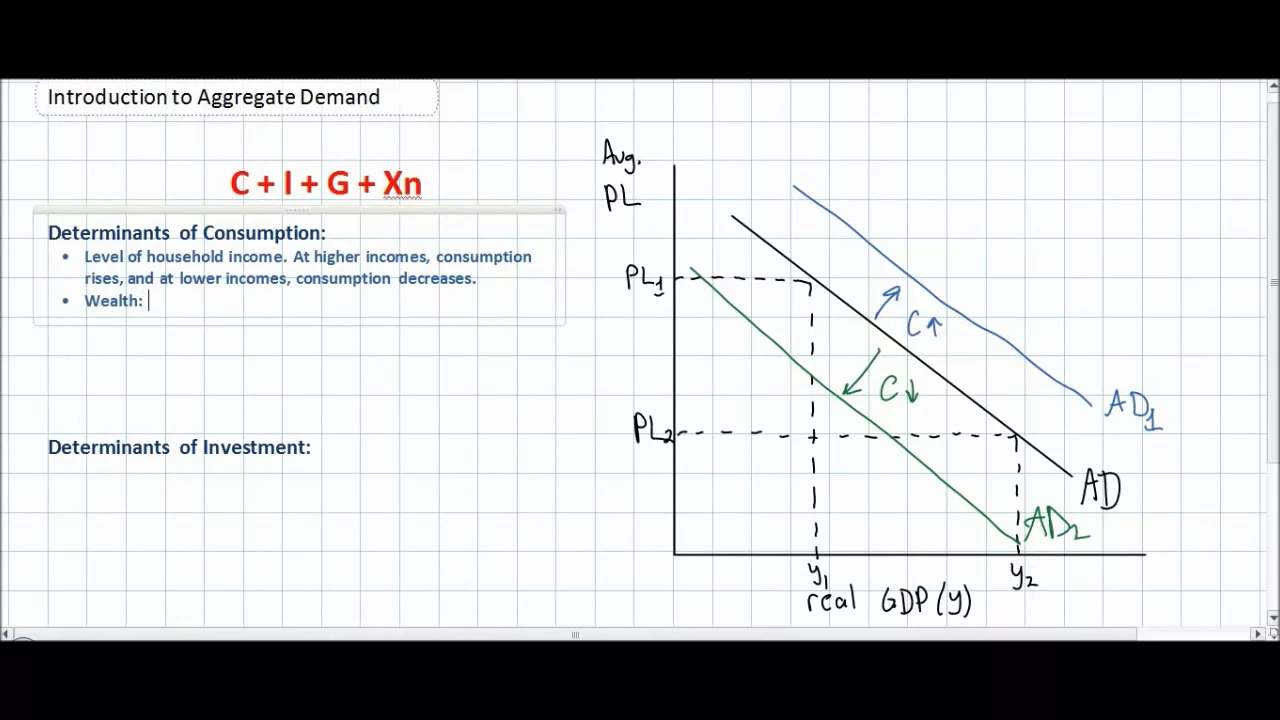
Added:Understanding the components of Aggregate Demand, specifically Consumption (C), Investment (I), Government Spending (G), and Net Exports (NX).
The concept of Marginal Propensity to Consume (MPC) and Marginal Propensity to Save (MPS), and how they dictate consumer behavior.
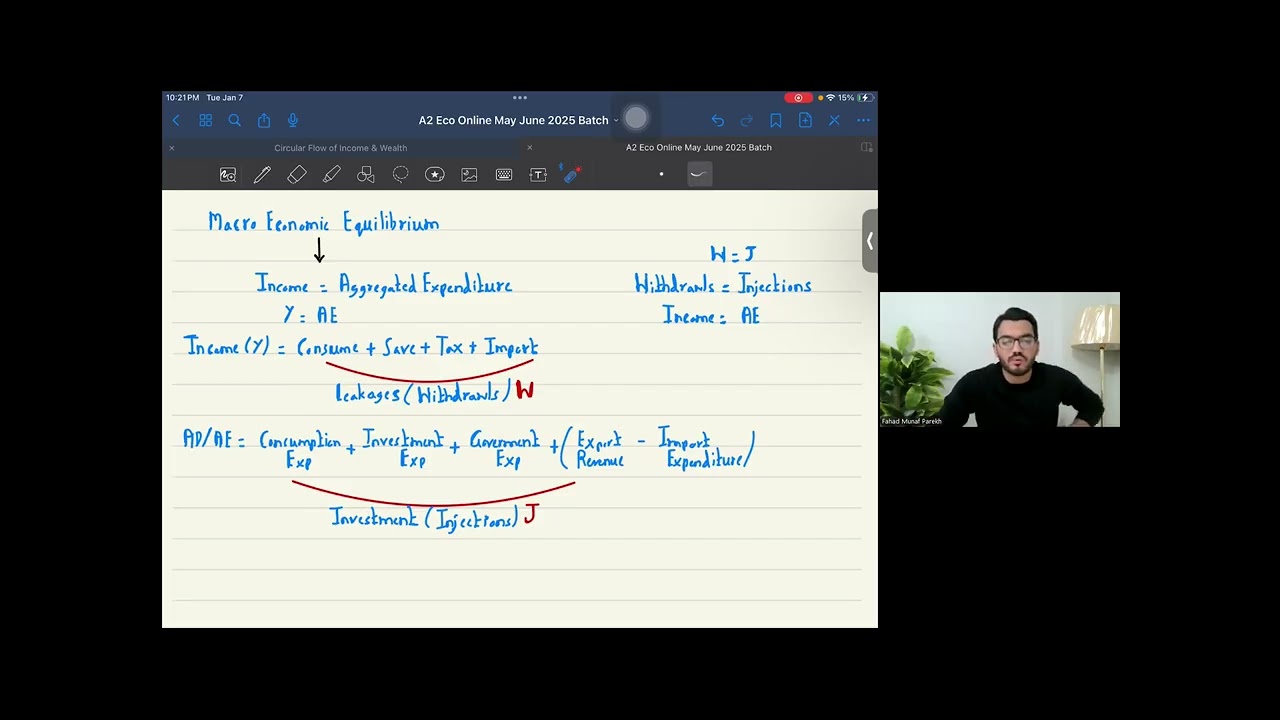
The definition of macroeconomic equilibrium where aggregate output (Y) equals planned aggregate expenditure (PE).
An introductory understanding of fiscal policy, specifically the distinction between government spending and taxation.
The IS-LM Model, which integrates the goods market (Keynesian Cross) with the money market to show the impact of interest rates.
The Crowding-Out Effect, explaining how expansionary fiscal policy might raise interest rates and reduce private investment.
A comparative analysis of the Government Spending Multiplier versus the Tax Multiplier and the Balanced Budget Multiplier.
Real-world limitations and criticisms of the Keynesian multiplier, such as implementation lags, inflation, and import leakages.
218.5K views753likes10:27Original Release: 2012-04-05
In the last video, we saw how the Keynesian Cross could help us visualize an increase in government spending which was a shift in our aggregate planned expenditure line right over here and we saw how the actual change, the actual increase in output if you take all the assumptions that we took in this, the actual change in output and aggregate income was larger than the change in government spending.
You might say okay, Keynesian thinking, this is very left wing, this is the government's growing larger right here.
I'm more conservative. I'm not a believer in Keynesian thinking.
The reality is you actually might be.
Whether you're on the right or the left, although Keynesian economics tends to be poo-pooed more by the right and embraced more by the left, most of the mainstream right policies, especially in the US, have actually been very Keynesian.
They just haven't been by manipulating this variable right over here.
For example, when people talk about expanding the economy by lowering taxes, they are a Keynesian when they say that because if we were to rewind and we go back to our original function so if we don't do this, if we go back to just having our G here, we're now back on this orange line, our original planned expenditure, you could, based on this model right over here, also shift it up by lowering taxes.
If you change your taxes to be taxes minus some delta in taxes, the reason why this is going to shift the whole curve up is because you're multiplying this whole thing by a negative number, by negative C1.
C1, your marginal propensity to consume, we're assuming is positive.
There's a negative out here.
When you multiply it by a negative, when you multiply a decrease by a negative, this is a negative change in taxes, then this whole thing is going to shift up again.
You would actually shift up.
You would actually shift up in this case and depending on what the actual magnitude of the change in taxes are, but you would actually shift up and the amount that you would shift up - I don't want to make my graph to messy so this is our new aggregate planned expenditures - but the amount you would move up is by this coefficient down here, C1, -C1 x -delta T.
You're change, the amount that you would move up, is -C1 x -delta T, if we assume delta T is positive and so you actually have a C1, delta T.
The negatives cancel out so that's actually how much it would actually move up.
It's also Keynesian when you say if we increase taxes that will lower aggregate output because if you increase taxes, now all of a sudden this is a positive, this is a positive and then you would shift the curve by that much.
You would actually shift the curve down and then you would get to a lower equilibrium GDP.
This really isn't a difference between right leaning fiscal policy or left leaning fiscal policy and everything I've talked about so far at the end of the last video and this video really has been fiscal policy.
This has been the spending lever of fiscal policy and this right over here has been the taxing lever of fiscal policy.
If you believe either of those can effect aggregate output, then you are essentially subscribing to the Keynesian model.
Now one thing that I did touch on a little bit in the last video is whatever our change is, however much we shift this aggregate planned expenditure curve, the change in our output actually was some multiple of that.
What I want to do now is show you mathematically that it actually all works out that the multiple is actually the multiplier.
If we go back to our original and this will just get a little bit mathy right over here so I'm just going to rewrite it all.
We have our planned expenditure, just to redig our minds into the actual expression, the planned expenditure is equal to the marginal propensity to consume times aggregate income and then you're going to have all of this business right over here.
We're just going to go with the original one, not what I changed.
All this business, let's just call this B.
That will just make it simple for us to manipulate this so let's just call of this business right over here B.
We could substitute that back in later.
We know that an economy is in equilibrium when planned expenditures is equal to output.
That is an economy in equilibrium so let's set this.
Let's set planned expenditures equal to aggregate output, which is the same thing as aggregate expenditures, the same thing as aggregate income.
We can just solve for our equilibrium income.
We can just solve for it.
You get Y=C1xY+B, this is going to look very familiar to you in a second.
Subtract C1xY from both sides.
Y-C1Y, that's the left-hand side now.
On the right-hand side, obviously if we subtract C1Y, it's going to go away and that is equal to B.
Then we can factor out the aggregate income from this, so Yx1-C1=B and then we divide both sides by 1-C1 and we get, that cancels out.
I'll write it right over here.
We get, a little bit of a drum roll, aggregate income, our equilibrium, aggregate income, aggregate output.
GDP is going to be equal to 1/1-C1xB.
Remember B was all this business up here.
Now what is this?
You might remember this or if you haven't seen the video, you might want to watch the video on the multiplier.
This C1 right over here is our marginal propensity to consume.
1 minus our marginal propensity to consume is actually - And I don't think I've actually referred to it before which let me rewrite it here just so that you know the term - so C1 is equal to our marginal propensity to consume.
For example, if this is 30% or 0.3, that means for every incremental dollar of disposable income I get, I want to spend $.30 of it.
Now 1-C1, you could view this as your marginal propensity to save.
If I'm going to spend 30%, that means I'm going to save 70%.
This is just saying I'm going to save 1-C1.
If I'm spending 30% of that incremental disposable dollar, then I'm going to save 70% of it.
This whole thing, this is the marginal propensity to consume.
This entire denominator is the marginal propensity to save and then one over that, so 1/1-C1 which is the the same thing as 1/marginal propensity to save, that is the multiplier.
We saw that a few videos ago.
If you take this infinite geometric series, if we just think through how money spends, if I spend some money on some good or service, the person who has that money as income is going to spend some fraction of it based on their marginal propensity to consume and we're assuming that it's constant throughout the economy at all income levels for this model right over here.
Then they'll spend some of it and then the person that they spend it on, they're going to spend some fraction.
When you keep adding all that infinite series up, you actually get this multiplier right over here.
This is equal to our multiplier.
For example, if B gets shifted up by any amount, let's say B gets shifted up and it could get shifted up by changes in any of this stuff right over here.
Net exports can change, planned investments can change, could be shifted up or down.
The impact on GDP is going to be whatever that shift is times the multiplier.
We saw it before.
If, for example, if C1=0.6, that means for every incremental disposable dollar, people will spend 60% of it.
That means that the marginal propensity to save is equal to 40%.
They're going to save 40% of any incremental disposable dollar and then the multiplier is going to be one over that, is going to be 1/0.4 which is the same thing as one over two-fifths, which is the same thing as five-halves, which is the same thing as 2.5.
For example, in this situation, we just saw that Y, the equilibrium Y is going to be 2.5 times whatever all of this other business is.
If we change B by, let's say, $1 billion and maybe if we increase B by $1 billion.
We might increase B by $1 billion by increasing government spending by $1 billion or maybe having this whole term including this negative right over here become less negative by $1 billion.
Maybe we have planned investment increase by $1 billion and that could actually be done a little bit with tax policy too by letting companies maybe depreciate their assets faster.
If we could increase net exports by $1 billion.
Essentially any way that we increase B by $1 billion, that'll increase GDP by $2.5 billion, 2.5 times our change in B.
We can write this down this way.
Our change in Y is going to be 2.5 times our change in B.
Another way to think about it when you write the expression like this, if you said Y is a function of B, then you would say look the slope is 2.5, so change in Y over change in B is equal to 2.5, but I just wanted to right this to show you that this isn't some magical voodoo that we're doing.
This is what we looked at visually when we looked at the Keynesian Cross.
This is really just describing the same multiplier effect that we saw in previous videos and where we actually derived the actual multiplier.
Up Next

3:21
Tax Multiplier Explained: Fiscal Policy Practice | Macroeconomics
@JacobAClifford
325.8K views•2012-02-07

5:07
Impact of Yuan in Indo-Russian Trade Amid Sanctions
@WION
261.9K views•2022-07-01
8:18
Commodity Money vs Fiat Money: AP Macroeconomics Guide
@khanacademy
278.6K views•2016-06-20

113:18
The Age of Easy Money: Fed & Inflation | Full Documentary
@frontline
21.2M views•2023-03-15
Related Study Plans & Knowledge Roadmaps
Structured learning paths in Economics
economics
Sovereign Debt: Defaults, IMF & Restructuring
01Introduction to Sovereign Debt & Government Bonds
02Debt Sustainability & Credit Ratings
03Anatomy and History of Debt Crises
+ 2 more learning modules
12h5 modules
Explore Roadmap
economics
Market Design: Matching Theory & Gale-Shapley
01Introduction to Market Design and Price-Free Markets
02Two-Sided Matching & The Gale-Shapley Algorithm
03School Choice Systems and Mechanism Design
+ 2 more learning modules
10h5 modules
Explore Roadmap
economics
Impossible Trinity: Forex, Capital & Policy
01Introduction to Monetary Policy and Central Banking
02Exchange Rates and International Capital Flows
03The Mundell-Fleming Model
+ 2 more learning modules
8h5 modules
Explore Roadmap
economics
Healthcare Economics: Market Failures & Systems
01Introduction to Healthcare Markets and Market Failure
02Asymmetric Information and Adverse Selection
03Moral Hazard and Insurance Design
+ 2 more learning modules
12h5 modules
Explore Roadmap