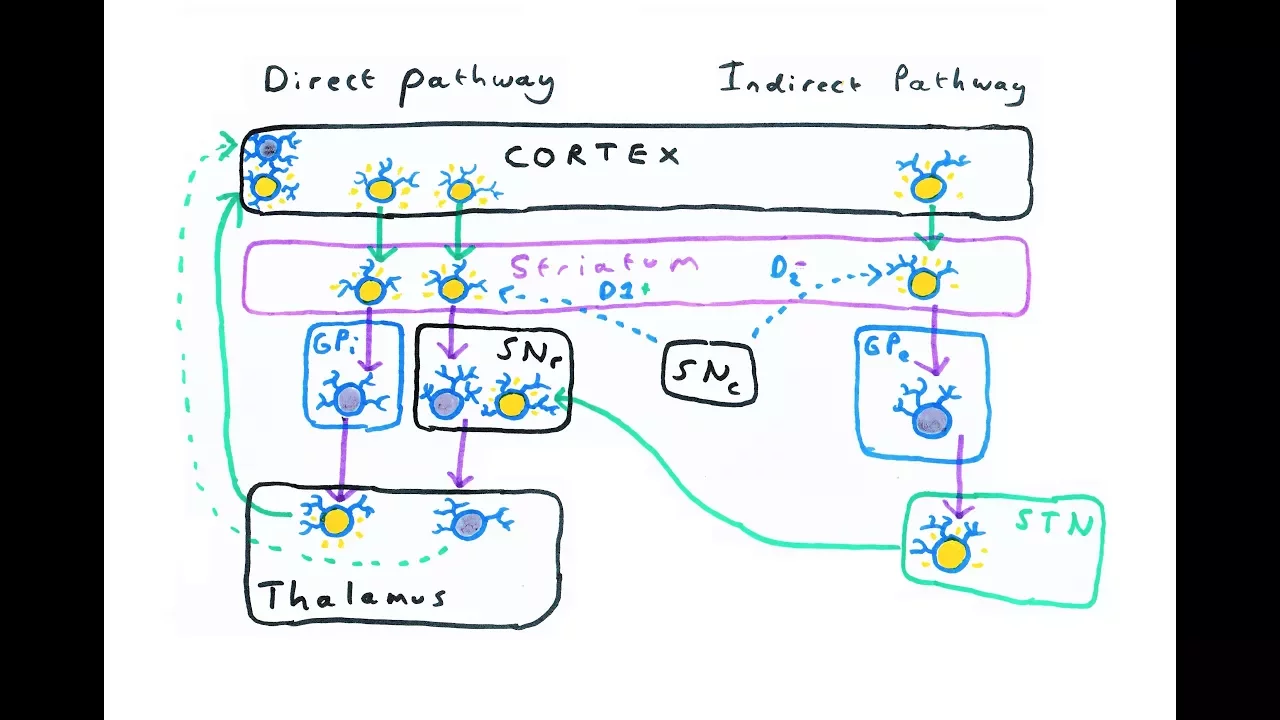






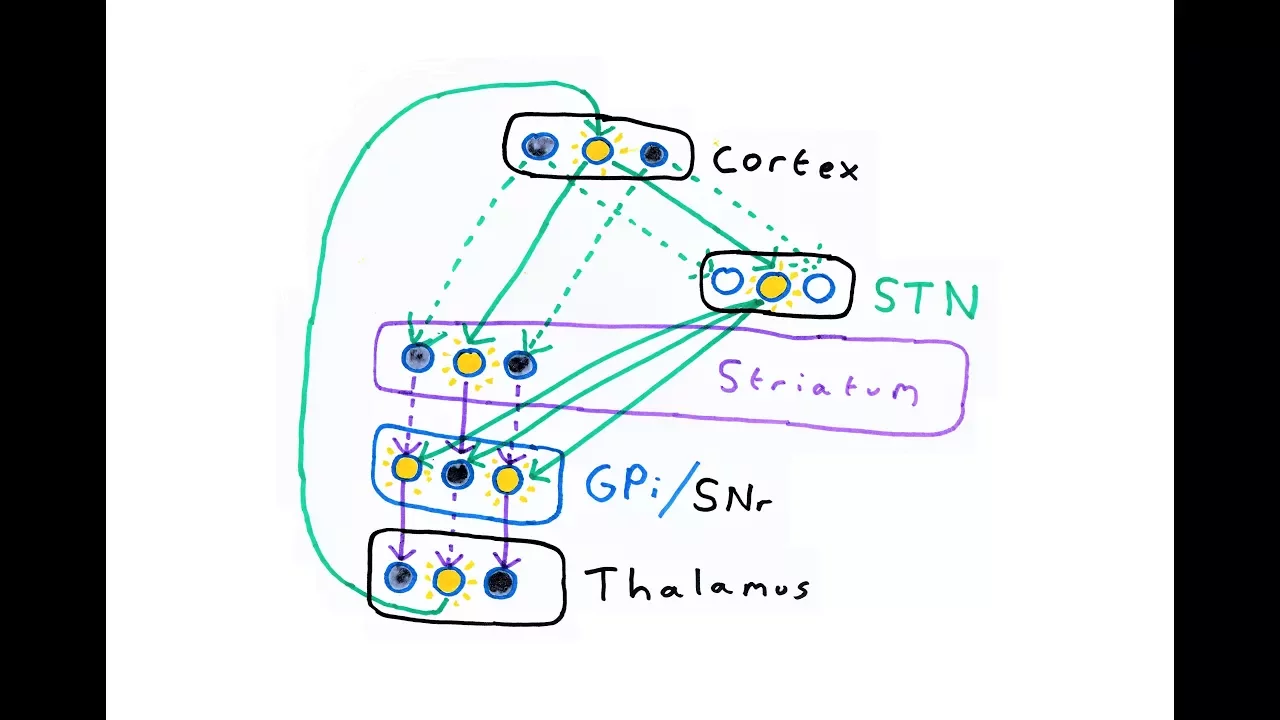







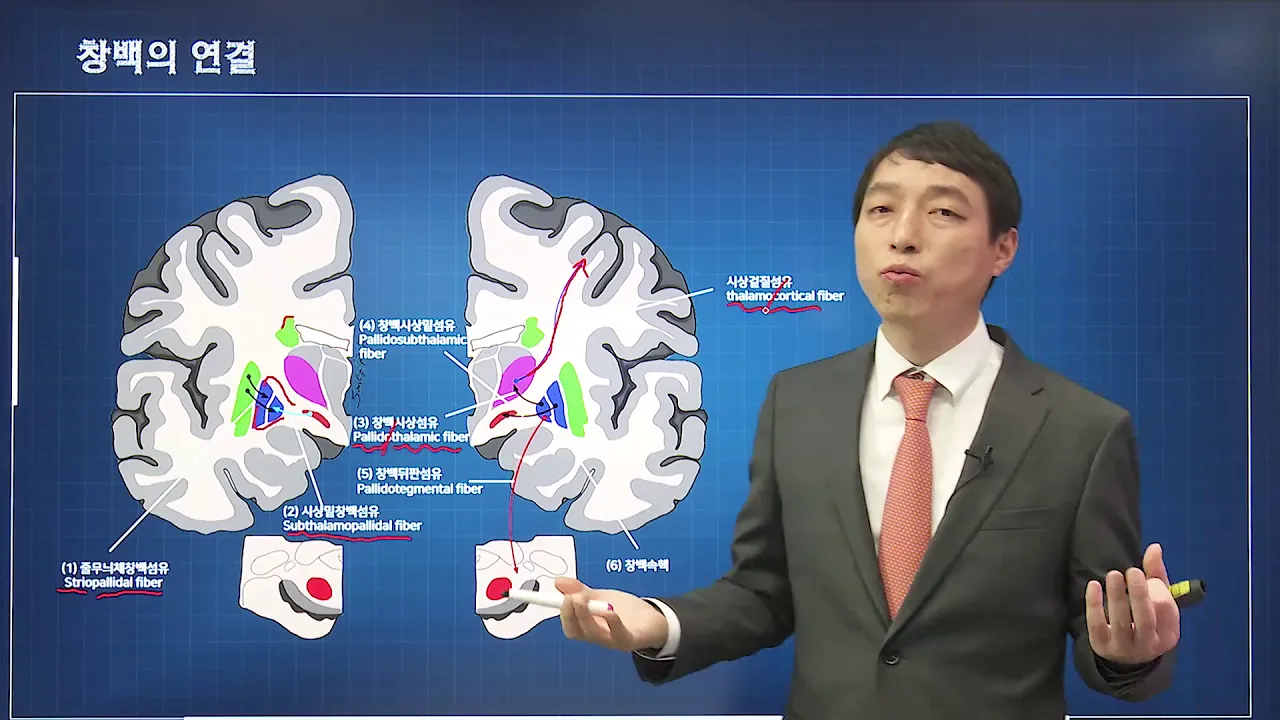
The basal ganglia regulate voluntary movement through two opposing pathways: the direct pathway (initiates movement by disinhibiting the thalamus via GABA from medium spiny neurons projecting to globus pallidus internal) and the indirect pathway (suppresses competing movements by disinhibiting the subthalamic nucleus via GABA from medium spiny neurons projecting to globus pallidus external); dopamine from the substantia nigra modulates both pathways—amplifying the direct pathway via D1 receptors and partially inhibiting the indirect pathway via D2 receptors on interneurons—to regulate movement speed and selection.
Basal Ganglia Circuitry: Direct and Indirect Pathways Explained
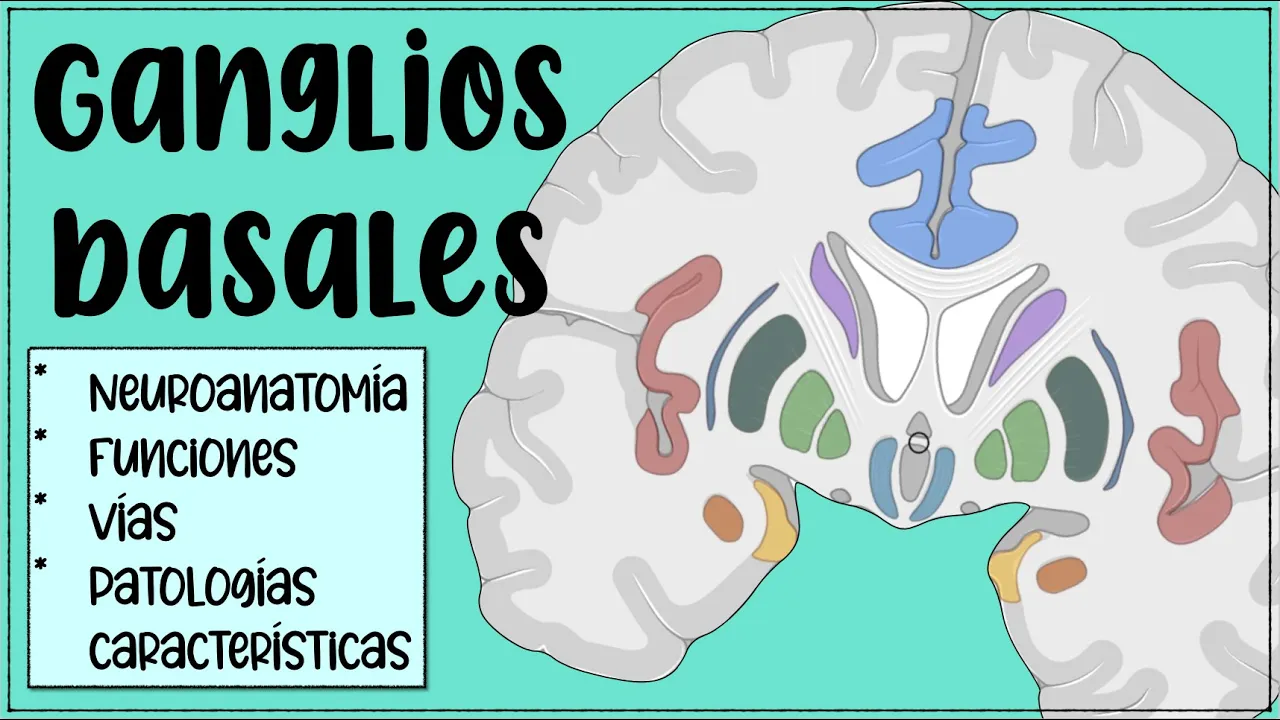
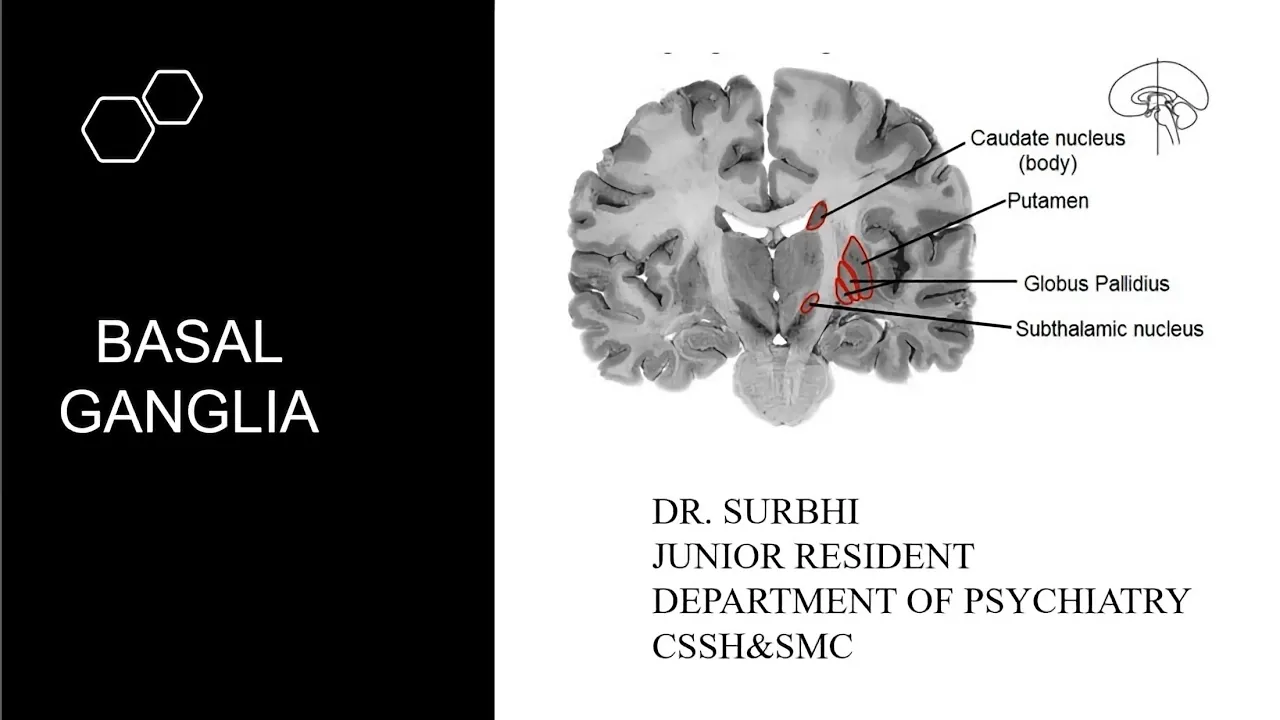
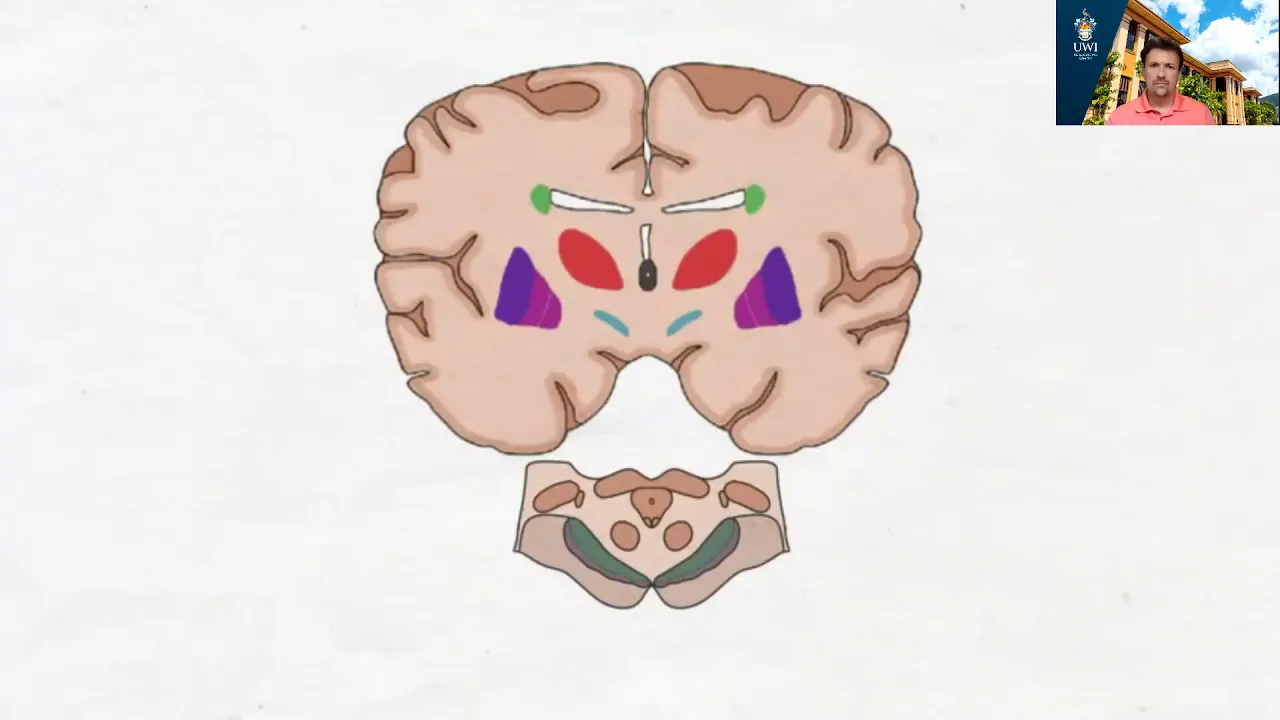
Added:Basic neuroanatomy of the cerebrum and brainstem, specifically identifying the location of the striatum, globus pallidus, subthalamic nucleus, and substantia nigra.
The mechanisms of chemical synaptic transmission, particularly the functional differences between excitatory (glutamatergic) and inhibitory (GABAergic) neurotransmitters.
The physiological concept of 'disinhibition' in neural circuits, where inhibiting an inhibitory neuron leads to the excitation of a post-synaptic target.
An understanding of the primary motor cortex's role in planning and initiating voluntary muscle movements.
Pathophysiology of movement disorders, analyzing how imbalances in the direct and indirect pathways manifest as Parkinson's disease (hypokinesia) or Huntington's disease (hyperkinesia).
The 'hyperdirect pathway' and its role in rapid motor suppression and conflict resolution during action selection.
Clinical interventions for basal ganglia dysfunction, including the mechanism of action of L-DOPA and the neurophysiological principles behind Deep Brain Stimulation (DBS).
The non-motor functions of the basal ganglia loops, exploring their contributions to habit formation, procedural learning, and reward-based decision-making.
1.9K views35likes19:45Original Release: 2021-01-16
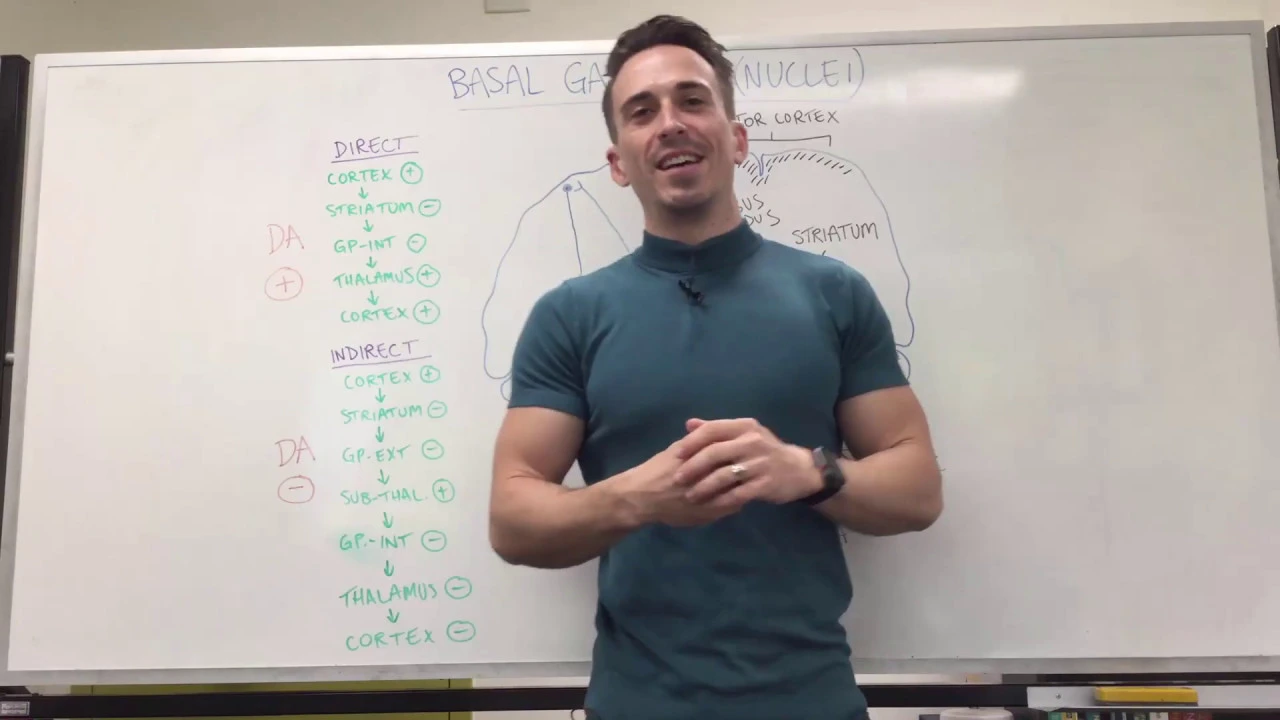
the goal of movement of our muscles is to be fluid efficient and target oriented to achieve this our motor association areas and sensory cortices send their input to the basal ganglia which ultimately make a decision on whether to execute a movement and then streamline the plan to do so at the end of this lightboard video you should be able to explain the major motor loops associated with the basal ganglia specifically the direct pathway and the indirect pathway this includes their subloops the neurotransmitters involved the anatomical structures or nuclei as well as the consequential movement in general for our basal ganglia or group of nuclei to work neurons are sent from the cerebral cortex to our basal ganglia striatum specifically constituting the chordate nucleus and the putamen from the striatum we then have outputs ultimately to the thalamus and from the thalamus we then see communication of neurons back to the cortex two main pathways are included in the sequence specifically we have our direct pathway and our indirect pathway the aim of the direct pathway which axifies the striatopaladal loop and the nigrostriatal loop is to initiate and execute voluntary movement in contrast the goal of the indirect pathway is to resist against or stop competing voluntary movements this acts via the subthalamic nucleus so you can think of the direct pathway as the most straightforward quickest route as if you are plugging in routes via your gps whereas the indirect pathway can be compared to the scenic route if you have a lot more time involving a lot more structures or cities or suburbs the indirect route is obviously going to take longer but the indirect loop in our case is going to act to stop movement our first major input from the basal ganglia comes from the sensory motor cortex specifically our motor association areas and our sensory cortices specifically we have neurons that are called our cortical paramidal neurons that are going to be excitatory as a consequence they will act using the neurotransmitter glutamate and they will act to excite the striatum [Music] these neurons more specifically are located in the frontal and the parietal cortices we can also call this input the corticostriatal pathway or loop and this is our first input for the basal ganglia the release then of glutamate is going to excite the striatum you will recall that the striatum constitutes two structures this is going to be the chordate nucleus and the putamen within the striatum there are actually two specific types of neurons we either have projecting neurons and this constitutes 90 of the neurons in the striatum or we have interneurons which then constitutes the remaining 10 percent our projecting neurons can also be called our medium spiny neurons for the purposes of this video excitatory neurons will be expressed using green and our inhibitory neurons will be expressed using pink [Music] the projecting neurons located within the striatum are considered to be inhibitory neurons meaning that they will release gaba these are called our medium spiny neurons and our medium spiny neurons can then be subdivided into two categories those that project to the globus pallidus internal and those that project to the globus pallidus external if our median spiny neurons project to the globus pallidus internal these are then involved in the direct pathway and if they project to the external component these are involved in the indirect pathway as i mentioned the neurotransmitter released is going to be gaba and if we're then focusing firstly on the direct pathway so we have output acting then on the globus pallidus internal the net effect of gaba is going to be to inhibit the globus pallidus internal the function of the globus pallidus internal normally is to inhibit the thalamus so now when we have an influx of gaba produced by a median spiny neuron the gaba is actually going to decrease the activity in the globus pallidus internal meaning that it can no longer inhibit or alternatively we say it's going to disinhibit the thalamus we can also liken the globus pallidus internal to a fictional character referred to as george if we imagine that george has an eight-week-old puppy called tammy when george is taking his puppy out for a walk obviously he will put a leash on his puppy to prevent her from running away so the globus pallidus internal actually resembles george holding a leash that is going to dictate whether you let tammy go and ultimately run or whether you'll rein her back in if we then try to visualize the relationship between the globus pallidus internal and the thalamus we have inhibitory neurons located in the globus pallidus internal that are then going to produce gaba that specifically act upon or inhibit the ventroanterior and ventrolateral nuclei in the thalamus [Music] you'll remember that the function of the thalamus almost acts like the switchboard of the brain or we might liken it to grand central station in the sense that we have incoming and outgoing motor and sensory information being relayed all the time we also know that the thalamus has important roles in our regulation of consciousness sleep regulation as well as how alert we are so neurons specifically excitatory neurons located in the thalamus are going to then project specifically back to the cortex and this predominantly occurs to three major areas our prefrontal cortex our pre-motor cortex and our motor association areas as mentioned in the direct pathway because we have the release of gaba by the median spiny neuron this is then going to decrease the activity in the globus pallidus internal a reduction in this activity then means that we can no longer inhibit the thalamus so we see disinhibition of the thalamus meaning that activity of the thalamus is going to increase so if george can no longer hold on to the leash of the puppy it means that tammy the puppy is going to go absolutely crazy as puppies are they're highly energetic so the thalamus is going to go crazy this is then going to excite the cortex if the cortex gets excited we then see synapses with our two major motor tracks our cortical spinal tract and our cortical bulb attract ultimately the result will be a production or an increase in voluntary movement of our muscles just reiterating then the function of the direct pathway is to initiate and execute voluntary movement so ultimately we're going to produce more movement or more muscle contractions in contrast let's now focus on the indirect pathway the indirect pathway has the same inputs as the direct pathway so that means we still have our cortical paramidal neurons originating from the motor association area and our sensory cortices that input and excite the striatum these will still act upon the median spiny neurons located within the striatum and specifically we now see increased activity on the median spiny neurons that are going to have outputs or act upon the globus pallidus external so now taking the scenic route the function of the globus pallidus external is to inhibit the subthalamic nucleus so the subthalamic nucleus is now involved in this pathway this means that we see an inhibitory neuron located within the globus pallidus external communicating with the subthalamic nucleus so ultimately in the indirect pathway because we have excitation or increased activity in the striatum this means that the median spiny neurons will produce gaba gaba will then inhibit the globus pallidus external so if we inhibit or decrease the activity in globus pallidus external this is consequently going to then disinhibit the subthalamic nucleus so we see an increase in the activity of the subthalamic nucleus in the indirect pathway accordingly if we have an increase then in the activity in the subthalamic nucleus we will then excite the excitatory neuron that communicates with and releases glutamate to the globus pallidus internal accordingly if we now excite the globus pallidus internal remember its function is to hold down the puppy or to hold the leash and decrease the activity in the thalamus consequently we're not going to be able to excite or initiate the release of glutamate by the excitatory neurons to the cortex which means we don't then see synapses with the corticospinal and corticobulba tracts this accordingly means that there is no movement then produced by the indirect pathway what we focused on so far is the first main input being the corticostriatal input it is important for us also to consider the role of the substantia in this pathway we know that the substantia can be divided into two main parts or structures we have the substantia niagara pars reticulara in this case the pars reticulara actually functions with the globus pallidus internal and has the same net effect on the direct pathway the substantia pars compactor is then involved in the nigrostriatal pathway it's important to keep in mind that in the substantia niagara plus compactor there are actually four dopaminergic pathways but specifically we're only going to focus on the role of the cell bodies of the dopamine neurons that are involved in the nigrostriatal pathway that communicate with the striatum and act upon our median spiny neurons or the interneurons you should be familiar with the fact that located in the substantia niagara pass compactor we have dopamine neurons our dopamine neurons are going to communicate with or output to the striatum in the direct pathway the dopanergic neurons from the substantia niagara are going to synapse with the d1 receptors on our median spiny neurons if we then think about the effect of the release of the dopamine neurotransmitter binding to the receptor on the median spiny neuron in the direct pathway this means that we're going to further inhibit the median spiny neuron which means that more gaba is going to be produced if more gaba is produced that acts upon the globus pallidus internal it's going to decrease the activity in this nuclei even further which means that the thalamus is going to become more excited as a consequence we have more glutamate that is released and acts upon the cortex and then we're going to have more activity in our motor tracks ultimately then the effect or the net effect of dopamine on the direct pathway is going to be to amplify the speed of the pathway so you may want to think of this as how you transition from a jog to a run if we think about increasing the pace of our run ultimately we're going to then have the addition of dopamine or a second pathway or circuit kick in to go from a single speed to double speed on the other hand let's consider what happens with the net effect of the nigrostriatal pathway on the indirect pathway our dopamine neurons in the substantia niagara are firstly going to bind to an interneuron located within the striatum the binding to the interneuron is then going to have an inhibitory effect on the median spiny neuron specifically binding to the d2 receptor on the neuron and the d2 receptor is going to be an inhibitory response this means that we're now going to inhibit the inhibitory neuron if we're thinking about this with respect to the amount of gaba produced we might want to say that we now have half the amount of gaba produced due to the binding or the inhibition of our inhibitory neuron so if we had for instance rudimentary speaking eight gaba molecules that were produced originally the influence now of our niagara striatal pathway and that interneuron is going to be a reduction in the amount of gaba this means that we then see an increase in some of the activity in the globus pallidus external this means that we're then going to decrease the activity in the subthalamic nucleus and ultimately it means that we're now going to decrease the excitation within the globus pallidus internal the ultimate consequence then of dopamine on the indirect pathway is going to be that it allows some activity in the thalamus so if we're coming back to our analogy of the puppy we're now able to loosen the leash on the puppy a little bit so that it can walk a little bit faster so the ultimate consequence of dopamine and the niagara striatal pathway is to increase the activity in both pathways the direct and the indirect pathways the final thing that i want to cover in this light board is the role of the subthalamic nucleus which ultimately acts as the pacemaker of our basal ganglia we refer to this as the pacemaker because ultimately we don't want the activity of the basal ganglia and our movements to always be functioning at double speed we want to be able to slow down and speed up and it's the role of the subthalamic nucleus and its interaction with the substantia niagara plus compactor that regulates the speed of the movements accordingly for this to happen we need to have an excitatory neuron that is going to communicate with the substantia niagara to excited in order to release more dopamine and then we also need to on the flip side have an inhibitory neuron running from the substantia niagara back to the subthalamic nucleus telling it to calm down and accordingly let up on our movements i hope that this provides you with a simplistic way of understanding the basal ganglia direct and indirect pathways obviously the next step from here would be to learn about how the effects of a loss of dopamine neurons within the substantia niagara as we see in conditions such as parkinson's disease then affect the consequential movements in patients but i hope that this gives you a foundational understanding of the basal ganglia structures how they communicate with each other in order to produce movement in order to stop movement and then in order to regulate or streamline movements thank you very much for your attention and please subscribe to my youtube channel for more videos that cover such complex concepts such as this one you
Up Next
22:22
Dopamine's Role in Habit Formation and Compulsive Behavior
@NUFeinbergMed
392 views•2025-08-25
21:55
Deciphering Neural Circuits Controlling Anorexia in Mice | Richard Palmiter
@AllenInstitute
2.3K views•2011-10-10

4:10
Vagus Nerve (CN X): Anatomy, Nuclei & Functions Explained
@Alilamedicalmedia
305.2K views•2022-10-31
13:03
How Exercise Benefits Your Brain: Science Explained
@TED
11.4M views•2018-03-21
Related Study Plans & Knowledge Roadmaps
Structured learning paths in Neuroscience
neuroscience
Appetite Regulation: Brain Circuits & Hormones
01Foundations of Endocrinology and Brain Anatomy
02Introduction to Energy Homeostasis
03Peripheral Signals: Leptin, Ghrelin, and Insulin
+ 2 more learning modules
14h5 modules
Explore Roadmap
neuroscience
Neuroeconomics: Value, Risk & Brain Mechanisms
01Foundations of Neuroscience and Brain Anatomy
02Introduction to Neuroeconomics and Subjective Value
03Dopaminergic Prediction Errors & Reinforcement Learning
+ 3 more learning modules
18h6 modules
Explore Roadmap
neuroscience
Spatial Navigation: Cells, Grids & Brain Maps
01Foundations of Brain Anatomy and Memory
02Place Cells and Head-Direction Cells
03Grid Cells: The Brain's Coordinate System
+ 2 more learning modules
12h5 modules
Explore Roadmap
neuroscience
BCIs: Neural Decoding & Prosthetic Control
01Neuroscience Foundations: How the Brain Signals Intent
02Signal Acquisition: Recording the Brain's Activity
03Neural Decoding: Translating Brain Waves into Data
+ 2 more learning modules
25h5 modules
Explore Roadmap