Spatial Navigation: Cells, Grids & Brain Maps
Learning Goal: Analyze the neural mechanisms of spatial navigation and cognitive mapping, detailing how hippocampal place cells, entorhinal grid cells, and head-direction cells interact to compute spatial coordinates, execute path integration, and construct mental representations of physical space.
- Prerequisites: Basic knowledge of cellular biology and intro-level neuroanatomy (neurons, action potentials, and synaptic transmission).
- Estimated Total Study Time: 12 Hours
Module 1: Foundations of Brain Anatomy and Memory
This module establishes the anatomical and functional foundations required to understand spatial navigation. You will explore the structure of the human brain with particular focus on the temporal lobe and the limbic system. You will learn how the hippocampus is structured, how it interfaces with the surrounding neocortex, and how it translates sensory experiences into stable declarative and spatial memories.
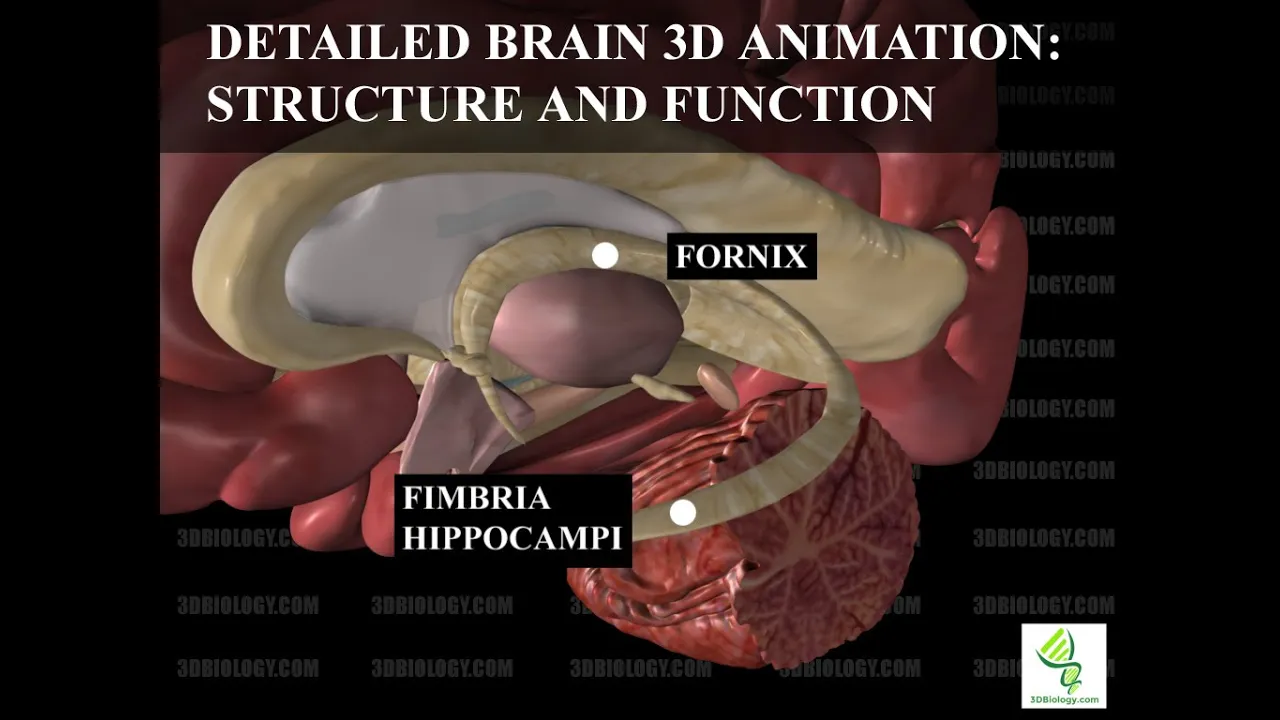
Video 1: Human Neuroanatomy: Detailed Brain 3D Animation - Structure and Function
Why this video
This video provides an excellent 3D visual walkthrough of brain anatomy. It allows you to visualize the spatial orientation of the temporal lobe, subcortical structures, and the limbic system, setting a firm structural foundation for localizing the brain's "GPS."
Knowledge Checkpoint
- Identify the boundaries and physiological roles of the major cerebral lobes (specifically the temporal and parietal lobes).
- Locate the medial temporal lobe (MTL) structures relative to the brainstem and ventricles.
- Explain the primary pathway through which sensory information reaches the cerebral cortex.
Video 2: Brain Anatomy Introduction
Why this video
A quick, high-yield coronal brain dissection and mapping tutorial. This video helps transition your understanding from broad lateral surfaces to cross-sectional interior anatomy, specifically introducing deep structures like the hippocampus, fornix, and ventricles.
Knowledge Checkpoint
- Trace a coronal slice of the human brain and locate the deep medial temporal structures.
- Define the structural relationship between the fornix and the hippocampus.
- Distinguish between the gray matter regions of the cortex and the underlying white matter pathways.
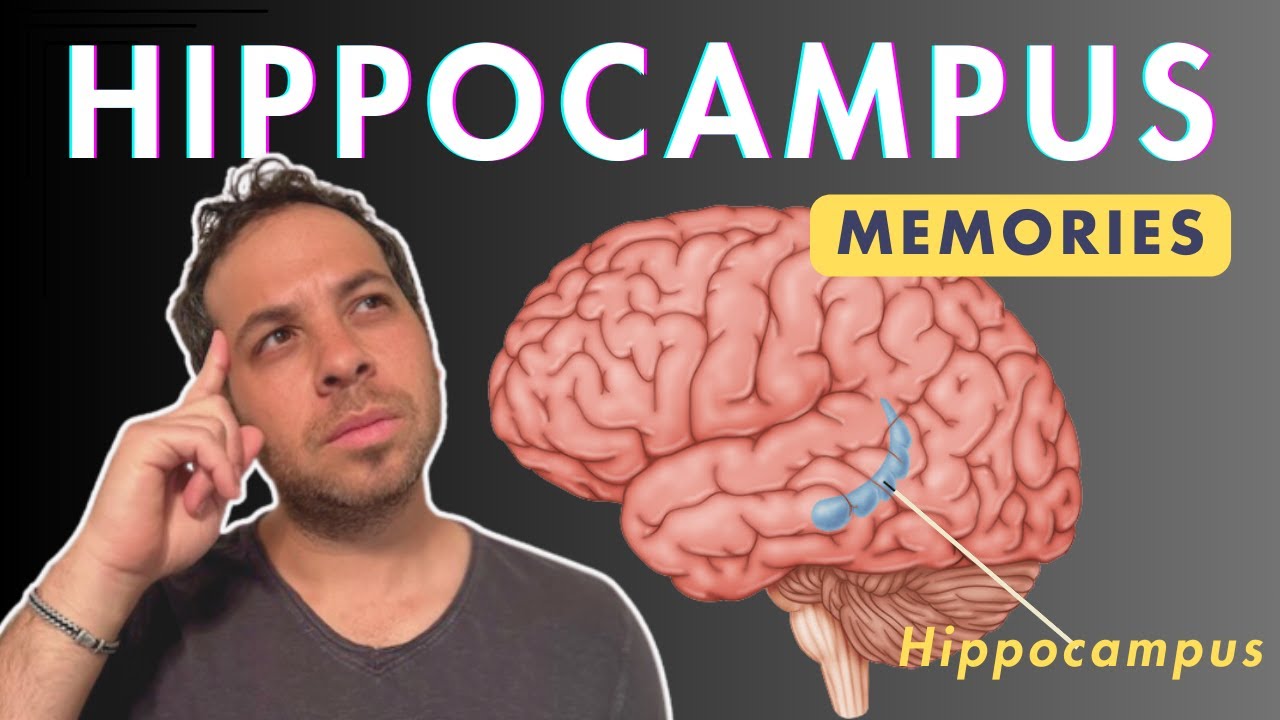
Video 3: Hippocampus and Memories
Why this video
This video bridges anatomy and function, diving directly into how the hippocampus acts as the brain's memory engine. It details memory consolidation, the difference between short-term and long-term memory, and introduces the classic case study of patient H.M., highlighting how bilateral damage to the hippocampus impacts both episodic memory and spatial tracking.
Knowledge Checkpoint
- Explain the difference between anterograde and retrograde amnesia in relation to hippocampal lesions.
- Describe the process of memory consolidation from the medial temporal lobe to the neocortex.
- Distinguish between declarative (explicit) and non-declarative (implicit) memory storage pathways.
Module 2: Place Cells and Head-Direction Cells
This module explores the individual cellular building blocks of the spatial navigation network. You will study place cells in the CA1 and CA3 regions of the hippocampus—cells that fire selectively when an organism enters a specific part of its environment—and head-direction (HD) cells, which act as a neural compass by tracking the direction the animal's head is pointing.
Video 1: John O'Keefe, Nobel Prize in Physiology or Medicine 2014: Official Lecture

Why this video
Presented by the pioneer who discovered place cells in 1971, this lecture outlines the experimental history, the physiological traits of CA1/CA3 pyramidal neurons, and how the brain uses Environmental Cues (such as boundaries and visual landmarks) to anchor place fields.
Knowledge Checkpoint
- Define a "place field" and describe how place cells fire selectively in response to an animal's location.
- Explain the relationship between environmental boundaries and the stability of hippocampal place fields.
- Differentiate between allocentric and egocentric spatial frameworks as presented in O'Keefe's models.
Video 2: 6.3 - Hippocampus and Place Cells
Why this video
Produced by the MIT Center for Brains, Minds, and Machines, this highly academic tutorial breaks down the technical details of place cell firing patterns, showing how multi-electrode recordings track populations of active place cells to decode an animal's path in real time.
Knowledge Checkpoint
- Describe how in-vivo extracellular electrophysiology recordings are used to capture place cell action potentials.
- Explain "remapping" and how place cell populations react when an animal transitions from a familiar to a novel environment.
- Understand how a population vector can accurately reconstruct an animal's coordinate position within an environment.
Video 3: 3. What are head direction cells?
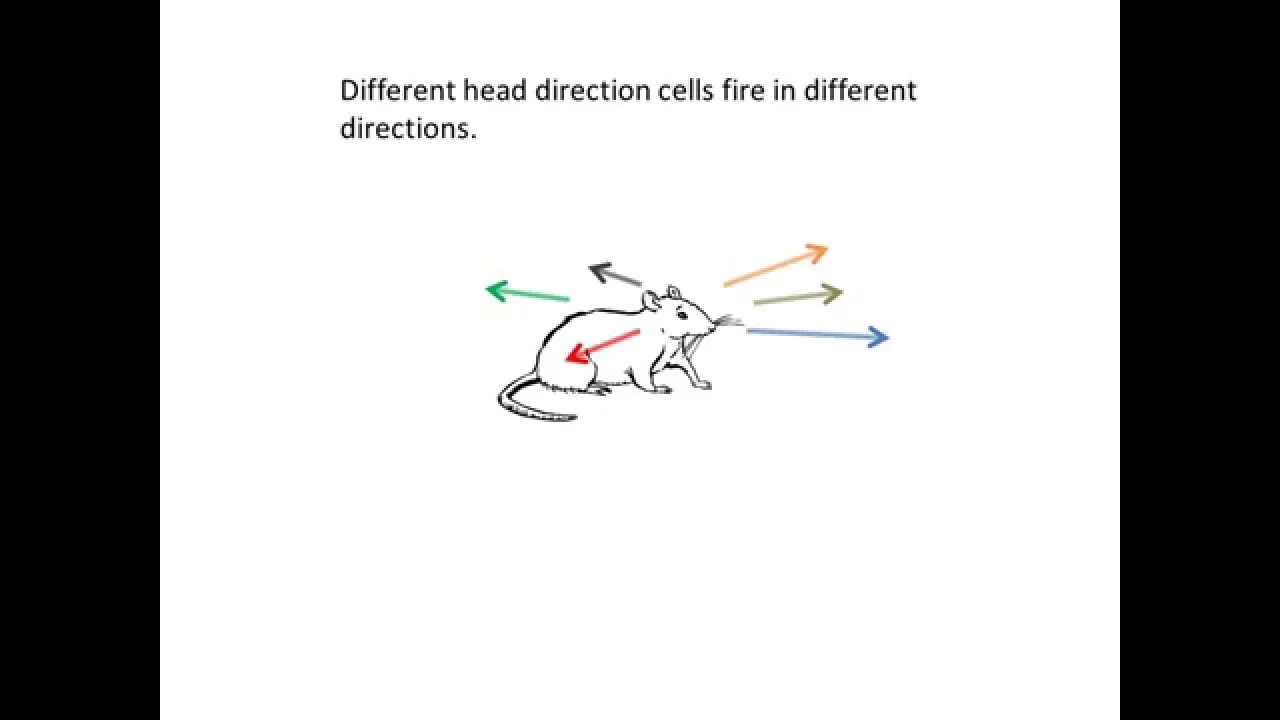
Why this video
This tutorial introduces the second major component of our spatial brain: head-direction (HD) cells. It discusses where these cells are found (including the postsubiculum and anterodorsal thalamic nuclei) and explains how they compute orientation independently of place or visual context.
Knowledge Checkpoint
- Explain how head-direction (HD) cells differ functionally from hippocampal place cells.
- List the primary brain areas where HD cells are located (e.g., presubiculum, thalamic nuclei).
- Describe how HD cells maintain orientation tracking when visual inputs are completely removed (e.g., in the dark).
Module 3: Grid Cells: The Brain's Coordinate System
Discovered in 2005 by Edvard and May-Britt Moser, grid cells in the medial entorhinal cortex (MEC) are key to the brain's metric mapping system. Unlike place cells, which fire in a single spot, grid cells fire at multiple regularly-spaced locations. This creates a hexagonal tessellation across the environment that functions like a mathematical coordinate grid.
Video 1: LEARNMEM2018 Keynote Lecture by Edvard Moser, Ph.D. | Grid Cells and the Entorhinal Map of Space
Why this video
In this comprehensive 80-minute lecture, Nobel Laureate Edvard Moser explains the functional architecture of the entorhinal cortex. He covers grid scale modularity, the topographical dorsal-ventral organization, and how grid networks dynamically scale in response to changing environments.
Knowledge Checkpoint
- Describe the hexagonal geometry of grid cell firing and how it functions as a distance metric.
- Explain the topographical gradient of grid scale (field size and spacing) along the dorsal-to-ventral axis of the MEC.
- Detail the physical and functional distinction between entorhinal grid cells and hippocampal place cells.
Video 2: A Journey Into Entorhinal Cortex | Edvard and May-Britt Moser | NTNU

Why this video
This video features real lab footage and animations from the Mosers' research institute. It shows how grid cells fire as a rat navigates, providing a clear visual representation of how the hexagonal pattern forms.
Knowledge Checkpoint
- Explain the concept of spatial firing periodicity and how it translates to an environment-independent metric.
- Discuss the experimental design used to capture the hexagonal firing structures of MEC cells in moving rodents.
- Define how grid cells are thought to provide a distance-measuring mechanism for the brain.
Video 3: Grid Cells and Neural Maps of Space | Edvard Moser
Why this video
This presentation focuses on the modular organization of grid cells, demonstrating that they do not change size smoothly. Instead, they are organized in distinct step-like modules. It also explains how these modules interact to create a highly flexible spatial mapping system.
Knowledge Checkpoint
- Describe the step-like modular transitions of grid cell populations along the medial entorhinal cortex.
- Contrast continuous topological mapping with discrete modular coding in the entorhinal-hippocampal network.
- Explain why a modular organization prevents local structural errors from distorting the overall coordinate map of space.
Module 4: Path Integration and Neural Computation
This module focuses on how the brain computes coordinates using internal movement signals, a process known as path integration (or dead reckoning). You will examine how the brain integrates head-direction and velocity inputs from specialized speed cells to update its position, and how Continuous Attractor Networks (CANs) maintain these spatial representations.
Educational Note: While computational videos on YouTube are somewhat limited, the following recommended videos provide key theoretical insights. To study this topic further, search for terms like "Continuous Attractor Networks path integration" or "oscillatory interference grid cells."
Video 1: RatSLAM: Using Models of Rodent Hippocampus for Robot Navigation

Why this video
This video demonstrates how computational neuroscience models of the hippocampus and entorhinal cortex are used in robotic navigation (SLAM). It provides a concrete introduction to Continuous Attractor Networks (CANs), showing how mathematical models of local excitation and lateral inhibition create a stable representation of location that can be shifted by movement.
Knowledge Checkpoint
- Explain the concept of a Continuous Attractor Network (CAN) and how it maintains a stable "bump" of neural activity.
- Describe how local excitatory and distant inhibitory connections are used to create stable spatial patterns.
- Explain how a robot or animal uses path integration to navigate without relying on external visual landmarks.
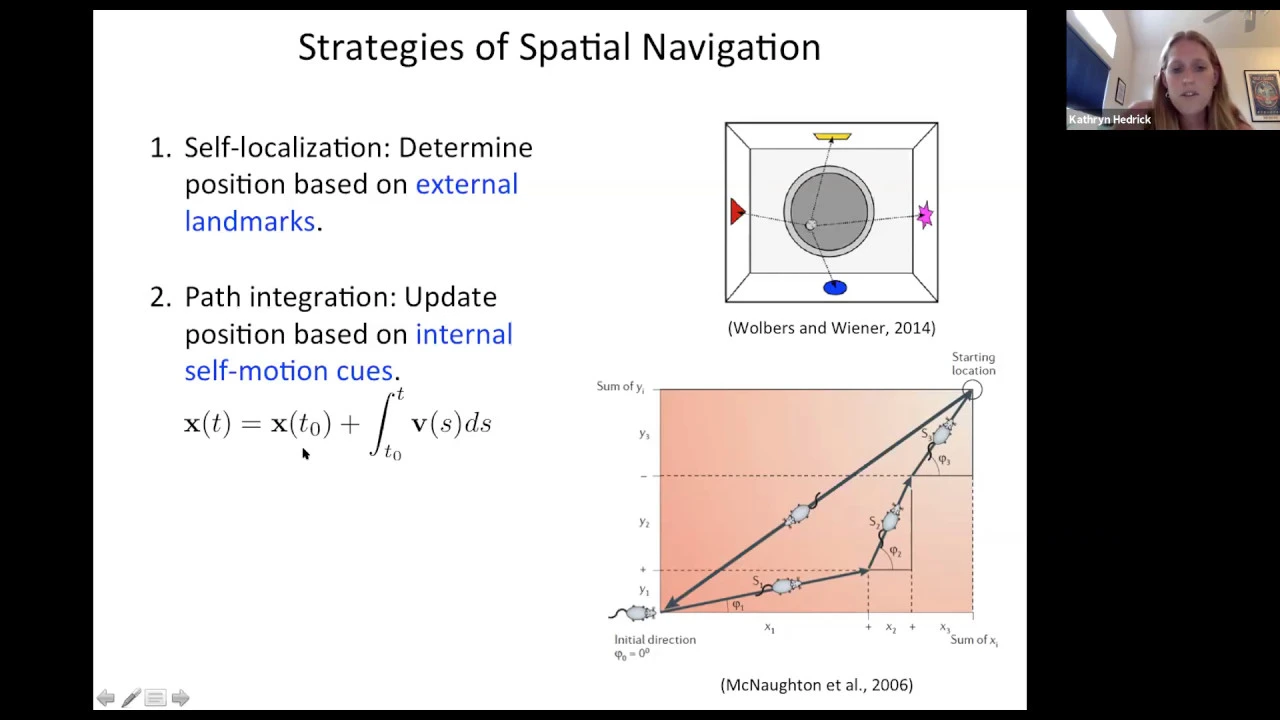
Video 2: Mathematical Theory of Gain Recalibration of the Hippocampal Path Integration System
Why this video
A deep dive into the math behind the brain's navigation system. This video explains how path integration accumulates mathematical errors over time (sensorimotor drift), and how the brain uses external visual cues to recalibrate and correct these internal coordinate offsets.
Knowledge Checkpoint
- Define "path integration drift" and explain why path integration is mathematically prone to error accumulation.
- Explain how external sensory inputs (visual landmarks, boundaries) are used to correct internal path integration errors.
- Describe the process of gain recalibration in the hippocampal-entorhinal network.
Video 3: Does your brain have one model of the world or thousands? | Inner Cosmos with David Eagleman
Why this video
This video explains how the brain uses path integration to continuously update its position, and explores how the entorhinal-hippocampal network acts as a flexible reference frame for navigating physical space, abstract concepts, and sensory details.
Knowledge Checkpoint
- Define "dead reckoning" and trace its evolution into biological path integration.
- Explain how the entorhinal cortex acts as a generalized reference frame.
- Discuss why speed and heading signals must be integrated continuously to update the internal coordinate map.
Video 4: Lecture of Cheng Lyu on Building an allocentric travelling direction signal via vector computation
Why this video
This lecture details how neural populations perform vector math to convert egocentric sensory inputs (movement relative to oneself) into allocentric coordinate signals (movement relative to the external world). It explores the biophysics of this coordinate transformation, which is critical for driving path integration.
Knowledge Checkpoint
- Distinguish between an egocentric coordinate frame and an allocentric spatial frame.
- Trace how head-direction and velocity inputs are mathematically integrated to construct an allocentric traveling vector.
- Explain how population vector addition is implemented at the circuit level by specialized populations of neurons.
Deep Dive: Speed Cells & Path Integration Math
Path integration relies on integrating speed and direction inputs over time to compute change in position:
Where:
-
is the unit vector of head direction, provided by head-direction cells.
-
is the instantaneous velocity, tracked by speed cells in the medial entorhinal cortex (MEC). These speed cells increase their firing rate linearly with the animal's physical running speed, supplying the crucial speed signal that drives the Continuous Attractor Network (CAN) to update grid coordinates in real time.
[ Speed Cells (velocity v) ] ---> [ CAN Path Integration Engine ] | (Shifts neural activity bump) [ Head-Direction Cells (vector d) ] ---> \ / [ Updated Grid Cell State ]
Module 5: Cognitive Mapping, Replay, and Planning
In this final module, we look at how the brain uses spatial coordinate systems to construct high-level cognitive maps, plan routes, and consolidate memories. You will explore Edward Tolman’s classic concept of the cognitive map, study how the brain simulates trajectories, and examine how sharp wave ripples (SWRs) in the hippocampus trigger spatial replay during rest to consolidate spatial experiences.
Video 1: Discussing Representation in Neuroscience with Lynn Nadel & Andrea Hiott

Why this video
Lynn Nadel, co-author of the seminal book The Hippocampus as a Cognitive Map (with John O’Keefe), discusses the history of cognitive mapping, Edward Tolman’s behavioral experiments, and how cognitive maps serve as a flexible framework for planning, imagination, and memory.
Knowledge Checkpoint
- Explain Edward Tolman’s concept of a "cognitive map" and how it challenged traditional behaviorist S-R (Stimulus-Response) theories.
- Describe how the entorhinal-hippocampal system allows for flexible, non-route-based navigation (e.g., taking shortcuts).
- Explain how spatial representations can be adapted to organize non-spatial, abstract memories and conceptual networks.
Video 2: Memory Consolidation: Time Machine of the Brain

Why this video
This highly detailed, animated video explains how memories are consolidated during sleep. It shows how the hippocampus replays waking neural activity patterns through sharp wave ripples (SWRs) to transfer spatial and episodic data to the neocortex for long-term storage.
Knowledge Checkpoint
- Define a "sharp wave ripple" (SWR) and describe its frequency profile (~150-200 Hz) and site of origin.
- Explain the concept of "hippocampal replay" and how it occurs during non-REM sleep and quiet resting states.
- Detail how replay acts as a bridge for consolidating memory from the hippocampus to the neocortex.
Video 3: David Foster: Neuronal sequences in the hippocampus for memory and imagination

Why this video
Dr. David Foster discusses how the brain sequences place cell activity during behavior and rest. He explains how spatial sequences are replayed in fast-forward during planning, showing how the brain simulates future trajectories to make navigation decisions.
Knowledge Checkpoint
- Describe how place cells fire sequentially during resting periods to represent past or potential future paths.
- Distinguish between "forward replay" and "reverse replay" and explain their respective roles in planning and learning.
- Explain how the brain uses spatial replay to simulate and evaluate future pathways before moving.
Video 4: Gyorgy Buzsaki - From Navigation to Memory and Planning

Why this video
In this presentation, leading neuroscientist György Buzsáki discusses the dual role of hippocampal oscillations. He explains how the neural mechanisms that evolved for physical navigation are also used to organize episodic memory and abstract planning, showing how the brain's GPS functions as its primary engine for cognitive organization.
Knowledge Checkpoint
- Explain Buzsáki's theory that the neural mechanisms of physical navigation were evolutionary precursors to memory and planning.
- Detail how sharp wave ripples represent the most synchronous patterns of electrical activity in the mammalian brain.
- Discuss how theta oscillations coordinate real-time exploration, while sharp wave ripples organize off-line consolidation.
To explore the biophysics of SWRs further, search for terms like: "sharp wave ripples replay hippocampal place cells animation".
Course Map
This map shows how the modules are structured, tracking your progression from fundamental brain anatomy to the neural computations and cognitive mapping systems that guide navigation.
Key People Index
| Researcher | Key Discovery / Contribution | Context within Curriculum |
|---|---|---|
| John O’Keefe | Discovered place cells in the hippocampus (1971); proposed the spatial coordinate map theory of hippocampal function. | Nobel Prize in Physiology or Medicine (2014); covered extensively in Module 2. |
| May-Britt Moser | Co-discovered grid cells in the medial entorhinal cortex (2005) and characterized the brain's internal metric grid. | Nobel Prize in Physiology or Medicine (2014); covered in Module 3. |
| Edvard Moser | Co-discovered grid cells and mapped the modular organization of the medial entorhinal cortex. | Nobel Prize in Physiology or Medicine (2014); covered in Module 3. |
| Edward C. Tolman | Coined the term "cognitive map" (1948) through behavioral experiments demonstrating latent learning in rats. | Established the cognitive framework for spatial navigation; covered in Module 5. |
| György Buzsáki | Pioneer in the study of hippocampal system dynamics, specifically the biophysics of sharp wave ripples (SWRs). | Leading researcher on hippocampal oscillations and spatial consolidation; covered in Module 5. |
| David Foster | Characterized the fast-forward sequencing of hippocampal place cells during planning and navigation. | Researches trajectory replay and spatial planning; covered in Module 5. |
Final Self-Assessment
Test your understanding of the complete curriculum by completing the following review checklist:
- Describe how sensory inputs travel through the entorhinal-hippocampal loop, including the dentate gyrus, CA3, CA1, and subiculum.
- Explain how a place cell's firing rate maps to physical locations, and how place fields adapt (remap) when entering new environments.
- Explain how head-direction (HD) cells function as a neural compass, using vestibular and visual inputs to track heading in real time.
- Draw a grid cell's hexagonal firing pattern and explain how its spatial scale changes along the dorsal-ventral axis of the medial entorhinal cortex.
- Define path integration and describe how speed cells and head-direction cells interact to update grid cell coordinates during movement.
- Explain the role of Continuous Attractor Networks (CANs) in keeping spatial maps stable and moving them in response to self-motion signals.
- Contrast egocentric (self-centered) and allocentric (world-centered) spatial frameworks, and explain where and how the brain translates between them.
- Explain how Edward Tolman’s classic rat maze experiments demonstrated latent learning and led to the theory of cognitive mapping.
- Define sharp wave ripples (SWRs), explain where they originate in the hippocampus, and describe their role in triggering memory replay.
- Compare forward and reverse hippocampal replay, and explain how the brain uses these sequences to consolidate memories and plan future paths.