




















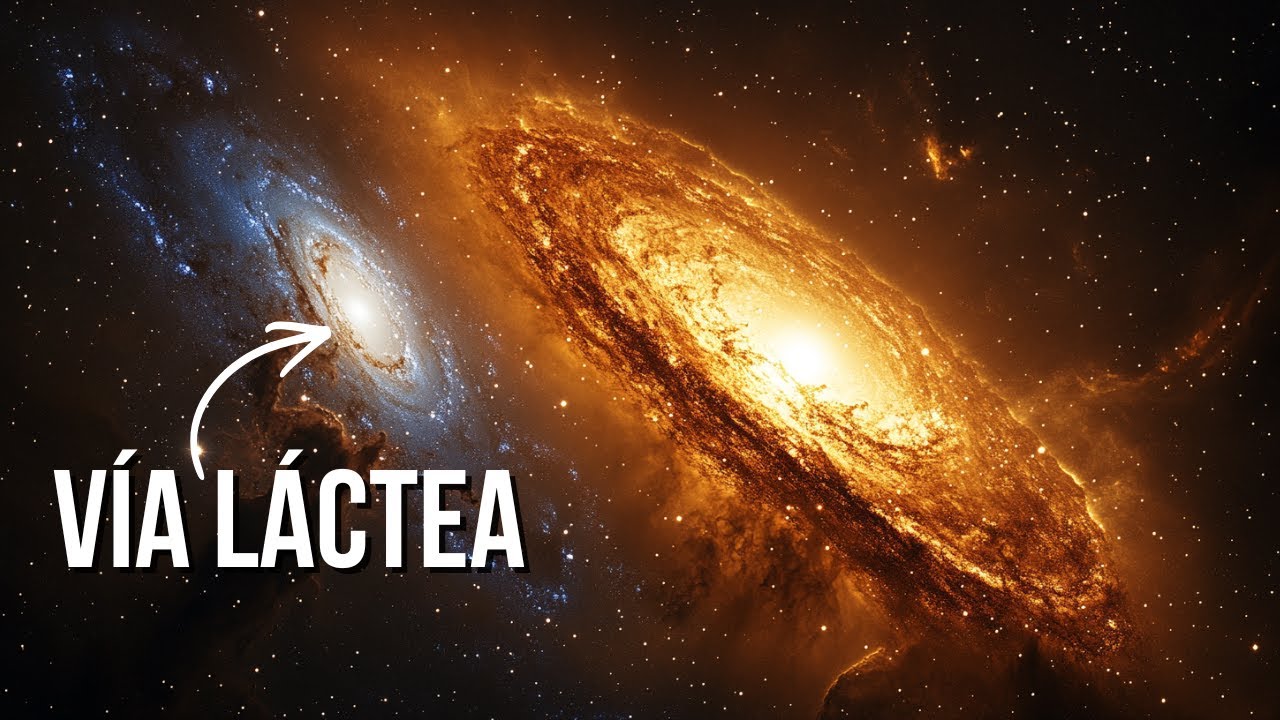
Circular velocity (vc) in galactic systems is given by vc = √(r × dφ/dr), where r is the radius and φ is the gravitational potential; this formula explains why observed rotation curves of galaxies remain nearly constant at large radii, indicating the presence of dark matter halos that provide additional gravitational potential beyond what visible matter alone would produce.
Galactic Dynamics Lecture 2: Potential, Circular Velocity & Applications
Added:Fundamental Newtonian gravitation, including gravitational potential, force equations, and shell theorems.
Vector calculus concepts, particularly divergence, gradient, the Laplacian operator, and Gauss's Divergence Theorem.
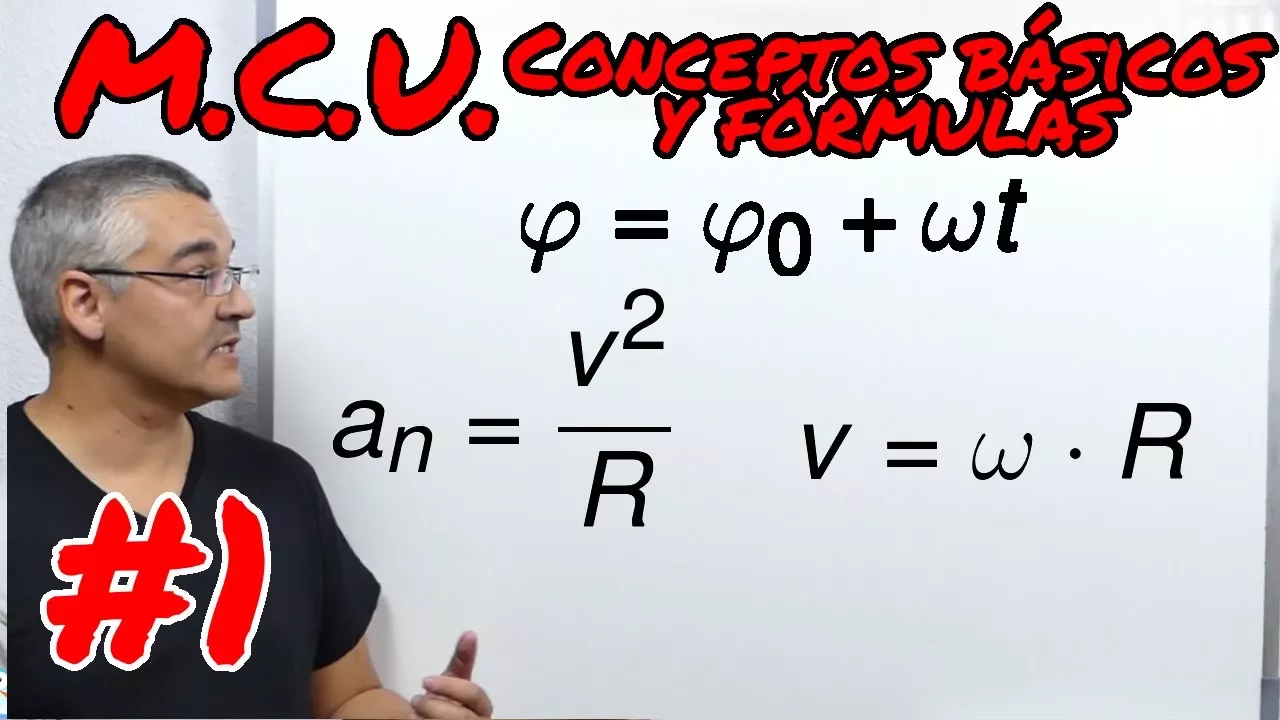
Classical mechanics principles of circular motion, centripetal acceleration, and basic two-body orbital kinematics.
Introductory astrophysics terminology regarding galactic structures, such as stellar disks, bulges, and dark matter halos.
Analyzing galactic rotation curves and interpreting the discrepancy between luminous matter and observed circular velocities as evidence for dark matter.
The Collisionless Boltzmann Equation and Jeans equations, which transition from individual orbits to the statistical mechanics of stellar systems.
Advanced orbit theory in non-spherical potentials, including axisymmetric disks and triaxial systems.
Galactic tidal interactions, dynamical friction, and the mathematical modeling of galactic mergers.
620 views20likes19:07Original Release: 2016-09-18
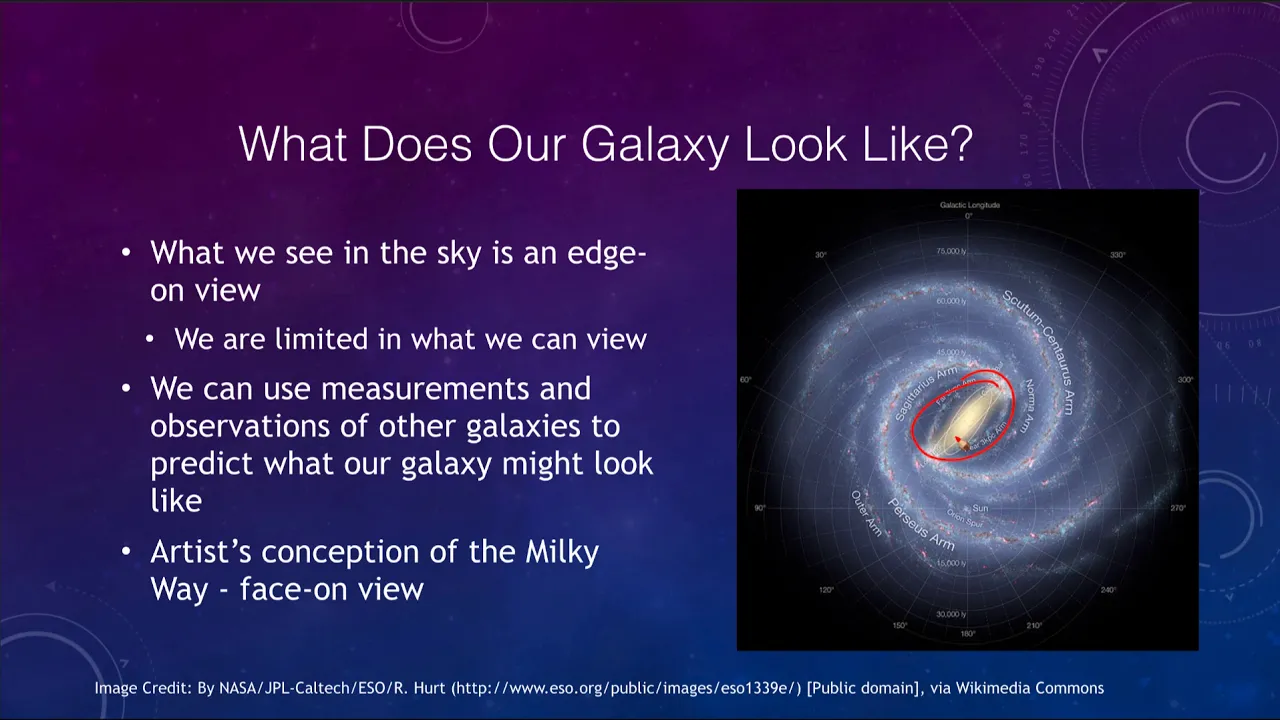
hi guys I I hope you are doing fine welcome to the second lecture of collective dynamic lecture series so just a quick revision so in the last lecture we discussed a certain numbers that concerned our own galaxy Milky Way and so there are about 10 to the power 11 stars and the gas the the mass of the gal that sits in the galaxy it's about 10 to the power 10 solar masses we also discussed that though there are so many stars that are in the galaxy the collisions are very rare we showed this using a very straightforward calculations and we came to a conclusion that the collision of two stars would take about 10 to about 19 years of time which is much much greater than the age of the galaxy itself so it's not quite physical for two stars to radio collide further we discuss the very general profile of of the disk galaxies like our own Milky Way here is the profile of Milky Way and then we discuss a little bit about the rotation curve not this curve right here is what in the theory was proposed before nineteen fifty but then this curve right here for the galaxies what was observed and then this discrepancy this because as the mass would increase in the galaxy the potential would increase and the rise in potential would cause rising force and rising force would call it cause large velocities so this is what was proposed in the theory and this is what was observed higher velocities were observed as one moved away from the radius as one moved away in the radius so on the x axis we have the radius and on the y axis we have the circular velocity so as one moved away from the radius there was rice almost a constant velocity was observed using her but which is much much greater than what theory has proposed using the visible stars so this extra velocity meaning this extra mass that should be somewhere in the solar in the galaxy that we are unable to see was accounted by saying that there is dark matter that sits in the outer part of the galaxy in the halo of the galaxy but today let's move on so today I just wanted to divide certain formulas that we already know like Poisson equation of course theorem not i'm sure you guys must have studied in your graduate program further we will talk a lot about circular velocity because circular velocity is very important it's like a stepping stone in galactic dynamics and it's also used in morphology study of galaxies as well so it's very important in the end will solve an America related to potential energy a simple one and I hope I'm able to make myself clearer than that so okay so let's begin so right here it's a Poisson equation del square phi x equals 4 x 0 x which is basically the double spatial derivative of potential of a given system equals 4 pi z times the mass distribution density of that system at that particular space points so basically if you know a potential of any system you just take a double spatial derivative and you can know the mass distribution of that system or vice versa but if you know the density you will have to integrate that density to get the potential of the system back then we know Gauss theorem so cos theorem basically Gauss theorem in galactic dynamics or in physics in general in the gravitation physics comes by taking volume integral of the Poisson equation so if you take volume integral of this term right here the volume integral of densities of course mass total which is trivial so basically the mask contained within this volume that we are integrating over and if we consider this term right here and take its volume integral so we can convert this divergence tone into this divergence over the stone volume integral equals the surface integral of this delphi term which is right here in the bracket we can do this by using Gauss theorem which is very famous in mathematics and in physics a spell so using this integrals volume integrals we get this and this right here it's a very famous Gauss theorem in in gravitation which basically states that the normal component of delphi integrated over a surface equals 4 pi z times the mass contained within that surface so again so there's Gotham right here that's famous in electricity and magnetism it's famous in gravitation and it's the general theorem now let's move on to circular velocity so for so circular velocity is given by this formula right here where r is the radius how far the object sets from the system and VC right here it's a circular velocity and Phi it's the potential energy so certain velocity is basically given for spherical systems in which particles would really have meaningful circular velocity but even if the system its non spherical but a particle sees it as a spherical system one can apply this formula right here for example in the galaxy profile that we discussed in our last lecture right here so suppose there is a particle in the disk galaxies that sits right over here like our Sun itself so our sun sets at about our equals 8.5 kiloparsecs but i'd said equal to 0 now if you make z equal to 0 in this particular density distribution if z equals 0 then this term vanishes and our mass distribution now depends only on our this means that the Sun which is at z equal to 0 sees the system the galaxy as a spherical system depending on your are and since the density depends only on our so will the potential so one can find the server velocity in such cases that how the object of the via are interested in calculating server velocity sees the system so for Sun just give you a number the server velocity is about to 20 kilometer per second now this circular velocity led us to the rotation curve the galaxies so on the x-axis it's the r and on the y axis we have the circular velocity so before nineteen fifty the theory proposed we had the vision using a telescopes that our galaxy it's it's a disc-shaped galaxy and for a disk shape and for the given mass and the potential would go as phi r equals 1 by art this is how the VC the server velocities was modeled right here if our galaxy had only been consisting of stars but then what was observed was this blue curve right over here so this means there was some extra potential giving rise to extra velocity that was observed which have a discrepancy with our model that we had in nineteen fifty or before that so this extra potential meaning this this extra mass was accounted by blaming it to the dark matter that sits in our halo so if jara a galaxy been consisting on your of stars we would have modeled the potential of the galaxy as one over R and we will obtain RVC using this formula as one over under root R but now since the galaxy looks almost constant the sorry the VC the circular velocity looks almost constant this means vc is constant this means d phi by dr should go over should go as 1 by r so that our our cancels which means phi should be log odd so now if you substitute phi over here you would get your VCS constant so this is all we model the dark matter distribution in our galaxy in a very simplistic case as log of our but this is not quite the realistic case as we will discuss in our for the lecture so let's now study some applications of the circular velocity so a part let's consider a point mass and we know the gravitation given by a point mass is minus G overall if you try to calculate the circular velocity using the formula that was shown and last on last page you would get your VC as this Justin so this is called capillary a velocity curve because the velocity curve goes as one over under root R and this is what Kepler had actually observed for the planets which were revolving around the Sun right and as an exercise you can try to calculate density using Poisson equation given the file right now the second case of the homogenous fear so a sphere with constant density whose mass at a given radius would be given by this right the mass contained within the r would be given by this formula right here now you can try and calculate Phi given this density using Poisson equation again so this is again an exercise and you would find the circular velocity is directly proportional to radius so this is that so this is very much in contrast with what we have before that as you go away in the radius the velocity the circular velocity of an object increases right you can also try and calculate the orbital time period of any object which is in the circular which is on the circular orbit using this trivial formula 2 PI R by VC right now suppose you have in homo do you have a homogeneous favor of radius R not right and there is an object that sits right here at a distance R ok and you leave it from rest ok you were holding it and you just leave it right there so this object right here would go under harmonic oscillations ok you can see it mathematically here so if you try to write an equation of it it's d square R 0 by DT square equals the force which is minus GM over R in our case which is minus 4 pi g / 3 or 5 and now since and which becomes since this right here it's constant right it becomes minus kr okay so this this equation I hope it reminds you of harmonic oscillator the one-dimensional harmonic oscillator was d square X by DT square equals minus KX so if you just leave it it has no initial motion this object would go as hard wood would go under harmonic oscillations try and yes so and this is what is expected also so for this homogeneous fear you can give a density right and for density as an exercise you can try and calculate potential I've given the solution here using Poisson equation again ok now in the previous two cases the orbit would be elliptical right because it's these are spherical systems so we expect elliptical orbits moving on we have isochron potential and its potential profile is given by this the importance of this potential right here is that at R equals zero the potential doesn't diverge right so in in previous cases right here at r equal to zero potential diverge to infinity and you will find here as well that at r equals infant at r equals zero the potential would type of it but right here at r equal to zero or at very small are the potential remains constant and at very large are it again follows the killarian potential distribution right so you can try and calculate the circular velocity for this isoform potential right here which you will find as this with a given as under root B Square + R square so as you can see right here for really very large are the circular velocity would go as one over under root r you can check this which is again the keplerian potential leather get the complete in velocity curve that be we just discussed okay now as an exercise again given the potential it's a very straightforward exercise and so you can do this in spherical coordinates the most it would be most easy to do so you can calculate the density for a given iso from potential the density distribution of such a system as an exercise you can try and do that right okay so now let's go now let's do a numerical so the numerical is that show that the potential energy of a spherical system is given by this thing right here so this is the work done in bringing the system together so bringing them all the masses from infinity to make it a system is given by minus g x to 0 to infinity m square r over r square dr you can pause the video right here just to solve it by yourself I'll discuss it anyway okay so right so we will we would need couple of formulas for this first is that we would need poisson equation the second is that we would need need the first step to solve this problem which is if you remember for continuous system the potential energy of the system is given by 1 over 2 integral of Rho x5 XD cubix ok now if you use Poisson equation right here if you convert this density to potential this is what the stone would look like ok now I want to get rid of this del square Phi Phi and I want to convert it to Delphi whole square ok this term so let's see how I do that so let's consider this term and take its divergence and using simple chain form then in derivatives we would get the dell would act on this term forced x this and then they would act on this x this it should give you a square now let's take a volume integral of this equation tight here ok and these terms are left as it is and then using Gauss theorem I can convert this divergence tome into a spherical or into a surface integral term right and since the surface integral it's taken on the boundaries and the boundaries exist at R equals infinity and we know that at r equal to infinity 5 vanishes at r equal to infinity 5 becomes 0 so this this surface integral becomes zero at the boundaries which exists at infinity this term right here at zero so since this Plus this equals zero this means that this term basically becomes negative of system now coming back to this equation right here and using this fact that we have just evaluated I can convert the storm as the storm right using this fact now we know that since it's a spherical system so 5 would depend only on our right so so I am converting the Cartesian coordinates to spherical coordinates over here so my volume integral basically becomes 4 pi r square dr with our integrated from zero to infinity right and when Phi and theta are integrated you get 4 pi okay and then this right here that simplified further you can moving on just one more thing to make use of the fact that in the question is given it's a spherical system so rho r is given by M are over 4 by 3 pie r cube and the Poisson equation that we have right so i can convert this row so i can try and evaluate row in terms of this now i want to know the value of D Phi by dr right because in my last equation i have d phi by dr so i want to evaluate d phi by dr and see what what what w looks like okay so now i am trying to get d phi by dr in terms of em are okay sorry my battery is low okay so using Poisson equation in spherical coordinates we have this equation right here so I'm bringing everything on the right hand side right and this is d of this equals this now if I take the take the integral from 0 to R on this side and this side so this this would give me mr so the volume integral of density would give me mr and the volume integral of its not the volume integral is basically the radial integral but Rho are using for pie I would converted to volume integral to get mr and this right here would remain as it is when i'll integrated over all right so i get my D Phi by dr as GM over R square now I'll substitute this D Phi by dr into my previous equation and then it's then it's a trivial as you can already start to see that this resembles what we wanted to show right so the potential energy of a spherical system is given by minus G 0 PI 2 integral of 0 to infinity M square over r square dr you can so i hope you guys understood this new miracles and what velocity curve is and what are the kind of potential that we would be dealing with and the density distribution and etcetera ok thank you
Up Next
8:22
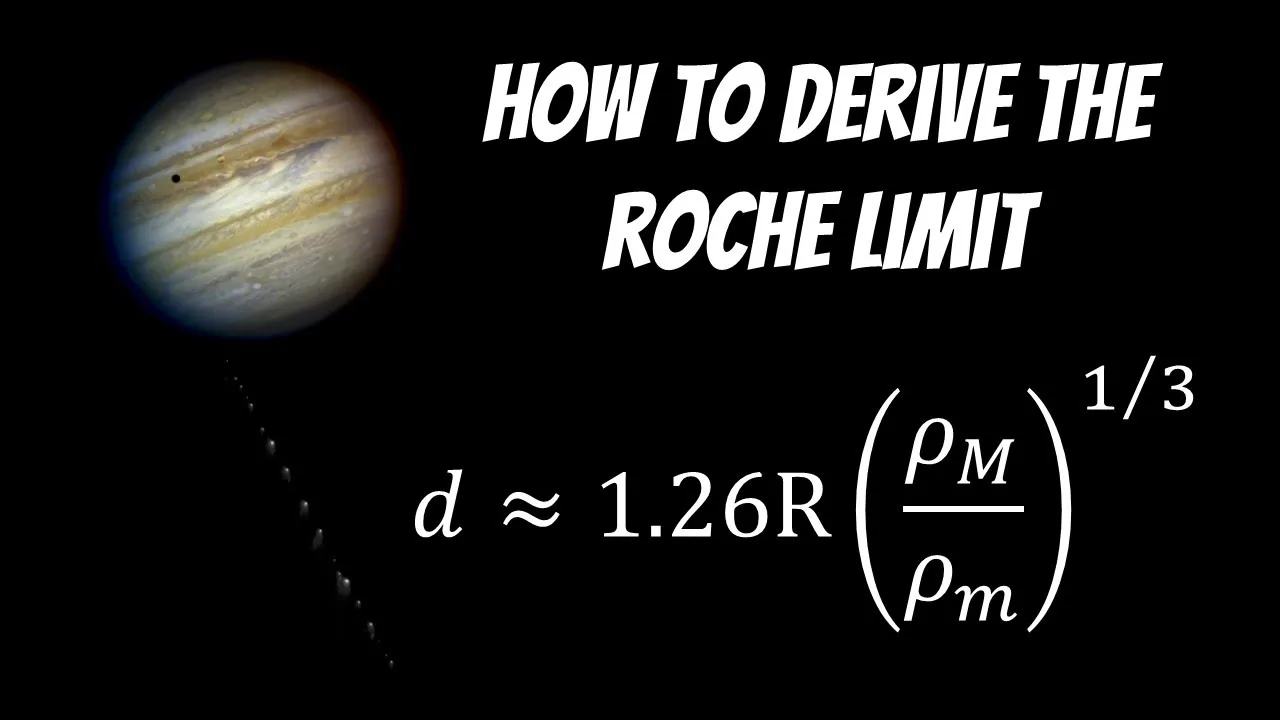
How to Derive the Roche Limit: A Step-by-Step Physics Guide
@AstroPhil2000
10.5K views•2021-06-17
61:17
First Billion Years of the Universe with the Square Kilometre Array
@iaaudc
121 views•2022-05-26

6:25
Kepler's Laws of Planetary Motion Explained (Educational Astronomy Video)
@Peekaboo_Kidz
404.9K views•2023-02-17

6:10
Gamma-Ray Bursts: Cosmic Snipers Explained | Astronomy
@kurzgesagt
15M views•2016-07-31
Related Study Plans & Knowledge Roadmaps
Structured learning paths in Astronomy
astronomy
Reionization: Pop III Stars, IGM & 21cm Line
01Foundations of Cosmology & the Early Universe
02Population III Stars & Cosmic Dawn
03Physical Mechanisms of Reionization
+ 2 more learning modules
17h5 modules
Explore Roadmap
astronomy
Planetary Rings: Dynamics, Roche & Resonances
01Foundations of Gravity and Orbital Mechanics
02Tidal Forces and the Roche Limit
03Structure, Composition, and Collisions
+ 2 more learning modules
10h5 modules
Explore Roadmap
astronomy
Asteroseismology: Stellar Waves, Ages & Cores
01Foundations of Stellar Astrophysics & Wave Mechanics
02Stellar Oscillation Modes: P-modes and G-modes
03Mathematical Framework of Asteroseismology
+ 2 more learning modules
35h5 modules
Explore Roadmap
astronomy
Adaptive Optics: Physics, Engineering & Control
01Foundations of Wave Optics and Wavefronts
02Atmospheric Turbulence & Optical Distortion
03Wavefront Sensing Technologies
+ 3 more learning modules
35h6 modules
Explore Roadmap