






















Electromagnetic waves are self-propagating transverse waves consisting of oscillating electric and magnetic fields that are perpendicular to each other and to the direction of propagation; they travel at the speed of light (3 × 10^8 m/s) through vacuum, carry energy proportional to the square of their electric field strength, and span the entire electromagnetic spectrum from radio waves to gamma rays, with applications ranging from radio communication to solar sail propulsion.
Understanding Electromagnetic Waves: EM Spectrum, Energy & Momentum
Added:Basic wave mechanics, including the concepts of wavelength, frequency, amplitude, and the wave speed equation.
Fundamentals of electrostatics and magnetostatics, specifically how electric and magnetic fields are generated and defined.
Introduction to Maxwell's equations in their qualitative form, explaining how time-varying magnetic fields induce electric fields and vice-versa.
Basic vector algebra, specifically dot and cross products, which are necessary to understand field propagation and polarization states.
Special Relativity, exploring how the constancy of the speed of electromagnetic waves in a vacuum led to Einstein's reformulation of space and time.
Introduction to quantum mechanics and wave-particle duality, studying how electromagnetic radiation behaves as both waves and discrete packets of energy (photons).
Electromagnetic wave propagation in materials, including topics like refraction, dispersion, absorption, and boundary conditions (Fresnel equations).
Astrophysical applications of the Doppler shift, such as analyzing cosmological redshift, stellar motion, and the expansion of the universe.
4.5M views40.8Klikes2:11:45Original Release: 2014-08-06
>> Hi, everybody.
How is everybody doing today?
>> Good.
>> Feeling good?
Trying to stay out of the heat?
It's much nicer in the studio here.
It's very cool.
Thanks for the air conditioning, Dave.
Appreciate it.
>> We paid our taxes.
[ Laughter ] >> These guys paid our taxes.
Yeah. How is everybody feeling about this stuff?
Are you feeling a little overwhelmed these days?
Okay. Good.
That means -- that means you're paying attention.
You're in the right spot, okay?
This stuff is very challenging.
It should be very time-consuming.
And just do your best to absorb as much material as you can.
The point of this couple of chapters that we've been dealing with is the idea that changing one field affects other fields, okay?
So, changing the magnetic field led to a changing of some sort of electric field.
We called it the EMF, right?
The electromotive force or voltage.
But it's this idea that these things are actually going to talk to each other, okay?
And so, this is where we're heading.
The next topic, therefore, is just that, electromagnetic waves, okay?
We are now going to combine both of these things, electricity and magnetism, into one concept, electromagnetic waves.
So, let's talk for a second about the following.
Let's say we have a charge, a positive charge, and we have a negative charge.
And let's say we're going to take these two charges and we're going to move them up and down, okay?
So, let's move them vertically -- -- and let's see what happens as a function of time.
Well, at one instant in time, they look like that.
And if I think about the electric field in between these two, I know what the electric field looks like.
It's pointing from the positive to the negative, okay?
I'm just going to draw one line for simplicity.
But now, let's move them vertically.
So, the plus is going to come down, and the negative is going to come up.
And so, at some later time, they're nearly right on top of each other.
And at that time, the E-field is essentially zero, okay?
There's nowhere I can draw an E-field very cleanly.
But now, let's keep moving them.
We're going to put the positive charge all the way down on the bottom and put the negative charge up on the top.
And now, the E-field is pointing up, okay?
So, all we're doing is we're taking these positive charges and negative charges, we're putting them together, and then we're going to keep moving them.
So, now, they're the opposite way.
And then, we're going to come back together again.
So, now, the minus is heading back down and the positive is heading back up.
And eventually, they're back to where they started.
So, if I think about what this E-field looks like, it is getting smaller and smaller and eventually zero.
And then, it flips direction and starts getting bigger and bigger.
And now, it's a positive.
And then, it gets smaller and smaller until it's zero.
And then, it flips direction and gets bigger and bigger until it's again pointing in the negative direction.
It sort of oscillates up and down, okay?
And that hopefully looks familiar to you, right?
We like things that oscillate.
And if I think about drawing the electric field as a function of time now, what can I say?
Well, here it was negative.
So, it's some negative value.
Here, it was zero.
Here, it was positive.
Here, it was zero.
Here, it was negative.
And so, it's going to look something like this.
Okay? It oscillates up and down as a function of time.
As I move these charges up and down, the electric field is going to oscillate up and down.
It's pointing down here, and then it's pointing up here, and then it's pointing down over here, and so forth.
A graph like this is just, "What is the size of the electric field as a function of time?"
So, here, the electric field is zero.
Here, the electric field is zero.
But at this point, it's a positive number.
At this point, it's a negative number.
All right.
Let's go back to this picture here for a second, and let's think about this charge.
Okay. Charge moving up and down, that is a lot like a current.
If I take a wire and I run current up and down, then this current I -- -- would look like positive charge heading down and negative charge heading up.
These are equivalent pictures.
But we know what happens when we have current.
What happens when we have current?
What do we generate when we have current in a wire?
It was a title of a couple chapters ago.
Magnetic fields, right?
If we have current, we have magnetic fields.
I leads to magnetic field B. And so, there is a magnetic field that develops here.
How does it develop?
Like that, okay?
And you can pick the direction based on the right-hand rule.
Remember, you put your thumb in the direction of the current.
So, stick your thumb down in the direction of the current.
Your fingers are going to wrap around in the direction of B, okay?
And so, we get a B-field that looks like that for this particular picture.
That was this case.
But when those charges come together, now the current is equal to zero.
And if the current is equal to zero, then B is equal to zero.
And later on as we keep going, the current is going to change direction.
The current is going to be going up later on.
And if current is going up, we again develop a B-field.
Then, you use your right-hand rule.
And now, it's wrapping around this way, okay?
Thumb in the direction of the current.
Fingers are wrapping around in the direction of the B-field, okay?
Again, it's going to be confusing if you look at me in the glass here, so look at the computer monitor when I do this and confirm that your thumb going up gets you a B-field that wraps around like that, okay?
And when you do it in the monitor, make sure you use your right hand.
Does everybody see that one?
Okay. So, the charges went up and down, and we developed an E that oscillated in time, but now, we have a current that's going up and down, and we're going to develop a B that oscillates in time.
And so, if we draw B as a function of time -- -- it is going into and out of the screen.
If I think about just one side of this, B is now going to be like this.
Okay? And this is supposed to be coming out of the screen and into the screen over and over again.
Okay? And we're trying to draw it in the third dimension here.
So, the E-field was going up and down, but the B-field is orthogonal to that.
It is 90 degrees to that.
So, if the B-field is in the plane of the screen, then -- if the E-field is in the plane of the screen, then the B-field is in and out of the board.
All right.
But maybe we can put all this stuff together.
So, the idea is this, a changing E -- -- generates a B.
And a changing B generates an E.
I change B, I can generate E. But if I change E, I can generate B. And maybe these things can balance out just right that you can generate electromagnetic waves, and that is indeed what happens, okay?
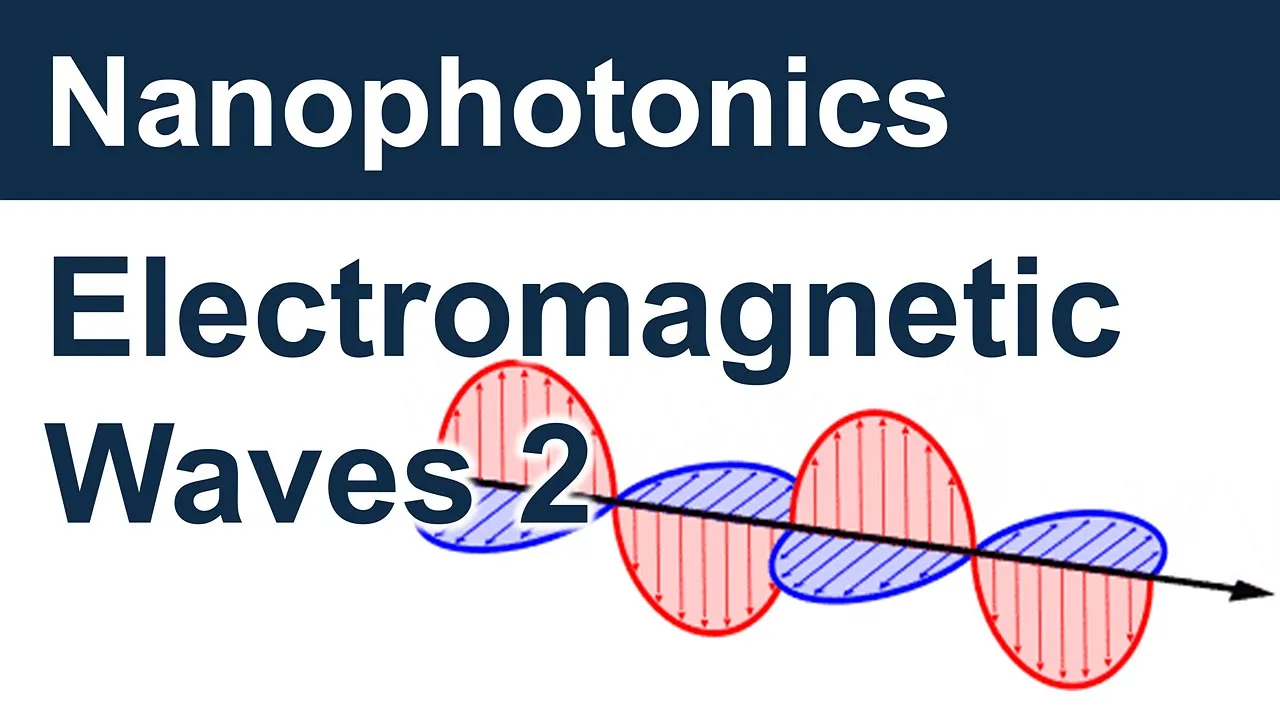
An electromagnetic wave looks like this.
I've got an E-field that is going up and down like so, and this means that it's pointing up in this region, and then it's pointing down in this region, and so forth.
Up, goes through zero, pointing down, and just keeps oscillating back and forth.
But that changing E-field can generate a changing B-field.
And the B-field is orthogonal to that.
It's at a 90-degree angle to it.
So, if E is up and down in the plane of the board, then B is in fact going in and out of the board.
And this is a little hard to draw.
But the idea is B is pointing this way, and then it's pointing into the board, and then it's pointing out of the board, and then into the board, and so on.
Okay? So, these things are doing something like this.
E-field is going up and down.
B-field is going in and out.
And so, they're sort of doing this, okay?
It's like two fish swimming along, one going up and down, one going left and right.
. And as this happens, this entire thing propagates to the right.
So, what is weird about this?
What's weird about this is there's no charges anymore.
There's no wires of current anymore.
These things can just propagate on their own because the changing E-field creates a B-field, changing B-field creates an E-field, and they just keep going like that, sloshing back and forth.
And this is called an electromagnetic wave.
So, how fast do these things propagate?
We said that it's going to propagate to the right.
It is called a transverse wave because the E-field and the B-field are perpendicular to the propagation -- -- direction.
Okay? So, even though the wave is moving this way, the E-field is oscillating up and down, and the B-field is oscillating in and out.
Those are both perpendicular to the propagation direction.
How fast are these things moving?
How fast does an electromagnetic wave propagate?
Well, I think we know the answer to that, right?
They propagate at the speed of light, 3 times 10 to the 8 meters per second.
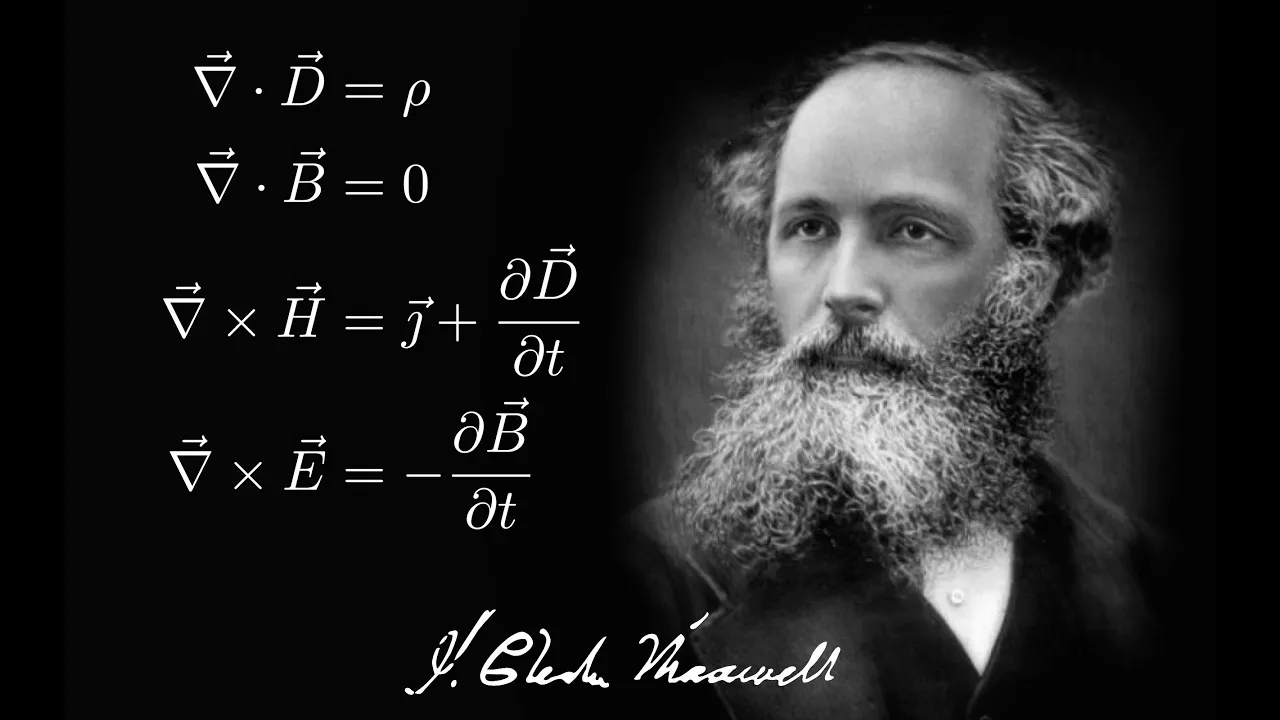
So, this stuff, electromagnetic waves, came about from something called Maxwell's equations.
And up until Maxwell, we had independent quantities.
We had electricity.
And then, we had magnetism.
Electricity was governed by things like Coulomb's law.
Magnetism was governed by things called Ampere's law.
Faraday's law started to tie those two together, but it wasn't until Maxwell came along and combined all of those things into one quantity that we ended up knowing that light itself is made up of electromagnetic waves.
People knew a whole bunch about light.
People knew a whole bunch about electricity and magnetism.
But what they didn't know was that light itself was electromagnetic waves.
And Maxwell put all those equations together and combined them into four neat equations.
And if you happen to continue in physics and take my upper-division Electricity and Magnetism course, it's all about Maxwell's equations.
Start with those four equations and spend an entire year trying to uncover all of their interesting phenomena, okay?
It's really very fascinating stuff.
All right.
If we have these changing electromagnetic waves that are flying around the universe, how do we detect them?
Well, let's think about this wave right here.
Let's say we do the following, and let's redraw it, but let's erase the magnetic field.
Now, let's ask this question, "How are we going to detect these electromagnetic waves?"
Well, let's draw the electric field coming along, okay?
It looks like that.
It's pointing up, and then it's pointing down, and then it's pointing up, and then it's pointing down.
So, let's take a wire -- -- a metal wire -- -- and let's just hold it up right there in space, okay?
When the electric field comes along and it is pointing up, what happens to the charges in the wire?
They of course feel a force going up.
The positive charges feel a force going up.
The negative charges feel a force going down.
And so, there is a current, I, which develops in the wire, okay?
And later when the electric field is pointing down, the current is going to flip and come back down, okay?
So, the current will in fact oscillate up and down.
All right.
Let's take this whole wire, and let's connect it to a circuit.
And let's connect it to a circuit that you are familiar with now, okay?
Let's put in an L and a c in our circuit.
And let's connect another inductor right there.
This looks like a transformer.
And we're going to send this signal to an amplifier.
And now, we're going to adjust -- -- the capacitor.
How do you adjust the capacitor?
Well, you can move the plates relative to one another, and that will adjust the value of the capacitance.
And if I do that, I can find the resonant frequency of this circuit that just matches the resonant frequency of the wave coming in.
And this is a device that you're all familiar with.
What device have we just drawn?
I can almost guarantee you you've used it today.
Anybody know what we just drew?
>> A phone?
>> Okay. Nope, not your phone.
It is your car radio.
Okay? This is your car radio.
You guys are like, "I don't have a fancy car with one of these radios in it.
I did for a while, but then it got stolen.
I haven't replaced it.
So, now, I just listen to my iPod while I drive, which is illegal if you have two headphones in.
So, don't do that.
All right.
This is your car radio.
What is this thing?
What is this big metal wire?
>> Antenna?
>> That's your antenna, right?
You go outside your car, you reach in, and you pull out this big telescoping wire.
That's your antenna.
What is it there to do?
It's there to collect the radio waves that are coming in.
This is from the radio station, okay?
Those radio waves come in, they hit your big metal bar, it excites current up and down, it transfers to your car stereo system, and when you pick just the right value of the capacitor, you tune into a particular frequency.
Every different station is coming in on a different frequency.
And so, there will be different oscillations here.
And by adjusting c, you move that frequency up or down the dial.
Okay. Let's talk about the electromagnetic spectrum.
So, one thing that we need to know is the speed of these EM waves -- -- we said was equal to c, right?
And c is 3 times 10 to the 8 meters per second.
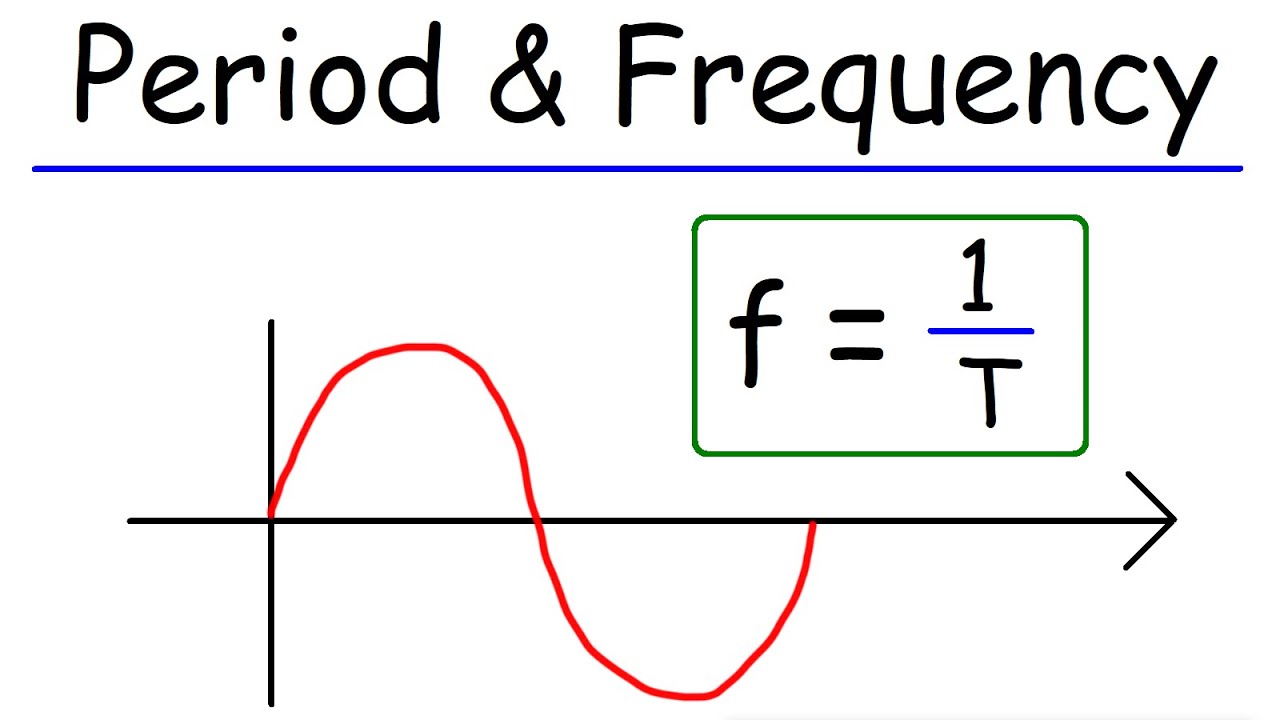
But there is a relationship between c and some of the other quantities that we're going to talk about, which is the following, c is equal to f times lambda.
The f is the frequency.
Lambda is the wavelength, c is of course the speed of light, okay?
So, meters per second is f, which is 1 over seconds, times lambda, which is meters.
Okay? So, that's the relationship that we're dealing with.
And now, let's think about the full electromagnetic spectrum.
So, we have a big long line here, and let's label this one frequency, f, measured in hertz.
And it's going to start down here at the low end at something like a kilohertz.
And at the high end, it's going to go up to 10 to the 22 hertz.
And then, going the other way -- -- we have lambda, and lambda is measured in meters.
Those are inversely related since c is a constant, right?
If f goes up, lambda has to go down.
If f goes down, then lambda has to go up.
And this over here is on the order of 10 to the minus 13, and it goes all the way over to on the order of 10 to the 5, okay?
So, these things aren't going to line up perfectly well, but they're going to be roughly close.
So, down here at the low end of the spectrum, we have what is called the radiofrequency, okay?
And the radiofrequency extends up to about 10 to the 9 in hertz or roughly 1 in meters.
So, radiofrequencies contain of course power lines way down here at the bottom end -- -- AM radio, FM radio, and television, okay?
And these are all operating in the radiofrequency.
The next region is called microwaves.
And microwaves are of course like your microwave oven, but also your Wi-Fi signals.
And this is going to go up to on the order of 10 to the 10 or 10 to the 11, okay?
So, this is what we talked about in class.
People were a little concerned about cellular phones and Wi-Fi signals because it's really close to the same frequencies that you use for your microwave oven to heat your food.
After that, we get infrared, okay?
Infrared goes up to about 10 to the 14, 10 to the 13, 10 to the 14, somewhere in there.
And then, after infrared, we get to visible.
And visible goes from 10 to the 14 up to about 10 to the 15.
If we keep going to higher frequencies, we get to UV.
UV gets up to about 10 to the 16.
And then, we get to x-rays.
X-rays go all the way up to about 10 to the 19.
And then, the very last bit is something called gamma rays and gamma rays can go as high as 10 to the 22.
So, infrared, that's stuff like heat lamps.
Visible is of course the sun.
UV would be black lights.
X-rays you get when you go to the dentist.
Gamma rays you only get from objects like quasars, okay?
And on the scale here, 10 to the 10 corresponds to about 0.1.
And then, we get to 10 to the minus 6 up here and 10 to the minus 7 and 10 to the minus 8 and 10 to the minus 10 and so on, okay?
These numbers aren't going to match up exactly.
And in fact, these divisions are not precise, okay?
They just say this region is microwaves.
But nobody says this is the hard cutoff for microwaves on the right side and the hard cut off on the left side, okay?
These are general regions, except with regards to visible, okay?
Visible we describe in exquisite detail, and that's largely because we operate on the visible wavelengths.
Remember we asked that question a second ago, "How do you detect electromagnetic waves?"
Well, you can use your car antenna and detect radiofrequency waves.
But if you want to detect visible light, how do you do it?
How do you guys detect visible light?
You're doing it right now, right?
You use your eyeballs.
Visible light is what you see.
That is the light that you see.
And it's sort of interesting that there's this huge range available, and it's all electromagnetic waves.
All the way from gamma rays down to radiofrequency waves, it's all the same stuff.
It's all electromagnetic waves.
But we only detect visible, which is a really small portion of the spectrum.
If somehow you could detect UV and infrared and x-rays and microwaves, you could see a lot more of what's happening in the world.
And in fact, you're familiar with one area, which is this right here, infrared, because you've all seen the Arnold Schwarzenegger movies where they use infrared goggles, okay?
Which is adapted from the military.
And the idea is you can detect infrared waves.
And if you have a special device, infrared goggles, you can turn it to visible.
And so now, you can see things out there that are emitting infrared light, even though they're not emitting any visible light.
And this is kind of weird, right?
Because if we turned off all the lights in this room and turned off the board, you guys would be in the dark.
And if I looked at you, I can't see you.
But if I could look at you with my infrared goggles, all of a sudden I would be able to see you because as humans sitting here emitting light, it's in the infrared region.
You're at a temperature of 98.6 degrees.
You are emitting light that is about 10 microns long.
And so, with my goggles, I'd be able to see you.
Maybe I'll bring some in.
We'll try that sometime.
I think that'd be good.
Okay. Questions about this electromagnetic spectrum?
All right.
There's one other point that I wanted to make, and this is something that we're not going to see a lot of in this class, but I wanted to give you a taste for where you might be going in your physics education, which is this idea of quantum physics.
Has anybody ever heard of the wave-particle duality in quantum physics?
Okay. There's this notion in quantum that everything behaves like a wave and a particle simultaneously.
Even things like electrons, they're not really just point particles.
They also have this wave-like property to them.
And it turns out that when you're looking at this end of the electromagnetic spectrum, everything behaves like waves.
Everything looks like a wave.
It doesn't look like a particle.
But up at this end of the spectrum, everything behaves like a particle.
It doesn't behave like waves.
So, gamma rays really act like little tiny bullets, little particles just flying through the universe.
It's very hard to discern any wave-like properties at this end.
And it's very hard to discern any particle-like properties at this end.
So, at either end, you have waves over here and particles over here.
But where we sit in the middle in this visible spectrum, light acts like a wave and a particle.
And this is the basis for the wave-particle duality.
And light in this region has been shown to behave like both simultaneously, okay?
Depending on how you design your experiment, you might look for the wave properties.
Different experiments, you might do the particle properties.
But over here at gamma rays, particles.
Over here at radio waves, it's waves.
So, it's kind of interesting, and we'll learn more about that when we get to a bit of quantum physics.
Do you guys have any questions up to this point?
Now, why don't we see if we can pull up one of your next chapter's homework problems, and we'll take a look at one that is hopefully relevant.
I just posted this this afternoon, so it's up on Mastering.
It's due Friday night.
And let's take a look at -- -- let's look at 22.07.
Okay. So, in this one, it says the following.
It says, "In an electromagnetic wave traveling west, the B-field oscillates up and down vertically and has a frequency of 93 kilohertz and an rms strength of 7.15 times 10 to the minus 9 T, teslas.
Assume that the wave travels in free space."
Okay? And Part A says, "What is the frequency of the electric field?"
Okay. So, let's start with -- -- Part A.
Okay? And we have an electromagnetic wave.
And it says that we're going to describe the B-field.
And the B-field that we drew before was going in and out of the board, so let's draw the whole thing again.
Here was our E-field going up, going down, going up and down.
And the B-field was coming in and out of the board.
Okay? E going up.
B like that.
So, the first thing they tell us is the B-field oscillates with a frequency of 93 kilohertz.
So, if the B-field is oscillating at 93 kilohertz, what do you think the frequency of the electric field is?
What do you think?
>> It's got to be the same?
>> It's got to be the same, right?
I mean, look at the picture.
E is going up and down at exactly the same rate as the B is going.
So, this has to be 93 kilohertz as well.
All right.
Let's try it, 93.
Let's see if it'll take a kHz for our kilohertz.
And in fact, it does.
And it says we are correct.
All right.
Part B says, "What is the rms strength of the electric field?"
And what they gave us was the strength of the B-field, rms, and they told us it was 7.15 times 10 to the minus 9 tesla.
And so, now, we're looking for E-rms.
Hmm. Well, we're not really sure how E relates to B yet.
But if we push forward a little bit in the discussion, there is a very nice and simple relationship between E and B.
And let me pull it up here.
And this is going to be a little bit ahead of ourselves.
But we'll get back to it in a second.
What we can say is the following, the energy in the E-field is in fact equal to the energy in the B-field.
And those things relate to each other by the speed of light.
So, what is the electric field?
It's equal to c, the speed of light, times the B-field, okay?
So, E-rms is just equal to c times B-rms.
So, if I take this value of B and I multiply it by c, 3 times 10 to the 8 meters per second, we're going to get the right answer.
Okay? And if somebody wants to try that in your calculator, tell me what you get.
It should be about -- what's that -- 3 times 7 is 21.
And then, we've got 3 of those 15s, which is a 0.45.
And then, we've got a 10 to the minus 1.
So, I'm going to say this thing is 2.145, and it's the value of electric field, which is of course volts per meter.
>> That's right.
>> Okay. So, let's try it, 2.145 volts per meter, submit it, and we are correct.
So, let's see how we're going to get to this discussion right there.
All right.
To do that, we need to think a little bit about electromagnetic energy.
First off, let's ask you guys a question.
Do electromagnetic waves carry energy?
Sure. How do you know that?
What happens when you go outside and sit in the sunshine?
Especially like today.
What happens when you absorb a lot of sunshine?
You get warm, right?
You get hot.
And that's because those electromagnetic waves, which are coming from the sun, travel all the way across space, punch through our atmosphere, come down, hit you, you're absorbing it, you are absorbing that energy, you get warm.
And so, electromagnetic waves clearly carry energy.
And we talked about this a little bit before with the idea of water, right?
Water is H2O.
It looks like that.
But it also has a dipole moment to it.
And so, if we flip this thing to the right, and then flip it to the left, and flip it to the right, and flip it to the left, we can do that.
Yeah. And you'll get a little seasick.
But if you do that at a particular frequency, 2.4 gigahertz, this thing turning right and left, that is of course your microwave oven.
Okay? And there's an electric field that's going to do that.
And so, we can draw this electric field coming in to do that.
Now, if that electromagnetic field is carrying energy, which it is, it's transferring it to the water, and that's heating up your food.
So, there is some electric energy density, which we talked about before.
And the electric energy density -- -- was the following.
Remember energy density is just energy per volume, and we ended up with 1/2 epsilon-naught E-squared.
In the last chapter, we talked about the magnetic energy density, how much energy is in a magnetic field, and that was 1 over 2 mu-naught B-squared.
And so, the total energy density -- -- in a wave -- -- is just going to be the sum of those two.
It's 1/2 epsilon-naught E-squared plus 1 over 2 mu-naught B-squared.
But the two components have equal contribution to the overall energy density.
And so, we have the caveat that the electric energy density is in fact equal to the magnetic energy density.
And so, we can write the total energy in that wave.
And u is what we're calling the energy density.
And we can write it in terms of E.
And if the electric part is equal to the magnetic part, we can just write it as twice the magnetic part, epsilon-naught E-squared, or we can write it in terms of the magnetic part, 1 over mu-naught B-squared.
Okay? And this is what we're calling u, the total energy density.
Okay. So, we have equal parts E and B, but let's take a look at this last equation here and see if we can determine the relationship between E and B.
So, what we said was 1/2 epsilon-naught E-squared is the same as 1 over 2 mu-naught B-squared.
Let's multiply by 2 on each side, get rid of the half.
And now, let's divide by an epsilon-naught.
And now, let's take a square root of both sides.
Okay? But we know what these values are.
We know what epsilon-naught is and mu-naught is.
So, this becomes the following, E is 1 over the square root of epsilon-naught, which we said was 8.85 times 10 to the minus 12.
Mu-naught was 4 pi times 10 to the minus 7.
And somebody punch this stuff into your calculator and tell me what you get, and I will approximate it here.
And hopefully, you got that.
Anybody get that number when they did 1 over the square root of all this stuff right here?
>> It's right.
>> That's right?
So, this is kind of cool, right?
C, the speed of light, came about from that.
You take those electric experiments that you did, and you figured out what epsilon-naught was.
You did some magnetic experiments, and you figured out what mu-naught was.
And suddenly, you put them together in this special way, and you get the speed of light.
You get how fast electromagnetic waves travel across the universe.
And this is the beauty of Maxwell's equations and Maxwell's derivation of this problem.
Before Maxwell, nobody really knew definitively that light was electromagnetic waves, and it was only after Maxwell that we knew that.
Okay. Welcome back, everybody.
If you're at home watching and want to chime in, Ian's monitoring the computer over there.
Dave brought in one of his cool radios.
This is what a radio looks like.
Are you guys familiar with these devices?
Okay? And this is the big metal bar that we were talking about, right?
You lift it up like that.
And then, you can turn it on.
[ Music ] Yeah. Okay?
That sounds pretty good.
Now, let's say your reception is not very good.
What can you do?
You can move your antenna around.
And in fact, if I point it like that, now listen.
[music] That doesn't sound very good, right?
So, let's move it back up.
[music] And now, it sounds quite a bit better.
[music] So, what can you tell me about the electromagnetic wave that's coming to our radio from the radio station?
Just on that little experiment that we did, what can you tell me about the electric field that's coming?
Can you tell me anything?
[ Student Answer ] Okay. Ian says if we're getting better reception like this, then the electromagnetic wave must have an electric field that is pointing up and down this metal bar.
And so, the electromagnetic field that came in was going like this.
And when I turn this bar over to the side, it doesn't get as good reception because that electromagnetic field that's going up and down can't excite the current along the length of the wire.
So, this is kind of cool.
You can actually tell what the electromagnetic field is just by one of these things moving around in space and checking your reception, all right?
Very nice.
Okay. Let's take a look at one of your homework problems from Chapter 22, and this is number 22.15.
Okay. In this example, it says, "What is the wavelength of a 25.75 times 10 to the 9 hertz radar signal in free space?"
Okay? So, radar is just another region of the electromagnetic spectrum, and they're telling us that the frequency is 25.75 times 10 to the 9 hertz.
Okay. Radar being a frequency of this range means it's in the radiofrequency of the spectrum.
Anybody know what radar stands for?
Anybody in the ROTC program here?
[ Student Answer ] Okay. Radar stands for radio detection and ranging.
That's what radar means, radio wave detection and ranging.
And so, you can use radar to detect opponents and range.
How far away are they?
Okay? So, that's what radar means.
So, the speed of light they tell us is not really 3 times 10 to the 8.
It is actually 2.9979 times 10 to the 8 meters per second.
So, it's pretty close to 3 times 10 to the 8, and that's why we usually approximate it.
But this is the exact value.
And now, they want to know, "What is lambda?"
Okay. When you think about these electromagnetic waves, what we said was the electric field is going up and down like that.
And if we're thinking about a wavelength -- [ Phone Alarm ] -- that's my jam.
It's not my jam.
What are we talking about?
We're talking about, "How far is it from there to there?"
Okay? Which is the same as, "How far is it from there to there?"
Any time the wave repeats itself, that is 1 lambda, all right?
And we know the relationship, right?
We know that c is equal to f times lambda.
So, what is lambda?
It is c over f. And now, we have all those numbers, right, c is 2.9979 times 10 to the 8 meters per second, f we said was 25.75 times 10 to the 9.
Hertz is 1 over seconds.
And so, we're going to end up with something in meters, and they want four significant figures, okay?
So, that's going to be tough for me to approximate it here, so somebody punch this into your calculator and tell me what you get for that answer right there.
[ Student Answer ] Okay? And the units are meters.
The per seconds are going to cancel out.
Ten to the minus 2, that sounds good, right?
That sounds like radio wavelengths.
Why does it sound like radio wavelengths?
Because it's centimeters.
And when you think about a radio, the antenna has to be on the order of the wavelength.
So, if this is my wavelength of a half a meter, that would be AM radio station or maybe even FM.
This is centimeters, but that's okay.
That's on that order right there.
All right.
So, let's punch in that number and see if we get the right answer, 1.164 times 10 to the minus 2.
And the units are meters.
And that is indeed the correct answer, okay?
And now, as a followup to Part B, it says, "What's the frequency of an x-ray with wavelength 0.11 nanometers?"
So, that one you can handle on your own.
You're of course going to use the same relationship, c is equal to f lambda.
But there's an important point here, which is if I'm thinking about radar waves moving through space and then I'm thinking about x-rays moving through space, are both of those things really moving at the same speed?
And the answer is yes, they are.
All electromagnetic waves travel through free space, through vacuum, the universe, at this particular speed.
It doesn't matter if they're x-rays or if they are radio waves.
They all go through at the exact same speed.
This is the universal speed limit for the universe, okay?
This is as fast as you can go.
Okay. Let's think about intensity.
So, when we talk about electromagnetic waves and we talk about these things carrying energy, we need to talk about intensity of the electromagnetic wave.
So, you're familiar with this idea, right?
When you go out and lay in the sunshine, you get warm, okay?
But that sunshine that is hitting the ant on the ground warms up the ant.
But if I take a big lens, right?
And I focus a whole bunch of sunlight onto that poor little ant, I can in fact burn up the ant, right?
You've probably done this experiment when you were kids.
So, what has changed?
And what has changed is the intensity of the electromagnetic wave at that focal spot.
So, let's talk about intensity.
Intensity we actually are going to write with an S, okay?
And S is power divided by area.
The reason that we use an S is this comes from something called the Poynting vector, and the Poynting vector, traditionally, they use an S. So, power is P. Area is A. But we know that power is energy per ton.
And we're going to divide that by area A, okay?
Energy per time is the same as energy density times volume -- -- divided by time -- -- times area A.
Okay? And we know what some of these things are.
We know what energy density is.
Energy density was our good old u. What about volume?
Volume we're not really sure yet, so we'll leave it right there.
Time is just t. So, what do we mean by volume?
Well, let's think about an electromagnetic wave propagating along, okay?
This electromagnetic wave propagating along is going to occupy a region of space that has a cross-sectional area A to it, and it has a length here L, which is equal to how fast it's moving for how long.
It moves at c. It does that for a time t. That's the length of this box.
So, what's the volume of the box?
Well, it's just cross-sectional area A times the length L. So, it is Act.
So, what do we get here?
We get u times the volume Act, and we're going to divide it by At.
The A's cancel out.
The t's cancel out.
And we just get u times c.
Okay? So, S is equal to u times c.
But we know exactly what u is, u is 1/2 epsilon-naught E-squared plus 1 over 2 mu-naught B-squared.
But those are equal.
And so, we can just double one of them.
We can say S is equal to c epsilon-naught E-squared or S is equal to c over mu-naught B-squared.
Those are equivalent statements.
Okay. So, with this information now, let's see if we can understand something about our sun.
How about something relevant to our particular situation on the earth?
How about the sun?
And let's ask the following question: What is -- -- the total -- what is the total power output of the sun?
What is the total power output of the sun?
And let's say that we know a couple things.
We're going to say that the intensity at the earth is equal to 1390 watts per square meter.
This is the intensity of the sunlight at the earth.
All right.
Let's draw a picture of this thing.
Here's our sun, okay?
It is spitting out electromagnetic waves in all directions.
Some of those we collect right here on the earth, okay?
And we know that we are a distance -- -- capital R away from the sun.
So, if I want to think about how much power is emitted by the sun in total, I have to worry about this sphere right here of radius capital R, okay?
The total power emitted through that sphere is hopefully something we can calculate based on the intensity at the earth.
All right.
How do we do it?
Well, at the earth -- -- the intensity that we measure is just power over area.
And that is what we said was 1390 watts per square centimeter.
But the total power -- -- coming out of the sun -- -- is going to be that intensity that we measure here multiplied by the area of this giant sphere.
Okay? We know S. What is the area of this giant dashed sphere?
It is 4 pi capital R-squared.
Now, take our little intensity and multiply it by the area of the sphere.
And as you can imagine, that's going to be a pretty big number.
So, we have 1390 for S. We have a 4.
We have a pi.
And now, we need this number R.
And this you can look up in your textbook.
How far is the earth from the sun?
It is 1.5 times 10 to the 11 meters.
And so, you're going to square that.
And somebody double-check my calculation.
I ran this earlier, but maybe you can double-check.
I get 3.93 times 10 to the 26 watts.
Okay, 3.93 times 10 to 26 watts for the total power coming out of the sun, which is a pretty big number, right?
When we were talking about how much power your hair dryer uses, it was like 1 and 1/2 kilowatts, right?
It was like 10 to the 3 watts.
And here's something that is 23 orders of magnitude bigger.
So, like you would expect, there's a lot of power coming out of the sun.
Okay. But if that's the total power coming out of the sun, let's ask a followup question.
What is the intensity at the sun's surface?
Okay? And how do we do that?
Well, we're going to need to know the radius of the sun.
And if we do that, then we can calculate the intensity at the sun's surface -- -- because it's just going to be that total power divided by the area of the sun.
And we know the total power and the area of the sun is 4 pi times the radius of the sun squared.
And so now again, you can look up that number.
And let's punch it in right here.
So, P-total we said was 3.93 times 10 to the 26 watts.
We've got a 4 pi.
And then, we have R-squared, which if you look it up is 6.96 times 10 to the 8 meters.
That's the radius of the sun.
And if you put all this together, you get 6.42 times 10 to the 7 watts per square meter.
Okay? Which is a big number, right?
Think about a square meter, it's like that, and it's going to have 64 million watts in that square meter.
That is a lot of electromagnetic intensity.
>> A question came in.
>> Yeah.
Somebody's got a question out there, Ian?
>> I have a different answer.
>> Oh, never mind.
It just takes me, you know.
[ Laughter ] From Kelly.
>> I just -- I sent that one in myself right here.
Did somebody get a different number for that last calculation?
>> I did.
>> Okay. What'd you get?
>> I got 4.49 times 10 to the 16.
>> That doesn't sound quite right, but let's just double-check.
So, we had 3.93 times 10 to the 26.
And then, we had a 4 pi.
And then, we had 6.96 times 10 to the 8, but that whole thing was squared.
Did you remember to square it?
>> Oh, no.
>> Okay. All right.
Good. Yeah, it couldn't be that high, right?
Because this is going to get us like a 10 to the 16, so it's got to be less than sort of 10 to the 10, which is where we ended up.
Okay.
Ian ask who that was out there watching or if you're watching still.
Who is that?
>> It looks like Kelly.
>> Who?
>> Kelly.
>> Kelly. All right.
Hi, Kelly.
How you doing?
Hopefully, you're sitting in a cool coffee shop somewhere watching this.
So, let's go back to the burning ants question, right?
What we said was if you're sitting here on the earth -- -- and the sun is up above you -- -- and now I take a big lens, I can in fact create an intensity here that will burn up the poor little ant, right?
Here's a little ant, not so happy.
Let's see why that works, okay?
And let's say that we're going to use a lens to focus the sunlight down to an area, which we will call a spot, okay?
So, the lens focuses the sunlight.
And therefore, the intensity at the spot is going to be how much power you collected with your lens or how much power is in that spot divided by the area of that spot.
But how much power you collect with your lens, that is just S at the earth times the area of the lens.
And then, we have to divide by the area of the spot.
So, how big is your spot?
Well, it's a circular lens.
And so, it's just pi r-squared, okay?
And let's say that the -- -- the spot is pretty small.
Let's say that it has a diameter of about a millimeter, okay?
So, we'll let r be something like a half a millimeter.
And then, we need to know the area of the lens.
And that's the pi r of the lens squared.
And that can be pretty big.
And let's say that the area ends up about 0.09 square meters, okay?
So, it's a lens maybe that big.
We already know S at the earth.
That was our 1390 watts per square meter.
And so, now we can put all this stuff together and calculate the intensity at that spot.
Okay. So, the intensity at the spot -- -- is going to be S at the earth -- -- area of that lens divided by the area of the spot.
And S at the earth we said was 1390.
Area of our lens we said was 0.09.
We're all in SI units here.
And then, we need a pi r-squared for this guy, so we have pi times -- a half a millimeter is 5 times 10 to the minus 4 meters, and we've got to square that thing, okay?
So, if you punch in all those numbers, tell me what you get.
When I did it earlier, I got 1.6 times 10 to the 8 watts per square meter, okay?
And this is with a lens about yea big.
Anybody else get that number?
How intense is this?
It's similar.
So, in fact a little bit bigger, but comparable to the intensity at the surface of the sun.
Okay? Remember at the surface of the sun, we've got something like 6 times 10 to the 7.
And now, we've got something 10 to the 8.
So, it's extremely comparable, in fact a little bit bigger, than the intensity of the surface at the sun.
So, it's no wonder that ant burns up, right?
And in fact, if you do this experiment yourself, if you go out with a big lens like that big and you go outside on a hot clear day -- it's got to be nice clear day -- you can burn holes in concrete, okay?
You can burn holes right into the concrete itself.
It's really fun.
I've got a big lens in my lab.
We'll try it on one of these really hot days.
You've got to be a little careful obviously because, you know, it's an intense spot and you can burn yourself.
But also, you can't really look at the spot because it's sort of like looking at a welder's arc.
It's just so intense that you can hurt your eyeballs when you do this experiment.
So, you've definitely got to be a little careful.
All right.
Let's see.
Let's try just one more of your homework questions, and let's take a look at -- -- let's see.
Let's take a look at the MisConceptual Question 22.07, which is number 2 on your homework.
Okay. So, this is MisConceptual Question 22.07.
And it says, "If the earth-sun distance were doubled, the intensity of the radiation from the sun that reaches the earth's surface would do what?"
And your options are drop to a quarter, quadruple, drop to a half, or double.
So, let's go back to our picture.
Here's our sun.
Here's the earth, okay?
Some of that sunlight is getting us here on the earth.
But now, we're going to take that earth and move it out to a distance twice as far away.
So, if this was R, now we are 2 R away.
So, how do we think about this?
Well, there is a finite amount of power that's leaving the sun.
All of that power is going to be intercepted by this sphere of radius R.
But all that power is also going to be intercepted by this sphere of radius 2 R, right?
All that light that's coming out of the sun eventually is going to go through this bigger sphere.
And so, the intensity at any location is just P-total divided by area where it's the area of these spheres.
So, for the first case, we've got P-total divided by -- what is area?
Area of a sphere is 4 pi R-squared.
So, in the first case, it's just 4 pi R-squared.
But in the second case, the power doesn't change, but what does change is this radius down here becomes 2 R quantity squared.
And now, I have a 1 over 2-squared, and that's the same as 1 over 4 of what we had before.
So, S2 is a quarter of S1.
Double the distance, it goes down by a factor of four.
So, let's try that one and click it in.
And it says we're right.
All right.
Everybody feeling okay?
Or at least completely overwhelmed?
Okay. That's good.
All right.
Let's get out of here.
I'll see you guys tomorrow.
Cheers. Hi, class.
>> Hi.
>> Hi, class.
How's everybody doing?
>> Good.
>> Good. We're going to continue talking about electromagnetic waves.
Did you guys get a chance to watch the videos from yesterday that introduce electromagnetic waves?
>> Yes.
>> Yes? Yeah.
Even if you didn't, just nod appreciatively, "Yes, we did.
Thank you very much."
So, let's continue that discussion.
I thought maybe what we do first is take a look at one of the homework problems for Chapter 22, which is one of the MisConceptual Questions.
And it says the following.
It says, "An electromagnetic wave is traveling straight down toward the center of the earth.
At a certain moment in time, the electric field points west.
In which direction does the magnetic field point at this moment?"
So, remember yesterday when we drew electric and magnetic fields that combine to make a wave, we said the following.
E, let's let that oscillate up and down, okay?
And we know what that means.
It's going up, then it's going down, up and down, and so forth.
But the B-field was at a right angle to that.
So, if we draw the B-field -- let's try it in green -- the B-field in fact comes into and out of the page.
Okay? So, it's pointing out of the page and into the page over and over again.
Both of these things are of course oscillating sinusoidally.
And so, this would be the direction of B. Now, the whole wave propagates to the right.
So, the wave propagation direction is to the right.
But there is a certain relationship between the E-field and the B-field, okay?
And to figure out how to calculate the propagation direction, we can again go back to our right-hand rule.
Okay? So, the right-hand rule is the following.
You put your fingers straight in the direction of E.
You bend your fingers in the direction of B.
And then, the propagation direction, which later on we're going to learn is actually given with a K, propagation K -- -- is in fact the direction of your thumb, okay?
So, let's try that with this picture and see if we can convince ourselves that it is true.
And let's look at the first instant of time.
In the first section of this wave, I have an E-field that is pointing up.
I have a B-field that is coming out of the page.
And therefore, my thumb gets me the direction of K. So, everybody look at the computer monitor.
Hold up your right hand, okay?
And try that.
Put your finger straight up in the direction of E. And now, bend your fingers in the direction of B. Your thumb should be pointing in the direction of K. Is that what everybody is seeing?
>> No.
>> No? Okay.
We could have -- we could have it flipped.
Let me see if I can see what's going on in the computer monitor.
So, we've got E going up.
And then, B is coming out towards you guys?
Is that right?
Okay? And so, you should get a thumb that's going to your right if you look in the computer monitor.
>> It's usually there, and now it's gone.
>> Yeah, don't look at this.
>> Yeah.
>> This is confusing, right?
Look at that.
Is that working over there?
Does that look like my right hand in the computer monitor?
It looks like my right hand, right?
My fingers are in the direction of E, yes?
Now, I'm in the direction of B because it's coming out towards you.
And now, my thumb is going in the direction of K. Is that working?
>> Yeah.
>> Yeah. It gets confusing when you're looking over here at the glass because it's inverted on the screen.
And so, we have to do a little clever trick there.
So, the relationship between E and B, those two angles determine the direction of K. E is always orthogonal to B.
And if you use your right-hand rule, it will tell you the direction of K. So, let's go back to the question that they had for a second.
They said that, "An electromagnetic wave is traveling straight down towards the center of the earth.
At a certain moment in time, the electric field points west."
Okay. "In which direction does the magnetic field point at this moment?"
All right?
Well, let's see if we can draw this picture, and it might be kind of tricky to draw, but let's give it a shot.
This is the earth, okay?
And we're going to say that the west is to the left, the east is to the right, okay?
That means the north would be into the screen, south would be out of the screen.
And so, if the wave is propagating down towards the center of the earth, it's going to be coming down this way.
And at a certain moment in time, the electric field points west.
Okay. So, here comes our wave.
It is propagating this way.
And at this moment in time, the electric field is pointing to the west.
So, there is our electric field.
So, if the electric field is pointing west and the wave is propagating towards the center of the earth -- this is our E-field -- we know that the B-field has to be at a right angle to the E-field, okay?
So, it can't be west, and it can't be east.
We also know that it can't be up, and it can't be down.
So, the only option is into the screen or out of the screen.
It's either north or south.
And if north is into the screen, let's see what we would get.
We would get -- E cross B would get me a K that is pointing -- well, let's see if we do this right.
We've got -- we've got an E. And then, if B was coming in, it would give me a K like that.
So, it looks like we do want a B-field that is doing that, okay?
We've taken this picture, and we've rotated it to this where the B is going into and out of the board.
So, I would say -- -- I would say that we need -- is that right?
I think that's the wrong way.
I think it's got to be this way.
But you know what?
Let's try it.
So, E going west means that the B-field I'm going to say should be north.
Let's just try it and see if we're right.
And if we're wrong, it's probably the opposite, which is south.
And it says we are correct.
Okay. So, B-field is in fact in the north direction.
I might have tweaked this up a little bit, but the important point is we can eliminate west and east, up and down.
Okay. Let's go back to this idea of waves for a second and talk about something called the Doppler shift because this is really interesting.
So, this is something that you guys have heard about -- -- but let's talk a little bit about what's really going on with something called the Doppler effect, okay?
And the Doppler effect is just this.
Let's say I'm looking at a star, and I know that that star is spitting out light in all directions, and let's say that it is stationary relative to me, okay?
Here I am on the earth.
I'm looking at the star with my eyeball.
Some of that light comes all the way and gets to me.
What do I -- what do I observe?
I observe some particular color that came out of this star, okay?
This is usually a whole spectrum of colors of course, but I observe some particular colors that are coming out of this star.
But let's say the following happens.
Let's say the star starts moving towards us.
Okay? The universe is a big, crazy, violent place.
Stars are moving all over the place.
Let's say we find one and that it's moving towards us, okay?
It's still emitting light, and some of that light gets all the way to us.
When we look at that light, we can measure the frequency.
And f is the frequency of that light.
And let's say we did the measurement up here and we measured the frequency when it was at rest.
And we call that f-naught.
And let's measure this one and see how it compares.
With that star moving towards us, is this frequency the same as we measured before or is it something totally different?
Well, it turns out that the frequency is in fact bigger than it was before.
And one way to think about this is when you're exciting these waves and you're traveling along with the wave, you kind of compress the wavelength.
A shorter wavelength means it has to have a higher frequency, okay?
And this is something that you've heard of.
It's called the blue shift.
You've probably heard of the opposite, which is when the star is moving away from us.
Okay? So, now, we're going to take that star, and it's going to move away from us.
In this one, it was moving towards us with a speed v.
And now, it's going to move away from us with a speed v. And when that light gets to us, it in fact is shifted the other way.
In this case -- so, that was moving towards us, this is moving away -- we have f is in fact less than f-naught.
And that's called a red shift.
Okay? And this is probably something that you've heard about in astronomy classes, right?
They talk about the red shift of different stars out there, and what it means is the light that we observe has a different frequency than it should, than it would if it was at rest, okay?
Now, how does all this stuff tie together?
How do we actually calculate the Doppler shift for different moving objects?
So, the equation that we need is the following, f is equal to f-naught times 1 plus or minus v over c, okay?
So, this is the frequency that you measure -- -- the observed frequency.
This is the source frequency.
That way that it's emitting, if it was all at rest, what would it be?
The v is of course the relative velocity.
The c is speed of light.
And this thing, the plus or minus, just means moving towards or away -- -- from the observer.
Okay? Frequency can either go up if it's coming towards you or it can go down if it's moving away from you.
Now, this is true when the relative velocity v is much less than the speed of light.
It gets a little more complicated once you get up to close to the speed of light.
But for most objects that we're familiar with, the thing is not going to be moving anywhere near the speed of light.
So, let's take a look at an example of this, and let's look at a rotating galaxy.
Okay? So, a rotating galaxy looks sort of like this.
It's got these spiral arms on it, and the whole thing is spinning.
And as it spins, it emits light that we can observe down here on the earth.
Not to scale.
Okay? And the thing is spinning in this direction.
So, there is some point here, which has some speed v. There's some point on the other side, which has some speed v. And so, the whole thing is spinning around like that.
All right.
Let's see if we can calculate some stuff about this galaxy using the Doppler shift.
Okay. So, we're going to say that not only is the whole thing spinning, but the whole thing is moving away from us, and we'll call that speed v of the center, okay?
It's moving away from us and it's rotating, so we have this complicated system.
And let's write down some givens.
So, the speed that it's moving away from us is 1.6 times 10 to the 6 meters per second.
The speed here v is 0.4 times 10 to the 6 meters per second, but this is relative to the center of that galaxy.
Okay? The source of the light has a frequency f-naught of 6.2 times 10 to the 14 hertz.
And now, we want to find the following.
We want to figure out, "What is the observed frequency from A?"
And, "What is the observed frequency from B?"
Okay? You've got a star on this side that is emitting some light, and we're going to collect it.
You've got a star on this side that is emitting some light, and we're going to collect it.
And we want to figure out what those frequencies are, okay?
So, we go back to the Doppler shift.
So, the Doppler shift we said was f equals f-0 times 1 plus or minus v over c. But remember that is relative to us, okay?
So, we're going to label that v-relative.
And the whole galaxy is moving away from us, okay?
And it's moving away from us faster than it's spinning.
And so, both of these are going to be red shift.
Both signals are in fact red-shifted, which means lower frequency.
And so, we want to use the minus sign in our equation, okay?
So, what is f-A going to be?
It is the natural frequency f-0, and then we have 1 minus v-relative, okay?
But remember the A side was coming towards us as the galaxy was moving away from us.
And so, we in fact need to put up here v-center minus v all over c, okay?
And now, we have all those numbers.
And so, we can punch them in and try it out.
And let's do that.
We've got a 6.2 times 10 to the 14.
Out in front, we have a 1 minus this thing, which is 1.6 times 10 to the 6 minus the rotational speed, which is 0.4 times 10 to the 6.
And then, that last bit is all over c, which we know is 3 times 10 to the 8 meters per second, okay?
We'll just keep SI units on everything.
We don't have to write the units.
Close the parentheses.
And if you do that, you should get -- you can double-check my numbers -- I got 6.1752 times 10 to the 14 hertz, okay?
That was the frequency of A. Now, if you do the other side, frequency B, what do you get?
Frequency B is going to look very similar, except we're going to change one of these signs.
So, it's 1 minus v-center plus v all over c. And now, it's the same numbers you're going to plug in.
You just put a positive sign right there.
And if you do that, you should get 6.1587 times 10 to the 14 hertz.
Okay. So, this is the Doppler shift.
It's something that's not in your textbook chapter, but I think it's really important to understand what's happening in our universe and especially since this has such an impact in astronomy.
Okay. One thing that we need to talk about is this idea of polarization, okay?
And this is going to come back again later on when we start talking a little bit more about optics.
But when we say polarization, what do we mean?
Polarization is the direction of the E-field.
Okay? This is just how it's defined.
So, for instance, if my wave has an E-field that's going up and down -- -- then we say that it has vertical polarization.
Okay? We don't really care about what the B-field is doing.
It's just defined in terms of the E-field.
But if you have a wave where the E-field is in and out of the board -- -- like so -- -- then this is called horizontal polarization.
Okay? So, these are the two polarizations for an electromagnetic wave, either horizontal or vertical.
And things like lasers have a preferred orientation for their electric field, okay?
They either come out vertical or horizontal.
But things like sunlight have all different polarizations, okay?
They have a vertical component, they have a horizontal component, and then they have all the different angles in between, okay?
So, incandescent sources, like sunlight, like a light bulb, those will have random polarization, whereas lasers will have defined polarization.
So, you're familiar with this because of two things.
One is you might have sunglasses that are polarized, okay?
And what polarized sunglasses mean is they block one of these polarizations.
It turns out that the glare off the ocean or the glare off a wet street is dominantly polarized in one direction.
And so, if you put on your sunglasses to just block that particular polarization, you essentially cut out the glare, okay?
So, when you're looking at the ocean, if you see a bunch of glare, put on your polarized sunglasses.
The glare goes away, and that's because that glare is polarized in one direction, and your polarized sunglasses block it.
But this is also used in things like 3-D movies, okay, 3-D movies take advantage of polarization.
And basically, they use a different polarizer for each eye.
Okay? So, if you go to a 3-D movie and you get those glasses, what those glasses are doing is there's a different polarization on the left eye than on the right eye.
And so, when they project it on the screen with a certain polarization from the lamp -- they use some polarizers to do it -- they're creating a different image for your left eye than your right eye.
So, now, when you put them back together, it looks like a 3-D picture to you.
Okay. Let's take -- let's take a look at another one of your homework problems.
Okay. So, this relates to stuff that we talked about yesterday.
Let's look at 22.22.
Okay. So, it says the following.
The E-field in an EM wave has a peak value of the following, 21.7 millivolts per meter, okay?
So, that's 21.7 times 10 to the minus 3 volts per meter.
And it wants to know, "What is the average rate at which this wave carries energy across unit area per unit time?"
So, we have some electromagnetic wave coming along.
And we need to define some area and figure out how much is coming across per unit area per unit time.
Now, when we talked about energy per time, remember that was power.
And when we talked about power per area -- -- that was what we called intensity.
Okay? Now, yesterday, we were using intensity as S.
In your book, I think they use intensity as I, all right?
So, just make sure that you're aware that where we're using S, they were using I.
Okay. So, it looks like energy per time is power.
If I divide that by area, I just get -- I just get intensity.
And that's exactly what they're looking for in this problem, okay?
The average rate at which this wave carries energy across unit area per unit time.
So, we need to figure out what S is equal to.
And if we back up a little bit in your notes or you click on the video from yesterday, we can go back to what we were talking about for S.
Okay? And what we said was the following.
S is in fact equal to c times u, c is the speed of light, u is the energy density.
And that is the same as c times epsilon-naught E-squared.
So, if I know E, I can in fact calculate this.
Now, we've got to be perhaps slightly careful about this because they tell us it's a peak value, and so we have to be a little bit careful about what we're going to use in here.
But let's try it, and we'll see if it works out.
Okay. So, 3 times 10 to the 8 is c. Epsilon-naught is 8.85 times 10 to the minus 12.
E we just said was this, 21.7 times 10 to the minus 3.
Okay? So, if you punch in all those numbers into your calculator, tell me what you get, and I will approximate it right here.
So, we've got a 3 times a 9 times a 20.
So, that's a 60 times a 9, 60 times 9 is 540.
And then, we've got a 10 to the 8 with a 10 to the minus 12, so that's a 10 to the minus 4.
And then, we've got a 10 to the minus 6, so that becomes a 10 to the minus 10.
Okay? So, this is 5.4 times 10 to the minus 8.
And the units are SI units, watts per square meter.
Did anybody punch this into your calculator and get a real answer?
>> Yes.
>> What'd you get?
>> I got 5.76 times 10 to the negative 5.
>> So, 5.76 times 10 to the negative 5?
Okay.
What did I do wrong?
Can anybody see where I went wrong here?
Can anybody else confirm that number?
>> I got 1.25 times 10 to the negative 6.
>> You got what?
>> I got 1.25 times 10 to the negative 6.
>> Okay, 1.25 times 10 to the negative 6.
All right.
We've got three different answers so far.
Should we get some more?
[ Student Answer ] This one's right?
[ Student Answer ] Okay. So, we'll erase that one.
Is that one confirmed by anybody?
Okay.
>> I got 5.76 times 10 to the negative 8.
>> So, 5.76 times 10 to the negative 8?
All right.
I tell you what we'll do.
>> I got 1.25 times 10 to the negative 6.
>> All right.
We've got two votes here.
Check, check.
And we've got two votes here.
Check, check.
Why don't we do this?
We'll take a five-minute break, okay?
We'll work this out.
And then, we'll come back here and tell you what the answer is, all right?
So, Joe, why don't you to take us out for five minutes, okay?
All right.
Welcome back.
We figured out where we went wrong.
My approximation was no good because we forgot to square the 20, okay?
So, that was no good.
And in fact, I disagree with that answer right there.
So, somebody chimed in from home and confirmed that that is indeed what they got as well.
And I just checked on WolframAlpha.
If you guys have never used WolframAlpha, it's a great website.
Just go to WolframAlpha, and you can type in whatever you want.
So, I just typed in this, and it told me that.
Okay. So, this is the value of c epsilon-naught E-squared, but we have to be a little bit careful because when we think about E-squared, what's it going to look like?
It's in fact going to look like that, right?
It's a positive number.
It's going to go up this high.
And so, when we are calculating the average S-bar, we need to calculate a half of the maximum.
So, it's going to be 1/2 c epsilon E-squared if this was the maximum value, okay?
Which is what we put in there.
So, what's the answer to our question?
It is going to be 1.25 times 10 to the minus 6 divided by 2 watts per square meter.
And if you divide that by 2, you should get 6.25 times 10 to the minus 7, okay?
And I plugged that in on my Mastering, and it told me I was indeed correct.
All right.
I like this physics by democracy approach that we're taking here.
This is good.
I should take advantage of you guys more often.
I got all these brains in the room, these brains at home, all sorts of calculators everywhere.
I've got to take advantage of that.
Okay. Any questions about that problem?
All right.
Let's talk about something else.
Here's the sun.
Okay? Here you are standing on the earth.
Some of that sunlight is going to come and hit you, right?
You're outside, you're absorbing sunlight.
When you absorb sunlight -- -- what happens to you?
You guys have all done this experiment.
You sit out in the sun, what happens?
>> You get hot.
>> You get hot, right?
You get warm.
It heats you up.
Okay? But let's ask a followup question.
Does it also push you?
We know it heats you up, but does it also push on you?
Well, it doesn't seem like it.
If I go out in the sunshine, I don't get pushed over by the sunshine, right?
But in fact, it is pushing on you.
Not very much, but a little bit, okay?
And so, there's this idea, which we call radiation pressure.
Radiation just refers to electromagnetic waves.
And those waves, when they hit something, not only do they transfer energy to it and heat it up, but they also push on it.
So, if I think about an absorber, and here comes a wave, and it hits the absorber, and it gets absorbed in the material, if this is the before picture, then after this thing starts moving.
The wave is gone.
It got absorbed.
The object now is moving.
It gets pushed away.
So, there is a momentum transfer between these two, okay?
And we need to understand exactly how that works.
So, for an absorber -- -- the momentum transfer from the wave to the absorber looks like the following -- -- delta-p is delta-u over c. How much energy was absorbed -- -- divided by how fast it was going, the speed of light, okay?
And this is the delta-p that is picked up by that absorber.
If it's reflected -- -- then that wave doesn't just get absorbed in the material, it actually bounces off and goes back the way it came.
And if it's a reflector, now the delta-p is twice what it is in the absorbing case.
This is kind of like when we talked about throwing the Super Ball at the wall, it transfers twice its momentum to the wall, whereas when you throw the sticky wad of clay at the wall, it just transfers one of its mv to the wall.
Okay. But if we have a delta-p here, we have some change in momentum, then we have to have a force because we know that force f is related to momentum.
It's delta-p over delta-t.
All right.
If I have a force and I have some area, then I have to have a pressure.
And pressure we write with this sort of capital-P-looking thing.
Pressure is just force divided by area.
Force we just said was delta-p over delta-t.
But I know what delta-p is.
Delta-p in the absorber case is just delta-u over c. So, this becomes 1 over A delta-t.
And then, I have delta-p, which is delta-u over c. And now, let's rearrange this a little bit, and we can write it as the following, 1 over c times delta-u over A delta-t.
But we know exactly what this stuff is.
This is our good old intensity.
And so, this whole thing simplifies to that -- -- where S-bar is our average intensity.
Okay. So, for an absorber -- -- P is just S-bar over c. For a reflector -- -- and this is supposed to be capital P, right, pressure -- is 2 S-bar over c. Let's take a look at an example, and this is something that people have actually undertaken.
Here's the earth.
Here's the sun way over here.
Okay? The sun is spitting out sunlight in all directions.
Some of that -- some sunlight is skimming past our atmosphere.
Let's take a spaceship, send it up into outer space.
And inside that spaceship, let's include a sheet of Teflon foil or Mylar that expands when it gets into outer space.
This is something called a solar sail, okay?
Mylar is like a big reflector.
And so, if that little spaceship has a big sail on it -- and we'll attach it to our little spaceship, put some antennas on it -- -- the sunlight that's going to come in hits the solar sail and pushes the spacecraft.
Okay? And this is a real project that humans have undertaken, right?
This idea of a solar sail.
Let's see if we can calculate what the accelerating force -- -- is, okay?
Let's see if we can calculate that.
Well, we know we've got pressure, right?
We just talked about pressure right here for a reflector.
Pressure is equal to 2 S-bar over c. If I want to calculate the force, force is just pressure times area.
And so, I need to know the area of this solar sail.
And they actually make these things big, right?
These solar sails can be 50 meters by 50 meters, okay?
You want a big sail.
Do we know what S-bar is?
Well, S-bar is related to this electromagnetic wave that's coming in.
And so, S-bar is the average intensity -- -- of sunlight -- -- basically where the earth is located.
And we know what that is.
It's roughly 1400 watts per square meter, okay, 1400 watts per square meter.
You know that it's a big number because when you park your car in the sunshine and you leave all the windows rolled up, it gets really hot in there because your windows have an area of like 1 square meter.
And so, they're letting in 1400 watts of sunlight into your car.
That's like you put the hairdryer on full blast and left it in your car.
It would heat up in there quite a bit.
Okay. So, let's see if we can calculate this now.
We've got 2 times S-bar, which we just said is about 1400 watts per square meter.
We've got the area of the solar sail, which is 50 meters squared.
And then, we're going to divide by the speed of light, 3 times 10 to the 8 meters per second.
So, somebody punch that into your calculator and tell me what you get.
I'll just let you guys do that.
While you do that, I'll check WolframAlpha.
If you're at home and you want to take a look, WolframAlpha is a great place to go.
Two times 1400 times 50-squared, all over 3 times 10 to the 8.
And I got 0.023.
Is that what you guys got?
So, 0.023, and that 3 continues, but that's fine.
And the units are newtons.
Okay. So, that's the force on this sail.
It doesn't seem like a lot of force, right?
That seems like a pretty small number.
Let's put this in a comparison of something we know.
What we know is that 1/4 pound is about 1 newton.
So, if I have 0.023 newtons and I want to convert that to pounds, all I have to do is multiply by 1.
So, it's 1/4 pound over 1 newton.
And so, I get 0.023 over 4 pounds.
And 0.023 over 4 is what?
Well, it's about 0.005 pounds, okay?
It's something really very small, right?
This is about the weight -- -- of a marble, okay?
A very small marble has this much weight.
So, why would you do this, right?
If you're pushing on this giant spacecraft with the weight of a marble, who cares, right?
The acceleration of that thing is going to be really, really slow.
Why would you even do this experiment?
Because sunlight is free.
You don't have to send any fuel with the rocket.
It's continuous.
It's on all the time.
And in outer space, there's essentially no resistance.
There's nothing slowing you down.
So, even though this force is very small, which means the acceleration is going to be pretty small, it keeps accelerating forever, okay?
Until it leaves --
Up Next
26:48
Measure Light Wavelength at Home Using Homemade Diffraction Grating
@ElectromagneticVideos
27.4K views•2024-03-17

4:32
How Tuned Mass Dampers Stop Structures from Shaking
@MinutePhysics
573K views•2018-08-28
43:16
Total Internal Reflection & Thin Lens Optics Explained
@yoprofmatt
118.1K views•2016-11-10

33:44
The Blue LED: A Decade-Long Scientific Challenge Explained
@veritasium
46.5M views•2024-02-08
Related Study Plans & Knowledge Roadmaps
Structured learning paths in Physics
physics
Medical Physics: Imaging, MRI & Radiotherapy
01Foundations of Radiation and Matter Interaction
02X-Ray Imaging and Computed Tomography (CT)
03Magnetic Resonance Imaging (MRI) Physics
+ 3 more learning modules
15h6 modules
Explore Roadmap
physics
Nuclear Physics (Decay, Fission & Reactors)
01Atomic Structure and the Binding Force
02Radioactive Decay and Half-Life
03Nuclear Fission Mechanics and Chain Reactions
+ 2 more learning modules
12h5 modules
Explore Roadmap
physics
Soft Matter (Polymers, Colloids & Rheology)
01Foundations of Soft Matter & Thermal Forces
02Polymer Physics and Macromolecules
03Colloids, Surfactants, and Self-Assembly
+ 2 more learning modules
38h5 modules
Explore Roadmap
physics
Analytical Mechanics: Lagrangian & Hamiltonian
01Mathematical Foundations: Calculus of Variations
02From Newtonian Mechanics to Constraint Dynamics
03The Principle of Least Action & Lagrangian Mechanics
+ 3 more learning modules
28h6 modules
Explore Roadmap